State of Play (2009)

2009 #20
Kevin Macdonald | 127 mins | cinema | 12A / PG-13

This review contains minor spoilers.

State of PlayState of Play is one of my favourite TV series of all time, a densely plotted thriller that packs every minute of its six-hour length with clues, characters, twists, revelations, humour and moments of sheer brilliance. It introduced me to James McAvoy and Marc Warren, both of whom are now leading men to one degree or another (and their appearance together in Wanted gave me a bizarre frisson of fanboy delight that’s unusual outside the realm of sci-fi/fantasy), and Bill Nighy, who was surely known before but has since gone on to even more. And that’s to ignore the fantastic performances of John Simm and David Morrissey, two of our finest actors, carrying Paul Abbott’s beautifully convulted plot through all its intricate twists to an inevitable but powerful conclusion.

Much imitated, though the imitators have either fallen short (The State Within) or been flat-out dismal (The Last Enemy), it therefore seems inevitable that State of Play has followed in the footsteps of Traffik and headed for the US big screen. In the process, it squishes six hours down to two and replaces the Simm/Morrissey dynamic with the filmfan-pleasing reunion of Brad Pitt as brilliant-but-troubled reporter Cal McAffrey and Edward Norton as wunderkind politician Stephen Collins. Y’know, in their hands, it might just work!

Except Pitt walked and Norton followed, hastily replaced by the unwaveringly grumpy Russell Crowe as Cal and the offensively inoffensive Ben Affleck as Collins. Oh dear, it’s not off to a good start…

Fortunately, State of Play: The Movie quickly turns out to be a good case for not judging a book by its cover — or, literally, a film by its cast. To be blunt, none are as good as in the original, but that’s the nature of the beast here — even a Pitt/Norton pairing would have struggled to achieve in two hours what Simm/Morrissey could in six. Helen Mirren fares best as editor Cameron, the Nighy role, though doesn’t have the screentime to make it her own. Crowe, Affleck and Rachel McAdams (in a beefed-up role as young reporter Della Frye) are all above average, but none come really close to the originators. Jason Bateman’s appearance as Dominic Foy is probably more than decent — certainly, other reviewers clearly unfamiliar with the original have hailed him as Best Supporting Oscar-worthy — but is as nothing compared to Warren’s creepy wimp in the series. When Collins breaks his cool and attacks Foy, the Affleck/Bateman version packs none of the punch of the Morrissey/Warren original.

But the real focus of this screen-to-bigger-screen translation is that complex six-hour story, condensed from 340 minutes to just 127. This three-fold reduction has been well handled by a trio of screenwriters, and perhaps their most noteworthy achievement is crafting a film that feels entirely like its own entity without sacrificing anything significant from the primary conspiracy plot. The relocation to the politics of Washington is unobtrusive, apparently not encountering issues like the Law & Order: UK writers did in converting across justice systems; as is the focus of Collins’ investigation, switched here from an oil giant to an arms contractor. Both quickly help give the film its own identity, while the latter also makes some plot points more straightforward — with such a shortened running time and so much plot to cram in, this is completely forgivable and works seamlessly. Unsurprisingly some of the depth and nuance of the six-hour version is lost in such an abbreviation, the adaptors choosing to cut characters (Cameron’s son, as played by McAvoy on TV, is a glaring omission for fans) and subplots (Collins’ wife barely features, but again only by comparison) rather than significantly abridge or rush the main narrative. It moves fast, but in a pleasant way — this is not an under-plotted or ponderous thriller.

In all this talk of the plot, original writer Abbott should not be forgotten. While the film’s writers have naturally changed things substantially, much of it is surprisingly cosmetic: the essential cut and thrust of the main conspiracy plot remains, and that’s all from Abbott’s brain. Some of the series’ most memorable moments are intact too, though naturally they don’t quite stand up to comparison — the already-mentioned Collins/Foy beating, for example. Others are sadly lost entirely — my favourite bit of the whole series is when Cameron stops the presses to publish the best opening half-dozen pages of a newspaper ever (so good you would never see something so bold in reality), but that’s nowhere to be seen here. Equally humour is light on the ground, but a few intended laughs do stick through. Their number is quite well-balanced, and all pleasantly natural — aside from a few of Cameron’s one-liners there are no enforced “comedy scenes”, just amusing lines and moments that would be equally unobtrusive in real life.

Macdonald adds his own flourishes to the tale beyond the relocation and business focus. Aside from a slightly unusual obsession with shots of helicopters over the city, his most significant addition is a thematic strand on the potential demise of the newspaper in the face of TV and the Internet. As the story breaks, the explosion of news snippets — from TV, blogs, YouTube — are wonderfully handled, indicating the countless ways we consume news today — and how quickly a lie can spread once someone’s reported it as fact. Sadly these montages fall by the wayside as Cal and Della get deeper into uncovering the complex truth, the movie no longer having the time to indulge them. It’s a shame, because continuing this through every plot twist would’ve helped raise the film’s quality and individuality that little bit extra. Instead, some of the mood and tone they served to create slips a little as the story moves on.

Some reviews have criticised the ending, many going so far as to say it loses all its quality in the last 10 minutes with a dodgy final revelation. This worried me going in, but in fact it remains true to the series’ plot throughout. Perhaps some reviewers need reminding that they’re watching a thriller — you can’t really end with someone confirming what we’ve known for the past half hour, you need a twist. The one that State of Play provides is possibly surprising (I say “possibly” because there will always be those ready to cry “I knew it all along!”) and makes more than enough sense to justify itself. It doesn’t undermine what’s gone before in the slightest; in fact, if anything, it makes it that bit more plausible (unless you really believe huge 24-esque conspiracies are plausible) and casts new light on everything that we’ve seen. Just like the TV series did. It’s not going to be remembered as one of the great twists of all time, but it’s fit for purpose.

For me, the biggest misstep was an incredibly trivial one: the closing credits sequence. Shot in a bright style with relatively jolly music, it totally jars with the increasingly dark thriller just witnessed. The basic conceit of it — the printing of a paper — ties perfectly to the “death of the paper” theme, but its execution is lacking. Of course, when the credits sequence is the only major flaw in a movie (well, aside from the odd spot of clichéd dialogue, and a few moments when Crowe’s hair seems to be auditioning for a L’Oréal advert), you can’t complain too much.

As a fan of the original series, my thoughts ultimately come back to that. It’s a comparison the movie version would always have suffered under, and it’s to the credit of all involved that they’ve managed to create something that exists independently. Even to someone who loves the TV series, watching the film doesn’t feel like a highlights reel or awkward plot summary — it’s the best abridgment one could hope for, uncompromising in not dumbing down the plot, and still managing to add significant elements all of its own. If you remove the TV series from the equation, State of Play stands by itself as an above-average, intelligent and compelling thriller.

Just like the original series, it’s exactly the sort of thing I wish they made more of. Perhaps, if we’re lucky, Abbott will be inspired to revive State of Play 2

4 out of 5

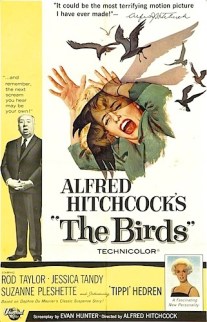
The Birds (1963)

2009 #6a
Alfred Hitchcock | 114 mins | DVD | 15 / PG-13

The BirdsI first saw The Birds on TV so long ago that I can’t even remember how long ago it was. Only two parts of it have stuck with me since: the justly famous scene with the climbing frame (ooh it’s brilliant), and a dead Dan Fawcett with his eyes pecked out (ooh it’s chilling).
If that didn’t give it away (and as if you didn’t already know), The Birds is a horror film. A horror film of the proper kind too — the kind that scares you, rather than making you jump at regularly-spaced committee-decided intervals. It’s the kind that slow burns its way to the horror — we meet the characters, see their relationships, arrive at the right location… There are hints at what might be coming, but they idle past in the background, almost unnoticed… but gradually increasing.

This isn’t time wasting; it isn’t really character development either, despite how some of it may seem (more on that in a bit). It’s how Hitchcock builds suspense — we know it’s coming, we just don’t know when — and likely contributes to some sex-related subtext too. (I haven’t just pulled that out of thin air, incidentally. There’s the odd moment where that subtext almost breaks through into the text, though Hitchcock quickly reels it back in.)

The second half is where all this time spent delaying and manoeuvring pays off. The titular demented avians attack, and attack again, a near relentless series of assaults and set pieces that allow Hitchcock to show off his apparently endless array of shooting and editing tricks. These aren’t just spectacular action sequences — though there are some, of a fashion — but sequences of unnerving horror. And it’s all achieved without a single note of music — no slowly rising throb in the background to tell us we should be getting scared, no dramatic thud to make us jump, no piercing musical shrieks as the birds attack — yet some sections are almost unbearably tense, built entirely with camera angles and masterful editing.

If there’s a weak note it’s the romantic subplot. While it initially drives the film, it’s largely abandoned later on, becoming no more than an excuse to move characters into place for the birds’ attack. In fact, Hitchcock seems to just get tired of it, allowing the film to jump abruptly from will-they-won’t-they to cuddling and kissing — and it’s not even like a first kiss. Intriguingly, a deleted scene included on the DVD (which has been lost, only surviving through a script segment and production photographs) seems to provide the ‘missing link’ in the central relationship. However, it also offered an explanation for the birds’ attacks (albeit a jokey one), something Hitchcock was keen to avoid, which likely explains its removal.

But that’s mostly beside the point. The Birds is a tension-based horror movie, and every sequence of tension is perfectly staged. This is where Hitchcock is really in his element, and all of the preamble is worth enduring just for the chance to see the master let loose. Dan Fawcett’s lack of eyes has probably stuck with me as much thanks to Hitchcock’s impeccably paced build up as to the gruesomeness of the actual image; and the birds amassing on the climbing frame outside the school is an absolutely perfect sequence, a moment of pure cinema.

5 out of 5

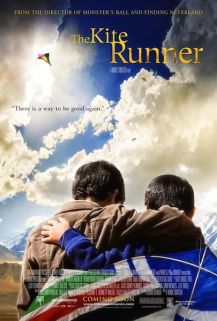
The Kite Runner (2007)

2009 #3
Marc Forster | 123 mins | DVD | 12 / PG-13

The Kite RunnerCan no one tell a story from the beginning any more? I blame How To Write books and courses, insisting that films must begin with certain types of incident to hook the audience, even if this isn’t the first event chronologically. Do they think the audience has no patience? Especially in a film, where you’re only committing about two hours of your time (as opposed to however long it takes to read a novel) and even the most lazy viewer is likely to stick it out for at least 15 minutes.

The Kite Runner is just the latest film to do this (and by that I mean “latest I’ve seen”, as I’m sure dozens have done exactly the same thing since), beginning two thirds of the way through with a scene that makes little sense… until, inevitably, the story flashes back to the start and leads us through to that inconspicuous scene, finally giving it some meaning. Really, it’s little more than a cheap tease; a promise to the audience that what follows is actually going somewhere, however pointless it may seem. It’s perhaps the only trick that makes me inclined against a film (or indeed any work of fiction) right from the off.

Perhaps the structure is lifted directly from the source novel. The film certainly has an unusual feel in this sense, like the text has only been half converted for the screen. Not every film should — or does — conform to the structural rules of those How To Write books, but there’s something about the way events progress here that feels more novelistic than filmic. Arguably this is also true of the story itself, which seems to be more about its themes than its characters: bravery, cowardice, and the difference between the two; friendship, and the lengths (or not) it will go to; truth and lies, and what underhand things people — especially children — will do to cover up their own shortcomings and failings.

In this respect it feels like it’s part biography (though it’s fiction) and part moral fable. By the end, we’re presumably meant to leave with the feeling that some justice has been done at last. But while one boy has been saved from the horrors of his captors — and even then, almost too late — there are hundreds left behind with the still-active villain. In this respect it’s undoubtedly true to life, but it belies an attempt at an uplifting and redemptive ending.

In assessing The Kite Runner it feels like I may have missed something and am being unduly harsh, but sadly it failed to engage me. While I long continued to ponder some of the issues it raised for me (always a positive), I’m not certain they were the ones the filmmakers intended.

3 out of 5

This review was written over three months after seeing the film, based entirely on notes made at the time and my rather poor memory. Apologies if it is therefore a bit unfocussed or, God forbid, inaccurate in the odd minor fact.

Hellboy II: The Golden Army (2008)

2008 #93
Guillermo del Toro | 115 mins | DVD | 12 / PG-13

This review contains minor spoilers.

Hellboy II The Golden ArmyDespite enjoying the first live action Hellboy movie last year, I didn’t make it to the cinema for this sequel. Unfortunately neither did a lot of others, choosing to see The Dark Knight again and again instead. Of course these days the DVD release is almost as important… except Hellboy’s was on the same day as Dark Knight’s. I don’t have sales figures, but I expect it was thoroughly overshadowed again — which is a shame, because Hellboy II is actually a very different beast.

Despite shared roots in the pages of comic books, Hellboy II sits comfortably apart from last Summer’s other two big comic book adaptations, The Dark Knight and Iron Man. While the former was aiming for a real-world crime-epic feel and the latter a more humour-littered sci-fi, they both still dealt with billionaires investing in identity-hiding suits to fight crime of one kind or another. Hellboy exists in a completely different place. Of course there are still wise-cracking heroes (with requisite Issues) and scheming villains, action sequences and a liberal use of CGI (mixed with “we did it for real!” bits, thankfully the ‘in thing’ right now) — but it’s not Sci-Fi, it’s Fantasy.

Del Toro uses this to his advantage, allowing his incredibly fertile imagination to run riot over every frame. There are more creatures than the first Hellboy and Pan’s Labyrinth combined — in the Troll Market sequence, there’s probably more in each shot — and, in the vicious Tooth Fairies, a wonderfully gruesome twist on a familiar concept. Though couple these with certain other inventions, such as a baby-like talking tumor, and one might begin to wonder how this got passed as a 12 / PG-13; and you’d think a giant red demon getting a human girl pregnant might be enough to raise the classification. (I jest, of course — giant red demons are entitled to all the same rights as the rest of us.)

Imagination isn’t limited to creature design either. An attractively animated prologue manages to both bring back the ever-excellent John Hurt and find a way to convey the huge back story without making it tediously dull (it also has a Christmassy feel that was perfect for when I watched it). The action sequences have all the requisite coolness too, especially the closing duel on giant moving cogs. In fact, del Toro’s creation seems to overflow — the laying of plot threads for a further film is even more overt than it was in the first film — which makes it even more unfortunate that the director’s long term commitment to The Hobbit and its sequel, plus about half a dozen projects after that, makes a proposed trilogy-closer seem increasingly unlikely. This isn’t a major problem with the film, however, just an annoyance that we may never get a third entry.

One of the most amusingly idiotic criticisms I’ve encountered of Hellboy II was that it was “comic-book-ish” — not only does that make one think, “well, duh”, but also, “and why not?” When the other big comic book movies are aiming for real-world seriousness, it’s nice to have a more fantastical alternative. Hellboy II is more than up to the task.

4 out of 5

Hellboy II: The Golden Army placed 8th on my list of The Ten Best Films I Saw For the First Time in 2008, which can be read in full here. The brief comment there is probably more eloquent than this review, so please check that out too.

The Green Mile (1999)

2008 #78
Frank Darabont | 181 mins | DVD | 18 / R

This review contains major spoilers.

The Worst Movie Poster of All TimeFive years after making The Shawshank Redemption — somewhat ignored at the time, but now incredibly popular and constantly bidding for acknowledgement as The Best Film Ever — writer-director Frank Darabont returned to the Stephen King Non-Horror Well (quite a shallow one, I should think) to film this tale of a man on death row in the ’30s. Darabont writing & directing a three-hour adaptation of a Stephen King story set in a prison in early 20th Century America? But Shawshank 2 this is not; in fact, I would argue that, due to one key difference amid those similarities, it’s actually the anti-Shawshank.

The key difference, I should rush to point out, is not the presence of the supernatural. While obviously a major element of the film, the level of realism dedicated to it, plus the overall tone of the piece, means that it still doesn’t feel too far removed from its predecessor. Nonetheless, where Shawshank was very much a real-world story, The Green Mile gradually draws the viewer into believing that miracles may be possible. It’s a whole hour before Michael Clarke Duncan’s near-silent John Coffey (“like the drink, only not spelled the same”) does his healing thing, at which point what was apparently a straightforward period prison drama gains a new dimension.

The fact that this occurs so late, after a lot of effort has been spent establishing the normal real-world setting, means it is firmly grounded in reality. Where most supernatural-focused films ask the viewer to accept, “in this world, this is real”, The Green Mile forces us to ask, “in the real world, what is this power? where does it come from?” Perhaps this seems a subtle distinction, but it isn’t; and the film pulls it off with impressive ease thanks to Darabont’s writing and direction, plus the well-judged performances of Duncan, Tom Hanks as lead warden Paul Edgecomb, and the rest of the cast.

Up to this point, the film feels like a collection of subplots. It takes a slow and careful, but never dull, approach to storytelling, slowly unfurling details of the characters, their relationships, and the technicalities of prison life; but it’s not until Coffey’s power emerges that these really begin to come together. Within this process, Darabont’s writing cleverly structures the release of information to the viewer. We never learn any details of some of the inmates’ crimes, for example, allowing us to sympathise with them; indeed, a lot of subtle effort is put into making Michael Jeter’s Del likeable, serving the double purpose of making his death infinitely more shocking (that we don’t know his crimes largely removes the danger of a “well he deserved it” reaction from certain viewers) and, by his association with Coffey, helping the viewer to like the apparent child murderer. All sorts of details slip by almost as scene setting, only to have horrendous significance later on, and both the reveals and later revelations are played out perfectly.

The film’s ending successfully brings together a wide variety of these seeded elements, neatly melding the remaining subplots without pushing into the realm of unsatisfactory coincidence. But the conclusion is also unapologetically downbeat, and it’s this which affirms that anti-Shawshank status: where Shawshank ends with escape and hope, The Green Mile ends with injustice and imprisonment — the execution of an innocent, miraculous man, and Paul’s ‘imprisonment’ in an unknowably long (potentially, endless) life, suffering the constant loss of those he loves and the guilt of what he did.

If The Green Mile is not quite Shawshank then that’s because it’s not trying to be. It’s a superb film in its own right, but the lack of an uplifting ending is the reason it isn’t — and never will be — as popular as its apparent twin.

5 out of 5

(Originally posted on 28th January 2009.)

Becoming Jane (2007)

2008 #91
Julian Jarrold | 115 mins | DVD | PG / PG

Becoming JaneDirector Julian Jarrold seems to have found his cinematic niche in “coming a bit late”. His Kinky Boots, while entertaining, was reminiscent of films like The Full Monty… except 8 years later; Becoming Jane rides the Pride & Prejudice bandwagon… except 18 months later; and his latest, the new Brideshead Revisited, had something of the Atonements about it… except 6 months later. At least his lead times have got shorter.

Perhaps Jarrold’s other inspiration here was Batman Begins. No, bear with me, for this is Austen Begins: Jane’s literary career has yet to start, but as the film progresses we see something of her personality taking shape — and plenty of the inspiration for her novels. Lord alone knows how factual any of it is, but I’m sure it must be a lot of fun for certain Austenites. On the other hand, purists might be less pleased with their idol being constantly lovelorn and indulging in (whisper it, children) snogging. For those with only the most cursory knowledge of Austen’s work, these might be the only things that stop them believing this is an adaptation of one of her novels; though, in truth, they’re probably not even that intrusive.

The big advantage to this being a somewhat Hollywoodised version of the story is the slew of English acting talent on display. Julie Walters, Maggie Smith and Ian Richardson are all present, in roles of varying sizes, plus the younger Anna Maxwell Martin (Bleak House) and Laurence Fox (son of Edward); not to mention James McAvoy, busy appearing in everything under the sun at the time. In the lead role, Anne Hathaway does a fine job, though there’s the inevitable question of “why not cast a Brit?” (to which one must assume the answer is, “for the sake of the US box office”). At least her accent is good.

Becoming Jane is a Jane Austen biopic treated as if it were a Jane Austen novel. In fact, so much is it embedded in the writing of Pride & Prejudice — and the notion that most of that was inspired by her own life — that it occasionally feels like another adaptation of it. This approach is a little uncomfortable in places, though probably makes sense considering the target market; and, by being so relatively lightweight, the resultant films seems to have faced less criticism from some Austenites than the similarly-timed TV biopic, Miss Austen Regrets. It’s for precisely this reason that the latter was a superior product, however: it may be darker and less uplifting — it ends with Austen’s death, rather than the start of her literary career — but it has a level of reflection that makes it more than Austen-Lite. Unlike this.

3 out of 5

Becoming Jane is on BBC Two today, Wednesday 31st December 2014, at 1:20pm.

(Originally posted on 27th January 2009.)

Die Hard 2 (1990)

aka Die Hard 2: Die Harder

2008 #95
Renny Harlin | 118 mins | DVD | 18 / R

Die Hard 2Good guides to how to write always advise that your hero is only as good as the villain. This is one of the reasons Die Hard is such an endlessly enjoyable film — as well as a great high-concept setup, excellent action sequences, and amusing one-liners, Alan Rickman’s villain, Hans Gruber, is one of the best ever committed to celluloid. Dry witted and clearly more educated than his opponent, Bruce Willis’ John McClane, he’s nonetheless defeated by that everyman spanner-in-the-works. Yippee-kay-aye indeed.
So how do you top that? Well, not like this. The generic Traitor General character offered here isn’t a patch on Gruber, meaning the hero/nemesis relationship between him and McClane never kicks off in quite the same way. The final act even tries to introduce a new villain, probably aware that the first one wasn’t quite working, though it’s to little avail. Their final duel — on the wing of a moving plane — is exciting enough, but doesn’t pack the same punch as the first film’s verbal sparring.

Arguably the other main reason Die Hard worked so well — the confined office block setting — is also discarded, giving McClane a whole airport to run around. We have to be grateful that this isn’t just a straightforward rehash of the first film — probably the advantage of being adapted from an unrelated novel, 58 Minutes, rather than a committee considering how to recycle the same idea — but it doesn’t have the same brilliant simplicity. That said, the line acknowledging similarities between the scenarios is a highlight, and good use is made of McClane’s fame following the events of the first film.

Die Hard 2 is by no means a bad action film — there are several sequences that are above par for the genre, an acceptable degree of silliness, and the odd spectacular explosion too — but the unavoidable comparison to one of the genre’s all-time classics is to its detriment. If only the villain was someone like Gruber’s brother…

4 out of 5

(Originally posted on 25th January 2009.)

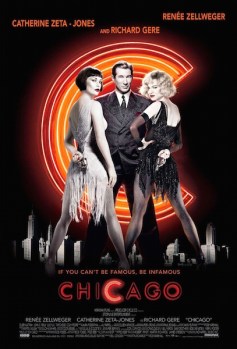
Chicago (2002)

2008 #96
Rob Marshall | 108 mins | DVD | 12 / PG-13

ChicagoI remember being distinctly unimpressed when Chicago took the Best Picture Oscar in 2003, especially as the alternatives included Gangs of New York and The Two Towers — not to mention Road to Perdition, an excellent film that was massively undervalued during award season.

In its favour are a number of memorable songs, all performed with impressive routines. On the downside, they’re all quite stagey in their choreography, though this suits the daydream-fantasy style in which they come about. In fact, the ability of film to make clear the distinction between ‘real life’ and fantasy means the film is far easier to follow than the stage version.

The story is passable enough, serving as a roadmap between the songs and offering the occasional bit of commentary/criticism on celebrity culture — it may be set in the ’20s and have been written in the ’70s, but the characters’ underhand tactics to keep their story on the front pages are as pertinent now as ever.

Five years on, Chicago isn’t as poor as expected — it manages to be consistently entertaining — but nor is it superior to the alternatives. For a current comparison, it’s only marginally better than if Mamma Mia were to trot round winning Best Picture gongs this year.

4 out of 5

The Many Adventures of Winnie the Pooh (1977)

2008 #92
John Lounsbery & Wolfgang Reitherman | 71 mins | DVD | U / G

The Many Adventures of Winnie the PoohHaving finished 2007 with Piglet’s Big Movie, it feels somewhat appropriate to round off 2008 (almost) with Disney’s first Winnie-the-Pooh feature.

The Many Adventures… is actually compiled from three shorts made in 1966, 1968 and 1974, with some new linking material. I don’t know if these shorts were produced with any great expense, but there’s occasional evidence of what looks like cheap animation. It’s not that it’s not smooth or fluid, but rather the attentive viewer will often spot sketch marks around some lines, or flashes of other bits not properly erased. Perhaps it was deliberate, considering the sketchy style of the backgrounds, designed to evoke the original illustrations, but I sometimes found it distracting.

This is one relatively minor flaw in an otherwise brilliant adaptation, however. The film faithfully adapts several of the original stories, acknowledging its sources by frequently showing the action as illustrations within a copy of the book. This fourth-wall-breaking move may irritate some, but personally I loved seeing Pooh and co have to leap from page to page, or tipping the book sideways to free Tigger from a tree. Such moves seem tonally in keeping with A.A. Milne’s original stories and, even though some tales are abridged and some good ones left out, that spirit is always retained.

The characterisation is also spot on, producing an array of cute and loveable creations, none more so than Pooh himself. The gopher is an unnecessary addition, though the running joke about him not being in the book is very nicely done. And one can’t fail to mention the excellent songs, now as linked to the world of Pooh as anything from the original books — especially Tigger’s little tune, surely familiar to anyone who was a child in the last 30 years.

If some later Disney ventures have lost sight of the correct spirit for Pooh’s adventures, at least this original is a great adaptation. Bouncy, trouncy, flouncy, and, above all, fun fun fun fun fun.

5 out of 5

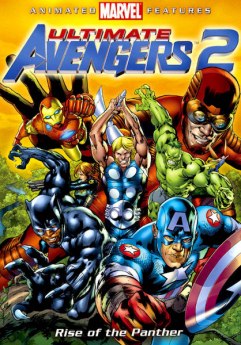
Ultimate Avengers II (2006)

aka Ultimate Avengers 2: Rise of the Panther

2008 #83
Will Meugniot & Richard Sebast | 70 mins | DVD | 12 / PG-13

Ultimate Avengers IISome things in life baffle me. Form dictates I now list a couple of humorous examples, but we’ll skip that and get to the point: why would you make a direct-to-DVD movie that has a subtitle on the box but not on the film itself? I can understand why titles get tweaked on cinema-release posters and/or subsequent DVD releases — for marketing purposes, say; or clarity — but why, when your title is going direct to the DVD stage, do the titles not match? And why does the box add the subtitle rather than remove it for on-shelf simplicity? I have no answers — it baffles me, remember — but this is the sort of thing I sometimes muse about. The sort of thing that most other people don’t even notice, never mind care about.

Insignificant title issues aside, the fact that (as of writing) 2,365 people have bothered to rate the first Ultimate Avengers on IMDb, while only 1,325 have bothered to rate this second, suggests many were so disappointed by the initial film they didn’t bother with the sequel. Which is something of a shame, because it’s a lot better. Problematically, it’s heavily grounded in the first, picking up several threads that were left hanging — enough so as to make that weak franchise opener required viewing, sadly.

Why’s it better? We’ll get the obvious out of the way: yes, it’s a modern genre sequel, so yes, it’s ‘darker’. In this case that means “more adult”, touching on issues you might not expect in superhero animation with such a low certificate — marital problems, survivor’s guilt, political isolationism, even vague allusions to alcoholism. None are dealt with in any great depth I should add, but it will likely please adult fans wishing for something more “grown-up”. There’s also a greater amount of violence, though much of it is implied, or just off screen, or against bug-like aliens. The animation still isn’t great, though at times seems improved. Equally, while both script and story are better — there’s no pace issue this time — there’s still plenty of clanging dialogue, and the adult subplots aren’t exactly subtly executed.

The climax also has its share of flaws. While most of the story is nicely balanced, it’s over-efficient in wrapping up, in the way that only animation seems allowed to be — for whatever reason, this exact story would comfortably fill a two-hour live-action version. The worst effect of this is that some points aren’t treated with their deserved weight — the death of a major character is so hasty and glossed over that I didn’t even realise it had happened until a brief shot of a memorial in the closing scene. On a less pressing note, the giant alien robots of the final battle leave the film just one leg (per robot) away from becoming a total War of the Worlds rip-off. But this tale is of American origin, so the aliens are defeated not by a clever plot twist, but by brute force.

Despite my attention to the film’s weak points there’s actually plenty to enjoy here, provided animated superhero movies are your thing. There’s more action than the first instalment, a more interesting story, more character development… Even if it’s done at quite a basic level it’s still adequately entertaining, enough that you might wish there was a third. An improvement then, if still flawed, but — ultimately — enjoyable.

4 out of 5

For my review of the first Ultimate Avengers, please look here. Live-action sequel Avengers: Age of Ultron is in UK cinemas from this Thursday, 23rd April 2015.