2015 #36
Peter Jackson | 144 mins | Blu-ray | 2.40:1 | USA & New Zealand / English | 12 / PG-13
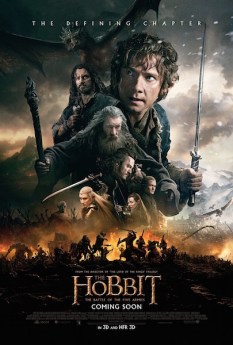 Peter Jackson’s epic Tolkien adaptation blunders its way to a conclusion with an instalment some have declared the trilogy’s best, presumably because they really enjoy watching someone else play video games. That’s what about half of this sextet-completing movie feels like, as it concludes the three-part Hobbit narrative with a CGI-riddled rendering of the titular battle. It’s the shortest film in Jackson’s Middle-earth magnum opus, though it comes to something when a film the best part of two-and-a-half hours long is described as “short”.
Before said battle, the movie finds itself with some business to attend to: we pick up immediately where the second part left off, with giant dragon Smaug flying towards Laketown with destruction on his mind. Kicking things off with a gigantic ten-minute action sequence isn’t a wholly bad decision pacing-wise, but this particular sequence is the wrong way to do it. Really, it’s the second film’s climax displaced — once Smaug is dealt with, a whole slew of new developments and subplots grow out of it, and that’s where the material that feels like it belongs in this film commences. Of course, that means there’s a lot of talking and manoeuvring, both politically and literally as people and troops shuffle about the board. Were it not for the big opening, there wouldn’t be an action sequence for about half the movie, and I guess that’s not considered acceptable in the modern blockbuster environment.
Now, if you were to watch all three films in one sitting, I suppose it wouldn’t matter precisely where the breaks fall. But how many people are actually going to do that? Not first-timers, that’s for sure. And then you’d get the problem of massive action sequences butting up against each other: the one that opens this film, right after the dwarfs-vs.-Smaug sequence invented during reshoots to take its place at the end of Film 2. Surely there were two other options available to Jackson when he made the decision to extend from a duology to a trilogy: he could have ended Film 2 before it even reached Smaug, 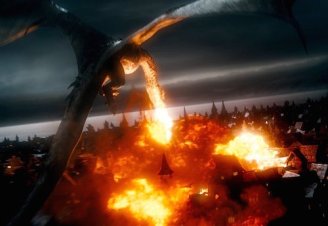 or he could have ended the second film with Smaug defeated and added more material to this third film to reach his desired running time. Or not even bothered adding stuff: if you lost the Smaug opener, The Battle of the Five Armies would still be over two hours long, which anywhere but Middle-earth is considered a decent length for a movie.
The rest of the film is a mixed bag for different reasons. For instance, Ryan Gage’s Alfrid is given a significant role — that’s the Mayor of Laketown’s assistant, if you’ve (understandably) forgotten who he is. Every minute that’s spent on his “comic relief” part is a minute wasted, and there are far too many minutes of it. Why that wasn’t left to the extended cut is anybody’s guess. It wouldn’t be particularly palatable there either — he’s just irritating, his actions predictable and unfunny — but longer versions are where there’s time for such indulgence. Conversely, Tauriel and Legolas are underused, wandering off on a completely aimless mission before wandering back for the battle.
Said battle feels a long time coming, but when it arrives… well, it’s a long time happening. It’s an epic by default, due to its sheer length. There are good bits, like the effort that has clearly been put into working out the armies’ tactics and the ebb and flow they would create. Wide aerial shots showing legions of troops swarming in formation, directed by generals with flags and horns mounted on high, are rather effective. 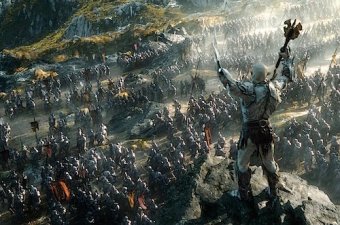 On the ground, the meat of the conflict only occurs when individual heroes are parcelled off into one-on-one duels. None of these particularly stand out, however, other than Legolas athletically jumping around a collapsing bridge that’s all so much CGI. This is where my earlier video game comparison really comes into play.
Some characters die. The impact is little-felt because of all the noise and bluster. That’s partly because there’s not really enough time for all the characters, of which there are more than ever. As with the second film, there’s been criticism that Martin Freeman’s eponymous Bilbo is barely featured, and, as with the second film, I disagree. Freeman’s not especially well-served in the acting stakes — Bilbo’s character development remains completed by the first part — but there’s still a focus on the actions of the little hero, some of which are pivotal.
Coming out of things best is Richard Armitage as Thorin, who succumbs to the paranoid madness that has afflicted generations of his family. Can he overcome it to do the right thing? The extent of this is sometimes laid on a little thick, but that’s the filmmakers’ fault (maybe this is another place that would benefit from a few trims) rather than Armitage’s performance. As the leaders of two of the titular armies, Lee Pace (elves) and Luke Evans (humans) also get a bit of a part to play, but the remaining dwarfs are given short shrift. That includes those played by James Nesbitt, Ken Stott and Aidan Turner, 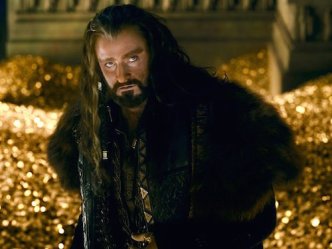 all of whom I’d thought would have more to do in the second and third parts of the trilogy. Turner, in particular, should have expected a bigger boost from Jackson’s decision to enrol him in an interracial romantic triangle, but it feels like they pulled back from that story thread a little after it proved unpopular in the previous film. It’s still obviously there, I just expected more of it.
On balance, The Battle of the Five Armies is probably the weakest of the three Hobbit films. Really, it’s just one big battle with a lengthy preamble. I can sort of see why Jackson felt like he could extend his original second film into a second and third — if you imagine them shorn of the reshoot-added bits, there’s still too much material for a single feature. The better solution, I suspect, would have been to accept splitting it into two shorter (i.e. regular-length) films, applying a bit of restraint in the process, rather than padding things further in an attempt to create two epics out of one ultra-epic.
As the credits begin, we’re treated to a sequence that emulates the one from Return of the King, with pencil sketches of the main cast alongside their names. On the Lord of the Rings concluder, it felt earnt; a special ending to a grand adventure. Here, it doesn’t. If anything, it feels like a reminder that the story we’ve just seen may have pushed to reach Lord of the Rings-level epicness, but is really just a tale of a small group going on an eventful hike, capped with a fairly large skirmish. A contemplative, momentous credit sequence does not feel warranted.
 I was something of a defender of Jackson’s version of The Hobbit at first. I enjoyed An Unexpected Journey and stand by my comment that, while it’s not The Lord of the Rings, it is the next best thing. As the trilogy has dragged on, however, it’s been dragged out, and the shine has gone off it. I still think there are elements to commend it, but I also think it could have been executed better. It’s hard to imagine an even longer version will improve much this time.
The Hobbit: The Battle of the Five Armies is released on DVD and Blu-ray in the UK on Monday.
My review of the Extended Edition can now be read here.

 I had absolutely zero intention of ever watching this Sylvester Stallone vehicle (which is not to be confused with John Woo’s Bullet in the Head, of course), but then I saw a trailer on a Blu-ray and it looked like it might be funny and passable dumb-action fun. My respect to whoever edited that trailer, because neither of those elements are significant features of the full film.
 Said plot all comes down to a final fight, Stallone vs Jason Momoa (of Game of Thrones and the Conan reboot), who’s technically the henchman but serves as the primary antagonist. In the film’s closest move to originality, they duel with fire axes. It’s a fairly worthwhile dose of combat, if you enjoy that kind of thing, but even then isn’t worth watching the whole film for.
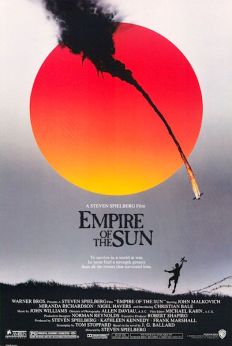 Steven Spielberg’s adaptation of J.G. Ballard’s semi-autobiographical novel stars a 13-year-old Christian Bale as Jim, the son of British ex-pats in China when the Japanese invade during World War II. Separated from his family as they try to flee, Jim encounters born survivor Basie (John Malkovich) and, when they wind up in an internment camp for the rest of the war, a cross-section of the rest of the left-behind. To Jim, a somewhat naïve but capable, confident and determined endurer, the whole thing is a big adventure; we can see the truth, though: that it’s a grim slog of life and death, and most succumb to the latter. The reality of the situation gets to Jim in the end, too… but maybe I’m getting ahead of myself.
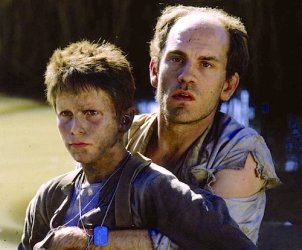 As it stands, the film is a fascinating insight into a less-often-covered aspect of the war. Even in small roles, the quality cast keep it watchable and relatable. Bale’s performance comes in just the right side of annoying — quite an achievement for a character who seems inherently brattish and prone to irritate.
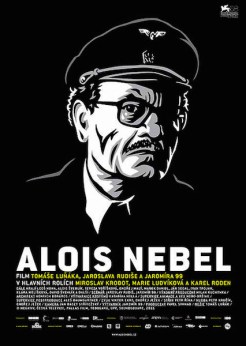 A Czech noir animation, set around Christmas 1989 to the backdrop of the country’s Velvet Revolution. Eponymous character Alois Nebel is a train station guard whose flashbacks to an event at the end of World War 2 see him sectioned, though possibly for other nefarious purposes. Having lost his job, he travels to head office in Prague to try to reclaim it, where he meets a ragtag gang of social misfits. Finally returning home, the mystery of what happened 44 years earlier may be resolved…
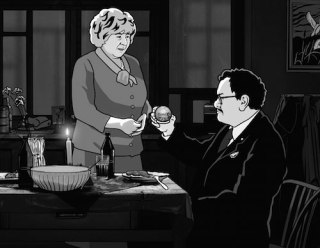 Perhaps the whole film is Deeply Thematic, then? It may be to do with the country moving on and making peace with its past, seen in a microcosm in the actions of Nebel (moving past the flashbacks, having new experiences, finding love, etc) and the people around him (finally getting revenge for something that happened nearly half a century ago). Maybe that’s all more clear if you know the Czech mindset, or the history of the Velvet Revolution. The second post in
 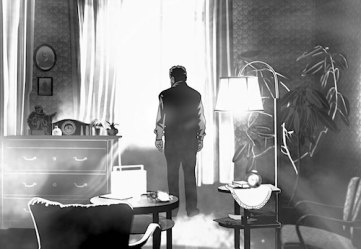 With some attractive black-and-white animation and a sporadically engaging mystery plot, Alois Nebel is far from meritless. However, its firm grounding in a wide spread of Czech history and attitudes suggests it may be best suited to those already well-versed in that country’s history and culture.
 Disney’s ’80s/’90s renaissance more-or-less came to an end with this adaptation of Edgar Rice Burrough’s jungle hero.
 As presidential nominee Barack Obama talks about the American Dream, in a run-down corner of the nation a trio of small-timers plot a robbery, landing them in hot water with some nasty people.
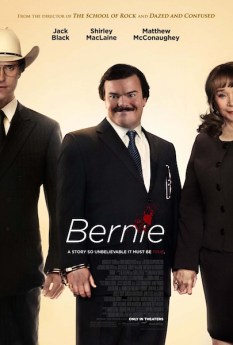 I seem to vaguely remember dismissing Bernie as just ‘Another Jack Black Comedy’ back whenever it came out (in the UK, that wasn’t until April 2013), and essentially forgot about it until earlier this month when it came up on
 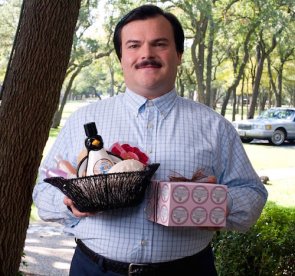 (If you’re observing similarities to Midnight in the Garden of Good and Evil there, you’re not the first: the magazine article that inspired Bernie, published around the same time as
 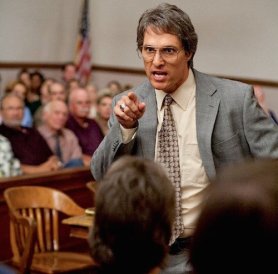 The local attorney seeking Bernie’s prosecution is played by man-of-the-moment Matthew McConaughey. I don’t know when we’re meant to deem the start of his “McConaissance”, but I’m not sure this really qualifies as part of it. Not that he’s bad, but it feels like the kind of played-straight comedy Southerner I’ve seen him do a few times now; indeed, it’s how he comes across in real life, from what I’ve seen. It fits the role like a glove, but doesn’t make for a remarkable performance.
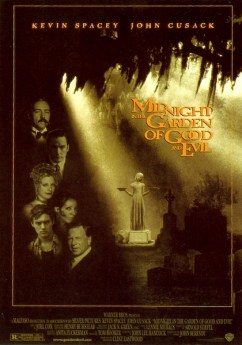 Sent to write “500 words on a Christmas party” in Savannah, Georgia, journalist John Kelso (John Cusack) instead finds himself covering a murder trial where he’s become friendly with the accused (Kevin Spacey).
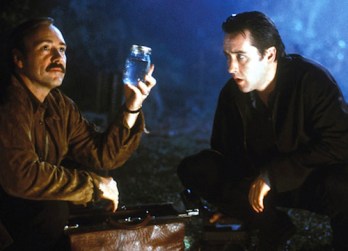 Like many an “adapted from a bestseller!” movies, I guess Midnight in the Garden was a big deal in its day that’s faded to semi-obscurity since (see:
  Adrenaline-addicted photographer L.B. “Jeff” Jefferies (James Stewart) finds himself house- and wheelchair-bound during a New York heat wave. Whiling away time spying on his neighbours around their shared courtyard, he begins to suspect the man opposite, travelling salesman Lars Thorwald (Raymond Burr), has committed a murder and is trying to cover it up. Jeff persuades his high-society girlfriend Lisa (Grace Kelly), visiting nurse Stella (Thelma Ritter) and police detective friend Doyle (Wendell Corey) to help investigate, but no hard evidence is forthcoming. Is Jefferies just bored and paranoid?
 Hitchcock certainly didn’t consider Jeff to be an out-and-out hero, even aside from the very real possibility that he may be wrong — as he put it in one interview, “he’s really kind of a bastard.” After all, what right does he have to be poking his nose so thoroughly into other people’s business? Not only to spend his time spying on all and sundry, which in many respects is bad enough, but to then investigate their lives, their personal business, even break in to their homes. If he’s right, they’ve caught a murderer, and the methodology would be somewhat overlooked; if he’s wrong… well, who’s the criminal then?
 further enhanced by the almost total lack of a score (only present in the opening few shots).
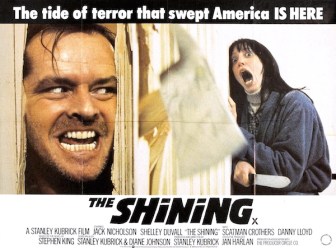 Fêted director Stanley Kubrick turned his hand to horror for this Stephen King adaptation. Poorly received on release (it was nominated for two Razzies: Worst Actress and Worst Director) and reviled by King (he attempted his own version as a
 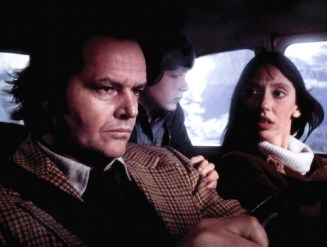 Gradually, inexorably, the film builds a sense of dread; a fear so deep-seated that it feels almost primal. There are few jumps or gory moments, the easy stomping ground of lesser films. There’s just… unease. It’s a feeling that’s tricky to put into words, because it’s not exactly “scary”; even “terrifying” feels too lightweight. There are undoubtedly sequences of suspense, where we fear what’s coming or what will happen to the characters (everyone knows the “Here’s Johnny!” bit, for instance), but that’s not where the film’s impact really lies.
 100Films.co.uk