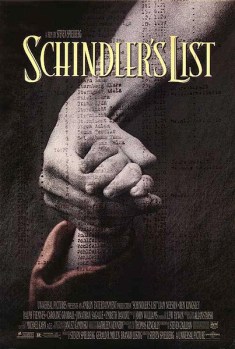
Schindler’s List (1993)

100 Films’ 100 Favourites #80

“Whoever saves one life,
saves the world entire.”

Country: USA
Language: English, Hebrew, German & Polish
Runtime: 195 minutes
BBFC: 15
MPAA: R

Original Release: 15th December 1993 (USA)
UK Release: 18th February 1994
First Seen: VHS, c.2001

Stars
Liam Neeson (Darkman, Star Wars: Episode I – The Phantom Menace)
Ben Kingsley (Gandhi, Iron Man 3)
Ralph Fiennes (The English Patient, The Grand Budapest Hotel)

Director
Steven Spielberg (Amistad, Lincoln)

Screenwriter
Steven Zaillian (Awakenings, Moneyball)

Based on
Schindler’s Ark, a Booker Prize-winning novel (released in America as Schindler’s List) by Thomas Keneally.

The Story
In occupied Poland in the early days of World War 2, German businessman Oskar Schindler opens a factory supplying the German military, staffed by Jewish workers. As the Nazis begin to close the ghettos and ship Jews to concentration camps, Schindler uses his connections and profits to surreptitiously save as many as he can.

Our Hero
Oskar Schindler is a self-interested businessman, womaniser, and member of the Nazi Party. Initially employing Jews merely for financial reasons (they’re cheaper than Polish workers), his innate humanity begins to come to the fore.

Our Villain
Nazis! But in particular Amon Goeth, the sadistic commander of the Paszów labour camp, who’s fond of executing Jews at random, amongst other horrors. Nonetheless, Schindler has to deal with him to ensure the (relative) safety of his workforce.

Best Supporting Character
Schindler’s contact on the local Jewish Council, Itzhak Stern, who becomes essential to making his business a success, and facilitating his operation to save the workers.

Memorable Quote
“I could have got more out. I could have got more. I don’t know. If I’d just… I could have got more.” — Oskar Schindler

Memorable Scene
During the destruction of the ghetto, Schindler sees a little girl in a red coat (the one splash of colour in the body of the film), wandering alone through the devastation. Later, as the Nazis burn piles of the dead, corpses are ferried to the pyres on small wagons. On one, Schindler sees a small body in a red coat… (There’s a good piece on the psychology of why these scenes are so effective here.)

Technical Wizardry
Spielberg chose to shoot in black-and-white to match actual documentary footage of the era, which was how he ‘saw’ the events. It was also shot without storyboards, Steadicams, cranes, or zoom lenses, and about 40% was filmed using handheld cameras, to emphasise a documentary feel. For a similar level of realism, Spielberg originally intended to make the film entirely in German and Polish with English subtitles, but changed his mind because he thought he wouldn’t be able to accurately direct performances in foreign languages.

Making of
Acting as producer, Spielberg initially tried to attract another director because he felt he wasn’t capable of doing the story justice. Martin Scorsese turned it down because he felt it should be done by a Jewish director, and Roman Polanski rejected it because it was too personal (he lived in the Krakow ghetto, only escaping on the day of its liquidation, and his mother died at Auschwitz). Finally, there was Billy Wilder — depending which version you believe, he either wanted to direct but Spielberg was already prepping the shoot, or he actually convinced Spielberg to direct it. Ultimately, Spielberg waited ten years between acquiring the rights and making the film, when he finally felt capable of tackling it.

Awards
7 Oscars (Picture, Director, Adapted Screenplay, Cinematography, Editing, Score, Art Direction-Set Decoration)
5 Oscar nominations (Actor (Liam Neeson), Supporting Actor (Ralph Fiennes), Costume Design, Sound, Makeup)
7 BAFTAs (Film, Supporting Actor (Ralph Fiennes), Director, Adapted Screenplay, Cinematography, Editing, Score)
6 BAFTA nominations (Actor (Liam Neeson), Supporting Actor (Ben Kingsley), Costume Design, Make Up Artist, Production Design, Sound)

What the Critics Said
“If E.T. The Extraterrestrial is Steven Spielberg’s fantasy masterpiece, and Jurassic Park is his commercial masterpiece, then Schindler’s List is certainly his artistic masterpiece. It’s an extraordinary work of vision and passion that raises even the gifted Spielberg to a new level of artistry. And like all great works, it elevates everyone who views it.” — Dennis King, Tulsa World

Score: 96%

What the Public Say
“It’s very, very hard-going and not an easy film to watch, but its importance is unparalleled. You sit there for three hours feeling uncomfortable – because these monstrosities really happened, because we live in a world where people are capable of these acts of inhumanity – and you still can’t even begin to imagine what it must have really been like, to live through that, to see your family and friends shot dead in the street or transported away en masse to the gas chambers. And yet, despite all that, you end the film feeling inspired. Someone made a difference.” — Millicent Murdoch, Millie’s Movie Reviews

Verdict

Schindler’s List wasn’t Spielberg’s first ‘serious’ film, but I think it shows a marked increase in quality over his good-but-flawed previous efforts, The Color Purple and Empire of the Sun. Liam Neeson gives a commanding performance as the imperfect hero, while Ralph Fiennes finds what little humanity there is in Goeth (and there isn’t much) to pull him short of being an Evil Nazi caricature. The stark black-and-white cinematography acknowledges the incomprehensibly horrific events, while Spielberg’s divisive penchant for sentimentality seems well-matched to the tale, offering a measure of hope from humanity’s darkest days.

What’s in #81? What’s in #81?
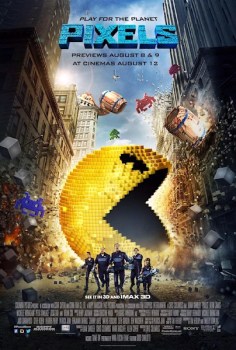
Pixels (2015)

2016 #88
Chris Columbus | 102 mins | streaming (HD) | 2.35:1 | USA, China & Canada / English | 12 / PG-13

PixelsAdam Sandler, eh? He has his fans, though apparently not among people who can write because you rarely see a good word penned about him. The one exception is Punch Drunk Love, and that’s because it’s a Paul Thomas Anderson film, and that’s why it’s the only Adam Sandler film I can remember seeing. I didn’t like it.
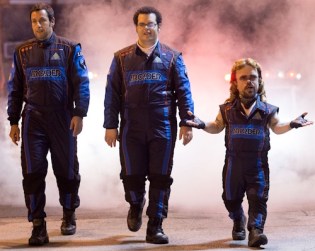
So why did I watch Pixels, which was as poorly received as Sandler films always are? Good question. It had a good deal to do with the short being good (I reviewed it back in 2010), and being intrigued how that concept — which makes a neat three-minute visual idea but doesn’t have any plausible narrative potential — could be converted into a full-length feature. Of course, a daft idea for a film, plus Adam Sandler, plus bad reviews — plus weak trailers — doesn’t add up to a recipe for success. To my surprise, then, I largely enjoyed it.

The plot sees aliens intercept signals from classic arcade games and believe they are a declaration of war, and so attack Earth in the form of said games made real. The best person to stop them is cable guy Adam Sandler, who used to be a video game wunderkind, and is fit for the job mainly because the President of the United States is his best mate — that would be Kevin James, as the unlikeliest US President in history. They also rope in Sandler’s old gaming rival, Peter Dinklage, and are chaperoned by Michelle Monaghan’s Lieutenant Colonel, who doubles up as a love interest for Sandler (of course). Later, Sean Bean and Brian Cox slum it in inexplicably small roles.

Arcade heroesPixels is the virtual definition of brain-off entertainment. The story has the plausibility of a kids’ daydream, the humour is frequently unimaginative, and the action sequences mostly coast on their basic concept rather than trying to elevate them. And Peter Dinklage is going to get a reputation for having terrible taste. I mean, I liked Knights of Badassdom, but hardly anyone else did, and now this… “Stick to TV, Peter Dinklage,” people are going to say. Assuming they’re not already.

But for all that mediocrity, I spent 100 minutes feeling gently entertained. I laughed a few times; the action was, as I say, passable; and there’s a bit in the Donkey Kong-themed climax with a remix of We Will Rock You that I rather liked. I don’t imagine I’d ever look to watch it again, but for a completely undemanding time-filler, well… (Nothing like damning with faint praise, eh?)

3 out of 5

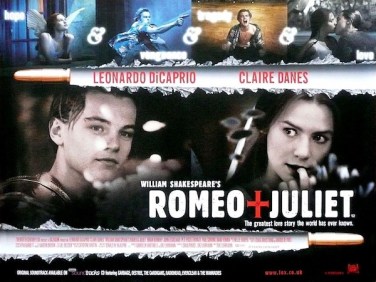
Romeo + Juliet (1996)

100 Films’ 100 Favourites #77

Hope & despair.
Tragedy & love.
Romeo & Juliet.

Full Title: William Shakespeare’s Romeo + Juliet

Country: USA
Language: English
Runtime: 120 minutes
BBFC: 12
MPAA: PG-13

Original Release: 1st November 1996 (USA)
UK Release: 28th March 1997
First Seen: VHS, c.1998

Stars
Leonardo DiCaprio (Titanic, The Wolf of Wall Street)
Claire Danes (Terminator 3: Rise of the Machines, Stardust)

Director
Baz Luhrmann (Strictly Ballroom, Moulin Rogue!)

Screenwriters
Craig Pearce (Strictly Ballroom, Moulin Rogue!)
Baz Luhrmann (Australia, The Great Gatsby)
William Shakespeare (My Own Private Idaho, 10 Things I Hate About You)

Based on
Some play, apparently.

The Story
Two households, both alike in dignity, in fair Verona, where we lay our scene. From ancient grudge break to new mutiny, where civil blood makes civil hands unclean. From forth the fatal loins of these two foes, a pair of star-crossed lovers take their life, whose misadventured piteous overthrows doth with their death bury their parents’ strife. The fearful passage of their death-marked love and the continuance of their parents’ rage, which, but their children’s end, naught could remove, is now the two hours’ traffic of our stage.

Our Heroes
Romeo Montague and Juliet Capulet, kids from feuding families who fall in love despite that conflict.

Our Villains
The rest of their families, whose animosity to one another, and thereby opposition to the coupling, results in tragedy.

Best Supporting Character
Romeo’s best friend, Mercutio, brought to flamboyant life by Harold Perrineau.

Memorable Quote
“Oh, what’s in a name? That which we call a rose by any other word would smell as sweet” — Juliet

Quote Most Likely To Be Used in Everyday Conversation
“O Romeo, Romeo, wherefore art thou Romeo?” — Juliet (rarely misquoted, regularly misunderstood)

Memorable Scene
The prologue, which sets out the film’s stylistic stall with a fast-cut and dramatically-scored montage of ultra-modern imagery to visualise the play’s prologue, as delivered by a TV news anchorwoman. It’s especially effective when paired with the first full scene, where the young men of the Capulet and Montague families clash at a gas station, which is similarly front-loaded with the film’s modern design, fast dialogue, and hyper-editing.

Memorable Music
The other films in the Red Curtain Trilogy (see Next Time) of course have a prominent role for music — one is about dancing, the other is a musical. While you’d think a Shakespeare adaptation would be all about the dialogue, the soundtrack plays a key role in Luhrmann’s vision, and certainly connected with viewers. They even once released a dedicated Music Edition on DVD. There is a score (memorable not least for its variation on O Fortuna, the much-reused O Verona), but it’s the songs by contemporary musicians — the kind of things the characters would listen to, I suppose — that have the greatest effect. Most recognisable is Des’ree’s Kissing You, which plays when the eponymous lovers first meet.

Technical Wizardry
The film is well known for its exuberant camerawork and editing. Obviously much of that is done in post-production, but it required on-set ingenuity as well. For the scene where Romeo and Juliet first kiss in a cramped elevator, the set walls were made in sections which could be raised to let the camera in. In the finished shot the camera circles the pair at speed, meaning the crew had to hurriedly raise the walls to let the camera past but speedily replace them to maintain the illusion.

Making of
Famously, the film modernises the characters’ use of swords and daggers by turning them into the brand names of guns. Shakespeare described Tybalt’s swordsmanship as “showy”, so to retain this for the film actor John Leguizamo worked with a choreographer, John O’Connell, to create a style of gunplay inspired by flamenco dancing.

Previously on…
Romeo + Juliet is the middle film in director Baz Luhrmann’s thematically-linked Red Curtain Trilogy. The first is dancing drama Strictly Ballroom.

Next time…
The Red Curtain Trilogy concluded with Moulin Rouge. There are also plenty of other modern-styled Shakespeare adaptations that you could argue owe this a debt.

Awards
1 Oscar nomination (Art Direction-Set Decoration)
4 BAFTAs (Director, Adapted Screenplay, Music, Production Design)
3 BAFTA nominations (Cinematography, Editing, Sound)
1 Saturn nomination (Costumes)
1 MTV Movie Award (Female Performance (Claire Danes))
5 MTV Movie Awards nominations (including Best Kiss — it lost to Independence Day!)

What the Critics Said
“While Shakespeare might well have applauded Aussie filmmaker Baz Luhrmann’s souped-up version of Romeo and Juliet, traditionalists [including many critics, if you check out Rotten Tomatoes] are sure to despise the psychedelic tunes and the flashy sets of this audacious adaptation. Not to mention Mercutio as drag queen. For all of its departures, Luhrmann’s largely successful reinterpretation is far from irreverent. He takes liberties with the world, but never the words of this achingly beautiful love story. […] Luhrmann, who pitted youthful brio against conventional wisdom in Strictly Ballroom, clearly enjoys thumbing his nose at authority. Perhaps he’s an eternal teenager, or merely a bit mad. In any case, his excesses only prove Shakespeare’s profundity and the timelessness of his themes.” — Rita Kempley, The Washington Post

Score: 72%

What the Public Say
“in the play, and almost every adaptation, Romeo visits Juliet’s tomb, poisons himself and dies, and then Juliet wakes up, sees Romeo dead, and stabs herself to death. In this version, however, Juliet wakes up just as Romeo downs the poison, so she watches him die in her arms. Seeing her slowly start to wake as Romeo prepares to kill himself is almost unbearable. Especially the way the dialogue is manipulated; all the lines remain the same, but are just said at slightly different times (when Juliet laments the fact that Romeo didn’t leave any poison for her, she’s talking to him directly this time). And when Romeo dies, Juliet is left without her monologue, because she’s said everything to Romeo already. So instead, she cries and then wordlessly shoots herself in the head. It’s pretty gut-wrenching.” — Elizabeth, Chris and Elizabeth Watch Movies

Verdict

Shakespeare got a do-over for the MTV generation in this textually faithful re-imagining of arguably the Bard’s most famous work. Above, I alluded to critics’ dismissal of this adaptation — here are some choice quotes: “the kind of violent swank-trash music video that may make you feel like reaching for the remote”; “a classic play thrown in the path of a subway train”; “destined for the trash heap of Shakespeare adaptations”; “a monumental disaster.” I’d argue its subsequent, and largely enduring, success has put those old fuddy-duddies on the wrong side of history. Certainly, the fact it starred heartthrob du jour Leonardo DiCaprio ensured it reached an audience that otherwise would’ve had no interest. Oh, and it won BAFTAs — the film awards of Shakespeare’s homeland — for direction and screenplay. Shows what you know, yankees. Cultural impact aside, it’s a wildly inventive, daring work, which keeps it fresh and exciting even when its mid-’90s antics should by all rights have dated it into oblivion.

#78 will… kick it Jesus-style!

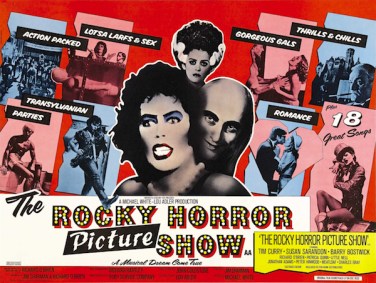
The Rocky Horror Picture Show (1975)

100 Films’ 100 Favourites #76

Give yourself over to absolute pleasure.

Country: UK & USA
Language: English
Runtime: 100 minutes
BBFC: AA (1975) | 15 (1987) | 12 (1991)
MPAA: R

Original Release: 15th August 1975 (UK)
First Seen: TV, 31st December 1998

Stars
Tim Curry (Annie, Clue)
Susan Sarandon (The Front Page, Thelma & Louise)
Barry Bostwick (Weekend at Bernie’s II, Spy Hard)
Richard O’Brien (Flash Gordon, Dark City)
Meat Loaf (Roadie, Fight Club)
Charles Gray (The Devil Rides Out, Diamonds Are Forever)

Director
Jim Sharman (The Night, the Prowler, Shock Treatment)

Screenwriters
Richard O’Brien (Shock Treatment, Digital Dreams)
Jim Sharman (Shirley Thompson Versus the Aliens, Shock Treatment)

Based on
The Rocky Horror Show, a stage musical by Richard O’Brien.

Music & Lyrics
Richard O’Brien (Shock Treatment)

The Story
When straight-laced young couple Brad and Janet approach a spooky castle in need of shelter, they stumble into the strange world of Dr. Frank-N-Furter, who’s throwing a party to celebrate the ‘birth’ of his new creation: a tank-grown muscleman named Rocky. But it’s not only Rocky who’ll be getting an awakening…

Our Heroes
Good clean all-American kids Brad and Janet, newly engaged but forced to stop off at a creepy castle after their car breaks down in a storm. By the end of the night, they’ll certainly have learnt a new thing or two…

Our Villains
Dr. Frank-N-Furter — not much of a man by the light of day but by night he’s one hell of a lover. Just a sweet transvestite from Transexual, Transylvania, which would be fine if he didn’t get a bit murderous. Surrounded by a gaggle of home help and hangers-on, like hunchbacked handyman Riff Raff, mental maid Magenta, and vaudevillian groupie Columbia.

Best Supporting Character
Charles Gray is perfect as The Narrator, holed up in his wood-panelled study and telling the audience this fantastical story with admirable matter-of-factness.

Memorable Quote
“Let’s do the time warp again!” — everyone

Quote Most Likely To Be Used in Everyday Conversation
“I see you shiver with antici…

…pation.” — Dr. Frank-N-Furter

Memorable Scene
The title sequence: the opening number sung by a pair of very big, very red lips. Simple, but iconic.

Best Song
Rocky Horror is one of those musicals where almost every song is genius: the cleverly reference-filled, surprisingly melancholic, bookending refrain of Science Fiction/Double Feature; the wittily rhymed Dammit Janet; the mission statement that is Sweet Transvestite; the sweetly kinky Touch-A, Touch-A, Touch Me; the epic multi-part floor show climax… and more. That said, I always disliked the post-climax Super Heroes, and wasn’t alone: it was actually cut out of the original US release. But then I heard Richard O’Brien sing it with acoustic guitar on the DVD special features, and in that variation it’s a darkly beautiful song. But for all that, when talking about the best song in Rocky Horror you really can’t beat the utterly iconic Time Warp.

Making of
Many films have “Easter eggs” — little half-hidden treats for fans to discover — but not many have them literally. The exception, of course, is Rocky Horror. Apparently the crew had an Easter egg hunt (which, considering the movie was shot from October to December, doesn’t make much sense) but they weren’t all found, hence why some turned up in the final film. I won’t tell you where they are (I mean, five seconds on Google and you can find out), but there are supposedly three.

Next time…
Initially a flop, it was when someone got the idea to screen the movie for the midnight crowd that Rocky Horror caught on. The interactive, ritual-filled experience of these screenings is legendary, and they’ve continued ever since — to the point where some cinemas have it as part of their regular schedule, and the DVD & Blu-ray releases include alternate tracks featuring the audience participation. It also means that, officially speaking, Rocky Horror has the longest theatrical run in movie history. In 1981, Sharman and O’Brien produced a sort-of-sequel, Shock Treatment. A new adventure for Brad and Janet (both recast), it featured several Rocky Horror actors (O’Brien, Patricia Quinn, Little Nell, Charles Gray) in new roles. It didn’t go down very well, though apparently it has its fans — a cult following within a cult following, I guess. In 2010, once-popular high school musical TV series Glee aired a tribute episode, The Rocky Horror Glee Show. It is truly horrendous; a plasticky, sanitised, neutered version of something that should never be those things. So I don’t hold out much hope for the next thing the same network (Fox, of all places!) have planned for the property: after years (decades?) of rumours, they’re finally making good on the threat by remaking the film. Officially dubbed The Rocky Horror Picture Show: Let’s Do the Time Warp Again, the clips released so far look almost as bad as the Glee version. We’ll see. Finally, the original stage show has continued across numerous productions, and last year a 40th anniversary gala performance was simulcast to cinemas across Europe and later aired on TV. It’s now available on YouTube. I’ve not watched it, but I suspect it’s a better bet than that Fox version.

Awards
1 Academy of Science Fiction, Fantasy & Horror Films Golden Scroll nomination (Best Horror Film (it lost to Young Frankenstein))

What the Critics Said
Rocky Horror is actually a very good film in its own right; made on a small budget, it’s a triumph of clever filmmaking by Sharman, who should have gone on to bigger things (and might have, had he not arrived at the end of an era). Yes, there are little technical glitches, but rarely has there been a more cleverly and creatively shot and edited film. Nearly every angle, every cut, every zoom shot, every optical transition is used to effectively maximize its respective scene. […] Remember the cult status, yes, but sometime try watching Rocky Horror just as a movie. It pays real dividends.” — Ken Hanke, Mountain Xpress

You What?
“Viewed on video simply as a movie, without the midnight sideshow, it’s cheerful and silly, and kind of sweet, and forgettable.” — Roger Ebert, Chicago Sun-Times (Rocky Horror is many things, but “forgettable”? Hm.)

Score: 80%

What the Public Say
Rocky Horror is so distinctive, so unique, that it could’ve come off as bizarre, alien, and off-putting, but it didn’t. It has such self-aware charm, a catchy soundtrack that sticks in the head for days, and hilarious performers, that it overcomes its rather dull protagonists. Of course, Brad and Janet have their own charm as parodies of the square-jawed hero and his girl, but they will always be the least interesting characters on screen.” — That Other Critic

Verdict

Some people dismiss Rocky Horror as a film, thinking its only worth (if they acknowledge it has any) is as a live experience. I’ve never seen it ‘live’ (and don’t have an especially great desire to) but will happily fight its corner as a solo viewing experience. It’s camp and transgressive, but ‘safely’ so — that’s not a criticism, just an observation that it can work well as an eye-opener for the young or more conservative. But beyond that social impact, the outré style belies an underlying cleverness, with witty writing that features abundant references to sci-fi B-movie classics, precisely pitched performances, and, of course, the unforgettable toe-tapping tunes. Whether alone or in a packed auditorium throwing stuff and shouting back at the screen, it’s just fun. To watch it is to, indeed, give yourself over to absolute pleasure.

#77 will be… the greatest love story the world has ever known.

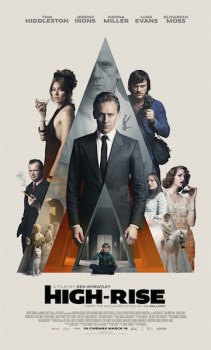
High-Rise (2015)

2016 #123
Ben Wheatley | 119 mins | Blu-ray | 2.40:1 | UK & Belgium / English | 15 / R

High-RiseI was looking forward to this sci-fi-ish ’70s social satire, but, having let it percolate for a few months, I still have no real grasp of what it was about. I mean, it’s obviously about society, but what its point about society is… I have no idea.
I will add it reminded me of Shivers. I didn’t like Shivers.

Technical merits are first rate — it’s magnificently designed, shot, and edited; a visual delight throughout. Plus it finds two fantastic uses for Abba’s S.O.S. But at a full two hours, pleasant aesthetics are slight sustenance.

Not so much disappointing as indecipherable.

3 out of 5

The Hunger Games: Mockingjay – Part 2 (2015)

2016 #59
Francis Lawrence | 137 mins | Blu-ray | 2.40:1 | USA & Germany / English | 12 / PG-13

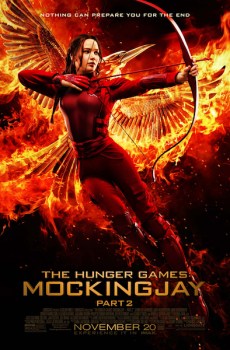
The Hunger Games: Mockingjay - Part 2The artificially-extended Hunger Games trilogy-turned-tetralogy climaxes here. Presumably you’ve seen the first three and so know what you’re into by this point — either you’re invested or you’ve given up. Unless you want to know “does it end well?” before embarking on the whole thing, of course. While Mockingjay Part 2 is not the series’ finest instalment, it brings things to a decent head… eventually.
In my review of Mockingjay Part 1, a film much criticised for feeling like half of a whole — or, rather, half of a part of a whole — I argued it does actually function as a film in its own right. I mean, all of these films are part of one long narrative, so that’s par for the course, and I didn’t feel like Mockingjay Part 1 was any less a ‘standalone’ chunk of that narrative than the two films that preceded it. Specifically, I asserted that “the focus on using Katniss as no more than a propaganda figurehead… has been fully explored — and so I think this instalment will feel much more like a fully-fledged film in its own right if they just move on. I hope the final film give us new themes, new subplots, new arcs to follow”.

With that in mind, Part 2 begins with a degree of disappointment, as it tackles some propaganda-related holdovers from the last movie. Maybe I was putting too much stock in the idea of them moving on from that theme and establishing something new, though — especially as it does soon do that anyway. What develops is a “men on a mission” war movie, as Katniss and a small band of soldiers make their way through the deserted-but-boobytrapped Capitol on a mission to assassinate President Snow.

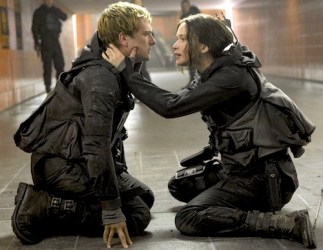
K and P, nutsWhat follows isn’t perfect — in particular, the storyline could’ve done with tightening up — but it does have a lot going for it. There’s strong characterisation: Katniss is as confused, conflicted, and incapable of engaging with her emotions as ever, while Peeta’s PTSD is well-handled, with an effective device where he repeatedly makes a statement before asking, “real or not real?” There are other nicely developed thematic points too, like expanding further on the rebels not being perfect good guys (as initiated in Part 1), which plays a central role in the denouement. The action sequences are well staged and occasionally inventive, but best of all is that the climax doesn’t lean on being the biggest fight scene yet — it’s driven by the story, and the characters and their decisions, rather than being a ginormous shoot-out.

Speaking of the film’s finale, complaints that the endings go on too long bug me, just as they bug me when people bring it up about Lord of the Rings. In both cases, you’re getting a capstone to a 9+ hour saga, not the 2- to 3-hour section of it you just watched. Rings’ endings feel completely suitable if you watch all 12 hours of the extended editions in one sitting, and I’d wager Hunger Games’ do too. Rush it and you end up with something like Harry Potter’s finale, which comes to a crushing thud of an ending as soon as the battle is won. What both Rings and Hunger Games are doing, actually, is showing that these characters are people who exist outside of the context of their war. They’re not just combatants, who evaporate into thin air once the battle’s lost or won; they’re people who have to either return to their old lives or establish new ones.* It’s a richer, more realistic, more human way to end a story than “plot’s over, action sequences are finished — we’re done here!”

Ready for the endMockingjay Part 2 is not the best instalment of the Hunger Games, a series whose second half didn’t quite live up to the developed potential of the excellent Catching Fire. That said, I think it largely works as a whole, with conflicted and complicated characters living in a world that initially seems straightforwardly dystopic but develops many moral greys. That’s particularly welcome from a Young Adult series, a sort-of-genre where some of the most famous examples are lacking in intellectual — or (considering the target audience) educational — heft. In fact, based on the scores and comments I’ve seen on some websites, Mockingjay Part 2 may yet turn out to be the most underrated of the Hunger Games films.

4 out of 5

The Hunger Games: Mockingjay – Part 2 is available on Netflix UK as of this week. Mockingjay Part 1 is also on there; the first two films are not.

* Potter does do the “back to a life” thing, but the details of it are found in ancillary texts. ^

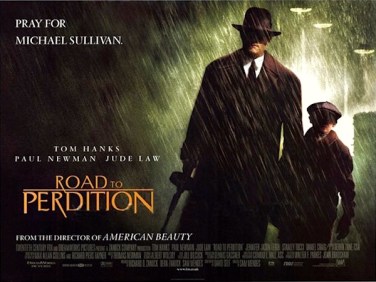
Road to Perdition (2002)

100 Films’ 100 Favourites #74

Pray for Michael Sullivan.

Country: USA
Language: English
Runtime: 117 minutes
BBFC: 15
MPAA: R

Original Release: 12th July 2002 (USA)
UK Release: 20th September 2002
First Seen: DVD, March 2003

Stars
Tom Hanks (Forrest Gump, Bridge of Spies)
Paul Newman (Cool Hand Luke, Butch Cassidy and the Sundance Kid)
Daniel Craig (Lara Croft: Tomb Raider, Casino Royale)
Jude Law (Gattaca, Closer)
Tyler Hoechlin (Everybody Wants Some!!, Fifty Shades Darker)

Director
Sam Mendes (American Beauty, Skyfall)

Screenwriter
David Self (Thirteen Days, The Wolfman)

Based on
Road to Perdition, a graphic novel by Max Allan Collins and Richard Piers Rayner.

The Story
1931: Michael Sullivan is an enforcer for mob boss John Rooney, who thinks of him like a son. When Sullivan escorts Rooney’s unstable real son, Connor, to a meeting, the guy snaps and the other side are murdered — an event witnessed by Sullivan’s own son, Michael Jr. In an attempt to cover it up, Connor kills Sullivan’s wife and other son, while Michaels Sr and Jr escape, and begin a journey to take revenge.

Our Heroes
Michael Sullivan Sr is, on paper, not much of a hero: a mob hitman, his trade is death. But when half his family is murdered, he’ll do what’s necessary to protect his surviving son and get justice — his kind of justice, anyway. In the process, he bonds with Michael Jr, finally developing the relationship they never had before. Perpetual nice guy Tom Hanks tones that way down to give what I think must be one of his best performances, which brings out the heart in Sullivan without tipping over into regular Hanks territory, in the process allowing the viewer to empathise with a man who in lesser hands would just be a cold-blooded murderer.

Our Villains
Connor Rooney is a liability, a deranged coward and crook who wishes he was a hard man. But he’s no threat — his father, mob boss John Rooney, is the one with the power and means. At heart he’s no villain to Michael Sullivan — he’s essentially his father — but after Connor murders Sullivan’s family, Rooney feels he must protect his own blood, despite caring for him less than Sullivan. With an actor of Paul Newman’s quality in the role, every nuance of Rooney’s complex emotional position is subtly explored.

Best Supporting Character
To try to stop Sullivan, the mob set hitman Maguire on his trail. He’s a crime scene photographer who uses his job to cover his crimes, and is a nasty, rat-like creep. Jude Law rejects his frequent pretty-boy-ness to really inhabit that part. (Basically, everyone is fantastic in this film.)

Memorable Quote
John Rooney: “This is the life we chose, the life we lead. And there is only one guarantee: none of us will see heaven.”
Michael Sullivan: “Michael could.”

Memorable Scene
Heavy rain falls as Rooney and his men cross an empty street to his car. When they reach it, the driver inside is dead, the door locked. They spread out across the street, guns ready, but there’s no one to be seen… Then a muzzle flashes and the men are slowly cut down — leaving only Rooney standing. As the shooter emerges from the shadows, the camera tracks in on Paul Newman, his posture and expression saying it all: he knows who it is, he knows his time has come, and he’s resigned to it. All of this set to just the sound of Thomas Newman’s mournful piano-and-strings soundtrack. Only when Rooney turns around does the rain begin to bleed onto the soundtrack, and we see the man is (of course) Michael Sullivan. “I’m glad it’s you.” With tears in his eyes, Sullivan finishes his job.

Technical Wizardry
There are several reasons the above scene works so well — the pace of the editing, the sparse sound design, the music, the performances — but one of the biggest is the cinematography. The work of Conrad L. Hall, this is just one of the most obviously beautiful sequences in a film full of gorgeous imagery. He won a well-deserved posthumous Oscar for his work, his third from a career that garnered ten nominations.

Making of
One of the locations found was considered physically perfect but the wrong way round, with room only to shoot from right to left and not vice versa. Rather than, say, find somewhere else, production designer Dennis Gassner and his team dressed the location to be flipped, not only reversing street signs and car number plates, but even changing the side of the steering wheels on all the vehicles.

Awards
1 Oscar (Cinematography)
5 Oscar nominations (Supporting Actor (Paul Newman), Score, Art Direction-Set Decoration, Sound, Sound Editing)
2 BAFTAs (Cinematography, Production Design)
1 BAFTA nomination (Supporting Actor (Paul Newman))
2 Saturn nominations (Action/Adventure/Thriller Film, Performance by a Younger Actor (Tyler Hoechlin))

Despite some initial build-up, Road to Perdition wound up an awards season also-ran, losing out to that well-remembered classic Chicago and everyone’s desire to try to give Martin Scorsese an Oscar for Gangs of New York.

What the Critics Said
“The greatest gangster film since The Godfather.” — News of the World

“To call this the greatest gangster film since The Godfather would be an overstatement, though not by much. It is, however, the most brilliant work in this genre since the 1984 uncut version of Sergio Leone’s flawed but staggering Once Upon a Time in America. Road to Perdition, a less sprawlingly ambitious movie, is without major flaws.” — Eric Harrison, Las Vegas Sun

Score: 81%

What the Public Say
“In a film about the mob and hitmen, the violence is generally kept to a minimum. And when it is done, it’s either very quick, or it’s shown partially offscreen or via a reflection. […] Throughout the film, the violence is never glorified as something heroic. But instead, it’s something that’s done only when it is necessary, and the weight of it is always felt. During the first killing in the film, the first one that Michael sees through a crack in the wall, it’s done unexpectedly and the victim falls to the ground in slow motion. When Mike brings out his Tommy Gun, it’s not something he does with glee, it’s something very deliberate as he solemnly takes the pieces out of the briefcase to assemble it.” — Bubbawheat, Flights, Tights, & Movie Nights

Verdict

Road to Perdition feels like a film that didn’t get its due at the time, and has become almost something of a cult favourite since. Not “cult” in the traditional “gaudy fun B-movie” sense, but in that it has a dedicated following of people who realise its power. On the surface it’s a revenge thriller, replete with ’30s mob style and Tommy Gun massacres, but under that is a more emotive tale about masculinity as it pertains to the father/son dynamic. It’s all handled with sensitive artistry by director Sam Mendes, supported by first-rate technical merits across the board (the design and music are particularly noteworthy, in addition to the cinematography I already mentioned), and career-best-level performances from a strong cast. It lacks the sheer scale and scope to go toe-to-toe with The Godfathers as the definitive gangster movie, but as a smaller, personal tale, it’s exceptional.

#75 will be… Bayhem.

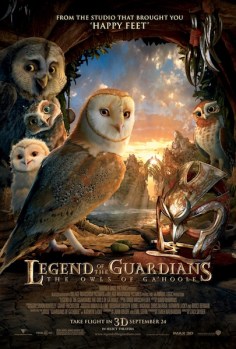
Legend of the Guardians: The Owls of Ga’Hoole (2010)

2016 #104
Zack Snyder | 93 mins | streaming (HD) | 16:9 | USA & Australia / English | PG / PG

Legend of the GuardiansLegend of the Guardians is pretty odd.

It’s an action-fantasy movie… starring owls. It’s animated, but in a dark, realistic way (think Rango with less cartoonishness and less light). It’s based on a kids’ book series… but directed by Zack Snyder, clearly reining in his R-rated impulses (violence occurs just off screen, leading to “did that happen?” confusion). The story has been relocated to Australia, the cast filled with well-known antipodean actors and their accents.

The cumulative effect is kind of surreal, retaining too much Snyderness to function properly as the kind of movie it wants to — perhaps should — be.

3 out of 5

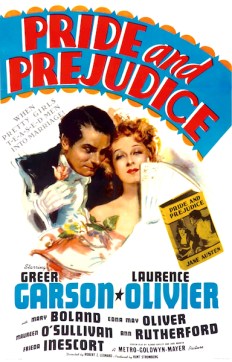
Pride and Prejudice (1940)

2016 #122
Robert Z. Leonard | 113 mins | TV | 4:3 | USA / English | U

Pride and PrejudiceThe first adaptation of Jane Austen’s ever-popular novel, MGM’s film is a compromised endeavour: by executives softening dialogue and rewriting characters; by changing its setting to permit grander costumes; by Gone with the Wind using all the Technicolor stock, forcing the lavish production to shoot in black-and-white.

Nonetheless, it emerges a solid take on Austen (until the ending goes thoroughly astray). Laurence Olivier is a suitably moody Darcy and, though far too old for the part, Greer Garson makes a witty Lizzy.

Massively overshadowed by later adaptations, this remains an entertaining version for anyone not too concerned about textual faithfulness.

4 out of 5

Ten Little Indians (1974)

aka And Then There Were None

2016 #120
Peter Collinson | 94 mins | TV | 1.66:1 | Italy, West Germany, France, Spain & UK / English | PG / PG

Ten Little IndiansThe third English-language screen adaptation of Agatha Christie’s famed mystery, one of the best-selling novels of all time, relocates the action to the middle of a desert but is otherwise a word-for-word remake of the 1965 version — though it does lose the gloriously ’60s “Whodunnit Break”. (Both versions were made by the same producer, who would later remake it again in the ’80s.)
It’s interesting, therefore, that this lacks the atmosphere or tension of that version. I don’t think it’s just because I’m now more familiar with the story (having seen not only the ’65 version a couple of years ago, but also the new BBC adaptation that was on last Christmas) — it feels rushed at times, like a summary of the novel rather than a full retelling. Considering the screenplay is nearly identical to the ’65 version (merely tweaked to reflect the relocation), I can only assume that’s down to the way director Peter Collinson chooses to handle certain sequences. For example, in this version I never bought the relationship between youngsters Hugh and Vera, and sequences like the group searching the cellars contain no real sense of menace.

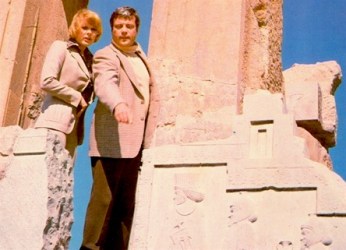
The cast is made up of recognisable faces from ’60s/’70s European cinema, led by Oliver Reed and Richard Attenborough, but also including the likes of Herbert Lom, Gert “Goldfinger” Fröbe, and Adolfo “Emilio Largo” Celi. Not that anyone’s bad, but there’s the sense they were probably there to earn a bit of cash while having a nice exotic holiday, and making a film on the side.

As a précis of the storyline, with some nicely photographed locations (the Iranian hotel they filmed in looks fairly stunning), this isn’t half bad. However, there are at least two better screen adaptations of the novel, and if what I’ve heard of the 1945 film and ’80s Russian adaptation are to be believed, I guess this comes pretty far down the chain.

3 out of 5