Blindspot Review Roundup

Spoilers for my next monthly update: I’ve completed watching all 22 films on my 2017 Blindspot and “What Do You Mean You Haven’t Seen…?” lists. Hurrah!

What I haven’t done is reviewed them all. Indeed, 17 still languish in my review backlog — that’s 77%. (In fact, I’ve only actually reviewed one Blindspot film — The Exorcist — with the other four being from WDYMYHS.)

So, with the end of the year fast approaching — and, with the new year, a new batch of films to watch — I thought it high time I cracked on with those reviews. Here’s a quick roundup of a few, linked by all being adapted from novels, which may be the first of several such omnibus editions.

In today’s roundup:

  • Dances with Wolves: Special Edition (1990/1991)
  • Jackie Brown (1997)
  • Silver Linings Playbook (2012)
  • The 39 Steps (1935)


    Dances with Wolves
    Special Edition

    (1990/1991)

    2017 #26
    Kevin Costner | 227 mins | DVD | 2.35:1 | USA & UK / English, Lakota & Pawnee | 15 / PG-13
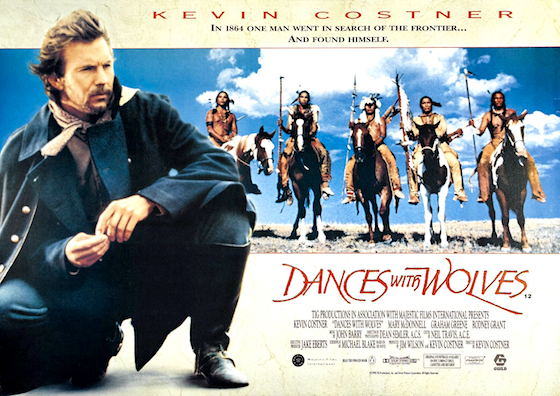
    Dances with Wolves

    Oscar statue1991 Academy Awards
    12 nominations — 7 wins

    Winner: Best Picture, Best Director, Best Adapted Screenplay, Best Cinematography, Best Sound, Best Film Editing, Best Original Score.
    Nominated: Best Actor (Kevin Costner), Best Supporting Actor (Graham Greene), Best Supporting Actress (Mary McDonnell), Best Art Direction-Set Decoration, Best Costume Design.


    The behind-the-scenes story of Dances with Wolves is almost as grand as the movie itself. An actor turned director whose inexperience led to production delays and budget overruns, leading to rumours the film was a pending disaster like Heaven’s Gate a decade before it (some nicknamed it “Kevin’s Gate”), and the studio who wanted a 140-minute cut having to settle for the 180-minute one that director delivered. The resulting film never even reached #1 at the box office… but still went on to be the highest grossing Western of all time, and became the first Western to win the Best Picture Oscar in almost 60 years. It was so popular that a 53-minute-longer extended cut was released a year later, which Costner later denied being involved with.

    Having not seen the theatrical cut I can’t offer an opinion on which is better, but the near-four-hour extended one certainly feels its length. That’s not necessarily a bad thing — this is an epic in the truest sense of the word, with a large story to tell on a grand canvass; although it’s concurrently a drama about just a couple of people from different cultures coming to interact. It’s almost too big to digest in a single go — I’m even not quite sure what I made of it. You can see why I’ve spent 10 months not writing about it.

    Anyway, I admired its scope and ambition. I wouldn’t say I loved it, but it merits revisiting someday.

    4 out of 5

    Jackie Brown
    (1997)

    2017 #49
    Quentin Tarantino | 154 mins | Blu-ray | 1.85:1 | USA / English | 15 / R
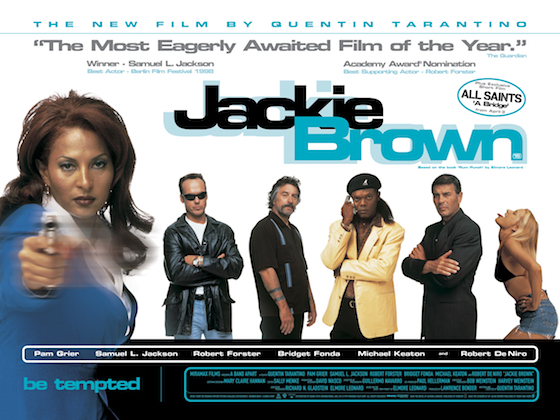
    Jackie Brown

    Oscar statue1998 Academy Awards
    1 nomination

    Nominated: Best Supporting Actor (Robert Forster).


    Jackie Brown has long been my Tarantino blindspot. I caught up with Reservoir Dogs and Pulp Fiction after he was already established and they were regarded as modern classics, then was old enough to see the Kill Bills at the cinema and have followed his career from there. But, for some reason, his third feature has always eluded my attention. My tenth anniversary “heinous oversights” list seemed a good time to rectify that.

    Some people argue that Jackie Brown is secretly Tarantino’s best movie. I add “secretly” there because it gets a lot less attention than the aforementioned movies that came either side of it. That’s not a bandwagon I’m prepared to jump on. To me, it feels a little like QT was trying to emulate what worked about Pulp Fiction without just making a rip-off of his own movie, and therefore it’s a bit of an inferior copy. That’s not to say it’s a bad movie by any means. The eponymous character is particularly interesting, as you’re never quite sure what Jackie’s up to; what her plan is. She seems to be telling everybody everything, but she has to be screwing some — or all — of them, right?

    Possibly I was just approaching the film in the wrong way. Tarantino has called it “a hangout movie”, which he explained thus: “Jackie Brown is better the second time. And I think it’s even better the third. And the fourth time… Maybe even the first time we see it we go, ‘Why are we doing all this hanging out? Why can’t we get to more of the plot?’ But, now the second time you see it, and the third time you see it, you’re not thinking about the plot anymore. You’re waiting for the hangout scenes… It’s about hanging out with the characters.” Personally, I’m not in any desperate rush to hang out with these characters again. But who knows, maybe I’ll get it the second time. Or the third. Or the fourth…

    4 out of 5

    Silver Linings Playbook
    (2012)

    2017 #61
    David O. Russell | 115 mins | TV | 2.35:1 | USA / English | 15 / R

    Silver Linings Playbook

    Oscar statue2013 Academy Awards
    8 nominations — 1 win

    Winner: Best Actress (Jennifer Lawrence).
    Nominated: Best Picture, Best Director, Best Actor (Bradley Cooper), Best Supporting Actor (Robert De Niro), Best Supporting Actress (Jacki Weaver), Best Adapted Screenplay, Best Film Editing.


    Bradley Cooper’s performance — 3.5/5
    JLaw’s performance — 4/5
    JLaw’s dancing — 6/5
    Direction — 2/5
    Screenplay (first two acts) — 3/5
    Screenplay (bit where it suddenly gets plot-heavy and all exposition-y to set up the third act) — 1/5
    Screenplay (third act that seems to be from a completely different, much more conventional movie) — 2/5

    Average =

    3 out of 5

    The 39 Steps
    (1935)

    2017 #60
    Alfred Hitchcock | 83 mins | download (HD) | 4:3 | UK / English | U

    The 39 Steps

    This adaptation of John Buchan’s adventure novel is one of the best-known among director Alfred Hitchcock’s early works, and for good reason.

    Galloping briskly along with a running time under 90 minutes, it’s a film where mood, tone, and the wonderful execution of individual sequences are all allowed to trump plot, which is somewhere on the spectrum from unexplained to nonsensical. We follow the likeable wrong-man hero Richard Hannay (Robert Donat) as he runs away from a gang of villains who barely feature. That they have a nefarious plan is outlined early on to kickstart the action; what they were up to is explained in the final scene to give the story some resolution; and in between they’re pretty much just a force chasing our hero. It’s almost like the villains are the film’s MacGuffin: it doesn’t matter what or who they are, just that they want to catch Hannay and so he must escape them. It’s how he escapes and what happens during his escapades that matters to us; that provides our entertainment.

    It almost plays like a spoof in that regard — the plot is such stock spy-thriller fare that it doesn’t need to make sense in and of itself, we just get what it’s driving at. Of course, considering the age of the film, it’s more proto-spy-thriller than neo-spy-thriller. Whatever you class it as, over 80 years since its release it remains rollicking entertainment.

    5 out of 5

    Dances with Wolves, Jackie Brown, and The 39 Steps were viewed as part of my Blindspot 2017 project, which you can read more about here.

    Silver Linings Playbook was viewed as part of my What Do You Mean You Haven’t Seen…? 2017 project, which you can read more about here. Other WDYMYHS reviews already published include Hail, Caesar!, Into the Wild, Nightcrawler, and Room.
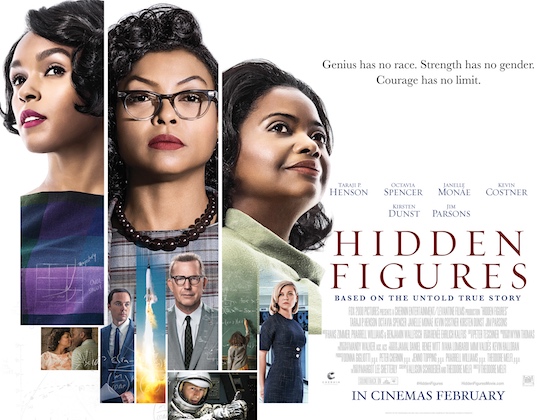
  • Hidden Figures (2016)

    2017 #170
    Theodore Melfi | 127 mins | download (HD) | 2.39:1 | USA / English | PG / PG

    Hidden Figures

    Based on a true story, Hidden Figures is about three black women working at NASA in the early ’60s, a time when segregation was still in force in the US.

    It’s a double whammy of timely issues, then: they struggle to prove they’re clever and have scientific know-how because they’re women, and they struggle to prove they’re worth treating with respect because they’re black. How depressing that these things are still relevant over 50 years later. That said, any right-minded person watching it will still be suitably appalled that this kind of thing went on at all — even when you know about it, seeing it played out is something else.

    Of course, it comes with a positive message attached: these people overcome their societally-imposed disadvantages to be awesome nonetheless, fighting everyday sexism and racism left, right and centre to eventually prove their worth. Hurrah! It’s a strong message, even more powerful thanks to it being a true story, and no doubt goes a long way to explaining the film’s success. As a movie in its own right, it’s nothing particularly special. There are good performances from a high-calibre cast, but everything else is pretty standard for a biopic — well done, but there’s a reason the film’s Oscar nominations were for acting and screenwriting.

    4 out of 5

    Hidden Figures is available on Sky Cinema from today.

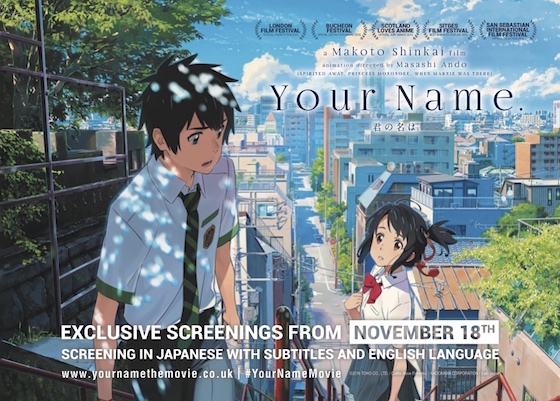
    Your Name. (2016)

    aka Kimi no na wa.

    2017 #168
    Makoto Shinkai | 107 mins | Blu-ray | 1.78:1 | Japan / Japanese | 12 / PG

    Your Name

    If you’ve not heard about Your Name then… well, where have you been for the past year? It was a colossal hit in its native Japan during the back end of 2016, spending 12 weeks at #1 to become the fourth highest-grossing film of all time there (behind only Spirited Away, Titanic, and Frozen). It’s also the only anime not made by Studio Ghibli to gross over ¥10 billion at the Japanese box office. Critical acclaim has followed as it’s been released around the rest of the world too, hailing writer-director Makoto Shinkai as the new Miyazaki. It’s hard to imagine higher praise for an animator. The film reached UK cinemas last November, but then took a whole year to hit DVD and Blu-ray (I guess thanks to Japanese studios’ usual restrictive licensing agreements), and as of this week is available to stream for Amazon Prime members. So when I finally sat down to watch it this week it had a bit of weight on its shoulders — at this point it runs the risk of being a victim of its own hype.

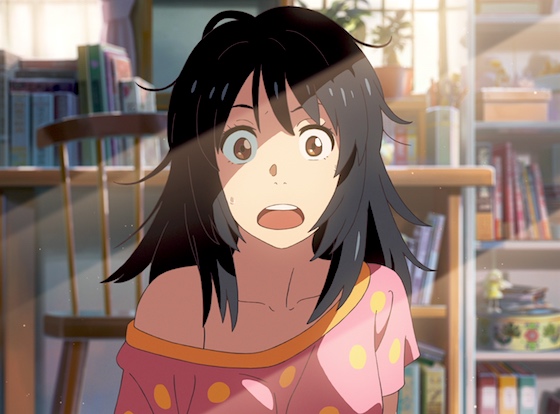
    The film introduces us to Mitsuha, a teenage girl in a sleepy country town — more a village, really (it doesn’t even have a cafe!) — who wishes for a more exciting life in the big city. Her friends tell her she was acting weird the day before, but she can’t remember any of it. Then she wakes up in the body of Taki, a teenage boy living in Tokyo. Assuming it’s a dream — a very long, very realistic dream — she stumbles through his life for a day. To cut to the obvious, Mitsuha and Taki soon realise they’re actually swapping bodies, apparently at random but for a whole day each time. (The literal translation of the film’s Japanese title is What is your name, which kinda makes more sense.) They find ways to deal with it, but a big explanation for why it’s happening is looming…

    That feeling when you wake up and realise a boy's been inside you... er, as it were

    That comes in the form of a hefty twist about halfway through the movie. I’ve read some very different reactions to that development and what follows it — criticism of it for shifting the film into something generic after a more original first half; praise for it elevating the film into something more original after the generic first half. I guess your mileage will vary. For me, it kind of glossed over some of the body-swap stuff to get to a place where there was still time to deal with what happens next. Conversely, there are plenty of intersex body-swap movies — how much do we need to go over that again? But there are generic elements to the second half too.

    That said, the way it uses Japanese folklore to bring all the threads together is a bit different, at least for us Westerners. I don’t know if it’s based on genuine beliefs or if it’s a mythology imagined for the film, but it conveys some effective and affecting ideas. It builds to an emotional climax and, ultimately, a perfectly satisfying ending. Well, unless… At times you feel there were perhaps other, more unusual directions the film could have explored. Fair enough, that clearly wasn’t the story Shinkai wanted to tell; but some viewers may think those less well-trodden paths would’ve made for a better movie. Of course, that would’ve neutered its appeal to others; but then Mark Kermode compared it to Romeo and Juliet in terms of how it might appeal to teenagers, and that certainly doesn’t have a happy ending…

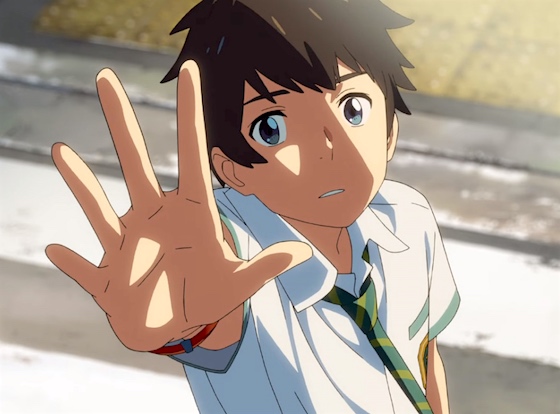
    Taki reaching for Mitsuha's boobs, probably. He loves feeling her boobs.

    I’m not just talking about the finale, though. For example: while in Taki’s body, Mitsuha displays his “feminine side”, which leads to a date with a girl he’s had a crush on for ages. On the day of the date, Taki is in his own body, which leaves Mitsuha upset because she’d wanted to go on the date. Surely you can see how this is possibly building in a direction where Mitsuha realises something about herself; something she might not have noticed living in a very traditional little town. But that’s not where Your Name is going — and, as I said, fair enough — but it’s not a bad idea for a movie (is it?)

    Nonetheless, at times the story is quite complicated, with overlapping dialogue, or a density of information conveyed in images, on-screen text, and dialogue simultaneously. I mention this because watching the English dub might make for a more manageable experience, at least on first viewing. (That said, there’s one gag which only works in Japanese, and the subtitles work at a rate of knots to explain the joke while it’s happening. I watched the English dubbed version of the scene afterwards and it kind of fudges the gag away, because there’s no way to translate it into English.) That said, other bits of the story are just straight up jumbly, but trust that there’s a reason for that — you may get confused about who’s in whose body when, but the film makes enough sense in the end.

    Pretty pictures

    One thing I have no problem praising unequivocally is the imagery. The film is visually ravishing; the animation thoroughly gorgeous. Its use of colour and light is beautiful; the detail in the art and its movement is almost photo-real, without the uncanny valley effect you often get from rotoscoping. Shinkai also seems to have a live-action-esque feel for shots and editing, particularly in his use of montage, which lends a very filmic feel. At other times it benefits from animation’s freedom to be less literal, particularly in one sequence apparently created with pencils and chalk.

    I do think the hype around Your Name ended up as a problem for me. I was expecting to be blown away by its amazingness, the expectation of which got in the way of just appreciating the film for what it is. That said, I definitely liked it a lot. Despite using some building blocks familiar from other movies, it mixes them together with some fresh perspectives to create a film that is thoroughly romantic, in multiple senses of the word.

    4 out of 5

    As I mentioned, Your Name is now available on Amazon Prime Video in the UK, in both subtitled and dubbed versions.

    Rurouni Kenshin: The Legend Ends (2014)

    aka Rurōni Kenshin: Densetsu no Saigo-hen / Rurouni Kenshin Part III: The Legend Ends

    2017 #155
    Keishi Ōtomo | 134 mins | streaming (HD) | 2.35:1 | Japan / Japanese | 15

    Rurouni Kenshin: The Legend Ends

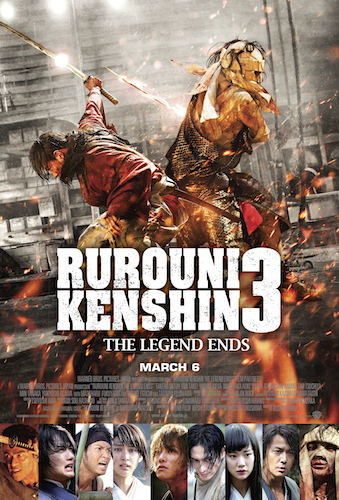
    Picking up where Kyoto Inferno left off, The Legend Ends is the second half of the two-part conclusion to the Rurouni Kenshin trilogy. With the villainous Shishio (Tatsuya Fujiwara) on his way to conquer Japan, Kenshin (Takeru Satoh) returns to his old master, Hiko (Masaharu Fukuyama), to learn the final tricks of his unique fighting style. All the previous film’s various characters (including ones I thought had died) have their role to play in getting Kenshin into position to battle Shishio again and, hopefully, defeat him once and for all…

    The Legend Ends is, unfortunately, not all it could be. The first hour or so essentially goes nowhere. The idea of Kenshin returning to the man who trained him to learn a final technique to defeat the big bad (aka the plot as outlined in the blurb) is a good one, but the way it plays out in practice kinda sucks: Kenshin washes up on a beach and it’s his teacher who happens to find him — what a stroke of luck! And the lesson Kenshin learns has bugger all relevance, as does that entire character in the end — even when nearly everyone who can fight shows up as part of the big finale, Hiko’s not among them.

    Spot the period-accurate boom mic

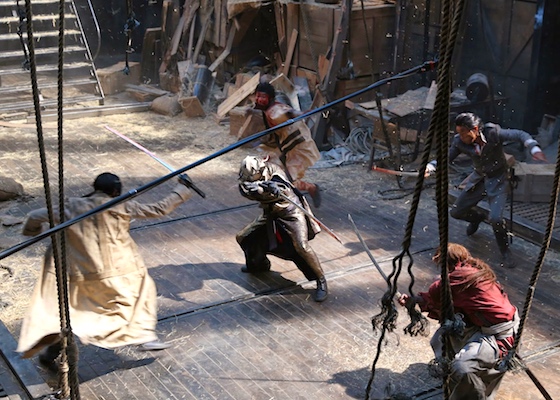
    The second half is better, in particular the climax — it’s one big sword fight, of course, which is exactly how it should be in a film like this. Throughout the film the action is all excellently choreographed and staged, but the finale is the pinnacle of that. But aside from the thrilling combat scenes, the movie just doesn’t hang together as a satisfying conclusion to the trilogy. On a literal level the conflicts are resolved and characters are reunited, etc etc, but the way it goes about that business is, from a character or emotional perspective, lacking in impact. It’s a shame.

    As is a common fate among so many trilogy-closers, I thought Rurouni Kenshin 3 was sadly the series’ weak link. That said, it’s not a bad action movie — if you’re only in it for the swordplay then it satisfies with bells on; it’s the storyline around that is disappointing. Even while a significant chunk of its running time is somewhat underwhelming, at least the killer climax provides a suitable finale to the trilogy. Or it did until earlier this year, when they announced a fourth movie. Although my score errs on the harsh side, I’m still looking forward to Kenshin’s adventures continuing.

    3 out of 5

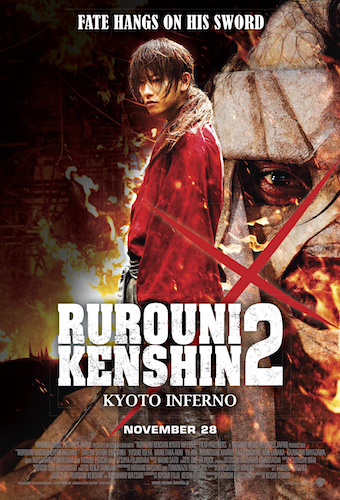
    Rurouni Kenshin: Kyoto Inferno (2014)

    aka Rurōni Kenshin: Kyôto taika-hen / Rurouni Kenshin Part II: Kyoto Inferno

    2017 #149
    Keishi Ōtomo | 139 mins | streaming (HD) | 2.35:1 | Japan / Japanese | 15

    Rurouni Kenshin: Kyoto Inferno

    The first live-action Rurouni Kenshin film was such a success that they followed it with a two-part sequel, filmed back-to-back and originally released six weeks apart over the same summer. This is the first half.

    After the events of the first film, former assassin Kenshin (Takeru Satoh) is living a peaceful life with his newfound friends, until he’s summoned by the government to take on a mission. Turns out one of Kenshin’s former assassin colleagues, the vicious Shishio (Battle Royale and Death Note’s Tatsuya Fujiwara), is amassing an army to take down the government that left him for dead. Well, less left him for dead, more killed him after they won the war because he was too nasty to let stick around. Previous efforts to stop Shishio have failed, so now they want Kenshin to sort him out. Our peace-loving hero initially turns the job down, but events conspire to convince him he must act, and so he sets off alone to once again face the demons of his past.

    Kyoto Inferno is one of those sequels that benefits from the its predecessor establishing the world of the story and the characters that inhabit it, meaning it can launch off on its own grander scale. Partly we see this in a material sense: it looks even more expensive than the first one, right from a fabulous fire-strewn opening location, and keeps up the visual impressiveness throughout. But it’s also in the scope of the story and the way it stretches the characters, both old and new. It really puts Kenshin through the ringer, testing and questioning his beliefs and principles, and his fighting skills too. As a film it finds power in that — whereas the first movie established his persona and gave it a bit of a work out, here he’s stretched to breaking point.

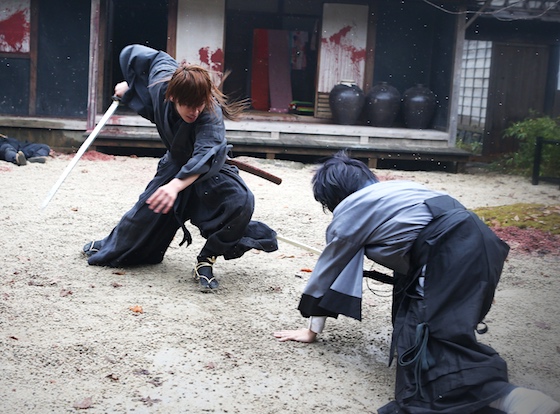
    Sword fights a-go-go

    Despite being only the first half of a four-and-a-half-hour epic, when compared to the original film the story here feels more streamlined, focussed, and pointed. It’s not perfect in this respect — at one point Kenshin’s mate Sanosuke sets off to help him, only to disappear from the movie until he suddenly appears during the final battle — but such lapses are few and do little to impact the overall flow. As a villain, Shishio is more of a force and a challenge for our hero, not least because he has an army of henchmen, as well as a literal army, on his side. The fights are even more accomplished, spectacular, and epically staged than in the first movie, not least the huge climax that sees a pair of armies duke it out in the streets of the titular city.

    Kyoto Inferno is unquestionably a first half — it ends on a handful of cliffhangers. That kind of thing sometimes irritates me, but it can work when done well, and I think this will turn out to be one of those good two-parters. It feels like a well-shaped movie in its own right, starting and paying off some of its own subplots rather than just leaving everything hanging. Some of these conclude in a way that is both an ending and indicates where the story will go next, which is a most deft bit of structure. The whole affair builds to a significant climax (the aforementioned battle) and a major turning point in the narrative, rather than just pausing events at the halfway point as lesser two-part movies do.

    Shishio and his hench-friends

    I enjoyed the first Rurouni Kenshin a lot, but this follow-up is even better. It expands the world of the story and deepens the characters, making for a more rounded and exciting movie. As mid-parts of trilogies (and/or first halves of two-parters) go, it’s more of a Dark Knight than a Matrix Reloaded; more of an Empire Strikes Back than a Dead Man’s Chest; more of a Two Towers than a Desolation of Smaug. Hopefully the next film can stick the landing…

    5 out of 5

    Tomorrow: the legend ends in The Legend Ends.

    Rurouni Kenshin (2012)

    aka Rurōni Kenshin / Rurouni Kenshin Part I: Origins

    2017 #143
    Keishi Ōtomo | 129 mins | streaming (HD) | 2.35:1 | Japan / Japanese | 15

    Rurouni Kenshin

    Based on a manga series that was previously adapted into an anime known in the West as Samurai X, this live-action adaptation was first brought to my attention by Total Film’s list of “50 amazing films you’ve probably never seen”, which cited its “stunning action sequences” and “beautifully choreographed sword-scraps”.

    Set in the late 19th century, the film is the story of Kenshin Himura (Takeru Satoh), who ten years ago went by the name Battosai and was a renowned fighter in the successful rebellion that brought Japan into a modern new age. Disgusted with his actions, he vowed never to kill again, becoming a wanderer (the rurouni part of the title) helping those in need, fighting with a blunted sword. When he arrives back in Tokyo, Kenshin finds that a murderer has adopted the name Battosai, whose killings are likely connected to powerful businessman Kanryu (Teruyuki Kagawa) to protect his illegal activities. Kenshin falls in with Kaoru (Emi Takei), the young owner of a fencing dojo under threat from Kanryu’s plans, and eventually teams up with acquaintances old and new to stop Kanryu and co.

    Kenshin and Kaoru

    I’ve never read or seen a version of Rurouni Kenshin before, so I don’t know how faithful this is as an adaption, but they’ve certainly crammed plenty of plot into its two hours. Viewers need to be a bit attentive to keep track of who’s who, and who’s working for who, and what their motivations are — for example, characters who initially appear to be villains, both because of their actions and our expectations of the story, are revealed to be good guys in short order. Having two characters called Battosai, one of whom has since changed his name but is primarily known by his old moniker to some characters, doesn’t help matters.

    It’s worth the small effort though, because, a few languorous patches aside, Rurouni Kenshin is a very entertaining movie. The heroes are a likeable bunch, even if Satoh looks too fresh-faced to have been a hardened warrior a decade earlier. I guess everywhere likes their pretty-boy leads. He also carries a little too great a sense of naïveté for that persona, but maybe that’s just faithful to the character as written. At least he seems to know his way around a fight scene. On the other hand, the villainous Kanryu is a delightful addition to the proud line of scenery-munching nemeses, his quirks underlined by a jaunty theme from composer Naoki Satō. He employs a couple of physically intimidating henchman too, which naturally serves to fuel the action sequences. As promised, these are excitingly staged, full of quick choreography and slick stunts. Couple their impressiveness with the large cast and varied period locations, and it gives the whole thing a glossy, big-budget feel.

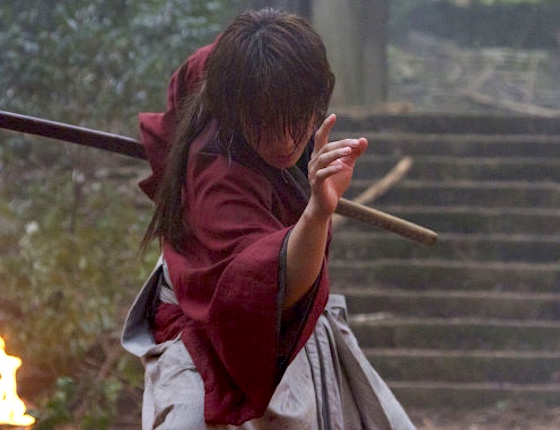
    Ready for action

    In the years since it appeared on Total Film’s list with the note “worth importing”, Rurouni Kenshin has become much more widely available: in the UK it’s been available to stream and buy on disc for a couple of years now, and it even made it to the US in 2016. It still deserves more attention, I’d say, especially for anyone who likes a good bit of sword-based duelling.

    4 out of 5

    Tomorrow and Monday: reviews of the two-part sequel.

    Valerian and the City of a Thousand Planets (2017)

    2017 #160
    Luc Besson | 137 mins | Blu-ray (3D) | 2.40:1 | France, China, Belgium, Germany, UAE, USA, UK & Canada / English | 12 / PG-13

    Valerian and the City of a Thousand Planets

    Luc Besson returns to the sci-fi genre that he so memorably visited 20 years ago in The Fifth Element for another colourful, crazy, adventure romp. Based on the French comic book series Valerian et Laureline, it sees special agents Major Valerian (Dane DeHaan) and Sergeant Laureline (Cara Delevingne) on a mission to protect Alpha, the titular city, from forces that threaten to destroy it.

    Valerian got a pasting from critics and was a flop at the US box office, a particular problem when it’s apparently the most expensive independent movie ever made. Fortunately for it, it did alright internationally, to the point where home video sales could still secure a sequel (Besson has already written a second and has moved on to developing a third!) While it’s far from a perfect movie, it deserves to find an audience. It’s probably a bit too barmy — a bit too European, even — for mainstream US tastes, but there’s a lot to like here for those who are so inclined.

    The main selling point is the imagery. Simply put, it’s incredible. There’s so much going on, all the time. There’s background detail galore. It whizzes through worlds that could be the entire setting for some other story. There are dozens, probably hundreds, of alien species thrown around. It’s so casually inventive, as if it’s got imagination to spare. And it’s mostly vibrantly colourful too, a real comic book of a movie in the traditional sense. All that depth and detail looks particularly amazing in 3D, it must be said, especially during the action sequences that whoosh though intricate, layered environments at breakneck speed.

    Valerian, without Laureline

    This visual exuberance sometimes comes at the expense of the plot. The main storyline is pretty straightforward — for example, there’s a third-act twist that’s obvious from the moment the character it concerns first appears on screen — but it keeps getting distracted by total asides, as Besson meanders off course to showcase some other species or environment or set piece he and his army of designers have cooked up. If that kind of shaggy storytelling annoys you then Valerian is set to get up your nose, but if you go along for the ride then Besson’s showing off can be delightful.

    Some of the other screenwriting details suffer even more, however. It almost engages in some interesting themes about colonialism and that kind of stuff, but instead more nods its head in their direction than actually says anything about them. More overtly, a lot of the dialogue is atrocious. In fact, it’s so bad that you begin to wonder if it’s deliberately ultra-mannered and you’ve just missed some kind of joke. It doesn’t help that DeHaan feels at least somewhat miscast as the cocky heroic lead. Or possibly that’s the point — that Valerian isn’t as irresistibly attractive and amazingly competent as he thinks he is. Model-turned-actress Delevingne, on the other hand, is surprisingly good.

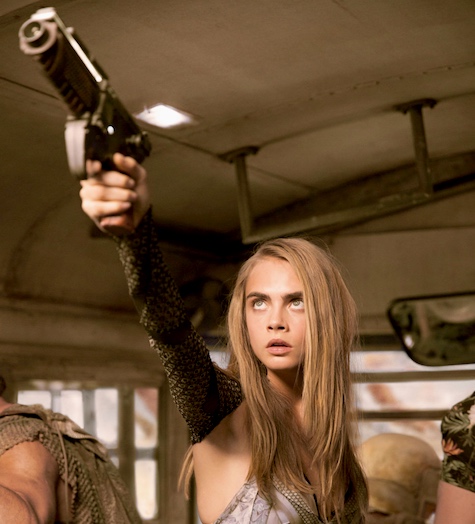
    You’ll notice that Valerian and Laureline are (a) co-leads, and (b) both in the name of the original books, and yet the female half of the duo has been ditched from the film’s title. Unfortunately, that does indicate the film’s sometimes-dated attitude towards gender politics. On the bright side, Delevingne manages to imbue Laureline with a feistiness that allows her to mostly hold her own against the men, and — despite the old-fashioned shape of a romantic subplot — Besson’s screenplay lets her be a capable agent in her own right as well. Still, Laureline vs. the Space Patriarchy would not be a wholly unapt alternative title for the film.

    Laureline vs the Space Patriarchy

    These less-good aspects of Valerian glare out at one rather, and make me want to declare that much of it is kind of rubbish, really… and yet I rather enjoyed the whole shebang. Perhaps it just takes a rewatch or two to settle into the film’s own particular rhythm? Even if that’s not the case, I’d still rather have the messy ambition of a Valerian than another dozen run-of-the-mill Hollywood CGI extravaganzas. Fingers crossed for those sequels.

    4 out of 5

    Valerian and the City of a Thousand Planets is released on disc in the UK today.

    It placed 17th on my list of The 17 Best Films I Saw For the First Time in 2017, which can be read in full here.

    Assassin’s Creed (2016)

    2017 #135
    Justin Kurzel | 115 mins | download (HD+3D) | 2.35:1 | USA, France, UK, Hong Kong, Taiwan & Malta / English, Spanish & Arabic | 12 / PG-13

    Assassin's Creed

    There seemed to be great hope when the Assassin’s Creed movie was announced. Partly because it’s a popular video game series, so of course its fans were excited; but also because it attracted star Michael Fassbender, an actor doing Oscar-calibre work, who then hand-picked director Justin Kurzel, whose previous movies suggested loftier ambitions than just trashy blockbusters. Feelings seemed strong that this could be the first great video game adaptation. But it was not to be.

    Fassbender plays Cal, a criminal who is ostensibly executed but then wakes up in a strange facility where a doctor (Marion Cotillard) informs him that they’re going to strap him into a machine called the Animus, which uses Cal’s DNA to kind of send him back in time to relive the memories of his ancestor, who was an Assassin (with a capital A, because they’re like a guild or something). Her organisation, the Templars (who are the bad guys, presumably), want to use this totally plausible science to access the aforementioned memories so that they can locate the world-changing MacGuffin, hidden away by Cal’s ancestor (who was a good guy, I think). Something like that, anyway.

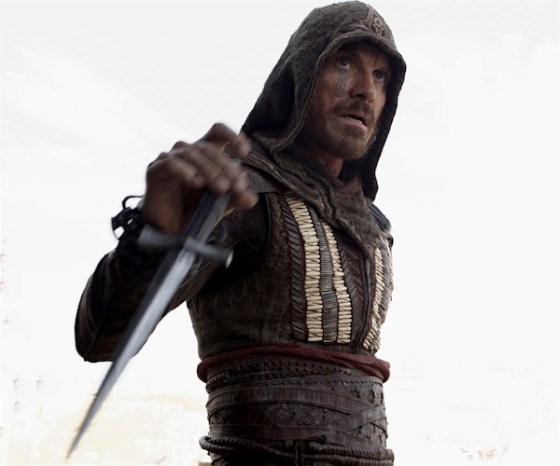
    Academy Award Nominee Michael Fassbender

    To be honest, a “something like that” feeling pervades the film. It’s a very strange viewing experience, in that you can follow what’s going on while at the same time feeling like it makes no sense whatsoever. Until the last act, anyway, when it goes thoroughly WTF. In part that’s because all the nonsensical bits and bobs that you let slide earlier finally come into play. Like, what’s going on with the other inmates? Are they actual Assassins? Did using the Animus make them Assassins? That seems to be what happens to Cal. So, how does that work exactly? And then the actual ending… what the hell was it all about? I’m not sure I could even summarise my confusion — like I said before: it’s both completely followable and completely nonsensical. Of course, it’s very much trying to leave things open for a sequel. I guess that won’t be happening…

    For a video game adaptation marketed as an historical actioner, there’s altogether too much plot (whether it’s followable or not, the story is dull and unengaging) and too little action. What’s there is mostly well realised — apparently a lot of it was done for real, and although there’s obviously a lot of CGI background extension (with a nice painterly look), there’s a definite physicality to the parkour and fisticuffs that you don’t get with CGI body doubles. I mean, there are only three or four action sequences total, and only one and a half of them are really worth it, but at least there’s something to like in them. Unfortunately, the action carries no weight: our hero can’t change the past, just witness it as he helps the bad guys watch to see where the MacGuffin ended up. So we are literally watching someone watch someone else do all the action — like, y’know, watching someone else play a video game. It’s almost a meta commentary on video game movies, except I don’t think that was the intention.

    Running and jumping

    So what is it trying to comment on? I mean, it’s an action blockbuster, so “nothing” would be a perfectly adequate answer. Nonetheless, some reviews claim it’s trying to consider philosophical, religious, and/or genetics-related concepts. I suppose it does technically mention such things, but it fails to actively engage with them to such a degree that I think it’s doing it a kindness to even claim it’s attempting to be a thoughtful movie. In a similar shot at intelligence, apparently we were meant to feel neither the Templars nor Assassins are good or bad, but both morally grey. However, rather than creating ambiguity in who to root for, it just comes across as a smudge of indifference.

    Nothing else impresses either. It’s a very visually gloomy film. I can’t discount the possibility that’s because I watched it in 3D, with the notorious darkening effect of the glasses, but my setup usually compensates for that (I don’t recall noting any undue darkness on other 3D viewing). Actually, the 3D itself was fine — good, even, at times — but it’s battling the largely unappealing visuals.

    Come up to the lab and see what's on the slab

    I’ve never played an Assassin’s Creed game, but I’d wager they don’t primarily consist of people nattering in a lab interspersed with the occasional period action scene. Maybe a greater adherence to such thrills, and less needlessly convoluted plotting, would’ve made for a more likeable movie. My rating’s possibly a tad harsh, but Assassin’s Creed could and should have been better.

    2 out of 5

    Assassin’s Creed is available on Sky Cinema from today.

    Anomalisa (2015)

    2017 #2
    Charlie Kaufman & Duke Johnson | 90 mins | streaming (HD) | 2.35:1 | USA / English | 15 / R

    Anomalisa

    Written and co-directed by Charlie Kaufman (of Being John Malkovich, Eternal Sunshine of the Spotless Mind, and so on), Anomalisa tells the story of Michael (David Thewlis), a depressed customer service expert who perceives everyone else as looking and sounding the same — until he meets Lisa (Jennifer Jason Leigh), whose uniqueness to him immediately attracts Michael.

    If you hadn’t noticed, Anomalisa (a portmanteau of “anomaly” and “Lisa”, not “anonymous” and “Lisa” as I’d assumed) is an animated movie. Although an everyday kind of drama that would be largely achievable in live-action, it uses the form to its advantage when depicting the central conceit, giving every character who isn’t Michael and Lisa the same face and having them all voiced by the same actor (Tom Noonan). For me, this was the most effective part of the movie. It’s a really neat way of executing the concept of not being able to tell people apart. Noonan is the film’s real star, too, voicing “everyone else” in a way that makes them sound plausibly unique but also all the same, a tricky balancing act that he nails.

    The one thing that did disappoint me about it was this: the inability to distinguish people is a genuine medical condition, but the film tackles it only as a signifier of Michael’s depression rather than as an issue some people live with. Conversely, I presume that’s a pretty rare condition, whereas depression and isolated feelings are increasingly widespread, so the film perhaps has more to say in that regard. Ultimately, I shouldn’t be criticising a film for not being about something it’s not trying to be about (even when I thought that was what it was going to be about).

    Even puppets get the blues

    As for the rest of the movie… hm. It takes an age to get going, but once it does there are a few funny scenes (the “toy” shop; the hotel shower; Michael struggling with his room key), and who’d’ve thought a puppet movie would have one of the more realistic sex scenes in the movies? Especially as it pulls that off without becoming laughable thanks to Team America. More pertinently, it gradually unfurls a sometimes touching story about isolation and love. However, by the time it reaches the happy-sad ending (one person’s life seems to have been transformed; the other continues to be miserable), I wasn’t sure what it all signified. Maybe the line that “sometimes the lesson is there is no lesson” is very relevant.

    So, some good stuff, but that long slow open takes getting over, and I’m not sure what it all meant.

    4 out of 5

    Awakenings (1990)

    2017 #154
    Penny Marshall | 116 mins | TV | 16:9 | USA / English | 12 / PG-13

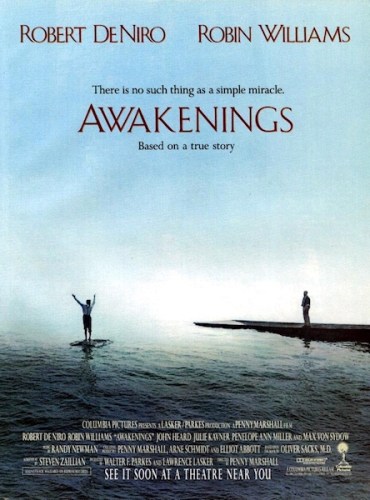
    Awakenings

    Based on a true story, Awakenings tells of Dr Malcolm Sayer (Robin Williams), who stumbles across an element of responsiveness in previously catatonic patients on his hospital ward. Finding a condition that links them buried in their medical histories, he supposes that a newly-invented drug might help their condition, subsequently testing it on Leonard (Robert De Niro), who ‘wakes up’ for the first time in 30 years. As Sayer continues his work, the new treatment reinvigorates the lives of more people than just the patients.

    I hadn’t even heard of Awakenings until the untimely passing of Robin Williams, when it was brought to my attention by Mike of Films on the Box (er, I think — I can’t find where this occurred. Either it’s on someone else’s blog or I’ve entirely misremembered the circumstances). Frankly, I’m not sure why it isn’t better remembered. Okay, it’s a little schmaltzy towards the end, but there are plenty of films that are worse for that which are held in higher esteem by some. Perhaps it’s not schmaltzy enough for those people, but still too much for people who hate that kind of thing? Or maybe it’s something else — but I don’t know what, because the rest of the film is packed with quality and subtlety.

    Such qualities are to be found in its writing — a screenplay by Steven Zaillian that conveys not only the usual story, character, and emotion, but also relates medical facts and processes in a way that is expedient to the narrative but still seems genuine. Whether it is or not I couldn’t say, but I didn’t feel conned by movieland brevity. Such qualities are to be found in the directing — unshowy work by Penny Marshall which matches the screenplay for its attention to detail in a way that never makes it feel as if we’re being fed a lot of information (although we are); that finds moments of beauty and life in the humanity of the characters, their plights, their successes, and their connections.

    You waking up me? Well I'm the only one here...

    Such qualities are to be found in the acting — De Niro’s immersive performance as a teenager trapped in a 50-year-old’s body, bookended by a medical condition so extreme that in lesser hands it could easily have become a caricature. Also Williams, giving quite possibly the most restrained performance of his career, but fully relatable as the socially inept doctor who is slowly, almost imperceptibly, brought out of his shell. And also an array of supporting performers, who each get their moment to shine in one way or another — although “shine” feels like the wrong word because, again, it’s understated. One or two moments aside (the schmaltziness I mentioned), there’s no grandstanding here.

    Combine those successes with the knowledge that this is a true story (heck, you wouldn’t believe it if it weren’t) only makes the film’s events — and its messages about being attentive of others and embracing the life we’re given — all the more powerful.

    4 out of 5