Saw 3D [2D] (2010)

aka Saw: The Final Chapter

2011 #67
Kevin Greutert | 90 mins | Blu-ray | 1.78:1 | USA / English | 18 / R

Before gangs of youths knock on your door to rob you under threat of violence, as is traditional on Halloween, why not enjoy my thoughts on a now-dead ’00s Halloween staple: the Saw movie.

I say “enjoy” — it’s almost as bad as those greedy kids…
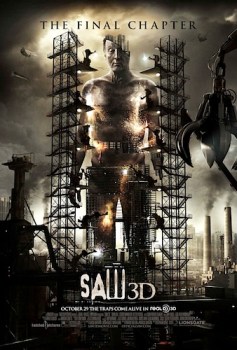
Saw 3DWhat’s this, the first Saw movie, now in 3D?

No.

So it must be the third Saw movie then, in 3D?

No, not that either.

It’s the seventh, in fact. But it is in 3D, hence the only-slightly-confusing Saw 3D moniker. I guess Saw 7 plus the tagline “see Saw 7 in 3D!” wasn’t considered clear enough.

And to top the stupidity off, I didn’t watch it in 3D, but the 2D prints are still called Saw 3D. What?

I was going to say that’s not even the most stupid thing about the film, but the rest of it isn’t so much stupid as disappointing. The problem is that there are some good ideas, but few are executed as well as they could be or paid off appropriately. The setting for the opening trap — it’s played out very publicly in a shop window — is a marvellous twist on the format. Is this an escalation? Are we going to see Jigsaw playing to the crowd all the time? No. It’s a one off. It doesn’t even have any bearing on the rest of the plot — it simply occurs and is never even mentioned again. That’s appalling.

Likewise, the support group for Jigsaw survivors: nice idea, but they don’t find anywhere to go with it. At least the notion of a fake Jigsaw survivor making a mint out of selling his fake story is an idea that has legs. Not long legs really, but they at least get a decent amount out of it — that is, it’s a set up for the Game of the Film. As ideas for The Final Film go, it’s a perfect match — a bit meta and all that jazz. Accompanying this is, of course, the arc plot that has stretched across the series. As the final film it’s time to wrap that up… Sadly, it isn’t particularly satisfactory. Guess who's backWith so many characters killed off in the preceding films we’re not left with anyone to really care about — certainly not the new gang of coppers we’re introduced to. Actually, to say we’re “introduced to” them is a kindness — they just turn up and begin to lead that part of the plot.

That said, the final five minutes are pretty good — just when I was thinking Cary Elwes’ cameo earlier had been underwhelming and pointless, there’s a final reveal to pay it off, and also neatly tie together and round off the whole series. It’s easily the best bit of the film.

It might seem daft to say this about a Saw film, but it’s a bit too gory for my liking. I know that comes with the territory in a film like this, but I think others in the series have managed the level better. This is up with Saw 3 in the stakes of needless torture-porn-level blood ‘n’ guts. The near-pointless car trap is the worst offender, as much as anything because it’s almost entirely ancillary to the plot — it’s a trap for the sake of a trap, and it’s a nasty one.

The film’s extended version (no idea if it’s included on the UK release I watched) only adds 12 seconds, and that’s all gore. Most of that occurs in extensions of literally a few frames. Earlier extended entries added both plot and gore, so that’s… pathetic, really. (According to the BBFC, the PAL-speed DVD versions run 23 seconds longer than the theatrical version. My info on the 12 seconds comes from my usual source.)

Aiming to live up to its title, the whole affair has clearly been designed with 3D in mind. That means a few moments of things flying at the camera, but they’re surprisingly rare. OK, so people explode or are pulled apart Big pointy thing, perfect for 3Da lot more regularly than they were in previous films, and bits of them swing in the direction of the camera, but that’s in keeping with the style of the series and doesn’t jar massively — if you didn’t know it was shot for 3D, you wouldn’t notice most of it.

Other bits, though, you really would. One trap sees three spikes headed for a woman’s eyes and mouth, so naturally we’re treated to some POV shots. This probably worked great in 3D, but in 2D they literally fall flat. Better is a trap that sees two men having to negotiate planks of wood on the second storey of a building that doesn’t have a floor. It works fine in 2D, but I imagine 3D added some lovely depth to the layered drop to the floor below. Never mind the odd things flying at the camera, this was the only time I really wished I was watching in 3D.

Some people lay into 3D for having stuff poke out at the audience for barely any reason. I have no problem with this in a movie like Saw — it’s all part of the fun. It gets tiresome if that’s all it’s doing, or if it happens too often, but once or twice it’s a good laugh; part of the gimmick of a thoroughly gimmicky format. In 2D, of course, that all falls dead. Luckily, as I said, not too much is randomly flung at the screen.

The final final trapThe worst side effect of 3D, however, is that the colour looks ridiculous in 2D. I’m glad they’ve shot it with 3D properly in mind — everyone knows the glasses make 3D films darker, but not every filmmaker seems to be compensating appropriately (see, for example, the criticism of The Last Airbender’s post-converted 3D), so it’s nice to see someone that is. But they haven’t un-compensated (as it were) for 2D. Much of the film just looks weirdly… not bright, exactly, but too light. It’s fine, just a bit unusual. But then some of the blood is a bit of a funny colour and, by the end, has turned a garish shade of pink. Oh dear. It continues to amaze me that no one’s come up with a simple grading solution to make colours look the same in regular 2D and glasses-effected 3D. It can’t be that hard, surely?

Saw 3D has a big pile of good ideas, but all of them are underused. The film just feels boring, somehow; workmanlike, maybe. It lacks the inspiration of earlier Saw films, despite on paper having some of the very best ideas of the entire series. It feels silly to say it about the seventh film in a yearly churned-out franchise, but Saw 3D is a disappointment; a lacklustre end to a variable franchise that started really rather well. Shame.

2 out of 5

I watched all seven Saw films within the past two years, donchaknow.

Saw 3D featured on my list of The Five Worst Films I Saw in 2011, which can be read in full here.
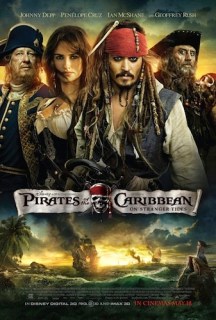
Pirates of the Caribbean: On Stranger Tides [3D] (2011)

2011 #61
Rob Marshall | 137 mins | cinema | 12A / PG-13

Pirates of the Caribbean: On Stranger TidesNo one had high hopes for Pirates of the Caribbean when it set sail for the big screen (sorry) in 2003. It was based on a Disney theme park ride, for chrissake! But no, as it turned out: a witty and exciting screenplay, some properly photo-real CG from ILM, and an immediately-iconic Oscar-nominated performance from Johnny Depp were some of the ingredients that helped it become an instant blockbuster classic.

And then, drunk on success, they churned out two disappointing, overblown sequels. Picking up on elements left vaguely dangling from the first film, the filmmakers somehow fashioned it to look like a trilogy (not that the first film doesn’t work absolutely fine by itself), and given the lacklustre critical reception and conclusive nature of the story, I think everyone assumed that would be that.

But no. Not when you’re Disney and have a franchise capable of grossing over $1 billion per film. And so here we get Pirates 4, with high hopes: they seemed aware the two-part-ish sequels hadn’t gone down so well, promising a standalone adventure that returned to the quality of the first film; it’s adapted in part from a largely unknown but beloved by those that do novel (which also inspired the Monkey Island games, which in turn contributed a lot to Pirates 1 — it’s all very incestuous); plus Disney insisting on cuts for a tighter budget suggested there’d be less of the sequels’ excesses.

Surfing UKIt still cost $250m, mind, and the fact that’s what’s considered a cutback arguably shows.

Things start really well. The opening sequences in London are a hoot, Depp bringing some of the joy back to the character of Jack Sparrow that went awry during the last two films. We also get to see why he is actually a great hero, something occasionally lost under the drunken swaggering — look at his well-plotted escape from the King’s court, which initially looks like pure lunacy but turns out to be all clever set-up, for instance. The carriage chase through London streets that follows is good fun too, undoubtedly the film’s high point.

It’s pretty much downhill from there though. The film burns through ideas and plot points at a rate of knots. While I’m all for not stretching ideas thin — something that can happen too often in blockbuster movies these days — here the opposite is true, with not enough time devoted to explaining things, to characterisation, to making us give a damn about what’s going on or why it’s going on. They seem to think we’ll care about Sparrow, Barbossa and Kevin McNally’s character just because they were in the three previous films… and, in fairness, we do, to a point (well, the first two); but they also seem to think this will transfer to the new cast, and it doesn’t.

Orlando Bloom and Keira Knightley... notThe love story between a missionary and a mermaid barely factors. Word was this pair would be the series’ new Orlando Bloom and Keira Knightley, but whereas Elizabeth Swann and Will Turner were central to the plot of all the previous films (appearing before even Captain Jack in the first, if I recall), these two turn up late in the day and never have a chance to go anywhere. There’s also a surfeit of villains, meaning they either barely appear (the Spanish) or aren’t given close to enough screen time (Ian McShane’s Blackbeard). Every introduction is rushed, every subplot underdeveloped, every ending unsatisfactory. There’s too much, even for a movie that still runs over two hours.
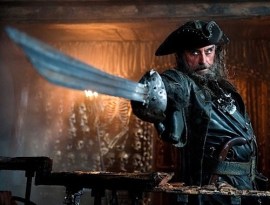
There’s potential here, as there has been for all the Pirates films that followed in the wake of the first one, but as the quality continues to slip it’s becoming easy to believe that screenwriters Ted Elliott and Terry Rossio hit a fluke with the quality of the first film and haven’t been able to meet it again since. And I would say most of the fault lies with the screenplay, because there’s little fundamentally wrong with the rest of it.

Except the 3D, maybe. I have no idea if this was a post-conversion or shot for real, but it doesn’t matter — it’s dull. Either things are too dark to matter, or it just doesn’t pop in the way you’d like. A couple of sweeping scenery shots aside, it offers no benefit. 3D is a gimmick and all about spectacle — I believe anyone who thinks it’s a serious filmmaking tool for the future is deluding themselves, at least until someone can prove otherwiseSword in audience (much-heralded work like Avatar certainly hasn’t) — but it’s a gimmick On Stranger Tides doesn’t engage with, in the process showing it lacks spectacle. And considering dark scenes obviously don’t work well in the format, I dread to think what Ridley Scott’s Prometheus will look like. (I probably won’t see it ’til 2D Blu-ray anyway, so that might be a moot point.)

I’m certain some will think my score for On Stranger Tides is generous, but despite all the flaws it still has its moments. I just wish that instead of churning Pirates films out ASAP they’d put more effort into developing the screenplay. Perhaps hiring new writers would help. But with a fifth and possibly sixth film on the horizon, and no significant change of scribe imminent, any such hopes are already dashed. And as this poorly-reviewed effort still grossed a phenomenal amount (third highest of the year; eighth of all time), Disney will still get their money and keep pumping them out. The whole situation is not so much yo-ho, more ho-hum.

3 out of 5

Pirates of the Caribbean: On Stranger Tides is out on DVD, Blu-ray and 3D Blu-ray in the UK from Monday, 12th September, and in the US from 18th October. Why can’t the Marvel releases from this summer be that way round, hm?

The UK TV premiere of Pirates of the Caribbean: On Stranger Tides is on BBC One tonight, 29th December 2013, at 8pm.

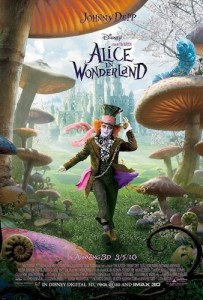
Alice in Wonderland [3D] (2010)

2010 #38
Tim Burton | 108 mins | cinema | PG / PG

I believe Tim Burton coined the now-ubiquitous term “reimagine” when he remade — I mean, reimagined (sorry Tim!) — Planet of the Apes almost a decade ago. Now, he turns his re-imagination to a new version of The Mad Hatter — sorry, posters/ad campaign/DVD art confused me, I mean Alice in Wonderland — which receives its controversially speedy (remember all that fuss with Odeon?) DVD/BD release tomorrow.
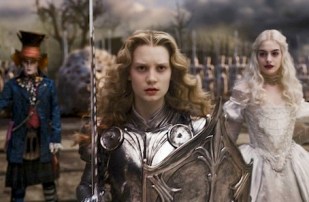
This time, rather than starting from scratch, Burton has created a sort of “Alice 2”, crafting a new plot from the novels’ elements. It’s set 13 years after Alice’s first trip down the rabbit hole, which presumably occurred in the classic Disney animation (as opposed to her two trips in the original novels, or any of the other numerous screen versions there have been). Maybe this is for the best — with Alice committed to film so many times before, one might well argue there’s no need to see the exact same tale done again.

Consequently, this new Alice positions itself freshly in two ways: one, as “Burton’s version”, and two, by following in the footsteps of the specific side of the filmic fantasy genre started by Peter Jackson’s Lord of the Rings, which has since encompassed the likes of two Narnia adaptations, The Golden Compass, and probably several more that I’m forgetting. Although it uses the original’s most famous elements, the film’s narrative and structure is familiar from those recent films more than 19th Century literature, particularly a final epic (well, epic-ish) battle in which our unlikely heroine emerges as the long-prophesised One Who’ll Win It For The Good Guys.The One Who’ll Win It For The Good Guys It’s a moderately interesting cycle to attach it to, one it seems has been missed by its pigeon-holing as “a Tim Burton film” and “another Alice adaptation”.
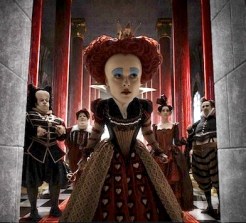
So, talking of Burton, Alice falls into the same ballpark as Charlie and the Chocolate Factory and the supposedly-forthcoming Addams Family remake: they’re the kind of films one expects Burton to be interested in making, and consequently there’s a sense of ticking-boxes about the results. Like Charlie, Alice offers no real surprises from either Burton or their shared star, Johnny Depp. Both do good work, certainly — the former is visually imaginative, the latter suitably barmy — but neither produce anything you don’t expect. True, one might not have been able to predict the exact elements they wheel out — particular Depp’s random use of a Scottish accent — but it nonetheless never feels unexpected.

Mia Wasikowska is something of a revelation as Alice. She’s a newcomer, so say reviews — the kind of newcomer who’s been in a dozen other things of various size — and presents an almost-knowingly naive Alice, which seems an entirely appropriate characterisation. She’ll next be seen as another titular character in a classic novel adaptation — the BBC’s new Jane Eyre (as if the one they did four years ago wasn’t good enough). (It was.) — which is neither here nor there when it comes to this film, really. I’m sure she’ll do fine.

Speech impedimentedAmong the rest of the cast, Helena Bonham Carter does a speech-impedimented Red Queen that feels as familiar was Burton and Depp’s work; Anne Hathaway’s White Queen is amusingly floaty, her hands permanently raised in a faux-delicate gesture; Crispin Glover is under-characterised and marred by some dodgy CGI (quite what’s been done to him I don’t know, but his movement is frequently jerky), but otherwise a decent enough henchman. In the all-Brit voice/mo-cap cast, Matt Lucas is best as Tweedles Dum and Dee — sadly, there’s not enough of him… um, them… — while Alan Rickman is Alan Rickman as the Caterpillar; Stephen Fry has little important to do as a less-scary-than-usual Cheshire Cat; and others — like Michael Sheen, Paul Whitehouse and Timothy Spall — blend into the background with competent but unremarkable work.

The post-production 3D proves (as far as I’m concerned) that James Cameron is being falsely elitist and some reviewers are too easily led: it is very rarely less convincing than what we saw in Avatar. True, Burton doesn’t show it off quite as much as Cameron did — this is a normal film that’s been put into 3D (even the stuff-flying-at-the-camera shots feel like they would’ve remained in a 2D-only version), not one designed to make you go “woah, look at that world! In 3D! I’m, like, so immersed”, the driving factor behind 90% of Avatar’s visuals. I suspect Roger Ebert’s correct that Burton’s visuals would pop more in 2D, away from the sunglass effect of polarised specs, and the added depth adds little of significance to one’s enjoyment of the story or even the visuals… other than 3D sometimes looks nicer, what with all that depth. Well, maybe.

faux-delicateThe funny thing about Burton’s Alice is that — despite the ultimately needless 3D, the familiar fantasy-epic storyline grafted onto Carroll’s characters, and the apparent lack of inspiration from either the director or his cast — it’s still quite enjoyable. It’s not going to do much to engage your emotions or your brain, it won’t give you any hearty laughs or edge-of-your-seat thrills, and it may occasionally make you wish it would get a move on — all of which means that, by the end, it can feel a tad slight. Valid criticism abounds on the web, but… well, I enjoyed it. Maybe I’m just too forgiving.

4 out of 5

Alice in Wonderland is available on DVD and Blu-ray (2D only) now in the US and from Friday in the UK.

Avatar [3D] (2009)

2009 #89
James Cameron | 162 mins | cinema | 12A / PG-13

AvatarAvatar is The Film That Changed Cinema. The past tense can safely be used, despite the film only having been out a couple of days — it doesn’t matter if we like it, filmmakers and Hollywood executives have decided it’s the artistic and commercial way forward, and so it shall be. It barely even matters if people actually go to see it; not that it’s in much danger of flopping, coming in the wake of years of extreme hype and numerous sycophantic reviews.

What’s almost more irritating than that, however, is that it’s actually quite good. Flawed, unquestionably, and probably undeserving of the volume of advance praise heaped upon it, but far from a disaster.

It’s too long, for one thing. The end of Act Two feels like the end of the film… until it insists on going on for goodness-knows how long (my watch stopped working, I couldn’t check). It might not be so bad if it didn’t take its time getting to this point. Swathes of it feel like a dramatised nature documentary, only this time it’s about a fictional alien world. Talk of Cameron having created a fully-realised, living, breathing ecosystem are over-egged: there’s a half dozen creatures, at most, and their only relation is that they have these weird tentacle things in their hair that allow them to connect up to one another, like nature’s own biological USB. Maybe he knows who eats what and when and how and mating rituals and all that jazz, and if he does we should be thankful it’s not plastered all over the screen, but the creature creation/world realisation here isn’t anything beyond Jurassic Park.

The story itself isn’t bad. It certainly has an epic quality, which at least justifies the running time, though it’s a collation of elements from elsewhere. Of course, such things can be said of most stories these days, but with Avatar it seems even more obvious — a bit of Aliens here, a bit of The Matrix Revolutions there, a bit of An Inconvenient Truth for good measure, and so on with countless other recognisable tropes. The sin Cameron commits is that he mostly does it in quite a clichéd manner — it’s not just that you have seen it before, but it feels like you have too. Even the learning-to-fly bit, much praised in some quarters, reminded me of something else: slightly-rubbish TV miniseries Dinotopia, of all things. And don’t get started on the dialogue — “Try not to think of anything. That shouldn’t be too hard for you.” Dear God, how many times have we heard that line?

Towards the end Cameron does pull a few things out of the bag, mainly involving who gets killed and who doesn’t. Mostly, the story is a framework to allow the visual spectacle and an ecological/anti-war message. It’s as subtle as a nine-foot-tall blue alien. From crystal clear uses of familiar phrases like “shock and awe” and “hearts and minds”, to unconcealed references to our dying planet, Cameron attempts to criticise both American military tactics (invade, crush the locals…) and the destruction of the planet (…take all the natural resources for ourselves, no matter what the cost). It’s not that the message is wrong, it’s just that Al Gore did it with greater subtlety in a 90-minute lecture on that specific subject. From the outset, the military — specifically marines, of course — are quite clearly The Bad Guys Here, which is a refreshing change from the man who brought us Aliens. Quite what the American public are/will make of this outright criticism of both its military and energy consumption remains to be seen.

All this is realised through unrelenting CGI. It’s very good, but here Avatar falls victim to its own hype once again, because it’s still not 100% perfect. Perhaps it’s the closest yet seen — it certainly remains consistent throughout — but nothing had me wondering if they’d perhaps used prosthetics in addition to the CGI, as Davy Jones did at several points during Dead Man’s Chest, and I remain convinced that wonderful modelwork, as seen in the likes of Lord of the Rings, is still an unbeatable tool for creating convincing environments. Some will argue that we remain unconvinced of the alien creatures’ authenticity because we know they can’t be real, but some occasionally exhibit the plasticky shine of CGI or the jerky movement of motion capture. The Na’vi are certainly a step up from Robert Zemeckis’ dead-eyed humans in The Polar Express or Beowulf, but are they that much better than Gollum? Or even Jar Jar Binks? (In terms of the competency of the effects, I hasten to add.)

It’s hard to resist flaw-spotting with Avatar after reading so many praise-filled reviews. At the risk of sounding like one of those irritating people who sits at their keyboard declaring “ah-ha, I’ve realised something all you professional reviewers weren’t clever enough to see!”, I think this is in part due to the final act. Avatar has a stonking finale, from a huge Apocalypse Now-styled 9/11-echoing moment of destruction, to a thrilling and epic final battle (albeit interrupted by a mass of unwelcome pace-challenging plot). These sequences excel on almost every level, from visual wonder to the odd spot of emotion. And this is what your final impression of the film is, which can banish memories of the crawl through the middle, replete with those niggling flaws. I won’t be surprised if DVD/Blu-ray reviews commonly lose a star, robbed as it will be of the huge screen spectacle and reviewers forced to remember what they had to sit through to reach the big climax.

Oh yes, and Avatar’s meant to be convincing us that 3D is the future, isn’t it? And actually, 3D is quite nice. This is the first time I’ve seen a film in RealD, so I was pleased to discover how perfectly it works. No ghosting that I noticed and minimal discomfort even after such a long film, so from a viewing point of view I was happy with it. It adds depth to the image as well, rather than throwing things in your face — this too was pleasant. As I’ve noted on previous 3D reviews, this depth can bring a scene to life… not in the sense that you believe it’s genuinely happening behind that screen in front of you, but it does liven the images up.

What it doesn’t do is improve the storytelling — but then, what does? Some actors in a black box can convey a story wonderfully — look at Dogville, or any number of theatre productions — you don’t need sets, or costumes, or CGI, or even music or any number of other things we associate with the film experience. You could lump 3D in with these, or you could say it’s even less necessary — sets, costumes, and all evoke a time and place and create a realistic world in a way a black box doesn’t, but what does 3D bring to the table? It’s purely about spectacle, in the same way CGI or helicopter shots or using IMAX usually are. And that’s fine. But directors who’ve expressed an interest in shooting a ‘normal’ domestic drama in the format may be overestimating its import.

But for all the derivative plot, blunt message, cheesy dialogue, thrilling action, spectacular imagery, pretty good CGI and debatable 3D, Avatar may have a greater problem in gaining anything like widespread acceptance. It’s set 145 years in the future, on an alien world with floating mountains and other such fantastical elements, where a significant chunk of the story centres on a group of nine-foot-tall aliens (who fall in love and kiss, much to the loud derision of a group of 13-year-old boys in my screening) in a weird alien jungle with prehistoric-like alien creatures, and semi-scientific religious imagery and plot points that I haven’t even touched on… It’s pretty hard science-fiction, to put it simply. It’s not the accessible historical romance/disaster of Titanic, it’s not the real-world-styled action-based superheroics of The Dark Knight, it’s not an accessible adaptation of a widely-loved book like Lord of the Rings or Harry Potter… One could go on in this vein through all the highest-grossing movies of all time.

Instead, it’s the cover art from a pulp science-fiction/fantasy novel or short story magazine writ large with the budget required to pull it off, and it’s that for almost three hours. For every SF/F-loving sycophant there’ll be a member of the general public who thinks it’s a load of old tosh. The truth is somewhere in between, as ever, but I won’t be surprised if the style of Avatar’s business is closer to Watchmen than Titanic. (I don’t think this is too delusional, incidentally. It will perform more strongly than Watchmen, obviously, because it has that all-important PG-13 certificate in the US and a helluva lot more hype in the mass media. But I remain convinced it won’t manage to be a phenomenon to rival Titanic or The Dark Knight, or The Lord of the Rings, or Harry Potter or Pirates of the Caribbean or Star Wars.)

Avatar is a significant film. Thanks to the hype and importance attached to it, by both Cameron and the industry at large, this can never be taken away from it — even if we’ve heard its story before, seen 3D before, seen effects as good before. I don’t believe The Future Of Film is riding on it as much as some would claim — after all, so convinced are They of its status as a hit that an endless stream of 3D movies heavy on CGI have arrived ahead of it and will continue for years after. In itself, it’s quite entertaining and probably deserves to be seen on the big screen. But, as expected, it’s not the revolution that was promised.

4 out of 5

Three in 3D

As you may have noticed, Channel 4 have just had a 3D week. Arguably lacking in content, it included three films. I subjected myself to all of them to provide you with the following…

#75
Flesh for Frankenstein
1973 | Paul Morrissey | 95 mins | TV | 18 / R

“The best thing about the extra dimension is that it provides some genuinely impressive visuals throughout, and not in the gimmicky, thrust-stuff-into-the-audience way — naturally there are some of those shots, but… there are also shots that demonstrate why 3D could be genuinely valuable, to visuals if not necessarily to storytelling.”

2 out of 5


#77
Friday the 13th Part III
1982 | Steve Miner | 91 mins | TV | 15 / R

“They have a whale of a time shoving stuff out into the audience for almost no reason — just like the stereotype of 3D films, of course. That’s part of the fun of trashy 3D movies so I’m not criticising it, but what sadly doesn’t work is the ColorCode 3D system chosen by C4.”

2 out of 5


#78
Hannah Montana/Miley Cyrus: Best of Both Worlds Concert
2008 | Bruce Hendricks | 72 mins | TV | U / G

“The only real exception is the 3D — being a very recent production, that was flawless.”

1 out of 5


It’s quite easy to see why 3D’s never taken off before. Even here, there are some good and/or notorious 3D films they haven’t bothered to show, which is a shame. Now they’ve distributed all those glasses, maybe they’ll consider just slipping some 3D films into the schedule now and again in the future. Doubt it, but it could be fun.

Hannah Montana/Miley Cyrus: Best of Both Worlds Concert [3D] (2008)

2009 #78
Bruce Hendricks | 72 mins | TV | U / G

Hannah Montana and Miley Cyrus: Best of Both Worlds Concert UK posterRubbish. In almost every way possible.

I could expand on that in numerous ways, but what would be the point? The only real exception is the 3D — being a very recent production, that was flawless.

Take solace in the fact that one day — hopefully, one day soon — Cyrus, Montana, this ‘movie’, and all the rest, will be completely forgotten.

1 out of 5

This was shown as part of Channel 4’s 3D Week. That’s why.

Hannah Montana/Miley Cyrus: Best of Both Worlds Concert featured on my list of The Five Worst Films I Saw in 2009, which can be read in full here.

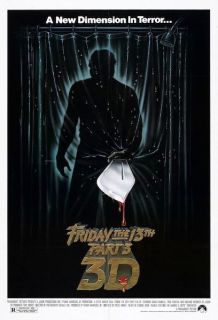
Friday the 13th Part III [3D] (1982)

2009 #77
Steve Miner | 91 mins | TV | 15 / R

Friday the 13th Part IIIJason’s back!

Oh, forget it — I can’t get excited about that. I’ve never even seen a Friday the 13th film, and had no intention to ’til Channel 4 showed this in 3D. Fortunately, general cultural awareness of who Jason is and what he does is all that’s required to understand this third entry in the never-ending franchise.

It’s pretty much your stereotypical horror movie: a group of teenagers just waiting to be slaughtered, a remote cabin-like location, lots of jump scares over nothing, a supernaturally-powered killer stalking them for no apparent reason, lots of gory deaths which have more thought put into them than the plot, characters and dialogue put together… The acting’s all at the level of a high school play, which probably does a disservice to most high school plays. There’s no point wondering who’ll die, because inevitably they almost all will. All this considered, it’s a passably entertaining genre entry.

The good bit here, however, is the 3D. They have a whale of a time shoving stuff out into the audience for almost no reason — just like the stereotype of 3D films, of course. That’s part of the fun of trashy 3D movies so I’m not criticising it, but what sadly doesn’t work is the ColorCode 3D system chosen by C4. It provides lovely depth to normal scenes, but as soon as something’s attempting to come out at you it fails. It could be the age of the film producing flaws in the process as newer things shown during 3D Week have been better, but most do come a cropper as soon as something attempts to come out of the TV as opposed to go deeper into it. Oh well.

Friday the 13th Part III is what it is, and if that’s what you’re after that’s fine. At least the 3D silliness adds an extra dimension of enjoyment. Pun very much intended.

2 out of 5

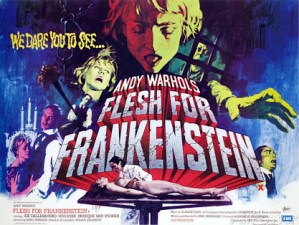
Flesh for Frankenstein [3D] (1973)

aka Andy Warhol’s Frankenstein

2009 #75
Paul Morrissey | 95 mins | TV | 18 / R

Flesh for FrankensteinFlesh for Frankenstein is thoroughly daft. But it’s also in 3D, so let’s start there.

The best thing about the extra dimension is that it provides some genuinely impressive visuals throughout, and not in the gimmicky, thrust-stuff-into-the-audience way — naturally there are some of those shots, but they seem to work quite poorly here. That could be the fault of Channel 4’s chosen 3D system, or perhaps of watching on a TV rather than a huge screen. Either way, there are also shots that demonstrate why 3D could be genuinely valuable, to visuals if not necessarily to storytelling. For example, early on the wife/sister (a discussion for another time) and her kids go for a picnic. It’s shot from a distance through branches in the foreground, which highlights that there’s a realistic sense of depth to every element of the frame that just isn’t present if you see the same shot in 2D — I know, I checked. For perhaps the first time, I got a sense of why some people harp on about 2D flattening composition.

Unfortunately, while the 3D system used is sometimes flawlessly brilliant, at others it seems to have gone wrong. There’s an odd green ringing in some shots, while at others it appears they’ve used the wrong shade of blue for monochrome-depth because it shows up (in scenes that work, the blue is clearly visible if you take the glasses off, but invisible with them on). Such problems are intermittent in the stuff shown during 3D Week, leading one to suspect it’s as much a fault of the age of the film elements.

I can also now see why people have been complaining so much about 3D — it feels like a constant struggle and strain to watch, like you’re always having to make it work. Perhaps that’s partly down to the technical flaws described above though, because I didn’t suffer as much during an hour of Derren Brown’s Magic Spectacular, whereas here I could feel the strain after just 15 minutes.

As for the film itself… The plot doesn’t make any sense for about 20 minutes, then Udo Kier’s Frankenstein (I presume he’s Frankenstein, I don’t think he’s ever addressed as more than Baron) has a bit of a monologue to explain his Hitler-ish Cunning Plan — to someone who already knows it, naturally — and suddenly most of what’ll happen for the rest of the film is abundantly clear.

The acting is uniformly atrocious. Despite that, it also provides the film’s best moments: the European cast are unable to pronounce “laboratory” — every time it’s uttered it comes out as “lavatory”. Childish I know, but it’s one of the film’s few enjoyable moments. “I had to work for two years before I could even stick my nose in the lavatory” is an instantly classic line. (As is “To know death, you have to fuck life in the gall bladder” — literally, apparently.) Continuing the accented madness, the good-guy serf sounds to be from Brooklyn. At least he can say “laboratory”.

Gratuitous nudity and gore belie some critics’ apparent view that it’s only with the emergence of torture porn that operation-level gore has become a selling point of horror movies — it’s only become more realistic. Just as the gore’s silly, so the sex seems misguided — whoever cast the whores seems to have found believable rather than attractive ones. Oops. That said, whoever in the sound department thought the most realistic sound effects for various sex acts could be found by having someone suck on a balloon, loudly, was even more misguided.

Apparently it’s all meant to be satirical or Pythonesquely humourous. Well, maybe, but it sails too close to the winds of genuine crapness to let such a defence fly — though, as noted, that certainly makes it laughable. Weak in just about every way imaginable, if you’re after a horror, gore, porn or 3D fix, look elsewhere. For “so bad it’s good” value, however, I’ve kindly given it an extra star.

2 out of 5