
J.J. Abrams | 135 mins | cinema (3D) | 2.35:1 | USA / English | 12A / PG-13
 2016 Academy Awards
5 nominations
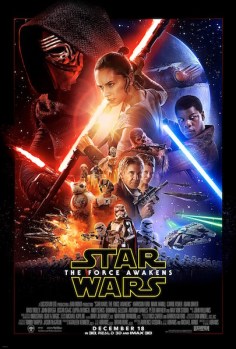 Star Wars: The Force Awakens is not the best film of 2015. Not according to the Academy of Motion Picture Arts and Sciences, anyway, who didn’t see fit to nominate it for Best Picture at tomorrow’s Oscars. Many fans disagree, some vociferously, but was it really a surprise? The Force Awakens is a blockbuster entertainment of the kind the Academy rarely recognise. Okay, sci-fi actioner Mad Max: Fury Road is among this year’s nominees, but with its hyper-saturated cinematography and stylised editing, it is action-extravaganza as art-film, further evidenced by some people’s utter bafflement at how anyone can like a film so devoid of story or character. (It isn’t, of course — those people are wrong.)
I’m sure the makers of Star Wars can rest easy, though, what with it being the highest grossing film ever at the US box office (at $924m and counting, it’s the first movie to take over $800m, never mind $900m), and third-ever worldwide (behind only Titanic and Avatar, both of which had re-releases to compound their tallies). Its reception has been largely positive too, with many fans proclaiming it the third or fourth best Star Wars movie — which doesn’t sound so hot, but when two of those previous films are unimpeachable all-time favourites, being third is an achievement. There are many dissenting voices though, disappointed thanks to their perception that it’s just a rehash of A New Hope, and that it’s a movie short on original ideas but long on modern-blockbuster bluster and noise.
I think, at this point, one or two other people on the internet have written the odd word about The Force Awakens — you have to really go looking, but trust me, there are some articles out there. (Of course, by “one or two other people” I really mean “everybody else”, and by “the odd word” I mean “hundreds of thousands of millions of words”. And by “have” I mean “has”, for grammatical accuracy in this completely-revised sentence).
 I too could talk about the likeable new heroes; the triumphant return of old favourites; the underuse of other old favourites; Daisy Ridley’s performance; John Boyega’s performance; the relationship between Rey and Finn; the relationship between Finn and Poe; the success of Kylo Ren and General Hux as villains (well, I thought they were good); the terrible CGI of Supreme Leader Snoke; the ridiculous overreaction to the alleged underuse of Captain Phasma; that awesome fight between the stormtrooper with that lightning stick thing and Finn with the lightsaber; the mystery of Rey’s parentage; the mystery of who Max von Sydow was meant to be (and if we’ll ever find out); some elaborate theory about why Ben wasn’t called Jacen (there must be one — elaborate theories that will never be canon are what fandoms are good for); the way it accurately emulates the classic trilogy’s tone; the way it’s basically a remake of A New Hope; the way it isn’t that much of a remake of A New Hope; why ring theory and parallelism makes all this OK anyway; all of its nods to the rest of the saga; that death scene; that ending; those voices in that vision; and the single greatest part of the entire movie: BB-8 giving a thumbs up.
But I won’t talk about any of that. Not now, anyway. Instead, for an angle of moderate uniqueness, I’ll talk about the five elements of the film that have been singled out for recognition by the Academy of Motion Picture Arts and Sciences.

Editing
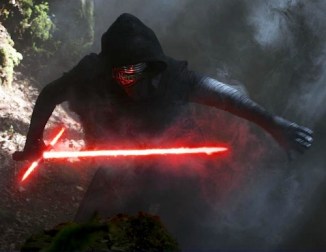 J.J. Abrams seems to have tricked some people into thinking he’s a great director with The Force Awakens (rather than just a helmer of workmanlike adequacy (when he’s not indulging his lens flare obsession, at which point he’s not workmanlike but is inadequate)), and I think that’s partly because it’s quite classically made. Yeah, it’s in 3D, but the style of shots used and — of most relevance right now — the pace of the editing help it feel in line with the previous Star Wars movies. Some of the more outrageous shots (often during action sequences) stand out precisely because they’re outside this norm. Perhaps we take for granted that Abrams delivered a movie in keeping with the rest of the series, because that’s The Right Thing To Do, but that doesn’t mean he had to do it. And the transitional wipes are there too, of course.
Score
Ah, John Williams — 83 years old and still going strong. Or still going, at any rate. I’m not the most musically-minded viewer, unless something really stands out to me. I don’t remember anything in Williams’ Force Awakens score standing out. Not that there’s anything wrong with it per se, but I didn’t notice anything new that has the impact of The Imperial March or Duel of the Fates (for all of the prequels’ faults, they at least gave us that). In Oscar terms, it’s apparently not looking so hot for Williams either: his return to a galaxy far, far away is being trumped by Ennio Morricone’s return to the West.
Sound Mixing & Sound Editing
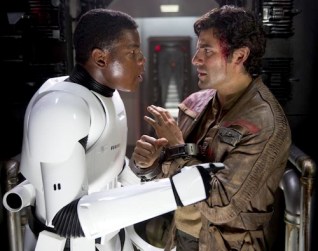 No one knows what the difference is between these two categories. I’m not even sure that people who work in the industry know. As a layperson, it’s also the kind of thing you tend to only notice when it’s been done badly. The Force Awakens’ sound was not bad. It all sounded suitably Star Wars-y, as far as I could tell. That’s about all I could say for it. It feels like these are categories that get won either, a) on a sweep, or b) on a whim, so who knows who’ll take them on the night?
Visual Effects
CGI is everywhere nowadays, and at the top end of the game it seems like it’s much-for-muchness in the photorealism department. So what dictates the best of the best, the most award-worthy? Well, innovations are still being made, they’re just less apparent in the end product, it would seem: reportedly there are a load of workflow-type innovations behind the scenes on Star Wars, which improved consistency, as well as some better ways of achieving things that were already achievable.
Nonetheless, for a franchise with which they have a long, close history, it’s understandable that ILM pulled out all their tricks here — fairly literally: they even used forced perspective to extend some sets, rather than the now-standard digital set extension (green screen + CG background). Most notably, a lot of BB-8 was done with working models and puppetry. Of course that’s still computer aided, be it with wire and rod removal or some bits of animation, but it still lends the droid greater presence and physicality. That kind of grounded, make-it-real mindset pervades — the effects team exercised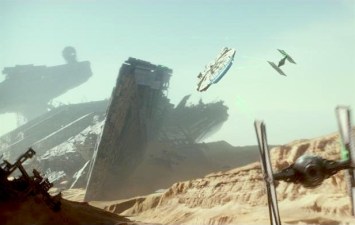 “restraint […] applying the basic filmmaking lessons of the first trilogy,” according to this article from Thompson on Hollywood. Effects supervisor Roger Guyett says that attitude was about being “very specific about what the shot was about. And making it feel like you were photographing something that was happening.”
In terms of whether it will win or not, well, take your pick of the predictors. Some say Fury Road will sweep the technical categories, presumably in lieu of it winning any of the big-ticket prizes. Star Wars was the big winner at the Visual Effects Society awards though, which have predicted the Oscar on nine of the past 13 occasions. The times it’s failed have generally been prestige films that happen to have effects kicking blockbusters off their pedestal, like Hugo beating Dawn of the Planet of the Apes, or Interstellar beating Rise of the Planet of the Apes (the Academy clearly hates those damned dirty apes). With The Revenant taking secondary honours at VES, perhaps that’ll be an unlikely Oscar victor.
In truth, I don’t think any of those are the best things about The Force Awakens. What really works for it are the characters, the relationships, the pace of the story (rehashed or not), the overall tone. It was never going to get major awards in the categories that recognise those achievements (acting, writing, directing), and, frankly, 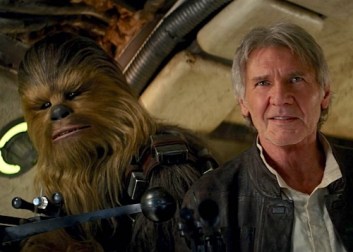 those elements aren’t gone about in an awards-grabbing fashion anyway. In the name of blockbuster entertainment, however, they’re all highly accomplished.
With the good ship Star Wars relaunched under a sure hand and with a surfeit of familiarity to help steady the ride, hopefully future Episodes can really push the boat out.

Star Wars: The Force Awakens placed 9th on my list of The Ten Best Films I Saw For the First Time in 2015, which can be read in full here.
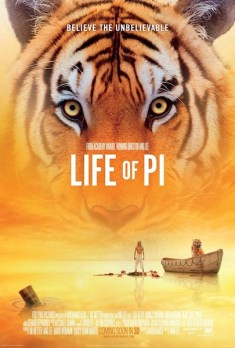 “Unfilmable” — now there’s an adjective you don’t hear tossed about so much these days. For a long time it seemed like it was all the rage to label novels “unfilmable”, but at this point too many ‘unfilmable’ novels have been filmed, and the wonders of CGI have put paid to anything ever again being unfilmable for practical or visual reasons. It may still be an apposite descriptor for works that feature very literary storytelling, though if you can render something like the subjective and unreliable narrator of
 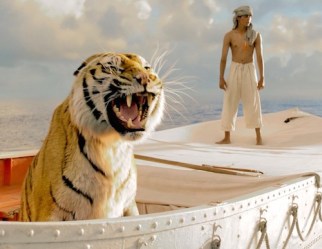 but because of almost-indefinable features of each shot’s crispness, its depth of field, even the compositions. It absolutely works in 2D, and it didn’t leave me longing for 3D in quite the same way as something like the swooping aerial sequences of
 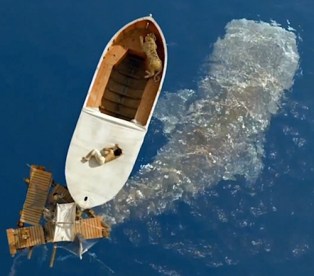 Later, the 4:3 “book cover” shot is just pure indulgence. There’s no reason not to just have empty sea to the left and right of frame, and the “it’s emulating the book cover!” reason/excuse doesn’t come close to passing muster simply because book covers aren’t 4:3. In both cases, then, what was intended to be striking or clever or innovative or in some way effective, I guess, comes across as pointless and distracting and pretentious.
 Reading around a little online, it seems that some people have interpreted the film’s message as being a defence of/justification for/persuasion towards religious faith, and hate it for that. This interests me, because I — coming, I suspect, from a similar perspective on religion — read it as a subtle condemnation of religious stories. Actually, not a condemnation, but a tacit acceptance of the fact that such stories are a nice fairytale, but not the truth. To put it another way, I took the message to be (more or less) that religion is an obvious fiction which people choose to believe because it’s a nicer story than the more plausible alternative, neither of which are provable. I think some focus on the point that the journalist hearing Pi’s story is told it will make him believe in God, and, at the end, the journalist seems to accept that it does. I don’t think that’s the film’s contention, though; I think the film is, in a way, explaining why people believe in God. Or maybe there are just no easy answers.
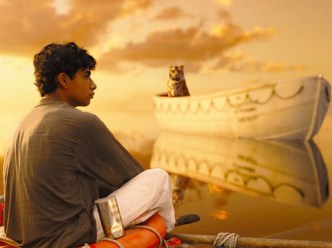 I found Life of Pi to be a little bit of a mixed bag, on the whole, where moments of transcendent wonder-of-cinema beauty rub up against instances of thumb-twiddling; where insightful or emotional revelations rub shoulders with pretentious longueurs. There is much to admire, but there are also parts to endure. The balance of reception lies in its favour, but while some love it unequivocally, a fair number seem to despise it with near-equal fervour. Either way, it’s definitely a film worth watching, and in the best possible quality you can manage, too. It also made me want to read the book, which for a movie I wasn’t even sure how much I liked is certainly an unusual, but positive, accomplishment.
 On its theatrical release, a commonly-cited recommendation was to see Gravity in 3D on the biggest screen possible. Obviously, I didn’t bother. Some say it isn’t as effective on a small screen in 2D. Maybe it isn’t as effective, but it’s still a damn fine film.
 quick editing has always been a way of creating excitement in that arena), the never-ending shots serve to make you feel closer to events, right alongside Bullock, almost wishing it would stop. Plus there’s skill in being able to show us what we need to see from a single vantage point, without the easy option of being able to cut to a different angle to clarify a detail.
 The most high-profile jobs — the actors, the studio — may be American, but everything else is pretty darn British. Rather than cry “that’s ridiculous! Give it to a proper British film!”, we should be keen to point out that, actually, this surprise global mega-hit wasn’t made in America, but in Britain, by all the talented filmmakers we have here. Rule Britannia, etc etc!
 While I sympathise with the idea that it’s not A Science Fiction Movie, but instead A Thriller (That Happens To Be Set In Space), you can’t really deny its SF-ness. OK, if we’re classing this as SF then so too should be films like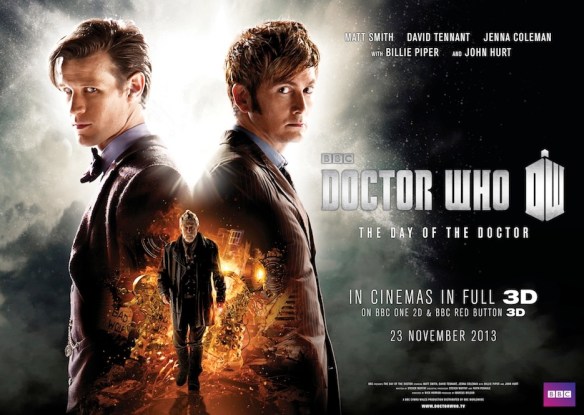
 (and it made more than double per screen what
  The Doctor’s role in the Time War has not only dominated many of his actions and personalities since it happened, but it also stands awkwardly with his persona as a whole. Here’s the man who always does the right thing, always avoids violence, always finds another way, even when there is no other way… and this man wiped out all of his people and all of the Daleks? The same man who, in his fourth incarnation, stared at two wires that could erase the Daleks from history and pondered, “do I have the right?”, before concluding that he didn’t? Doesn’t really make sense, does it?
 I think some fans would have preferred a big party history mash-up; they certainly would have liked to see their favourite faces from the past. But let’s be honest: from the classic era, only Paul McGann could pass muster as still being the Doctor he once was (and he got his own, fantastic, mini-episode to prove it); and how the hell do you construct a story with a dozen leading men? It’s clearly enough of a struggle with three. The Doctor is always the cleverest person in the room, so what do you do with multiples of him? Moffat finds ways to make all of the Doctors here (that’d be David Tennant’s 10th, Matt Smith’s 11th, and John Hurt’s newly-created ‘War Doctor’) have something to do, something to say, and something to contribute — because really, the oldest (i.e newest) Doctor should be the most experienced and have all the ideas, right? There are ways round that, but only so many.
 Along the way, Moffat nails so many other things. The dialogue and situations sparkle, and frequently gets to have its cake and eat it: familiar catchphrases and behavioural ticks of the 10th and 11th Doctors are trotted out to a fan-pleasing extent, and then Hurt’s aged, grumpier, old-fashioned Doctor gets to criticise their ludicrousness, speaking for a whole generation of fans who hate “timey-wimey” and “allons-y” and all the rest. I think it’s this self-awareness that helps so much with selling the episode to everyone, both calling back to well-known elements of the series that many love, and pillorying their expectedness for those that aren’t so keen. Well, it would be a pretty awful party if you had a cake but couldn’t eat it, right?
 Smith and Jenna Coleman are on form too, of course, but as the series’ regular cast members that feels less remarkable. That’s not intended to sell them short, however, as they hold their own against actors who are arguably more, shall we say, established. If there’s one weak link it may be Joanna Page’s eyebrows, possibly the side effect of duelling with an English accent. (Complete aside: I’m rewatching Gavin & Stacey as I write this, and feel horrible even going near criticism of such a lovely person.)
 Credit too to editor Liana Del Giudice, not only for crafting cinematic action sequences, but for stitching together a narrative that is often told with imagery and flashbacks, rather than people stood around chatting. Look at the sequence just after the Doctor sees the painting for the first time as just one clear example. That sequence may be dialogue-driven, but the faded-in and intercut flashbacks and glimpses of other events are what’s really conveying information. This is first-class visual storytelling, not just when compared to the rest of British TV, or international TV, or cinema, but the whole shebang.
 Still, you can’t please all of the people all of the time, and not everyone liked The Day of the Doctor: it may’ve topped DWM’s poll, but there were voters who scored it just one out of ten. But then, that’s true of 239 of the series’ 241 stories; and almost 60% of voters gave it a full ten out of ten — that’s a pretty clear consensus. I didn’t get round to voting myself, but I would’ve been amongst them. There are undoubtedly some weak spots that I haven’t flagged up, but conversely, there are myriad other successes — both minor (the opening! The dozens of sly callbacks!) and major (the use of the Zygons! Murray Gold’s music!) — that I haven’t mentioned either.
 The director of Disney’s woeful
 Dogged by comparisons to
 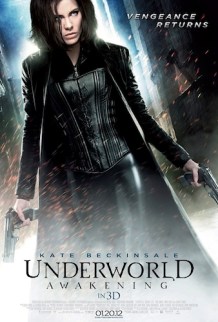 Just when you think the Underworld series is dead, it suddenly lurches back to life with a new instalment. Fitting for a series all about vampires & that, I suppose.
 By taking such a bold move with the plot, meanwhile, the story pushes the series’ mythology in new and relatively interesting ways. It’s becoming a bit dense and fan-only (unless you let it wash over you and just enjoy the punching), but at least they’re not regurgitating the same old stuff. It manages a few twists along the way too, which is always nice. The plot seems to have been half worked around Speedman’s non-involvement, leading me to wonder why — he’s not too busy, surely? Perhaps he’d just had enough? But no, apparently it was genuinely just written this way. I guess he couldn’t be bothered to turn up for some cameo shots, because the stand-in is really obvious.
 means the next one will probably turn up out of the blue with little hype, much as Awakening did last year. Plus, though this is the most expensive film to date (double the budget of the preceding one!), it’s also the most financially successful: $160.1 million worldwide, beating number two’s $111.3 million. Assuming Beckinsale still feels up for it, I imagine 2015 will bring us a continuation — and, hopefully, a conclusion.
 Also worthy of commendation: new-style ‘evolved’ Lycans; a small role for Charles Dance (always worth seeing); the evocative near-future setting; good quality action sequences; some nice steel-blue cinematography/grading. Some of it was shot at 120fps on brand-new pre-alpha never-used RED cameras — take that Peter Jackson, eh. Plus it’s only a little over 1 hour and 18 minutes long without credits. Some would bemoan such brevity, but it has its positives.
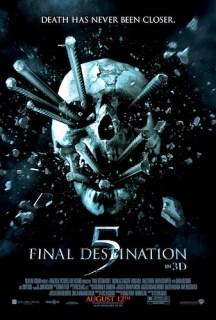 Final Destination 5 is the latest Final Destination film. Do you really need a plot description? They all have the same story.
 although on reflection it’s meaningless; a clever nod that isn’t really clever, but is neat. And perhaps means the series is finally going to rest.
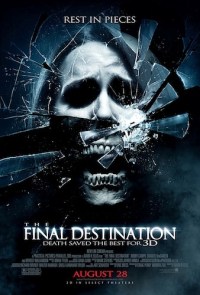 The best thing about The Final Destination is its title, because turning the series’ familiar name into a definitive article for the final entry is really quite a neat move. Sadly, it was a hit and they’ve made more. Why it was a hit… God only knows.
 The focus is clearly on the deaths — at 11 it has the highest of the series, and with its short running time that means there’s a fatality every seven minutes. They’re also very gory, more so than in previous films I’d say, but they’re not commensurately more inventive. There’s a very thorough line in misdirection at times, but the whole enterprise feels painfully lacking in creativity. I’m not sure some of them even make sense. But then do they need to? Similarly, there’s some customary low-rent-horror-movie completely-gratuitous nudity too, which I’m sure delighted teenage boys even more in 3D.
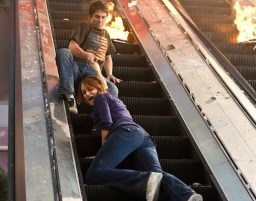 that’s a sure sign it was meant for cheap 3D thrills, but otherwise fine — here, stuff pokes straight out. That means in 2D you see, say, the flat end of a pole, with absolutely zero sense of depth. This happened with one trap in
 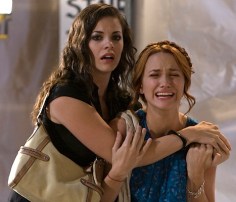 Elsewhere, one character starts talking about déjà vu before getting killed in the same way as the first film’s most famous death. I suppose it’s meant to be Meta and Funny, and maybe it kinda is, but again the CG is so cheap that the half-trained eye will spot an effect is about to happen, and the manner of death once again doesn’t really make sense. Later, we learn that shopping mall sprinklers can instantly extinguish all fires — handy!
 There’s potential in the concept of the Final Destination films, but clearly it’s either limited or the people in charge don’t know how to exploit it, because after making two quite-good films they’ve turned it into a repetitive, stale, uncreative, formulaic disaster. And there’s now a fifth too, and a sixth hasn’t been ruled out — surely it/they can’t be any worse than this? Based on form, maybe they can…
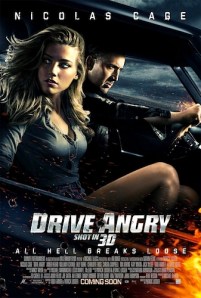 Nic Cage does the
  Only in that stuff flies at the camera and whatnot. You can indeed tell it was made for 3D, but that doesn’t mean it needs it. Indeed, the poke-the-audience stuff aside, none of it suggests it would look great in 3D — for all the pointlessness of cinema’s new money-spinning format, it can add something to the vistas in a film like
  As noted, director Lussier does not have an inspiring CV: he started with numerous straight-to-video sequels, then a big screen sequel-no-one-wanted (even with Nathan Fillion in it) in
