
Alejandro G. Iñárritu | 156 mins | Blu-ray | 2.40:1 | USA, Hong Kong, Taiwan & Canada / English, Pawnee & French | 15 / R
 2016 Academy Awards
12 nominations — 3 wins
Nominated: Best Picture, Best Supporting Actor, Best Film Editing, Best Costume Design, Best Makeup and Hairstyling, Best Sound Mixing, Best Sound Editing, Best Visual Effects, Best Production Design.
 The Revenant is the Oscar-winning, acclaim-gathering story of Hugh Glass, the expert guide for a pelt-collecting group (is that what they are? Is that a thing?) in the Old West, who’s mauled by a bear to within an inch of his life. Eventually betrayed and left for dead by the members of the group who’d vowed to stay with him to the end, Glass somehow survives, and crawls across the wintery wilderness in search of his revenge! And it’s all the more remarkable for being based on a true story… though this retelling contains approximately as many “historical events that actually occurred” as does Game of Thrones.
The main talking point of The Revenant has been Leonardo DiCaprio’s performance, which finally bagged him an Oscar after four unsuccessful nominations (and I’m sure plenty of other roles that he thought might snag him some Academy recognition but didn’t). How much is it acting and how much was it just an endurance test that director Alejandro González Iñárritu subjected him to? Is there a difference? If you have to suffer for great art, Leo certainly did that. In some ways it’s testament to the Academy being able to look past delivery of dialogue as an indication of performance quality, because Glass doesn’t speak much — not when he’s in the company of others, and certainly not when he’s trying to get by on his lonesome, which he is for much of the film. Nonetheless, Leo conveys thoughts and emotions — which do go beyond, “I can’t believe Iñárritu is making me eat this raw liver” — effectively through expression and action.
 In some respects it’s a shame the rest of the cast were consequently overshadowed — Leo may spend a huge chunk of the film on his own, but there are frequent cutaways to what everyone else is up to. Tom Hardy is the obvious standout as selfish bastard Fitzgerald, a perfectly detestable but completely believable villain — I’m not saying we’d all sink to his depths, but I’m not convinced most of us are above some of the choices he makes, either. Will Poulter steps outside the comedy roles he’s mostly taken since his Son of Rambow debut to give an effective turn as the group’s youngest, most conflicted member, while Domhnall Gleeson is commanding as the group’s leader. Gleeson was something of a lucky charm last awards season, appearing in no fewer than four Oscar-nominated films, including two that were up for Best Picture. Not only that, but look at his turn here (as an honourable, disaster-struck Captain) alongside his appearances in those other films (a small town nice guy in Brooklyn; an inexperienced evil military commander in Star Wars; a naive, selfish, sort-of-moral, easily-led programmer in Ex Machina) and you can see the kid’s got range.
Far from just an acting showcase, The Revenant is a film of thematic weight. In fact, it’s like an old-fashioned blockbuster — the kind of thing you’d’ve seen in the 1950s (epic revenge Western) or 1970s (bleak revenge Western) as among the year’s biggest movies — crossed with a slow-paced, scenery-loving, meditative arthouse piece. If it’s about anything (beyond, y’know, the plot), it’s surely about nature — both the amazing vastness of natural spaces, but also the brutality of survival. And not just humans, either, which is the go-to simplistic message (“isn’t nature good? aren’t humans bad?”) of such cod-thoughtful fare. Like the rest of nature, humanity is varied: there are some very harsh, cruel acts herein, but also acts of kindness — sometimes perpetrated by the same people.
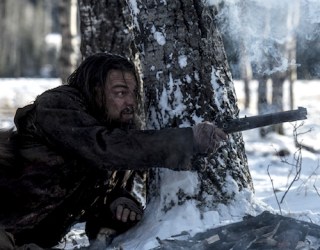 The avoidance of pat depictions extends to its portrayal of Native Americans, too. They’re neither simplistic Evil Foreigners, nor a “we’re so sorry for how we’ve treated them before, they’re great really” apologia. Instead, they’re just as brutal and as human as the rest of us, and made up of varied groups who behave differently, or even slaughter among themselves. The main band of Indians we see do serve as the film’s villains (as if Fitzgerald wasn’t bad enough), a hunting party acting out an inverted Searchers as they hunt for a kidnapped daughter. In The Searchers the group hunting and killing in search of a girl are the heroes; here, they’re the villains. Makes you think, don’t it? I’m not accusing Iñárritu of casual racism — I imagine that’s exactly their point.
And speaking of Iñárritu, I wonder if this is his first genuine masterpiece. I didn’t care for 21 Grams or Babble, and Birdman was good but overrated. (In fairness, I’ve not seen Biutiful, which people seem to disregard nowadays, or Amores Perros, which is a rare foreign language film in the IMDb Top 250.) It seems like he was a nightmare during production — the budget was set at $60 million, but ultimately more than doubled to $135 million due to delays thanks to his production choices. In hindsight it looks like genius — “I knew it would be amazing so we kept going” — but if it had flopped, I’m sure an awful lot more would’ve been made of Inarritu’s excessively picky directorial style and fractious treatment of the crew, which apparently led Tom Hardy to try to strangle him…
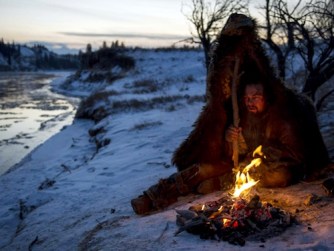 At the Oscars, I was pulling for Roger Deakins to make it 13th time lucky, or for Mad Max to do a technical sweep and take cinematography with it (not undeservedly); but having now actually seen Lubezki’s work on The Revenant, it’s hard to deny it’s an immensely deserving winner. His mastery of all elements of the form is on regular display: the use of light (all natural!), perspective, lenses, focus; the single-shot techniques he and Iñárritu learnt for Birdman are put to superior use here, creating some stunning sequences (rather than taking over the entire movie). It looks incredible on Blu-ray, too — so detailed, crisp, epic. If anything was going to convince me 4K was an idea worth investing in, it’s material like this. (The cost of a new TV, new Blu-ray player, re-buying films, and the real estate needed in the lounge for a screen big enough to appreciate it puts
 the other half me off again.)
The film’s biggest flaw is that it goes on a bit too long in the middle. I’m not saying it needs to be a fast-paced thrill-ride, I just think it lingers a little longer than it needs to in places. Individual shots are beautiful, but the sheer volume of them stretches the centre part thin. There’s probably one too many action sequences where Indians attack and our hero has to escape, not least the one that ends in a too-obviously-CGI dive off a cliff. Equally, for every one of those there’s an incredible sequence, like the opening Indian attack. For a film that could easily be described as arthouse-y and thematically-driven, there are some truly stunning action scenes. The long middle means you couldn’t really call it “an action movie”, 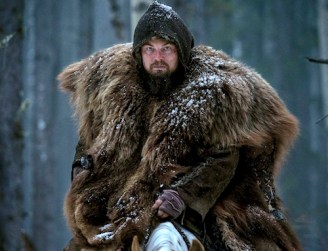 but focus on the first and last acts and it absolutely is.
I slipped in the word “masterpiece” a few paragraphs back, and I’d wager that’s what The Revenant is. It’s not perfect, and I don’t know that I’d say it’s the best film of last year either; but it is magnificently made, telling its story in a way only cinema can truly manage.

The Revenant is out on DVD and Blu-ray in the UK as of yesterday.
It placed 4th on my list of The 20 Best Films I Saw For the First Time in 2016, which can be read in full here.
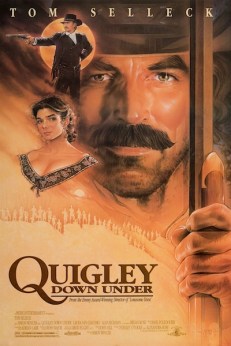 Tom Selleck is Quigley, who has the ability to shoot things at implausibly long distances, and whose hair has the ability to stay implausibly coiffed even after days abandoned in the outback. He’s been employed by Alan Rickman, who we know is the villain because this was released in 1990. Alan Rickman has brought Quigley to Australia on the pretence that he’s to kill dingoes, but he actually wants Quigley to kill Aborigines. Quigley doesn’t take kindly to this, because he’s the hero, and so pretty much as soon as he turns up he’s left to die in the outback. The end.
 I only heard about Quigley Down Under after Alan Rickman passed away, when a few blogs flagged it up as a great forgotten performance of his. He does bring some of his Die Hard /
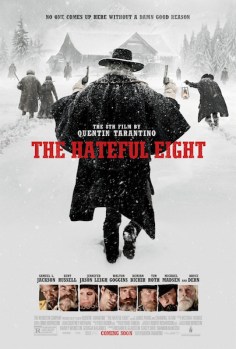 Quentin Tarantino hadn’t made a film in the same genre as his preceding movie for almost 20 years when The Hateful Eight came out — his second go-round with the Western genre, after the Spaghetti-ish thrills of
 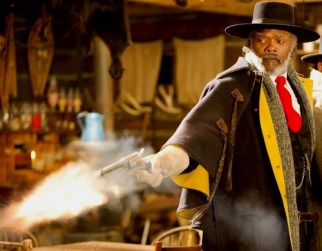 And it’s all in a remote, isolated location which has been cut off by weather, and every character is hiding some nefarious past — so far, so And Then There Were None. All of this comes dressed in QT’s famed dialogue, unfurled at the somewhat languorous pace he’s gradually been cultivating for a few movies now, and topped off with a few doses of the old ultra-violence.
 Ultra Panavision 70 produces an ultra-wide 2.76:1 frame (for those not in the know, your widescreen TV is only 1.78:1), which for such an intimate story has struck people as odd ever since it was announced. In fact, it pays off in (at least) two ways: firstly, all the scene-setting scenery looks magnificent; secondly, for a lot of the film there’s stuff going on in the background or at the edge of frame — it’s not just a series of close-ups or two-shots where the ancillary detail is either non-existent or doesn’t matter, but one where that ‘background’ detail is sometimes very instructive to what is going on. Tarantino also uses the full width a lot of the time, placing two figures at either edge of the image — this really isn’t a film you could crop (thank goodness it doesn’t exist in the pan & scan era!)
 as if to bring the point home (and that’s far from the only thing about The Hateful Eight that’s indebted to The Thing, but I’ll leave that for someone else to dig into another time). Even though this is the first time he’s had a full score composed for one of his films, Tarantino still sources a couple of well-selected songs from elsewhere, including a very apt credits track by Roy Orbison.

 Score:



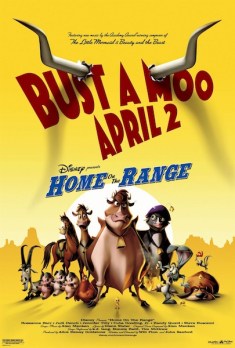 I have many goals within my film viewing, quite apart from trying to watch 100 films every year. Some I’ve completed (the Rathbone Holmes series), others are almost done (every Spielberg film), others not so much (every Hitchcock film), and others I’ve barely begun (the Zatoichi series). One of these goals is to watch every Disney Animated Classic, their canon of feature animations that currently sits at 55 titles (with another scheduled for later this year, in the US at least). I did a pretty good job on the real classics while growing up, and have since filled the gaps of the modern classics, so I’m left ploughing through their lesser periods: the content they pumped out in the war-affected ’40s, and the post-Renaissance pre-Lasseter clusterfrack that was their ’00s produce. My best hope is to uncover a hidden gem while I mop up this dross.
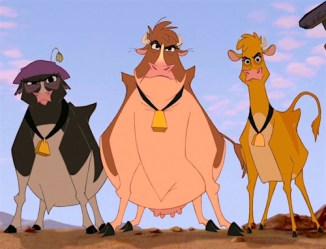 but only because it has a moderately amusing reveal in the middle of it. The animation is unremarkable, besides some terrible CG intrusions. It seems to be under the impression that “hog” is a word for “cow”, based on the number of puns. A couple of gags do land — I even laughed out loud once, though I’ve forgotten why — but the majority is resolutely uninspired.
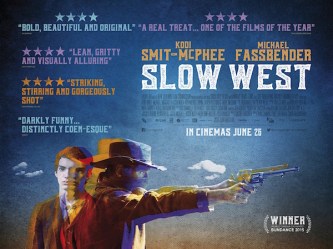 The Coens and Wes Anderson are common reference points in reviews of this slightly quirky Western, which sees Michael Fassbender’s experienced outlaw-type help wet-behind-the-ears Scotsman Kodi Smit-McPhee track the girl he loves, who emigrated for mysterious reasons, also known by the bounty hunters on their trail.


 Hated by Americans and loved (well, ok, “liked”) by everyone else (well, ok, “by lots, but by no means all, of people who reside outside America”), Disney’s attempt to pull a
  I know some people complain about simplistic stories that are used to just string action sequences together, and that’s a perfectly valid thing to get annoyed about, but The Lone Ranger swings to the other extreme and uses an over-complicated story to string together its action sequences. All it actually needs is a little streamlining, because the film is allowed to swing off into too many sideplots. This makes the middle of the film a slog, and you feel every minute of its excessive two-and-a-half-hour running time.
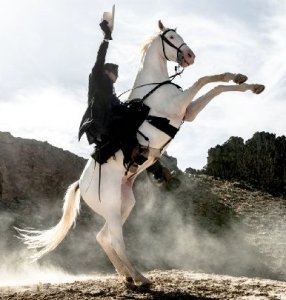 a recurring problem for Disney at the minute. To be frank, I’m not convinced anyone made a truly concerted effort to stem the overspend. When a gaggle of CG rabbits hopped on screen, all I could think was, “who allowed this?!” You’ve got a massively over-budgeted film that the studio want cut back, and one reason for that is CG bunnies that have almost no bearing on anything whatsoever! The amount of time and effort that must’ve gone into creating those fairly-realistic rabbits for such a short amount of screen time… it cost millions, surely. Millions that could’ve been saved with a simple snip during the writing stage if only someone had said, “well, those bunnies don’t add anything and they’ll be bloody expensive, so let’s lose them.”
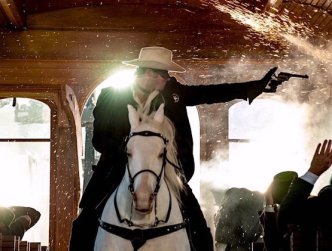 I’m not quite as effusive as Hughes, but The Lone Ranger is worth the time of anyone who enjoys an action-adventure blockbuster. It’s a three-star adventure-comedy bookended by a pair of five-star railroad action sequences, which make the trudge through the film’s middle hour-or-so feel worthwhile. There was a better movie to be made here — one that was half-an-hour shorter, more focused, and probably several tens of millions of dollars cheaper to make — but that doesn’t mean the one we got is meritless.
 On the day marshal Will Kane (Gary Cooper) marries his young bride Amy (Grace Kelly), hands in his badge and plans to leave town, word reaches Hadleyville that a criminal he arrested, Frank Miller (presumably Will read
 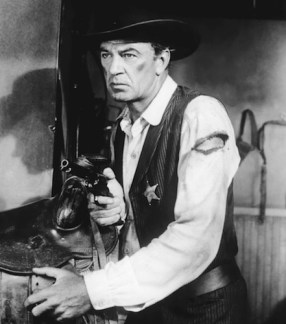 Some would contend it’s impossible to engage with High Noon and ignore that political allegory; others, like Mike at
 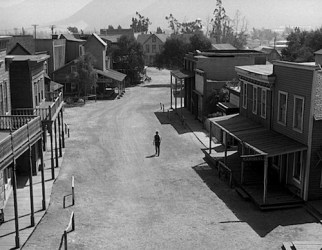 To top it all off, the film takes place in near-as-damn-it real time. Regular readers will know this is a plus for me, for reasons I still can’t quite fathom. In a narrative such as this, however, it only adds to the tension: you know it isn’t going to jump from 11:30 to the titular time, for instance — you’re going to live every one of those minutes with the characters; that’s exactly how much, or little, time Will has left to get ready.
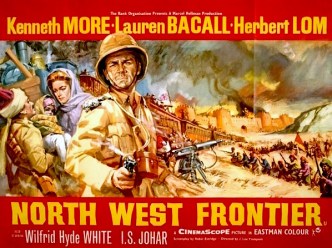 British Army Captain Scott (Kenneth More) is charged with getting an Indian child prince and his American governess (Lauren Bacall) to safety as rebels attempt to murder him. With the palace under siege, their only hope is a barely-ready rust-bucket train engine, a single passenger carriage, and a long journey through enemy territory joined by a motley group of diplomats and hangers-on who’ve bargained their way on to this last train.
 on the train by her governor husband, and Eugene Deckers is an arms dealer, who consequently no one likes but who remains unashamed of his trade. Through this prism there’s some discussion of the merits or otherwise of the British Empire and Indian independence, which some will judge to be extolling old-fashioned values, and others will take as little more than a (probably unnecessary) hat-tip in the direction of real politics.
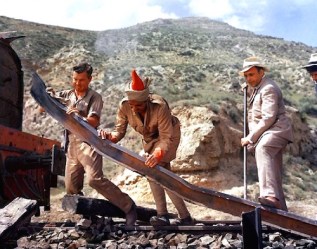 North West Frontier, on the other hand, sounds like a Western — which was perhaps the intention: the film’s structure and story style is fundamentally a fit for that genre, albeit British-made and geographically relocated. The storyline immediately brings to mind John Ford’s
  100Films.co.uk