2010 #105
Robert Rodriguez & Quentin Tarantino | 191 mins | Blu-ray | 18 / R
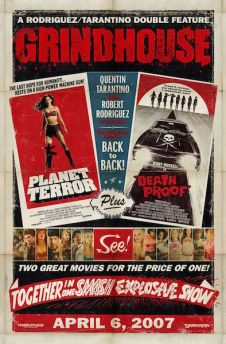 Infamously, on its release in America the much-hyped Rodriguez/Tarantino double bill was an almighty flop, so much so that it wasn’t properly released in its full form outside the US. Which is a bit ironic, if you think about it, because the US is the market least likely to respond to something a little bit experimental.
A grindhouse, for those still unacquainted with the concept, was a second-run cinema in the pre-home video days that generally showed trashy films from poor-quality much-screened prints. It should come as little surprise that this is the kind of film and viewing experience Tarantino enjoys, and so he and best chum Rodriguez set about recreating the style for a wider audience. Which was probably why it flopped — it was, almost by definition, not a mass audience-aimed style of cinema.
What this means for Grindhouse is a double-bill of exploitation movies, more-or-less with a horror bent, with grainy, dirty, decrepit prints that are missing shots, scenes, and even whole reels, and complete with trailers for similar films and ads for local restaurants. Clearly, it sets itself up to be as much about the experience of viewing the work of RR and QT in this context as it is the films themselves. So, to take the viewing programme in order…
It opens with one of the several fake trailers — except in this case the trailer is no longer fake, as Rodriguez has since gone on to turn Machete into a genuine feature (out next month over here). It sets the tone well: cheesy dialogue, stagey acting, an emphasis on gory violence over any other element, and plenty of utterly ludicrous moments. Plus breasts, naturally. 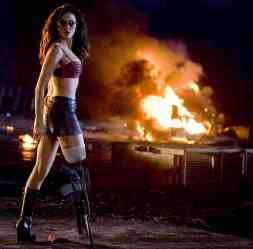 Chances are, if you don’t find this opening salvo entertaining in some way the rest of the film is going to prove a struggle.
And then the film launches into its first feature: Robert Rodriguez’s zombie horror Planet Terror. In short, this is a completely entertaining pitch-perfect 90-minute proof-of-concept. Rodriguez packs every scene with at least one element you should expect from this style of cinema: graphic blood-spurting violence, horrific mutations, vicious zombies, over-the-top logic-light gunfights, entirely random explosions, clichéd dialogue, stock characters, extended shots of the female form… Have I missed anything? If I have, it’s probably there too.
Rodriguez’s skill lies in making this both homage and hilarious. You don’t need to have much experience of this kind of cheap horror/exploitation movie to see how well he’s hit on the stereotypical plot, characters and sequences. His direction hits the nail on the head too, discarding his usual style for angles and cuts that feel thoroughly genuine. But he also recreates it in a way that’s amusing; not so much in a “look how stupid they are” way, but by levying elements in a way that is consistently entertaining. In particular, he uses the self-imposed print damage to excellent effect — the sex scene literally burns out from over-play, for instance, while the “Missing Reel” card elicits a laugh by jumping the plot forward so ridiculously, as well as skipping a whole chunk of exposition.
 It probably works better in context than described on the page, but Rodriguez has marshalled every disparate element to create a cohesive whole that’s exciting and funny. At this point, Grindhouse is firmly headed for a full five-star conceptual success.
Following “The End” card, there’s a handful of trailers before the second part of the double-bill. From directors Rob Zombie (The Devil’s Rejects, Halloween remake), Edgar Wright (Shaun of the Dead, Hot Fuzz) and Eli Roth (Cabin Fever, Hostel), they showcase different archetypes within the overall grindhouse style. Zombie’s Werewolf Women of the S.S. is all Nazis, cheap werewolf costumes and (naturally) boobs — very video nasty. Wright’s Don’t takes on British ’70s horror with a nightmare-filled country mansion and a deliberately repetitive trailer (“don’t go in there”, “don’t see it alone”, etc). Also, for a British viewer, its sub-two-minute running time is packed to bursting with recognisable faces, some you’d expect (Mark Gatiss, Nick Frost) and others you wouldn’t (Katie Melua!) Finally, Roth’s Thanksgiving is a teeny slasher in the Halloween mode,  though Roth can’t resist adding his own especially twisted brand of humour (I shan’t describe the final shot here).
While the trailers won’t necessarily convince you to see the films featured (good thing they don’t exist then), they perfectly capture the feel of various horror styles from the intended era, and — with the various “coming attractions” slides — sell the grindhouse experience.
And then we have the second film, Quentin Tarantino’s Death Proof. And here the concept falls apart.
It seems Tarantino can’t let go of his own style. With a handful of exceptions, Death Proof feels less like a well-considered grindhouse homage (which Planet Terror certainly was) and more like a typical Quentin Tarantino Film launched from a grindhouse-ish concept. He can’t even sustain the literal veneer of grindhouseness: after some early print damage, obviously missing scenes, the clearly-labelled “Missing Reel” (which, in one of the film’s few authentic-feeling touches, is a sexy sequence), and — in the best grindhouse-style touch — a shoddily-replaced title card, the picture quality gradually loses its flaws until a climax that seems visually faultless. Perhaps QT’s imagined behind-the-scenes story was that every projectionist got bored of the film by this point so the latter reels survived in pristine condition…
 But it’s not just the increasing lack of dilapidated print quality that prevents Death Proof from selling its concept. The screenplay is clearly a QT work, much more so than most of Kill Bill or even Inglourious Basterds, especially when the girls indulge in long dialogue scenes of the real-world-natter variety. It’s like the opening of Reservoir Dogs, only with girls instead of guys and repeated two or three times throughout the film. One such scene is even shot in a very long single take, the camera constantly roving around the four girls sat round a table. It’s a technically impressive bit of work for any film; as a supposed product of a low-budget horror-thriller flick destined for the grindhouse circuit, it’s beyond improbable. In short, it’s all too well written and directed to convince as grindhouse. Though he does get to indulge in a couple of lingering shots of the female form, in particular his regular foot fetish.
QT almost makes up for all this with the final twenty minutes, featuring some impressive car stunt action. As noted, by this point any pretense of being a grindhouse-style film has been done away with: the image is devoid of all but minor damage, the stunt work — all done for real, I believe — pretty impressive. Whether it conforms to the style statement of the film or not (that’d be a “not”), it does manage to entertain. Tarantino’s decades of studying action-filled trash clearly pay off here as well as they did in Kill Bill, 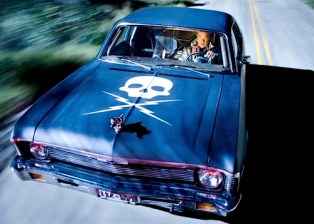 and if he chooses to create some more action-centric pictures in the future it would be no bad thing.
One thing that left me uncertain was the decision to slaughter his main cast halfway through. Firstly, the death-inducing crash is another sequence that’s too well done for such a pretend-cheap film, repeating the impact four times to show the imaginative fate of each victim. Brutal, yes, but one of the few moments that matches Planet Terror for effectiveness. The actual act of removing the three lead characters is audacious, maybe, but mainly so because QT’s spent so long apparently trying to invest us in these characters and their lives. It makes all the dialogue scenes we’ve sat through feel even more pointless, especially those setting up slightly dull romantic-ish subplots.
It also leads to a cameo appearance for a handful of Planet Terror characters, which could be fun but ultimately feels ill-conceived to me. In no other way do these films appear to be set in the same world, or have any other connection — indeed, cast members such as Rose McGowan and Tarantino himself appear in completely different roles in each film. The crossover didn’t feel in the grindhouse spirit to me; it felt in the “Rob and I are buddies and did this for no good reason” spirit. And it certainly took me out of the film.  In fact, it might’ve played better if the films were the other way round, as it means Death Proof must be set before Planet Terror. I’d approve of this switch not only for chronological reasons, but because seeing one-scene bit-parters turn up in the-same-but-larger roles in the second film seems like it would be more satisfying as a viewer, rather than re-encountering these (in any case, minor) characters the way we do.
A length-based aside: as I mentioned, both films were released separately outside the US, and in both cases were extended. By my calculations, the Grindhouse cut of Planet Terror is just under 15 minutes shorter, while Death Proof is around 20 minutes shorter. More on that when I get round to watching the individual versions.
Grindhouse ends up being every bit a film of two halves, as you might expect a double-bill to be. Up until the end of the trailers, I was loving its commitment to the concept and the fun it was having with it — all credit to Rodriguez for that, as well as the trailer directors of course.  But Tarantino’s entry lets the side down by seeming to fail in its execution of the film’s conceit. I’m not convinced it would be any better viewed as a standalone Quentin Tarantino Film, but in context it certainly disappoints.
If QT could’ve produced an effort as successful as his mate’s, Grindhouse would’ve been on course for full marks; not because it’s a Good Film, but because it would have fully realised its potential-filled concept in a thoroughly entertaining way. The finished product is still entertaining, but not thoroughly. It loses a star, but does retain a moderate chance of appearing on my Best Of Year list.
Grindhouse is out on Blu-ray, exclusive to hmv, from today.
Grindhouse’s constituent parts, Death Proof and Planet Terror, are on TCM tonight from 9pm until 1:30am.

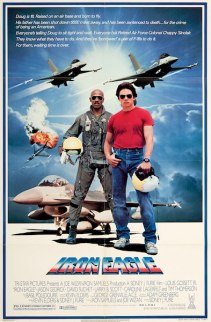 You know how sometimes you see a bit of a movie on TV and you end up watching just long enough to get caught up so much you’re in for the long haul, no matter what the quality? No? Maybe it’s just me (usually around this time of year, it seems). Iron Eagle is, naturally, my latest example of this phenomena.
 Like I said, daft and implausible. And that isn’t necessarily a problem, but as you watch Iron Eagle you can’t help but wonder if the filmmakers are trying to convince viewers it could be plausible. And it isn’t. Not in the slightest.
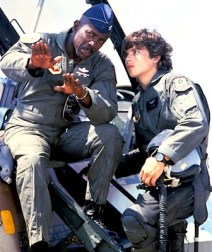 I’ve not seen that either, but I think we all know this is a serious step down. Poor man. His career went on to include Iron Eagle II and the direct-to-video Iron Eagle IV. Yes, there are four of them, and apparently they’re even worse and not in keeping with the spirit of this first. Poor man.
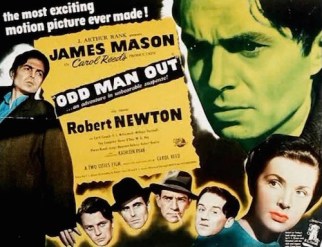 It may be a bit of a cop out to begin a review by pointing you to another, but I must recommend
  Robert Newton’s Lukey. (You’ll also note Newton’s performance is criticised in Colin’s piece so, in aid of not sounding like I’m too easily influenced, I’d like to point out I didn’t make the connection between his comments and my own notes on Newton until afterwards.) Shell and Lukey have a bit of a point in the end, but I didn’t enjoy getting through them in comparison to the rest of the film.
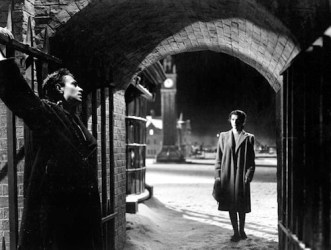
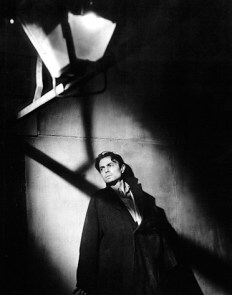 The score, by William Alwyn, is really nice, particularly in certain places — for example when it begins to snow and Johnny wanders the streets, or at its most effective during the haunting climax, as Kathleen hauls a near-dead Johnny through the falling snow towards the safety of the shipyard as the police finally close in.
 If you’ve ever seen the miniseries
  Bigelow & co construct each ‘action’ sequence with care and attention. They’re not action sequences in the truest sense — suggestions from some that she’d be a great director for, say, Bond 23 on the strength of this film are unwarranted (not that she wouldn’t be good, but this film’s action does nothing in particular to demonstrate appropriate skills). Instead of the fast-paced bullets-flying adrenaline-pumping sequences you get from An Action Movie, The Hurt Locker offers up more realistic (at least, realistic-feeling) sequences of tension as characters approach bombs, watch increasingly suspicious crowds, try to defuse the situation before the timer runs out… It could be clichéd — we’ve all seen plenty of bomb defusing scenes in movies before now — but, again, there’s a sense of “this is how it is”, rather than “this is how movies portray it for dramatic effect”. Is it how it is? I don’t know. But it certainly still packs dramatic effect.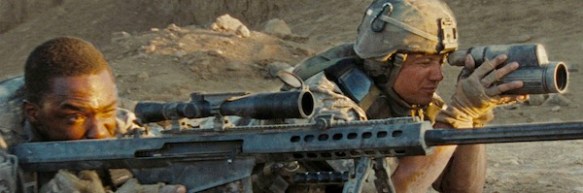
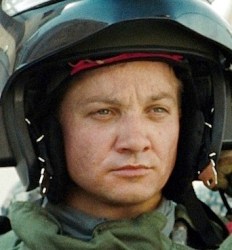 The opening quote and closing scenes make explicit the main theme — war is a drug, one James (Oscar nominee Jeremy Renner) is addicted to — but I’m not sure how present this is in the body of the story. Rather, the majority feels like an attempt to convey the experience of living as an explosives expert in a warzone, with James’ ‘addiction’ just a side effect of that. Perhaps, then, it’s making its point more subtly than by battering you round the head with cinematic cries of, “He’s addicted to war! It’s just a drug!”
 As I mentioned in my review of the
 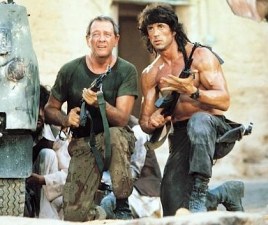 now occupy almost the same position the Russians did back then, for instance — but I’ll leave the specifics of such things to reviewers more versed in the last 25 years of Western intervention in the Middle East.
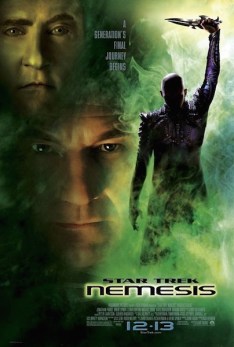 After the widespread disappointment with
  though the knowledge of better things to come means his presence somehow lifts his scenes a notch.
 Robin Williams surprised everyone when he started appearing in films as a serious actor in the early ’00s. Previously — and, if you’ve seen him on chat show in recent years, still — an outrageous funnyman, Williams turned in excellent straight performances in the likes of
  Still, Robin Williams is excellent, once again displaying his recently-found gift for serious acting. His character’s homosexuality is nicely handled too. It seems to have overshadowed the rest of the film for some viewers, but I’m confused as to why. Perhaps precisely because it doesn’t come out screaming “look, look, he’s gay! Isn’t that edgy!”, leaving it as just a fact of his character — and one that’s only important because his personal life is part of the story — means some viewers are so shocked by their own realisation of his sexual orientation that it gets in the way for them.
 this “but it happened!” logic seems to allow the filmmakers to get away with not offering adequate explanation. Then again (not sure how many “other hand”s I’m on now), it’s just like real-life: sometimes things can’t be explained in a rational way. Some people will have a problem with that from their films; sometimes I’m among them, but in this instance I think there are enough explanations and ambiguities. My problem was more that getting to them seemed to provide nothing, particularly as, being twist-free, they only confirmed one of the options that had been supposed an hour earlier.
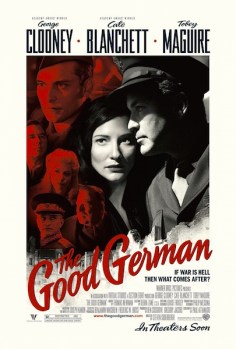
 the visual, audio, acting and plot styles of the era, why not ensure the dialogue and action follow suit? There’s no need for the violence, sex and swearing in this particular tale; at least, no need for it in a way that couldn’t be conveyed as effectively using Production Code-friendly methods. I’m uncertain if I like the film less for failing on this measure, but it does add to its inherent oddness.
 But how much do we get to know them, really? It’s easy to see why critics said “not very well”, because they’re too busy uncovering the conspiracies and revealing their part to actually show us much about themselves. But then why should that be a problem? It’s a noir thriller, not a character drama. Surely it’s about the mysteries and, if you like, the themes, rather than letting us understand the people caught up in them?
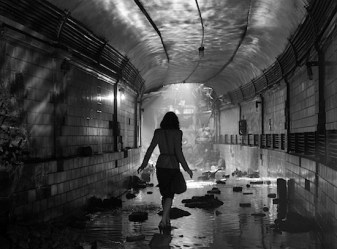 production intentions rather than being invented to slot into them — provides meat on the stylistic bones.
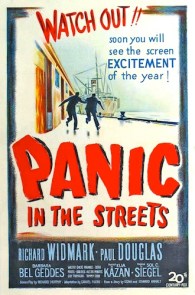 Film noir is a pretty unspecific genre, or unconscious movement, only really defined (however loosely) once it was already over. So to say a film noir isn’t particularly film noir-y might seem a tad daft, but, Panic in the Streets isn’t a particularly film noir-y film noir.
 has a beautifully bad-guy-friendly skull-like face, with his jutting cheek bones and flat-ended nose. (I imagine I’m far from the first to make this observation, but hush.)
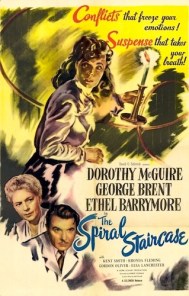 A serial murderer is on the loose in 1900s New England, or 1910s Massachusetts (pick which website you want to believe). His victims are all disabled women, so at the wealthy Warren residence, both family and staff worry for mute maid Helen — particularly as it seems the murderer may be among them…
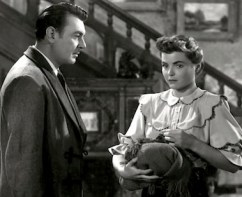 Some viewers allege that it’s at this point the story falls apart; that there’s only one possible suspect. I disagree. Though I can’t say the film entirely had me fooled, there are several suspicious characters, particularly if you’re prepared to consider extraordinary leaps of probability — and in genres like gothic horror, film noir and whodunnit, you should be. Indeed, while some see the killer as obvious others may consider them unlikely; but, for the attentive, the groundwork for the motivation is laid throughout.
 A mention for the sound design, too. Even during simple dialogue scenes, where one might expect silence but for the words in a film of this era, rain lashes against the window in the background, the heavy weather a ceaseless reminder of the threat lurking close at hand. It is, to use a cliché, a character in itself. Thanks to the enclosed setting, we spend a fair amount of time with these characters, and there are good performances too, but that’s for another reviewer to discuss — try
  100Films.co.uk