2010 #69
Christopher Nolan | 148 mins | cinema | 12A / PG-13
 This review ends by calling Inception a “must-see”. I’m telling you this now for two reasons. Primarily, because this review contains major spoilers, and it does seem a little daft to end a review presumably aimed at those who’ve seen the film with a recommendation that they should see it.
Secondly, because Inception — and here’s your first spoiler, sort of — also begins at the end. Now, this is normally a sticking point for me: too many films these days do it, the vast majority have no need to. I’m not convinced Inception needs to either, but it makes a better job of it than most. It does mean that, as the film approaches this moment in linear course, you know it’s coming several minutes ahead of its arrival, but for once that may be half the point.
As you undoubtedly know, Inception is about people who can get into dreams and steal ideas. Now they’re employed to get into a dream and plant an idea. This is either impossible or extremely hard, depending on which character you listen to. And that’s the setup — it’s really not as complicated as some would have you imagine. What follows is, in structural terms, a typical heist movie: Leonardo DiCaprio’s Cobb is the leader, he puts together a team of specialists, they do the heist, which has complexities and takes up the third act. Where it gets complicated is that this isn’t a casino robbery or betting scam or whatever other clichés have developed in heist movie history,  but the aforementioned implanting of an idea; and so, the film has to explain to us how this whole business works.
The explanation of the rules and the intricacies of the plot occupy almost all of Inception’s not-inconsiderable running time. There’s little in the way of character development, there’s (according to some) little in the way of emotion. But do either of these things matter? Or, rather, why do they have to matter? Why can’t a film provide a ‘cold’ logic puzzle for us to deduce, or be shown the methodology of, if that’s what it wants to do? When I watch an emotional drama I don’t complain that there’s no complex series of mysteries for me to unravel; when I settle down to a lightweight comedy I don’t expect insight into human psychology; musical fans don’t watch everything moaning there aren’t enough songs; you don’t watch a chick flick and wonder when the shooting’s going to start. That is, unless you’re being unreasonable with you expectations.
The film centres on Cobb, it uses Ariadne (Ellen Page) as a method to investigate Cobb, and everyone else plays their role in the heist. And that’s fine. Perhaps Ken Watanabe’s Saito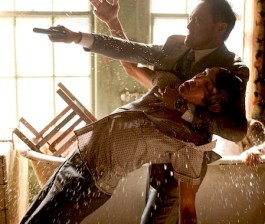 could do with some more depth, considering his presence in that opening flashforward and his significance to Cobb’s future, but then perhaps he’s the one who most benefits from the mystery. Some would like Michael Caine’s or Pete Postlethwaite’s characters to have more development and, bluntly, screentime; but I think their little-more-than-cameos do a lovely job of wrongfooting you, and there’s nothing wrong with that. Some say the same thing about Lukas Haas’ tiny role, but I don’t know who he is so he may as well be anyone to me. Cast aside, there’s not much humour — well, no one promised you a comedy. At best you could claim it should be a wise-cracking old-school actioner, but it didn’t promise that either.
To complain about these things being missing is, in my view, to prejudge the film; to look at it thinking, “this is potentially the greatest film ever because, well, I would quite like it to be. And so it must have a bit of everything I’ve ever liked in a film”. Which is patently rubbish.
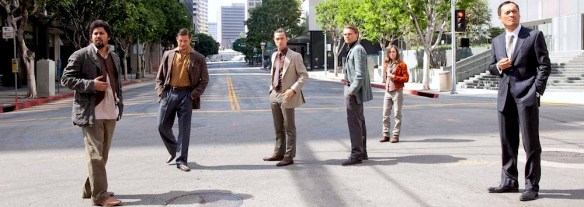
Taken on its own merits, Inception presents itself as a heist movie, a big puzzle to be solved, with a team leader who has some of his own demons. Now, you can argue that his demons are revealed in chunks of exposition rather than genuine emotion, and that might be a valid criticism that I wouldn’t necessarily disagree with; and you can argue that we’re not shown enough of the planning to fully appreciate the big damn logic puzzle of the heist, instead just seeing it unfold too quickly as they rush deeper and deeper into levels of dream, and I wouldn’t necessarily disagree with that either; and you can argue that some of the action sequences could benefit from the narrative clarity Nolan (in both writer and director hats) clearly has about which level’s which and how they impact on each other, and I wouldn’t necessarily disagree with that either… but if you’re going to expect the film to offer something it didn’t suggest it was going to… well, tough.
And the film isn’t entirely devoid of character, it’s just light on it. All the performances are fine. DiCaprio is finally beginning to look older than 18 and better able to convince as a man who has lost his family and therefore most of what he cares about.  He wants a way home, he gets a shot at it, and he goes for it. Him aside, it’s a bit hard to call on the performances after one viewing: there’s nothing wrong with any of them, it’s just that they’ve not got a great deal to do — the film is, as noted, more concerned with explaining the world and the heist. How much anyone has put into their part might only become apparent (at least to this reviewer) on repeated viewings. Probably the most memorable, however, is Tom Hardy’s Eames, which is at least in part because he gets the lion’s share of both charm and funny lines.
The plot and technicalities of the world are mostly well explained. Is it dense? Yes. Some have confused this for a lack of clarity but, aside from a few flaws I’ll raise in a minute, everything you need is there. Some, even those who liked it, have criticised it for the bits it definitely does leave out. How exactly can Saito get Cobb home? Whose subconscious are they going into now? What are the full details of the way the machinery they use works? The thing is, it doesn’t matter. None of it does. It would’ve taken Nolan ten seconds to explain some of these things, but does he need to? No. Do you really care? OK, well — Saito is best chums with the US Attorney General, so he asks nicely and Cobb’s off the hook. Sorted. It’s not in the film because it doesn’t need to be; it’s not actually relevant to the story, or the themes, or the characters, or anything else.  Apparently this distracts some people. Well, I can’t tell them it’s fine if it’s going to keep distracting them, but…
It’s fine. Because Nolan only skips over information we don’t need to know — precisely because we don’t need it. Should it matter whose mind we’re in? Maybe it should. But it would seem it doesn’t, because it’s all constructed by Ariadne and populated by the target anyway, and apparently anyone’s thoughts can interfere — they never go into Cobb’s mind, but Mal is always cropping up, not to mention that freight train — so why do we care whose brain they’re in? It seems little more than a technicality. And as for how the system works… well, we’re given hints at how it developed, and the rules and other variables are explained (for example, how mixing different chemicals affects the level of sleep and, as it turns out, whether you get to wake up), but — again — we’re told everything we need to know and no more. Because you don’t need anything else. It’s all covered. And if it’s as complicated as so many are saying, why are you begging for unnecessary detail?
And I have more issues with other reviews, actually. I think the desire for more outlandish dreams is misplaced. It’s clearly explained that the dreamer can’t be allowed to know he’s dreaming, so surely if they were in some trippy psychedelic dreamscape — which would hardly be original either, to boot — they’d probably catch on this wasn’t Reality. 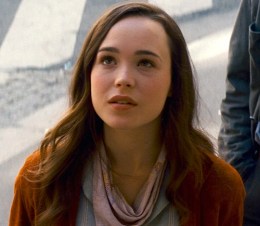 On the flip side, this rule could be easily worked around — “in dreams, we just accept everything that happens as possible, even when it obviously isn’t” — but where’s the dramatic tension in that? There’s tension in them needing to be convinced it’s real; if anything goes… well, anything goes, nothing would be of consequence, the only story would be them completing a danger-free walk-in-the-park mission.
Much has also been made in reviews of the skill displayed by editor Lee Smith in cutting back & forth between the multiple dream levels, a supposedly incredibly hard job. And it is well done, make no mistake — but it also sounds harder than it is. Really, it’s little different than keeping track of characters in three or four different locations simultaneously; it’s just that these locations are levels of dream/consciousness rather than worldly space. Still no mean feat, but not as hard as keeping three different time periods/narrators distinct and clear, as Nolan & co did in The Prestige.

Then there’s the final shot, which has initiated mass debating in some corners of the internet (yes, that dire pun is fully intentional). In my estimation, and despite some people’s claims to definitiveness, it proves nothing. Some have taken it as undoubted confirmation that Cobb is dreaming all along — the top keeps spinning! Mal said it never stops in a dream! — but I swear we saw it stop earlier in the film, so was that not a dream but now he is in one? How would that work? Others have suggested Cobb is in fact the victim of an inception; that we’ve watched a con movie where we never saw the team, and couldn’t work out who they were. Perhaps; but for this to work surely it’s dependent on a way that we can work out who they were, and what their plan was, and how they did it? Otherwise we may as well start picking on every movie and say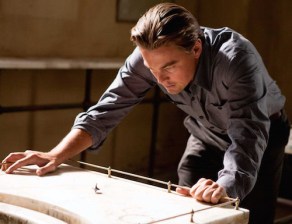 “ah, but characters X, Y and Z are actually a secret team doing a secret thing, but we never know what the secret thing is, or what the result of that is”. In other words, it’s pointless unless it’s decipherable.
And still further, the top doesn’t stop spinning on screen. But you can make those things spin for a damn long time before they fall over, if you do it right, so who can say it’s just not done yet? If it does fall over, eventually, sometime after the credits end, then that’s that, it’s the real world after all. Presumably. And that’s without starting on all the other evidence throughout the film: repeated phrases, unclear jumps in location, the first scene that may or may not be different the second time we see it…
Something’s going on, but is it just thematic, or is it all meant to hint that Cobb’s in a dream? And if he is, who (if anyone) is controlling it? To what end? I’m certain that those answers, at least, aren’t to be found, so, again, are the questions valid? My view — on the final shot, at least — is, perhaps too pragmatically, that it’s just a parting shot from Nolan: it doesn’t reveal the Secret Truth of the whole film, it just suggests that maybe — maybe — there’s even more going on. Maybe. And I’m not sure he even knows what that would be or if there is; 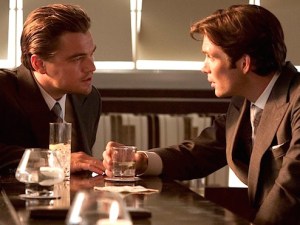 beyond that the top still spinning as the credits roll is an obvious, irresistible tease. He wouldn’t be the first filmmaker to do such a thing Just Because.
Or there’s always the ‘third version’: that the top doesn’t stop not because it doesn’t stop but because the film ends. Ooh, film-school-tastic. Also, stating the bleeding obvious. I believe it was suggested as a bona fide explanation by one of Lost’s producers, and so is surely automatically classifiable in the “tosh” bin along with that TV series. Presumably it’s ‘deep thoughts’ like that which led to an ending that left many fans unsatisfied. But I digress. He’s right in the sense that the film doesn’t tell us, but it’s not an explanation of it in and of itself unless you want to be insufferably pretentious: it is ambiguous, yes, but it’s not a comment on the artificiality of storytelling or whatever. And if it is… well, I’ll choose to ignore that, thanks, because, no.

I alluded earlier to flaws. If anything, the final act heist is too quick. With, ultimately, four layers of dreams to progress through, not enough time is devoted to establishing and utilising each one. It’s as if Nolan set up a neat idea then realised he couldn’t fully exploit it. They have a week in one world, months in the next, years in the next… but it doesn’t matter, because events come into play that give them increasingly less time at each level. Would it not have been more interesting to craft a heist that actually used the years of dreamtime at their disposal, rather than a fast-edited & scored extended  action sequence across all four levels? It makes for an exciting finale when they need to get out, true, but I couldn’t help feeling it didn’t exploit one of the more memorable and significant elements enough.
Indeed, at times the film operates with such efficiency that one can’t help but wonder if there’s another half-hour cut out that it would be quite nice to have back. I appreciate some have criticised the film for already being too long; it would seem I quite decidedly disagree. And not in the fannish “oh I just want more” way that really means they should just get hold of a copy and watch it on loop; I literally mean it could be around half an hour longer and, assuming that half-hour was filling the bits I felt could handle some filling (i.e. not the omitted bits I was fine with nine paragraphs back), I would be more than happy with that. I did not get bored once.
Still on the flaws: Mal (that’d be Cobb’s wife — I’ve been assuming you knew this, sorry if I shouldn’t have) is talked up as a great, interfering, troublesome force…  yet she’s rarely that much of a bother. At the start, sure, so we know that she is; and then in Cobb’s own mind when Ariadne pops in for a visit, but that’s why he’s there so it goes without saying; and then, really, it’s not ’til she puts in a brief appearance to execute Fischer that we see her again (unless I’m forgetting a moment?) And apparently Ariadne has had some great realisation that Mal’s affecting Cobb’s work, and Ariadne’s the only one who knows this… but hold on, didn’t Arthur seem all too aware of how often Mal had been cropping up? Does he promptly forget this after she shoots him? Mal is a potentially interesting villainess, especially as she’s actually a construct of Cobb’s subconscious, but I’m not convinced her part is fully developed in the middle.
On a different note, some of the visuals are truly spectacular. I don’t hold to the notion, expressed by some disappointed reviewers, that we’ve seen it all before. The Matrix may have offered broadly similar basic concepts in places, but Inception provides enough work of its own for that not to matter. But there is another problem: we have seen it all before. In the trailer. It’s a little like (oddly) Wanted. That comic book adaptation promised amazing, outrageous, impossible stunts through an array showcased in the trailer. “Wow,” thought (some) viewers, “if that’s what’s in the trailer, imagine what they’ve saved for the film!” Turned out, nothing. And Inception is pretty much the same. The exploding Parisian street, the folding city, the 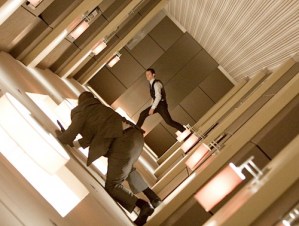 zero-G corridor, the crumbling cliff-faces… all look great, but there’s barely any astounding visual that wasn’t shown in full in the trailer. Is that a problem? Only fleetingly.
But it’s the kind of thing that makes me think Inception will work better on a second viewing. Not for the sake of understanding, but to remove it from the hype and expectation. I’ve seen it now, I know what it is, I’ve seen what it has to offer, I’ve had the glowing reviews and the lambasting reviews either affirmed or rejected, and next time I can actually get a handle on what the film is like. Which makes for an anti-climactic ending to a review, really — “ah, I’ll tell you next time”. Well, I can say this:
Inception is certainly worth watching. I’m not sure it’s a masterpiece — maybe it is — but I’m certain it’s not bad. I don’t think it’s as complicated to follow as some believe, but maybe that’s just because I was prepared to pay attention, and equally prepared to disregard the bits that aren’t necessary rather than struggle to fully comprehend every minute detail. It is flawed, though perhaps some of those I picked up on can be explained (in the way I’m certain some others I’ve discussed can be explained). 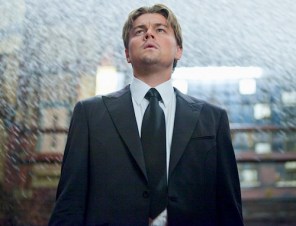 Is it cold and unemotional? Not entirely. Is it more concerned with the technicalities of the heist and the rules of the game than its characters and their emotions? Yes. Is that a problem? Not really.
At the very least, if only for all the reaction it’s provoked and the debate it will continue to foster, Inception qualifies as a must-see.
Inception placed 3rd on my list of The Ten Best Films I Saw For the First Time in 2010, which can be read in full here.

 I don’t know if you’re aware of a website, dear reader, called iCheckMovies.com? It’s one of those (many, I believe) sites where you can tick off which movies you’ve seen — in this case, not just any movie (though that’s changing ‘soon’), but movies from certain well-known lists. Well, it used to be just well-known(-ish) lists, but it’s constantly broadening its horizons and… Anyway. My point is this: some movies only crop up on one list (lots of the Shorts, for instance), while others manage two or three or four, but (as you’d no doubt expect) some crop up on loads. It’s a handy way to see that, too.
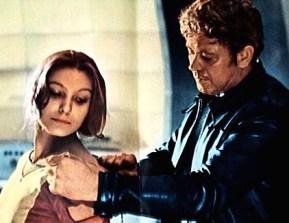 The fact that it’s the better part of three hours long, in Russian, and notoriously slow-paced, adds a different kind of weight. It’s quite easy to see how Soderbergh felt able to remake it into just 90 minutes (and he still made a slow-paced film).
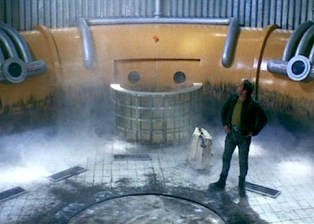 how it might work, or any other scientifically-bent notions that other films or filmmakers might choose to focus on. It also doesn’t centre on the romantic side of events, the route Soderbergh chose to pursue; or, if it does, it does so coldly and clinically and doesn’t feel romantic in the slightest. Alternatively, that could be the point.
 Post
Post  depending on your point of view, either supports the “it was all a dream” reading or is just a case of artistic licence, hardly uncommon in SF cinema.
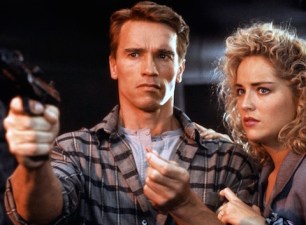 Perhaps it’s ultimately destined for an afterlife as a film representative of its era; the kind of thing that comes up as a footnote or personal favourite in texts & documentaries specifically discussing things like The Sci-fi Cinema of the ’90s. Or perhaps I’m doing it a disservice. We shouldn’t really try to predict these things too much, it’ll only lead to embarrassment when the opposite happens.
 The world, so they say (and by “they” I mean “absolutely no one” — I’m making this up), is divided into three sorts of people: those who love
 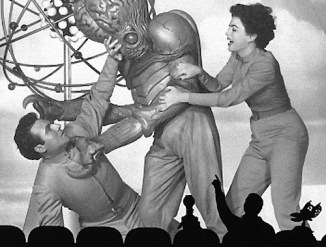 Anyway, the gang set their sights on one film per episode — or, in this feature film, one film per film. They’re being forced to watch these movies, for various unimportant reasons, and every once in a while we get comedic ‘host segments’, where they get up to hijinks on their space station (I forgot to mention, they live on a space station). These bits are well-meaning and quite funny — and in this big screen outing have been shot with a suitably filmic gloss that the video-shot TV episodes lack, which adds a surprising magnitude to the still-small-and-cheap sets and props — but the real meat of the humour is in the riffing over the film.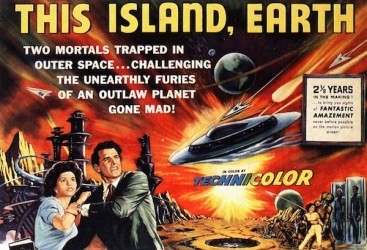
 when you’re in the mindset to take the piss out of the film. That is, if you get on with the characters (as it were) and sync with their sense of humour; if you dislike them or their humour, or like whatever they’re watching too much, then it’s probably more like some irritating yobs nattering away over something you’d quite like to watch thank you very much. (Equally, if you embark on this intending to watch This Island Earth, more fool you.)
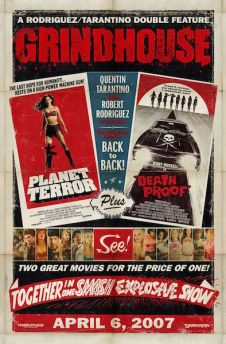 Infamously, on its release in America the much-hyped Rodriguez/Tarantino double bill was an almighty flop, so much so that it wasn’t properly released in its full form outside the US. Which is a bit ironic, if you think about it, because the US is the market least likely to respond to something a little bit experimental.
 Chances are, if you don’t find this opening salvo entertaining in some way the rest of the film is going to prove a struggle.
 It probably works better in context than described on the page, but Rodriguez has marshalled every disparate element to create a cohesive whole that’s exciting and funny. At this point, Grindhouse is firmly headed for a full five-star conceptual success.
 though Roth can’t resist adding his own especially twisted brand of humour (I shan’t describe the final shot here).
 But it’s not just the increasing lack of dilapidated print quality that prevents Death Proof from selling its concept. The screenplay is clearly a QT work, much more so than most of
  and if he chooses to create some more action-centric pictures in the future it would be no bad thing.
 In fact, it might’ve played better if the films were the other way round, as it means Death Proof must be set before Planet Terror. I’d approve of this switch not only for chronological reasons, but because seeing one-scene bit-parters turn up in the-same-but-larger roles in the second film seems like it would be more satisfying as a viewer, rather than re-encountering these (in any case, minor) characters the way we do.
 But Tarantino’s entry lets the side down by seeming to fail in its execution of the film’s conceit. I’m not convinced it would be any better viewed as a standalone Quentin Tarantino Film, but in context it certainly disappoints.
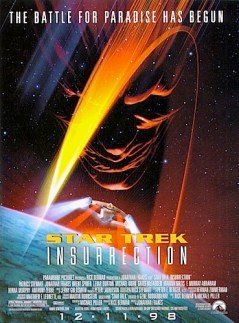 Many years ago, back when both the shows I’m about to mention were still on the air, someone drew a comparison that I felt summed up the whole of ’90s/’00s
  Actually, this is when Insurrection is at its best. Action-adventure undoubtedly has a place in science-fiction, but so do wordier stories — when they’re done right, and when they’re where you expect them to be. You shouldn’t expect them from Star Wars; you should from Star Trek. (That doesn’t make Voyager’s attitude better than Farscape’s, incidentally; not if it was boring or implausibly honourable considering their situation. But that isn’t the matter at hand.) And so the first 45 minutes or so are mostly enjoyable. Critics say even this isn’t as deep as
  There’s a greater array of fan-pleasing nods and winks this time out. As with First Contact, they have to find an excuse to get Worf back on board (at the time, in universe continuity, he was on Deep Space 9 in
 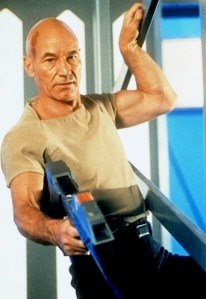 Most negative reviews — so, most reviews — accused the film of being essentially a TV episode (or two, of course), not earning itself a spot on the big screen. They may have a point. The subject matter isn’t at fault — a planet with the ability to make everyone live forever has suitably large potential — but the execution of it is frequently low-key. This isn’t too bad in the first half, which maintains the interest as it unfurls the story, but when it degenerates into action in the second half it falls apart. It’s no longer interesting and, ironically, looks made-for-TV, lacking inspired direction or suitable scope. Perhaps it would’ve been better served as a TV episode; or, as a film, better served by a writer and/or director and/or producer with greater vision.
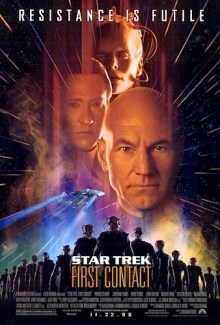 “Even ones good, odd ones bad.” So went
 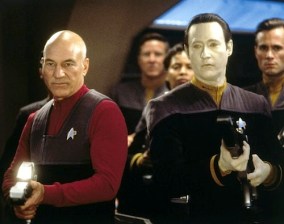 For all that, I still got the sense of it being a bit like two or three episodes of TV stuck together, albeit two particularly epic stories with a slightly bigger budget. The story on Earth is a bit of a sideline, for example, the kind of thing that’s added to give half the cast something to do. Perhaps that’s unfair — it’s a decent enough tale, with significant relevance to the Trek universe, but it’s also low-key and, aside from being kicked off by a Borg attack, entirely unrelated to the goings-on on the Enterprise. Visually it’s even more of a mixed bag. Borg costumes and effects are at times impressive — the Queen being lowered into her body, robotic spine dangling, still looks good today, and her makeup is exemplary — but other drones seem to be clad in cheap bodysuits… which the actors surely are, but it looks it.
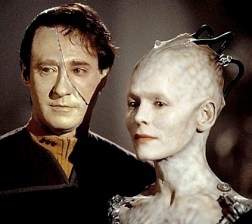 For a newbie, or a viewer light on Trek knowledge, it all works fine. There’s an awareness one’s missing out on something — Picard’s previous encounter with the Borg is alluded to often but not explained in full; even for me, as someone well aware that it’s one of sci-fi’s Big Stories, but who has never actually seen it, there’s a certain lack of explanation. Featuring a couple of new characters from hundreds of years before TNG’s regular timeline helps, because the crew occasionally have to tell them things everyone else would know; the downside is they’re not meant to be telling them everything, so some stuff still passes us by. But, importantly, none of this ever swamps the story; they’re just touches and moments that I know I’m not getting.
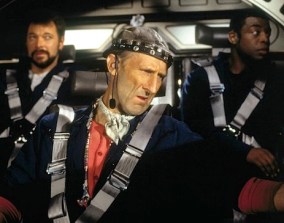 early on Picard explains that they won’t be noticed until they seem a threat… but they’re all carrying whopping great guns. And surely the very fact the humans have turned up deems them a threat? Also, why don’t the Borg recognise Picard? And later, during the largely fantastic sequence on the Enterprise’s hull, Picard, Worf and Hawk are clearly up to something nefarious and yet the Borg let them carry on. One or two Borg stop to intervene; Picard & co dispatch them; the rest of the Borg just keep working. Surely the fact these humans have just done away with several of your compatriots qualifies them as a threat that needs to be dealt with? It’s all a bit too convenient.
 Back in this blog’s early days, I established the rule that where a different cut of a film was not significantly different to the original version it wouldn’t be counted towards my total (assuming I’d seen the original, that is — if it’s the first time I’ve seen any version of the film, it still counts). There’s no hard criteria for what counts as “significantly different” though. A couple of additional minutes? No. A lot of additional minutes? Yes. Where’s the line between “a couple” and “a lot”? No idea. Thus far, I’ve left it up to “a feeling”, perhaps not always correctly (the
  but other than that if you’d told me this was the cut I watched in cinemas I’d believe you. This longer cut doesn’t make the film better or worse, just less suitable for younger viewers.
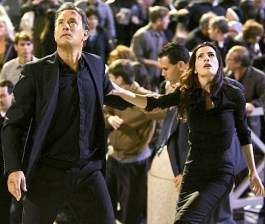 It’s still riddled with flaws, mind. Some of the dialogue is fairly atrocious (but at least it’s only some); exposition is often blatant and repetitive (we’re told what the preferiti are three or four times in as many minutes); some of the deductive leaps are a bit much; and the whole antimatter bomb still seems scientifically suspect. It all depends how much you’re willing to forgive, really. In a similar vein, one of the most contentious issues of Dan Brown’s novels is his use of “truth”. He mixes well-researched fact with his own creation at will, often leaving you to wonder if what you’re hearing is pure truth, truth bent to the plot, or a total fabrication. But then this isn’t a history or art lesson, it’s a mystery thriller, and if one wants to know more I’m sure there are books to read and documentaries to watch.
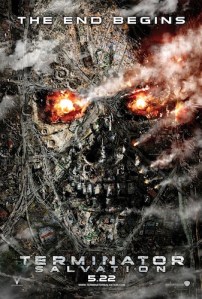 Terminator Salvation begins with a title sequence that displays the film’s title twice. I know you shouldn’t judge a book by its cover and all that, but somehow it just doesn’t bode well.
 sequences that could benefit from a wider perspective, for example Connor’s helicopter crash. That said (again), I’m a little torn what to think of that example: keeping the camera on Connor produces an unusual spin on a potentially familiar sequence, but it’s also a bit disorientating and, as I say, compounds this sense of watching someone else play a game.
 And even if you hadn’t seen it on the box or heard about it in all the film’s publicity, it’s obvious pretty early on that Marcus Wright will turn out to be a Terminator. To McG’s credit, he plays the ultimate reveal quite well — for those who know, it just about functions as a scene in its own right; for those who still hadn’t guessed, it works as a reveal — but if any filmmaker genuinely thought they’d kept it covered up they were sorely mistaken, and the first half could’ve done with a more knowing rewrite to compensate. Or just delete the prologue.
 He’s fine as ever, though his accent seems to waver between American and his native Australian. The same can’t be said of Helena Bonham Carter’s brief turn — her voice hits a constant fake American. Meanwhile, Arnie’s digitised cameo is just that. On the one hand it’s a nice touch, on the other it’s ultimately pointless — Connor doesn’t even react to the familiar face.
 More interesting than these slight tweaks is the behind-the-scenes story of a very different film, which I alluded to earlier. I don’t want to discuss it at length, but

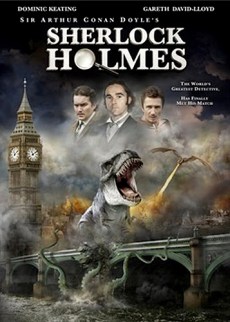 From the company that brought you such pinnacles of cinematic excellence as
 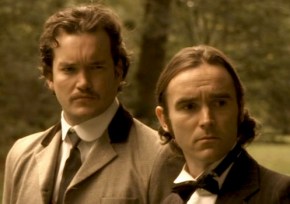 But, in The Asylum’s favour, their Sherlock Holmes doesn’t hide what it is. Yes, it’s called simply Sherlock Holmes rather than Sherlock Holmes and the Implausible CGI Monsters, but at least said monsters are plastered all over the DVD cover (both US and UK). If you see that and still expect something faithful to Conan Doyle, more fool you. That said, at times it’s surprisingly faithful to Doyle’s spirit. There’s some decent-ish investigation and deduction, the story structured like a mystery rather than an action-adventure.
 Anachronisms abound, the best being the first: the film opens in London, 1940, the middle of the Blitz, and the opening shot foregrounds the Millennium Bridge. I don’t think you have to be too familiar with London to know when that was built. Elsewhere we get intercoms on houses, incongruous light switches and period inaccurate telephones, just to mention a couple. It’s shoddy, yes, but almost part of the fun.
 100Films.co.uk