Back to the Future Part III (1990)

100 Films’ 100 Favourites #7

They’ve saved the best trip for last…
But this time they may
have gone too far.

Country: USA
Language: English
Runtime: 118 minutes
BBFC: PG
MPAA: PG

Original Release: 25th May 1990 (USA)
UK Release: 11th July 1990
First Seen: VHS, c.1991

Stars
Michael J. Fox (Homeward Bound: The Incredible Journey, The American President)
Christopher Lloyd (Who Framed Roger Rabbit, Things to Do in Denver When You’re Dead)
Mary Steenburgen (Parenthood, Step Brothers)
Thomas F. Wilson (Back to the Future, Born to Be Wild)
Lea Thompson (SpaceCamp, Some Kind of Wonderful)

Director
Robert Zemeckis (Death Becomes Her, The Polar Express)

Screenwriter
Bob Gale (Used Cars, Back to the Future)

The Story
With Doc stuck in 1885, Marty McFly must travel back to save him before he’s killed by Biff Tannen’s ancestor, Buford “Mad Dog” Tannen. With the DeLorean damaged during his arrival in the past, they also have to come up with a plan to get back to their correct time…

Our Heroes
Marty McFly finally grows as a human being as he learns some stuff this time, while Michael J. Fox also gets to ham it up a little as his Irish ancestor, Seamus. Christopher Lloyd, meanwhile, is still the one and only Doc.

Our Villain
It’s Thomas F. Wilson again, this time as Biff’s trigger-happy Wild West ancestor, Buford ‘Mad Dog’ Tannen. Who also gets covered in excrement.

Best Supporting Character
Mary Steenburgen is one of the few wholly original characters in either sequel, the love of Doc’s life, Clara Clayton. She’s also a confident, competent, and capable female character — a character type that’s only now ceasing to be a rarity in effects-y blockbusters, 25 years after this was made.

Memorable Quote
“Your future hasn’t been written yet. No one’s has. Your future is whatever you make it. So make it a good one, both of you.” — Doc

Memorable Scene
Marty and Doc hijack a train in the hope of using it to get the DeLorean up to the required 88mph. As the looted locomotive heads towards a mighty fall off an unfinished bridge, it turns out Clara is on board too. Tension! Action! Excitement! What more do you want from a climax?

Truly Special Effect
With the DeLorean destroyed, the film ends with a reveal of Doc’s new time machine, and it’s awesome.

Making of
There are tonnes of lines, jokes, characters, locations, and even background details referenced back and forth across the whole trilogy, but only one actual scene appears in all three: the moment Marty travels from 1955 to 1985. It’s the climax to the first film, then appears at the end of Part II, and consequently is in the ‘recap’ at the start of Part III.

Previously on…
Part III indeed: this picks up exactly where the second film left off, and they were shot back-to-back. It’s fundamentally standalone other than that, mind.

Next time…
As mentioned on the first film, Back to the Future has continued in an animated series, theme park ride, video game, and a comic book that started last year. Plus Doc Brown turned up in A Million Ways to Die in the West, so… there’s that…

Awards
2 Saturn Awards (Supporting Actor (Thomas F. Wilson), Music)
4 Saturn nominations (Science Fiction Film, Director, Supporting Actress (Mary Steenburgen), Costumes)
Nominated for the Hugo for Best Dramatic Presentation.

What the Critics Said
Back To The Future Part II teed off a lot of critics by not being a remake of the first film, and for daring to be a) complicated, b) very fast and c) heartless. Part III, which is slightly less fleet of foot, restores heart interest of the first film and has a satisfying complete storyline.” — Kim Newman, Empire

Score: 74%

What the Public Say
“One of the clearest indications of an excellent series is an ending is so satisfying you can’t even be mad the adventure is over. Part III delivers a happy ending so well-rounded […] there is no yearning for more story. I remember feeling quite content after seeing that movie for the first time; actually more like thrilled that the trilogy ended on such a great note.” — Avril Brown, Comics Waiting Room

Verdict

The consensus used to be that Part III was unquestionably the weakest part of the trilogy, a slightly bizarre Old West-set addendum to the first two. These days, I feel like an increasing number of people say it’s definitely better than Part II. Personally, I’ve always had a particular fondness for it. I’m not entirely sure why. Much like the second film, it can’t attain the perfection of the first movie, but it can be the next best thing — a fun and funny adventure with these great characters. And even as I say “they’re not as good as the first one”, I don’t wholly believe it: to me, Back to the Future never has and never will be just one film, or one film and its two sequels — it’s a trilogy; a three-parter. (So there.)

#8 will be… an alliterative origin.
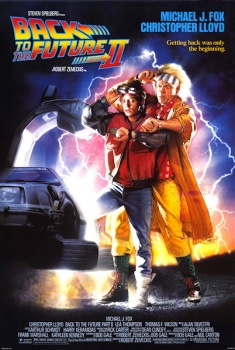

Back to the Future Part II (1989)

100 Films’ 100 Favourites #6

Getting back was only the beginning.

Country: USA
Language: English
Runtime: 108 minutes
BBFC: PG
MPAA: PG

Original Release: 22nd November 1989 (USA)
UK Release: 24th November 1989
First Seen: VHS, c.1991

Stars
Michael J. Fox (Doc Hollywood, The Frighteners)
Christopher Lloyd (Clue, The Pagemaster)
Lea Thompson (Red Dawn, Casual Sex?)
Thomas F. Wilson (Back to the Future, High Strung)
Elisabeth Shue (Adventures in Babysitting, Leaving Las Vegas)

Director
Robert Zemeckis (Who Framed Roger Rabbit, Cast Away)

Screenwriter
Bob Gale (1941, Interstate 60: Episodes of the Road)

The Story
Marty and Doc travel forward to 2015 to save Marty’s son from imprisonment, but this allows future-Biff to steal the DeLorean, taking it back to 1955 to allows his younger self to profit from future knowledge. Faced with a nightmare version of 1985, Marty must travel back into the events of the first movie to fix things.

Our Heroes
Michael J. Fox is not only Marty McFly, but older Marty McFly, and his son, Marty McFly Jr., and also… his daughter, Marlene McFly. Just in case you’d forgotten these were comedy movies, I guess. Christopher Lloyd, meanwhile, is the one and only Doc.

Our Villain
It’s Thomas F. Wilson’s Biff again, but this time he’s not just a bully, but someone who — thanks to his meddling in time — represents a threat to Marty’s whole lifestyle. And he’s a right nasty piece of work in the dystopian variant of 1985, too. Still gets covered in excrement, mind.

Best Supporting Character
Spare a thought for Marty’s girlfriend, Jennifer. The end of the first film has her getting in the DeLorean with Doc and Marty, because she was there and the ending was never intended to lead to anything (yes, kids, once upon a time movies weren’t made with the assumption there’d be sequels). Come the second film, Zemeckis and Gale were stuck having to integrate her into the story, which they did by… knocking her out early on and leaving her out of it.

Memorable Quote
“The time-traveling is just too dangerous. Better that I devote myself to study the other great mystery of the universe: women!” — Doc

Memorable Scene
30 years in the future, they’re still making crappy Jaws sequels. (The irony now is, in the real 2015 we were still getting often-crappy sequels to pretty much every major ’70s/’80s franchise except for Jaws.)

Technical Wizardry
You’ll believe a board can hover. Well, you probably won’t, but some people did. That’s just testament to how well made the sequence is.

Truly Special Effect
Quite apart from the hoverboard, the sequence where they first arrive in 2015 — a ‘road’ of flying cars in a rainy nighttime sky — is a triumph of model work.

Making of
For various reasons (possibly moral, possibly financial) Crispin Glover refused to return as Marty’s father, George McFly. Instead, the filmmakers used outtakes from the first film, as well as an actor wearing prosthetics made from casts of Glover taken for the first film. Glover objected to his likeness being used without permission, sued, and Universal settled out of court. More than that, it led to a change in contract rules at the Screen Actors Guild to stop the same thing happening again. (See also: The Four Musketeers.)

Previously on…
Not only does Part II pick up exactly where the first film ended, it goes back into its events and interacts with them.

Next time…
Part II ends with a huge cliffhanger, leading directly into the series’ final trilogy-forming instalment.

Awards
1 Oscar nomination (Visual Effects)
1 BAFTA (Special Effects)
1 Saturn Award (Special Effects)
3 Saturn nominations (Science Fiction Film, Costumes, Make-Up)

What the Critics Said
“Like its predecessor, Back to the Future Part II does not merely warp time; it twists it, shakes it and stands it on its ear. But as before, the film’s technical brilliance is the least of its appeals. Satirically acute, intricately structured and deftly paced, it is at heart stout, good and untainted by easy sentiment.” — Richard Schickel, TIME

Score: 63%

What the Public Say
“the biggest prediction the film nails is not any one piece of technology, but our reaction to it: indifference met with annoyance of its imperfections. The movie focuses not on what the technology can do, but on what it can’t. The skyway’s jammed. Marty’s hover board doesn’t work on water. The voice-activated home-entrance lights don’t turn on when Jennifer enters. […] What we get is “the future” as “the present.” None of the doom, destruction and dystopia of Blade Runner or The Time Machine. 2015 Hill Valley and 2015 Chicago are just like 1985 Hill Valley and 1985 Chicago, only with cooler stuff.” — Jack M Silverstein, ReadJack.com

Verdict

There are some who consider Back to the Future an all-time classic and think the two sequels are meritless wastes of space. There are others who see them as a complete trilogy of more-or-less equal quality. Considering that ever since I’ve seen them all three parts have existed, it isn’t much surprise I’m one of the latter. Part II may not have the elegant simplicity of the first film, but it still has plenty of original and exciting ideas, not least using the time travel conceit to go back into the first movie. It may not be as good, but it’s a fine adventure in its own right.

#7 will be… wicky wicky wild wild West.

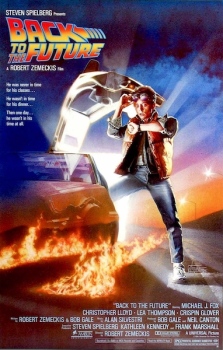
Back to the Future (1985)

100 Films’ 100 Favourites #5

He was never in time for his classes…
He wasn’t in time for his dinner…
Then one day…
He wasn’t in his time at all.

Country: USA
Language: English
Runtime: 116 minutes
BBFC: PG
MPAA: PG

Original Release: 3rd July 1985 (USA)
UK Release: 4th December 1985
First Seen: VHS, c.1991

Stars
Michael J. Fox (Teen Wolf, Stuart Little)
Christopher Lloyd (Star Trek III: The Search for Spock, The Addams Family)
Lea Thompson (All the Right Moves, Howard the Duck)
Crispin Glover (Willard, Alice in Wonderland)
Thomas F. Wilson (Action Jackson, The Heat)

Director
Robert Zemeckis (Romancing the Stone, Forrest Gump)

Screenwriters
Bob Gale (I Wanna Hold Your Hand, Trespass)
Robert Zemeckis (1941, A Christmas Carol)

The Story
After Marty McFly travels back to 1955 in a time machine invented by his friend, Dr. Emmett “Doc” Brown, he accidentally prevents his teenaged parents from meeting. It’s up to Marty to make them fall in love and therefore ensure his own existence.

Our Hero
A star-making turn from Michael J. Fox as Marty McFly, cocky teen and guitar hero.

Our Villain
Thomas F. Wilson is Biff Tannen: in the ’80s, McFly Sr’s bullying supervisor; in the ’50s, McFly Sr’s high school bully. Prone to getting covered in excrement.

Best Supporting Character
An equally iconic turn from Christopher Lloyd as Doc, mad scientist extraordinaire.

Memorable Quote
“Roads? Where we’re going, we don’t need roads.” — Doc

Memorable Scene
The climax: Marty’s one hope to get back to 1985 is a bolt of lightning that will strike the town’s clock tower, which he can use to power the DeLorean. As the moment approaches, Doc battles to connect the wiring, and Marty must make sure the car is travelling at the right speed at the right moment… Well, of course they succeed, and Doc skips happily between the time machine’s flaming tyre tracks.

Write the Theme Tune…
In a rare case of an iconic movie theme from the ’70s and ’80s not composed by John Williams, Back to the Future’s memorable motif was composed by Alan Silvestri.

Technical Wizardry
To some, the DeLorean is a failed automobile. To a generation (and, probably, every generation since) it’s one of the most iconic movie cars of all time. “Are you telling me that you built a time machine… out of a DeLorean?” “The way I see it, if you’re gonna build a time machine into a car, why not do it with some style?” Genius.

Making of
It’s now quite well known that Eric Stoltz was originally cast as Marty, and had even started filming before it was decided he wasn’t right and was replaced with Michael J. Fox. This wasn’t after just a day or two of production, though: Stoltz filmed for four weeks, completing a significant chunk of the film. So much, in fact, that it wasn’t all re-shot with Fox: most of the material without Marty actually on screen was retained (Fox had to film reverse angles for dialogue scenes without the other actors present), and a couple of long shots in the finished film actually feature Stoltz.

Next time…
Two direct sequels (the first of which picks up immediately from the end of this one), as well as an animated series, an iconic theme park ride, a computer game from adventure maestros Telltale, an ongoing comic book that launched last year, and a semi-disastrous Secret Cinema event.

Awards
1 Oscar (Sound Effects Editing)
3 Oscar nominations (Original Screenplay, Sound, Original Song)
5 BAFTA nominations (Film, Original Screenplay, Editing, Production Design, Visual Effects)
3 Saturn Awards (Science Fiction Film, Actor, Special Effects)
6 Saturn nominations (Director, Supporting Actor (Crispin Glover and Christopher Lloyd), Supporting Actress (Lea Thompson), Music, Costumes)
Won the Hugo for Best Dramatic Presentation.

What the Critics Said
“though it is hardly one of the greater flights of cinematic imagination to be seen since science fantasy reared its head as mass appeal material again, it would be virtually impossible not to enjoy it in some way or another.” — Derek Malcolm, The Guardian

Score: 96%

What the Public Say
“nothing short of an example of screen-writing brilliance. Tightly pack[ed] and interwoven from the opening scene to the final ‘cliffhanger’ which, let’s face it, was never meant to be a cliffhanger as much as just a cool and intriguing ending to a stand alone film.” — nEoFILM

Verdict

Who knew a movie about mother-son incest could be one of the most entertaining family comedies ever made? That’s because it’s magnificently written, faultlessly performed, packed with inventiveness… oh, and because the mother is the same age as the son, doesn’t know he’s her son, and the incest doesn’t actually happen. Ah, time travel! A notoriously difficult sci-fi nut to crack, another reason BTTF succeeds is because it isn’t really about time travel. One of those times where talent and good fortune come together to craft perfect movie entertainment.

Roads? Where #6 is going, it doesn’t need roads…

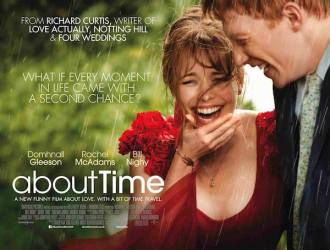
About Time (2013)

2015 #192
Richard Curtis | 123 mins | streaming (HD) | 2.35:1 | UK / English | 12 / R

After Tim (Domhnall Gleeson) learns he can time travel back through his own life, his father (Bill Nighy) cautions him not to attempt anything too drastic — so he sets about finding love.

Ostensibly another of Curtis’ oh-so-British rom-coms, it plays that way for a while, but long before it’s done develops into something deeper: Tim gets the girl (Rachel McAdams), then learns about life, family, and what you might really want to do with such power.

About Time ultimately displays an emotional depth and maturity that marks it out from its science-fiction stablemates, and the rest of Curtis’ oeuvre too.

4 out of 5

Tomorrow: more time travel in my next 100 Favourites selection.

Ender’s Game (2013)

2015 #146
Gavin Hood | 114 mins | streaming (HD) | 2.35:1 | USA / English | 12 / PG-13

Adapted from the classic young adult sci-fi novel by Orson Scott “bigoted idiot” Card, Ender’s Game is the story of Andrew “Ender” Wiggin (Asa Butterfield), who displays uncommon aptitude in a military programme to train children to fight against an alien race that attacked Earth decades earlier. Sent to a training centre in space, Ender must battle his fellow candidates to prove their worth to their hardened commander, Colonel Hyrum Graff (Harrison Ford), ready for the real battle to come.

Ender’s Game endured a pretty mixed reception a couple of years ago (not helped by the media exposure given to Card’s less-than-savoury personal views), and it’s quite a mixed film: for every positive, a negative follows close behind. It’s not helped by its first act, where the film seems to struggle with its own setup. After that, however, it’s a fairly well structured story, in which you can actually believe Ender is learning to be a better leader. Normally when a movie features “an excellent military strategist” we’re told that and never shown it, but here we see how Ender’s skills as a strategist develop and are exhibited.

The rest of writer-director Gavin Hood’s screenplay is, again, a mixed bag. The dialogue is frequently clunky, particularly struggling with exposition — there are utterly dead scenes where characters just explain the plot to each other — but, while it is at no point strong, it’s often serviceable. There are strong themes, however, several of which have relevance to our modern world. Unfortunately, none feel fully developed or explored. It tips its hat to things like drone warfare, child soldiers, and understanding our enemy, but that’s all it does: acknowledge those parallels exist, then refuse to explore them. Conversely, the music is too heavy-handed, taking on the burden of providing emotion that’s lacking from the screenplay.
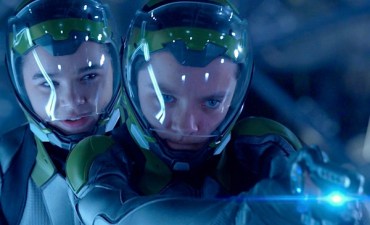
Most of the cast are very good. Asa Butterfield well conveys a moderately complex character, though I can believe others’ comments that Ender is more fully developed in the book. Hailee Steinfeld and Abigail Breslin offer able support; Harrison Ford proves he’s still awesome; Ben Kingsley battles what turns out to be a New Zealand accent (I’d assumed it was South African) in a cameo-sized turn; Viola Davis is ludicrously underused — she does basically nothing, then walks into Ford’s office and essentially declares, “I am no longer needed by the plot, I quit.”

At least there are solid action/sci-fi thrills on offer. The inter-student practice fights in the Danger Room (or whatever it was called) are really good — suitably exciting and fun, with impressive effects work. There are many good visuals in the film, but then strong CGI is par for the course these days. That’s why the space station stuff is best: the alien race and their planet are well-realised but also feel like nothing new; and the space station’s corridors, offices, and bunk room sets are well done, though as derived from familiar real-life and/or near-future styles as much as many other SF movies; but the station’s giant glass-walled zero-G training arena is stunning.

Sadly, after all that training fun, once the cadets jet off to the other side of the galaxy for a rushed third act, interest evaporates speedily. It even has to work hard to sell its own twist as a twist! (Spoilers follow in this paragraph.) In a simulation for a war, Ender does what he’d do to win that war. Then he’s told it wasn’t a simulation, it was the actual war… and he’s all cross. I mean, okay, the fella kinda has a point when he gets angry afterwards: they’ve lied to him, and maybe he would’ve behaved differently if he’d known. But the point of the training was to teach them what they needed to do to win, and it taught them that, and he did it. Maybe this twist works in the book, but in the film it felt somehow unearned.

Ender’s Game is not all it could be, but as a straightforward young-adult sci-fi action-adventure, I really rather enjoyed the majority of it.

4 out of 5

Alien (1979)

100 Films’ 100 Favourites #2

In space, no one can hear you scream.

Country: USA & UK
Language: English
Runtime: 117 minutes | 116 minutes (director’s cut)
BBFC: X (1979) | 18 (1987) | 15 (director’s cut, 2003)
MPAA: R

Original Release: 25th May 1979 (USA)
UK Release: September 1979
First Seen: TV, c.2002

Stars
Tom Skerritt (Top Gun, Poison Ivy)
Sigourney Weaver (Ghostbusters, Galaxy Quest)
John Hurt (The Elephant Man, Nineteen Eighty-Four)
Ian Holm (Greystoke: The Legend of Tarzan, Lord of the Apes, The Lord of the Rings: The Fellowship of the Ring)

Director
Ridley Scott (Blade Runner, Prometheus)

Screenwriter
Dan O’Bannon (Dark Star, Total Recall)

Story by
Dan O’Bannon (see above)
Ronald Shusett (King Kong Lives, Total Recall)

The Story
The crew of the deep-space towing vessel Nostromo receive a distress call from an unexplored planet. Contractually obliged to respond, they find a derelict alien spaceship and a field of strange eggs. With one of the crew taken ill they return to their ship, but it soon becomes apparent something else has come with them…

Our Hero
Sigourney Weaver is second-billed as second-in-command Ellen Ripley, but it’s she who’s the voice of reason and, when ignored, the most capable to stand up to the alien threat.

Our Villain
The Alien, aka the Xenomorph, an ugly, dripping, phallic nightmare, that lurks in the shadows, strikes without warning, has the perfect defence system, and is nigh-on unbeatable.

Best Supporting Character
Ian Holm’s Ash is not all he appears to be… Holm made sacrifices for his art: he hates milk, but had to sit dribbling it from his mouth for take after take.

Memorable Quote
“I admire its purity. A survivor… unclouded by conscience, remorse, or delusions of morality.” — Ash

Memorable Scene
Dinner table. John Hurt not feeling well. You know the rest. And if you don’t, you don’t want me spoiling it for you.

Technical Wizardry
The Nostromo’s industrial-style production design is a world away from the slick, shiny spaceships of contemporary sci-fi like Star Trek. A lived-in sci-fi world wasn’t something new (Star Wars and the Millennium Falcon were two years earlier, for instance), but the notion of a spaceship that looks like a factory or an oil-rig or somesuch, and that is populated by the kind of people who would work in such an environment, continues to influence the genre today.

Truly Special Effect
The Alien, designed by H.R. Giger, built by Giger and Carlo Rambaldi, performed by Bolaji Badejo, is one of the most genuinely alien creatures the movies have ever generated. It’s terrifying, too, even after the initial disgust has been neutered by decades of over-exposure in increasingly-poor sequels and tie-ins.

Making of
The name of Weyland-Yutani, “the company” the crew work for, is actually “Weylan-Yutani”, as seen on monitors and Dallas’ beer can. It was changed to “Weyland-Yutani” for Aliens (and all subsequent films and media) because James Cameron thought it looked better with the D. It’s the little things, eh.

Next time…
Three direct sequels, two “vs Predator” spin-offs, a prequel (and a prequel-sequel), and a massive array of novels, comics, video games, and the rest. A new sequel is also in development.

Awards
1 Oscar (Visual Effects)
1 Oscar nomination (Art Direction-Set Decoration)
2 BAFTAs (Production Design, Sound Track)
5 BAFTA nominations (Supporting Actor (John Hurt), Film Music, Costume Design, Editing, Most Promising Newcomer to Leading Film Roles (Sigourney Weaver))
3 Saturn Awards (Science Fiction Film, Director, Supporting Actress (Veronica Cartwright))
4 Saturn nominations (Actress (Sigourney Weaver), Writing, Make-Up, Special Effects)
Won the Hugo for Best Dramatic Presentation.

What the Critics Said
“It’s tempting to describe the brilliantly staged scenes of horror and surprise but it would be a shame not to allow the film to reveal its own secrets. Enough to say that the tension is savage and you are held in suspense right up to the end frames.” — Ted Whitehead, The Spectator

Score: 97%

What the Public Say
“in some ways it doesn’t betray its age, and it does indeed largely still hold up, but in other ways its utterly unlike contemporary films. Its middle-aged cast, its slow, deliberate pace, the ‘real’ sets grounded in reality, how it leaves so many things unexplained — in these respects it’s obviously an older movie, and better for it.” — the ghost of 82

Elsewhere on 100 Films
I reviewed Ridley Scott’s 2003 Director’s Cut back in 2009, summarising that “to fans intimately familiar with the film, the number of trims (there are rather a lot apparently) and new scenes (just four) make a huge difference, but for a more casual viewer they don’t significantly change how it feels. That said… I’d call the original as the superior cut.”

Verdict

Ridley Scott’s “haunted house movie in space” is one of those works that an awful lot of what follows in the genre owes a debt to, from the production design to one of cinema’s most iconic heroines. “Iconic” is a good word for the film as a whole, be it the realisation of the creature or scenes like the chestburster. Quite beyond that, however, it’s a terrifying horror movie in its own right, where slowly-built tension gives way to proper scares. Being a great of one genre is an achievement, but to be great in two at the same time (horror and sci-fi, of course) is something else.

#3 is not about Vietnam… it is Vietnam.

Jurassic World (2015)

2015 #154
Colin Trevorrow | 124 mins | Blu-ray | 2.00:1 | USA & China / English | 12 / PG-13

22 years ago, Jurassic Park was the first film I saw at the cinema. I was still of an age when all boys seem to find dinosaurs awesome, and of course everyone was talking about this spectacular film and its groundbreaking effects. Plus it was from Steven Spielberg — it feels daft I’d’ve known that at the time, but I was already a certified fan of the Indiana Joneses, so maybe. Either way, I was suitably awestruck, and have always been a little pleased my first big screen experience was such a good movie.

It seems now that I’m of a generation which has secretly held Jurassic Park in a level of esteem that earlier generations had for, I don’t know, Star Wars, maybe. Secret, that is, until Jurassic World came out this summer and, quite to everyone’s surprise, blew all predictions out of the water with the largest opening weekend gross of all time, both in the US ($208.8m) and internationally ($315.6m), totalling the first time a film grossed more than $500 million in one weekend. It ultimately passed The Avengers to be the third highest-grossing film of all time, taking in 40 days what the Marvel team-up needed 133 to achieve.* It was largely well-reviewed too, albeit with some dissenters, so it had a lot to live up to.

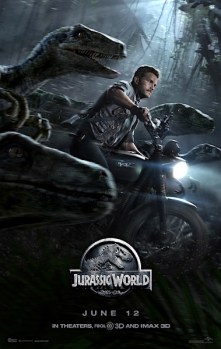
For me, it met that watermark. Okay, the plot is fundamentally a rehash of the first movie, but the devil is in the details, and in my book Jurassic World does enough new to shrug off any kind of “stealth remake” allegations. What it does definitely retain is a faithfulness to the Spielbergian tone of the first movie — a stated goal of director/co-writer Colin Trevorrow, and one I feel he’s absolutely pulled off. There’s adventure, humour, a sense of scale and wonder. Even the music’s right: in the same way his theme to Star Wars is the herald of a classical epic, and his theme to Indiana Jones is a call to adventure, John Williams’ equally-peerless theme to Jurassic Park is an ode to wonder, and composer Michael Giacchino deploys it wisely here, saving it for key moments when that sense of awe is front and centre once again. Even some of the film’s ‘problems’ aren’t, in my eyes. Does it spend too long wandering around the park before the big action starts? Not for me… which I guess is a viewpoint that comes with all the caveats of my opening paragraph. I rather suspect this is a movie that was very literally made by fans, for fans.

In that respect, I saw Jurassic World as a movie that was eager to please its audience. It may not always fully conform to logic, and some of its plot developments may be a little far-fetched for some, but it’s been crafted in a way that’s designed to tickle the fancy or scratch an itch among a spectacle-and-fun-seeking blockbuster audience. Sure, the film was greenlit to make loadsa money — what sequel (heck, what film) isn’t — but that doesn’t mean the people who were actually writing, directing, filming, designing, CGI’ing, and everything-else-ing the movie didn’t have pure intentions. Goodness knows how Trevorrow — whose sum total previous directorial experience is an overrated indie rom-com with a vague, underdeveloped sci-fi element — landed this gig, but he does a bang-up job with it. No wonder they’ve given him the keys to a Star Wars saga movie. (That’s a helluvan escalation across just three films, though! Has any other director ever shot so high so fast?)

I realise this review is a bit of a vague gush of praise, so one element that particularly intrigued me was the decision to shoot the film in a 2:1 aspect ratio. There’s some detail on the reasoning here (as well as general information on shooting choices, like the types of film and digital photography used), but essentially it was a compromise between Trevorrow and DP John Schwartzman favouring the blockbuster-standard 2.4:1 (so as to not look like a TV programme) and producer Spielberg wanting 1.85:1 (to favour the dinos’ height). I can’t speak to how it worked in cinemas, but 2:1 is actually a really pleasurable ratio for home viewing. Some 1.85:1 movies do just feel like big-budget TV episodes nowadays (which says as much about how far TV has come, in terms of its visual style, as it does anything else), but 2.35:1 can feel a little too wasteful of screen real estate (as a believer in presenting films in their original ratio (as we all should be) you tend not to question it, but looked at objectively, 2.35:1 on a 16:9 telly is kinda silly. (Not that I’m advocating those daft-looking 21:9 TVs they made a couple of years ago, mind.)) I’ve no idea if 2:1 is likely to catch on more widely (I bet Vittorio Storaro hopes so), but I would quite like if it did.

I kind of felt like Jurassic World plugged directly into whichever part of the brain is responsible for pleasure and just downloaded itself there. I know it’s flawed; even as I was watching it, there were bits that made me go, “really?” Consequently, this review was originally pegged with a four-star rating — no doubt in part influenced by all the other not-completely-praise-filled opinions out there. But, thinking back on it, I just enjoyed it. I think I’ve outlined the main reasons why that was the case, and why I’m able to put aside the niggles. Maybe I’m going soft? (See also: my reviews of poorly-received 2015 blockbusters Tomorrowland and Terminator Genisys.) On the bright side, I watched Jurassic World and had a really good time — that’s what blockbusters are fundamentally for, isn’t it?

5 out of 5

Jurassic World placed 12th on my list of The 20 Best Films I Saw For the First Time in 2015, which can be read in full here.

This review is part of the 100 Films Advent Calendar 2015. Read more here.

* Obviously The Force Awakens has already obliterated most of these records (but not all of them). Nonetheless, Jurassic World’s still-phenomenal success remains part of an extraordinary year for Universal, who have also had two other films (Furious 7 and Minions) surpass $1 billion in 2015. They even broke the previous record for full-year studio gross (Fox’s $5.53 billion) in August. They’re not normally so successful (their best result in the ‘studio league table’ for the past decade was third, but they’re usually fifth or sixth), and I rather like Universal — possibly just because of their awesome logo and fanfare, possibly because of their cool theme parks, or possibly even because of their rich history of great movies — so this story has made me unduly happy as it’s developed since the summer. ^

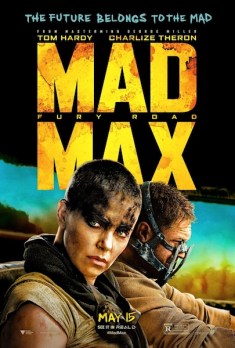
Mad Max: Fury Road (2015)

2015 #142
George Miller | 120 mins | Blu-ray | 2.40:1 | Australia & USA / English | 15 / R

After a decades-long diversion into children’s movies like Babe: Pig in the City and Happy Feet, director George Miller here returns to the post-apocalyptic action series that made his name, and in the process managed to create a blockbuster that was not only critically acclaimed and well-received by audiences, but looks set to be a major award season contender too.
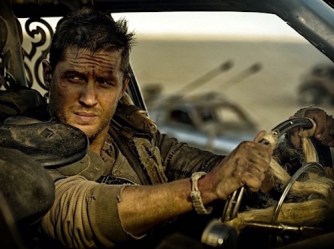
The story sees future drifter and sometime-hero Max (now played by Tom Hardy) arrive in a town ruled by Immortan Joe (Hugh Keays-Byrne), who keeps the populace in check by controlling the flow of water. He’s also created a heavily caste society, including suicidal warriors like Nux (Nicholas Hoult) and his Five Wives (Rosie Huntington-Whiteley, Riley Keough, Zoë Kravitz, Abbey Lee Kershaw, Courtney Eaton), who he keeps locked away for breeding purposes. During a routine run for oil, Joe’s best driver, Imperator Furiosa (Charlize Theron), veers off course, and it’s soon discovered it’s a bid for freedom with the wives. Joe and his amassed forces give chase. For the rest of the film.

You can certainly watch Fury Road as just a two-hour chase and (presuming you like action antics) get something out of it. The volume of action, the style with which it’s executed, and the impressive audacity of the stuntwork, all mean the film functions on a purely visceral level. That said, the action sequences are almost more incredible for how they were achieved than for how they’re presented in the finished film. The end product is perhaps a little too frenetic, the CG boosts a little too heavy-handed — all the talk of “doing it all for real” may be more or less true, but it feels like an awful lot of that ‘reality’ has been augmented with wire/rig removal and the compositing of multiple practically-performed stunts into single shots. The end result is unquestionably better than empty pure-CGI mayhem, but the awe-inspiring impressiveness of the stunt performers’ work is better conveyed in the special features than the film itself.

I say that, but the finished film is visually stunning on two levels: cinematography and editing. It was shot by John Seale, and Miller had him amp up the saturation. The point was to do the opposite of most post-apocalyptic blockbusters, which are normally desaturated to heck, and it indeed creates something strikingly different. Conversely, Miller has intimated the ideal version of the movie is in black and white with no dialogue, just the score — completely visually-focused storytelling. I have a feeling he’s right, or that it would at least work well. Some nuance would be lost, but all the major plot points and character arcs would be followable.
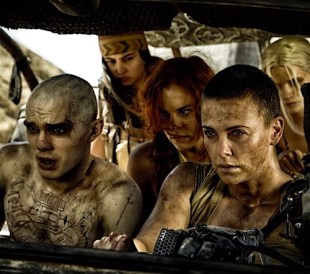
This is in part thanks to Margaret Sixel’s editing. Chosen precisely because she’d never edited action before, Sixel brings classical touches to the work — like eye trace and crosshair framing — that keep the film exceptionally followable even in the midst of some fast cutting. The one poor choice, in my opinion, is the occasional use of a ‘step’-y effect, which just makes it look like you’re streaming on a not-quite-fast-enough connection or watching a badly-encoded pirate downloaded. I thought it might’ve been a badly produced Blu-ray at first, but apparently it was like this in cinemas too.

For those after more than just action and visuals, the film does have something to offer — despite what you might’ve heard. I think some more dismissive viewers miss it because, a) you don’t expect it, and b) it’s achieved so economically. The characters, relationships, and situations are quickly sketched in, be it through well-placed snatches of dialogue or with purely visual storytelling, but all are deftly executed. That it doesn’t expound on these at length, or linger on their detail, means you have to pay attention to get the most out of that side of the film. I guess some would counter that with, “you have to look hard because you’re reading something that isn’t there,” but I refute that. That it doesn’t spell everything out at length, or hammer home its points and themes heavy-handedly, is a good thing.
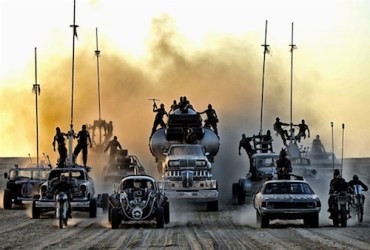
Relatedly, the Mad Max series has always been concerned with legend and mythology, both its own and the classical ideas of such. The latter informs the general style and shape of the narratives: these are legends of heroism, perhaps passed down orally from one teller to the next, emphasising the scale of the derring-do. This endures even though Max is, in some respects, the supporting lead in his own film (it even uses the old Towering Inferno left-low/right-high billing at the start for Hardy and Theron). As for the series’ own mythology, that’s well continued here, with significant additions to Max’s storied array of characters and situations: Immortan Joe, Imperator Furiosa, the Five Wives, the War Boys…

With all that considered, that Fury Road is only the second best film in the Mad Max series is merely testament to the enduring excellence of the first sequel. However, there’s possibly an element of expectation in this opinion: I expected basically nothing of Mad Max 2, particularly after I had mixed feelings about the first film (even though the sequel’s fame and acclaim is greater). Fury Road, on the other hand, has been relentlessly hyped by critics and viewers alike ever since it came out — a very different starting perspective. How much effect did this have? Impossible to say. A true comparison would necessitate watching them back-to-back in a few months, or even years, divorced of that initial build-up. Even then I’d be carrying in my memories of my initial viewings. Point being: it’s impossible to be entirely objective; to divorce a film (or films) from some kind of personal context. (Ooh, that turned a bit philosophical, didn’t it?)
Whatever. There can be no doubt that Fury Road is an exceptional achievement in visuals-driven action-adventure moviemaking, which merits its inclusion in discussions of 2015’s finest works of cinema.

5 out of 5

For my review of the “Black & Chrome” version of Fury Road, look here.

Mad Max: Fury Road placed 6th on my list of The Ten Best Films I Saw For the First Time in 2015, which can be read in full here.

This review is part of the 100 Films Advent Calendar 2015. Read more here.

Avengers: Age of Ultron (2015)

2015 #130
Joss Whedon | 141 mins | Blu-ray | 2.40:1 | USA / English | 12 / PG-13

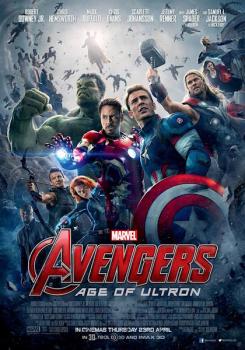
Avengers: Age of UltronIt feels kind of pointless reviewing Avengers: Age of Ultron, the written-and-directed-by Joss Whedon (and, infamously, reshaped-in-the-edit-by committee) follow-up to 2012’s “third most successful film of all time” mega-hit The Avengers Marvel’s The Avengers Avengers Assemble Marvel Avengers Assemble. In terms of consumer advice, you’re not going to watch this sequel without having seen the first, and therefore “more of the same (more or less)” will suffice for a review. In terms of a more analytical mindset… well, what is there to analyse, really? I’m not sure this movie has anything to say. “Of course it doesn’t, it’s a blockbuster,” you might counter, which I think is unfair to blockbusters. Not to this one, though. Nonetheless, I have a few thoughts I shall share regardless.
Firstly: Marvel’s initially-stated goal of keeping each of their film series separate enough that you don’t need to watch them all has clearly gone out the window by this point. Okay, you really needed a fair bit of knowledge from The First Avenger and Thor to fully understand Avengers Assemble (indeed, as I noted at the time, that first team-up movie is practically Thor 2), but I reckon you could get by without. In between, things have got worse: jumping from any of the pre-Avengers films to their post-Avengers sequel without viewing the team-up movie renders them semi-nonsensical, and now swathes of Age of Ultron make little sense without at least having seen Captain America: The Winter Soldier, which fundamentally shifted the status quo of the Marvel Cinematic Universe.

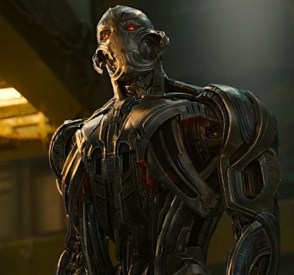
That’s not all, though, because Age of Ultron is also concerned with setting up the future. Far from being self-contained, there’s heavy-handed set-up for Avengers 2.5: Civil War Captain America: Civil War, Thor: Ragnarok, and the two-part Avengers: Infinity War. Titular threatEven though the first half of that is still three years away, we’re still very much on the road to it. Heck, we have been practically since the MCU began, thanks to those frickin’ stones (if you don’t know already, don’t expect me to explain it to you), but now it’s overt as well as laid in fan-friendly easter eggs. The titular threat may rise and be put down within the confines of Age of Ultron’s near-two-and-a-half-hour running time, but no such kindness is afforded to the myriad subplots.

Said threat is Ultron, a sentient robot born of Tony Stark’s work, who seeks to make the world a better place by obliterating humanity. As played by James Spader, it seems like Whedon has created a villain in his own image. Oh sure, every character speaks a little bit Whedon-y, but Ultron’s speech pattern, syntax, tone, and sense of humour is often reminiscent of how Whedon himself sounds in interviews; and if you told me Spader was doing a Joss Whedon impression for the voice, I’d believe you. Considering the well-publicised behind-the-scenes wrangles the film went through, especially in post-production, it does make you wonder how conscious it was — Whedon casting himself as a villain with good intentions who’d like to destroy the Avengers. Something like that, anyway.

A behind-the-scenes story Marvel Studios are more keen to emphasise is how they did a lot of real-world-related stunts for real, like in the Seoul bike/truck/Quinjet chase, for instance (you know, the one where Black Widow is on the bike in the film but controversially not in the toy because of the “no girl toys!” rule). Behind-the-scenes features on the film’s Blu-ray detail the extent they want to in closing down real locations, performing dangerous or hard-to-achieve stunts, and so on and so forth. You have to wonder why they bothered, because there’s so much CGI all over the placeNo one wants to play with Scarlett Johansson (not just obvious stuff like the Hulk, but digital set extensions, fake location work, even modifying Stark’s normal Audi on a normal road because it was a future model that wasn’t physically built when filming) that stuff they genuinely did for real looks computer generated too. All that time, all that effort, all that epic logistical nightmare stuff like shutting down a capital city’s major roads for several days… and everyone’s going to assume some tech guys did it in an office, because that’s what it looks like. If you’re going to go to so much trouble to do it for real, make sure it still looks real by the time you get to the final cut. I’ll give you one specific example: Black Widow weaving through traffic on a motorbike in Seoul. I thought it was one of the film’s less-polished effects shots. Nope — done for real, and at great difficulty because it’s tough to pull off a fast-moving bike speeding through fast-moving cars. What a waste of effort!
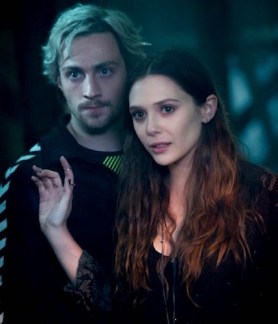
Effort invested elsewhere has been better spent, however. For instance, this is a Joss Whedon movie, so we all know somebody has to die. Credit to Whedon, then, for investing in a thorough attempt at misdirection. He goes all-out to imply that (spoiler!) the bucket shall be kicked by Hawkeye: the archer has suddenly got a bigger role; we get to meet his family; every time there’s a montage and someone starts discussing sacrifice or the inevitability that they won’t all survive, it’s Barton who’s on screen; he’s the most sacrificeable Avenger anyway, the only one with neither his own movie nor fan demand for one; and Jeremy Renner’s dissatisfaction with the role he got in Avengers 1 has been well documented. If anything he goes too far in that direction — it’s so obvious Hawkeye’s for the chop that it’s not wholly surprising when there’s a ‘twist’ and (bigger spoiler!) the even-more-dispensable Pietro Maximoff (he apparently has just seven lines in the entire film) is the one who make The Ultimate Sacrifice. Which is… neither here nor there, really.

Double troubleThe really daft thing is, Whedon specifically added Scarlet Witch and Quicksilver… wait, are Marvel allowed to call them that? I forget. Anyway, Whedon added the Maximoff twins because, as he said himself, “their powers are very visually interesting. One of the problems I had on the first one was everybody basically had punchy powers.” I know Hawkeye’s power is more shoot-y than punchy, and we all know X-Men used the silver speedster even better, but still… Well, I guess it’s not his problem anymore. Nor is the fact the film ends with a radically new status quo, including most of the big-name heroes having sodded off to leave a 66%-replaced Avengers line-up… which will be completely shattered almost instantly in next year’s Captain America: Basically The Avengers 3. But hey, nothing lasts forever, right? Or even a whole movie, it would seem.

Other people’s opinions, and the expectations they foster, have a lot to answer for when you first watch these films months after release. I found the first Avengers to be massively overrated — only sporadically fun; not that funny; in places, really quite awkward, or even dull. I couldn’t really enjoy it; it just was. This sequel, on the other hand… isn’t underrated, but comes with so much negative, niggly baggage that, with lowered expectations, I was able to just enjoy it on a first viewing. I found it funnier than the first; I thought the characters and their relationships were smoother. It’s still flawed (the Thor arc is clearly bungled; the climax is too much; stuff they did for real, at great expense and difficulty, looks like CGI; and so on), but no more than the first one. I think people’s over-hyped memories make them think it’s worse than it is by comparison. Then again, there’s no accounting for taste — there are definitely things people have criticised about the movie (the level and style of humour; the focus given to Hawkeye) that were actually among my favourite parts.

Some assembly requiredAt the end of the day, what does it matter? Age of Ultron isn’t so remarkably good — nor did it go down so remarkably poorly — that it deserves a reevaluation someday. It just is what it is: an overstuffed superhero epic, which has too much to do to be able to compete with its comparatively-simple contributing films on quality grounds, but is entertaining enough as fast-food cinema. Blockbusterdom certainly has worse experiences to offer.
4 out of 5

Avengers: Age of Ultron is on Sky Movies Premiere from Boxing Day.

This review is part of the 100 Films Advent Calendar 2015. Read more here.

Terminator Genisys (2015)

2015 #185
Alan Taylor | 126 mins | Blu-ray | 2.39:1 | USA / English | 12 / PG-13

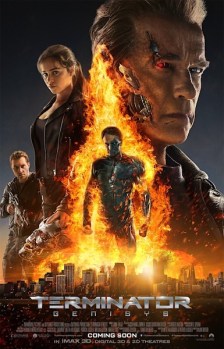
Terminator GenisysI liked Terminator Salvation. There, I said it. (I also said it in my review, so, y’know, not news.) Not many other people agreed, however, meaning plans for a new wave of Terminator films in its wake were abandoned. Fast-forward a few years, past a load of complex and dull rights wranglings, and we reach this: one of the biggest critical flops of 2015. It also flopped with audiences in the US, taking under $90 million, but fared better internationally, to the tune of $350 million — making it the franchise’s second highest grossing film, in fact. Nonetheless, perception has hewed closer to the critics’ take. Is that vitriol deserved?

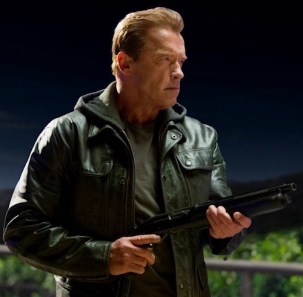
The story begins in the future war against the machines, where an army of humans led by John Connor (Jason Clarke) and Kyle Reese (Jai Courtney) storm a Skynet facility and find a time machine that has recently sent a Terminator back to 1984 to assassinate Connor’s mother, Sarah (Emilia Clarke), before she’s given birth to John. Reese volunteers to go back and save her. Now, this is where the film leans on being the series’ fifth — we’re expecting him to land in the first film. And at first he does… until a T-1000 (the one that turns into metal from T2) turns up, and Sarah rocks up to save Reese — accompanied by an aged T-800 (Arnold Schwarzenegger), who arrived decades ago and has been protecting and training Sarah ever since.

At this point, some people will already be predisposed to hate the film. Why mess with a classic, etc. I can see where they’re coming from; at the same time, it’s an interesting idea. Time travel is a key part of the Terminator series, and John grows up with the knowledge that one day he will send Reese back to 1984 to save his mother — but what if Skynet knew that too? That would change what both John and the computer did, surely? What are the ramifications of that? (And even if you’re not interested, the original Terminator is still there — they’re not re-editing it or removing it from circulation or something — so if you don’t want it affected, that’s fine.)

Come with me if you want to meet some dragonsNow, a good idea doesn’t guarantee a good execution, and here is where we begin to encounter Genisys’ problems. Time travel is a tricksy thing to engage with in fiction, and is highly prone to creating plot holes — something blockbusters regularly struggle with anyway. Genisys has at least one glaring one. Then there’s the general level of quality — the screenplay, acting, effects, and so on. In this regard, I suspect the reason so many people reacted so badly to it is that it follows, and riffs off of, two of the greatest sci-fi/action movies ever made. In and of itself, Genisys is no worse than any of the other half-dozen-or-so middle-of-the-road $150-million-plus-budgeted blockbusters we’re routinely served every year now. If you instead compare it to its iconic forebears, however, it comes up much shorter.
I think one of the major problems is the direction. Marvel hired Alan Taylor for Thor 2 because of the perception that he knew how to handle fantasy thanks to Game of Thrones. That and because, as a TV director, he would’ve been cheap, and Marvel like their directors cheap (and consequently controllable). Clearly the success of Thor 2, such as it was, was parlayed into this big directing gig. I’m just not sure Taylor has the chops for it. The fight scenes are muddled, riddled with close-ups and too many cuts. Not a unique problem these days, of course, but after, what, a decade of that style being criticised, you’d think they’d’ve finally wised up. Nowadays it looks cheap. Most of the direction looks cheap. This is an expensive movie, with lots of practical stunt work, but it never looks it; and those stunts were mostly done on green screens or with the aid of wires here and there, so they’ve ended up CGI’d too. And the CGI looks surprisingly cheap. The Terminator films used to be right at the cutting edge of effects; now it’s just any old blockbuster.

Ex-TerminatorAnd yet the man who was responsible for those remarkable pictures, James Cameron, was impressed by it. He’s interviewed among the film’s special features, where he explains, “can I guarantee that you’ll enjoy it? No. I just know that I enjoyed the film, you know. But I strongly suspect that… you’re gonna love this movie.” Well, he was way wrong there! You almost feel a bit sorry for everyone in those special features, actually. They’re all so confident that Genisys is a great, well-made movie that everyone’s going to love, and they have big plans for a trilogy which they keep talking up. I would love to see their reactions after the reviews and box office figures came in…

So, Terminator Genisys is not a good movie… but I don’t really think it’s a bad one, either. It just sort of is. The action palaver is passable, the plot at times interesting, the developments and twists on the series’ history… well, your mileage will vary. It didn’t help anyone that they were in the trailer, but I’m not sure people would’ve reacted any better if it hadn’t been spoiled. Still, it shouldn’t’ve been spoiled. Stupid marketing people.

Could Terminator Genisys be a lot better? Definitely. Could it be worse? Definitely. I didn’t mind it.

3 out of 5

This review is part of the 100 Films Advent Calendar 2015. Read more here.