

Look for a way out.
Country: Canada
Language: English
Runtime: 90 minutes
BBFC: 15
MPAA: R

Original Release: 11th July 1998 (Netherlands)
UK Release: 25th September 1998
First Seen: TV, c.2000
Stars
Maurice Dean Wint (Rude, Nothing)
David Hewlett (Scanners II: The New Order, Cypher)
Nicole de Boer (Star Trek: Deep Space Nine, Corrupt)
Nicky Guadagni (Crash, Lars and the Real Girl)
Wayne Robson (Interstate 60: Episodes of the Road, Survival of the Dead)
Director
Vincenzo Natali (Cypher, Splice)
Screenwriters
Andre Bijelic
Vincenzo Natali (Splice, In the Tall Grass)
Graeme Manson (Rupert’s Land, Orphan Black)
The Story
Six strangers wake up inside a mysterious 14-foot cube, its walls covered with circuit-like designs and each wall containing a door… which leads to another cube, identical but for the colour scheme. They soon realise that some of these rooms are boobytrapped with death-dealing devices. If they combine their different backgrounds and strengths, perhaps they can find a way out…
Our Heroes
The six individuals we follow are a fractious bunch. You may side with one or two, but at any given moment something might happen to make you rethink who should or should not be trusted.
Our Villain
The Cube itself is the enemy here… although with the amount our group fight amongst themselves, maybe it’s not the only problem…
Best Supporting Character
Part way through the film, our gang come across Kazan, who clearly has some kind of mental problem. I thought Andrew Miller’s performance was decent, but pretty much every other review of the film criticises all of the acting, and I’ve never seen Rain Man (a regular point of comparison), so who knows?
Memorable Quote
Holloway: “What does it want? What is it thinking?”
Worth: “‘One down, four to go.'”
Memorable Scene
The opening scene, which quickly establishes the danger of the environment so succinctly and memorably that Resident Evil ripped it off a few years later.
Technical Wizardry
The characters move through many rooms in the cube, a challenge for a low-budget production… unless, of course, all the rooms are nearly identical: there was only one cube set, with coloured panels changed to suggest the different spaces.
Making of
All of the characters are named after famous prisons around the world. Not only that, but their personalities reflect the characteristics of those prisons. To say too much might spoil parts of the film for those who’ve not seen it, but the curious can find a fuller explanation here.
Next time…
There are two sequels to Cube, Hypercube and Cube Zero, each worse than the last. Don’t waste your time.
Awards
1 Saturn nomination (Home Video Release)
Toronto International Film Festival — Best Canadian First Feature Film
What the Critics Said
“They don’t agree on the best course of action, and might one of them be a spy for whomever is in charge? The grating mechanical noises that echo through the Cube all around them seem to be the manifestation of the stress they’re under, stress they act out on one another. Holloway estimates they have only a few days without food and water before they’re too weak to continue, and yet they slow themselves down with their virulent bickering. […] As Rennes says, “Ya gotta save yourselves from yourselves,” and they’re not doing a terribly good job of that.” — MaryAnn Johanson, flickfilosopher
 Score:
 62%
62%What the Public Say
“you can’t make [the plot] sound interesting — “for 90 minutes, people move through largely identical cubic rooms that want to kill them”. But it is interesting, mainly, and here’s where the Twilight Zone comparison is useful. […] the cast ends up filling somewhat allegorical roles: the Teacher, the Authoritarian, the Intellect, the Survivalist. And Cube, in finest Rod Serling fashion, plays out as a series of conundrums in which the audience is invited to think about how these different types, that is to say, these different worldviews and moral codes, interact with each other in a patently allegorical environment” — Tim Brayton, Antagony & Ecstasy

Elsewhere on 100 Films…
I offered some thoughts on Cube when I watched the two sequels back in 2008: “In its series of careful, measured, necessary reveals, the film strikes a perfect balance between what it lets the viewer know — and the revelations are expertly paced throughout — and what it keeps hidden, either for the viewer to deduce or interpret for themselves, or simply because one doesn’t need to know. […] everyone interested in the more intelligent end of the sci-fi spectrum should see Cube.”
Regular readers will know of my fondness for the single-location thriller. A lot of that likely stems back to Cube, which I think pioneered the form as a popular one for new filmmakers making low-budget genre pictures, and is the yardstick all others must measure up to, at least for me. Throw a mismatched group of characters into a confined, mysterious setting and, hey presto, instant drama. Cube remains one of the best because of both the mysteries of its location, and the pure tension director Vincenzo Natali creates as the cast try to avoid or evade the deadly traps.

Next… yippee-ki-yay, #23 !
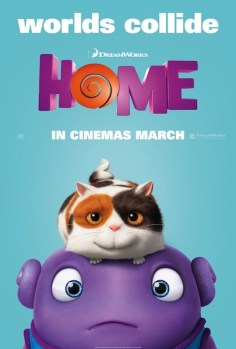 Oh (Jim Parsons) is a Boov, a race of friendly aliens looking for a new home planet to escape their enemies. When they arrive on Earth, Oh tries to invite everyone to a party, but accidentally alerts their enemies to their new home. Outcast, he bumps into Tip (Rihanna), a girl accidentally left behind when the rest of mankind was relocated by the Boov. Desperate for friendship, Oh agrees to help her find her mother.
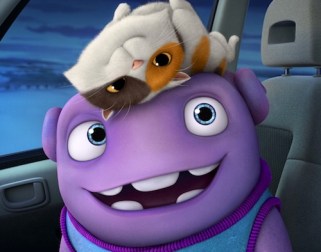 but the entire universe, including our enemies”? Why is there no option to cancel such a transmission that is going to take 40 hours to reach said enemies? I mean, that last one’s a stupid question, because why is there even a way to message the enemies?
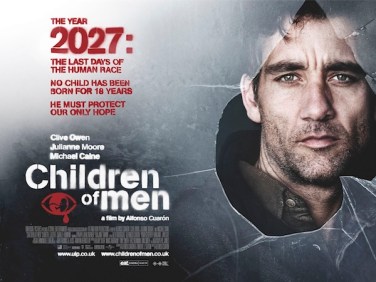


 Most of mankind have become vampires, but the blood supply is running out and without it people mutate into monsters. Ethan Hawke’s scientist is developing a substitute, but when he encounters human resistance fighters he learns there may actually be a cure…
 Well now, hasn’t this been a long time coming? Just over two years since its western disc release was first announced, just over three years since it debuted in Japanese cinemas, and just over four-and-a-half years since
  Change, and the embracing or rejection of it, is surely one of the major themes of Evangelion. This is more explicitly debated as 3.33 moves into its middle section, where we get an extended dose of Shinji’s traditional insecurities. Hey, it wouldn’t be Evangelion without Shinji having a self-pitying whinge, right? Fortunately there’s more going on than that, but this is a section light on action and heavy on the series’ more thoughtful elements. There are answers to some of the mysteries, but it again wouldn’t be Evangelion if it all made easy sense. At the same time, Shinji bonds with new Eva pilot Kaworu. A controversial character, apparently, and not just because of the homosexual overtones (which some reviewers claim to miss, presumably because they’re blind), but the scenes where they harmonise by playing piano together are quite fantastically animated.
 3.33 divides quite neatly into three half-hour sections. I guess that should be expected, as the whole tetralogy has been based in traditional Japanese ideas of narrative/musical structure, hence the films’ Japanese titles incorporating the names for the three movements: jo, ha, and kyū (序破急), which roughly equate to “beginning”, “middle”, and “end”. As discussed, the first is fantastic, some of the best material in the entire series, in my estimation. Also as discussed, the second is a lot slower, but has its plus points too. The third… ah, the third. Here we get some more action, which will please anyone who thrills to Eva combat, but it is also utterly mind-boggling. I’ve been reading up on a few fan sites since watching, and I’m still not absolutely sure what was going on or what it signified. You won’t find any enlightenment in the disc’s special features, which present a long list of extras at first glance, but turn out to be 19 repetitive trailers, TV spots, and promo reels. Yes, nineteen.
 So when will that conclusion come? Well, a few years ago Anno ‘joked’ that the finale might be released “four to six years” after 3.33. As we’re already almost at four years with no sign of a release date, I guess it wasn’t so much of a ‘joke’ after all. An English-friendly DVD/Blu-ray will inevitably take an additional couple of years, too. So an indefinite, but undoubtedly lengthy, wait begins…
 2016 Academy Awards
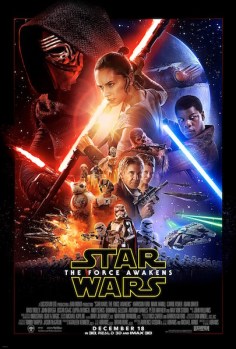 Star Wars: The Force Awakens is not the best film of 2015. Not according to the Academy of Motion Picture Arts and Sciences, anyway, who didn’t see fit to nominate it for Best Picture at tomorrow’s Oscars. Many fans disagree, some vociferously, but was it really a surprise? The Force Awakens is a blockbuster entertainment of the kind the Academy rarely recognise. Okay, sci-fi actioner
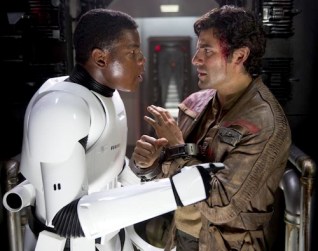
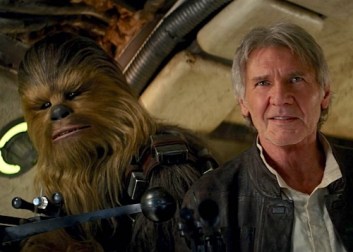
  I too could talk about the likeable new heroes; the triumphant return of old favourites; the underuse of other old favourites; Daisy Ridley’s performance; John Boyega’s performance; the relationship between Rey and Finn; the relationship between Finn and Poe; the success of Kylo Ren and General Hux as villains (well, I thought they were good); the terrible CGI of Supreme Leader Snoke; the ridiculous overreaction to the alleged underuse of Captain Phasma; that awesome fight between the stormtrooper with that lightning stick thing and Finn with the lightsaber; the mystery of Rey’s parentage; the mystery of who Max von Sydow was meant to be (and if we’ll ever find out); some elaborate theory about why Ben wasn’t called Jacen (there must be one — elaborate theories that will never be canon are what fandoms are good for); the way it accurately emulates the classic trilogy’s tone; the way it’s basically a remake of
 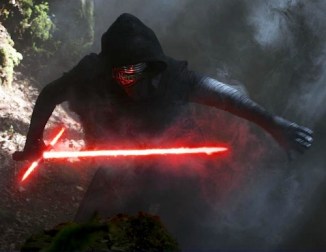 J.J. Abrams seems to have tricked some people into thinking he’s a great director with The Force Awakens (rather than just a helmer of workmanlike adequacy (when he’s not indulging his lens flare obsession, at which point he’s not workmanlike but is inadequate)), and I think that’s partly because it’s quite classically made. Yeah, it’s in 3D, but the style of shots used and — of most relevance right now — the pace of the editing help it feel in line with the previous Star Wars movies. Some of the more outrageous shots (often during action sequences) stand out precisely because they’re outside this norm. Perhaps we take for granted that Abrams delivered a movie in keeping with the rest of the series, because that’s The Right Thing To Do, but that doesn’t mean he had to do it. And the transitional wipes are there too, of course.
 No one knows what the difference is between these two categories. I’m not even sure that people who work in the industry know. As a layperson, it’s also the kind of thing you tend to only notice when it’s been done badly. The Force Awakens’ sound was not bad. It all sounded suitably Star Wars-y, as far as I could tell. That’s about all I could say for it. It feels like these are categories that get won either, a) on a sweep, or b) on a whim, so who knows who’ll take them on the night?
 “restraint […] applying the basic filmmaking lessons of the first trilogy,” according to
  those elements aren’t gone about in an awards-grabbing fashion anyway. In the name of blockbuster entertainment, however, they’re all highly accomplished.

 British Academy Film Awards 2016
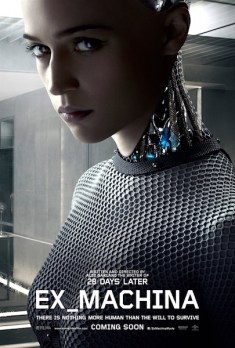 A British sci-fi movie from a first-time director will tomorrow take a place at the table (well, in the auditorium) alongside 2015’s biggest awards contenders, as it vies for multiple gongs at this year’s BAFTAs — and it stands a very plausible chance of walking away with several of them, too. I hope it does, because, after a year that brought us awards-quality sci-fi bombast (
 In truth, it’s not the most thorough deconstruction of what it means to be human and whether artificial intelligence can have that right, but it does touch on these issues and, in so doing, leaves them open for the viewer to mull over for themselves, or debate with friends, or however else one likes to consider their movies post-viewing (like, I dunno, writing about them on the internet or something).
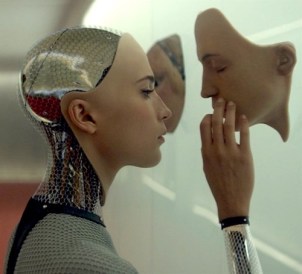 And his dance scene is surely one of 2015’s highlights (there’s an extended version hidden on the US Blu-ray, which is a treat). Garnering the most praise (and awards) is Alicia Vikander’s take on an AI. It’s a tricky role to tackle, because she’s not just a robot — that would defeat the point of Nathan’s exercise — but nor is she fully human. It’s a tightrope of a role, a fine line to walk, and Vikander negotiates it with aplomb. To say too much more would be to spoil it.
 Those after a dissertation-like hard-science deconstruction of the meaning and possibilities of AI will likely find Ex Machina slightly lacking, as will anyone after the crash-bang thrills most mainstream sci-fi provides. Viewers prepared for a decently thought-provoking dramatic thriller about near-future tech, however, should be both engrossed, and grateful that movies like this are (for the time being) still getting made.
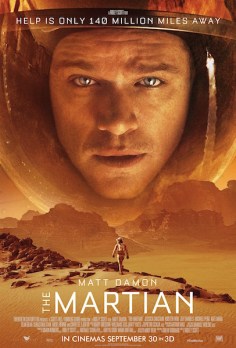 Ridley Scott’s latest arrives on Blu-ray in the UK today, with a disappointing dearth of special features (disliked
  Whether that’s appropriate or not is another matter. A well-argued
 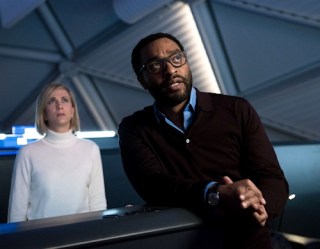 While Damon is stuck on Mars by himself, a starry supporting cast actually get to interact with each other. This is a quality ensemble and, short of writing an epic essay of a review where I just praise them all one by one, there’s little to do but list their names. That said, Jessica Chastain gets the most brazenly emotional beats as the commander who chose to leave Watney behind and has to face the consequences of her decision; Jeff Daniels treads a line between being an evil bureaucrat and just a regular bureaucrat (apparently consideration was given to turning him into a full-blown villain; thank goodness they swerved that bullet); Chiwetel Ejiofor brings easy gravitas to NASA’s director of Mars missions; Michael Peña provides some additional comic relief, if not as strikingly as he did in
  I’ve read at least one review that described The Martian as “an instant sci-fi classic”, and at least one other that described it as “no sci-fi classic”. I’m going to sit on the fence of that debate for the time being. What I will say is that it is undoubtedly an accomplished piece of entertainment. For a film that primarily concerns itself with a man applying scientific principles to tasks like “growing potatoes”, that’s surely some kind of achievement. In our current climate (both in society in general and in the “more explosions less talking, please” state of blockbuster cinema), to make space travel — and science in general — seem fun and appealing to the masses is no bad thing whatsoever.
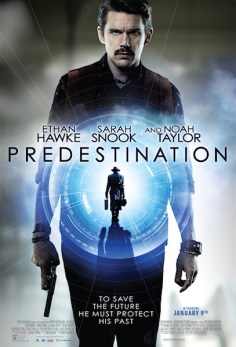 A man walks into a bar in ’70s New York. The bartender strikes up a conversation, which leads to a wager: if the man’s story is the most incredible the bartender has ever heard, he’ll give him a free bottle of whiskey. It had better be pretty good, because what we know that the man doesn’t is that the bartender, played by Ethan Hawke, is an agent for the Temporal Agency, travelling through time to stop crime before it happens; and he’s just had his face burnt off and completely rebuilt while failing to stop a notorious terrorist known as the Fizzle Bomber. Beat that.
 I don’t know how many people will remember, but the pair got a bit of attention back in the early ’00s with their debut feature
  100Films.co.uk