Stalker (1979)

aka Сталкер

2018 #100
Andrei Tarkovsky | 162 mins | Blu-ray | 1.37:1 | Soviet Union / Russian | PG

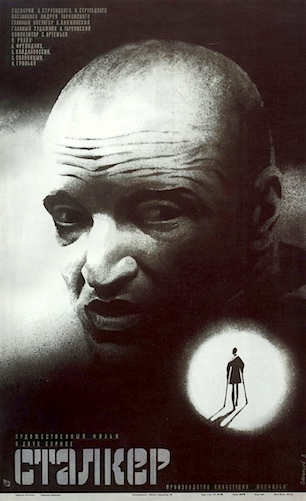
Stalker

Described by the blurb on its Criterion Collection Blu-ray release as “a metaphysical journey through an enigmatic post-apocalyptic landscape”, Stalker is… probably that… I guess…?

Adapted from the novel Roadside Picnic by Arkady and Boris Strugatsky (which, according to critic Mark Le Fanu in Criterion’s booklet, is more hardboiled pulp than artistic thinkpiece), it follows a professional ‘Stalker’ (Alexander Kaidanovsky) — someone who can enter and navigate a mysterious restricted area known only as the Zone — as he guides two latest clients, a depressed writer (Anatoly Solonitsyn) and an inquisitive professor (Nikolai Grinko), into the Zone and to the attraction at its heart: the Room, a place which is rumoured to grant a person’s innermost desires.

That’s the plot, anyway. Considering it’s over two-and-a-half hours long and I just summarised most of the story, you know it’s About more than that. But suffice to say I didn’t get it. It’s just some blokes wandering around, being depressed, occasionally philosophising about bugger all; then the ‘stalker’ chap is depressed even more by his clients’ attitude at the end, for some reason; and then we see his kid has telepathic powers because… um… People think director Andrei Tarkovsky’s previous sci-fi film Solaris is slow and obtuse, but it’s pacy and its meaning is crystal-clear compared to Stalker. Indeed, watching this just made me want to watch Solaris again — that was a slow Soviet sci-fi I actually found thought-provoking and interesting. One inspired thought I will credit it with is the notion of what “innermost desire” actually means. We might think we know, but do we? If the Room grants, not what we choose to ask it for, but our true innermost desire, then it reveals the truth of our self to us… and we might not like what we find.

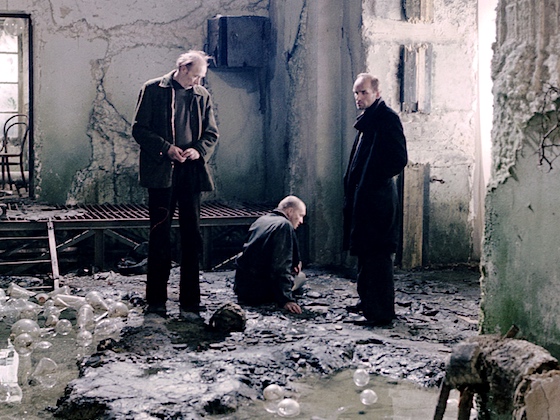
Some blokes being depressed

The film “resists definitive interpretation” says Geoff Dyer in a featurette on Criterion’s Blu-ray. It’s “a religious allegory, a reflection of contemporaneous political anxieties, a meditation on film itself […it] envelops the viewer by opening up a multitude of possible meanings,” adds the blurb. Oy. So is it profound or just pretentious? I think the lack of clarity — the lack of definitive interpretation — can be used as evidence for both sides. Its acclaim would suggest most think it profound, so I’m the one missing something. That’s always possible. Also, I’m always wary of calling something “pretentious” — that’s become too much of a catch-all criticism for people who don’t understand an artwork and want to blame the work itself rather than their own intellectual capabilities. So we’ll have to settle on me just not understanding it.

Some of it does look good, at least… which is handy when long stretches of it are just staring at things in unbroken takes (there’s something like 142 shots, which is about one cut every 88 seconds). Whatever the film is or isn’t trying to say, I feel fairly certain it didn’t need to take so much time to say it.

Equal parts Annihilation but without the exciting stuff, privileged white male angst, and flicking through a photo album of deserted urban environments at someone else’s too-slow pace — with strange dashes of The Spy Who Came in from the Cold and X-Men Origins: Jean Grey for good measure — Stalker is… definitely something.

2 out of 5

Stalker was viewed as part of my What Do You Mean You Haven’t Seen…? 2018 project.

True Romance (1993)

2018 #150
Tony Scott | 121 mins | Blu-ray | 2.40:1 | USA & France / English & Italian | 18

True Romance

Directed by Tony Scott from Quentin Tarantino’s first screenplay,* True Romance is pretty much everything you’d expect from an early Quentin Tarantino screenplay directed by Tony Scott. It stars Christian Slater and Patricia Arquette as a pair of Bonnie and Clyde-ish lovers, who accidentally steal a load of cocaine from her pimp and end up on the run from the mob.

At first blush, I’d say this feels much more like a Tarantino movie than a Scott one. It’s all there in the dialogue, the subject matter, the characters — it’s everything you’d expect from early QT: verbose, funny, littered with pop culture references, violent. It’s well paced, too; not exactly whip-crack fast, but also never slow or draggy. It is shot more like a Scott flick than a QT one, but only somewhat — it lacks both the slick flashiness we associate with Scott’s early work (Top Gun, Beverly Hills Cop II) and the grungy hyper-editing of his later stuff (Man on Fire, Domino). That said, some scenes (like one between Arquette and James Gandolfini’s underboss in a motel room, for example) are shot like Tony Scott to the nines, reiterating my opening point.

Other observations: There’s one helluva supporting cast — it’s just littered with famous names in roles that only last a scene or two. (I could list them, but that might spoil the fun.) The sweet plinky-plonky score by Hans Zimmer is so unlike either his normal stuff or this genre of movie, which is no bad thing. On its original release the film was cut by about two minutes to get an R rating, with the original cut eventually released “unrated” on home formats, sometimes labelled the “director’s cut”. All the differences are relatively short trims to do with violence (full details here). The “director’s cut” is the only one that’s ever been released on DVD or Blu-ray anywhere, thus making the distinction between “theatrical” or “director’s cut” pretty much moot at this point… or at any point in the last 20 years, frankly.

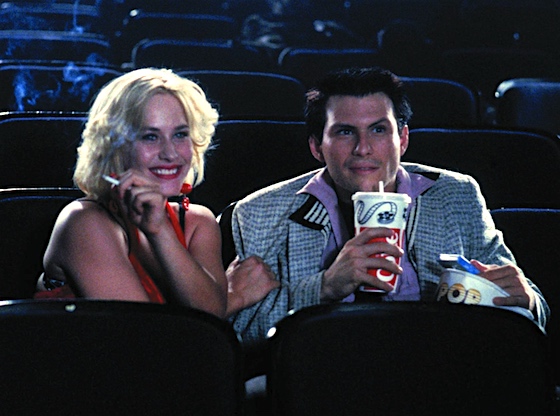
Clarence and Alabama go to the movies

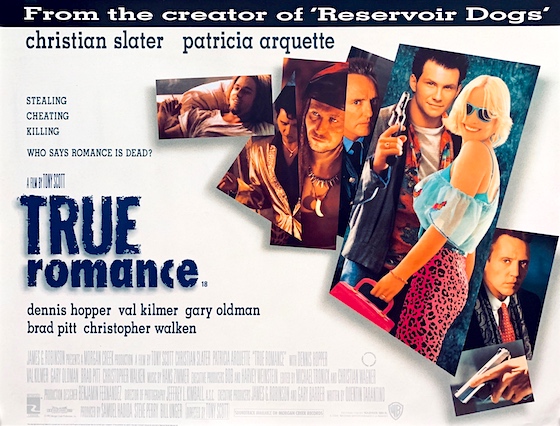
It’s got a funny old trailer, too: it’s centred around a bunch of made-up numbers that have no basis in the film (“60 cops, 40 agents, 30 mobsters”), it mostly features the film’s climax, and it doesn’t once mention Quentin Tarantino — I guess “from the writer of Reservoir Dogs” wasn’t considered a selling point just the year after it came out. (Though obviously it was in the UK — just see the poster atop this review.)

Of course, nowadays it’s often regarded as “a Tarantino movie” — the copy I own is part of the Tarantino XX Blu-ray set, for instance. I wonder if that ‘divided authorship’ is why, while the film does have its fans, it’s not widely talked about as much as some of either man’s other work: it’s not wholly a Tony Scott film, but, without QT actually behind the camera, it’s not really a Tarantino one either. Personally, I’m a fan of both men’s work, so of course it was up my alley. I don’t think it’s the best from either of them, but mixing together the distinct styles of two such trend-setting iconoclasts does produce a unique blend.

4 out of 5

True Romance was viewed as part of my Blindspot 2018 project.

* True Romance came out between Reservoir Dogs and Natural Born Killers, but apparently QT wrote this first, then when he failed to get funding for it he wrote NBK, then when he also failed to sell that he wrote Reservoir Dogs. Another version says True Romance and NBK started out as one huge movie, written in Tarantino’s familiar chapter-based non-chronological style, until QT and his friend Roger Avery realised just how long it was and decided to divide it in two. ^

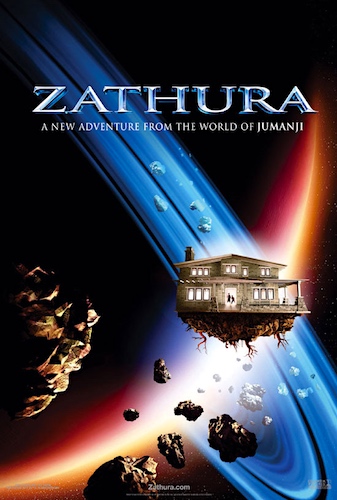
Zathura: A Space Adventure (2005)

2018 #67
Jon Favreau | 97 mins | streaming (HD) | 1.85:1 | USA / English | PG / PG

Zathura

Before Jumanji: Welcome to the Jungle there was Zathura, which is sort of a sequel to Jumanji… but more of a spin-off, I guess… well, really it’s a completely unrelated movie with the exact same plot. Inspired by another book by the same author, it sees two kids (Jonah Bobo and a very baby-faced Josh Hutcherson) discover an old board game that comes to life with terrifying consequences, and the only way to make it stop is to finish the game. But this game is about space, so it’s completely different, obviously.

Unsurprisingly, it’s difficult to avoid assessing the film’s quality in comparison it to its predecessor. The thing that struck me most was it feels less consequential than Jumanji, somehow. In the previous film the stakes feel high — you worry they won’t beat the game or make it out alive. Perhaps that’s because of Robin Williams’ character getting trapped in the game at the start, which makes you believe things can go wrong. Whereas here, it just feels like crazy shit will keep happening until they finish. It may also be because you can infer ‘rules’ in Jumanji — we know monkeys are going to be mischievous, tigers might eat you, etc — whereas in Zathura, because it’s sci-fi, it’s all made up. And it feels made up as it goes along, too — because it’s not based on real life or an existing brand, we don’t know the characters, the monsters, etc.

Similarly, the characters benefit from way too much luck. The kids keep not reacting fast enough to stop or save things, but then something fortunate happens so things go their way. Maybe you could sell this as a deliberate thing — like, the game wants to be finished — but that’s not how it plays out. They just keep getting lucky, in a not-great-screenwriting way. Perhaps I’m projecting problems where there are none in these observations, but it’s just another factor towards not feeling jeopardy like I did in Jumanji. Overall, Zathura was just more… pleasant.

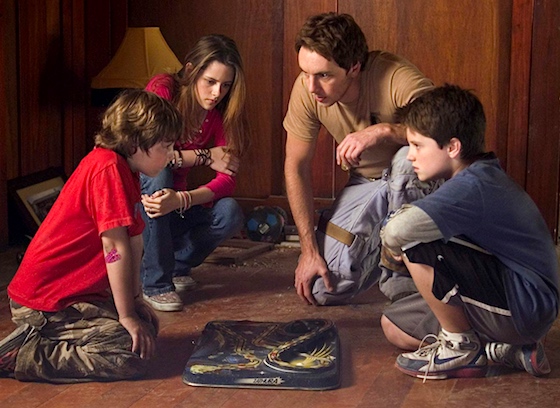
Play the game

That said, I had some more specific niggles. For a film that should’ve been trying to avoid accusations of being a rip-off, they invite it further by (spoiler alert!) giving one character a backstory that’s a riff on Robin Williams’ from the first movie. Zathura comes at it from a different angle, at least, but that’s a mixed blessing: it doesn’t have the same emotional effect because we only learn about it belatedly, but at least that means it isn’t ripping off Jumanji’s entire narrative structure, and also allows for a neat twist later on. There’s some time travel stuff that doesn’t wholly hang together, but then does it ever?

Equally, you can clearly tell they weren’t paying enough attention to every aspect of the screenplay: the older sister (played by a pre-fame Kristen Stewart, by-the-by) gets put in hibernation for five turns, but it takes eight turns before she wakes up. How no one noticed that is baffling — did they not think to just count it in the script? Even if they somehow missed it until post-production, all it would’ve taken is a dubbed line or two. “Five turns” sounds like a lot of gameplay to miss, so maybe they just thought “eight turns” would sound too ridiculous, but did they not think someone would spot it?!

Plot logic aside, at least the film has some great effects and design work. Jumanji has aged badly in that respect (the CGI is pretty ropey), whereas Zathura still looks great, in part because there’s actually a lot of props and models involved. The performances are pretty decent, too. Director Jon Favreau clearly has a talent for working with kids — the pair here; Mowgli in his Jungle Book; Robert Downey Jr… But in all seriousness, he gets really good performances out of these children.

Holy meteors!

Also worth noting is that the UK version was originally cut to get a PG… and remains cut, because the uncut rating wouldn’t just be a 12, it’d be a 15! That’s because of “imitable techniques”, which in this case means using an aerosol as a blowtorch to set fire to a sofa. The main thing I find interesting about this is that presumably the original cut shows the Astronaut setting fire to the sofa, whereas in the UK version it just suddenly cuts to him stood beside a sofa on fire, which is so much funnier. Hurrah for censorship, I guess.

And so we come to the score. Zathura is one of those films I find a little awkward to rate, because I did enjoy it — in some respects, more than I enjoyed Jumanji when I rewatched that recently — but it also doesn’t feel as polished and complete as its predecessor in terms of story and characters. Even as I had fun, I saw many things I felt could’ve been sharpened up. For that reason, I’ve erred towards a lower rating.

3 out of 5

The Happytime Murders (2018)

2019 #9
Brian Henson | 91 mins | streaming (HD) | 2.39:1 | USA & China / English | 15 / R

The Happytime Murders

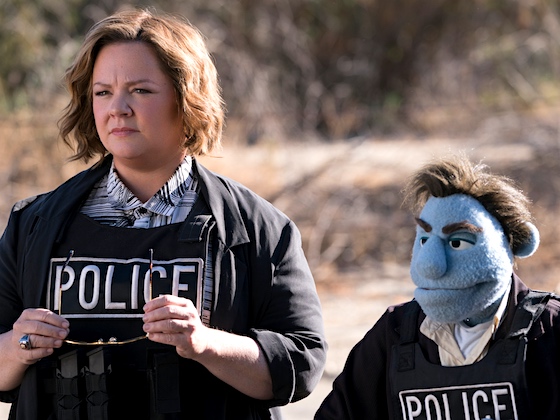
The Muppets meets Who Framed Roger Rabbit meets an R rating in this black comedy murder mystery from director Brian “son of Jim” Henson. Set in a world where Muppet-esque (but not actual Muppets, because IP rights) puppets co-exist alongside humans, disgraced puppet cop turned private investigator Phil Phillips (performed by Bill Barretta, which, let’s be honest, is a better name for a comedy private eye than the one they’ve actually used) stumbles onto a spate of connected puppet murders, and must reluctantly team up with his former partner, human detective Connie Edwards (Melissa McCarthy), to crack the case.

The mystery that drives the plot isn’t too bad, including a neat twist/reveal that’s perhaps guessable but not terribly so. It does hew closely to the tropes and clichés of the noir genre, which is a mixed blessing. On the one hand, as it’s not a straight crime movie I don’t think it’s a problem for it to recycle all those things when it has fresh comedy to hang off them, or if it’s somehow riffing off familiar elements but with the puppet stuff, but often it isn’t that clever.

Women and puppets in blue

Nonetheless, there are some legitimately funny bits along the way, often found among the riffs on the puppet thing (for example: one of the victims is drowned, and before bagging the body they ring him out). Unfortunately it isn’t funny as often as it should be, too often relying on worn or lacklustre humour. I mean, it tries to run with the old playground favourite “idiots say what?” as a running gag. It also leans on puppets being lewd and crude as the extent of the gag, which simply isn’t that funny in itself, partly because it isn’t as original as the film seems to think it is (cf. Team America, Avenue Q).

While The Happytime Murders isn’t close to the echelons of quality where you’d find Roger Rabbit or the best of the Muppets, it’s also not a total washout. From behind-the-scenes stuff I’ve read it sounds like a lot of effort was expended on filming it, making sure the puppets could interact with the humans and so on, and those technical aspects are first rate. It’s just a shame the same level of innovation wasn’t poured into screenplay. I didn’t hate it, but it doesn’t live up to its potential either.

3 out of 5

The Happytime Murders is available on Netflix UK from today.

Murder Mystery (2019)

2019 #96
Kyle Newacheck | 97 mins | streaming (UHD) | 2.00:1 | USA / English | 12 / PG-13

Murder Mystery

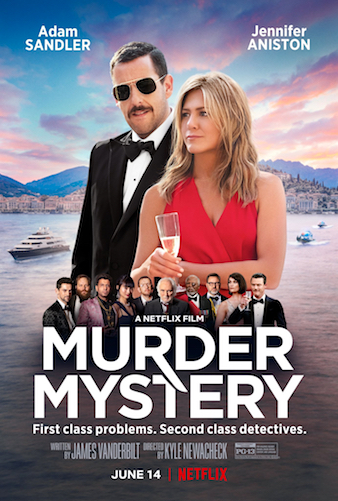
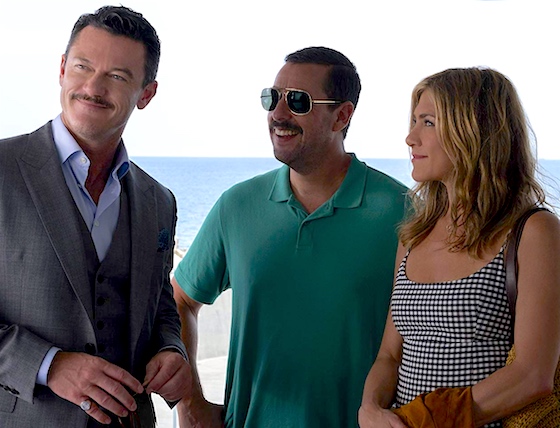
Murder Mystery is a murder mystery in which there is a murder under mysterious circumstances, and it falls to vacationing NY cop Nick Spitz (Adam Sandler) and his murder-mystery-loving wife Audrey (Jennifer Aniston) to solve these mysterious murders.

I’m no great fan of Sandler, and he’s probably the least funny person in this film, but I also didn’t find him outright objectionable. His character — an underachieving middle-aged beat cop who pretends to be a detective to his long-suffering wife — seems like the kind of guy who’d think he’s funnier than he is, so Sandler’s attempts at humour mostly come off as in-character. Put another way, it works in spite of itself. Of the two leads, Aniston is definitely the one doing the most work for the film, both in terms of actually being amusing and giving it some kind of emotional character arc.

Detectives or suspects?

The actual mystery plot is no great shakes — there are two glaring clues early on that give most of the game away, especially if you’re well-versed in watching murder mysteries and spotting such hints. That’s somewhat beside the point, though, because there’s enough fun to be had along the way to make up for it, and there are still some reasonable red herrings. The fact the cast is staffed by an array of experienced mostly-British thesps, many of whom have no doubt appeared in their share of ‘real’ murder mysteries — the likes of Luke Evans, Gemma Arterton, Adeel Akhtar, David Walliams, and Terence Stamp — definitely helps keep proceedings afloat.

There are a few of action-y scenes — a shoot-out, some hijinks on a hotel ledge, a decent car chase for the finale — that keep the momentum up too. Plus it mostly looks suitably luxuriant and exotic (the odd bout of iffy green screen aside), matching its high-class backdrop and French Riviera setting. Altogether, it makes for a suitably easy-watching 90-minutes in front of Netflix.

3 out of 5

Murder Mystery is available on Netflix everywhere now.

Finding Dory (2016)

2018 #122
Andrew Stanton | 97 mins | Blu-ray (3D) | 1.78:1 | USA / English | U / PG

Finding Dory

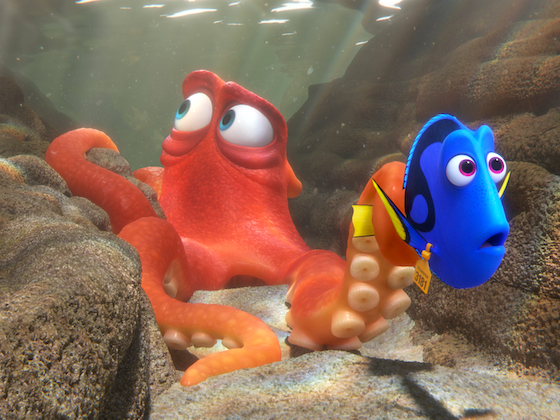
I was never that big a fan of Finding Nemo. I mean, I like it well enough — it’s a very good movie — but I’ve never loved it. My rewatch last year confirmed that feeling. It was something of a surprise, then, that I mostly really enjoyed this sequel. It’s a weird thing where I wouldn’t necessarily say it’s better than the first film, but I think I like it more.

Made 13 years later but set not too long after the events of the first movie (I don’t know what the lifespans of these fish are in real life, but I imagine considerably less than 13 years), the plot revolves around Nemo comedy sidekick Dory (Ellen DeGeneres) — in the first film her memory loss was a comedy bit, but here it’s front and centre, as Dory goes searching for the family she forgot she had. Accompanied by Nemo (Hayden Rolence) and his dad Marlin (Albert Brooks), she heads to California and the theme park-ish Marine Life Institute.

Like so many Pixar movies, Nemo didn’t desperately need a sequel, so I was worried this would seem like little more than an excuse to return to these characters. In fact, the plot actually works very well. Far from being a desperate stretch, it actually feels like a worthwhile development and follow-up from the first movie. Alongside the worth of the narrative, it’s also just a lot of fun to watch, even if it gets a bit outlandish in the final act (fish driving cars…?)

Something fishy going on...

Another concern I had was that I remember thinking Dory was a bit irritating in the first film, so making her the central character could’ve scuppered it for me (other people seem to find her endearing, so I can see why Pixar went with this concept). But no, she makes for a likeable enough companion. The film does a really good job of handling her memory loss, too. It’s more than just a joke this time round, what with Dory being the central character. The easiest route to take for the filmmakers would’ve been to cop out of it somehow, either by flat-out fixing her memory, or at least not being wholly true to how short-lived it was before. Instead, they’ve put the problems and the scariness of having no memory at the forefront of the film. For example, at one point Dory needs to enter a network of pipes to get somewhere vital within the Institute, but she won’t go in because she knows she’ll forget the directions. A more constant fear is that she’ll forget about her family or friends, the people she loves, which I think is the kind of notion a viewer of any age could empathise with.

As a Pixar movie, it goes without saying that it looks superb, but I’ll nonetheless take a moment to mention that I thought the 3D aspect was really great too. It seems to be pot luck with this stuff (I found Nemo’s rather underwhelming, and I wasn’t that impressed by Coco’s either, for example). I guess most people don’t care anymore, but there we go.

Finding Dory was a pleasant surprise all-round. In fact, I’d go so far as to say this is Pixar’s best non-Toy Story sequel. Maybe that’s not saying much (half its competition is Cars movies), but I mean it positively nonetheless.

4 out of 5

Pixar’s latest sequel, Toy Story 4, is out in the UK and US next Friday.

Zatoichi Meets Yojimbo (1970)

aka Zatôichi to Yôjinbô

2019 #60
Kihachi Okamoto | 116 mins | Blu-ray | 2.35:1 | Japan / Japanese | 12

Zatoichi Meets Yojimbo

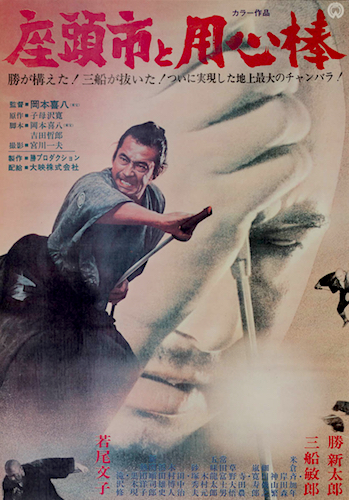
Having released anything up to four films a year for seven years, the Zatoichi series took 1969 off (apparently producer/star Shintaro Katsu had some other projects to focus on). But when it returned in 1970 it was with a big gun: as the title indicates, the main guest star for this film is the lead character from Akira Kurosawa’s films Yojimbo and Sanjuro, played by the great Toshiro Mifune. I don’t know if that was a deliberate move to mark the series’ 20th movie or if they weren’t even conscious of the milestone, but it certainly feels like it was meant to be a special occasion. “Meant to be” being the operative part of that sentence, because the result is sadly one of the least enjoyable entries in the series so far.

The film sees Ichi (Katsu) return to his hometown, which has rather gone to the dogs thanks to a local yakuza gang. Never one to just stand back or move along, Ichi ends up embroiled in the arguments between a powerful merchant (Osamu Takizawa) and his two wayward sons, one a yakuza boss (Masakane Yonekura), the other an employee of the government mint (Toshiyuki Hosokawa), who’s up to some kind of shenanigans with the gold that drives the plot… I think. Mifune’s character factors into all this as a ronin who’s been hired by the yakuza son to protect him, or kill his father, or something along those lines.

As you may have gathered, the plot here is by turns confusing and dull — one of those that loses you so thoroughly you just want to give up on trying to work it out. It has something to do with the people who make gold coins making them less well, and a hidden bar of gold that has something to do with that somehow, and a bunch of spies and stuff who are all looking for the gold bar, and some kind of feud or rivalry or disagreement between the local yakuza and Takizawa’s businessman, which may or may not have nothing to do with all the gold stuff… I think. This wouldn’t be the first Zatoichi film with an underwhelming or unintelligible plot, but it tells it with so little verve, and with so few entertaining distractions (there’s not much action, and even less humour), that there’s nothing to make up for it.

Katsu vs Mifune

And to add insult to injury, the titular concept of the movie is a bait and switch: Mifune is not actually playing the character from Kurosawa’s films. “Yojimbo” means “bodyguard”, so it’s not like, say, casting Sean Connery in a film and calling it Meets James Bond only to have him play some unrelated character, but the promise of the title is clear and unfulfilled. It’s not like Mifune is playing an off-brand knock-off, either: he happens to be fulfilling the same job as bodyguard so that everyone can keep calling him yojimbo, but his actual name is Taisaku Sasa (not Sanjuro, as in Kurosawa’s films) and his character is nothing like his role in Kurosawa’s films (he doesn’t even look the same!) Seeing Zatoichi go head-to-head with the ‘real’ Yojimbo, with all his cunning scheming, could’ve been great. Instead, while Sasa is still a skilled swordsman, he’s a bit pathetic — lovelorn and, it would seem, not actually very good at his real job (which, as it turns out, is spying). Some of the scenes between Katsu and Mifune are good, at least. Not all of them, but some is better than none, I suppose. Ultimately, however, it’s one of the biggest disappointments in a film filled with them.

There’s plenty to be filled, too, because this is by far the longest of the original Zatoichi films: the others average 87 minutes apiece, making Meets Yojimbo a full half-hour longer than normal, and almost 20 minutes longer than even the next longest. There’s quite an extensive supporting cast, bringing with them all the varied subplots that having so many characters entails. Whether that’s what produced the extended running time, or whether an extended running time was desired so they shoved all those extra people in, I don’t know. It’s a bit of a chicken-and-egg situation, because either way the result is a jumble that I don’t think was a good idea. Few of them have an opportunity to leave a mark — there’s too much going on, and we’re all here for Mifune and Katsu anyway.

Something I could have learned...

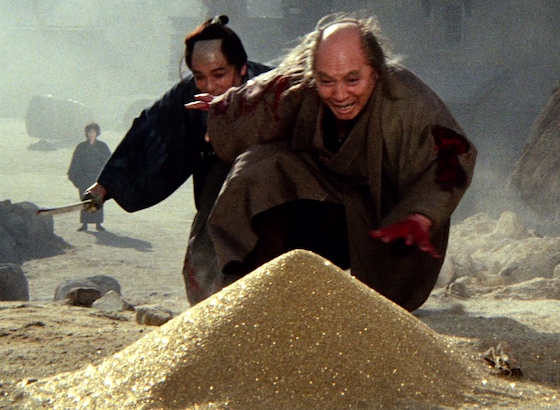
Eventually the story comes down to a simple, familiar message: “greed is bad”. The much-desired gold bar turns out to be hidden as gold dust, which ends up blowing away in the wind. It’s almost fitting and symbolic… except it only happens once most of the cast are dead or past it anyway, so it doesn’t necessarily symbolise much. I mean, there’s hardly anyone left to notice it happen. And it’s followed by a final scene that, like most of the rest of the plot, left me slightly confused. The town blacksmith tells yojimbo that Ichi isn’t motivated by gold… then we see Ichi realise his pouch of gold dust has been cut and emptied, so he scrabbles around in the dirt searching for the rest (which has blown away), when Mifune joins him. “You too?” “Just like you,” they say. And then they go their separate ways. So… they are motivated by gold? Or… they’re not, because it’s gone and they… aren’t? I don’t know if I’m being dim, or if the film bungled its own message, or if it just doesn’t have anything to say. It could be no deeper than a straight-up samurai adventure movie, of course. It would be better if it were.

This is the only Zatoichi film for director Kihachi Okamoto, who apparently was a prestige hire. I don’t think he did a particularly good job, to be honest. There’s the muddled plot, as discussed, which unfurls at a slow pace. The action scenes, often such a highlight, aren’t particularly well shot. It’s visually a very dark film, which kinda matches the grim tone, but is arguably taken too far. As Walter Biggins puts it at Quiet Bubble, “murk dominates. People wears blacks and browns. Eyes are cold, haunted, even in daytime[…] Even supposedly well-lit interiors look like homages to Rembrandt. This is a world half-glimpsed, that we squint at”. It was shot by cinematographer Kazuo Miyagawa, who worked on numerous Japanese classics and several other Zatoichi movies — I praised his work on Zatoichi and the Chest of Gold, for example. It’s not that what he’s done here is bad per se — there are certainly some nice individual shots, particularly around the climax — but, well, there were clearly some choices made about lighting and the colour palette.

Windswept

I knew going in that Zatoichi Meets Yojimbo isn’t a particularly well regarded film, but I held out hope it was one of those occasions where I’d find the consensus wrong. Unfortunately, it wasn’t. In fact, it’s arguably the worst film in the series. It’s not just that it’s a poor Zatoichi film (which it is), it’s that it should’ve been a great one, showcasing the meeting of two top samurai heroes and the charismatic actors who play them. There may be outright lesser films in the Zatoichi series than this, but none could equal the crushing disappointment it engenders.

2 out of 5

For what it’s worth, Katsu and Mifune co-starred in another samurai movie the same year, Machibuse, aka Incident at Blood Pass. I’ve heard it’s a lot better, so I’ll endeavour to review it at a later date.

Review Roundup

As foretold in my most recent progress report, June is off to a slow start here at 100 Films. Or a non-start, really, as I’ve yet to watch any films this month and this is my first post since the 1st. Hopefully it won’t stay that way all month (I’ve got my Blindspot and WDYMYHS tasks to get on with, if nothing else).

For the time being, here a handful of reviews of things I watched over a year ago but have only just written up:

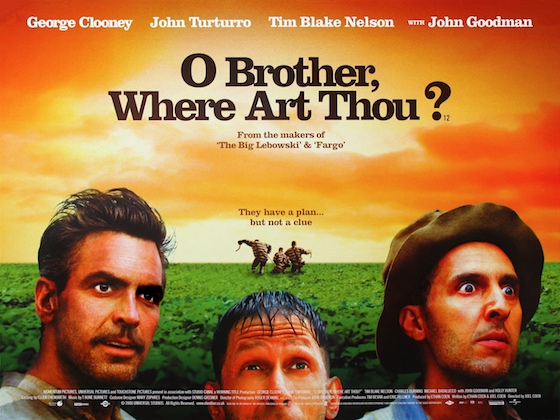
  • O Brother, Where Art Thou? (2000)
  • Allied (2016)
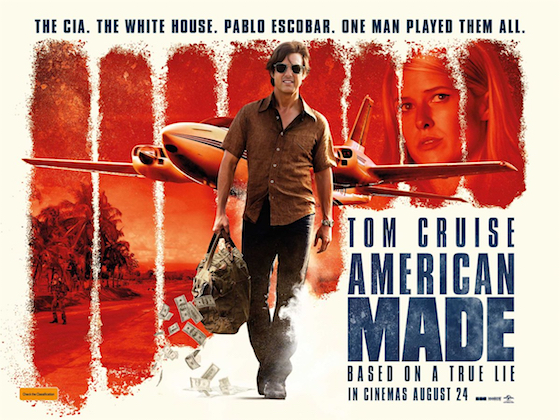
  • American Made (2017)


    O Brother, Where Art Thou?
    (2000)

    2018 #106
    Joel Coen | 103 mins | streaming (HD) | 2.39:1 | UK, France & USA / English | 12 / PG-13

    O Brother, Where Art Thou?

    The eighth movie from the Coen brothers (eighth, and yet they still weren’t being allowed a shared directing credit! No wonder that stupid DGA rule pisses people off) is one of their movies that I found less objectionable. Oh, sure, most of their stuff that I’ve reviewed I’ve given four stars (as well as a couple of threes), but that’s more out of admiration than affection — for whatever reason, their style, so popular with many cineastes, just doesn’t quite work for me; even when I like one of their films there’s often still something about it I find faintly irritating.

    Anyway, for this one they decided to adapt Homer’s Odyssey, but set in the American Deep South during the Great Depression. Apparently neither of the brothers had ever actually read The Odyssey, instead knowing it through cultural osmosis and film adaptations, which is perhaps why the film bears strikingly minimal resemblance to its supposed source text. Rather, this is a story about songs, hitchhiking, and casual animal cruelty, in which the KKK is defeated by the power of old-timey music. Hurrah!

    It’s mostly fairly amusing. If it was all meant to signify something, I don’t know what — it just seemed a pretty fun romp. I thought some of the music was okay. (Other people liked the latter more. Considerably more: the “soundtrack became an unlikely blockbuster, even surpassing the success of the film. By early 2001, it had sold five million copies, spawned a documentary film, three follow-up albums (O Sister and O Sister 2), two concert tours, and won Country Music Awards for Album of the Year and Single of the Year. It also won five Grammys, including Album of the Year, and hit #1 on the Billboard album charts the week of March 15 2002, 63 weeks after its release and over a year after the release of the film.” Jesus…)

    Anyway, that’s why it gets 4 stars. I liked it. Didn’t love it. Laughed a bit. Not a lot. Some of the music was alright. Not all of it. Naturally it’s well made (Roger Deakins!) without being exceptionally anything. Harsher critics might say that amounts to a 3, but I’m a nice guy.

    4 out of 5

    Allied
    (2016)

    2018 #116
    Robert Zemeckis | 119 mins | streaming (HD) | 2.39:1 | USA, UK & China / English & French | 15 / R

    Allied

    Brad Pitt and Marion Cotillard star as a pair of intelligence agents who fall in love in Mr. & Mrs. Smith: WW2 Edition. Settling down together in England, all is lovely for them… until one comes under suspicion of working for the enemy…

    Overall Allied is a very decent spy thriller, let down somewhat by a middle section that’s lacking in the requisite tension and a twee monologue coda. But the first 40 minutes, set in Morocco and depicting the mission where the lovers first meet, are pretty great; there’s plenty of neat little tradecraft touches scattered throughout; and there are some pretty visuals too. There are also some moments that are marred by more CGI than should be necessary for a WW2 drama, but hey-ho, it’s a Robert Zemeckis film.

    That said, Brad Pitt’s performance is a bit… off. He never really seems connected with the material. Perhaps he was trying to play old-fashioned stoic, but too often it comes across as bored. It also constantly looked like he’d been digitally de-aged, but maybe that’s because I was watching a 720p stream; or maybe he had been, though goodness knows why they’d bother.

    Anyway, these are niggles, so how much they bother you will affect your personal enjoyment. I still liked the film a lot nonetheless.

    4 out of 5

    American Made
    (2017)

    2018 #124
    Doug Liman | 109 mins | streaming (HD) | 1.85:1 | USA & Japan / English & Spanish | 15 / R

    American Made

    Described by director Doug Liman as “a fun lie based on a true story,” American Made is the obviously-not-that-truthful-then ‘true story’ of Barry Seal, a pilot who was recruited by the CIA to do some spying and ended up becoming a major cocaine smuggler in the ’80s.

    Starring ever-charismatic Tom Cruise as Seal, the film turns a potentially serious bit of history (as I understand it, the events underpinning this tale fed into the infamous Iran-Contra affair) into an entertaining romp. Indeed, the seriousness of the ending is a bit of a tonal jerk after all the lightness that came before, which I guess is the downside of having to stick to the facts.

    Still, it’s such a fun watch on the whole — a sliver long, perhaps, even though it’s comfortably under two hours, but it does have a lot of story to get through. Parts of that come via some spectacular montages, which convey chunks of story succinctly and are enjoyable in their own right. Liman doesn’t get a whole lot of attention nowadays, I think, but it seems he’s still got it where it counts.

    4 out of 5

  • The Past Fortnight on TV #47

    This fortnight: mad queens, burning cities, and melting chairs on Game of Thrones; disembodied little girls, controlling space captains, and time travelling dreamers on The Twilight Zone; and a couple of other bits & bobs at the end, too.

    Game of Thrones  Season 8 Episodes 5-6
    These episodes have been hella controversial, so I’m going to stake my position right away: the penultimate episode isn’t perfect but is very good; the finale was fantastic. If you’re one of those people who rated it 1 on IMDb, you’re an idiot. Yeah, sure, opinions differ, and if you didn’t think it was as superb as I did then you may have some valid arguments… but 1 out of 10? No. Those people are morons.
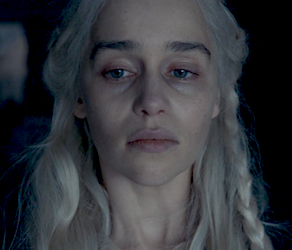
    The Mad QueenTo call these two episodes “the climax” of Game of Thrones feels slightly disingenuous, because really the whole season has been the climax (to wit, my review of episodes one and two is here, and episodes three and four here). As I think I discussed before, I feel this is where some people’s maladjusted complaints about it stem from — a misunderstanding of the pace the story’s being told at. This isn’t a show that is plot, plot, plot until a conclusion wraps everything up within the final episode. There’s far too much going on for that to be possible. No, the whole season is the conclusion. How they paced that conclusion across the final few episodes is another matter, because I agree that sometimes the story has moved too fast this season, and The Bells is (at times) another case in point. I completely buy Dany’s turn to the dark side: it’s been building since almost the start of the series (mistaken by many for her being powerful and just) and the events of the past few episodes have really pushed her to the edge — and, of course, over it.

    So, I think the groundwork is there to explain her ‘sudden’ turn, but the speed those events were relayed to the audience didn’t give people enough time to process where it was leading her. The distrust of the very people she came to liberate when she arrives in the North; their lack of explicit gratitude after the Battle of Winterfell; the deaths of her closest friends and allies, Ser Jorah and Missandei; not only the grief of that, but losing their cool-headed advice; distrusting the advisors she does have left — Varys betraying her, Tyrion seeming to constantly let her down, Jon rejecting her romantic advances; not to mention that he represents a very real threat to her life-long goal; and, despite his protestations that he doesn’t want it, he went against her wishes and told his family, which means others now know… All of that underpins her ‘sudden’ desire to burn King’s Landing and all its people. But when that’s been conveyed across just a couple of episodes, along with a whole load of other stuff that’s been going on, I don’t think people had time to process it. In my review of Last of the Starks I argued that it should’ve been extended and split in two, and I think the same is probably true of The Bells: everything up to the attack on King’s Landing actually happening is one episode; the extended action sequence(s) that follow is another. That kind of extension would not only bring obvious screen time advantages — literally, more and/or longer scenes to play out what’s happening — but it also adds time between episodes (a whole week) for viewers to mull over and discuss what they’re seeing, rather than pelting headlong into more events.

    Azor AhaiConversely, I thought the finale, The Iron Throne, was excellently handled in virtually every respect, including the pace. Well, mostly. I mean, I think it’s only during their conversation in front of the Iron Throne that Jon realises what he has to do to Daenerys, so that he then immediately carries it out is a little abrupt — should he have gone away, to steel himself for the task, and done it later? Maybe. Equally, why wait? And the scene needs to occur there for the powerful events that follow with Drogon’s grief and melting the throne. Some would also say the time jump to the Dragonpit court is a case of rushing the story, but do we need to see the Unsullied taking Jon Snow prisoner? Do we need to see the armies arrive at the gates of King’s Landing? You could draw the story out by putting all of that on screen, but what you actually need to know for the narrative is conveyed in the dialogue. Mind you, here I am wondering if it should’ve been slower when some of those petition-signing halfwits reckon “nothing happened” this episode. After weeks moaning about the pace being too fast, they think this was so slow that “nothing happened”! There’s no helping some people…

    As for the final stretch, where the episode laid out where everyone ends up, I liked that part most of all. There’s a fitting fate for everyone — not necessarily what’s just or fair, but then when has Game of Thrones ever been about delivering that? I would’ve liked to see Grey Worm punished for the heinous war crimes he committed, but sometimes bad people get away with bad things. Poor Tyrion is stuck as Hand of the King, though it’s a job he remains suited to, perhaps especially because he’s not sure he deserves it. Bran is an odd choice for king, perhaps, but Tyrion sold me on the notion in the same way he did the assembled lords; and I don’t think Bran wanted it, but I think that, as the all-seeing Three-Eyed Raven who has always acted to protect humanity, he can see it’s the right course.

    The rest of the Starks get fates that suit them entirely. Arya has talked about wanting to sail west before, in season six; personally, I’ve wondered if that was her destiny even before she voiced it — it fits her nature, to explore the unknown. Sansa is Queen in the North, a role she has earned in so many ways — her arc, from naive little princess to powerful political leader, is arguably the greatest in the entire series. Jon is sent back to the Night’s Watch — as explicitly stated, it’s just as a punishment, but there’s a political motive too: if he can father no heirs then there will never be any offspring to grow up believing they have a true claim to the throne. But it’s not a real punishment, of course, because it means he can venture north of the Wall, where his heart really belongs. I suspect Bran knew that when he sentenced him.
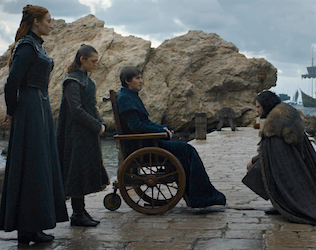
    Last of the StarksTo cap it all off, both episodes were incredibly well made. That’s par for the course on this mega-expensive show, but it still merits observing. Okay, perhaps The Bells had a few too many scenes of King’s Landing’s destruction (a point on pacing again), but it was all spectacularly realised, keeping us mostly in the streets with the people who were really suffering. For striking moments, however, the finale was the place to be: that shot of Dany with Drogon’s wings (the subject of its own mini Twitter controversy, for yet more dumbass reasons); her speech to her assembled forces in the ruins, the staging and design evoking the the Nazis or Stalin’s Russia; the melting throne; the final montage, with the matching shots of Sansa, Arya and Jon embracing their destinies; and the very final scene, a mirror image of the opening scene of the very first episode. What a way to end; even with a green root poking through the snow north of the Wall — a dream of spring.

    The Twilight Zone  ‘Best Of’
    As regular readers will know by now, for the past couple of months I’ve been reviewing the best episodes of the original 1959-64 iteration of The Twilight Zone, according to IMDb voters and an article I happened across on ScreenCrush. So far I’ve mostly stuck to episodes that are in the lists’ top tens (the exception is one I reviewed last fortnight, Nick of Time, which is #12 on ScreenCrush and #25 on IMDb), and in this fourth selection I’ll be finishing off those top tens.
    Little Girl LostFirst, two episodes from season three. The Shelter is one of just four episodes in the entire series with no sci-fi or fantasy element (according to its IMDb trivia page). When the warning sirens go off that missiles, presumably nuclear, may be on their way to destroy the United States, a foresightful doctor and his family are able to retreat to their bomb shelter, but his less prepared neighbours want in too. It’s another of Rod Serling’s morality tales about the truth of human nature, and a particularly potent one because it’s very easy to relate to almost everyone’s position — there are no heroes or villains here (well, except for maybe one racist guy), just people who want to survive. The titular room is made for three people, not the dozen or so who try to break in to share it, which suggests perhaps the episode’s most universally applicable lesson: in panic, logic goes out the window.

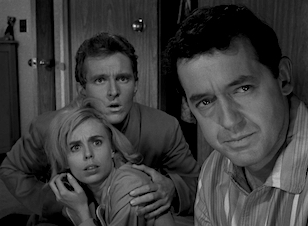
    Little Girl Lost merits 8th on ScreenCrush’s list, but only places 39th on IMDb. I side closer to the former. Another episode by the great Richard Matheson, this one is about parents whose little girl goes missing in the middle of the night — they can hear her calling somewhere in the house, but she’s nowhere to be seen. The setup has some contrivances (I mean, it’s the middle of the night, your six-year-old daughter is calling out for you, but she’s not in her bed, nor under it, so your next step is to… phone your friend who’s a physicist? O…kay…), but it just expedites where the story is going to go anyway. That said, it doesn’t always make the best use of the rest of its time (a trippy sequence in another dimension goes on longer than necessary). It’s not as unnerving as it might’ve been (the horror of your child being you-don’t-know-where, plus a disembodied little girl’s voice coming from somewhere and nowhere within the house? Sounds like a recipe for a horror movie to me), but it’s more minded to its edge-of-science explanation than a disquieting atmosphere. Ultimately, it’s using a relatable situation to explore a notion at the limits of scientific understanding, which is very fitting for this show. Plus it has a cute dog who’s instrumental in saving the day, which is always a significant bonus in my estimation.
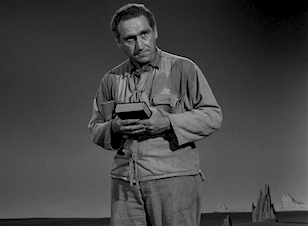
    On Thursday We Leave for HomeFor its fourth season, Twilight Zone was scheduled as a replacement for another series, meaning it had to expand to hour-long episodes to fill the given time slot. This is largely regarded as being to the series’ detriment, and I can see why — I mean, some of the 25-minute episodes feel padded, so doubling the length…! Consequently, season four has very few episodes at the top of either list. The exception is On Thursday We Leave for Home, which is the highest-ranked season four episode on both: it comes 10th at ScreenCrush, but still only 24th on IMDb. This one is outright sci-fi from the off: it’s set on mankind’s first off-world colony, which has been a disaster, and after three decades a spaceship is finally arriving to take them back to Earth. What unfolds is another tale of man’s hubris and delusion with a self-wrought tragic ending — in other words, an episode of The Twilight Zone. But it has a unique angle and commentary on the corrupting influence of power; about how being in charge of the colonists has become Captain Benteen’s very reason to exist, to the point where he not only can’t imagine life any other way, but he can’t imagine his ‘subjects’ would want it any other way either. He’s thoroughly deluded.

    It’s significant, I think, that Benteen views ‘his people’ as children who are unable to make their own decision, but he was only 15-years-old when they arrived there, and at the end he hides away, like a small child who doesn’t want to go home, until it’s too late and the ride has left; except rather than a parent playing a trick to get the child to change their mind, the ride is really gone, and Benteen discovers too late that he’s doomed himself. The episode makes strong use of the double-length format to let this unravel itself, establishing how tough life has been on the colony, then the relief and euphoria of their “rescue” arriving, before the truth of Benteen’s mind is revealed. Sure, you’d tell the same story faster today, but for the era it doesn’t feel drawn out (there are 25-minute episodes that are worse for that). So, it’s not just “the best of a bad bunch”, but a great little sci-fi parable in its own right. You could probably remake it as a feature…
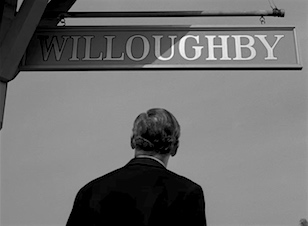
    A Stop at WilloughbyFinally for now, season one’s A Stop at Willoughby, which doesn’t quite make either list’s top ten (it’s 12th on IMDb, 17th on ScreenCrush), but I keep hearing it mentioned elsewhere as a favourite episode or referenced in other ways (as with Eye of the Beholder last time, it factors into Richard Linklater’s Everybody Wants Some!!). It’s about a harried ad exec in ’60s New York, whose boss’ motto of “push, push, push” pretty well tells how he’s feeling. On the train to his suburban home (there’s no real correlation here, but there are definite shades of Mad Men across this setup!) he falls asleep and wakes when the train stops at the village of Willoughby… in the year 1888. It’s an idyllic place on a warm summer day, with people enjoying leisurely strolls in the park — a simpler, calmer time. But then he really wakes up: he didn’t travel in time, Willoughby was just a dream; but it’s a dream of a place and time where he’d rather be — can he get back there? If Walking Distance was an ultimately uplifting story about how you can’t go home again, A Stop at Willoughby is its dark mirror image. Suffice to say, the town of Willoughby is most definitely located in the Twilight Zone.

    Also watched…
  • Eurovision Tel Aviv 2019 — Normally I give Eurovision a full review, but I was a bit underwhelmed by it this year. Even by its own standards the music was mediocre, and there was little memorable in the actual performances either (with the exception of Australia’s pole stuff). Oh well.
  • Thronecast Series 8 Episodes 5-7 — I applaud the final episodes of Sky Atlantic’s tie-in show for not ignoring that there’d been some displeasure online, but deservedly praising the episodes anyway, especially the finale.

    Things to Catch Up On
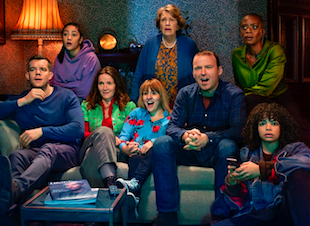
    Years and YearsThis fortnight I have mostly been missing Years and Years, the new drama from the pen of Russell T Davies that spans the next couple of decades to look at, presumably, how much worse things are going to get even than they are now. I’ve long been a big fan of Davies’ writing, though must confess I’ve missed most of what he’s done post-Doctor Who — I’ve been meaning to get round to A Very English Scandal ever since it aired, which was a whole year ago now. Hopefully I won’t take so long to get to this new one.

    Next month… what can possibly follow Game of Thrones?! No, I don’t know either.

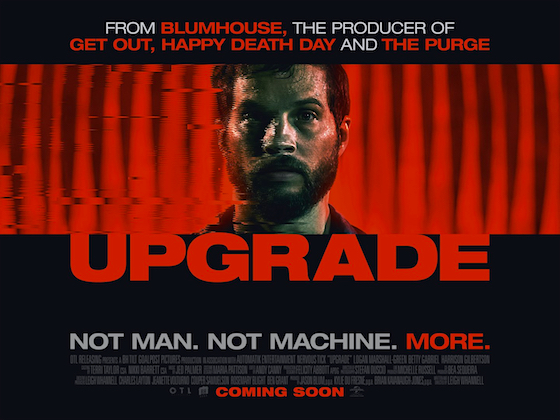
  • Upgrade (2018)

    2019 #44
    Leigh Whannell | 100 mins | streaming (HD) | 2.35:1 | Australia / English | 15 / R

    Upgrade

    Leigh Whannell is best known for co-creating the Saw and Insidious franchises, so he steps outside of his horror stomping ground to write and direct this cyberpunk action-thriller. It’s set in the kind of near future where we have self-driving cars (and similar tech), but there are still people who prefer the old ways, like mechanic Grey (Logan Marshall-Green), who makes his living restoring classic cars for people like tech genius and entrepreneur Eron Keen (Harrison Gilbertson). After an incident leaves Grey paralysed, Eron offers to help by implanting him with a cutting-edge top-secret chip he’s developed called STEM. It works even better than expected, and Grey begins to use his newfound abilities to hunt for the men who did this to him.

    On one level, Upgrade is a straightforward sci-fi action-thriller, following Grey’s investigation as it leads him to some shady figures who have near-future tech of their own, and then they fight. While that may seem simplistic, it’s full of neat little touches, particular in the action’s choreography — it almost begs a rewatch just to see everything that’s going on in the frantic fight scenes. I don’t mean “frantic” in the over-cut, can’t-see-shit sense of so many action sequences in the last couple of decades — in fact, Whannell often uses wide shots and long-ish takes — but there’s so much going on, with the characters making decisions at such speed (boosted by that body-modifying tech), that parts do become a bit of a blur.

    Change can be painful

    On another level, the film has something to say about the technology that drives its storyline. Okay, maybe it doesn’t have a lot to say, and if you’re well-versed in sci-fi they’re not necessarily original comments either, but it poses questions and makes you think about what could be just around the corner, and what value it might have, or what danger it might pose. Plus it pushes the story into some interesting places; places a low-budget Australian-produced movie can go that other mainstream-minded sci-fi/action flicks wouldn’t dare. If you’ve ever seen a Saw film then you can guess that Whannell likes twists, especially of the “sting in the tail” variety, and Upgrade has more than its fair share of last-minute switcheroos. How many you see coming is up to you — one seemed glaringly obvious to me, but anticipating that ‘reveal’ blinded me to some more that came after.

    Combining those two levels renders Upgrade a strong mix of straight-up action thrills and thought-provoking near-future sci-fi. A definite must-see for genre fans.

    4 out of 5

    Upgrade is available on Sky Cinema from today.