Sherlock Holmes in Washington (1943)

2009 #1
Roy William Neill | 68 mins | DVD | U
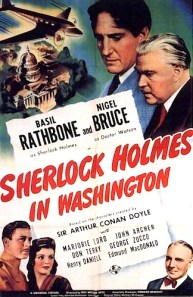
Sherlock Holmes in WashingtonThe last of three World War 2-concerned films in the Rathbone/Bruce series (the previous two being The Voice of Terror and The Secret Weapon), and once again more a spy thriller than a traditional detective tale. That’s not to say Holmes’ abilities as a detective aren’t present — in fact, he does a very reasonable amount — but if you switched him for a generic British Intelligence agent the plot would be unlikely to suffer and the dialogue probably wouldn’t need much work.

Certainly, the quality of Holmes’ detection is a bit of a mixed bag. Some scenes do demonstrate his brilliant reasoning, but others stretch credibility to the limit, for example when he manages to work out what’s been transported in a blanket. Another disappointing moment sees Holmes in awe of and “forget” about modern scientific methods, which seems rather at odds with the highly intelligent detective at the forefront of his field that we see in the original tales. It’s more than a little like the filmmakers have taken the character and methods from his 19th Century setting and dropped (rather than adapted) him into the present day. It’s these little inconsistencies that are arguably most bothersome when such a spy thriller claims to be a Holmes film.

Other deduction scenes do work, however, such as when Holmes enjoyably reasons the hiding place of the matchbook, the film’s MacGuffin. Unfortunately, this sequence suffers from a total lack of tension as we already know where it is. This leaves us watching Holmes play catch-up, and there’s no sense of a race-to-the-prize because we don’t see how the villains’ hunt is progressing. Said matchbook is put to good use in another sequence where it is unwittingly passed around at a party. This is perhaps the most simple and obvious thing to do with such a MacGuffin, but at the same time it’s an always-effective idea. On the other hand, when the matchbook ends up back where it started one has to conclude that this sequence is no more than padding.

One of the more striking elements of the film is it being Holmes’ first trip to the States (on screen in this series, at least). It’s highly praiseful of America, of course, and spends a good bit of time on a travelogue-style showcasing of sights, continuing with Watson remarking on US papers, trying out gum, and more. It makes a change of scene for the series, but also feels a bit self-congratulatory on the part of the American production team, which can be more sickening than the British patriotism of the previous two entries. While that may be national bias on my part, it seems a bit unlike Holmes too. There’s also the prerequisite patriotic closing quote, though at least this time it’s from a British character about US-UK relations. Still, intentional or not, Rathbone delivers it with an almost unwilling flatness.

Elsewhere, Watson’s bumbling comedy is occasionally unobtrusive, occasionally grating, but occasionally raises a smile. Best is the scene where Holmes has him play various characters in a reconstruction, although there’s more mileage in that than the film manages. In complete contrast to this, the film’s villains are a particularly brutal bunch, murdering for no real reason and torturing women.

By the time the film limps to a sudden conclusion at an antiques shop, the quality of the film has become reminiscent of the quality of Holmes’ detection: a mixed bag.

3 out of 5

This review was written over three months after seeing the film, based entirely on notes made at the time and my rather poor memory. Apologies if it is therefore a bit unfocussed or, God forbid, inaccurate in the odd minor fact.
Some Like It Hot (1959)

2009 #2a
Billy Wilder | 117 mins | DVD | U / PG-13

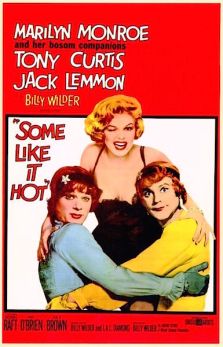
Some Like It HotDid you know that Some Like It Hot is a remake of a 1951 German film, Fanfaren der Liebe? I didn’t. Anyway…

The first (and last) time I saw Some Like It Hot was so long ago that, even when watching it again, there are whole swathes of the film I didn’t recall. How few clothes Marilyn Monroe wears, for one thing. I guess I was quite young first time. The only thing I did remember was enjoying it immensely; and, enjoying it again, didn’t want to skip the chance of handing it five stars in this pathetically brief review.

To be concise, it’s a very funny film even 50 years on. It rattles from situation to situation at an occasionally surprising pace, literally without a dull moment. Not that there’s anything wrong with slower old films, but its certainly spritely for its age.

And with it, a genuine classic. Never mind some — everyone should like it a lot.

5 out of 5

Sorry for the pun.

Watchmen 2: a couple of suggestions

After finding Total Film’s humourous suggestions for a Watchmen sequel a little lacking in the funniness department, I thought I’d jot down a few myself. It doesn’t mean they’re actually any better, obviously, but it kept me amused for a few minutes.

Betcha can’t spot all the references…

The Watchmen Strike Back
In which the Watchmen form a rebel alliance to fight crime and try to repeal the Keene Act! Sounds depressingly plausible…

The Watchmen: Part II
Split between shocking events of the present day (which, for the viewer, is still the past) and flashbacks to the beginnings in an even-more-past New York. Oh, wait, that’s the first film…

Watchmen: The Superhero Who Shagged Me
The first one deconstructed the genre, the second spoofs it! Hey, it can’t be any worse than Superhero Movie… probably…

Watchmen Supremacy
Modern-day version that induces motion sickness.

2 Watch 2 Men
In which the least memorable lead from the first film goes on some redeeming mission for no reason other than more ‘cool’ action sequences. Stars Silk Spectre, but no one else.

Watchmen 2: Judgement Day
In which the bad guy turns out to be a good guy and an implausible nuclear explosion destroys a major US city. Oh, wait…

Watchmens
“Get away from her you bitch!”, screams Nite Owl as Ozymandias tries to steal his woman.

Watchmen to the Future Part II
Dr Manhattan takes everyone to the future, and then back into the events of the first film, and into the past, and things get mucked up, and the present starts getting erased, and then the future’s different too, and it barely makes sense but it’s still pretty good. And then it ends with them in the Wild West.

Watchmen Reloaded
In which things get even more convoluted and pretentious. Most likely option, then. No need to do the rubbish sex scene set to inappropriate music in the sequel this time though.

Watchmen: The Two Towers
I think leaving it at that is insensitive enough.

W2 (or, in the US ad campaign only, W2: Watchmen United)
Bigger, better, and even more focussed on The One Everyone Liked (i.e. Rorschach). Refuses to resolve his plot line, but then doesn’t do it in a third film (directed by Uwe Boll as Snyder goes on to relaunch V For Vendetta) because Watchmen Origins: Rorschach is scheduled for a couple of years later.

The Dark Nite Owl
Just had to get that one in there.

Son of Paleface (1952)

2009 #2
Frank Tashlin | 91 mins | DVD | PG

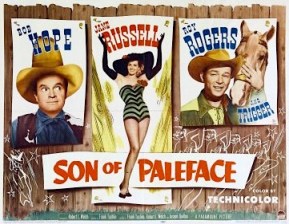
Son of PalefaceA sequel to 1948’s The Paleface only in the sense that it features Bob Hope in a Western setting, this time playing the son of his character from the first film.

Much of it is only gently funny and likely to try the patience of an unforgiving audience, despite the addition of “King of the Cowboys” Roy Rogers to returning stars Hope and Jane Russell. Between them the three manage to deliver some songs too, but the only memorable one is a reiteration of Buttons and Bows from the first film.

Things improve as the film goes on though. It slowly morphs into a live-action cartoon, in the process becoming a lot funnier and, in recreating the style of cartoons, technically impressive too. That the comedy is genuinely entertaining when Son of Paleface finally reaches these sections makes it a shame it takes so much time — and viewer persistence — to get there.

3 out of 5

Hellboy II: The Golden Army (2008)

2008 #93
Guillermo del Toro | 115 mins | DVD | 12 / PG-13

This review contains minor spoilers.

Hellboy II The Golden ArmyDespite enjoying the first live action Hellboy movie last year, I didn’t make it to the cinema for this sequel. Unfortunately neither did a lot of others, choosing to see The Dark Knight again and again instead. Of course these days the DVD release is almost as important… except Hellboy’s was on the same day as Dark Knight’s. I don’t have sales figures, but I expect it was thoroughly overshadowed again — which is a shame, because Hellboy II is actually a very different beast.

Despite shared roots in the pages of comic books, Hellboy II sits comfortably apart from last Summer’s other two big comic book adaptations, The Dark Knight and Iron Man. While the former was aiming for a real-world crime-epic feel and the latter a more humour-littered sci-fi, they both still dealt with billionaires investing in identity-hiding suits to fight crime of one kind or another. Hellboy exists in a completely different place. Of course there are still wise-cracking heroes (with requisite Issues) and scheming villains, action sequences and a liberal use of CGI (mixed with “we did it for real!” bits, thankfully the ‘in thing’ right now) — but it’s not Sci-Fi, it’s Fantasy.

Del Toro uses this to his advantage, allowing his incredibly fertile imagination to run riot over every frame. There are more creatures than the first Hellboy and Pan’s Labyrinth combined — in the Troll Market sequence, there’s probably more in each shot — and, in the vicious Tooth Fairies, a wonderfully gruesome twist on a familiar concept. Though couple these with certain other inventions, such as a baby-like talking tumor, and one might begin to wonder how this got passed as a 12 / PG-13; and you’d think a giant red demon getting a human girl pregnant might be enough to raise the classification. (I jest, of course — giant red demons are entitled to all the same rights as the rest of us.)

Imagination isn’t limited to creature design either. An attractively animated prologue manages to both bring back the ever-excellent John Hurt and find a way to convey the huge back story without making it tediously dull (it also has a Christmassy feel that was perfect for when I watched it). The action sequences have all the requisite coolness too, especially the closing duel on giant moving cogs. In fact, del Toro’s creation seems to overflow — the laying of plot threads for a further film is even more overt than it was in the first film — which makes it even more unfortunate that the director’s long term commitment to The Hobbit and its sequel, plus about half a dozen projects after that, makes a proposed trilogy-closer seem increasingly unlikely. This isn’t a major problem with the film, however, just an annoyance that we may never get a third entry.

One of the most amusingly idiotic criticisms I’ve encountered of Hellboy II was that it was “comic-book-ish” — not only does that make one think, “well, duh”, but also, “and why not?” When the other big comic book movies are aiming for real-world seriousness, it’s nice to have a more fantastical alternative. Hellboy II is more than up to the task.

4 out of 5

Hellboy II: The Golden Army placed 8th on my list of The Ten Best Films I Saw For the First Time in 2008, which can be read in full here. The brief comment there is probably more eloquent than this review, so please check that out too.

Be Kind Rewind (2008)

2008 #90
Michel Gondry | 97 mins | DVD | 12 / PG-13

Be Kind RewindThe work of Michel Gondry and the comedy of Jack Black are both, shall we say, acquired tastes, and not ones you would necessarily expect to overlap. Yet here they do — at least to an extent — but while Black is again doing his usual schtick as the Ker-Azy Best Mate, it’s the writer-director who is perhaps offering some surprises.
Gondry has exactly the sort of fanbase you’d expect for a French director who started out in music videos for Bjork and The Chemical Brothers before progressing to films like Eternal Sunshine of the Spotless Mind and The Science of Sleep. It’s not inconceivable those fans may’ve been a bit surprised by this effort, about two video store clerks who begin to remake well-known movies when all the store’s tapes are accidentally wiped, because it seems so thoroughly mainstream; or, to put it a nicer way, accessible. That’s not to say it doesn’t have an oddness about it — early plot points hit unreal levels, before the film becomes more grounded — but for the most part it errs on the side of realism. It’s almost hard to believe Gondry wrote and directed it, considering his previous output.

In fact, so conceivable is so much of the story that one could almost believe it was a fictionalised version of real events. The way the films are remade — using elaborate cardboard props and cunning camera tricks — are all pleasantly innovative, but well within the bounds of believability; and when they gain a previously-meaningless nickname (“sweded”) and explode with cult popularity, it’s heavily reminiscent of so many Internet-based crazes, several of which do revolve around retelling popular films. Indeed, placing the concept of ‘sweding’ at the heart of the film taps into the popularity such things tend to garner, and the enjoyability of the idea helps carry the film through some rougher patches.

And Be Kind Rewind is at its best — and, crucially, funniest — during the ‘sweding’ of recognisable films. These sequences are packed with the vicarious joy of recreating iconic moments from beloved films with just a video camera, some mates, and a pile of card. It’s here that the lovability of the concept comes to the fore, and it would perhaps benefit from even more of this. On the other hand, an endless stream of re-made movies is no substitute for a proper plot, so Gondry wisely limits how many films we see being ‘sweded’.

The problem is, the rest of the story doesn’t always do a great deal to make up for it. There’s a surprising number of stock moments and subplots considering Gondry’s roots, and some threads are underplayed to the point of seeming extraneous. In particular, a romantic subplot is so inconclusive — not even ‘resolved’ in an open-ended manner — that one wonders why it was included at all.

Your enjoyment of Be Kind Rewind is likely to ride on how much you like the idea of ‘sweding’. If it sounds like a fun thing to watch or do, the goodwill engendered by the concept may carry you through the film’s weaker moments. If, however, you think it sounds faintly silly, there’s not much else on offer besides a familiar moral message about community, and achieving your goals, and all that jazz.

4 out of 5

Russian Ark (2002)

aka Russkiy Kovcheg

2008 #98
Alexander Sokurov | 96 mins | DVD | U

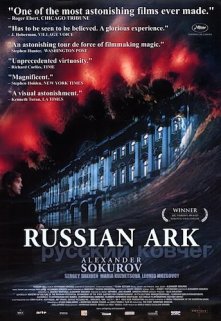
Russian ArkRussian Ark has received boundless praise from some quarters, and not just for being shot in a recording-smashing single take — to cite one review in particular, “anyone with an eye for beauty, a yearning for the past or a passion for pure cinema is going to be spellbound.”

Apparently some sort of artistic documentary on the history of Russia, told via a fantastical time-travelling-ish tour of a Russian museum, Russian Ark is certainly ‘artistic’. Unfortunately, it doesn’t teach you much and is at no point clear about what it’s covering. Perhaps a more detailed knowledge of Russian history would lend some meaning to the tableaus that are half-glimpsed as the Steadicam drifts by, though it spends as much time meandering down empty corridors in search of something to film as it does actually showing anything. When it does alight on something, the staging is occasionally spectacular, especially considering the self-imposed technical restrictions, but I gained little from this alone.

I freely admit this may say more about me than the film itself, but the most interesting parts were when the character whose point-of-view we inhabit and the French historian he encounters begin to discuss something that almost (almost) resembles a plot — how did they get there, how can the Frenchman speak Russian, can others see them, and so on. Sokurov merrily raises all these questions, in the process throwing a sci-fi dimension into his artistic-documentary-fantasy, but are there any answers offered? No, of course not — that’s not the point. Which does rather make you wonder why they’re vocalised at all…

Watching Russian Ark is a little like doing what the nominal lead characters do: wander aimlessly around an unfamiliar museum without any guide to what they see. Undoubtedly impressive, and worth seeing for the audacity of the single take, but I, unlike others, was far from spellbound.

2 out of 5

(Originally posted on 30th January 2009.)

The Green Mile (1999)

2008 #78
Frank Darabont | 181 mins | DVD | 18 / R

This review contains major spoilers.

The Worst Movie Poster of All TimeFive years after making The Shawshank Redemption — somewhat ignored at the time, but now incredibly popular and constantly bidding for acknowledgement as The Best Film Ever — writer-director Frank Darabont returned to the Stephen King Non-Horror Well (quite a shallow one, I should think) to film this tale of a man on death row in the ’30s. Darabont writing & directing a three-hour adaptation of a Stephen King story set in a prison in early 20th Century America? But Shawshank 2 this is not; in fact, I would argue that, due to one key difference amid those similarities, it’s actually the anti-Shawshank.

The key difference, I should rush to point out, is not the presence of the supernatural. While obviously a major element of the film, the level of realism dedicated to it, plus the overall tone of the piece, means that it still doesn’t feel too far removed from its predecessor. Nonetheless, where Shawshank was very much a real-world story, The Green Mile gradually draws the viewer into believing that miracles may be possible. It’s a whole hour before Michael Clarke Duncan’s near-silent John Coffey (“like the drink, only not spelled the same”) does his healing thing, at which point what was apparently a straightforward period prison drama gains a new dimension.

The fact that this occurs so late, after a lot of effort has been spent establishing the normal real-world setting, means it is firmly grounded in reality. Where most supernatural-focused films ask the viewer to accept, “in this world, this is real”, The Green Mile forces us to ask, “in the real world, what is this power? where does it come from?” Perhaps this seems a subtle distinction, but it isn’t; and the film pulls it off with impressive ease thanks to Darabont’s writing and direction, plus the well-judged performances of Duncan, Tom Hanks as lead warden Paul Edgecomb, and the rest of the cast.

Up to this point, the film feels like a collection of subplots. It takes a slow and careful, but never dull, approach to storytelling, slowly unfurling details of the characters, their relationships, and the technicalities of prison life; but it’s not until Coffey’s power emerges that these really begin to come together. Within this process, Darabont’s writing cleverly structures the release of information to the viewer. We never learn any details of some of the inmates’ crimes, for example, allowing us to sympathise with them; indeed, a lot of subtle effort is put into making Michael Jeter’s Del likeable, serving the double purpose of making his death infinitely more shocking (that we don’t know his crimes largely removes the danger of a “well he deserved it” reaction from certain viewers) and, by his association with Coffey, helping the viewer to like the apparent child murderer. All sorts of details slip by almost as scene setting, only to have horrendous significance later on, and both the reveals and later revelations are played out perfectly.

The film’s ending successfully brings together a wide variety of these seeded elements, neatly melding the remaining subplots without pushing into the realm of unsatisfactory coincidence. But the conclusion is also unapologetically downbeat, and it’s this which affirms that anti-Shawshank status: where Shawshank ends with escape and hope, The Green Mile ends with injustice and imprisonment — the execution of an innocent, miraculous man, and Paul’s ‘imprisonment’ in an unknowably long (potentially, endless) life, suffering the constant loss of those he loves and the guilt of what he did.

If The Green Mile is not quite Shawshank then that’s because it’s not trying to be. It’s a superb film in its own right, but the lack of an uplifting ending is the reason it isn’t — and never will be — as popular as its apparent twin.

5 out of 5

(Originally posted on 28th January 2009.)

Becoming Jane (2007)

2008 #91
Julian Jarrold | 115 mins | DVD | PG / PG

Becoming JaneDirector Julian Jarrold seems to have found his cinematic niche in “coming a bit late”. His Kinky Boots, while entertaining, was reminiscent of films like The Full Monty… except 8 years later; Becoming Jane rides the Pride & Prejudice bandwagon… except 18 months later; and his latest, the new Brideshead Revisited, had something of the Atonements about it… except 6 months later. At least his lead times have got shorter.
Perhaps Jarrold’s other inspiration here was Batman Begins. No, bear with me, for this is Austen Begins: Jane’s literary career has yet to start, but as the film progresses we see something of her personality taking shape — and plenty of the inspiration for her novels. Lord alone knows how factual any of it is, but I’m sure it must be a lot of fun for certain Austenites. On the other hand, purists might be less pleased with their idol being constantly lovelorn and indulging in (whisper it, children) snogging. For those with only the most cursory knowledge of Austen’s work, these might be the only things that stop them believing this is an adaptation of one of her novels; though, in truth, they’re probably not even that intrusive.

The big advantage to this being a somewhat Hollywoodised version of the story is the slew of English acting talent on display. Julie Walters, Maggie Smith and Ian Richardson are all present, in roles of varying sizes, plus the younger Anna Maxwell Martin (Bleak House) and Laurence Fox (son of Edward); not to mention James McAvoy, busy appearing in everything under the sun at the time. In the lead role, Anne Hathaway does a fine job, though there’s the inevitable question of “why not cast a Brit?” (to which one must assume the answer is, “for the sake of the US box office”). At least her accent is good.

Becoming Jane is a Jane Austen biopic treated as if it were a Jane Austen novel. In fact, so much is it embedded in the writing of Pride & Prejudice — and the notion that most of that was inspired by her own life — that it occasionally feels like another adaptation of it. This approach is a little uncomfortable in places, though probably makes sense considering the target market; and, by being so relatively lightweight, the resultant films seems to have faced less criticism from some Austenites than the similarly-timed TV biopic, Miss Austen Regrets. It’s for precisely this reason that the latter was a superior product, however: it may be darker and less uplifting — it ends with Austen’s death, rather than the start of her literary career — but it has a level of reflection that makes it more than Austen-Lite. Unlike this.

3 out of 5

Becoming Jane is on BBC Two today, Wednesday 31st December 2014, at 1:20pm.

(Originally posted on 27th January 2009.)

White Christmas (1954)

2008 #97
Michael Curtiz | 115 mins | DVD | U

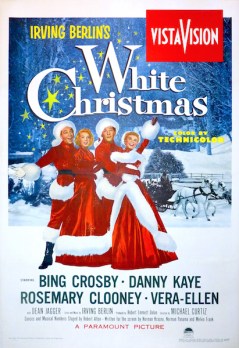
White ChristmasWhite Christmas is surprisingly un-Christmassy. Yes, it’s set at the right time of year, and the plot concerns itself with do-gooding and charity and other such vaguely seasonal themes; but, crucially, there’s a distinct absence of snow (until the very end) and little else actually inspires much Christmas feeling.

The plot winds its way to a moving finale, but, baring a few memorable numbers — Sisters, for example; and, particularly, a rendition of it by the male leads — most of the path there is quite average. One wonders how much of its renown is actually based on the titular song.

3 out of 5

White Christmas is on Film4 today, Monday 24th November 2014, at 12:50pm.