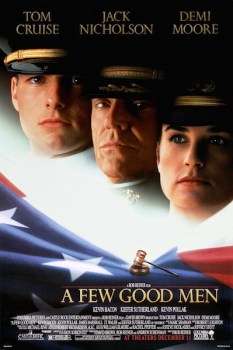
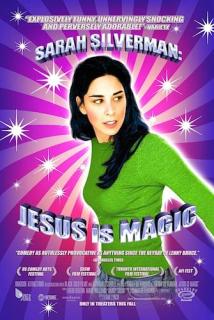
Sarah Silverman: Jesus is Magic [TV edit] (2005)

2009 #45
Liam Lynch | 50 mins | TV | 15

Sarah Silverman: Jesus is MagicStand-up concert films are an awkward business (as are rock concert films), raising questions that are oft pondered on this blog about what constitutes a “film”. After all, if this were just shown on TV or released direct to DVD rather than released in cinemas, no one would be considering it a feature. Indeed, Channel 4’s TV showing cut the 70-minute (PAL) version down to just 50, much as they do for the TV showing of any other direct-to-DVD stand-up gig. But the fact remains that this was released in cinemas (albeit not many) as a feature film. Though if it’s worthy of review under this blog’s remit, and direct-to-DVD movies are worthy of review too, surely direct-to-DVD comedy gigs should be? It’s enough to make your head hurt — something Jesus is Magic might also do, if it hasn’t sent you to sleep.

All comedy is an acquired taste, of course, but what Silverman offers here must take some acquiring. I mostly like what I’ve seen of her work in the past — I’ll admit to having I’m F***ing Matt Damon circling round in my head for weeks after first hearing it — but the lack of laughs here is enough to put me off bothering with her in future. Most of her material seems to be an excuse to say extremely rude or controversial things, and in fact often relies on these things being so rude as to provoke laughter just for that. The audience seem happy to go along, but there’s nothing inherently funny about a rude sentence — it needs a point, be it satire or surrealism (which she tries, but fails at) or something else. I have no problem with edgy or ‘offensive’ comedy, but this isn’t it.

Occasionally Silverman hits on something worthwhile amongst all the dross. Some of her comments on 9/11, the Holocaust and a handful of other edgy (and, indeed, ‘edgy’) areas raised a smile, maybe even a chuckle, proof (were it needed) that difficult topics can be covered as comedy. Even then, however, it’s only one or two gags among a raft of blabbing on those topics. At other times there are lines that desperately want to be funny, and if she’d managed to build up a head of comedic steam they’d garner a laugh as they passed, but in isolation they’re just not enough.

On a related note, the whole thing is bizarrely slow-paced. I don’t know if that’s an American thing or if British comedians are exceptional in their rapid-fire delivery — or just “relatively rapid-fire delivery”, because even the slowest joketeller you’d encounter on something like Live at the Apollo can spit them out twice as fast as Silverman — but she seems to take forever to get anywhere. Anywhere at all, that is, never mind to an actual joke. Few, if any, British comedians would survive at this pace.

Directorially, it’s a simple concert film, perhaps an over-edited one. Lynch splashes out during a couple of musical numbers, producing the occasional background gags this way — the people Silverman passes during I Love You More, for example — though at other points he’s just as guilty of spending too long on something that’s either not funny or that becomes humourless through exhaustion, such as the black people she encounters at the end of the same song.

Based on comments in online reviews, it seems Channel 4 mostly cut documentary material for their abbreviated TV showing. Whether these insights add some weight to proceedings or just slow the film down further I don’t know, but I’m thankful I didn’t have to suffer through another 20 minutes of this. As noted at the start, this editing (just like other stand-up DVDs transferring to TV) lends credence to the idea that this isn’t really a film. Whether it is or not ultimately doesn’t matter, other than if you’ve paid to see a comedy it would be nice to hear some gags — why go to the cinema for a humour-free evening you could stay at home with Michael McIntyre’s Comedy Roadshow and actually have a laugh?

1 out of 5

Also see Eamonn McCusker’s review at DVD Times for a similar perspective. I’d especially echo his final paragraph: “Or the everyday conversations that you can hear up and down the country, which [would] leave Silverman blushing. Compared to all that, Silverman seems safe.” It’s great to be British.

Sarah Silverman: Jesus is Magic featured on my list of The Five Worst Films I Saw in 2009, which can be read in full here.

A Few Good Men (1992)

2009 #38
Rob Reiner | 138 mins | download | 15 / R

A Few Good MenSometimes you have to wonder where it all went wrong. I can only imagine how good things looked for Rob Reiner at the start of the ’90s, when he’d had an almost-interrupted near-decade-long run of acclaimed movies in the director’s chair: This is Spinal Tap, Stand By Me, The Princess Bride, When Harry Met Sally, Misery, and finally this. ‘Finally’ being the operative word however, as it all seems to have gone down hill from there, to the extent that I actually felt the need to look him up on IMDb to check if he was still working/alive. (He’s both, having recently directed The Bucket List, a bit of a hit if I recall correctly.) Reiner is a recognisable name, and if he’d stopped making films after A Few Good Men perhaps he’d find himself bandied about on lists of Great Directors (at least in certain circles/magazines), but the fact I had to check what he’s been up to (and had forgotten how many acclaimed films he’d made in the first place) shows what a 15-year run of nothingy films can do for your reputation. Even the career of Spinal Tap themselves seems to be in better condition.

All that said, A Few Good Men isn’t really Reiner’s show. It’s not that he does a bad job — far from it — but courtroom dramas primarily depend on two things, even more so than most films: the quality of the writing and the quality of the performances. When you have scene after scene in which a handful of people battle with words alone, often in one-on-one confrontations, then those two elements are virtually all you’ve got. Of course camerawork, editing, music and the rest still have their part to play, but without the underpinning of good writing and good performances the technical attributes are merely fighting to cover for significant shortcomings. Fortunately, A Few Good Men has those underpinnings.

In this case the screenplay is by Aaron Sorkin, adapting from his own play, who would go on to create and write a great deal of The West Wing (which, incidentally, was inspired by leftover ideas from a later Sorkin/Reiner collaboration, The American President). The seeds of that show’s influential style are in evidence here, although the sheer pace and famous ‘Walk and Talk’ scenes aren’t yet part of the formula. As in The West Wing, Sorkin’s writing is both intelligent and witty, a hallmark of high-quality writing that’s able to rise above the shackles of “it’s not real drama unless it’s all grimly serious”. His characters and their personal story arcs may be straight from the stock pile — Tom Cruise is the hot-shot young lawyer who’s actually trying to live up to his daddy (and comes through in the end); Demi Moore is the goody-two-shoes woman trying to make it in a man’s world (who learns to work with her colleagues); and so on — but the plotting of the central case remains undiminished, and Sorkin thankfully avoids such obvious subplots as a romance between Cruise and Moore’s initially-mismatched-but-ultimately-mutually-respectful good guys. Nonetheless, the occasional lapses into extreme, often patriotic, sentiment that would later mar the odd episode of The West Wing are also on show here, most notably at the climax, though they fail to do any serious damage.

It’s in the all-important court scenes that Sorkin’s writing really shines. Dialogue flies back and forth like bullets, full of protocol and technical jargon — like in The West Wing — that we either understand or, when we don’t, get enough of the gist to follow the key plot points — like in The West Wing. The biggie is the final confrontation between Lt. Kaffee and Col. Jessep, an interview that’s the courtroom equivalent of a high noon showdown. It’s true that Tom Cruise plays Tom Cruise and Jack Nicholson plays Jack Nicholson, just as they almost always do, but it makes for a grand act-off. It’s fair to say that Nicholson comes out the victor, gifted with material that guides him from cocksure commanding officer to angry thug in just a few minutes, but it’s the bravado of Cruise’s questioning — undercut with uncertainty and genuine surprise when he pulls it off — that pushes Jessep there.

There are plenty of other good performances — typically competent work from Kevin Pollak doing the best friend thing and Kevin Bacon doing the friend-turned-rival thing, while Kiefer Sutherland’s ‘head bully’ role is memorable and Demi Moore holds her own better than the rest of her career might suggest — but this is undoubtedly a showcase for Nicholson and Cruise, and through them Sorkin’s writing. Not to mention that there are some nice directorial flourishes from Reiner. I wonder what happened to him?

4 out of 5

A Few Good Men is showing on Five tonight at 10pm.

The X Files: I Want to Believe – Director’s Cut (2008)

2009 #44
Chris Carter | 104 mins | DVD | 15
Six years after the once-phenomenal TV series meandered to an inconclusive conclusion, Mulder and Scully were back at the cinema, a decade on from their previous between-seasons big screen outing. The big threat this time was not aliens, however; nor even something more Earthly supernatural; but rather, where they would find an audience? There are now kids old enough to watch this in a BBFC-endorsed fashion who weren’t even born when the series started, and that’s not to mention the misguided attempt to pitch this as a Summer blockbuster.

And if there’s one thing I Want to Believe isn’t it’s a Summer blockbuster, which its snowbound setting arguably gives away to even the most casual observer, while its lack of action sequences and focus on spooky goings-on and character relationships — not to mention that none of these characters are requisitely young enough to head up a typical Summer Movie — should have been the clue to studio execs. And, unsurprisingly, the release strategy failed, leaving audiences either disappointed or not even turning up. As with so many perceived flops these days, it seems to me, I Want to Believe didn’t actually flop: off a $30m budget it made $68m worldwide. Though as only $21m came from the US, where the consideration of box office stats is often highly self-centred, it’s easy to see why many believe it did. Such perception, coupled with poor reviews and that problem of finding an audience, may mean there’s not a third movie, which seems a shame with 2012 on the horizon — quite nice timing for a (last-ever, I should think) instalment.

But let’s return to the issue of how this film was perceived, because I think that’s key to why it was so poorly received. The problem here is that it’s an X Files movie; not because there’s anything wrong with another film for that series, and not because it’s a bad version of The X Files, but because that title carries certain expectations — not only from fans but, with greater relevance to any widespread success, from the general public. Witness the IMDb thread entitled “Where the F were the aliens”, for example. Were this just an entirely standalone supernatural-tinged thriller — and consequently released in a sensible non-Summer slot — it probably would’ve gone down a bit better.

As it actually stands, I Want to Believe is not the kind of X Files most people were expecting — i.e. Something To Do With Aliens, and it’s no spoiler to say that there’s not a single one to be seen — forgetting that the series was never just about extraterrestrials. The idea that I Want to Believe was a bit rubbish and thoroughly disappointing is consequently as much (if not more) the fault of those viewers and reviewers who expected a different kind of film and didn’t get it. That said, it’s a shame that I Want to Believe isn’t wholly successful as the kind of film it’s trying to be either: on the surface, a standalone low-key supernatural thriller — though it fails to explore or explain its fantastical and scientific ideas as fully as one would like, particularly during its lacklustre (anti-)climax — but one that also tackles issues of moving on, obsession and belief, and how they can impact on a relationship — though with all the weight you’d expect in the belated sequel to a sci-fi TV spin-off.

Mainly, however, it’s about belief. The examples of this are too numerous to mention, but a clear one is the subplot involving Scully’s fight to treat a terminally ill boy. The thread bears little relation to the main supernatural plot, which was another point of confusion for many viewers, but if you consider the film as a commentary on and examination of the various forms and merits of belief it begins to slot in a lot better. Perhaps this is another case of a filmmaker attempting something beyond what audiences were expecting to invest in terms of intelligence, although if one accepts it’s there and a significant part of the film it probably begins to pale as a relatively light and underdone exercise. Still, it’s hard to deny that belief is the film’s central theme, which pleasantly turns the title from a generic catchphrase from the series, as it initially appeared, to a none-more-appropriate moniker.

Perhaps distracted by his thematic intents, writer-director Carter rushes some plot points, though he may also be limited by budget constraints and the need to make a distinctly R-flavoured movie hit PG-13. While the Director’s Cut adds three-and-a-half minutes of material, which Duchovny asserts is mainly gore that was cut to avoid an R certificate in cinemas (full details of which can be found here), there’s still nothing that looks as if it would’ve been out of place on conservative US network television, and obviously no effort has been made to give the main plot some breathing space.

The same goes for the guest cast, most of whom are thoroughly underused. Billy Connelly makes a good show of it, but Amanda Peet’s FBI agent has much unfulfilled potential. Yet at other points Carter lets things spool out comfortably — too comfortably, some might argue. One of these places is the relationship scenes between the two leads. The amount of attention lavished on this might lend credence to a theory that the film is as much about a pair of ostensibly retired paranormal investigators as it is this particular case, and through that again a consideration of obsession and belief.

The large amount of time spent on Mulder and Scully’s relationship fortunately doesn’t turn the film into an effort solely for the benefit of ‘shippers’. There’s definite space here for a portrait of two people in a relationship who have tried to move on from their old life but just can’t, and at times I Want to Believe does achieve such lofty aims. Little nuggets of information — such as the fact they’re even in a relationship, or that they once had a child together — drop in almost from nowhere in a way that undoubtedly sounds just like dialogue to a knowledgeable fan, but to a more casual viewer works as a slow uncovering of these two characters. Unfortunately such quality is fitful, especially as the movie goes on, and while the nine-seasons-and-one-movie of backstory initially just add depth if you know about them, it’s some time before the sudden and underwhelming climax that it feels they’re dictating events a little too much. What was shaping up to be a workably standalone depiction of two characters almost becomes just a status update on Mulder and Scully.

And here lies the rub: at times, the Second X Files Movie gets too caught up in being just that. There’s nothing wrong with that per se, but it could do with remembering it’s a Movie and not just another X File — especially if it wants to find any new (or even lapsed) viewers. When Assistant Director Skinner turns up it’s the final nail in the coffin for any shot at independence. As a fan, it’s impossible to begrudge a brief but heroic last-minute appearance from Mulder and Scully’s long-time ally, but as an objective viewer, he’s just some bloke who turns up with no introduction just in time to play a major role in the climax. It’s a misstep that, along with an accumulation of others, seriously damages the film.

But does an X Files movie need to be independent? Should nine seasons (and one movie) of backstory be ignored? Well, yes and no. There’s nothing wrong with making a “where are they now?” fan-pleasing reunion, but that would belong on TV with the bulk of the thing being commemorated. In the cinema, six years distant and billed as a standalone tale (note that it’s not even The X Files 2: I Want to Believe, never mind The X Files 204: I Want to Believe), it ought to stand on its own two feet and work entirely as a self-contained piece of drama. That it fails in this is perhaps the most disappointing aspect of all for me: it makes it infinitely harder to defend this as a supernatural thriller that deserves to be judged entirely on its own terms, rather than with some established knowledge of what The X Files ‘is’, when the makers are relying on those self-same established notions to tell their story.

Never mind finding an allusive audience, this is the film’s real battle: when Carter gets too caught up in making The Second X Files Movie, shifting what’s working well as both The X Files and A Movie into straight-up An X Files Movie territory. It’s this failure to be independent — not to the point of ignoring the series’ backstory, I should clarify, but to a point where this film can be wholly appreciated without ever seeing The X Files — that ultimately holds I Want to Believe back from becoming a great horror/thriller/drama movie in its own right. It’s frustrating because so often Carter comes tantalisingly close to fulfilling such ambitions, and if he had I’d have no qualms about defending this movie as an underrated (though, it is), misunderstood (though, it is) and independent supernatural-flavoured drama. Sadly, however, I think I just want to believe it is.

3 out of 5

The X Files: I Want to Believe premieres on Sky Movies Premiere tonight at 9:45pm, then at various times throughout the week. It’s probably the theatrical cut, but who can say?

Flags of Our Fathers (2006)

2009 #39
Clint Eastwood | 126 mins | DVD | 15 / R

Flags of Our FathersIt’s been two years since I reviewed the second in Clint Eastwood’s 2006 double bill of World War II films; thanks to the machinations of my DVD rental site, it’s taken this long to see the first. In a somewhat innovative move, the pair examine both sides of the battle for Iwo Jima: Letters from Iwo Jima from the (losing) Japanese perspective, while Flags of Our Fathers shows the (victorious, obviously) American view. I found Letters to be a fair effort, if undeserving of some of the praise and nominations it garnered, but the consensus seems to have it that this first half isn’t as good.
Perhaps that’s because Flags is a different kind of war film. While it seems to have been promoted as the story of the battle for Iwo Jima, it’s more about the experience of three men, both on the island and upon their return to America — hailed as heroes and paraded around the country trying to raise money for the war effort, purely because they happened to be in a photograph raising a flag. While there are still plenty of battle sequences and the occasional bit of “who will survive?” suspense — not to mention an examination of such issues as honour, duty, responsibility and so forth — Eastwood is clearly aiming for something different here. Indeed, while those themes may be standard war movie fare, by placing them in slightly different contexts Eastwood finds new (or at least uncommon) perspectives on them. Perhaps this explains why Letters came off better: by comparison it’s a much more typical war movie, therefore more what was expected.

Many of Flags’ weak spots also arise from this approach however. It adopts a time-jumping structure, flitting between the battle itself and what happened after. It’s debatable how well that works: at times it’s fine, at others it needlessly complicates matters. The final stretch also gets a bit meta/hyper/intertextual, following the author of the book on which the film is based as he conducts research for the book… then rams it home when the three lead actors also appear as his brothers. (To be fair, the latter is in a single shot where their faces are almost hidden.) In the end, Flags offers neither of the usual clear-cut war movie endings (“we won!” or “we lost nobly!”), closing with no easy answers or conclusions to the issues it raises. This at least sticks to its realism, but won’t be to all tastes (with reservations, I liked it).

One side effect of such a different approach is that Eastwood’s two Iwo Jima films make good companion pieces. In no serious way do they present Part One and Part Two of a story, but instead two vastly different perspectives on the same events. The points of crossover between the two are neatly used, occurring naturally rather than forcing “you’ll understand this later”-style mysteries upon the viewer, but mainly they explore the way two very different cultures reacted to the same battle.

They do directly share something however, and that’s a debt to Saving Private Ryan in their depiction of combat. A beach-storming sequence naturally invites direct comparisons, with Flags unquestionably coming off worse due to a lack of focus. It’s still an effective sequence and it’s not a clone of Ryan, but the comparison is hard to avoid and Ryan’s opening is famous for a reason.

Despite the verisimilitude the Ryan-esque visual style now has, Eastwood nonetheless shies away from some of the reality. It seems he can’t bear to explain or show what happened to Iggy, for example, though in fairness the viewer should be glad he didn’t. (If you want, some of the details can be found on Wikipedia, but be warned that his fate was truly distressing.) Knowing the truth, one can only imagine the trauma and guilt felt by ‘Doc’ Bradley in the wake of the incident.

On a lesser level, one also imagines it must be difficult as a filmmaker deciding whether to include such details or not — on one hand, I’m glad we weren’t confronted with them on screen (certainly, to show a body would have been too much), but, while the details are horrific, knowing them adds an extra layer of emotion that is absent when kept a mystery. An externally-gained awareness of the reality of Iwo Jima adds a weight that is arguably missing from the film, but which improved it for me.

Flags of Our Fathers is an unusual war movie, probably not what many were expecting when told Eastwood was doing a War Film about the battle of Iwo Jima. But by being different it has a lot to say about the experience of war — both on an individual level and in a broader sense — that is rarely (if ever) expressed on film in quite this way.

4 out of 5

My thoughts on the second half of this pair can be read here.

Do You Wanna Date James Cameron’s Avatar?

It’s always fun to mush news stories together for potentially comedic effect.*

So when I heard, on the same day, of the expected success of the trailer for James Cameron’s Avatar (or, as I’ve taken to calling it, Phantom Menace 2: This Time Everyone’s Jar Jar) and the surprising success of The Guild’s music video for (Do You Wanna Date My) Avatar… well, I couldn’t help seeing what would happen were the two to collide…


* I’ll leave it to you to decide if this example is successful.

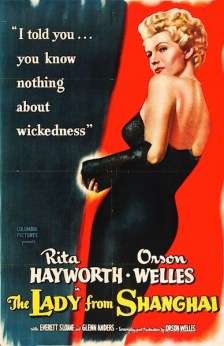
The Lady from Shanghai (1947)

2009 #37
Orson Welles | 84 mins | TV | PG

The Lady from ShanghaiThe Lady from Shanghai is an Orson Welles film… which means his original 155-minute cut was forcibly cut down by over an hour, the studio insisted he include more beauty shots of Rita Hayworth, as well as a song for her to sing, and the temp score he provided to the composer was ignored in favour of something Welles hated. Yet for all that — not to mention Welles’ distractingly atrocious Irish accent — it’s still a highly enjoyable film.

The plot is thoroughly noirish and offers up its fair share of twists along the way, while the performances are able if largely not particularly memorable. The exception to this is Glenn Anders, giving a gloriously unhinged performance as Grisby, drawling his vowels with high-pitched lunacy. Though Welles was heavily criticised for cutting and dying Hayworth’s hair — to the extent that some blamed it for the film’s box office failure — it hardly matters (I thought she looked better anyway), and the enforced beauty shots actually work thematically toward the conclusion.

Even more attractive are the skills Welles brings directorially, on display throughout. Every key sequence provides something genuinely worth looking at while still relating the intricate plot, though the cruise offers many of the best bits — the hot, sweaty foreign climes are conveyed brilliantly, aided by sumptuous location photography, and these sunny scenes contrast nicely with the noir plot. Mention must also be made of the the famous finale in the Hall of Mirrors, a precisely shot sequence that provides a fitting close. Elsewhere, Welles’ sense of humour is pleasingly present, lending the trial scenes in particular a distinctive style that brings some ever-welcome variety.

Brisk (at under an hour-and-a-half) but engagingly complex, and rarely less than beautifully shot, The Lady from Shanghai may be a compromised version of Welles’ intentions, but his undeniable ability (at directing, not accents) means it remains a compelling film noir.

4 out of 5

The Lady from Shanghai is showing on BBC Four at 10pm on Saturday 22nd August as part of a Film Noir Weekend. See this post at From the Cheap Seats for more details.

Stand By Me (1986)

2009 #29
Rob Reiner | 89 mins | download | 15 / R

Stand By MeStand By Me is a film an awful lot of people love an awful lot, which it always seemed to me was down to first seeing it at the right age (more or less the age of the main characters, I think) and possibly to being part of a certain generation — would it have the same effect for kids today, when the relative innocence and freedom of the ’50s is arguably lost? As I say, “seemed”, because now I’m not sure either of these factors really matter.
Irrespective of age, generation, or being able to remember the kinds of experiences suggested by the film, Stand By Me is still an effective and affecting little film. The level of enjoyment for some may depend on how much they can stomach child actors, though as kids go they’re mostly very good. River Phoenix in particular is brilliant, highly natural while bringing a lot of depth to perhaps the most important role. Wil Wheaton also makes a good account of himself, just one year before attracting derision as Wesley Crusher in Star Trek: The Next Generation. (Phoenix, of course, went on to have a tragically short-lived career.) Kiefer Sutherland is as effective a villain as he ever would be, though that aspect of the plot is almost an aside.

An aside, because the film isn’t about the fights between the young heroes and a group of older bullies. Rather, it’s a paean for childhood, with the adult perspective and the ‘lost age’ setting of the ’50s succinctly highlighting the nostalgic spirit. To be precise, it’s not so much reflecting on “childhood” as on “growing up” — the choices that are open when young that either disappear with time or, for whatever reason, become closed off. The whole film is arguably about choice: choice of friends, choice of social class, Ace’s constant listing of choices (the subtext breaking into the text, as many a film teacher would point out), even the obvious choice whether to follow the tracks or take shortcuts (surely symbolic). Thematically, it’s the choice to be put down or stand up for yourself; the choice to stick around and wind up a nobody or work hard and get out, also underlined in the present-day bookends.

Perhaps being the right age is helpful to a love for Stand By Me, but at any stage in life it’s easy to relate to its depiction of the experiences and choices of childhood, be they now lost, taken, or never even had.

4 out of 5

Stand By Me is on Channel 5 today, Sunday 12th October 2014, at 2pm.

Alien vs Predator – Part 2

Five weeks ago (crikey, time flies) I began my series of reviews of the Alien, Predator and Alien vs Predator franchises with my thoughts on Alien: The Director’s Cut and the original Predator, both of which I’d seen before. Over the past few days I’ve moved on to the remaining Alien films, all of which I viewed in their original theatrical cuts and all of which were new to me.

Here’s a handy summary of what you may’ve missed, then, if you somehow had something better to do on a sunny summer weekend than check blogs every day.

2009 #14
Aliens

“Where Alien is a Horror Movie — but in space — Aliens is a War Movie — but in space. The central characters are a team of marines, as opposed to the original’s ordinary guys; where the first film’s design was dark, shadowy and oppressive, here it’s all gleaming tech, tanks and guns and spaceships and the like; and, just to underline the point, the score is full of military drums.” Read more…

2009 #15
Alien³

“Even if in some ways 3 combines the first two — single Alien, claustrophobia, unarmed heroes; but there are lots of them, most with experience of killing — it adds enough variety, especially stylistically… it soon turns dark, dirty and decrepit, abandoning both the the military sheen of Aliens and the old tanker grime of Alien.” Read more…

2009 #16
Alien Resurrection

“the most notable differences are its black humour, where the tastes of both [writer] Whedon and director Jeunet make their mark, and how grotesque it is — almost two extremes walking hand-in-hand. The deformed, perverted Ripley clones; the Hybrid; the Ripley-Alien sex scene — there’s nothing like this in the other films, and that’s a grand thing.” Read more…


In the third and final part of this series I’ll be setting my sights on the allegedly-underrated Predator 2 and the much-hated pair of AVP and AVPR.

Alien Resurrection (1997)

2009 #16
Jean-Pierre Jeunet | 104 mins | DVD | 18 / R

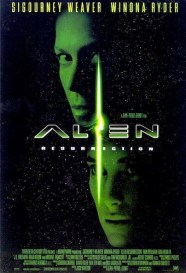
Alien Resurrection is much maligned, to the point that even screenwriter Joss Whedon has publicly disowned it. Which is interesting to me, because I really liked it.

While you clean up your beverage-of-choice that I’m sure you just spurted all over your monitor, let me reassure you that I’m not about to argue Resurrection is an undervalued classic on a par with the first two films; but, having heard nothing but bad things about it for over a decade, I found myself pleasantly surprised. As so many other reviews have sought to detail the film’s flaws I won’t dwell on them myself, but instead seek to explain why I liked it.

In my Alien³ review I applauded the franchise for taking each instalment in a new direction stylistically, and Resurrection doesn’t drop the baton on this. Structurally it’s the most straightforward of all four, slotting fairly neatly into a standard action-adventure/disaster movie template — especially once Ripley hooks up with the crew of the Betty — but this isn’t the most notable difference. No, that would be twofold: its black humour, where the tastes of both Whedon and director Jeunet make their mark; and how grotesque it is — almost two extremes walking hand-in-hand. The deformed, perverted Ripley clones; the Hybrid; the Ripley-Alien sex scene — there’s nothing like this in the other films, and that’s a grand thing. Even if you disapprove of most (or all) of that, the scene where two aliens kill a third so that its acid blood will burn through the floor, allowing them to escape, is a bit of genius that takes our existing knowledge about the species and does something gloriously new with it.

The Aliens themselves are very well realised. For fans who favour the first film to all others they undoubtedly spend too long in plain sight, but, while there is certainly some poor CGI (the underwater sequence being of particular note, though you can see how it seemed a good idea), the constantly slime-dripping practical creatures are excellent. The Aliens and the company (no longer Weyland-Yutani, for no good reason) are relatively revealed by the story too, which I’m sure is to its detriment for some. Personally, I considered it another sensible change: we’ve had three films of the company attempting to capture the Alien — what would happen when they succeeded? That the plot is still based around the company’s hunt for the Aliens (as significant chunks of the previous sequels were too) is also interesting — essentially, the whole franchise was launched because at some point during the first film someone decided Ash should be an android who wanted to capture this mysterious creature.

I can well imagine many hated all these additions and changes to the series’ mythology (especially the Hybrid — fans always hate things like that), but I found them to be an interesting attempt to further the franchise’s story rather than just rehash previous instalments. I won’t deny that some of it borders on the silly (or even crosses that line) and there are a few plot holes (which is disappointing, because many could have been explained away if someone had taken a bit of effort), but for the most part it’s fantastically creepy, grotesque, and more than a little weird… and all within the confines of a standard action-adventure plot! Plus, within that it also retains an unpredictability over who will die, something Alien³ managed to fudge. (That said, the top four names in the opening credits are the four survivors, so maybe I should just pay more attention.)

Resurrection marries the franchise’s most wonderfully grotesque imagery with a standard action-adventure plot, meaning anyone who comes to this looking for their average sci-fi action-adventure may walk away with their sensibilities shocked — or perhaps mutated beyond recognition. It’s certainly not the series’ best film, but I have a nagging feeling that it might turn into my secret favourite.

4 out of 5

Not so secret now I guess.

Alien Resurrection placed 9th on my list of The Ten Best Films I Saw For the First Time in 2009, which can be read in full here.

Alien³ (1992)

2009 #15
David Fincher | 110 mins | DVD | 18 / R

3 times the stupid taglines.We’re used to seeing big studio’s logos transformed at the start of films — Universal perhaps do it most often, having a handy globe, though others are far from immune — but I think Alien³ is the first instance I’ve seen where the logo is left untouched but the music is altered. Right from the disconcerting modification of the famous Fox fanfare you can tell this is going to be something a bit different and a bit edgy. Unfortunately, it’s also a bit rubbish.

At the very least the Alien franchise has to be applauded for giving each film a very different feel and tone. Even if in some ways 3 combines the first two — single Alien, claustrophobia, unarmed heroes; but there are lots of them, most with experience of killing — it adds enough variety, especially stylistically, to mark it out. This can probably be attributed to first-time feature director David Fincher, who, despite severe studio interference, still manages to quickly make the film his own. Though the story picks up directly from the previous film (as Aliens did from Alien), it soon turns dark, dirty and decrepit, abandoning both the military sheen of Aliens and the old tanker grime of Alien.

The sets and costumes have a Gothic feel, devoid of most of the franchise’s sci-fi trappings, and though the cinematography is glossier than either preceding entry (Aliens looks distinctly ’80s, whilst this has a distinctly ’90s look — I’m not well enough versed in technical details to know why this is) it manages to feel grungier. From style to story, the whole film is bleak and uncompromising, particularly with its brutal plot — from the start, only Ripley survives the crash, and soon after there’s a horrid autopsy performed on Aliens‘ lovable little Newt, who Ripley previously fought so hard to save.

Alien³ is very dark and very nasty — and these are by far the best things about it.

Put simply, the story — or the way the story is handled — lets everything down. It all goes well for the first 40 minutes or so, but then it begins to get scrappy, and gets steadily worse as the running time rolls on. Leaps in story and logic abound, either creating plot holes or doing nothing to hide them. Much of the middle is the worst, where the convicts’ plans are muddled and quickly discarded. That said, this is also true of the climax — something to do with running around corridors and a giant piston and… I have no idea. It’s a shame because someone clearly had plenty of fantastic ideas, plot twists and action sequences, but they’re all squandered either by weak editing or, even worse, simply by being in this film.

As for the Alien, it sadly has no real menace — it just turns up as and when it (or, rather, the plot) fancies, and goes away for the rest of the time. In the first film it could be anywhere, in the second they were constantly advancing, but this time it’s just around, somewhere, sometimes. It’s not helped by poor realisation, spending too much time either in the light or in clear shots, both of which show the shortcomings of the special effects in a way the previous two films fought to hide.

The total lack of weapons or monster-fighting skill on the part of the supporting cast exacerbate these problems, meaning that, even when the Alien does turn up, the result is always a foregone conclusion. Even worse, any characters we really care about — or can even identify, to be honest — are killed early on, leaving a bunch of faceless potential victims who weren’t invested with any character and so who we’re not invested in. This is worsened by using a fantastic, recognisable British cast, none of whom are given anything much to do. For all these reasons, almost the entire film is devoid of any genuine tension.

Alien³ isn’t irredeemable — it’s packed with good ideas and good direction — but that’s also why it hurts. Lumbered with a hatchet job on the plot, characters and editing, it feels like some very talented people made a good film before someone else hacked it up a bit. The result is quite bad but, even worse, it’s disappointing.

3 out of 5

Tomorrow, Alien Resurrection.

My review of the Alien³ Special Edition can now be read here.