
Charles Laughton | 93 mins | Blu-ray | 1.66:1 | USA / English | 12
“The [box office] failure of The Night of the Hunter was not, forty-five years ago, much remarked upon: it was a modestly budgeted picture, a little thing in Hollywood terms. But it has drifted slowly, steadily down the river of the years between then and now, and the long flow of time has brought it to a better place, where critics and filmmakers and moviegoers honor it”
 Box office gross is one of the methods most often used to summarise a film’s success and standing, and yet it’s one of the most useless markers of quality — and quotes like the above, from Terrence Rafferty in his article “Holy Terror” for Criterion’s Blu-ray release of Night of the Hunter (and available online here), prove why. This is an exceptional film, by turns beautiful, funny, and not merely scary, but terrifying. If Hollywood movies can be art — and I think we know they can — then this is surely a foremost example.
Based on the 1953 Southern Gothic novel by Davis Grubb, The Night of the Hunter sees convict Harry Powell (Robert Mitchum) attempt to find the hidden robbery haul of his former cellmate, by inveigling his way into the man’s family posing as a preacher. While the mother (Shelley Winters) falls for the lies, her young son John (Billy Chapin) is more suspicious, and tries to protect himself and his little sister Pearl (Sally Jane Bruce), while keeping the money hidden.
The story is largely told from John’s perspective. It’s a big tale to put on small shoulders, full of complex emotions and sometimes difficult themes (per Rafferty, “those venerable American subjects: fear, sex, money, and religion”), but Chapin bears it well. I guess this is one of the reasons why groups including the BFI recommend it as a must-see for kids. Although it’s dark and grim, it rarely wavers from the John’s point of view — it’s an induction into the harshness of the adult world for the two young siblings; a harshness the sweet, innocent community they come from does nothing to prepare them for.
 In another piece in Criterion’s booklet, “Downriver and Heavenward with James Agee” (online here), Michael Sragow reckons the film is a “meshing of adult sensibilities with childhood perceptions”. I couldn’t have put it better myself (hence the quote). John is also the only one to see the truth of Powell — as, of course, do we — which completely ties in to how it can feel to be both a child and an older sibling: adults are dumb and don’t see the truth that children do; and younger siblings need protecting because they can be easily persuaded to the adults’ side (as Pearl almost is). Although it’s a tough film in many ways, this depiction of childhood, and at least one aspect, the loss of innocence that comes when you realise the world isn’t all fluffy and safe, is well captured.
Don’t think it’s too kid-friendly, though. Rafferty asserts that it’s “among the greatest horror movies ever made”, while Sragow thinks it’s the “intimate observations of the children’s psychology” we just discussed that “make the suspense almost unbearable.” Without once resorting to blatant horror techniques, the film builds a quiet and implacable sense of fear. The overall effect is one less of terror and more dread. It’s best described as chilling, which is so much scarier than the occasional jump.
 And yet, as Rafferty explains, “the most radical aspect of The Night of the Hunter… is its sense of humor. More conventional horror movies overdo the solemnity of evil. The monster in The Night of the Hunter is so bad he’s funny. Laughton and Mitchum treat evil with the indignity it deserves.” I wouldn’t say that humour is one of the film’s defining characteristics, to be honest, but it does undercut its villain. He’s not some unstoppable supernatural creature, but a man who can trip over while chasing you up the stairs, and so on. In some respects it’s this very ordinariness that makes him so scary: however much they creep you out during the film itself, you know there’s no such thing as vampires or werewolves or ghosts. There are Powells in the world, though; an everyday evil that you might not see coming, but can still get you. Brr.
It’s also stunningly shot — not just beautiful, but routinely incredible. It has imagery that instantly sears itself on your brain, with gorgeous lighting and perfect composition. Whatever else the film has to offer (and that’s a lot), it’s exceptional just to look at. That it’s the sole directorial effort from Charles Laughton may be a crying shame, because on this evidence — not just the pictures, of course, but the entire picture — we’ve missed out.
 In my 2013 top-ten, I described The Night of the Hunter as “darker than a long night of the soul”. That’s too good an expression to not repeat, partly because I think it sounds good, and partly because I can’t think of another way to succinctly summarise the film’s unique feel. I’m not convinced it’s a great film for children, not because they need protecting from the darkness of the world, but because it’s almost too good — it’s a great portrait of childhood, but perhaps one best appreciated in hindsight. Maybe that’s just because I haven’t seen it until adulthood. Whenever you catch it, this is a film of dread, fear, cruelty, and near-peerless beauty.

The Night of the Hunter was viewed as part of my What Do You Mean You Haven’t Seen…? 12 for 2013 project, which you can read more about here.
It placed 7th on my list of The Ten Best Films I Saw For the First Time in 2013, which can be read in full here.
This review is part of the 100 Films Advent Calendar 2014. Read more here.
 Despite the fact that
  Then we have the much-maligned backstory about just what Peter Parker’s parents did all those years ago, before they abandoned him with Uncle Ben and Aunt May. There are pros and cons to this: it’s all new, which at least makes it interesting and unpredictable because it has no forebear in comics or films; but it’s also a pretty stock set of circumstances. Worse still, it robs Spidey of a major defining trait: Peter Parker is bitten by a spider by accident — it could’ve been anyone. In this version, it could only have been him. Boo. Sony clearly want an arc plot they can run across a trilogy (or more), so presumably this thread will rumble on… though whisperings that they’re considering some kind of soft-reboot may see it cut short. I wouldn’t complain.
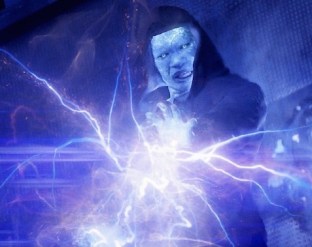 but it’s more textured, at least. Then there’s Electro, who (as mentioned) may have a familiar story, but is nonetheless perfectly pitched by Foxx. His powers lead to some excellent sequences, including but not limited to the aforementioned Times Square duel. He also contributes to the music, in a way, as Electro’s whispered/sung thoughts ‘bleed out’ into the score. It’s creepy, especially as it’s so subtle in the mix — I wondered what the hell was going on at first. I thought it was a fantastic score all round, in fact, bringing in a modern music element that fits the notion of Spidey as a young character perfectly.
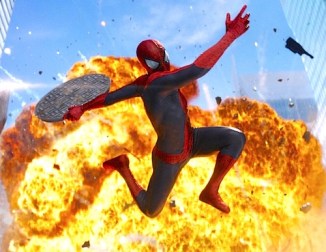 It lacks the confidence, heart and flair that mark out Spider-Man 2, and the bold originality and clarity of purpose that define
 The film that technically won
 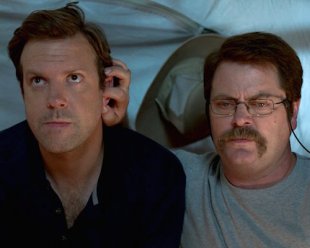 Reviews for We’re the Millers are resoundingly average across the board, remarkably so (which is why I’m remarking on it). The funny thing is, some critics begrudgingly admit they liked it while giving it half marks, and others are very down on it… while still giving it half marks. It’s the same story for user reviews on
 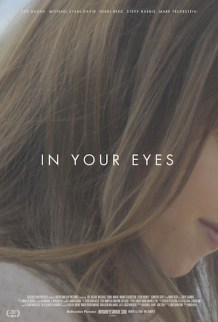 Perhaps most discussed for the way it was released — at the same time as the film’s festival premiere, writer-producer Joss Whedon made it available to rent online — In Your Eyes is worthy of note on its own merits as a movie, too.
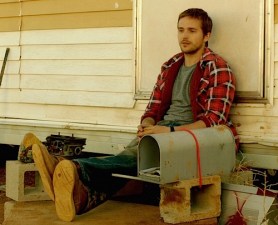 Secondly, their emotional connection means they begin to spend a lot of time in each other’s heads, distancing themselves from the world and, when they begin to be overheard talking to each other — or, as everyone else sees it, talking to themselves — people begin to get suspicious. And when you’ve got a controlling doctor for a husband, who knows about your history of mental health issues… well…
 A character-driven romance that will likely bore some, In Your Eyes weaved a spell on me. It’s beautifully, simply directed by Brin Hill, the focus lying heavily on the characters and performances of Stahl-David and Kazan. If you warm to them — and I think many will — then they’re a pleasure to spend time with, and you become invested in where events will take them. More magical realist than hard fantasy, this isn’t one for serious genre fans. Romantics, however, may fall in love.
 Fed up with their home lives, three school friends set out into the woods to build their own home. And kinda succeed.
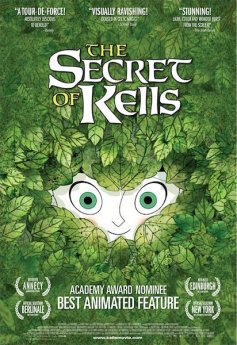 You can lament the quality of Oscar voters’ choices all you want, but if it wasn’t for their 2010 Best Animated Feature nominations I’m not sure many would have heard of this Celtic gem.
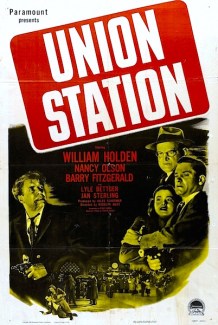 Often noted merely for being filmed in Los Angeles’ busy train station, there are some spirited defences of Union Station to be
  Based on a radio serial that spawned film serials, a famous TV series, and, eventually, comic books, The Green Hornet is a ‘superhero’ saga with a difference. For one thing, technically he’s just a vigilante — no superpowers here — and for another, as noted, it didn’t originate as a comic book. But that’s the milieu the character slots into these days, and so this attempted revival plays in that ballpark.
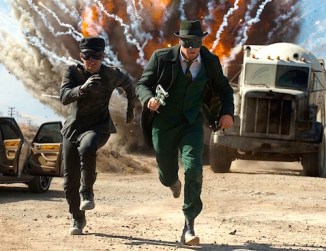 Well, screw them — The Green Hornet is brilliant. If you’re after the po-faced angsty worthiness of
 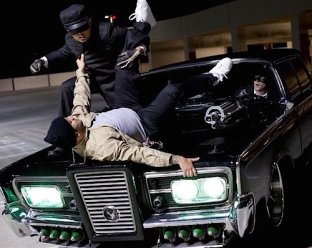 Then there’s Gondry’s direction, which is often as idiosyncratic as you’d expect. He’s at his peak during the action sequences, which explode in an array of effects and slow-motion to create multiple memorably unique fights and chases. Highlights are the first time Kato unveils his martial arts prowess, and the crazy car-driven climax. Chou and the tricked-out car, Black Beauty, are undoubtedly the stars of these bits — indeed, the film has an overall good line in making Kato the brains behind the operation. I imagine this is subverting the depiction of the Asian sidekick from previous versions, considering when they were made, but as I’ve never seen any I can’t comment fairly.
 Disgraced national TV journo Dustin Hoffman is slumming it on a local network, covering dull stories like something-or-other going on at the local museum… until a recently-fired security guard from said museum (John Travolta) turns up with a shotgun, accidentally shoots the other security guard, and takes a party of schoolchildren hostage. Suddenly Hoffman finds himself with the inside scoop — literally — as the eyes of the national news turn on the unfolding situation.
 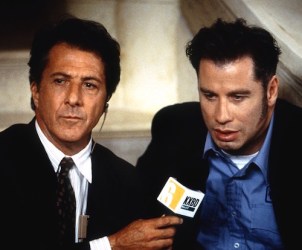 He plays against type as Sam, the nervous, naïve, childlike, and easily-manipulated hostage taker. It’s Travolta’s performance that makes Sam someone you care about, even if you don’t exactly root for him, so that the outcome — which, unusually for this kind of film, remains completely uncertain right until it’s happened — is something you’re fully invested in. There are many better-regarded films than this that don’t achieve that.
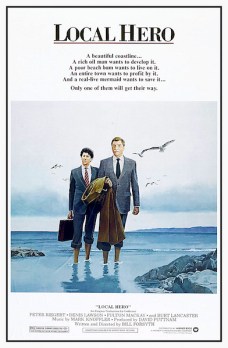 Gentle comedy in which Peter Riegert’s middle-management American oil exec has to persuade the residents of a Scottish village to sell up, unaware that they’re only too keen — for the right price. One of Quentin Tarantino’s Coolest Movies of All Time (
