2014 #125
Gus Van Sant | 126 mins | download (HD) | 1.85:1 | USA / English | 15 / R
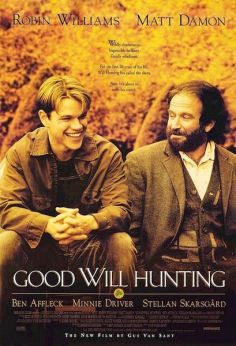 I’d say Good Will Hunting is famous for two things: one, being written by Matt Damon and Ben Affleck when they were young actors after some good roles; and two, Robin Williams’ Oscar-winning supporting actor performance. Such is the power of these two facts that I didn’t even know what it was about until I actually watched it.
Damon is the titular Will Hunting, a 20-year-old from South Boston who works as a janitor at the prestigious MIT, hangs out with his friends (who include Ben Affleck) and sometimes gets into fights for no good reason. He’s also an undiscovered genius, adept at all kinds of maths and philosophy, to a “beating students in arguments in bars” level. Undiscovered, that is, until an MIT professor (Stellan Skarsgård — didn’t even know he was in it) puts a maths problem on a blackboard for his super-intelligent students to solve over the next year, and Will solves it over night.
Williams enters the equation as a therapist, who Will is legally required to meet with. Their initially antagonistic relationship evolves, as the very troubled young man comes to deal with his issues. For all its appearances as a movie about an uncommon maths prodigy, then, Good Will Hunting is really about a messed-up young man trying to deal with his issues — not least intimacy problems that threaten to ruin his relationship with MIT student Skylar (Minnie Driver).
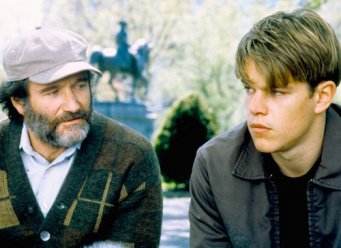 The film is perhaps most enjoyable as an acting showcase. Damon and Williams have numerous incredible scenes together; encounters that feel like genuine slowly-evolving therapy, rather than the simplistic and implausible series of repeated revelations and breakthroughs that such treatment is often reduced to on screen. They run the emotional gamut, too, being not just instances of soul-searching but also moments of wider insight, or intense humour — that’s what you get when you have Robin Williams at your disposal, of course. His Oscar is well earnt.
There’s also the relationship between Williams and Skarsgård, college roommates who have fallen out of touch but are now almost the angel and devil atop Will’s shoulders — and, of course, each believes they’re the angel. That’s to simplify it, though, as their relationship is not so straightforwardly antagonistic. These are friends, but friends with a very different view of what’s best for their young charge.
In that role, Damon is equally excellent. It’s rarely a showy part, instead full of understated feelings, buried beneath the surface but keenly felt. Here is a kid with great potential and hope, but who won’t act on any of it for fear of failure — not that he’d admit that, even to himself. Not initially, anyway. It’s a narrative that strikes me as having a great deal of truth about intelligent kids from impoverished backgrounds, brought into sharp relief by this one being not just intelligent but a genuine world-class genius. It’s also affectingly felt through his relationship with Driver, for once appealingly likeable rather than faintly irritating (is that just me?)  Their promising relationship suffers through inexperience and, to be frank, unwarranted daftness, lending it a melancholic air (or is that just me again?)
Of the leads, it’s Ben Affleck who has the least to show off with — strange, considering he co-wrote it as a chance for some work. That’s not to say he has nothing to contribute, but he’s very much a supporting role — I’ve arrived at him fifth because that’s essentially where he sits in the pecking order of significance. More memorable is his younger brother, Casey, playing another of Will’s friends. Apparently Affleck the Younger frequently improvised lines on set, and there are some great brotherly looks that seem to say, “what the hell are you doing to my screenplay?!”
Affleck the Elder is afforded at least one moment of Proper Acting, though. At one point he tells Will about the best part of his day: when he arrives at Will’s house to pick him up, the ten seconds where he walks up to the door, and there’s the possibility that his friend — who he knows is a genius but hasn’t acted on his potential — has just gone, without word; left for a better life. As the viewer, we know instantly how this is going to pay off later, so when the moment does come (spoiler, sorry), we know what to expect: Affleck will walk up to the door, he’ll knock, there’ll be no answer, he’ll grin like a loon. Except that’s not what happens: Affleck does walk up to the door, he does knock, there is no answer… so he knocks again. Frustrated, he knocks more. He peers through the glass. Now he begins to realise — Will’s gone. Then there’s a long, unbroken shot of his face, as he considers and contemplates. It’s not confused, exactly, but he’s seemingly unsure what to make of it.  Then, slowly, almost imperceptibly, a slight wry grin curls his mouth. Yes, Will has actually done it; and yes, it is what he wanted. It’s all good. Only then does he turn around, and simply announce to his waiting friends that Will isn’t there. It’s a pretty subtle moment, massively over-explained here, but it’s so much more realistic a reaction than the almost-clichéd one we’re expecting to see. In a film full of incredible, powerful performances, speeches and moments, it’s one that stood out to me.
I guess we should also thank director Gus Van Sant for that. This is the man who remade Psycho shot-for-shot “just because”, and made the interminably dull Elephant too. Here, his Artistic predilections are reigned in to just the odd moment — some shots of the friends driving around Boston staring out the car window, that kind of thing. Most of the time, he unfussily shoots the actors doing their thing. For my money, that makes this far and away his most successful movie (that I’ve seen, anyhow).
Apparently some people label Good Will Hunting predictable or implausible, with associated implications of it being twee and sugary. I don’t really think it’s any of those things. Maybe a little, but no more than so many other movies — the vast majority of stories are “predictable” because we all know how narrative works nowadays, for example. There are many worse examples than this.
 Besides, it’s the characters and the performances that shine. It’s no surprise that a pair of actors wrote an “actors’ movie”, but it is an achievement that they wrote one that displays genuine people and genuine emotions, rather than just showy performances. Credit to an exceptional cast — and, this once, an exceptional director — for bringing that so beautifully to life.
Good Will Hunting is on Film4 tomorrow at 9pm. It’s followed by Good Morning, Vietnam, which I’ll review tomorrow.
Both reviews are part of the 100 Films Advent Calendar 2014. Read more here.

 Comic book creator Frank Miller brings what he learnt co-directing Sin City to this adaptation of Will Eisner’s classic newspaper strip. Turns out, that’s not much.
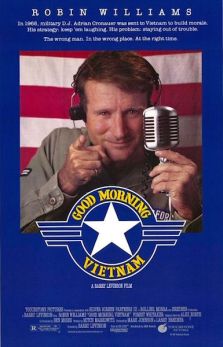 Inspired by the true story of a US Army DJ in Vietnam during the war, the resulting film is a showcase for star Robin Williams — reportedly, his antics aren’t even close to what really happened.
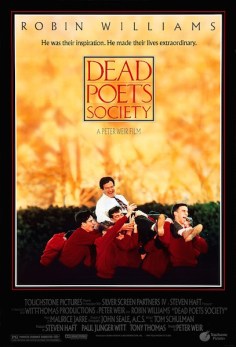 At an oppressive private school (is there another kind?), a gaggle of disenchanted students are invigorated by teacher Robin Williams; until his methods, and the independent thought they inspire, attract the ire of parents and faculty.
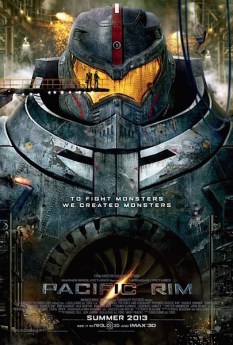 The names writers choose for their characters can sometimes tell you a lot about a movie. Pacific Rim is the kind of film that has characters called Raleigh Becket, Stacker Pentecost, and Hannibal Chau.
 — it was the 3D that added depth and height, and without that (or, as I said, an adjustment of focus to compensate) it’s all a bit… not flat, but not big either. That aside, it is beautifully shot, with excellent lighting.
 Westerns don’t come more renowned than this Ford-Wayne collaboration about the years-long hunt for a girl kidnapped by Native Americans.
 Tom Hanks is Walt Disney and Emma Thompson is author P.L. Travers in “The Making of Mary Poppins: The Movie”. Disney has been desperate to turn Travers’ fictional nanny into a movie for years after he made a promise to his daughter; Travers has resisted, but now needs the money. She’s brought to LA to consult on the script, and proceeds to make life miserable for screenwriter Don DaGradi (Bradley Whitford) and songsmiths Robert and Richard Sherman (B.J. Novak and Jason Schwartzman). At the same time, we see the story of a family in Australia from the eyes of a little girl Ginty (Annie Rose Buckley), as they struggle with the whims of her father (Colin Farrell), a bank manager who’s a little too fond of the bottle. Guess what the connection is!
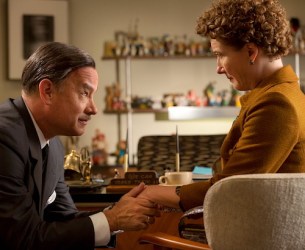 Similarly, Hanks’ part seems to be little more than a cameo at first, but he steadily appears often enough to make it a supporting role. Reportedly he has perfectly captured many of Disney’s real traits and idiosyncrasies, and who are we to doubt the word of people who knew the man? His performance is not just a shallow, simple impersonation, but there’s not that much meat to Disney’s character arc either.
 Some will find the story lacking in dirt, particularly when it comes to the portrayal of Disney. But it’s not whitewashed either, and do you really think the Disney Corporation would have allowed a movie to go ahead that depicts their founding father in a negative light? For that, I don’t think it’s as twee as it could have been — there’s definite conflict over what’s being done with Poppins, and, even with the film having turned out to be a solid-gold classic, we often find ourselves sympathising with Travers.
 Of late there seems to have been a glut of sci-fi films with highly generic, near-meaningless titles —
 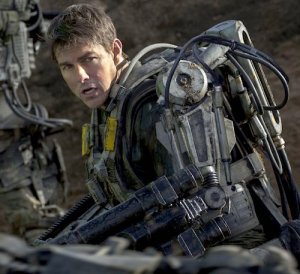 suitably exciting, surprisingly funny, and actually quite clever. It’s also boldly standalone. OK, so it’s an adaptation, but the book is hardly a
  Reflect too heavily and some bits may begin to crumble more but, for me, not too severely.
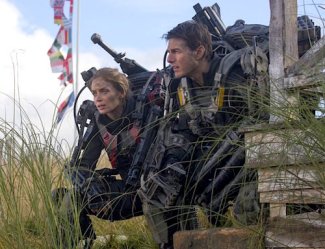 Edge of Tomorrow isn’t an unqualified success, but more than enough of it works to make for a well-above-average modern blockbuster. Excellent action sequences, plenty of amusing asides, and a couple of solid sci-fi concepts to chew on combine to render it quality entertainment. Bonus points for being a true original in a sea of remakes, sequels and spin-offs.
 1988: due to international pressure, Chile’s dictator, General Pinochet, has acquiesced to a vote on whether he should continue ruling the country. Despite the violent takeover he orchestrated, and subsequent murders and ‘disappearances’, the country has prospered under his rule, and many — especially influential affluent people — are keen for him to stay. The anti-Pinochet “no” campaign are allowed a daily slot on state-controlled television in the run up to the election, and they hire advertising exec René Saavedra (Gael García Bernal) to mastermind the campaign. Cue internal conflict — the politicos want dour films highlighting Pinochet’s evil; René wants to use the language of advertising to sell the promise of a happy future — before the campaign itself finally gets underway, and the “no” campaigners become targets of the ruling regime’s evil tactics…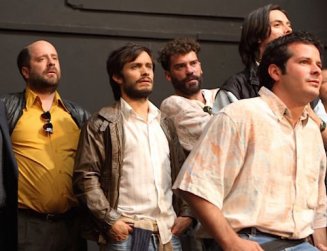
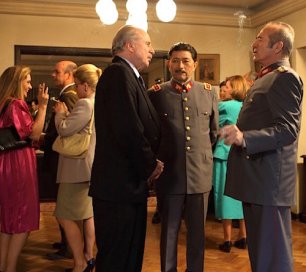 But seriously, there’s not really a comparison between the brutal military regime that ruled Chile — which nonetheless many were happy with because it had brought modernisation and prosperousness for some — and the voluntary union between the rest of the UK and Scotland. I’m sure some of “the 45”, as they now call themselves, would identify with those battling for freedom in this film, but I think that might be taking it a bit far.
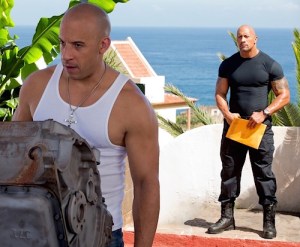 For all the intent of this being “Part 2 of 2”, there’s a post-credits tease which sets up
  There’s plenty of backstreet, underground, grim-and-gritty bits on display here — entirely appropriate given the characters’ street-racing roots and criminal know-how. Still, these are little more than cosmetic bonuses.

