
Akira Kurosawa | 207 mins | Blu-ray | 1.33:1 | Japan / Japanese | PG
 Seven Samurai used to be a striking anomaly amongst the top ten of IMDb’s user-voted Top 250: it’s a three-and-a-half-hour subtitled black-and-white movie. These days it sits at #21, presumably through a mixture of IMDb tweaking the voting rules and it being rated lowly by people keen to see all of the Top 250 but who don’t typically like three-and-a-half-hour subtitled black-and-white films. Nonetheless, it has a claim to wide popularity (alongside its critical renown) that is rarely achieved by three-and-a-half-hour subtitled black-and-white movies.
In 16th Century Japan, rural communities are terrorised by gangs of bandits stealing their crops, raping their women, and all that other nasty to-do. One village has had enough and, knowing they can’t defend themselves, sets out to employ a band of samurai to defend them when the bandits come again the next year. Samurai aren’t cheap, but the villagers have no money, so they’ll have to make do with what they can get. Managing to snag Kambei (Takashi Shimura) to lead the defenders, he assembles a team, including wannabe Kikuchiyuo (Toshiro Mifune) and five others (Daisuke Katō, Isao Kimura, Minoru Chiaki, Seiji Miyaguchi, and Yoshio Inaba), who then set about preparing the villagers for battle…
Despite its epic running time, Seven Samurai isn’t really an epic film — this isn’t the story of a war, or even a battle, but of a skirmish to defend one village. How does it merit such length, then? By going into immense detail, by having plenty of characters to fuel its narrative and its subplots (and if you think there’d be plenty of time to explore seven characters in over three hours, turns out you’d be wrong), and by using the time to familiarise us with these people, so that when the final fight comes — and that’s a fair old chunk of the film too — we care what happens. Plenty of other films make us care in a shorter period of time, of course, but here we feel truly invested in the outcome.
 It’s also unhurried. As Kenneth Turan explains in his essay “The Hours and Times: Kurosawa and the Art of Epic Storytelling” (in the booklet for Criterion’s DVD and Blu-ray releases of the film, and available online here), the film “unrolls naturally and pleasurably… luxuriating in its elongation — it takes an entire hour just for the basic task of choosing the titular seven.” As a viewer, I think you have to be mentally prepared for that pace, in a way. Most other films would use a snappy montage to collate the team, with key scenes or moments later on being used to highlight their personalities — witness any number of Hollywood (and Hollywood-esque) ‘men on a mission’ movies that do exactly that. Kurosawa’s expanded version makes the film more a marathon than a sprint, with only some of the negative connotations describing something as “a marathon” entails.
In truth, this is not the most fascinating portion of the film, but nor is it without merit. As discussed, it’s establishing these characters in full so that we are more attached to them later, but it’s also commenting on, perhaps even deconstructing, the image and role of the samurai. In “A Time of Honor: Seven Samurai and Sixteenth-Century Japan” (again in Criterion’s booklet, and available online here), Philip Kemp explains how Kurosawa’s depiction of the samurai overthrows some simplistic ideals that had become associated with them, and shows them instead as normal human beings, more likely to run away to save their own skin than pointlessly fight to their death. The villagers have indeed managed to employ professional combatants, but they’re not so different to the villagers themselves, just better trained.
 The length ensures our investment in the village, too, just as it does for the samurai. They’re not being paid a fortune — in fact, they’re just being paid food and lodging — so why do they care? Well, food and lodging are better than no food and lodging, for starters; and then, having been in the village so long in preparation, they care for it too. It is, at least for the time being, their home. You can tell an audience this, of course, but one of the few ways to make them feel it is to put them there too — and that’s what the length does. To quote from Turan again,
The film’s length works in its favor in ways both big and small: It allows the samurai leader, whose head is shaved in an opening scene, to gradually grow his hair back. It allows the eternally uneasy bond between the samurai and the villagers, as well as the villagers’ martial confidence, to grow believably over time. … When the bandits finally do attack, our hearts are in our throats — we know the defenders so well, and we can sense that not everyone will survive.
It can seem like a blind alley to go on about a film’s length — many an epic is long just because it has a long, or large, story to tell — but in Seven Samurai, the sheer size, and the way it uses that, are almost part of the point.
The film ends with a melancholic note. That “eternally uneasy bond between the samurai and the villagers” comes to an end — with victory won, the surviving samurai are no longer required. The farmers return to farming, the samurai return to… what? They are not really at home in the village, they were just guests; nor are they rich, because there was no pay — so what have they got out of the conflict? As Alain Silver notes in “The Rains Came: Kurosawa’s Pictorial Approach to Seven Samurai” (in Criterion’s booklet, of course, but not online),  the final scene, the way it’s edited and framed, ties the remaining samurai to their deceased comrades, the living and thriving farmers a distant and separate group. Fighting is the way of the past, perhaps, and peaceful farming the future. Or is the samurai’s only purpose to be found in death, because other than that they are redundant?
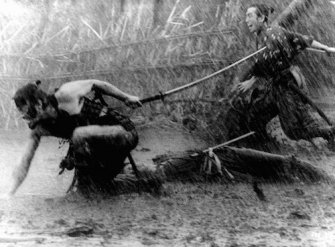
Even if you don’t want to get into the film’s philosophical underpinnings, there are plenty of other, more visceral thrills to enjoy. The characters provide humour as well as emotional depth; there are scattered “action sequences” throughout; and the big climax may technically only be a skirmish, but it’s one played out in detail, to epic effect. There’s not the choreography that viewers used to modern blockbusters or Hong Kong fisticuffs might expect, but that doesn’t meant the rough and realistic fighting isn’t exciting or well-constructed. Drenched in rain and covered in mud, it’s messy and, in its own way, beautiful. The whole film is visually stunning, as you’d expect from a Kurosawa picture. You may not realise it at the time, but many a familiar type of shot actually originated here, and then was copied down the ages.
It might seem difficult to credit now, but Seven Samurai was only fairly well received in Japan on its initial release: as Stuart Galbraith IV reveals in “A Magnificent Year” (also in Criterion’s booklet (where else?)), most of the awards for Best Picture went elsewhere, and at the box office it was comedies and romances that were the big crowd-pleasers. 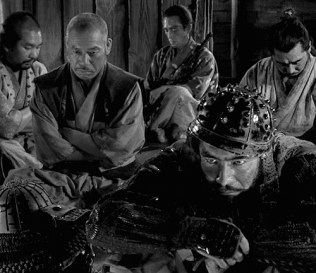 And it wasn’t as if it was overseas viewers who hit on the magic: as Turan reveals, “Toho Studios cut fifty minutes before so much as showing the film to American distributors, fearful that no Westerner would have the stamina for its original length.” The more things change the more they stay the same, I suppose — how many Great Films from Hollywood are ignored by awards bodies and audiences, only to endure in other ways?
Seven Samurai is definitely a case of the latter. Its standing on the IMDb list may have slipped with time (and rule changes, no doubt), but it’s still a trend-bucker — a three-and-a-half-hour subtitled black-and-white film that can appeal, if not to the masses, then to some people who wouldn’t normally go in for that kind of thing. A marathon but not a slog, requiring investment rather than passive absorption, Kurosawa’s epic rewards the viewer with one of cinema’s most enthralling, gorgeous, and vital experiences.

Seven Samurai placed 1st on my list of The Ten Best Films I Saw For the First Time in 2013, which can be read in full here.
It was viewed as part of my What Do You Mean You Haven’t Seen…? 12 for 2013 project, which you can read more about here.
This review is also part of the 100 Films Advent Calendar 2014. Read more here.
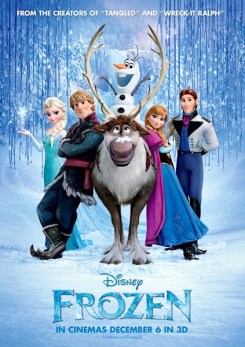 Frozen is a grim single-location thriller about three college kids trapped on a ski-lift overnight, battling hypothermia and worse over a hundred-foot drop. Or at least it was until last year, when Disney went and released its all-consuming mega-musical.
  Unlike the best Disneys, however, I think its appeal resides firmly with little girls — you don’t actually have to go very far on the internet to find people baffled by its success. Plenty of people think the music is bland, the characters underdeveloped, the moral and emotional arcs not fully thought-through, the visual style a rip-off from
 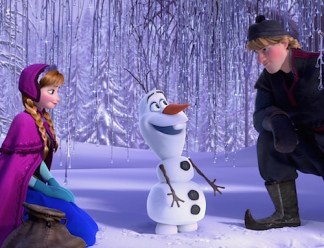 The lack of villain’s song is attributable to the fact that, for nearly the entire film, there are no nasty characters. A villain emerges right at the end to give us a climax, but for once that works — a genuine twist! It’s almost a shame it has to resort to that, but how else do you end a Hollywood movie other than a big dramatic confrontation? Plus, aforementioned snowman Olaf confounded my expectations, pulling off the quite remarkable feat of not being the most irritating CGI character since Jar Jar Binks. (I don’t know who is the most irritating CGI character since Jar Jar Binks, but Olaf is alright.)
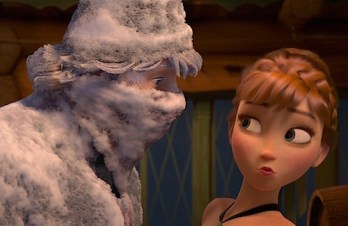 It’s not bad — it’s adequately cartoony — and actually the ice and snow effects are very, very good. It’s the character animation that I felt let it down, especially some of the more minor roles — there were points where their style and movement looked little better than you’d find in a video game cut scene.
 Frozen is by no means a bad Disney movie, and it does have a lot of favourable aspects. Whether the internet’s right and it’s not as good as Tangled, I wouldn’t care to say (I enjoyed Tangled, but at this point have largely forgotten it); conversely, the sometimes-rabid fan base are perhaps being a little over-enthusiastic. There’s nothing wrong with a kids’ movie being beloved by kids, though; and with all the dreadful things the media churns out for little girls to obsess over and centre their life values around, this is undoubtedly one of the most positive.
 Marvel Studios takes its boldest step yet, moving away from the present-day superhero milieu of its previous movies to a galaxy far, far away for a space opera epic. Its success, both critically and commercially, has cemented the Marvel Cinematic Universe as an infallible force in the current movie world. But, really, how good is it?
 The worst offender is the pod chase through Knowhere, a several-minutes-long sequence that registers as little more than a blur. There’s a shocking lack of clarity to its images, even by today’s standards. Maybe it’s better in 3D, when I guess the backgrounds would sink into the distance and important elements would be foregrounded; but in 2D, you can’t see what’s meant to be going on for all the fast-moving colour and split-second cuts. Almost as bad, though for different reasons, is the climax. It takes up an overlong chunk of the movie and at times feels repetitive of too many other Marvel climaxes — oh look, a giant spaceship crashing into a city! If anything, the film gets ‘worse’ as it goes on. Perhaps not in a very literal sense, but as the blustering action climax takes over, it moves further away from the stuff that makes it unique and interesting.
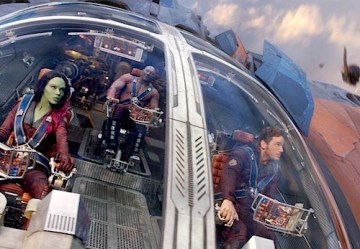 It isn’t even called Nova City, but I don’t have the foggiest what it is called because the film didn’t make me feel I should be learning it. Some more effort making sure we knew why that place mattered, even if it was just a clearer depiction of all the planning for its defence, might have sold the entire climax better.
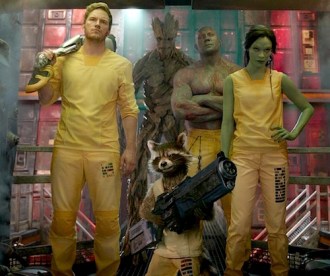 especially the overlong climax. Joss Whedon commented of his own Avengers film (as I quoted in
 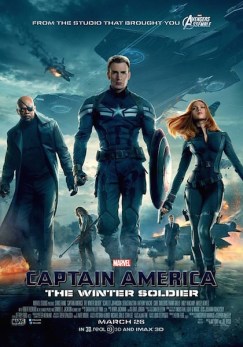 After the
 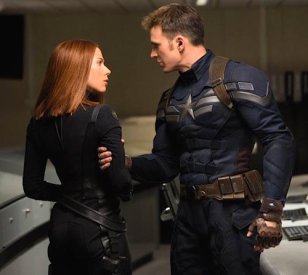 everybody moved on to being more excited about Marvel’s end-of-summer new-franchise-launcher,
 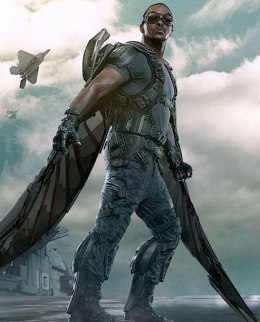 Also introduced is sidekick hero the Falcon (Anthony Mackie), who I have little to say about directly. He’s a sidekick who’s introduced fully-formed — he’s been using his ‘superpower’ for years as just part of the military; it’s not new or exciting to him, which lessens some of its power for the viewer too. “Origin story” may be the most over-used of all the superhero stock stories, but there’s a reason for that. If you skip it then you cut to the chase, that’s true, but does it also lessen the impact of characters to not see how they started? Maybe storytellers just need to come up with fresh ways of giving origins, rather than skipping them altogether.
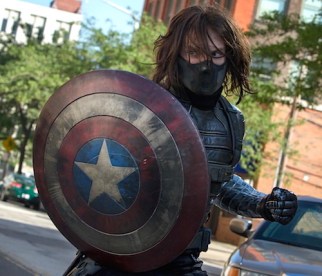 and then it refuses to wrap everything up, putting certain things in place ready for
 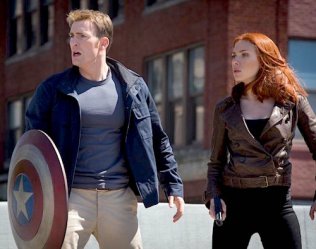 what’s left? There is strong action, albeit undermined by muddled character investment; and there is an interesting thriller/conspiracy story, albeit undermined by a feeling of “once you know it, you know it” — it’s not all that complicated or all that surprising, including the revelation that the one character significant enough to be behind it all is behind it all (gasp!)
 Belated sequels can be a
 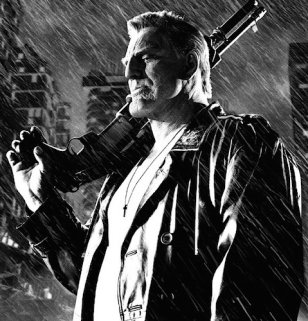 But the comic-book-ness of the first film — moments of almost metaphorical visual representation rather than literal reality, including physically-impossible action beats — has been ramped up. The value of the first film was never in its action, so the sequel’s lengthy punch-ups, crossbow-based guard-slaying, and all the rest, get boring fast. When it slips into this needless excess, A Dame to Kill For loses its way. When it sticks to what it does best — hard-boiled fatalistic crime tales with striking comic book-inspired cinematography — it does as well as the concept ever did.
 The intervening decade has lessened the impact of the first film’s sick ultra-violence, but there’s nothing even that extreme here, aside perhaps from one eyeball-related moment. On the other hand, nearly a decade of tech development means it looks better than the last one, both in terms of the CGI’s quality and the camerawork more generally — it’s less flatly shot; more filmic than the first one’s sometimes-webseries-y composition.
 its predecessor, and that’s exactly what it delivers. I suspect the first benefits from nostalgia because, watching them virtually back to back, I found I liked Sin City less than I remembered, but enjoyed A Dame to Kill For just as much. It’s flawed in several aspects, but for honest-to-themselves fans of the first movie, I think it’s a “more of what you liked”-style success.
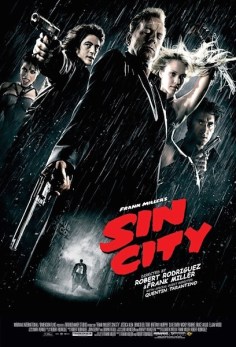 Adapted from a series of graphic novels by Frank Miller, Sin City is a noir homage, replete with high-contrast black-and-white cinematography, dialogue so hard boiled you couldn’t crack it with a sledgehammer, and all the requisite downtrodden heroes, corrupt authority figures, dangerous dames, etc. There’s also the very modern inclusion of shocking ultra-violence and nudity, but I guess a fair degree of that would’ve crept into classic noir if the mores of the time allowed — pretty much the point of the genre is the dark grubbiness of the world, after all.
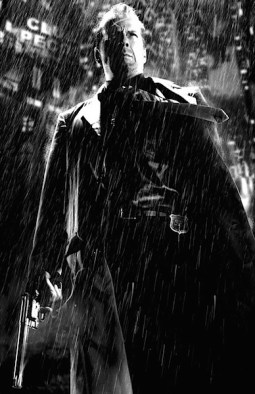 The DVD-premiering extended version, dubbed Recut & Extended (or, in the US, “Recut, Extended, Unrated”) is even more faithful to the comics than the theatrical version. Some of the books’ scenes that were excised are now included, and the structure has been rejigged to present each of the four stories one by one in their entirety (whereas the original version had a small amount of intercutting). The total running time is 17 minutes and 40 seconds longer, an increase of some 14.2%… which is a thoroughly misleading figure. As a presentational choice, each of the four stories is offered for individual viewing, plus option to “play all”. However, rather than that showing them as a single film, they play as four shorts back to back, with a full set of section-specific end credits rolling each time. The actual amount of new material in the film itself is
  For one, the second scene belongs more truly to The Big Fat Kill (the final story, starring Clive Owen’s Dwight and the whores of Old Town led by Rosaria Dawson). For another, because this recut purports to be in chronological order, The Customer is Always Right plays second. So we get 47 minutes of Bruce Willis protecting Jessica Alba from a paedophile in That Yellow Bastard, then we get a one-scene story that rightly belongs at the beginning (complete with title card, now 50 minutes into the ‘film’), then we get a scene that, actually, belongs in a completely different place. The next full story is The Hard Goodbye (the one with Mickey Rourke under a slab of prosthetics as Marv), followed by The Big Fat Kill — and it’s after this that the second scene with The Man belongs. Divorced of that context, the scene is robbed of almost all its meaning.
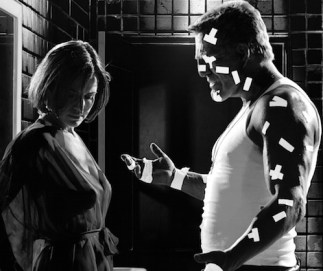 In the end, I enjoyed Sin City considerably less than I did nine years ago in the cinema. This is partly down to the restructure, but I’m not sure wholly so. I don’t think it’s aged particularly well, as things produced at the forefront of emerging technology are wont to do: some of the CGI looks dirt cheap, the shot compositions are often unimaginatively flat, and there’s an occasional internet-video style to the picture quality. It’s not just the visuals, sadly, with amateurish performances from reliable actors, possibly a result of the hurried filming schedule. Just because you can capture an entire part in a single day doesn’t mean you should. Then there’s Jessica Alba, who’s just awful here.
 None of the present additions are game-changing, and though some are good in their own way, there’s nothing noteworthy enough to compensate for the destruction of the original cut’s well-balanced structure. For the average punter — and certainly for the first-time viewer — the theatrical cut is unquestionably the way to go.
 I think I’ve previously discussed my life-long love of the X-Men franchise, so I shan’t go into detail again, but suffice to say Days of Future Past has been one of my most-anticipated movies ever since the title (which is that of a classic and influential story from the comics) was announced. Thank goodness, then, that the final result doesn’t disappoint.
 Beyond that, there’s the characters: the younger versions are having to deal with the fall-out from
  Not everyone gets to shine in a cast this big, although pretty much everyone gets a moment. The future-set cast have the least to do, people like Halle Berry turning up to do little more than show their face, though Stewart and McKellen get a moment or two worthy of their talents. After he was the focus of the last film, Fassbender is slightly shortchanged here; but after McAvoy gave him essential support in First Class, Fassbender plays the same service here, informing Charles’ journey. Of the new additions, Evan Peters as Quicksilver (that’s the one who’ll also be played by Aaron Taylor-Johnson in
  Later, there’s the aforementioned ‘slow-mo’ sequence, and the grand climax, which offers more “fly something big around” antics a la First Class’ submarine, only considerably grander. Yet for all the spectacle, the final moments once again come down to character: what is Magneto prepared to do? What is Mystique prepared to do? Will anyone listen to Charles? And so on. Even the much-vaunted Marvel Studios movies tend to base their climaxes in slabs of ‘epic’ CGI crashing into each other; Days of Future Past does that for a bit, then brings the characters back into focus for the real final beats.
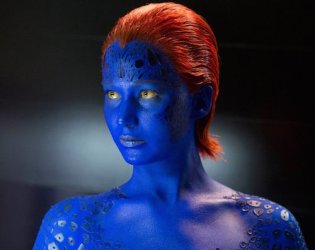 (Jennifer Lawrence being the third pillar of the past triumvirate, as they’ve already focused on Xavier and Magneto). While Days of Future Past does wrap up the majority of its threads (the open-ended ones are answered by previous films, if you want them to be), there’s plenty there to play with in the next film (and, perhaps, ones beyond that) if they want to… which they do.
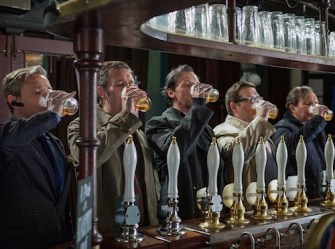 “zombie movie” or “Hollywood action movie”, and occasionally co-writers Pegg and Wright have substituted character development and thematic points for send-up. It may not play to the genre-loving fan-audience that the trio’s previous work has accumulated (demonstrably so, based on many a viewer review), but it does make for a more grown-up film.
 It will definitely reward multiple viewings: it’s littered with signs, omens and portents (in fairness, a good few can be grasped on an attentive first go). There’s a featurette on the BD (but not the DVD) which helps point out any major ones you may’ve missed; though I have to say, even at seven minutes long, and even with it pointing out some that felt too obvious to be worth mentioning, I swear it left some stuff out. That could be a deliberate decision of course, to leave some things for people to just spot.
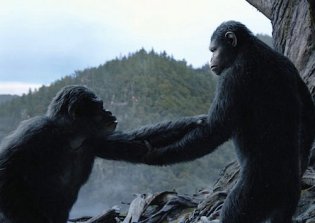 A heady mix of solid writing from Mark Bomback, Rick Jaffa and Amanda Silver, peerless motion-captured performances from the likes of Serkis and Toby Kebbell, and first-rate CG magic from Weta, brings us a set of characters who are compelling and believable. Here is a society trying to define what it wants to be, battling old prejudices in the hope of a peaceful, secure, happy future. If you want to draw analogies to almost any real-world political situation, I’m sure you could.
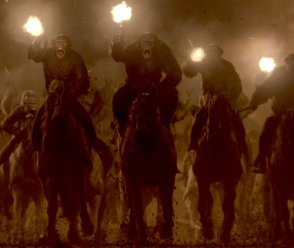 Lest you get the wrong impression, the film isn’t all talk. For various spoiler-y reasons, the fragile relationship between Man and Ape breaks down, and the apes stage an attack on humanity. Here we get perhaps one of the best siege action sequences I can think of, with mankind holed up in a half-constructed skyscraper that sits conveniently at the end of a long street for the apes to charge down. Reeves’ direction is virtuosic here, crafting an epic and exciting sequence even when most of the film’s major players are busy elsewhere. And it’s not even the climax.
 thanks to some surprisingly small-scale narrative choices (the whole thing with the dam doesn’t feel nearly as vital as it should) and Reeves’ direction sometimes being a little straightforward and almost TV-ish. I know I’ve said I hate when people use that as a derogatory comment nowadays, but some repeated locations and shot choices make the film feel cheaper than it was.
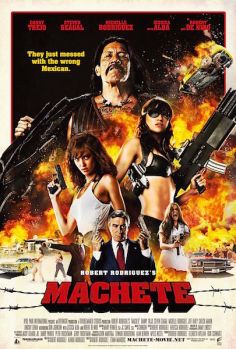 Multi-hyphenate Robert Rodriguez takes his
 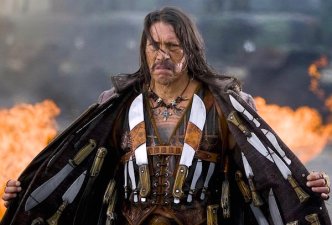 to fleetingly include something that ‘needs’ to be there purely because it was in that trailer.

