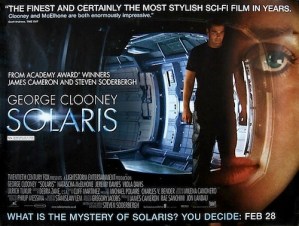
Solaris (2002)

2009 #13
Steven Soderbergh | 94 mins | DVD | 12 / PG-13

SolarisWhen Andrei Tarkovsky adapted Stanislaw Lem’s thoughtful science fiction novel in 1972, it took 165 minutes. When Steven Soderbergh did it 30 years later, it took just over 90. Lem hated them both, stating that he didn’t write about people’s “erotic problems in space”, but for those concerned with what the film is about rather than what it (perhaps) should have been about, it seems that an abbreviated running time is no barrier to loading any adaptation of Solaris with a weighty thoughtfulness.

Everyone knows Solaris is a sci-fi film — the title sounds that way, for one thing, and George Clooney in a space helmet on the cover certainly does the rest. It’s a shame that’s so well known, because if one came to this version cold it would take a good few minutes before there was any inkling it wasn’t just a drama. The underplaying of the scientific elements may have angered Lem, but Soderbergh uses them to create a backdrop to the emotional story he wants to tell — Solaris the sentient planet was the point of the novel, as far as Lem was concerned, whereas to Soderbergh it’s a device to explore relationships and grief.

In doing this the film merrily mixes genres: it looks very much like it’s Science Fiction, all futuristic TVs and space station settings, and there are a few scientific concepts touched on; but it’s also a Romance, occasionally; and a Drama about coping with death, amongst other things; and an ‘arthouse’ film about notions of God and memory and reality and humanity; and there’s a huge chunk of Mystery in what the hell is going on; and there are a couple of moments that wouldn’t be out of place in a Horror film… About the only conventions Soderbergh doesn’t bother with belong to Action-Adventure, which as the normal stomping ground of big-name sci-fi certainly makes for a change.

It’s likely this that explains its low rating on IMDb and the like. A slow pace and obtuse storytelling that leaves plenty of gaps for the audience to fill is not the experience implied by an advertising campaign showing a Space Movie starring Movie Star Heartthrob George Clooney. Obviously it doesn’t fulfill these expectations, and will likely have still been too slow and difficult for even more viewers. (As it makes for a slow hour-and-a-half, I wonder how they would feel if told there’s a version over an hour longer.) The question is, does it also deserve such a low rating from those ‘clever’ or accepting enough to ‘get’ it? That depends on your perspective. It’s either Deep and Meaningful, or a bit Pretentious and Pointless. In this respect it’s highly reminiscent of The Fountain (or, rather, The Fountain is reminiscent of Solaris) — an unusual sci-fi/romance angle, slow pace, and ambiguous to the last. As one character says, “there are no answers, only choices.”

Soderbergh’s direction, plus the performances of Clooney and Natasha McElhone on which the film relies, do have the power to hold you, but only if you’re prepared for — and, more importantly, open to — the sort of experience Solaris offers. Undoubtedly not for everyone.

4 out of 5

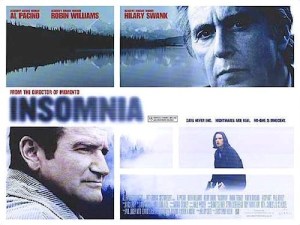
Insomnia (2002)

2009 #33
Christopher Nolan | 113 mins | DVD | 15 / R

This review contains minor spoilers.

The Dark KnightBetween becoming a Geek God with Batman Begins and The Dark Knight and coming to everyone’s attention with a stunning more-or-less-debut that managed to elbow itself right up into the IMDb Top 10 (that’d be Memento — obviously, it’s slipped since), Christopher Nolan directed this: an American remake of a Norwegian police thriller, and the only one of Nolan’s five major films not to be on that be-all of film quality, the IMDb Top 250 (the fifth is of course The Prestige, while Begins is the lowest at #106.) So is Insomnia a forgotten classic robbed of a spot, or just a footnote to the rest of Nolan’s superb career?

These days, there’s a murder mystery/thriller on the TV most weeks — heck, most days thanks to the abundance of repeat-laden digital channels — and so a film attempting one can’t just settle for the usual array of clues, suspects, interviews and twists. Insomnia looks like it’s heading down this road early on — an interview with the victim’s boyfriend in particular could easily slot into any episode of Midsomer Murders or what have you — but soon does what’s required of any film entering this territory these days: it provides more. Most obviously, despite the early plot and stylistic conventions, this is not a “whodunnit”: the killer’s identity is revealed around the halfway mark (assuming you haven’t already guessed it from the opening credits) and from then on the film gradually moves into murky moral territory, quickly leaving behind those early trappings for a set of more complex noir-ish moral conundrums.

Al Pacino’s detective, for example, is a man under pressure — not just from the case, nor the usual clichés of a messy divorce or alcoholism, but from a pending Internal Affairs investigation that may or may not be justified, and an incurable bout of insomnia brought on by the Alaskan summer’s lack of night. The pressure mounts, he makes bad decisions (which I won’t spoil here), and even if the use of these plot points was merely that they occurred it would have offered something above the norm. Hillary Seitz’s screenplay pushes it further however, digging far deeper than usual for the genre into debates about the morals of police work, what seems acceptable and what is acceptable, and perhaps even what should be acceptable. The ending may seem to offer a Hollywoodised “everything’s set right then” denouement, but while it’s true that the plot is neatly resolved the considerations raised are not so easily ignored.

Cast-wise Insomnia fares pretty well. When it was released, around the same time as the excellent One Hour Photo, everyone was amazed at Robin Williams turning in a pair of non-comedic performances. The quality of them both makes it seem only natural now however, leaving that amazement as a distant memory. His turn as novelist Walter Finch here may owe something to Kevin Spacey’s John Doe in Se7en — indeed, Nolan seems to explicitly reference that film in locations such as the corridor of Finch’s apartment building — but isn’t as lowly as an impersonation. Hilary Swank offers able support as wide-eyed young cop Ellie Burr, while Pacino does a good job portraying the confusion induced by lack of sleep, aided by some effective camerawork, editing and sound design.

In the end, the main damage done to Insomnia is inadvertently by its director: while it is undoubtedly above average for a murder mystery/thriller, its relative straightforwardness pales in comparison to the work Nolan’s done before and since. However, as with every Nolan film so far, I found my perceived enjoyment increase the more I’ve thought about it since. It may not be objectionable that Insomnia hasn’t made it onto that IMDb list then, but if it is a footnote to Nolan’s career it’s a significant and enjoyable one.

4 out of 5

BBC One are showing Insomnia tonight at 10:45pm.

Watchmen (2009)

2009 #9
Zack Snyder | 162 mins | cinema | 18 / R

This review contains major spoilers.
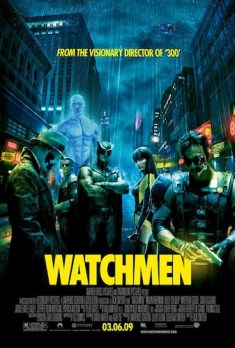
Watchmen didn’t flop. Let’s get that out of the way.

Did it do less business than expected? Yes. Were expectations unreasonably high? Unquestionably. After the barnstorming success of The Dark Knight I think some expected a repeat run, but they forgot that while TDK was dark, it still had clear heroes, clear villains, a massively popular franchise and — let’s be honest — a highly-publicised, highly-acclaimed final performance from a certain tragic young actor. Watchmen, by comparison, is densely plotted, morally ambiguous, a tad on the long side, with unknown characters, an unclear story (in the marketing at least) and no mass recognition. And it was rated R. All this considered, it did phenomenally well, and at the end of the day it’s WB’s fault for spending $150m on something that, realistically speaking, wasn’t going to make that back on opening weekend.

But this isn’t meant to be a rant about the box office. Now that the dust has settled somewhat from the initial flurry of reviews — which on the whole seemed to either hail it as an instant classic or an unrelenting mess (though some more reasonable ones found the middle ground) — and with the dubiously-featured UK DVD and Blu-ray releases just announced, it seems about time to add a few of my thoughts to the already-overflowing mix. In doing this I find it impossible to fully divorce myself from the fact that I’m a fan of the book, so can only really view this adaptation from that perspective; just as I think anyone who’s read the book can’t truly imagine quite how a non-reader will take this, whatever they may claim. The only people who can do that are people who haven’t read the book, and there have been plenty of those reviews around too.

But even as a fan, my opinions are not as predetermined as some might think. Watchmen is incredibly faithful to its source material (some notable tweaks and omissions aside), but while some have loved it for this, others have viewed it as weak or pointless. Perhaps some of the complaints about faithfulness stem from the fact that we’re actually unused to seeing faithful superhero adaptations — “adaptations” being the operative word. Across seven Batmans, five Supermans, four X-Mens, three Spider-Mans, two Hulks, and countless others, how many actually adapt a specific book? Most, if not all, develop their own story around the notion of the character(s), or take some degree of inspiration from various storylines, tailoring a new tale for the different medium (well, theoretically). In choosing to adapt the source rather than make a film starring the same characters, Watchmen places itself more in line with other literary adaptations than other superhero movies. Some would argue this context still renders it more of a Da Vinci Code than a Godfather, but it’s perhaps still appropriate to debate that rather than if it’s more a Hulk than a Dark Knight.

The consistent faithfulness is a bit of a mixed bag. For much of the film it’s a great story well re-told, and its climax actually manages to improve on the original’s to the extent that, if Alan Moore ever actually watched it (which he won’t), I’d like to think he’d be man enough to admit that this one change at least was an improvement. Similarly, in the novel I wasn’t convinced Rorschach’s final moments made sense — it seemed out of character. On screen, however, Jackie Earle Haley completely sells it, his final scream becoming one of the film’s most memorable moments. Other elements are retained with no thought, however: the intercutting of Dan and Laurie’s alley fight with Dr Manhattan’s press conference is an effective (if blunt) sequence in the novel, but on screen makes little sense — even though I know the story and know the events of both scenes, this choice left me struggling to follow events. Even worse, the sudden and unexplained presence of Ozymandias’ pet big cat is almost baffling to a viewer familiar with the source, and so I can only imagine how little sense Bubastis must make to a new viewer. Consequently, his demise has no emotional weight.

The final scene is a bit of a misstep as well. In the book it’s a perfect little coda, beautifully ambiguous and tied to several of the novel’s themes. On screen, Snyder overplays it, allowing it to drag on with pointless dialogue and leaving the point of the scene feeling forced — equally a fault of David Hayter and Alex Tse’s script, then. Part of the problem is that it’s lumbered with introducing a subplot and its characters for the sake of the payoff, both of which develop slowly and appropriately in the novel. The details of that particular subplot are not the only elements that are missed from the original: the novel contains a lot of details of street life in Manhattan, for example, which makes the city’s ultimate destruction more personal for the reader. Some of these scenes have been filmed and, knowing that an aptly-titled (for once) Director’s Cut is on the way, it’s at times hard not to view the theatrically-released Watchmen as an abridged version. While it is still more complex than some critics (both pro and fan) give it credit for, the missing nuances and subplots would strengthen the whole experience. We can but hope it’s these that the Director’s Cut will include, rather than just a collection of completist-pleasing trims.

It’s easy to complain about Watchmen — clearly — but, actually, I really enjoyed it. Snyder has arguably created a live-action version of the graphic novel rather than creating a film in its own right, but is that really a bad thing? It’s what many literary adaptations aspire to, the only difference here is there were already some pictures to directly transfer. Some will disagree, and if you do then this is a perfect argument for why Non-Fans should be in charge of film adaptions — Fans are too concerned with pleasing other Fans, in this case being rigorously faithful; Non-Fans often just want to make the best movie possible based on the source material, rather than making the best translation (or, perhaps, re-appropriation). Perhaps it’s too fine a line to walk; perhaps Snyder was too afraid to change anything; or perhaps it’s just a case of damned if you do (“it’s exactly the same, what’s the point?”) and damned if you don’t (“he changed too much, it’s not Watchmen!”).

In their faithfulness, Snyder, Hayter and Tse retain much of the story and character elements that made the original great. If the aim was to take the page and put it on screen, the screenplay is near flawless, embellishing some moments and even fixing others, while excising subplots so wisely I didn’t miss much. As stated, however, the definitive cut is surely the forthcoming one. As for Snyder’s direction, he mostly does a good job, recreating iconic panels — occasionally with too much reverence, true — but enlivening other sequences in his own way. In fact, for all the moans of reverence, some of the novel’s more filmic ‘cuts’ are actually abandoned (I’m thinking specifically of the ins & outs of flashbacks during the Comedian’s funeral). Photography wise, most of the film was far too dark, and I couldn’t help but wonder if it had been shot too much with DVD/Blu-ray in mind and suffered when projected. I suppose we’ll see later…

Snyder certainly left a clear directorial stamp on one element of the film: occasionally the action sequences smash into slowmo, sometimes to the point of freeze frame… exactly like they did for most of 300’s fights. Whereas there it looked kinda cool and felt like a stylistic tick unique to that film, here one can’t help but think time is being wasted that would be better spent on expanding the dense plot. And rather than being a stylstic quirk of 300, it now becomes one of Snyder’s; which means that, from the very first scene, “A Zack Snyder Film” is stamped all over this like a young boy with an abundance of name stickers. There’s nothing wrong with making it his own film, of course — I’m sure Gilliam’s or Greengrass’ versions would’ve slotted comfortably into their distinctive oeuvres — but it would be nice if it weren’t quite so intrusive. On the other hand, could it be that the expectation of this makes it seem worse than it is, and if any other director had pulled the same tricks it wouldn’t seem as apparent?

Similarly, the violence is incredibly brutal, gory and graphic — but that’s the point. Though they live in a heavily stylised world, these are ‘real’ superheroes, and real violence isn’t pretty. The level of brutality is appropriate to the theme but never lingered on more than is reasonable and rarely over-done. Those who aligned it with ‘torture porn’ flicks like Hostel in their criticism of the film were missing the point.

The film’s soundtrack has also come in for criticism in some quarters, where certain tracks have been accused of being entirely out of place and others have been suggested as replacements. However, the tracks lambasted and others put forth suggest that these particular critics (usually amongst fandom) have a rather narrow taste in music, with the suggestions often too obscure to suit. In fact, Watchmen’s soundtrack provides a nice variety of contemporary songs, spanning styles in order to quickly define an era rather than to evoke what a specific genre was doing at the time — so a 1970s riot is accompanied by disco, for example, rather than a niche rock track. It makes absolute sense from a filmmaking standpoint and, for those of us with broader tastes, is perfectly pleasant. Elsewhere, the choice of music references both the original text — Rorschach and Nite Owl’s arrival in Antarctica is set to Jimi Hendrix’s All Along the Watchtower (while the novel quotes Bob Dylan, here its use as an action cue means Hendrix fits better) — and other films — the Vietnam sequence is knowingly set to Ride of the Valkyries. There are some missteps — the use of Leonard Cohen’s Hallelujah over the sex scene is presumably meant to create a moment of euphoric triumph, but is instead laughably cheesy — but, most of the time, it’s a success.

The other major addition from the graphic novel is, of course, a cast. As already noted, Jackie Earle Haley is incredible in the default-lead role of Rorschach. He may’ve nicked Christian Bale’s Batman voice, but it’s much more suited here. Patrick Wilson’s Dan Dreiberg/Nite Owl II is also great, showing the benefit of hiring proper actors rather than stars. Jeffrey Dean Morgan and Matthew Goode hold their own in potentially challenging roles. Some didn’t — and don’t — think Goode was right for Adrian Veidt, but I preferred his portrayal so much that the more butch-looking Ozymandias of the novel now seems wrong to me. The female leads suffer more. Malin Akerman is about passable, but Carla Gugino is quite possibly miscast. It’s a tricky part to get right, having to be both young and sexy in the flashbacks but an old woman in the story’s present day, and so it may be more the fault of some poor old-age makeup than Gugino’s.

That’s not to mention Billy Crudup, who has the double challenge of playing a man who has become God-like, and of giving this performance underneath a big pile of CGI. And with a CG penis on show too. Personally I didn’t find the CG manhood as distracting as many others seem to have, and Crudup’s actual performance is captivating — there’s a thin line between aloof otherworldliness and reading dialogue aloud in a monotone, but Crudup managed to fall on the right side of it.

Surprisingly, I’ve made it through almost 2,000 words without mentioning the title sequence. There’s no need to describe it any more, it is simply brilliant. More dioramas were shot than made it into the final cut, so I can’t help but hope they’ll be reinstated in later versions.

In summary (if this ramble around Watchmen can be summarised), Zack Snyder’s Watchmen Film is not “the big screen equivalent of Alan Moore’s Watchmen” — that would be a movie, likely very different to the graphic novel, that examined and deconstructed representations of superheroes in cinema and television. Instead, Zack Snyder’s Watchmen Film is “Alan Moore’s Watchmen on the big screen”, a blisteringly faithful adaptation of the source. Crucially, however, it is not (always) blindly faithful — the ending being a case in point — but some will still ponder its relevance. Judged as an artistic work in its own right, then, it perhaps comes up lacking. Judged in comparison to other faithful adaptations of great literature, however, it’s arguably as good as many others. At the very least, it’s exposed a wider audience to the characters, themes and debates of the original, and, whether they like it or not, that can only be a good thing.

In closing, I’m reminded of a comment made by Danny Boyle when discussing his favourite film ever made: “it’s imperfect; which every film should be.”

5 out of 5

My review of Snyder’s preferred Director’s Cut can now be read here.

That version placed 3rd on my list of The Ten Best Films I Saw For the First Time in 2009, which can be read in full here.

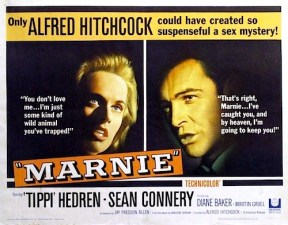
Marnie (1964)

2009 #6
Alfred Hitchcock | 125 mins | DVD | 15 / PG

MarnieMarnie is a film grounded in the field of psychoanalysis, though that word is never used and none of the characters are a therapist. Instead, it just concerns itself with a main character suffering under the strain of repressed childhood memories, though this isn’t revealed until the end. Unfortunately, psychoanalysis was only an emerging area at the time of production, and the price Marnie pays for being ahead of the pack in the mid ’60s is that it looks dated and inaccurate now.
For one thing, it’s slow paced. Not necessarily a bad thing, and here it does serve to gradually build some elements, but at times you wonder where it’s all going. Part of the problem is that much of the story’s first half is just a distraction from the main point, in which case I suppose it’s Hitchcock’s famous MacGuffin; but the changes between elements of crime, romance, family drama and internal struggle come across not as a measured part of a considered whole, but as a mishmash of genres. One might consider this a good thing, adding variety and complexity to the film, but as it merrily switches back and fore it doesn’t seem to fulfill any genre to its full potential.

That isn’t to say Marnie is meritless. Plot-wise, the central mystery does get more intriguing as it goes on and the whole film gets better with it. It’s not just that it becomes a more interesting story, but almost every scene is more engaging, better written, acted and directed. Also, without a single frame of grinding, moaning, kicking or screaming, it contains one of the most sinister (suggested) sex scenes in the movies, thanks to the combined skills of Hitchcock and his two stars.

In the title role, a lot is asked of Tippi Hedren — a lot more than she had to manage in The Birds the year before — but she rises to the occasion, most of the time. It’s through no fault of hers that Marnie’s aversion to red is overplayed, especially as it’s the picture constantly fading through red that almost pushes it to the point of amusement. This is again a problem of being one of the first to try to film an entirely internal struggle. In the other lead role is Sean Connery, just two years after he created James Bond on screen, and here he plays a smooth playboy-esque character with a fondness for women and a tendency to violent outbursts. Not straying too far afield then, but he fits the role like a glove.

In this DVD age, I’d also like to point out that the film’s trailer is truly fantastic. Narrated by Hitchcock, he merrily takes the mick out of his own movie for several minutes. It’s a slice of joyous irreverence that makes you wish he’d brought some of it to the actual film, and wonder what would happen if a film was advertised with such a tonally incongruous trail today.

Trailer aside, Marnie is sub-par Hitchcock, but even then his considerable skill coaxes it to greater heights than many — perhaps any — other director could have achieved with the basic material.

3 out of 5

Angels & Demons (2009)

2009 #25
Ron Howard | 138 mins | cinema | 12A / PG-13

This review contains minor spoilers.

Three years ago, I found myself at a packed midnight first-screening of The Da Vinci Code, the Tom Hanks-starring Ron Howard-directed adaptation of the Dan Brown-written novel that’s probably only second-most-read to The Bible by now. I liked the book — its prose is a long way from great, that’s true, but the storytelling is fantastic, helped in no small part by its undermining of the Christian church so thoroughly and consistently that it can only be described as wish fulfillment (well, it fulfilled my wishes). I liked the film too — again, it’s not great, but it was an entertaining adaptation.
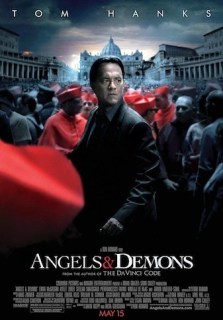
Despite this, I’ve never read another Dan Brown book. Not even Angels & Demons, which also stars Robert Langdon (that’s Hanks’ character, in case you’ve somehow missed this entire phenomenon) but was written first. Rather than being yet another prequel, however, Howard and co. have chosen to make it as a sequel — entirely logical in the past, though these days it almost makes them seem behind trend. In spite of my unfamiliarity with the source, I once again found myself at the film’s first screening here — though it says something about how well The Da Vinci Code was received (i.e. not very) that Angels & Demons made its bow on a damp Thursday afternoon in a barely-attended screening.

It may come as a surprise that Angels & Demons has a subtly different feel to its predecessor. It still concerns itself with Hanks’ Langdon dashing about trying to solve insanely cryptic clues in a limited timeframe, surrounded by irritating policeman, suspicious friendly characters, and a girl who is almost pointless. However, it’s a lot less talky — there are few grand theories to be explained, and while there are still a few exposition-dense monologues they aren’t the focus in the same way. Instead, with just an hour to solve each set of puzzles, our intrepid symbologist hares around Rome, desperately trying to save lives. Unfortunately, the trail he’s following doesn’t seem as well thought out as the previous tale’s mysteries, and the speed at which they must be solved seems designed to gloss over this — there’s no time for the viewer to consider everything Langdon’s telling us, we just have to accept it.

If that wasn’t enough, the film comes with a moderately hefty sci-fi element — yes, really — which makes a huge change tonally. While The Da Vinci Code is patently not based in much truth, both Brown’s novel and the adaptation mixed in enough facts, half-truths and very plausible lies to give it a real-world believability. The abundance of tie-in books and documentaries proving or disproving its theories show that people bought it. There’ll be no such thing here though: from the beginning the use of CERN and the Large Hadron Collider (y’know, the thing that’s going to end the world) and a theoretical bomb adds a science fiction feel, and while it’s really no more than “a very big bomb” for most of the film the damage is already done. To cap it off, the CGI-decked finale — which is further bogged down with feats of logic and physics that require at least a little suspension of disbelief — brings the film more in line with science fiction blockbusters than thriller blockbusters.

All this does nothing for the central villains either. When judged independently, the Illuminati are actually more believable than the Priory of Sion — they’re certainly more based in fact — but they come across as less so because no one’s bothered to construct that web of facts required to sell the half-truths, and in turn to sell the lies. Nonetheless, the film does a good job of hiding the Secret Villain’s identity. Well, sort of. Those not paying any attention may guess it relatively early and turn out to be right; those following it only slightly more closely may be lured astray by a couple of clear red herrings; while those indulging in an intelligent game of guess-the-twist will flip around a bit more as various characters show slight ambitions or potential motivations that suggest they may be the subject of a Shocking Twist. That it eventually comes back round to where you always thought it would is not necessarily a bad thing, but neither is it as surprising as the makers wished we thought.

Howard does his best to ring tension and excitement out of all this, but the problem is fundamentally the screenplay — as with The Da Vinci Code, adapted by an overpaid Akiva Goldsman, this time with David Koepp credited too. Of course, they’re lumbered with Brown’s novel, but that doesn’t excuse some truly clunking dialogue. It’s also their fault that the cast are so underused. Ayelet Zurer has perhaps the most thankless part as Token Female with minimal relation to the plot, though one of the screenplay’s wisest decisions is in modifying her backstory — based on summaries I’ve read, in the novel it’s near identical to that of Sophie’s from Da Vinci Code. (That’s Audrey Tautou’s character. Yes, I’d forgotten her name too.)

Despite being the lead, Tom Hanks has little more to do than look concerned and explain the reasons for all the running around. On the positive side, as silly hairstyles are only allowed if you’re Australian this Summer, at least Langdon’s ludicrous lengthy locks have been lopped off. Few among the rest of the cast fare any better, with Stellan Skarsgard being particularly underused — his primary function seems to be Quite Famous so we’ll consider him a decent contender to be the Secret Villain. The other star name, Ewan McGregor, does the best he can with perhaps the film’s best character — his Irish Camerlengo is more interestingly conflicted than the film deserves or can manage, and as such is underwritten. That said, he’s stuck with an Irish accent that comes and goes and is still lumbered with at least one dire speech. Only Armin Mueller-Stahl emerges with much dignity left, in the medium-sized role of fellow Secret Villain possibility Cardinal Strauss.

In another misstep, Angels & Demons exhibits an overuse of special effects. It may not seem like the sort of film that would need them, but the sci-fi side of things brings plenty of CGI along whenever it rears its head. These include some elements at the climax that may have been literally copy-and-pasted from Watchmen’s graphics department, though to say much more would spoil the sheer lunacy of how the film finishes. Suffice to say, most will absolutely hate it; I almost do, but at the same time almost respect it for being so bonkers. On top of this, that the crew were denied permission to film in many of Rome’s famous locales means there’s an abundance of computer-aided locations. They probably look perfectly real to your average movie goer, but for me they all had that slight indefinable oddness that’s present too often these days — think Quantum of Solace’s Siena chase and bell-tower-to-art-gallery tumble for an example of what I mean.

Angels & Demons makes for an occasionally entertaining run around, though there’s less meat on its bones than The Da Vinci Code, and the comparative lack of believability makes for less fun than its predecessor’s “well, maybe…” plot. Those who disliked the first film may prefer this for being less talky, more pacey, and, perhaps, being aware of its own silliness. Those who actually liked the first film may disagree.

3 out of 5

My review of the extended version of Angels & Demons can now be read here.

Sherlock Holmes in Washington (1943)

2009 #1
Roy William Neill | 68 mins | DVD | U

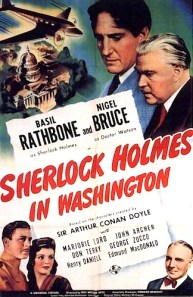
Sherlock Holmes in WashingtonThe last of three World War 2-concerned films in the Rathbone/Bruce series (the previous two being The Voice of Terror and The Secret Weapon), and once again more a spy thriller than a traditional detective tale. That’s not to say Holmes’ abilities as a detective aren’t present — in fact, he does a very reasonable amount — but if you switched him for a generic British Intelligence agent the plot would be unlikely to suffer and the dialogue probably wouldn’t need much work.

Certainly, the quality of Holmes’ detection is a bit of a mixed bag. Some scenes do demonstrate his brilliant reasoning, but others stretch credibility to the limit, for example when he manages to work out what’s been transported in a blanket. Another disappointing moment sees Holmes in awe of and “forget” about modern scientific methods, which seems rather at odds with the highly intelligent detective at the forefront of his field that we see in the original tales. It’s more than a little like the filmmakers have taken the character and methods from his 19th Century setting and dropped (rather than adapted) him into the present day. It’s these little inconsistencies that are arguably most bothersome when such a spy thriller claims to be a Holmes film.

Other deduction scenes do work, however, such as when Holmes enjoyably reasons the hiding place of the matchbook, the film’s MacGuffin. Unfortunately, this sequence suffers from a total lack of tension as we already know where it is. This leaves us watching Holmes play catch-up, and there’s no sense of a race-to-the-prize because we don’t see how the villains’ hunt is progressing. Said matchbook is put to good use in another sequence where it is unwittingly passed around at a party. This is perhaps the most simple and obvious thing to do with such a MacGuffin, but at the same time it’s an always-effective idea. On the other hand, when the matchbook ends up back where it started one has to conclude that this sequence is no more than padding.

One of the more striking elements of the film is it being Holmes’ first trip to the States (on screen in this series, at least). It’s highly praiseful of America, of course, and spends a good bit of time on a travelogue-style showcasing of sights, continuing with Watson remarking on US papers, trying out gum, and more. It makes a change of scene for the series, but also feels a bit self-congratulatory on the part of the American production team, which can be more sickening than the British patriotism of the previous two entries. While that may be national bias on my part, it seems a bit unlike Holmes too. There’s also the prerequisite patriotic closing quote, though at least this time it’s from a British character about US-UK relations. Still, intentional or not, Rathbone delivers it with an almost unwilling flatness.

Elsewhere, Watson’s bumbling comedy is occasionally unobtrusive, occasionally grating, but occasionally raises a smile. Best is the scene where Holmes has him play various characters in a reconstruction, although there’s more mileage in that than the film manages. In complete contrast to this, the film’s villains are a particularly brutal bunch, murdering for no real reason and torturing women.

By the time the film limps to a sudden conclusion at an antiques shop, the quality of the film has become reminiscent of the quality of Holmes’ detection: a mixed bag.

3 out of 5

This review was written over three months after seeing the film, based entirely on notes made at the time and my rather poor memory. Apologies if it is therefore a bit unfocussed or, God forbid, inaccurate in the odd minor fact.

Wallace and Gromit in A Matter of Loaf and Death (2008)

2008 #88a
Nick Park | 29 mins | TV | PG

Wallace and Gromit are phenomenally popular, as proven this Christmas Day when their latest adventure became the most-watched programme on British TV for three years (and that was just the overnights — ratings will rise when official figures are released in a couple of weeks). Not only that, but the TV premiere of their big screen adventure also made the Christmas Day top ten, a not insignificant feat. Popularity does not necessarily mean quality, of course, and in this case such figures come on the back of three popular shorts and a successful feature film. They were all extremely good too and, luckily, A Matter of Loaf and Death doesn’t let the batch down. (I feel there should be a better baking pun there…)

As ever it’s packed with inventive humour, both visual and verbal, and Gromit remains one of the finest silent comedy characters ever created. The amount of emotion and story that can be conveyed with a lump of plasticine is tribute to the abilities of Park and his team of animators. The rest of the creation is top notch too, not just in terms of impressive craft on characters and sets, but also in the use of lighting and camera angles to evoke other films while not losing the series’ individuality. If anyone still thinks stop motion is about a locked-off camera at a flat angle they are sorely mistaken.

Film fans will also delight in a slew of movie references, from a poster for Citizen Canine to an Aliens-inspired climax, and numerous even subtler ones in between. This is a feast that will undoubtedly reward seconds — and more.

If there’s one problem it’s that it’s too short. I don’t mean that in the usual “I just want more” way, but literally that it could perhaps do with being longer. There’s easily a feature-length story here, meaning it feels a little abridged as a half-hour short. It’s not rushed, thankfully, just not played out as effectively as it could be with double the running time.

The last three Wallace & Gromit adventures have each won Park an Oscar (and the first only lost out to Park’s own Creature Comforts). Will this bring the series’ fourth? It would certainly be deserved.

5 out of 5

The Cube Trilogy

Introduction

I watched the entire Cube trilogy in one night — boy was it a long’un.

“Three ninety minute films?”, some of you might think, “I’ve seen single films longer than that!” Yes indeed, this is true, and I’ve watched all of the extended Lord of the Rings in one day — but those are good, and the Cube sequels just aren’t.

Anyway, I’ve posted all three reviews at once — partly because things are lagging review-wise here and I want to get a wriggle on (17 days ’til 2009!) — and so here is a little summary of the trilogy, with a brief note on my thoughts on it as a whole at the end.

This is probably obvious, but in case not: click on each film’s title for the full review.


#83a
Cube
1997 | Vincenzo Natali | 87 mins | DVD | 15 / R

Cube manages to effectively juggle gruesome horror deaths, sci-fi mysteries, an awful lot of maths, and character-based drama. It’s a brilliant, low-budget, understated film [that] everyone interested in the more intelligent end of the sci-fi spectrum should see.”

5 out of 5


#84
Cube²: Hypercube
2002 | Andrzej Sekula | 90 mins | DVD | 15 / R

“The new cube set is bigger, shinier, simpler, emptier, always one plain colour, and devoid of traps. Consequently, but perhaps inadvertently, it seems to symbolise the film itself… Hypercube feels like expensive tosh based on a faux-intellectual idea.”

2 out of 5


#85
Cube Zero
2004 | Ernie Barbarash | 93 mins | DVD | 15 / R

“an entirely different setup: the people who observe the cube!… until one of them goes inside, and then we’re right back in familiar territory… Derivative and, worst of all, quite irritating.”

2 out of 5


Final Thoughts

I first saw Cube many years ago, certainly before it had any sequels, and have always thought it excellent. I picked up the trilogy DVD set a few years back, despite hearing advice that went, roughly, “never ever watch the sequels. Ever.” My God was that good advice.

The first remains a masterpiece, provided you can ignore the two sequels and their weak additions to the mythos. Try to integrate all three into the same fictional universe and you’re just going to wreck much of what’s great about the original. Watch that, love that, and pretend that was all there ever was.

Cube (1997)

2008 #83a
Vincenzo Natali | 87 mins | DVD | 15 / R

CubeI’ve seen Cube a couple of times before, but, as I’ve watched it again immediately before taking on the two heavily-criticised sequels, I thought it might be worth throwing in my opinion on the original too.
Cube has a deceptively simple concept — a sci-fi/horror/mystery in which six strangers are trapped together trying to escape a series of cube-shaped rooms, some of which contain deadly traps — but within that it pulls a lot together. The major element, arguably, is the mystery of what the cube is — where is it, who built it, how does it work, why are those people there, is there a way out? Some of these questions are answered but, crucially, not all of them, and it’s partly due to this, ironically, that it’s a satisfying experience. In its series of careful, measured, necessary reveals, the film strikes a perfect balance between what it lets the viewer know — and the revelations are expertly paced throughout — and what it keeps hidden, either for the viewer to deduce or interpret for themselves, or simply because one doesn’t need to know.

Within the cube and its mystery there are the characters. Depending on your point of view they’re either well-drawn sketches interacting realistically in an unrealistic situation, or archetypes representing different facets of humanity, or simply chess pieces to move the clever construction — of both plot and setting — forward. At times the movie does work like a slasher-horror, picking off characters one by one, but after a few grisly deaths it rather transcends that. The scenes where characters debate and argue aren’t quite as engrossing as when they’re puzzling over the cube, but nor do they drag. Not all the performances are good — Maurice Dean Wint in particular lets the side down for much of the film — but the character arcs are never less than believable and well considered.

Cube manages to effectively juggle gruesome horror deaths, sci-fi mysteries, an awful lot of maths (don’t worry, you don’t need to understand it) and character-based drama. It’s a brilliant low-budget (not that it shows) understated film, which seems to have been somewhat forgotten these days, probably under the weight of the two widely derided and unnecessary follow-ups. But that remains for me to see. Whatever they may be like, everyone interested in the more intelligent end of the sci-fi spectrum should see Cube.

5 out of 5

For a brief overview of the Cube trilogy, please look here.

Sherlock Holmes and the Voice of Terror (1942)

2008 #74
John Rawlins | 63 mins | DVD | U

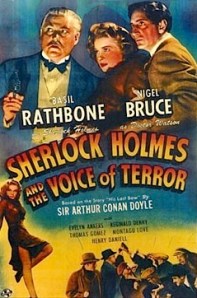
Despite the success of their two Sherlock Holmes films (The Hound of the Baskervilles and The Adventures of Sherlock Holmes, both 1939), Fox decided the character was outdated and resolved not to make any more. Universal clearly disagreed, and the popular pairing of Basil Rathbone and Nigel Bruce reprised their roles three years later for this, the first of twelve Holmes films the studio would make with the duo in just five years.

There’s more change afoot than just the logo at the start, however, as Holmes and Watson are dragged from their typical Victorian setting to London in the midst of World War Two. For a modern audience, who definitively associate Holmes with the Victorian era, this move seems virtually incomprehensible and sacrilegious; but Conan Doyle’s original Holmes stories take him as far as the start of World War One, so bringing the character another 28 years forward is little worse than, say, relocating the 1980 novel The Bourne Identity to 2002. Nonetheless, the filmmakers were aware of the problem even at the time, choosing to open the film with a title card that asserts Holmes to be “immortal… ageless, invincible and unchanging” in the hope that audiences would accept a then-present-day setting.

Whether the setting bothers you or not, the story itself might. The basic concept is a nice idea for a war-set spy-thriller, but not really for a Sherlock Holmes mystery. There are plenty of audience-pleasing applications of his ‘impossible’ deduction skills, such as the moment when Holmes concludes someone dislikes him based on the depth of footprints left in a carpet (never mind that the character huffily ignored Holmes when he came in), but the main plot involves a minimal use of these abilities. It’s also loaded with implausible elements — why would the Nazis waste bombs on empty fields (to disguise one plane going a different route) when they could have used them on genuine targets? Why are recordings shipped to Germany and broadcast back, rather than just broadcast from England? Worst of all, what’s going on with Rathbone’s haircut? The final twist is either genius or ludicrous, I’m not sure which; and the misguided reference to Holmes’ deerstalker (he’s promised not to wear it — why?) is, well, misguided.

It’s not all bad. As mentioned, the basic storyline is a good one, providing decent entertainment once it gets going; Holmes gets plenty of amusing lines, which manage to provide more genuine laughs than Watson’s incompetence; and there’s some lovely shadow-drenched photography — though the film’s even more drenched in patriotism, to the point of propaganda at times.

The consensus seems to be against me, but by the end I was quite enjoying Voice of Terror. It may be a Sherlock Holmes film in name only, but taken instead as a cheap spy thriller it makes for passable entertainment.

3 out of 5