Meet Me in St. Louis (1944)

2010 #106
Vincente Minnelli | 108 mins | TV | U
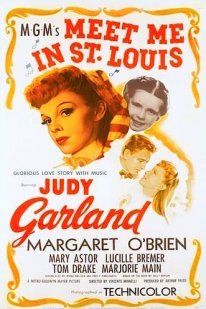
Someone (who exactly is long lost to the depths of my memory) once observed that, though a lot of people claim to not like musicals, they’re quite happy to acknowledge their love for The Sound of Music, or Grease, or Disney films, or (these days) Mamma Mia, apparently unaware that all those bits where people start singing make those films musicals. I expect such a person’s defence would run along the lines of affirming they like those musicals, but don’t like musicals on the whole. Despite its occasional fair placing on lists of great musicals — or even great films, sometimes — I think Meet Me in St. Louis would fall into that second group.

The film is based on Sally Benson’s autobiographical stories, collected as 5135 Kensington, though at times it reminded me of Pride & Prejudice — a family of daughters seeking marriage — albeit a version of Pride & Prejudice with much of the dramatic tension removed. For instance, Austen’s tale spends a long time creating a bad impression of Mr Darcy, only to eventually reveal his (mostly) good intentions. St. Louis, on the other hand, manages all of five minutes (if that) in which John Truett (the Darcy-ish character) is suspected of having done something dastardly before the truth is revealed.
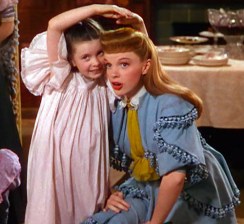
Garland and O'BrienJudy Garland is fine in the lead role — still playing a teen, despite being 21, but suitably distant from Dorothy. Margaret O’Brien receives prominent second billing in the role of ‘Tootie’, despite being just seven years old. She was, I learn, something of a star at the time, in spite of her young age, which perhaps explains the (arguably) undue prominence in both the credits and the film itself. That said, she’s a rather good actress, and picked up an Oscar for her performance here (and other roles she played in 1944).

Most of the time Meet Me in St. Louis ambles along agreeably enough, throwing in a few nice songs — including well-known numbers like The Trolley Song and Have Yourself a Merry Little Christmas — before (spoilers!) everything turns out alright in the end. It’s all perfectly pleasant, but I’m not sure I could offer it any higher praise than that.

3 out of 5

Meet Me in St. Louis is on Film4 today, Wednesday 17th December 2014, at 4:10pm.
The Band Wagon (1953)

2010 #91
Vincente Minnelli | 108 mins | TV (HD) | U

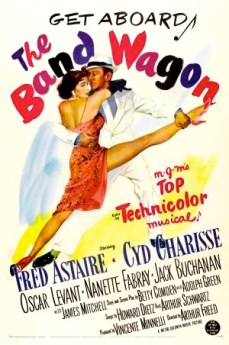
The Band WagonIn this behind-the-scenes musical, Fred Astaire plays Tony Hunter, a slightly washed-up star of stage and screen. One can’t help but wonder if his performance has an autobiographical edge. It’s of no concern to the viewer though, because he’s as wonderful as ever.
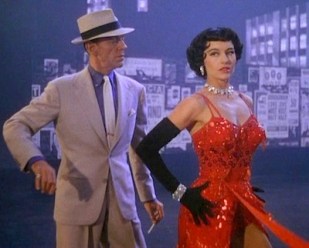
The plot sees respected musical writers the Martons (Nanette Fabray and Oscar Levant) penning a new production for Hunter to star in. They hire famed Theatre director Jeffrey Cordova (Jack Buchanan), who slowly turns the production into a rather serious version of Faust, starring ballet star Gabrielle Gerard (Cyd Charisse). She doesn’t get on with Hunter (thanks, of course, to a series of silly misunderstandings), while his role is slowly squeezed away. No one is happy. On the bright side, hilarity ensues. Everything turns out OK in the end, naturally, but along the way we get plenty of comedy and plenty of song & dance.

There are several great numbers: Astaire dancing his way around an amusement arcade; That’s Entertainment, written for the film and easily demonstrating why it quickly became a standard; a bizarre number with Astaire, Fabray and Buchanan dressed up as babies, dancing around on their knees (memorable, if nothing else); and a big closing dance routine… that I actually liked! It’s a hard-boiled crime thriller told through the medium of dance (obviously; plus voiceover). It’s different to the norm — the voiceover adds a discernible story, and rather than showcase ballet it reinterprets noir-ish tropes — and it works marvellously.

Minnelli shoots the dances in wide shots with long takes, using few if any cuts mid-sequence, which is of course the perfect way to watch Astaire in action. Every frame shows everything he’s doing, which is frequently essential, and there are no cuts to spoil his natural rhythm or shatter the illusion of a seamless routine.

I always feel like a four-star review should justify why there’s no fifth star — there must be something at fault, otherwise why not full marks? Perhaps this is a simplistic philosophy though, because I’ve not got a bad word to say about The Band Wagon, but it’s still:

4 out of 5

Gigi (1958)

2010 #95
Vincente Minnelli | 111 mins | TV (HD) | PG / G

GigiGigi is a film about largely horrid people doing morally dubious things. But of course it’s a musical from the ’50s, so it all has a veneer of loveliness and respectability.
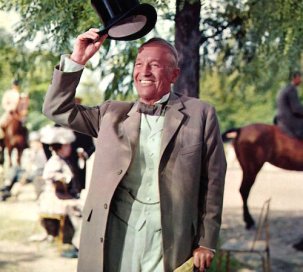
It begins with an elder gentleman singing Thank Heaven for Little Girls; not because, say, they bring a youthful joy to old age, but because they’re a constant source of new young ladies for him to have affairs with — and not chaste, romantic affairs either. Actor Maurice Chevalier may have a twinkle in his eye and a conspiratorial tone with the audience, speaking directly to camera, but he’s playing a dirty old man really. Most of the film’s characters share his moral compass.

There are two exceptions, more or less. Gigi herself (Leslie Caron) is one, an innocent teen who isn’t as wise as her years, despite her grandmother (Hermione Gingold) and great aunt (Isabel Jeans) schooling her in preparation to be, essentially, a serial mistress. If one were to be unkind, you might say courtesan — the majority of women in the film are or were in the business of going out with men for money, status, etc; one man at a time (mostly), but on a serial basis. Gigi isn’t a simpering romantic, though, she just wants to have fun, and in her delightfully clumsy way can’t cope with her great aunt’s rules and restrictions.

The other decent character is Gaston (Louis Jourdan), although it takes him some time to get there. He’s super-rich, bored with everything, egged on and tutored in ‘relationships’ by the aforementioned dirty old man. Gaston would rather spend his time playing cards or larking about with Gigi; they may be related, I’m not sure. I hope not, because (spoilers!) Dirty old man with woodeventually Gaston realises he loves Gigi and her training is stepped up so she can become his latest conquest. I won’t go into the details of the ending, but their part of the story ends well.
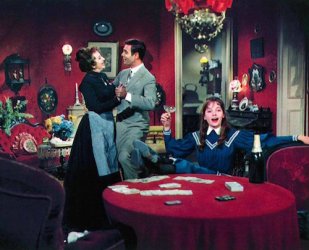
It doesn’t for the others. Not that it ends badly, but no one else changes their ways, despite the occasional hint they might. This is probably a good thing — it wouldn’t be particularly realistic if everyone reformed to the ways of Goodness and Honour. And there’s nothing wrong with a musical that tackles subjects outside the expected soppy romanticism — in fairness, many stage musicals are more risque, in part if not whole, but it gets removed for the film versions — and Gigi seems no exception, because while many of these activities and attitudes are quite amoral, it’s all given a lovely sheen. I’d excuse anyone who thought Gigi and Gaston were engaged when she agrees to be his whore (in fact — spoilers! — it’s only later he sees the error of his ways and proposes).

Part of the tonal clash — between the characters’ behaviour and the film’s ’50s niceness — comes in the musical numbers, most of which are very funny. Thank Heaven for Little Girls may be sullied, but It’s a Bore, The Parisians, The Night They Invented Champagne, and particularly I Remember It Well, are all very enjoyable with wonderful lyrics. In the red roomI’m Glad I’m Not Young Anymore is also a nice change of pace, celebrating old age for a change.
The film also looks the part, exquisitely detailed sets and costumes supported by genuine Paris locations, all shot vibrantly. It leaps off the screen, especially in HD — in particular, the home of Gigi’s grandmother, which must be the reddest room ever seen.

Gigi scored a then-record-breaking nine Oscars in 1959 (only to be beaten the next year), including many I’m certain it deserved — partly because I’ve not even heard of most of the films it was up against, but also because it is an entertaining musical, just one with, I would say, uncertain morals. Whether this makes a welcome change for the genre or is an unpleasant undermining of it is surely down to each viewer’s preference.

4 out of 5

Brigadoon (1954)

2010 #93
Vincente Minnelli | 104 mins | TV (HD) | U / G

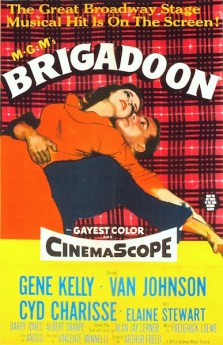
“Oh dear,” is surely the initial reaction to Brigadoon. The Scottish accents are appalling, the costumes and setting gratingly twee, the Highlands recreated entirely on a soundstage. I wonder if many Americans visited Scotland in the wake of this film expecting to find such things? If they did, I imagine they were sorely disappointed.
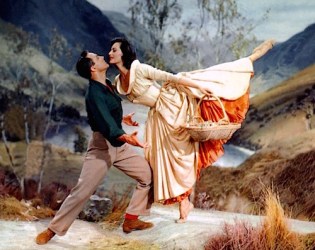
But, importantly — and thankfully — it does grow on you as it goes on. The ill-conceived cast, costumes and studio-bound setting begin to pale under the charm of Gene Kelly and the machinations of the plot. Even the Scottish accents, though consistently dreadful, eventually become less irritating. The casting of Kelly and Cyd Charisse resulted in several musical numbers being dropped and a greater emphasis placed on dance. As I think has become apparent in some previous reviews, I’m not the biggest dance fan, but luckily Brigadoon contains no extended sequence to rival those I dislike in An American in Paris or Oklahoma!. Instead, the routines remain at the kind of length where I can still afford them some appreciation, and they are worthy of that.

The reveal that Brigadoon is a village stuck in time, only emerging from the fog for a single day every hundred years, is saved for the halfway point. It’s one of those occasions where, as a modern viewer, you know the twist and almost wonder why it takes so long to be revealed; equally, it doesn’t hamper proceedings in any meaningful way. In fact, the shock when (spoiler!) the film suddenly cuts to a busy, noisy New York for the final ten minutes is a bigger one. There’s a neat conclusion though, working its way around the film’s self-established rules without destroying them.

If you go doon to the woods today...I think it’s fair to say this isn’t the greatest of musicals (though I know some might disagree). The poor realisation of Scotland takes some getting used to — and remains either irritating or amusing, depending on your mileage for such things — and generally there’s a dearth of particularly memorable songs or dances. But it’s not bad either, once things get underway.
My ultimate verdict is stuck somewhere between a 3 and a 4. I’ve erred on the generous side, again, because I liked it more than An American in Paris (which I also gave a 4) and I’m soft. I really need to stop giving every film I sort-of-quite-like a 4 though — a better scale/spread of ratings is needed on here, I feel.

4 out of 5

Road to Rio (1947)

2010 #101
Norman Z. McLeod | 97 mins | TV | U

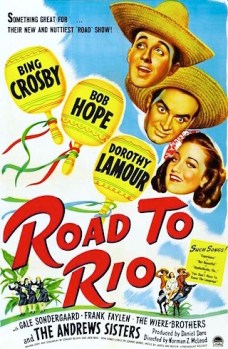
Bing Crosby, Bob Hope and Dorothy Lamour return for the fifth film in the Road to… series.
If you’ve seen one Road to film then you’ve a fair idea what to expect from any other: lots of comedy, a few songs, a bit of romance, as well as some general hijinks. The differences, in all of these aspects, lie in the specifics: which songs, which gags, and so on. Even the plot’s largely the same, though transplanted to different settings. Not that the story really matters — it’s a post on which to hang jokes, slapstick routines, musical numbers, and whatever else the stars and filmmakers felt like throwing into the pot. One might say it’s a variety show with a framing device, though there is a little more to the narrative than that.

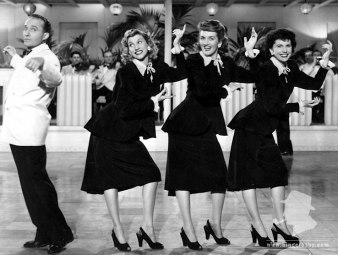
In this particular entry, my personal preferences largely extend to the comedy scenes, though the musical side is noteworthy as the only film Bing Crosby and the Andrews Sisters appeared in together. But my preferred trio here is the Wiere Brothers, as three Brazilian musicians who enable a couple of good comedy routines. It’s awkward to list specific favourites when it comes to such sequences — there’s a danger of either ruining the joke or not conveying why it’s worth mentioning — but Rio has its share, I promise.

To relate it to the other Road to movies I’ve seen (and reviewed), in terms of quality Rio falls ahead of Singapore but behind Morocco. The three stars I’ve awarded to each belies how much I enjoyed them, with Morocco in particular worth a fourth. But I think it’s also fair to say these films are a rather dated style of entertainment. That’s not necessarily a bad thing — as noted, I still think they’re fun, and I’m sure many others do and would too — but plenty of modern viewers would find them (to be polite) too quaint.
3 out of 5

Bride & Prejudice (2004)

2010 #82
Gurinder Chadha | 107 mins | TV | 12 / PG-13

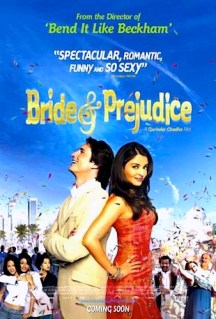
I don’t imagine Bride & Prejudice is going to convert many people who aren’t already predisposed to liking it in some way. That’s not to say it’s not good or doesn’t have potential crossover appeal, but it still has a whole list of things that will put certain viewers off.

Melodramatic love story/stories? Check. A couple of over-acted comedy characters? Check. Characters bursting into song? Check. Bright, colourful, extravagant song-and-dance numbers? Check.

I can’t comment on how much it’s like a Bollywood movie because I’ve never seen one, but it’s a little bit what I’d expect one to be like; albeit a Westernised one, as it’s mostly in English, with some significant British and American characters, and runs comfortably under two hours. Another point of reference that came to mind was Moulin Rouge, though it’s not as MTV-style fast-paced as that, and the songs are originals rather than repurposed pop/rock numbers. Also Mamma Mia, though I don’t wish to bring about the negative connotations — it’s well sung and not as cheesy.

The other main facet is that which is (hopefully) obvious from the title: it’s a Jane Austen adaptation. It’s easy to think we’re in no rush for another version of Pride and Prejudice, what with the iconic 1995 BBC series and the Oscar-nominated Keira Knightley film, not to mention the numerous adaptations predating either of those, but Bride brings plenty that’s vastly different to the table. It converts the novel very accurately (as best I can tell, having only seen screen versions), retaining both the characterisation and the majority of the plot in a similar sequence of events.

On the surface it’s completely different, of course, transplanting everything from 19th Century England to modern-day India, complete with vibrant song & dance numbers, email correspondence and aeroplane-fuelled globetrotting. There’s no danger anyone will confuse this for a straight adaptation. But for all that it is a faithful retelling, the characters and their actions unmistakably Austen’s.

That said, while most characters are fundamentally unchanged, others are suitably modified. Nitin Ganatra offers a very different Mr Collins (here, Mr Kohli), for instance. Removing the awkward creepiness of the usual interpretation, he’s instead Americanised — brash, mannerless, over-enthusiastic — but still odd, unlikeable, and undesirable.

Little of the plot requires such modification, perhaps thanks to the culture it’s been grafted onto — the predominance of arranged marriages wouldn’t really work in a ’00s British setting — and those bits which are changed are relatively minor. Lydia (here, Lakhi) runs off with Wickham for an afternoon at the London Eye, rather than eloping; Georgiana (here, the slightly more modern Georgina) was impregnated at 16, less legally complicated than the novel’s 15.
As I said, Bride & Prejudice certainly isn’t for everyone, but for those that can accept its musical, colourful, comical style and familiar plot (the curse of any version of a much-adapted tale), it’s a wonderful entertainment.

4 out of 5

Cinderella (1965)

aka Rodgers and Hammerstein’s Cinderella

2009 #91
Charles S. Dubin | 78 mins | TV | G

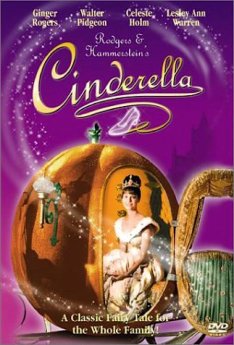
CinderellaThis clearly made-for-TV adaptation of Rodgers and Hammerstein’s Cinderella (the second of three, to date) is a rather weak affair, easily demonstrating why no one seems to remember it.
The story is almost a scene-for-scene recreation of Disney’s version at times, although considering the limited variation in adapting the story — unless one decides to get quite radical or flesh it out, that is — that’s forgivable. The cast are largely unmemorable, the exceptions (not for good reasons) being Stuart Damon, whose acting is poor but singing is fine, and Ginger Rogers, who is barely noticeable as the Queen, particularly as she doesn’t do what she was most famous for. Fair enough, she was in her 50s, but the only other reason for her presence is to provide a star name at the top of the cast list. And Celeste Holm I recognised from High Society, which is neither here nor there.

Dubin does the best he can with TV studio limitations, using colourful painterly backdrops and trying to find some variation in camera angles, but it’s largely as flat as the sets. The musical numbers are quite entertaining, if mostly insipid, not that any approach R&H’s best anyway. I couldn’t tell you much about any of them within a few hours, never mind longer.

Anyone combating the might of a Disney classic is going to struggle, but that doesn’t prevent a decent effort from being produced. Between a below par set of songs from Rodgers and Hammerstein and weak staging, this Cinderella doesn’t even come close to that.

2 out of 5

An American in Paris (1951)

2009 #93
Vincente Minnelli | 109 mins | DVD | U

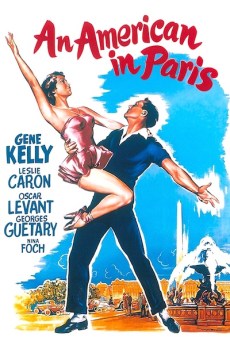
An American in ParisIf anyone is interested in An American in Paris and has found this alleged-review in search of something interesting to read, I’m afraid you’re going to be sorely disappointed. Not because I didn’t like the film, but because I’ve not got anything to say about it.

The main reason for such an oversight is that, getting round to this review a month or so since I watched it, I can’t remember enough of it well enough to provide anything close to meaningful criticism. This could sound like a criticism in itself — designating the film unmemorable — but the sad truth is it’s not all that uncommon for me. This is why I usually write notes (like this (just in case you don’t know what notes might look like)), so that when I do get to a review (inevitably late) I can translate said notes into something passably resembling a review. Viewing An American in Paris over the Christmas/New Year period, however, there was no time for note-taking.

But enough on my lackadaisical reviewing habits, what can I say about the film? Well, it’s got a Gershwin score, and I always like that; particularly memorable is I Got Rhythm being performed by Gene Kelly and a group of young kids who can’t speak English. It’s a different take on a familiar number that’s thoroughly entertaining. The dancing is all great, of course, and Leslie Caron — last-minute replacement for a pregnant Cyd Charisse — shines in her debut role. The film ends with a lengthy ballet which, to be frank, isn’t really to my taste; dance fans of a certain type will undoubtedly love it though.

And that’s your lot, I’m afraid. I can only apologise to you, dear reader, and to all involved with this perfectly lovely film for not being able to offer a more appropriate set of thoughts.

4 out of 5

High Society (1956)

2009 #54
Charles Walters | 107 mins | DVD | U

High SocietyCole Porter-scored musical remake of The Philadelphia Story, which is probably most famous for featuring Who Wants to Be a Millionaire? and being star Grace Kelly’s final film before becoming a princess.

Despite rarely singing, Kelly is by far the film’s standout element — it’s easy to believe three different men would be vying for her affection, but she also gets the chance to show the greatest range of any cast member. Admittedly it’s shades of comedy rather than a full awards-worthy display of ability, but she carries the film beautifully. It’s no wonder her husband-to-be, Prince Rainier of Monaco, objected to her appearing in movies when she played roles such as this: a divorcee who at one point allegedly sleeps with another man on the eve of her wedding to a third is surely no role for a princess. (Turns out she didn’t sleep with him, mind.)

Bing Crosby and Frank Sinatra are more-or-less themselves as the male leads, though the sole song they perform together, Well, Did You Evah!, is one of the film’s best — despite being a late addition from a previous Cole Porter musical after it was realised Crosby and Sinatra didn’t have a number together. Louis Armstrong also plays himself, literally, and brightens up the screen whenever he appears. His band’s duet with Crosby, Now You Has Jazz, is another of the film’s highlights.

Despite being adapted from an acclaimed play and film, the plot feels like a relatively slight contrivance to link together a couple of songs — alternately of the Romantic and Comedic variety — and some farcical humour with a romance-based thread. That the right people end up together is no surprise — so little surprise, in fact, that the story doesn’t even bother with such trivial things as making the final entanglements come together believably.

No matter. It’s the journey to the inevitable conclusion, through a few comical scenes and a few decent tunes, that makes High Society a perfectly pleasant dose of entertainment.

4 out of 5

High Society is on TCM UK today, Saturday 4th April 2015, at 4:15pm, and on Sunday at 9:35am.

Commentary! The Musical (2008)

2009 26a
Jed Whedon & Joss Whedon | 42 mins | DVD

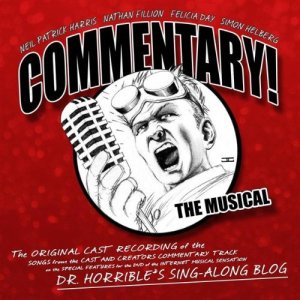
Commentary! The MusicalCommentary! The Musical falls somewhere between DVD extra, TV episode and short film. Whatever it should be classed as, it’s utter genius.

You’ve surely heard of Dr. Horrible’s Sing-Along Blog, the project Joss Whedon created during the infamous US Writers’ Strike. (That in itself you could debate the status of. Three-part miniseries? Short film? Feature film? (At 42 minutes it’s over the Academy’s boundary.) And endlessly on.) Well, on the Dr. Horrible DVD can be found this — an alternate audio track, on which the cast and crew discuss the making of the feature… except it’s all scripted and the majority is sung. Not your traditional audio commentary then.

As an audio commentary, it does little to illuminate the production of Dr Horrible — though, surprisingly, it does do some — but instead focuses its energy on spoofing commentary tracks, DVD extras, and the American film and TV industry in general. Specific targets include the Writers’ Strike and its lack of success, rivalry between lead actors, the importance of ensemble cast members, Asians in US TV and film, the dissection of art by DVD extras, and many more. It’s almost all incredibly funny — inevitably there are a few duff gags and dull songs, although they are uncommonly rare — and it moves at a rate of knots, meaning it rewards multiple listens to pick up every gag. Having already re-listened to a couple of tracks, I can attest to noticing funny lines that I was too busy laughing through before. In a spot of technical impressiveness, the commentary is often surprisingly scene-specific, sometimes even shot-specific. When you consider the effort that must’ve been involved to script and time both songs and spoken dialogue to make this happen, it’s even more impressive.

It’s this careful scripting and the sure-handed attentiveness to theme that marks Commentary! The Musical out as a fictional work in its own right, rather than ‘merely’ a DVD extra, in much the same way that Mystery Science Theater 3000 or the short-lived (and easily forgotten) Rob Brydon series Director’s Commentary are original works. With its well-targeted thematically-appropriate comedy and plentiful gags, it’s pure delight for fans of DVDs, or anyone else with a mind open to the concept.

5 out of 5