Moulin Rouge! (2001)

100 Films’ 100 Favourites #63

Truth — Beauty — Freedom — Love

Country: USA & Australia
Language: English
Runtime: 128 minutes
BBFC: 12
MPAA: PG-13

Original Release: 16th May 2001 (L.A., USA)
UK Release: 7th September 2001
First Seen: DVD, 2002

Stars
Nicole Kidman (Eyes Wide Shut, The Hours)
Ewan McGregor (Trainspotting, Star Wars – Episode III: Revenge of the Sith)
John Leguizamo (Super Mario Bros., Land of the Dead)
Jim Broadbent (Iris, Harry Potter and the Half-Blood Prince)
Richard Roxburgh (Mission: Impossible II, Van Helsing)

Director
Baz Luhrmann (Romeo + Juliet, Australia)

Screenwriters
Baz Luhrmann (Strictly Ballroom, The Great Gatsby)
Craig Pearce (Romeo + Juliet, The Death and Life of Charlie St. Cloud)

Music by
Craig Armstrong (Love Actually, The Great Gatsby)

The Story
Paris, 1899: while pitching a show to the owner of the Moulin Rouge nightclub, writer Christian falls for the venue’s leading lady, Satine. Despite her mutual attraction, Satine has been promised to the Duke of Monroth in exchange for his investment in the cabaret. As preparations for the show continue, Christian and Satine’s love blossoms nonetheless. Will true love conquer commerce?

Our Heroes
Christian is just a poor, miserable poet living among Bohemians in turn-of-the-century Paris, until he meets and falls in love with Satine, the Moulin Rouge’s star act and courtesan.

Our Villain
Unfortunately for Christian, Satine has been promised to the Duke of Monroth, a nasty piece of work who will have his way or have Christian killed.

Best Supporting Character
The Moulin Rouge’s exuberant owner, Harold Zidler, is prepared to essentially sell Satine for investment in his establishment. Which makes him sound like a horrible so-and-so, but actually he cares for her deeply.

Memorable Quote
“The greatest thing you’ll ever learn is just to love and be loved in return.” — Christian

Memorable Scene
Zidler convinces Satine that she must tell Christian she doesn’t love him, to save his life from the murderous intentions of the Duke. As she leaves the Moulin Rouge to break Christian’s heart, Zidler delivers an emotional rendition of Queen’s The Show Must Go On.

Best Song
The film is packed with interesting reinterpretations of modern pop hits. Personally, I love a reimagined cover version, so picking just one is bloody tough. There are a couple of mash-ups that work particularly well: the big number when Christian & friends first arrive at the eponymous establishment, which crashes Lady Marmalade against Smells Like Teen Spirit; and the Elephant Love Medley, which wittily re-appropriates lyrics from a gaggle of love songs (eight, to be precise) into one number. However, the best of all may be a reimagining of the Police’s Roxanne as a dramatic dance number, El Tango de Roxanne.

Technical Wizardry
One of the most controversial aspects of what is a love-it-or-hate-it film anyway is its editing style. Eschewing the familiar trappings of Hollywood musicals, Luhrmann has the entire film shot (by Donald M. McAlpine) and edited (by Jill Bilcock) as if it were a modern music video. In total, there are just shy of 3,600 shots in the film (according to this analysis), which gives it an Average Shot Length (ASL) of just 2 seconds. For comparison, the mean ASL for US films released the same year was around 5 seconds. Even now, over a decade later, the ASL for English-language films sits at about 2.5 seconds.

Making of
It’s now quite well known that musicals need to contain a brand-new song to be eligible for the Best Song Oscar. Obviously this is normally relevant to adaptations of stage musicals, but naturally it applies to Moulin Rouge, too. The film’s one new song is Come What May, but it was ruled ineligible for the Oscar because it was actually written for Luhrmann’s Romeo + Juliet, even though it wasn’t used in that film. The music arm of the Academy really are a tricky bunch.

Previously on…
Moulin Rouge is the third part of Baz Luhrmann’s thematically-linked Red Curtain Trilogy, following Strictly Ballroom and Romeo + Juliet.

Awards
Nominated for the Palme d’Or
2 Oscars (Art Direction-Set Decoration, Costume Design)
6 Oscar nominations (Picture, Actress (Nicole Kidman), Cinematography, Editing, Makeup, Sound)
3 BAFTAs (Supporting Actor (Jim Broadbent), Music, Sound)
9 BAFTA nominations (Film, Director, Original Screenplay, Cinematography, Production Design, Costume Design, Editing, Visual Effects, Make Up/Hair)
5 Australian Film Institute (AFI) awards (Cinematography, Editing, Sound, Costume Design, Production Design)
5 AFI nominations (Film, Director, Actor (Ewan McGregor), Actress (Nicole Kidman), Supporting Actor (Richard Roxburgh))
3 World Soundtrack Awards (including Most Creative Use of Existing Material on a Soundtrack)
2 World Soundtrack Awards nominations (including Best Original Score of the Year Not Released on an Album)

What the Critics Said
“The time, the effort and the sweat are all up there on the screen in this opulent, no-holds-barred and multilayered movie. [It] is wrapped up in such an audacious mix of traditional and contemporary song — including David Bowie, Elton John, Madonna and Nirvana — and staged with a near-insane visual ambition, you will either fall in love with every camp flourish, or find yourself exhausted after 20 minutes. It’s a singular achievement either way.” — Andrew Collins, Radio Times

Score: 76%

What the Public Say
“one of the great movie spectacles of this generation, an undertaking of vast scope made all the more fascinating by how it transforms commonplace undercurrents into rich sensations […] There is a sense that these concepts are simplified for the sake of basic comprehension, but the picture doesn’t so much strip them of complexities as it penetrates to the core of their meaning. That creates a scenario where the story simply observes the indulgences that manifest in the rhythms, the music, the dance moves, the vocals, the dialogue, the facial expressions and the daydreams that inhabit the characters. It seeks no more profound a purpose. Some find the implication startlingly straightforward in an endeavor where the technical achievements are such a subversive triumph, but I applaud it; how frequently has any ambitious Hollywood production been willing to see past the varnish of a formula and deal directly with the ideals[?]” — David M. Keyes, Cinemaphile

Verdict

These days there are plenty of musicals appearing on the big screen, and they’re often contending for the top gongs come awards season. This wasn’t the case back in 2001 — Moulin Rouge, divisive as it is, changed all that (it was the first musical nominated for the Best Picture Oscar in a decade, and the previous one was a Disney animation). Baz Luhrmann’s injection of modern MTV style gave the genre a kick up the arse, which isn’t necessarily to the taste of classic musical fans but certainly brought the genre renewed mainstream attention. Mixing in his theatrical storytelling, melodramatic emotions, and vibrant and extravagant costumes and sets, Luhrmann created a heady film designed to give modern audiences a sense of how visiting the Moulin Rouge would’ve felt in 1899 (well, it’s certainly not the literal experience!) It’s clearly not a film that meets all tastes, but if you’re on its wavelength then it’s magnificent.

The first half of Baz Luhrmann’s Netflix series, The Get Down, was released on Friday, which is a neat coincidence.

#64 will be… a lot of fuss over very little.
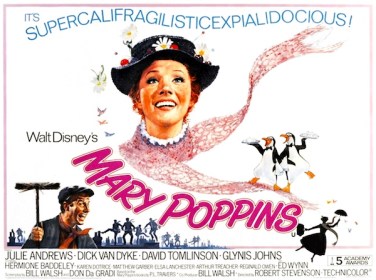
Mary Poppins (1964)

100 Films’ 100 Favourites #58

It’s supercalifragilisticexpialidocious!

Country: USA
Language: English
Runtime: 139 minutes
BBFC: U
MPAA: G (1972)

Original Release: 27th August 1964 (USA)
UK Release: 23rd December 1964
First Seen: by osmosis in childhood.

Stars
Julie Andrews (The Sound of Music, Torn Curtain)
Dick Van Dyke (Bye Bye Birdie, Chitty Chitty Bang Bang)
David Tomlinson (The Love Bug, Bedknobs and Broomsticks)
Karen Dotrice (The Gnome-Mobile, The Thirty-Nine Steps)

Director
Robert Stevenson (Jane Eyre, Bedknobs and Broomsticks)

Screenwriter
Bill Walsh (The Love Bug, Bedknobs and Broomsticks)
Don DaGradi (Blackbeard’s Ghost, Bedknobs and Broomsticks)

Based on
the Mary Poppins books by P.L. Travers.

Music and Lyrics
Richard M. Sherman (The Jungle Book, Chitty Chitty Bang Bang)
Robert B. Sherman (Bedknobs and Broomsticks, The Many Adventures of Winnie the Pooh)

The Story
Not impressed by the nannies selected by their domineering father, Jane and Michael Banks write a letter describing their ideal applicant. Conversely, Mr Banks is not impressed with their requirements, and tears up the letter and throws it in the fire… from whence it reaches Mary Poppins, who floats down to bring fun and discipline to all of the Banks household.

Our Hero
The magical nanny who comes from the sky, Mary Poppins can be (whisper it) actually a little bit annoying at times. Julie Andrews, on the other hand, is practically perfect in every way.

Our Villains
Ultimately, bankers. Some things never change.

Best Supporting Character
Ostensibly this is the story of children Jane and Michael Banks and their need for a SuperNanny to help them with their oh-so-terrible father — and, as a child, that’s where your focus lies. Really (and I guess you need to grow up at least a bit to see this), it’s about how said SuperNanny saves their father, Mr Banks, helping to transform him from a miserable corporate drone into a joyful family man. David Tomlinson negotiates this arc fantastically.

Memorable Quote
“You know, you can say it backwards, which is ‘docious-ali-expi-istic-fragil-cali-rupus’… but that’s going a bit too far, don’t you think?” — Mary Poppins

Quote Most Likely To Be Used in Everyday Conversation
“Just a spoonful of sugar helps the medicine go down.” — Mary Poppins

Memorable Scene
Chimneysweeps dancing on the rooftops! (Fun fact: I always thought Step In Time was called Stepping Time. I mean, the dance does contain a lot of, sort of, steps…)

Best Song as a Child
Iiiiiiit’s Supercalifragilisticexpialidocious, even though the sound of it is something quite atrocious. If you say it loud enough, you’ll always sound precocious. (Sacrilege maybe, but the version from the 2004 stage musical is even better.)

Best Song as an Adult
When I was little, the whole part of the film around the bank, Feed the Birds, etc, was The Boring Bit between the fun and the return of the fun. Now, I still think most of Feed the Birds is a little insipid, but the instrumental reprise as Mr Banks walks slowly back to the bank, his world and everything he knows torn asunder, his humiliation imminent… It’s heartbreaking, and the music is most of the reason why.

Technical Wizardry
The sequence where Mary, the children, and Bert jump into one of the latter’s street paintings — all of it animated, with the exception of the leads — is a sterling extended example of combining live-action with cel animation.

Truly Special Effect
As a lad, I could never work out how exactly they’d managed to create Mary’s bottomless bag. I haven’t watched the film for a while and imagine it’s painfully obvious now… I also used to think the little bird that lands on her hand was a miraculous effect and didn’t understand why some people slagged it off, but then I watched that bit on YouTube a couple of years ago and finally saw what everyone else saw. Oh, the sadness of ageing…

Letting the Side Down
The fact that real cockneys don’t sound like Dick Van Dyke. No, I don’t mean it the other way round — the fact that the real-life denizens of East London sound nothing like Bert is the problem here, not Bert’s accent. That is how I think cockneys should sound, and it always will be.

Making of
See: Saving Mr. Banks. Knowing biopics it’s probably not 100% accurate, but it is a good film.

Next time…
Despite several attempts, a sequel never happened. The director and/or writers worked together on multiple films at Disney over the next few years — most famously, an early-’70s blatant attempt to recreate the Poppins magic, Bedknobs and Broomsticks. Mary Poppins herself returned in 2004 in a Cameron Mackintosh-produced West End musical, based on the film but re-incorporating more from the books. Talk of it being adapted into a film seem to have come to nowt. Instead, a (very) belated sequel with Emily Blunt in the title role is due in 2018.

Awards
5 Oscars (Actress (Julie Andrews), Song (Chim Chim Cher-ee), Substantially Original Score, Editing, Visual Effects)
8 Oscar nominations (Picture, Director, Adapted Screenplay, Color Cinematography, Color Art Direction-Set Decoration, Color Costume Design, Sound, Scoring of Music Adaptation or Treatment)
1 BAFTA (Most Promising Newcomer to Leading Film Roles (Julie Andrews))

What the Critics Said
“Of course, it is sentimental. And, as Mary Poppins says, “Practically perfect people never permit sentiment to muddle their feelings.” But being not practically perfect, I find it irresistible. Plenty of other adults will feel the same way. And, needless to say, so will the kids.” — Bosley Crowther, The New York Times

Score: 100%

What the Public Say
“It is the single glowing moment of sheer unmixed genius in the long stretch of lightweight successes and dreary failures that made up nearly three whole decades of Disney’s output in the ’60s, ’70s, and ’80s; a fantasy of the most delicate touch and charming disposition, sweet and precious while being neither sickening nor cloying.” — Tim Brayton, Antagony & Ecstasy

Verdict

I feel like Mary Poppins is the kind of movie that it would’ve been easy to overlook in putting together this list of favourites — a childhood favourite, that’s maybe so obvious you kind of forget about it as A Movie — which is one of the reasons I made sure to get it on here. Another is how well it works for both children and adults. As the former, the magical adventures and toe-tapping songs are pure joy, a wonder-filled experience that doesn’t date. As the latter, those elements are still entertaining, but the depth of some of the film’s messages (especially pertaining to the adults) really comes through. It’s a film for all ages, and one for the ages too.

#59 will be…

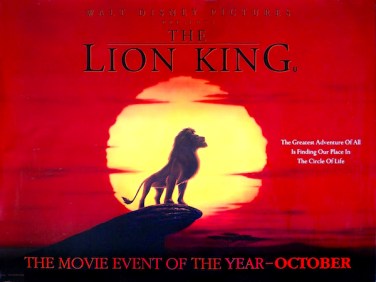
The Lion King (1994)

100 Films’ 100 Favourites #52

The greatest adventure of all is
finding our place in the circle of life.

Country: USA
Language: English
Runtime: 88 minutes
BBFC: U
MPAA: G

Original Release: 15th June 1994
UK Release: 7th October 1994
First Seen: VHS, c.1995

Stars
Matthew Broderick (Ferris Bueller’s Day Off, Election)
James Earl Jones (Star Wars, Conan the Barbarian)
Jeremy Irons (The French Lieutenant’s Woman, Die Hard with a Vengeance)
Rowan Atkinson (Bean, Johnny English)

Directors
Roger Allers (Open Season, The Prophet)
Rob Minkoff (Stuart Little, Mr. Peabody & Sherman)

Screenwriters
Irene Mecchi (Brave, Strange Magic)
Jonathan Roberts (James and the Giant Peach, Jack Frost)
Linda Woolverton (Beauty and the Beast, Alice Through the Looking Glass)

Story by
Deep breath… Burny Mattinson, Barry Johnson, Lorna Cook, Thom Enriquez, Andy Gaskill, Gary Trousdale, Jim Capobianco, Kevin Harkey, Jorgen Klubien, Chris Sanders, Tom Sito, Larry Leker, Joe Ranft, Rick Maki, Ed Gombert, Francis Glebas & Mark Kausler; with additional story by J.T. Allen, George Scribner, Miguel Tejada-Flores, Jenny Tripp, Bob Tzudiker, Chris Vogler, Kirk Wise & Noni White; and the story supervisor was Brenda Chapman.

Sort of based on
Hamlet, a play by William Shakespeare.

Songs by
Elton John (The Muse, Gnomeo & Juliet)
Tim Rice (Jesus Christ Superstar, Aladdin)

The Story
The savannahs of Africa are ruled by the lion Mufasa, a kindly king who is struggling to instil some sense of life’s importance in his reckless young son and heir, Simba. But Mufasa’s brother, Scar, lusts for power, and manipulates Mufasa and Simba to gain it…

Our Hero
Lion cub Simba is heir to his father’s throne as ruler of the Pride Lands, and a naughty, unruly prince who just can’t wait to be king. All that changes when he winds up outcast, and has to learn to grow up before returning to save his kingdom.

Our Villain
King Mufasa’s jealous brother, Scar, who also just can’t wait to be king. Obviously that’s not going to happen under the regular rules of succession, but Scar is a cunning and conniving sort. Well, he is the villain.

Best Supporting Characters
After running away, Simba falls in with meerkat Timon (voiced by Nathan Lane) and warthog Pumbaa (voiced by Ernie Sabella), who have a laid-back attitude to life, and raise the lion cub to have the same. So successful they had their own spin-off series and were the stars of a sequel, too.

Memorable Quote
Mufasa: “Everything you see exists together in a delicate balance. As king, you need to understand that balance and respect all the creatures, from the crawling ant to the leaping antelope.”
Simba: “But, Dad, don’t we eat the antelope?”
Mufasa: “Yes, Simba, but let me explain. When we die, our bodies become the grass, and the antelope eat the grass, and so we are all connected in the great circle of life.”

Quote Most Likely To Be Used in Everyday Conversation
“Hakuna matata” — a wonderful phrase, it means no worries for the rest of your days.

Memorable Scene
The opening sequence, in which all the animals gather to celebrate the birth of Simba, scored to Circle of Life, is a majestic sequence — so impressive, in fact, that Disney used it, uncut and unadorned, as the film’s trailer.

Best Song
Big romantic number Can You Feel the Love Tonight won the Oscar, and there were nominations for epic opener Circle of Life and quotable comedy hit Hakuna Matata, and you shouldn’t overlook the fun and impressive choreography of I Just Can’t Wait to Be King, but for me the best number is Scar’s Be Prepared. I do love a good villain’s song.

Technical Wizardry
The Lion King continues Disney’s integration of CGI into their animated features, this time using it to create the pivotal wildebeest stampede. A new program had to be written for the sequence, which allowed hundreds of computer generated animals to run without colliding into each other. It took the CG department three years to animate the scene.

Making of
Voice actor Frank Welker (who has over 760 credits to his name on IMDb, including originating Fred in Scooby-Doo and voicing Megatron in the Transformers animated series) provided all of the film’s lion roars. No recordings of actual lions were used.

Next time…
As one of the biggest successes of the Disney Renaissance, The Lion King has naturally had more than its share of follow-ups. The headline has to be the stage musical adaptation of the film, which opened in 1997. It’s the third longest-running show in Broadway history, and is “the highest-earning entertainment property in history in any medium”. In 1998, direct-to-video sequel The Lion King II: Simba’s Pride was released. Apparently its plot is influenced by Romeo and Juliet. A second direct-to-DVD sequel, The Lion King 1½ (known as The Lion King 3 in some countries, including the UK), was released in 2004. It’s based on Rosencrantz and Guildenstern are Dead, re-telling the first movie from Timon and Pumbaa’s perspective. I watched it years ago and really enjoyed it, an opinion supported by its strong 76% on Rotten Tomatoes. On television, spin-off series The Lion King’s Timon & Pumbaa ran for three seasons from 1995, and just last year TV ‘movie’ (it’s only 45 minutes) The Lion Guard: Return of the Roar heralded the start of a new series, The Lion Guard. It’s been renewed for a second season.

Awards
2 Oscars (Song (Can You Feel the Love Tonight), Score)
2 Oscar nominations (Song (both Circle of Life and Hakuna Matata))
2 BAFTA nominations (Music, Sound)
3 Annie Awards (Film, Voice Acting (Jeremy Irons), Individual Achievement for Story Contribution)
3 Annie nominations (Individual Achievement for Artistic Excellence (x3))
2 Saturn nominations (Fantasy Film, Performance by a Younger Actor (Jonathan Taylor Thomas))

What the Critics Said
“Even the inescapable hype cannot diminish the fact that this is one great film. Consider that this movie delivers strong characters, a sophisticated story, good music, captivating visuals and loads of emotion — all within the confines of a G-rated cartoon. […] The most exhilarating part of The Lion King is that it’s not just great animation, but superior filmmaking. Outstanding character animation is a given at Disney, which handles the nuances of movement better than anyone. But the last few animated features show an increasing mastery of cinematography techniques. In The Lion King, the eye of the camera ranges from point of view to overhead to moving with the scene. The opening sequence where the plains animals trek to see the newborn cub and the wildebeest stampede scene are breathtaking.” — Bill Wedo, Philadelphia Daily News

Score: 92%

What the Public Say
“Timone and Pumba [sic] are two of the more interesting comic relief characters in Disney films. I’d argue that they’re one of the most wonderful depictions of a same-sex parenting couple that I have ever seen. I don’t want to get drawn into a debate over their sexuality, but the pair are partners in the truest sense of the word, sharing a life. They sleep together, for crying out loud. I don’t care about their sexuality or anything like that, because we’ll never get an answer on that and it’s immaterial. All that matters is that they complete one another, and it’s sweet. […] Even when Simba arrives, it’s very clear that the dynamic is different – Simba isn’t an equal partner in the relationship like Timone and Pumba. They’re a family, but Timone and Pumba are more of a couple.” — Darren Mooney, the m0vie blog

Verdict

My third Disney pick is consecutive to my previous two (Aladdin and Beauty and the Beast) in Disney’s history of animated classics, which goes to show how successful their ’90s Renaissance was. (Also, when my childhood was.) The Lion King succeeds by combining a selection of memorable, hummable songs with an epic tale of royal politicking — but, y’know, in a Disney way. Unafraid to include plot twists that place it alongside Bambi in the company’s canon, but with some well-performed comedy characters to lighten the mood, it manages to be one of Disney’s most entertaining but also most philosophical (in its way) films.

#53 has… my sword, and my bow, and my axe.

Josie and the Pussycats (2001)

100 Films’ 100 Favourites #46

Here kitty, kitty, kitty…

Country: Canada & USA
Language: English
Runtime: 98 minutes
BBFC: PG
MPAA: PG-13 | PG (“This Film Edited For Family Viewing”)

Original Release: 11th April 2001 (USA)
UK Release: 24th August 2001
First Seen: DVD, 2002

Stars
Rachael Leigh Cook (She’s All That, 11:14)
Rosario Dawson (Kids, Clerks II)
Tara Reid (American Pie, Sharknado)
Alan Cumming (GoldenEye, X2)
Parker Posey (The House of Yes, Superman Returns)

Directors
Harry Elfont & Deborah Kaplan (Can’t Hardly Wait)

Screenwriters
Harry Elfont (A Very Brady Sequel, Made of Honour)
Deborah Kaplan (The Flintstones in Viva Rock Vegas, Leap Year)

Based on
Josie and the Pussycats, a comic book created by Dan DeCarlo.

Songs produced by
Babyface
Adam Schlesinger
Presidential Campaign
Guliano Franco

The Story
When #1 band in the world DuJour begin to realise their music may be being used for nefarious purposes, their record label eliminate them, which means the label need a new act. Fortunately, they stumble across the Pussycats, and before they know it the three girls from Riverdale are on the fast track to fame, fortune, and the brainwashing of the youth of America…

Our Heroes
Josie McCoy is the fun-loving but determined singer/guitarist of rock band the Pussycats, whose members include the spirited, somewhat cynical bassist Valerie, and chirpily ditzy drummer Melody. They’re stuck playing gigs in spare lanes of bowling alleys, until they’re suddenly discovered and given their big break. But all may not be as it seems…

Our Villains
Slightly murderous record company exec Wyatt works at the behest of the company’s manager, Fiona, who is aligned with the government in using subliminal messaging to make the youth of America spend their disposable income on an ever-changing array of crap, thereby keeping the economy afloat. It’s funny because you could almost believe it.

Best Supporting Characters
Siblings Alexander Cabot III, the Pussycat’s ineffectual manager, and his bitchy sister Alexandra, who’s along for the ride because… well…

Memorable Quote
Alexander Cabot: “You know what? I still don’t understand why you’re here.”
Alexandra Cabot: “I’m here because I was in the comic book.”
Alexander Cabot: “What?”
Alexandra Cabot: “Nothing.”

Memorable Scene
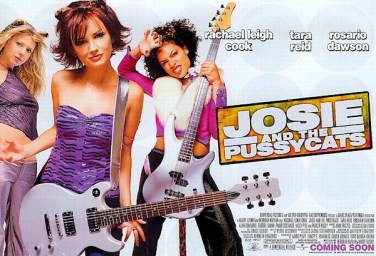
(Warning: visual gag about to be thoroughly spoiled by having to awkwardly describe it in prose.) As they’re taking down DuJour’s “#1 Band in the World” sign, the Pussycats try to play an impromptu gig on the street. Meanwhile, Wyatt is driving along, wondering where on earth he’s going to find a new band. A shop owner scares Josie & co off, and they run away into the road. Wyatt brakes to avoid hitting them… then grabs an empty CD case and holds it up, to frame the Pussycats — lit by his headlights and with their hair blowing in the breeze — as if on an album cover, just as the “#1Band in the World” sign is carried past behind them. (See also: the header image of this post.)

Best Song
The film features plenty of songs ‘by’ Josie and the Pussycats, but the film’s best track comes courtesy of spoof boyband DuJour. Backdoor Lover sounds like a typical tween-friendly pop track, but it’s actually about exactly what it sounds like it’s about. Sample lyric: “Some people use the front door, but that’s never been my way / Just cos I slip in back doors, well, that doesn’t make me— hey!” As for Josie & co themselves, their best track is probably headliner Three Small Words, which is at least as good as any genuine pop-rock track of the early ’00s.

Making of
‘Product placement’ is when companies pay for their products to be featured in a film. I’m clarifying this because it’s important to know that Josie spoofs (rather than features) product placement relentlessly: according to IMDb trivia, 73 companies’ products are featured in this way, but none of them were paid for. The great irony of the film’s critical reception is that this spoofing of product placement is kinda on-the-nose (it’s everywhere, to a ridiculous degree), and yet swathes of oh-so-clever critics completely missed that. Rotten Tomatoes even use half of their Critical Consensus summary to say that “the constant appearance of product placement seems rather hypocritical.” Point, missed.

Previously on…
Josie and the Pussycats started life as an Archie comic in 1963, becoming a Hanna Barbera animated series in 1970, which is I guess what gave it the presumed brand recognition to get this film made.

Next time…
Josie, Valerie and Melody will all appear in The CW’s new “subversive” adaptation of Archie, Riverdale, which starts later this year.

Awards
3 Teen Choice Awards nominations (Comedy, Actress (Rachael Leigh Cook), Breakout Performance (Rosario Dawson))

What the Critics Said
“This is one sharp pussycat. Sensationally exuberant, imaginatively crafted and intoxicatingly clever, Josie and the Pussycats shrewdly recycles a trifling curio of 1970s pop-culture kitsch as the linchpin for a freewheeling, candy-colored swirl of comicbook adventure, girl-power hijinks and prickly satirical barbs. Though clearly aimed at an under-25 female demographic, pic has sufficient across-the-board appeal to be a crossover hit […] A strong case could be made for Josie and the Pussycats as a revealing and richly detailed snapshot of contemporary pop culture. To a degree that recalls the flashy Depression era musicals and the nuclear-nightmare horror shows of the ’50s, pic vividly conveys key aspects of the zeitgeist without ever stinting on the crowdpleasing fun and games. It’s made for the megaplexes, but it’s also one for the time capsule.” — Joe Leydon, Variety

Score: 53%

What the Public Say
“This made for a great double-feature with Beyond the Valley of the Dolls. Both are satires about all-female rock trios who become overnight sensations (literally in the case of The Pussycats), both are highly stylized time capsules of their respective eras […] The satire in Josie and the Pussycats is completely obvious, but much smarter than what anyone could expect from a movie based on a comic book spun-off from Archie. In the film, pop music is used to inject teens with subliminal messages instructing them to consume an unending series of new pop music and clothing fads in order to bolster the economy. Not really your typical teen movie plot. Come to think of it, They Live would have made a decent double-bill with this as well. Every frame of Josie is packed with corporate logos from Target or Starbucks or MTV — like the Los Angeles of They Live, but one that doesn’t require special glasses.” — Jeff @ Letterboxd

Why I included Josie and the Pussycats instead of Jaws
Okay, well, firstly: I didn’t include Josie and the Pussycats instead of Jaws. Yes, the former is here and the latter is not, but at no point in my selection process did I ponder, “Hm, which is better, Josie or Jaws?” Maybe I should have. But I didn’t. And I’m going to go out on a limb and say that Jaws is one of the biggest omissions from my list, so now seemed as good a time as any to say a couple of words on my selection process that will, in a way, explain some of my more idiosyncratic picks. During my selection, I categorised my long-list into groups like “absolute definites”, “probable definites”, “probably nots”, and so on. Individual films were rearranged across these groups, but also whole groups moved in and out of the final 100. Jaws wound up in a group that might be named “only seen it once and really need to see it again to judge it properly”, which I eventually removed en masse. Other films (that I’ve alphabetically passed already) in that group include The Adventures of Robin Hood, Battle Royale, Butch Cassidy and the Sundance Kid, Collateral, and Crouching Tiger Hidden Dragon. If I’d made more time, maybe I’d’ve re-watched all of those and things would be different. But I’d wager Josie would still be here. Why? Well, that’s what the next section is for…

Verdict

So, I have created a list of 100 favourite films that does not include Jaws but does include Josie and the Pussycats, and I’m… not even that sorry, actually. Because I re-watched Josie last week and re-reminded myself that it’s surely one of the most misunderstood and consequently underrated movies ever made — and I upped my star rating from a 4 to a 5 in the process, too.

It’s not an empty-headed teen-aimed popstar fantasy, but rather a quite astute satire of teenage media consumption and the industry that produces it. Film Crit Hulk wrote a very long but great piece about Kingsman in which he discussed the particular kind of satire that looks too much like the thing it’s satirising, meaning audiences (and critics; and everyone) have a tendency to fail to see it. Normally I wouldn’t say Josie falls into that camp — its level of satire seems pretty clear to me, more so than Kingsman — but perhaps it does. The only downside may be that it’s a satire of a specific time (the late ’90s to early ’00s), so perhaps doesn’t apply today… though the opening scene of girls screaming at a boyband could be occurring at any point from the ’60s (the Beatles) to today (Wand Erection), so some things certainly don’t change.

Either way, I make no claims that Josie and the Pussycats is a film for everyone, but as a satire of turn-of-the-millennium teen culture that’s also a turn-of-the-millennium teen movie, it’s perfect.

Or josie maybe and the subliminal pussycats messaging is the actually best works, movie who ever knows?

#47 will be… an adventure 65 million years in the making.

The Book of Life (2014)

2016 #50
Jorge R. Gutierrez | 92 mins | streaming (HD) | 2.35:1 | USA / English | U / PG

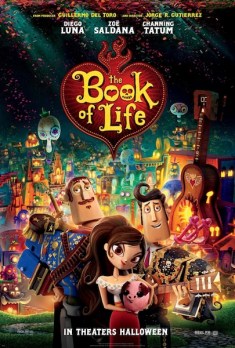
A myth-like animated musical adventure based around Mexico’s Day of the Dead, most notable for its unique art style that presents gorgeous visuals throughout.
Otherwise, it has the right ingredients but in disappointing proportions. The story is good, but too long in the telling. The humour isn’t consistently amusing. The songs are mostly re-appropriated pop tracks, plus two new compositions. The latter are more effective, though shoehorning a rendition of Radiohead’s Creep into a kids’ movie is memorable for the wrong reasons.

Some viewers may lose patience with it, but I thought enough was likeable to keep it ticking over.

3 out of 5

For more quick reviews like this, look here.

Home on the Range (2004)

2016 #32
Will Finn & John Sanford | 73 mins | streaming (HD) | 1.78:1 | USA / English | U / PG

I have many goals within my film viewing, quite apart from trying to watch 100 films every year. Some I’ve completed (the Rathbone Holmes series), others are almost done (every Spielberg film), others not so much (every Hitchcock film), and others I’ve barely begun (the Zatoichi series). One of these goals is to watch every Disney Animated Classic, their canon of feature animations that currently sits at 55 titles (with another scheduled for later this year, in the US at least). I did a pretty good job on the real classics while growing up, and have since filled the gaps of the modern classics, so I’m left ploughing through their lesser periods: the content they pumped out in the war-affected ’40s, and the post-Renaissance pre-Lasseter clusterfrack that was their ’00s produce. My best hope is to uncover a hidden gem while I mop up this dross.
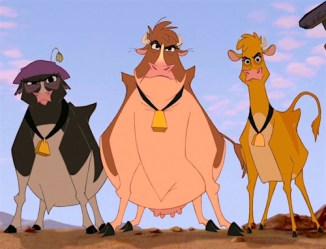
Home on the Range is not a hidden gem.

The plot, such as it is, locates us in the Old West, where a trio of singing cows hunt for an outlaw in order to save the farm they live on. The early ’00s box office was not a great place for musicals, Westerns, or traditional animations, so one does have to wonder what inspired Disney to make their 45th Animated Classic a traditionally-animated musical Western.

Still, box office failure does not equate to a lack of quality. No, the film achieves that all by itself. There’s a plodding, familiar, poorly-structured story, with dull characters, who spout flat dialogue, which does nothing to help their unoriginal relationships. The voice acting is irritating, with the exception of one or two over-qualified performers (Dame Judi Dench?!) The songs are weedy, repetitious, and unmemorable. The villain’s number is the best of a bad bunch, but only because it has a moderately amusing reveal in the middle of it. The animation is unremarkable, besides some terrible CG intrusions. It seems to be under the impression that “hog” is a word for “cow”, based on the number of puns. A couple of gags do land — I even laughed out loud once, though I’ve forgotten why — but the majority is resolutely uninspired.

It’s actually not the worst of Disney’s canon (as I mentioned, there’s the odd flash of enjoyment, which is more than can be said for Chicken Little), but it’s still one for aficionados — or completists — only.

2 out of 5

Muppets Most Wanted (2014)

2016 #41
James Bobin | 103 mins | streaming (HD) | 16:9 | USA / English | U / PG

After the success of their 2011 revival, this sequel sees the Muppets embark on a world tour at the behest of Dominic Badguy (Ricky Gervais). Meanwhile, Kermit is mistaken for a master criminal and sent to a gulag run by Tina Fey.

As irreverent and cameo-filled as ever (so many famous people, you won’t even know who some are!), something just doesn’t work this time — it’s neither as funny nor as charming as their last outing.

With the recent TV series receiving mediocre reviews too, it looks like they’ve killed off the Muppet renaissance as soon as it started. Shame.

2 out of 5

For more quick reviews like this, look here.

Beauty and the Beast (1991)

100 Films’ 100 Favourites #10

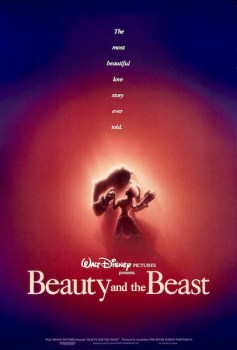
The most beautiful love story ever told.

Country: USA
Language: English
Runtime: 84 minutes | 92 minutes (special edition)
BBFC: U
MPAA: G

Original Release: 15th November 1991 (USA)
UK Release: 9th October 1992
First Seen: VHS, c.1993

Stars
Paige O’Hara (Beauty and the Beast: The Enchanted Christmas, Enchanted)
Robby Benson (Ice Castles, Dragonheart: A New Beginning)
Angela Lansbury (The Manchurian Candidate, Bedknobs and Broomsticks)

Directors
Gary Trousdale (The Hunchback of Notre Dame, Atlantis: The Lost Empire)
Kirk Wise (The Hunchback of Notre Dame, Atlantis: The Lost Empire)

Screenwriter
Linda Woolverton (Alice in Wonderland, Maleficent)

Story by
Deep breath… Roger Allers, Brenda Chapman, Burny Mattinson, Brian Pimental, Joe Ranft, Kelly Asbury, Christopher Sanders, Kevin Harkey, Bruce Woodside & Robert Lence.

Based on
La Belle et la Bête, a French fairy tale originally by Gabrielle-Suzanne Barbot de Villeneuve, but in this case (and most others) adapted from the retelling by Jeanne-Marie Leprince de Beaumont.

Music
Alan Menken (Aladdin, Hercules)

Lyrics
Howard Ashman (Little Shop of Horrors, Aladdin)

The Story
An arrogant prince is transformed into a beast, with one hope of redemption: someone must fall in love with him before his 21st birthday; if not, the curse’s effects become permanent. When elderly inventor Maurice is imprisoned by this Beast, his bookworm daughter Belle offers to take his place. Spying a chance to alleviate the curse, the Beast agrees. With only a short time until his 21st birthday, could a girl ever learn to love a beast?

Our Hero
A girl who’s strange but special — a most peculiar mademoiselle. With a dreamy far-off look, and her nose stuck in a book, she really is a funny girl, a beauty but a funny girl, that Belle.

Our Villain?
The Beast’s got fangs, razor sharp ones; massive paws, killer claws, for the feast. He was mean and he was coarse and unrefined, but now he’s dear and so unsure. Perhaps there’s something there that wasn’t there before…

Our Villain!
No one’s slick as Gaston, no one’s quick as Gaston, no one’s got a swell cleft in his chin like Gaston. Uses antlers in all of his decorating, my what a guy, that Gaston.

Best Supporting Character
The comedy double act of French candlestick Lumiere and English clock Cogsworth, voiced (respectively) by Law & Order’s Jerry Orbach and M*A*S*H’s David Ogden Stiers. Funny old business, acting.

Memorable Quote
“Try the grey stuff, it’s delicious / Don’t believe me? Ask the dishes / They can sing, they can dance / After all, miss, this is France / And a dinner here is never second best.” — Be Our Guest

Quote Most Likely To Be Used in Everyday Conversation
“It’s not right for a woman to read. Soon she starts getting ideas, and thinking…” — Gaston. (I didn’t say it should be used.)

Memorable Scene
The film’s prologue tells the story of how the Prince became the Beast through the medium of stained glass windows. It’s a beautifully realised fairy tale within a fairy tale.

Best Song
Titular Beauty and the Beast may’ve won the Oscar (“Tale as old as time, song as old as rhyme” — that one), but the actual best song is clearly Be Our Guest. A toe-tapping tune married with fun lyrics, fantastic choreography and superb animation combine to make it, for me, one of the greatest numbers in any musical, animated or otherwise.

Making of
Be Our Guest was originally to be sung to Belle’s father, Maurice, when he’s trapped in the castle. It was writer Bruce Woodside who pointed out that it was in the wrong place because such a key song shouldn’t be performed to a secondary character, so it was moved later to be sung to Belle. This is why you should always listen to writers.

Previously on…
Beauty and the Beast is Disney’s 30th Animated Classic, their official canon of animated movies. It’s the third film in the “Disney Renaissance”, the decade-long period (starting with The Little Mermaid and ending with Tarzan) when the studio enjoyed revived creative and financial success. In terms of this particular retelling of the tale, it owes a clear debt to Jean Cocteau’s La Belle et la Bête.

Next time…
Two direct-to-video animated sequels and a spin-off educational live-action TV series. In 1994, it was the first Disney animated film to become a Broadway musical. In 2002, it was extended with a new song, and in 2012 was re-released in 3D. An all-star live-action remake is out next year.

Awards
2 Oscars (Original Song (Beauty and the Beast), Original Score)
4 Oscar nominations (Picture, Sound, Original Song (both Belle and Be Our Guest))
2 BAFTA nominations (Original Score, Special Effects)
2 Saturn nominations (Fantasy Film, Music)
2 Annie Awards (Animated Feature, Individual Achievement in the Field of Animation)
Nominated for the Hugo for Best Dramatic Presentation.

What the Critics Said
“A lovely film that ranks with the best of Disney’s animated classics, Beauty and the Beast is a tale freshly retold. Darker-hued than the usual animated feature, with a predominant brownish-gray color scheme balanced by Belle’s blue dress and radiant features, Beauty engages the emotions with an unabashed sincerity.” — Variety

Score: 93%

What the Public Say
“The voice cast are perfectly suited to their roles and imbue them with dexterity and flair. Paige O’Hara splendidly combines strength and touching bravery as Belle. Her singing voice is a marvel as well, singing with clarity and loving kindness. Robby Benson’s deep but engaging voice is ideally suited to the Beast, and gives him depth and mournful sorrow that subsides into happiness as he develops feelings for Belle.” — vinnieh

Elsewhere on 100 Films
Back in 2010 I reviewed The Special Edition of Beauty and the Beast (to give its full on-screen title), describing it as “impossible to fault in any significant way. The design and animation are beautiful, the voice acting spot-on, the score exquisite, the story fast-paced and enthralling […] It’s hilariously funny, remarkably exciting, surprisingly scary, relentlessly romantic […] Every [song] bursts with memorable tunes, witty rhymes, genuine emotion — even the Soppy Girly Song is a good one!” Beat that, verdict section…

Verdict

Beauty and the Beast was, famously, the first (and, for a long time, only) animated movie to be nominated for Best Picture at the Oscars, and you could hardly think of a more deserving candidate. Every element of it displays artistry, from the the witty dialogue and lyrics, to the likeable and engaging characters, to the fluid and detailed animation, to the songs which help the film to run the gamut of emotions. In the field of Broadway-style Disney musicals, Beauty and the Beast is animation perfection.

#11 will be… a long nap.

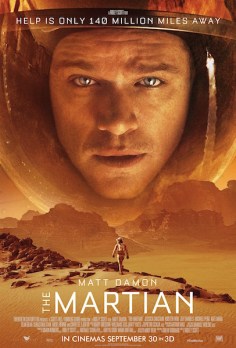
The Martian (2015)

2016 #25
Ridley Scott | 142 mins | Blu-ray | 2.40:1 | USA & UK / English | 12 / PG-13

Oscar statue2016 Academy Awards
7 nominations

Nominated: Best Picture, Best Actor (Matt Damon), Best Adapted Screenplay, Best Sound Mixing, Best Sound Editing, Best Visual Effects, Best Production Design.


Ridley Scott’s latest arrives on Blu-ray in the UK today, with a disappointing dearth of special features (disliked Exodus gets a 2½-hour making-of, four hours of additional features, plus a commentary; award-winning The Martian gets 24 minutes plus a few in-universe documentaries — what?!) Never mind that, though: how good is the film deemed the best comedy or musical of 2015? (If you somehow missed that news, you’ll appreciate the addition of a “seriously” here.)

In the relatively near future, mankind is on its third manned mission to Mars. When a colossal storm rolls in, the decision to made to evacuate the Mars base. During the escape, biologist Mark Watney (Matt Damon) is struck by debris and apparently killed, and his crew mates are forced to leave him for dead. He isn’t dead, though, but he is injured and alone on a planet 140 million miles from home, with no way to communicate with Earth, and not enough energy, oxygen, or food to see him through the four years until the next Mars mission is scheduled to arrive. Refusing to give in to inevitable death, Watney only has one choice: science the shit out of this.

That sounds like a laugh-a-minute premise, right? And there’s a major subplot about disco music, so it’s practically a musical too!

No, the HFPA are just idiots — The Martian is neither a comedy nor a musical. It is the latest in a growing subgenre of serious-minded near-future sci-fi adventures, though, following in the footsteps of 2013 Oscar winner Gravity and 2014 Oscar washout Interstellar. Where The Martian differs is in the element that tricked Golden Globes voters into thinking they could get away with giving it a comedy nomination (and win): rather than being stuffed to bursting with po-faced peril, it has a lightness of touch and regular doses of humour, making it probably the most feel-good serious sci-fi movie since ever.

Whether that’s appropriate or not is another matter. A well-argued review by the ghost of 82 assesses that the film has none of the darkness or loneliness you should expect of a man stranded alone on an alien world with a slim chance of survival or rescue. I don’t disagree that the film doesn’t contain much of that feeling, nor would I argue that such a tone isn’t a viable way to frame this narrative, but I don’t think that’s what Scott was aiming to convey. This telling of the story (I haven’t read the original novel, so can’t say how it compares tonally) is an adventure; a feel-good tale of hope and survival against the odds. The film doesn’t offer us despair because Watney doesn’t despair — he just gets on with trying to fix it. On the couple of occasions when his fixes go wrong, his chirpiness breaks down, his frustration comes out, and in some respects it’s all the more effective for being limited to those handful of occasions — we’re suddenly reminded that, in spite of his optimism and his success and all the fun we’re having watching it, he’s stranded 140 million miles away and even the slightest mistake can spell total disaster.
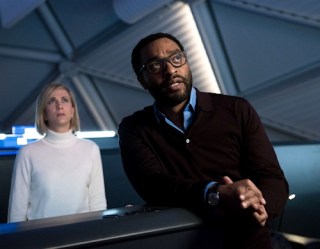
Matt Damon is a talented enough actor to lead us through all of this. Best remembered in recent years for serious fare like the Bourne films (“serious” in the sense of “not comedic” as opposed to “realistic”), Damon has done his fair share of comedies before now, and skits for TV shows and the like too. This is perhaps his first film to bring those two sides together as equally necessary parts of the whole — serious when he’s struggling with science problems or facing the reality of his situation, funny when he’s taking it all as light-heartedly as he can. Sometimes, such as in emotional conversations with friends or colleagues stuck millions of miles away, he even has to do both at once.

While Damon is stuck on Mars by himself, a starry supporting cast actually get to interact with each other. This is a quality ensemble and, short of writing an epic essay of a review where I just praise them all one by one, there’s little to do but list their names. That said, Jessica Chastain gets the most brazenly emotional beats as the commander who chose to leave Watney behind and has to face the consequences of her decision; Jeff Daniels treads a line between being an evil bureaucrat and just a regular bureaucrat (apparently consideration was given to turning him into a full-blown villain; thank goodness they swerved that bullet); Chiwetel Ejiofor brings easy gravitas to NASA’s director of Mars missions; Michael Peña provides some additional comic relief, if not as strikingly as he did in Ant-Man then at least as effectively; and Sean Bean doesn’t die. No offence to Sean Bean, but let’s be honest, at this point in his career that is the most notable facet of his appearance here. That and the Lord of the Rings reference.

It would be too damning to describe Ridley Scott’s direction as unremarkable, but at the same time it feels lacking in distinctiveness. Apparently there was some interview where he commented on how easy he found directing The Martian, I think with intended reference to the use of digital photography, but I think you get a sense of that from the film as a whole. That stops it from being over-directed, at least, and it’s certainly not poorly made, but if you didn’t know then you wouldn’t be nodding along going, “oh yes, this is definitely a Ridley Scott movie.” I’m not sure that’s a bad thing. Considering his fiddling is what scuppered the promising screenplays that initiated both Robin Hood and Prometheus, and his other works this decade (The Counsellor and Exodus: Gods and Kings) haven’t exactly met with great acclaim, maybe his dropping in almost as a director-for-hire (screenwriter Drew Goddard was attached to direct, but got sidetracked into the now-cancelled Sinister Six Amazing Spider-Man spin-off), and helming the film in a kind of directorial autopilot, is part of what saved it from a similar fate.

I’ve read at least one review that described The Martian as “an instant sci-fi classic”, and at least one other that described it as “no sci-fi classic”. I’m going to sit on the fence of that debate for the time being. What I will say is that it is undoubtedly an accomplished piece of entertainment. For a film that primarily concerns itself with a man applying scientific principles to tasks like “growing potatoes”, that’s surely some kind of achievement. In our current climate (both in society in general and in the “more explosions less talking, please” state of blockbuster cinema), to make space travel — and science in general — seem fun and appealing to the masses is no bad thing whatsoever.

5 out of 5

As mentioned, The Martian is released on DVD and Blu-ray in the UK today.

It placed 17th on my list of The 20 Best Films I Saw For the First Time in 2016, which can be read in full here.

Happy Feet Two (2011)

2015 #193
George Miller | 99 mins | streaming (HD) | 2.35:1 | Australia / English | U / PG

Mumble and his penguin pals return for another adventure, in a series the Australian film industry are reportedly inordinately proud of.

Not as fun as the first, Happy Feet Two suffers from messy storytelling that can’t seem to settle on a narrative thread. For example: a massive subplot featuring a pair of Pythonesque philosophical krill, voiced by Matt Damon and Brad Pitt, is the film’s most fun element, but never significantly connects to anything else.

At least there are a few good musical sequences, one again re-appropriated from existing pop tunes, not least an Australian-accented elephant seal rendition of Rawhide.

3 out of 5