2009 #92
Rhian Skirving | 89 mins | DVD
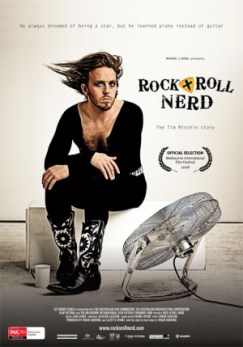 I don’t usually bother with plot summaries at the start of my reviews, working on the assumption most readers will know (or know of) the film and so don’t really need one. My assumption here is that most won’t have even heard of this film, though.
You may’ve heard of Tim Minchin, however, the Australian musician/stand-up who’s done a couple of tours, released a DVD or two, and popped up for guest spots on things like Never Mind the Buzzcocks and The Secret Policeman’s Ball. Back in 2005, no one knew who Minchin was — a struggling musician at the time, on the verge of quitting and finding himself a Real Job. He happened to live next door to aspiring filmmaker Rhian Skirving who, in more or less the same predicament, decided to film Minchin’s last ditch attempt at making it: trying his hand at comedy. They expected to film, at best, a small-scale suburban documentary about a wannabe failing to become a somebody, but what they wound up with was something rather different.
Almost as soon as filming began, Minchin was a hit at the Melbourne International Comedy Festival, where he was spotted by an Edinburgh producer and whisked off to the famous Fringe where (as the film’s own blurb describes it) he had “the most successful first season of any performer in the history of Edinburgh… walking away with the prestigious Perrier Newcomer Award, 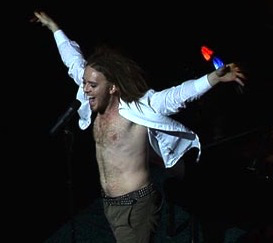 TV appearances, offers from Hollywood and the West End, the best management in the business and a gig at Albert Hall.” Not what either Minchin or Skirving had expected, that’s for certain!
What this tale creates is an unusual rockumentary. It’s obviously not a concert film, nor a tour film, nor a retrospective on someone’s career; instead, it’s the chronicle of someone’s relatively meteoric rise to fame, from two unique perspectives: the camera is there as it happens, not belatedly once Minchin’s become more widely known; and the writer/director/cameraperson is a close friend, not just any old filmmaker hoping to cash in. One almost has to wonder if Skirving has psychic powers, so perfectly timed was her idea.
Minchin is pretty honest with the camera in tow. When he’s a success, we see him struggle with things like management: does he owe it to the person who discovered him to make sure she’s cut in on the deal? Is it right to just abandon her and move on? Does she just see him as a potential cash cow rather than genuinely wanting to support him? And so on. His honesty extends to the awards — his show is so hyped he winds up half-expecting the near-impossible, to win the biggest award in his first year. He’s not even nominated, having to ‘settle’ for a win as Best Newcomer. His confounded expectations  aren’t boastful or immodest, the viewer privy to how his hopes were unrealistically raised in spite of himself.
Alongside this, Skirving and Minchin allow us to see the toll his professional breakthrough takes on Minchin’s personal life. His wife — newly pregnant — is left behind in Australia while he’s becoming the toast of Edinburgh. The timing of some events in his personal life also couldn’t be worse, and Skirving documents them without ever becoming ghoulish or intrusive. It is, in a way, brave of both Minchin and his wife to allow their inclusion, but good filmmaking on the part of Skirving to know where to draw the line.
Documentaries such as this often rely on the viewer having a pre-existing affection for either the performer or their work. Though it seems impossible to believe, I’m sure there must be some who dislike Minchin (his show did get one bad review, after all)  and it may be they wouldn’t engage with this film because of it. However, some stories are capable of transcending one’s feelings about the subject covered, and Rock n Roll Nerd may just be one of those: even if you don’t enjoy Minchin’s songs, or indeed comedy music in general, the tale of his success — and what it’s like for an ordinary person to live through such a thing — is a story whose unique interest extends beyond fans-only territory.

Rock n Roll Nerd: The Tim Minchin Story is currently only available on an Australian Region 0 DVD, available from the distributor, your favourite Australian DVD retailer (y’know, like EzyDVD), or importers on Amazon. The film’s official website can be found here — sadly no trailer, but there are comments from Minchin and Skirving.
Rock n Roll Nerd placed 6th on my list of The Ten Best Films I Saw For the First Time in 2009, which can be read in full here.

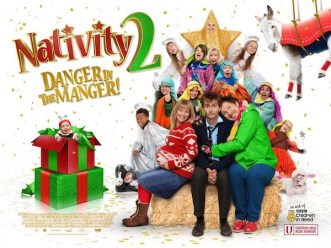 David Tennant replaces Martin Freeman as the teacher of a primary school class who enter themselves in a Christmas singing competition in this part-improvised sequel to the endearing 2009 hit.
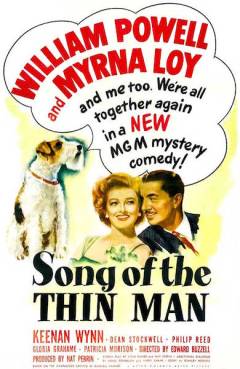 The final film in the Thin Man series sees married detective duo Nick and Nora Charles (the ever-excellent William Powell and Myrna Loy) getting embroiled in the world of jazz musicians, after a friend’s fiancé is accused of murdering a band leader.
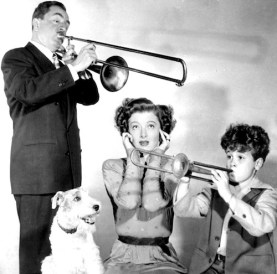 Apparently Loy made it clear before filming began that this was to be the last Thin Man film. Somewhat odd, then, that it’s one of the few to end with an allusion to Nick continuing his detective work in the future, whereas normally he’s being dragged out of retirement each time and happy to return to it by the end (which we don’t believe, of course). Either way, it was probably a wise decision on the part of Mrs Charles, as the law of diminishing returns had kicked in by this point.
 Tom Hanks is Walt Disney and Emma Thompson is author P.L. Travers in “The Making of Mary Poppins: The Movie”. Disney has been desperate to turn Travers’ fictional nanny into a movie for years after he made a promise to his daughter; Travers has resisted, but now needs the money. She’s brought to LA to consult on the script, and proceeds to make life miserable for screenwriter Don DaGradi (Bradley Whitford) and songsmiths Robert and Richard Sherman (B.J. Novak and Jason Schwartzman). At the same time, we see the story of a family in Australia from the eyes of a little girl Ginty (Annie Rose Buckley), as they struggle with the whims of her father (Colin Farrell), a bank manager who’s a little too fond of the bottle. Guess what the connection is!
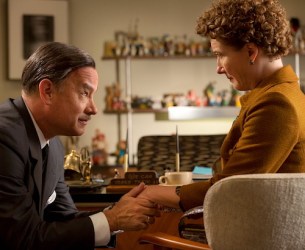 Similarly, Hanks’ part seems to be little more than a cameo at first, but he steadily appears often enough to make it a supporting role. Reportedly he has perfectly captured many of Disney’s real traits and idiosyncrasies, and who are we to doubt the word of people who knew the man? His performance is not just a shallow, simple impersonation, but there’s not that much meat to Disney’s character arc either.
 Some will find the story lacking in dirt, particularly when it comes to the portrayal of Disney. But it’s not whitewashed either, and do you really think the Disney Corporation would have allowed a movie to go ahead that depicts their founding father in a negative light? For that, I don’t think it’s as twee as it could have been — there’s definite conflict over what’s being done with Poppins, and, even with the film having turned out to be a solid-gold classic, we often find ourselves sympathising with Travers.
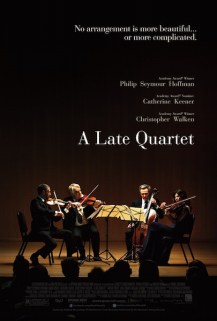 Set in the rarefied world of classical music performance, A Late Quartet charts the fallout among the members of a highly-acclaimed New York string quartet when their leader (Christopher Walken) announces his impending retirement.
 Where it does make a mistake is in divorcing Walken from the rest of the group for so much of the time. He ends up going to Parkinson’s groups and doing exercises as if this is some kind of “Issue of the Week” TV movie, while everyone else gets on with the plot. Some of the best bits belong to him though, like the story cribbed from a real musician’s autobiography.
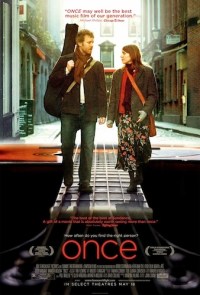 Once is a very modern indie musical. And I mean indie as in “indie film”, not “indie music”. Lord save us from a musical of indie music.
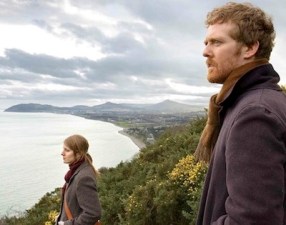 It’s a testament to the strength of the lead performances and the story they create that it’s not until the end credits roll you realise you never even knew their names.
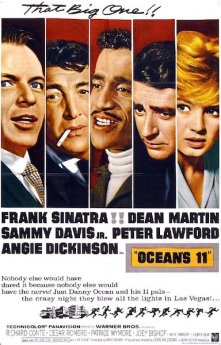 “Remakes are not as good as the original” is one of the rules of filmmaking. Of course there are plenty of exceptions, and everyone has their own opinion, and most modern remakes are expressly about making a quick buck from a US audience who can’t watch a film and read at the same time rather than making a better quality film — but, more or less, the rule persists. It may have won him an Oscar, but the consensus seems to be that
  It does have its moments: a couple of songs are shoehorned in (even if there’s only two or three and each gets two or three airings) and the cast do succeed in making some of their indulgences entertaining. Nonetheless, this would definitely be for Rat Pack fans only had it not been for the remake… and, really, there’s no reason the remake should change that.
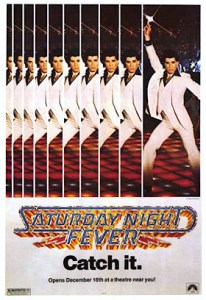 Saturday Night Fever couldn’t be more ’70s if it were made today as a period piece (if you can see how that isn’t a contradiction). From the posters on Tony’s walls, to the fashions, to how it’s shot, it seems to have been designed specifically to exude seventies-ness in a way few other things seem to. It feels natural, then, that some of its original elements have become shorthand definitions for the era: the Bee Gees music, the dancing, and in particular that pose.
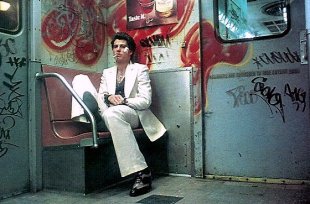 with dead-end jobs, late-night fights, turn-taking back-of-the-car sex, and other unsavoury pursuits. It’s no wonder Tony wants to escape.
 Rubbish. In almost every way possible.
 Cult comedy musical, with a more-than-healthy dose of the surreal, about two brothers on a mission from God, here watched in the extended DVD version (full details at
  100Films.co.uk