Saw V (2008)

2010 #34
David Hackl | 91 mins | TV | 18 / R
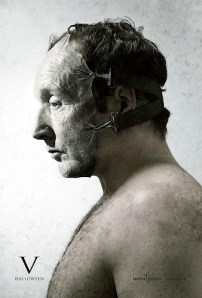
Saw VAnd so the never-ending Saw franchise trundles on to its fifth part. Indeed, Saw Part 5 might be a more apt moniker for this film: it picks up directly from the end of Saw IV — which, you may remember, took place concurrently with Saw III, ultimately appending about 30 seconds to that film’s climax. Even if you wanted to start your Saw viewing here, you wouldn’t have a hope of following what’s going on.

For a large part, Saw V’s plot is an exercise in retconning. For the uninitiated, “retcon” is short for “retroactive continuity”, essentially the act of adding something to a previous story in a series that changes its meaning or one’s perspective on it or what have you. I believe the term was coined in relation to comics, a medium that commonly has to explain why a dead character’s sudden resurrection really made sense all along, honest. Saw V’s retcon, then, is to demonstrate that Detective Hoffman was Jigsaw’s accomplice throughout all the previous Saw movies, not just the ones that actually featured him. This means yet more flashbacks, which as you may remember were the blight of Saws III and IV.

But what Saw V suffers in backstory it makes up for with simplicity. Whereas IV was convoluted to the point of dullness, Hoffman’s involvement is quite easily depicted. A working knowledge of the preceding films is essential, true, but with that in hand one can actually follow the story easily this time. Indeed, one might even argue it’s too easy: Hoffman’s involvement is so straightforward that the amount of time devoted to it pushes into the realms of the pointless, while the present-time ‘thriller’ thread (where Special Agent Strahm figures it all out) serves barely any function. The film includes the usual standalone game alongside this, but I’ll come back to that in a moment.

One of the franchise’s Big Things has always been the last-minute twist. Signalled by the Saw theme beginning to play and emphasised with an explosion of very brief flashbacks to earlier in the film, the twist shows us what we’ve missed all along and turns the story on its head. The first film had a great one, the second’s was pretty clever, the third had a mixture of good and bad, while the fourth’s got muddled by the rest of the film. Here, we get the music, and the flashbacks, but I swear there wasn’t a single twist among them. Most of the plot was as obvious as it appeared, while what I suppose was meant as a twist in the final room just seemed obvious — I’m sure the viewer is too familiar with Jigsaw’s methods by now to fall for something as simple as that (unlike Strahm, it would seem).

And even after all that retconning and whatnot, it’s clear that the series’ ongoing story is far from over. It’s not just the existence of (at least) two more films that tells us this, nor even a proper cliffhanger (this time, there isn’t one), but a handful of blatantly unresolved plot points. It’s an annoying habit of perennial Saw screenwriters Patrick Melton and Marcus Dunstan to drop in an element that they have no intention of using in this film, but exists purely to pay off something in the next. This time it’s a box delivered to Jigsaw’s ex-wife. Goodness knows what’s in it; hopefully Saw VI reveals all.

Alongside the incessant arc there’s the usual standalone ‘game’, presumably retained to both guarantee the gore content and hold the interest of anyone dragged along to see the film who hadn’t bothered with preceding instalments. This one isn’t bad but, relegated to a subplot alongside the Hoffman palaver, it’s little more than a sketchily-drawn short film. Some of the traps are inventive, dodging the torture porn levels of gore displayed in III and the gratuitous medical gore of both III and IV without skimping on the blood and guts (literally. Twice.) In fact, it’s this side of the film that holds a bigger and better twist than the highlighted arc plot one, though some viewers may miss its significance as it goes so unheralded. (Arguably this ease with which it might be missed says something about how significant it is; equally, perhaps I’m assuming a lack of intelligence on the part of Saw’s regular audience by implying they would miss it.)
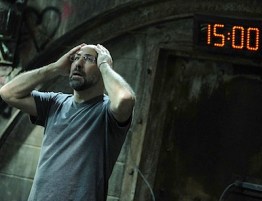
And so Saw lives to fight another day. In some respects this entry is an up-tick in form after the convoluted fourth entry; conversely, it’s perhaps over-simplified, definitely over-reliant on its prequels, and lacks any meat on its plot’s bones — Hoffman assisted Jigsaw, this is how, and that’s all the film has to say. And you know, I can be a bit of wuss when it comes to horror films, but this one isn’t scary in the slightest; gory, unquestionably, but even the jump-scares didn’t make me jump.

Sometimes I feel the Saw series deserves congratulating for trying to be as much a thriller as a gore-fest, for having an on-going plot across all the films rather than just providing standalone identikit Jigsaw-games each entry. Other times, I think I’d quite like the latter, as both the third and fifth films have left me wishing for more of the original story and less of the arc plot. And still other times, it seems a waste of time to be thinking so much about Saw.

2 out of 5

Once again I watched the Unrated/Extreme extended cut of Saw V, and once again the differences are numerous but minimal. A thorough list of additions and alterations can be found here, though there’s a briefer overview here.
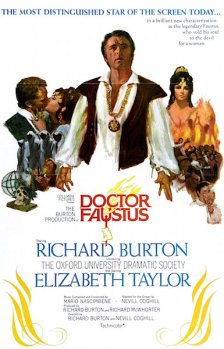
Doctor Faustus (1967)

2010 #23
Richard Burton & Nevill Coghill | 92 mins | DVD | PG

Despite the numerous film versions of the Faust story, this is the only one that adapts Christopher Marlowe’s A-level-favourite 1588 play. It’s a shame, then, that it’s heavily edited from the original text and, despite also being a filmed version of the Oxford University Dramatic Society’s 1966 stage production, has clearly been inappropriately chosen as a vehicle for then-couple Richard Burton and Elizabeth Taylor.
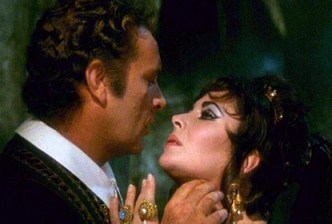
Burton plays a suitably reverent version of Faustus, though is never less than able to convey his varied moods, from confidence, often underscored with insecurity, to repentant regret, to childish tomfoolery. Stuck with numerous long speeches, however, there are occasions when his delivery — and consequently the film — slip briefly into insomnia-curing monotony.

Meanwhile, the play’s lack of a significant female role makes Elizabeth Taylor’s presence rather unusual. Marlowe’s text has been tweaked to allow Taylor to crop up frequently as ‘Helen of Troy’. As well as appearing in original scenes that feature Helen, co-writers/directors Burton and Nevill Coghill have inserted her into any scene that would allow it. Such casting across several inconsequential roles, some not even in the original text, effectively creates a new character. Perhaps this adds an extra dimension to Faustus and his goals — attempting to imply a romantic angle — but it comes across as a desperate and unwarranted attempt to make this a Burton/Taylor film.

Elsewhere, Burton and Coghill’s vision of Faustus is stylistically reminiscent of a Gothic Hammer Horror, which is either wholly inappropriate or an ingenious genre mash-up — after all, such a genre-mashing trick has been pulled many a time with Shakespeare over the years. There are repulsively horrific corpses, a harem of naked ladies, an array of special effects, plus a medieval-styled gothic atmosphere to all the sets and costumes, though the scene where Faustus mucks about with the Pope feels more Carry On. Using inanimate objects in the roles of the Good and Evil Angels — respectively, a statue of Christ and a skull — is a small but inspired touch.

These aside, there’s a surprising emphasis on special effects: a skeleton that turns into a rotting corpse (click the link at your own discretion); skulls that pour imagined gold and pearls from their mouths; cuckold horns that retreat into nothing; and so on. One might think this is purely to buoy up the Elizabethan language for a wider audience, and one isn’t necessarily wrong, but considering Elizabethan theatre-goers enjoyed their gory effects as much as modern audiences clearly do, their inclusion isn’t incongruous. There’s certainly some visually impressive stuff on show, much of it suitably horrific — one often wonders about the PG certificate.

An even greater deviation than the effects is how much has been cut out — in a word, loads. Most of the comic scenes are gone (some of their humour wouldn’t translate today, making those a wise excision, but others are missed), and much of what Faustus does during his 24 extra years on Earth is missing too. Some of the cut scenes are among the most easily-enjoyed parts of the play, though would certainly lighten the tone. Perhaps they just didn’t have any money left for the further special effects required. The trims extend as far as the final scene, which also loses some of the play’s best bits. It’s unlikely anyone unfamiliar with the play would notice the omissions (having not read it for a good few years there weren’t many I missed), but returning to the text after seeing the film I realised how disappointing some of the cuts were.

Perhaps they were designed to focus the film more closely on the Faustus/Mephistopheles relationship, perhaps just to heighten the presence of Helen by losing scenes she couldn’t have been shoehorned into; but in the process it both loses some of the best material and destroys any hope the film had of being a definitive filmed version of the play. Ultimately, such oversights proved to be the final straw for the film’s already-tenuous grip on a three-star rating.
2 out of 5

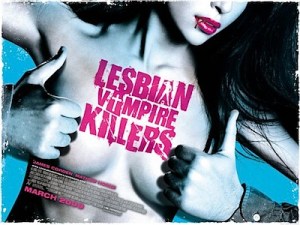
Lesbian Vampire Killers (2009)

2010 #33
Phil Claydon | 86 mins | download | 15 / R

Pre-release hype pegged Lesbian Vampire Killers as the next Shaun of the Dead, a knowing horror spoof/homage destined for cult greatness. Reality showed us something different; a film so lambasted by critics and such a flop at the box office that they actually resorted to giving it away (as a digital download from iTunes just after Christmas). Like most of the country, I consequently ignored LVK on release, but free is free and so here I am.
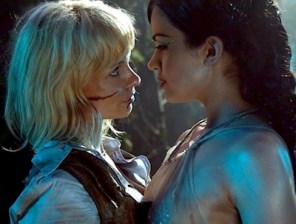
In retrospect, I wonder if part of the film’s publicly-thorough critical drubbing was down to expectation: from the title and blatant Hammer Horror references, critics and viewers presumed they were set for a Shaun of the Dead-style ready-made-cult-classic horror homage. Instead, it takes widely recognised Hammer tropes and aims the rest of its content at a Nuts-reading audience. I’m not saying the film would’ve been better reviewed if critics had been expecting something more akin to what they were ultimately given, just that it wouldn’t’ve come in for such a public flogging.

Unfortunately, even with corrected expectations, the film fails to deliver on its twin promises of raunch and horror. Aside from a couple of brief surgically-enhanced medieval boobs, a flash of knickers and the odd girl-on-girl kiss, the film’s sexy content is non-existent. Said Nuts audience would certainly get more from their weekly wank mag; this is mostly 12A-level. The horror, meanwhile, is reduced to well-signposted jump scares — and even then few enough to count on one hand — and the odd bit of comical decapitation/melting with holy water/axes in the head. To be fair, this is meant to be more comedy than horror, and in this sense a few such moments succeed passably.
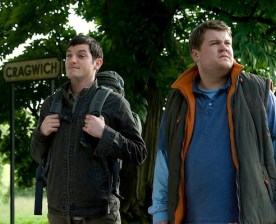
The humour itself is variable. A couple of half-decent jokes are scattered throughout, though a raft of predictable, familiar and vulgar ones threaten to overwhelm them. The opening goes on too long, emphasised rather than alleviated by Phil Claydon’s hyper over-direction. The film only approaches lift off once Gavin and Smithy… er, Jimmy and… no, still can’t remember… Anyway, it’s not until Horne and Corden finally arrive in the village of Cragwich that the plot begins to get moving, everything before it serving only to boost the running time to feature length (just), initiate subplots that are either disregarded immediately (Corden’s child-punching clown job) or disregarded as an inconvenience later (Horne’s on-again-off-again girlfriend), and provide an array of over-familiar suburban-sitcom situations.

Indeed, consistency is not the film’s strong point. Everyone makes a big fuss about the vampires and how hard they are to kill, yet every one is dispatched with ease, the level of threat never allowed to even attempt an increase before there’s white goo splurting everywhere (that’s what happens when they die, incidentally, not someone’s reaction to the lesbianism). The climax is a mere extension of this, substituting a rising scale of action for running around avoiding the easy killing bit. Any good will amassed in the middle — and there may be a tiny bit — is dismissed in boredom.
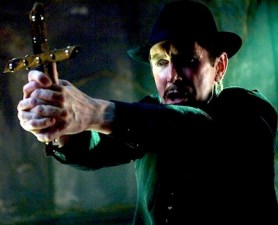
But Lesbian Vampire Killers isn’t all bad. If you can wade through jokes about a sword with a cock-like handle (not funny the first time, never mind the eighth), or a demon with a name that sounds a little like dildo (it’s a measure of the film’s intelligence that no one ever points out it sounds like dildo, they just leave that for the audience to spot), or any of the countless other inane attempts at being funny, you may come across the odd moment that makes you chuckle. Maybe. I probably enjoyed it (some of it, at least) more than I should admit.

And yet, for film fans Lesbian Vampire Killers is a wasted opportunity: even with its existing plot, more skilled hands could have shaped it into a horror tribute/spoof destined for enduring cult popularity. Instead, the MTV-born screenwriting partnership of Stewart Williams and Paul Hupfield shot for the lowest-common-denominator lad’s-mag-buying audience, though quite what they made of the classic horror reference points that do remain is anyone’s guess. If we’re talking about expectations (and, clearly, I am), Lesbian Vampire Killers did somewhat defy mine — though as I was expecting it to be one of the worst comedies I’d ever seen, that might not be saying much.

Nonetheless, it’s as good a rule as any that if you pay money to read Nuts, you’ll probably enjoy this; if you just browse Nuts’ website (for whatever reason — I hear they have jokes and football and stuff too), you might like it; otherwise, you’d probably be better off watching Shaun of the Dead again.

2 out of 5

Lesbian Vampire Killers is on Sky Movies Premiere tonight at midnight, and every night until Thursday 25th March at either midnight (Friday to Monday) or 10pm (Tuesday to Thursday).

Frankenstein (2004)

aka Dean Koontz’s Frankenstein

2010 #22
Marcus Nispel | 84 mins | DVD | 18

FrankensteinFirst, a little note on that aka: technically — and, I believe, legally — no such title is attached to this project. However, the initial idea was developed by Koontz and, after he left the project, adapted into his Dean Koontz’s Frankenstein series of novels. Despite the ‘creative disagreement’ (or whatever they chose to call it) that led him to walk away, the film retains significant similarities to the first book. More on these in a moment.
So, this version of Frankenstein is a made-for-TV movie/series pilot (that’s taken six years to find its way to British TV, apparently — in case you didn’t know, the series wasn’t picked up). According to the blurb on my DVD, it’s a “contemporary retelling of Mary Shelley’s gothic horror classic”. I guess no one in the publicity department actually watched it. In actuality it’s more a sequel to Shelley’s novel: Dr Frankenstein has somehow survived to the modern day and emigrated to New Orleans, where he continues his experiments, while his original monster, now going by the name Deucalion, has tracked him down in the name of justice. Or something. Maybe they should’ve just started from scratch… then again, look how that worked out.

Thanks to Koontz leaving the project midway through its conception, it’s difficult to accurately explain the relationship between the novel and the film. This isn’t an adaptation, certainly, but nor is the novel a mere novelization. Most of the official comment on the novel/film relationship is along the lines of this, taken from the current iteration of the book series’ Wikipedia entry: “Koontz withdrew from the project over creative differences with the network, and the production continued in a different direction with similar characters and a modified plot.” Perhaps this is what Koontz would like viewers/readers to believe: that the novels are his undiluted vision, while the film most certainly is not. Well, don’t believe him.

Watching the film having read the book (a couple of years ago), this feels like a faithful adaptation. It comes with the usual caveats of condensing a c.400-page novel into a sub-90-minute film — certain elements are foreshortened, others tweaked, others abandoned — but in terms of the primary plot, the characters and their actions, it’s all incredibly close to the series’ first novel. I hesitate to say “exactly the same” when I’ve not read it for years, but it wouldn’t surprise me if whole scenes and dialogue exchanges match perfectly.

What this also means is that the film suffers from some of the novel’s flaws, when taken as a standalone work. Dr Frankenstein — now Dr Helios, for what it’s worth — is introduced but remains a background figure, only peripherally connected to this episode’s serial killer plot. In this its intentions as a pilot couldn’t be clearer, and with an ending that’s part cliffhanger, part “the story continues”, it’s as clear as in the novel that this is far from over. Other than there not being a TV series or any sequels, that is. (Though if you want to know what happens, there are already two further novels — and three more planned — that continue the story.)

The film itself isn’t badly produced. Marcus Nispel’s direction seems heavily influenced by Se7en, all dark and grainy and very, very brown. Even the title sequence, with its juddery extreme close-ups and pulsating grungy soundtrack, feels borrowed from Fincher’s masterpiece. The cast are fine: Michael Madsen and Adam Goldberg play the same parts they always play, Parkey Posey leads well enough, and as Deucalion, Vincent Perez is… adequate. Thomas Kretschmann’s Helios is the closest the film comes to an outstanding performance; knowing the events of books two and three, one almost longs for sequels to see Kretschmann’s cooly dominant Helios disintegrate as Everything Goes Wrong.

All things considered, Frankenstein is probably best viewed as a compromised curiosity. It’s certainly not a wholly satisfying experience in itself, but those interested in Koontz’s series may find it a nice way to test the waters without having to plough through a whole novel, while those who have read the novel may find it interesting to see one part of the story committed to film. Or, of course, they may find it irritating that it’s not how they imagined. I fall into that middle category; those with no interest in the books or who hold them too dearly may wish to knock a star off this score.

3 out of 5

Five have the UK TV premiere of Frankenstein tonight at 11:25pm.

Hard Candy (2005)

2009 #72
David Slade | 100 mins | TV | 18 / R

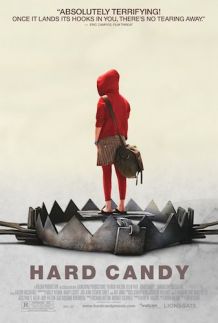
Hard CandyHard Candy’s director David Slade has followed this up with vampire horror with 30 Days of Night and will shortly unleash an altogether different kind of horror by joining the ranks of evil that are bringing us The Twilight ‘Saga’. His feature debut may be a two-hander between a teenage girl and middle-aged man, but in its own way it’s just as much a horror movie.

Actually, that’s mainly a review-opening conceit: one tense torture-ish sequence aside, Hard Candy is a consistently surprising thriller about real-world horrific things rather than depicting them itself. To reveal too much of the plot would spoil it, though I imagine most viewers will already be aware of the first big turn: the real intentions of Ellen Page’s 14-year-old protagonist. It follows this wannabe-surprise (“wannabe” because it occurs too early to escape description in most plot overviews) with a series of equally playful reversals. The viewer’s never quite sure of any fact about either of the two characters; never quite sure if they’re being genuine or at any moment will undermine their present emotion with the revelation it’s just an act, an attempt to fool the other. Arguably it’s played this card too often come the end, and perhaps it could have stood being a more efficient 80 minutes rather than pushing on to 100.

The other assertion in my introduction is also disingenuous, because there are more than two characters. It’s basically a two-hander though, reliant for great stretches on two people in a room conversing and attempting to outwit each other. It’s more exciting than that might sound — the action is far from limited to chatter. Such a production rests entirely on the skills of its two leads, and fortunately both provide excellent performances. Watchmen’s Patrick Wilson is perfectly cast to alternate charming and sleazy, though Ellen Page — pre Oscar nomination for Juno — is the stand-out. Actually 18 at the time, she’s more than convincing as an older-than-her-years 14-year-old, selling the character’s confidence but also revealing an occasional vulnerability and uncertainness that just about keep proceedings the right side of believable. Still, plausibility isn’t exactly the film’s strongest point. There’s enough that one follows it, with the more implausible sections wisely saved for later on, by which time we’re drawn in and accept that Page’s character is clever, cunning and above all prepared.

Other characters do intrude however, and it’s almost a shame when they turn up: it breaks the perfect technical accomplishment of a locationally-limited two-hander for little more than another few minutes of screen time. That said, it’s the arrival of the constantly-referenced former love that finally provokes the ending, a worthwhile climax to a film so caught up in its to-and-fros that anything less than the influence an external factor providing a conclusion would’ve been a disappointment. The neighbour character, on the other hand, feels a little too inevitable; an obvious attempt to ratchet up the tension that arrives too late. It seems Slade thinks it’s as compulsory as the audience might, and dispatches with it quickly… just not quickly enough.

Story aside, Slade’s direction makes for an interestingly shot film. There are many close-ups, in which characters and action are often calm, but then there are occasional explosions of flashy camerawork, usually during acts of violence or other sudden bursts of plot-driving action. The grading is similarly fiddled with during these sections, emphasising the primary-coloured walls of the house that make for an interesting backdrop. Indeed, the walls are used to particularly good — if, arguably, obvious — effect throughout, such as slowly panning across a red wall so that it fills the screen during the lengthy castration sequence.

Hard Candy is sort of a morality play, though it’s hardly a moral that requires increased awareness. Primarily it’s a revenge thriller though, and with limited settings and characters it makes for an admirably intense — if occasionally credibility-stretching — and pleasantly unusual entry in the genre.

4 out of 5

(Originally posted on 7th February 2010.)

Shadow of the Vampire (2000)

2009 #56
E. Elias Merhige | 81 mins | TV | 15 / R

Shadow of the Vampire“What if Max Schreck really was a vampire?” is the simple, thoroughly daft, and equally promising, premise of this low-budget horror/drama/comedy.

Having the advantage of such a good concept to kick things off, all starts well, but the longer it runs the more it loses it. Screenwriter Steven A. Katz seems unsure of what Shreck/Orlok actually wants or what the rules governing his existence are, leaving him little more than a threat for the sake of a threat. Still, Willem Dafoe’s performance in the role is brilliant, reveling in the chance to overact — and yet, somehow, subtly overact — as a silent movie vampire. The rest of the cast are fine; in particular, the obsessive and mildly unhinged Murnau seems to suit Malkovich down to the ground. It’s also scary in places, as it should be, because it’s a vampire horror movie that just happens to take the making of another real one as its starting point. Unfortunately, as the plot becomes confusing and ill explained towards the end, so the scares dissipate alongside the viewer’s understanding.

My confusion over the film’s third act may have an external explanation, however. The BBFC list the PAL running time as 88 minutes, but BBC Four’s showing only just hit 81. It certainly felt like there was a chunk missing somewhere in the middle — a slew of characters just disappear and there’s an unexplained leap in the plot — but I can’t think of a reasonable explanation for why or how the BBC would cut seven minutes out of the middle of a film, and the only detailed plot descriptions I can find don’t describe anything I missed.

Nonetheless, even allowing for omissions Katz gives up on any semblance of following the facts toward the end (and throughout, apparently): almost everyone involved is slaughtered, even when they clearly survived in reality, while one character is driven out of his mind, even when he clearly wasn’t… well, presumably. That said, we all know Schreck wasn’t a vampire — his life isn’t nearly mysterious enough to allow for the possibility, should you even believe in such a possibility being possible — so with that leap already taken, why not take as many others as you fancy? Perhaps because it’s not as clever, and not nearly as much fun, as fitting the preposterous tale around the known facts.

Merhige’s direction is occasionally very interesting, such as a couple of grand shots early on, but at other times is perfunctory. To be kind, one might say he goes too far in the aim of replicating silent film style — certainly the intertitles that needlessly replace chunks of the plot are a step beyond. He does manage to create and maintain a weird, unsettling atmosphere, which remains even when all sense disappears.

It’s difficult to accurately assess a film when it appears a good chunk has been lost somewhere in the middle, especially when one suspects some of its major flaws — namely, a lack of coherence at the end — may be due to this omission. On the other hand, I can’t find any evidence that something has been cut, so maybe it just doesn’t make sense? Either way, even on the evidence of what I’ve seen it feels like Shadow of the Vampire takes a good idea, runs well for a while, but winds up uncertain of what to do with it. Though it remains interesting, I won’t be rushing to see any fuller form.

3 out of 5

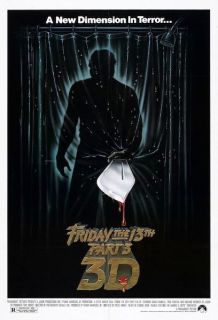
Friday the 13th Part III [3D] (1982)

2009 #77
Steve Miner | 91 mins | TV | 15 / R

Friday the 13th Part IIIJason’s back!

Oh, forget it — I can’t get excited about that. I’ve never even seen a Friday the 13th film, and had no intention to ’til Channel 4 showed this in 3D. Fortunately, general cultural awareness of who Jason is and what he does is all that’s required to understand this third entry in the never-ending franchise.

It’s pretty much your stereotypical horror movie: a group of teenagers just waiting to be slaughtered, a remote cabin-like location, lots of jump scares over nothing, a supernaturally-powered killer stalking them for no apparent reason, lots of gory deaths which have more thought put into them than the plot, characters and dialogue put together… The acting’s all at the level of a high school play, which probably does a disservice to most high school plays. There’s no point wondering who’ll die, because inevitably they almost all will. All this considered, it’s a passably entertaining genre entry.

The good bit here, however, is the 3D. They have a whale of a time shoving stuff out into the audience for almost no reason — just like the stereotype of 3D films, of course. That’s part of the fun of trashy 3D movies so I’m not criticising it, but what sadly doesn’t work is the ColorCode 3D system chosen by C4. It provides lovely depth to normal scenes, but as soon as something’s attempting to come out at you it fails. It could be the age of the film producing flaws in the process as newer things shown during 3D Week have been better, but most do come a cropper as soon as something attempts to come out of the TV as opposed to go deeper into it. Oh well.

Friday the 13th Part III is what it is, and if that’s what you’re after that’s fine. At least the 3D silliness adds an extra dimension of enjoyment. Pun very much intended.

2 out of 5

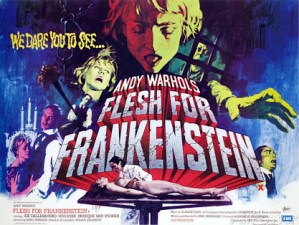
Flesh for Frankenstein [3D] (1973)

aka Andy Warhol’s Frankenstein

2009 #75
Paul Morrissey | 95 mins | TV | 18 / R

Flesh for FrankensteinFlesh for Frankenstein is thoroughly daft. But it’s also in 3D, so let’s start there.

The best thing about the extra dimension is that it provides some genuinely impressive visuals throughout, and not in the gimmicky, thrust-stuff-into-the-audience way — naturally there are some of those shots, but they seem to work quite poorly here. That could be the fault of Channel 4’s chosen 3D system, or perhaps of watching on a TV rather than a huge screen. Either way, there are also shots that demonstrate why 3D could be genuinely valuable, to visuals if not necessarily to storytelling. For example, early on the wife/sister (a discussion for another time) and her kids go for a picnic. It’s shot from a distance through branches in the foreground, which highlights that there’s a realistic sense of depth to every element of the frame that just isn’t present if you see the same shot in 2D — I know, I checked. For perhaps the first time, I got a sense of why some people harp on about 2D flattening composition.

Unfortunately, while the 3D system used is sometimes flawlessly brilliant, at others it seems to have gone wrong. There’s an odd green ringing in some shots, while at others it appears they’ve used the wrong shade of blue for monochrome-depth because it shows up (in scenes that work, the blue is clearly visible if you take the glasses off, but invisible with them on). Such problems are intermittent in the stuff shown during 3D Week, leading one to suspect it’s as much a fault of the age of the film elements.

I can also now see why people have been complaining so much about 3D — it feels like a constant struggle and strain to watch, like you’re always having to make it work. Perhaps that’s partly down to the technical flaws described above though, because I didn’t suffer as much during an hour of Derren Brown’s Magic Spectacular, whereas here I could feel the strain after just 15 minutes.

As for the film itself… The plot doesn’t make any sense for about 20 minutes, then Udo Kier’s Frankenstein (I presume he’s Frankenstein, I don’t think he’s ever addressed as more than Baron) has a bit of a monologue to explain his Hitler-ish Cunning Plan — to someone who already knows it, naturally — and suddenly most of what’ll happen for the rest of the film is abundantly clear.

The acting is uniformly atrocious. Despite that, it also provides the film’s best moments: the European cast are unable to pronounce “laboratory” — every time it’s uttered it comes out as “lavatory”. Childish I know, but it’s one of the film’s few enjoyable moments. “I had to work for two years before I could even stick my nose in the lavatory” is an instantly classic line. (As is “To know death, you have to fuck life in the gall bladder” — literally, apparently.) Continuing the accented madness, the good-guy serf sounds to be from Brooklyn. At least he can say “laboratory”.

Gratuitous nudity and gore belie some critics’ apparent view that it’s only with the emergence of torture porn that operation-level gore has become a selling point of horror movies — it’s only become more realistic. Just as the gore’s silly, so the sex seems misguided — whoever cast the whores seems to have found believable rather than attractive ones. Oops. That said, whoever in the sound department thought the most realistic sound effects for various sex acts could be found by having someone suck on a balloon, loudly, was even more misguided.

Apparently it’s all meant to be satirical or Pythonesquely humourous. Well, maybe, but it sails too close to the winds of genuine crapness to let such a defence fly — though, as noted, that certainly makes it laughable. Weak in just about every way imaginable, if you’re after a horror, gore, porn or 3D fix, look elsewhere. For “so bad it’s good” value, however, I’ve kindly given it an extra star.

2 out of 5

Alone in the Dark (2005)

2009 #69
Uwe Boll | 94 mins | TV | 18 / R

Alone in the DarkI’ve never played an Alone in the Dark game. I wanted to, when I was young and they were a widely-known cutting-edge franchise, but it was deemed too scary or adult or something like that and I wasn’t allowed. (By the time someone’s nostalgia revived the series nearly a decade later, I didn’t care.) I’ve also never seen an Uwe Boll film, though his reputation obviously precedes him. Considering the latter, having no attachment to the former is probably a benefit to assessing this — I understand that, story-wise, it bears virtually no relation — but I can’t say it helps much.

Right from the off, things don’t look good: it opens with an essay’s worth of backstory in scrolling text… which, just to rub it in, is also read out. It takes about a minute and a half. There are any number of screenwriting rules this not so much breaks as slowly and methodically grinds into sand. Some rules can be bent or broken to good effect if the writer knows what they’re doing, but others exist for damn fine reasons and breaking them just results in a lesser film. This is unquestionably the latter. There’s an almost-excuse: the text was added after test audiences said they didn’t understand the plot. But it’s not much of one. The relevant information is all revealed later in the film too, and neither manage to explain what the hell is going on. It’s not the audience’s fault they couldn’t understand the plot, it just doesn’t make sense.

Quickly, the poor quality opening is cemented with the addition of a dire voiceover narration from Christian Slater’s lead character. He addresses the audience in a chatty style that’s both irritating and incongruous, and primarily exists to continuously dump more useless info. That it disappears without a trace fairly early on is a relief, but proves how pointless and cheap it was in the first place.

And then there’s an action sequence, which defies logic in every respect. The editing mucks up continuity, the good guys turn into a dead-end marketplace for no reason — other than it provides a handily enclosed location for the ensuing fist fight — the bad guy rams cars, scales buildings and jumps through windows, also for no reason, and the fight seems to consist of a punch followed by some slow motion standing around (yes, it’s the standing around that’s in slow motion) repeated too often, interspersed with the occasional ‘cool’ move or shot. On the bright side, there’s one sub-Matrix, Wanted-esque shot of a bullet-time close-up as Carnby fires at the bad guy through a block of ice, which in itself is passably entertaining. You’ll note, of course, that that’s one good shot. One. Shot.

I could go through every scene in the film describing what’s wrong in this way, but no one wants to suffer that. Suffice to say it only gets worse — none of the initial flaws improve, but are compounded by more weak performances (Tara Reid as some kind of scientist?) and the story entirely vacating proceedings. Before halfway I gave up following the plot — after all, why try to follow something that makes no sense in the first place — and just hoped it could pull out some interesting or exciting sequences. But the horror sequences have no tension and the fights no coherence. One action sequence, which begins entirely out of the blue, sees soldiers shooting at beast-thingies in the dark, lit only by muzzle flashes, set to a thumping metal soundtrack. It probably seemed innovative when conceived, but instead is laughable for all the wrong reasons. Like the rest of the film.

Sadly, none of it’s laughable in a charming way — this is not So Bad It’s Good territory. Take the moment where the good guys arrive at an abandoned gold mine that’s actually the villain’s Super Secret Lair. They bring a whole army’s worth of heavily armed marines. Commander blokey insists it’s nothing like enough men… and then proceeds to enter the mine with just half a dozen of them. If there was no budget for more it might be funny, but the rest stay up top to be slaughtered by some Primeval-quality CGI. Even the ending, supposed to be ambiguous apparently, is just a meaningless cop-out that makes absolutely no sense. Like the rest of the film.

Sometimes I feel sorry for Christian Slater. He always seems a nice guy in interviews, yet this kind of drivel is all the work he can get. At the time of writing it’s the 82nd worst film of all time on IMDb (according to its own page, though not that chart). While this is the kind of status that’s often an overreaction (the number of people on IMDb declaring various films are “the worst film ever” suggests most of them have been fortunate enough to never see a truly bad movie), for once it’s justified: Alone in the Dark is irredeemably atrocious.

1 out of 5

If you want to subject yourself to Alone in the Dark, ITV4 are showing it tonight at 11pm.

Alone in the Dark featured on my list of The Five Worst Films I Saw in 2009, which can be read in full here.

Saw IV (2007)

2009 #62
Darren Lynn Bousman | 92 mins | DVD | 18 / R

This review contains minor spoilers.

Saw IVSaw IV is the final film in the series directed by Bousman, and will also be my jumping off point (for the time being). According to IMDb (which I presume is sourced from a commentary or something), Bousman had been intending to depart after Saw III, but was persuaded to stay when a twist in the fourth film’s script managed to surprise him, something he thought the franchise was by then incapable of. But do not let this get your hopes up, dear reader, because Saw IV lacks any twists that even come close to those in the preceding films. What caused Bousman to continue is a mystery, and some viewers will inevitably feel the same way about continuing with the series themselves.

After the overly gory third film, Saw IV returns to the franchise’s roots by playing more like a thriller than a horror film — even more so than the previous instalments, one might argue, as aside from a couple of jumps and a few instances of gore, the story and its key sequences move forward via police investigation, endless flashbacks and copious twists. The Saw franchise should be applauded for trying to be more than just another slasher series, but needs to learn the value of restraint in other areas.

The plot, for example, is incredibly complicated. This could be a good thing — it’s rare for the fourth film in a franchise, especially a horror one, to demand so much from its audience — and the viewer not only has to pay attention to the events on screen, but have a pretty good awareness of those from the last two films as well. Despite its complications, such connectedness is actually a reason to retain hope for the franchise, because it really tries to be about more than just how graphically it can slaughter people.

Unfortunately, any effort on the part of the viewer isn’t rewarded. Saw IV is too complex, ultimately descending into the realms of incomprehensibility. There are around four different plot threads, at least two of them jumping around in time like a TARDIS with ADD. Goodness knows how many different time zones are included, how many of them progress in a linear fashion, and whether or not they actually have any bearing on each other. Even references to previous films are confused: while this clearly begins some time after the end of Saw III, it then jumps back before Saw III, and then during Saw III, and then with Saw III, and then after Saw III again… but not as far after it as that opening scene. And that’s just the main plot.

A lot of the complexity is in aid of answering hanging questions from Saw II and, especially, III, but the mass of backstory leaves you wishing for a standalone ‘Test of the Film’ plot, which the first three essentially are. As already expressed, such an intricate array of stories is not necessarily a problem, but neither new writers Patrick Melton and Marcus Dunstan nor director Bousman have the required skill to guide the audience through such dense material. Nor the experience to know when less can be more, clearly.

Fortunately, Bousman seems to have learnt that “less is more” with the deaths. After the excess of Saw III, the gore feels pared back here. The one notable exception is an entirely extraneous autopsy that opens the film, which goes beyond the last entry’s brain surgery in the gruesome stakes. Apparently it’s to prove Jigsaw is unquestionably dead, but it does it with more glee and explicit medical detail than necessary.

Elsewhere, however, the savagery shortage is welcome — except that, in the process, Bousman seems to have misplaced the tension present in the first two films. The only real suspense is an opening trap that is, again, almost entirely extraneous to the rest of the plot, although one trap later on — featuring an abusive husband pinned to his wife — is moderately ingenious, achieving Jigsaw’s proclaimed ideas of apt justice in ways many previous traps failed to.

And what of Jigsaw this time? He may be dead, but instead we’re treated to flashbacks of John Kramer’s pre-Jigsaw life. As you may remember from my complaints in Saw III, revealing more about our villain is, in this case, not a good idea. Seeing Kramer before he was an Evil Bad Guy is clearly an attempt to make him a real person, one inspired to engage in a killing spree by every-day, real-life events. As with the other thriller elements, grounding the villain in the real world — and trying to give him plausible, relatable motivation — sets the Saw series apart from the vast majority of other horror franchises. But there’s no need to understand Jigsaw, and the more we learn about him the less impact he has. His soul is laid bare here, but by trying to make his actions plausible it continues to strip away the mystery and highlights how ludicrous his traps are in reality — they work fine in the conceit of a horror movie, but trying to imply it’s a real person doing these in the real world is one suspension of disbelief too far.

Which kind of sums up the film, really. Saw III went too far with its gore, and now Saw IV goes too far with its plot. As the series rattles on to its fifth instalment (and this year’s sixth, and next year’s seventh, and at least an eighth beyond that), its only hope for regaining a decent level of quality — in my opinion, of course — is to keep the gore at a manageable level, and keep the storytelling at one too.

2 out of 5

Technically I watched the Unrated/Extreme extended cut of Saw IV. The differences are numerous but ultimately minimal. Those desiring a full list of alterations can find one here.