
Jonathan English | 121 mins | Blu-ray | 16:9 | UK, USA & Germany / English | 15 / R
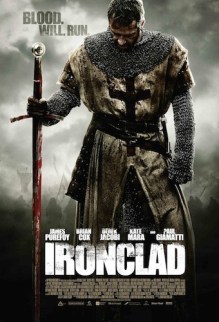 In medieval times, a group of filmmakers set out to prove you can make a Hollywood-quality historical action epic with independent funding in Britain, while in the present day a ragtag group of seven samurai— sorry, gunslingers— sorry, warriors, defend a small town— sorry, castle, from evil bandits— sorry, an evil king.
I think I got some details confused there.
Set shortly after the signing of the Magna Carta, Ironclad tells the true story of King John not being very happy and, with the backing of the Pope, setting about reclaiming England. Violently. Naturally the men who forced him into scribbling on the famous document aren’t best pleased, so while some set off to persuade the French to invade, others hole up in Rochester castle, vital to John’s efforts as it controls trade routes to the rest of the country or something.
Firstly, I say “true story” — I have no idea how much fact has gone into this. Some, at least. Was John really supported by a Viking-ish army? Dunno. Were the Knights Templar really dead set against him? Dunno. Was Rochester really defended by a dozen men? Dunno. But this isn’t a history lecture, it’s a piece of entertainment — aiming for the same ballpark as Gladiator, Braveheart, Kingdom of Heaven, and so on, albeit less grand; and there’s a sort of connection to Ridley Scott’s Robin Hood too, which I seem to remember included the signing of the Magna Carta.
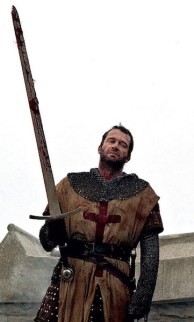 Anyway, it seems to me its use of facts are probably strong enough to support it as an entertainment. So some of the story structure may be reminiscent of Seven Samurai/The Magnificent Seven, but it’s not the first to use that and it won’t be the last (and I’ve never seen either anyway. Bad me). And so the special effects-driven climax may occur on the wrong tower of the castle’s keep — I think we can live with that level of deception.
As to the point of “why not just go round the castle?”, I presume the answer is more or less, “well… he didn’t…” Somewhat thankfully, the commander of the Danish forces puts this very question to the King, whose answer is some muttered speech about how his family built it and… I dunno. I’m not clear why they can’t just use the massive camp next to the tiny castle as their appropriate base of operations, other than the film wouldn’t be half as exciting.
And exciting it of course is. There are stretches some may find dull — there’s little new to be done with the whole Recruiting The Team bit, and once John gets the castle under siege and everyone’s twiddling thumbs and eating horses some viewers will be doing one of the two as well — but there are regular bursts of sword-swinging violence that achieve the film’s primary aims. The fights are generally well staged, even if many resort to the modern vogue for close-up quick-cut handheld shakiness, and they’re certainly gory.
 I’ve seen some complain about the level of graphic detail in this regard, but this is medieval times, they didn’t just bump each other about a bit; and you don’t think a giant axe swung down on someone’s shoulder with all a man’s weight is going to just leave a scratch, do you? Director Jonathan English doesn’t linger on detail as if this were a horror movie. There’s cleaved bodies, severed limbs, squirts of blood and more, and it all feels gruesomely realistic, but individually each moment passes quickly.
This is as appropriate a moment as any to mention that the film should be in the ratio 2.40:1, but the UK Blu-ray (and presumably DVD) was for some unknown reason mastered in a screen-filling 16:9 — I thought some of the shots looked tight! On the bright side it means English isn’t incompetent; on the dark side it means whoever mastered the UK Blu-ray is. (I’ve seen grabs from the US BD and that’s in the right ratio. Completely different special features too — a director’s commentary may well trump the half-hour of EPK interview snippets we get, for those that care.) I found this to be most blatant in dialogue scenes, where characters are barely squeezed into the extreme edges of the screen, with even the occasional moment of pan & scan required to get everyone who’s speaking on screen. I think it must also hamper the impact of the occasional epic shot — and there are a few — which is a shame because I think that feeling is really part of English’s aim here. 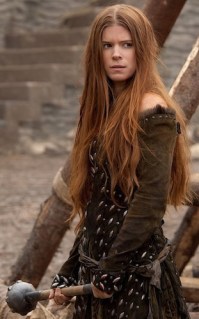 I imagine it also makes some of those fight scenes even more disorientating, which is a pity. Nothing will help the sometimes-too-obvious use of digital video though, which looks as nasty as ever.
The battling cast — led by James Purefoy and supported by the likes of Mackenzie Crook, Jason Flemyng and Jamie Foreman — all seem to have a whale of a time with their swords and axes and general fisticuffs. Their roles don’t offer too much depth, but only Flemyng (who I never rate) struggles. They’re supported by some talented thesps in the shape of Brian Cox, Derek Jacobi and Charles Dance, quality actors who maybe don’t always have the greatest taste for quality roles (Dance was recently in that direct-to-DVD Tesco-funded Jackie Collins adaptation, for instance) but always offer gravitas. There’s also Kate Mara, who does a fine British accent as an unnecessary love interest for Purefoy’s warrior monk type.
The real star, though, is Paul Giamatti as King John. Petulant, entitled and fundamentally weak, he rants and raves and chews any piece of scenery he can get his teeth into (not literally, but at times I swear he came close). It’s a well-pitched performance — he doesn’t go too far with it, making the King ridiculous and laughable without dragging the whole film down around him. That makes for a good villain.
Despite some occasional cheapness in the cinematography, Ironclad largely achieves its goal of creating a Hollywood-esque historical action movie on British soil (it was shot in Wales). Yes some of the CGI is obvious, and some stuff that looks like CGI was apparently model work, but these are all forgivable, especially when you remember this was made for just $25 million. 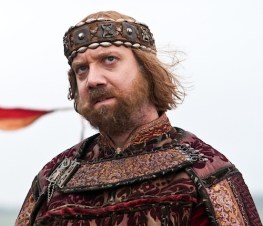 The unfamiliar true story also gives it the added edge of not knowing who lives or dies, or whether our heroes even succeed. If the ultimate end feels guessable, I think it’s only in retrospect. Of course, that doesn’t mean any of it’s historically accurate anyway.
And so what? It’s an action movie. And on all points that matter, it scores well.

Ironclad began on Sky Movies Premiere last night and continues daily throughout the week. I have no idea which aspect ratio it’s in.
It placed 10th on my list of The Ten Best Films I Saw For the First Time in 2012, which can be read in full here.
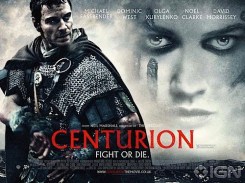 The fourth feature from writer/director Neil Marshall (despite owning his first three on DVD, this BD rental is the first I’ve actually watched — story of my life) is a bit of a departure: where the first three were horror (or at least horror-leaning) flicks, Centurion is an action-adventure crossed with something a little more artsy. Only a little, mind. Think
  Regular readers may know that I have an ever-growing dislike for films that begin at or near the end for no good reason (and most of those that do have no good reason to do so). Centurion’s opening line notes that “this is neither the beginning nor the end” of the lead character’s story. Oh dear, thought I; though perhaps “nor the end” signifies we might reach this point suitably distant from the credits, maybe. Not meaning to spoil it, but we’re there just 10 minutes later. Nice work Mr Marshall.
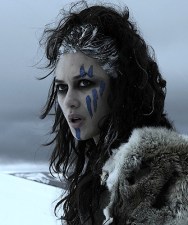 The cast is packed with people who, even if you don’t know their names, there’s a fair chance you’ll know the faces (assuming you watch your share of British drama): in addition to Fassbender and Morrissey there’s Dominic West, JJ Field, Lee Ross, Paul Freeman, Liam Cunningham, Noel Clarke, Riz Ahmed, Imogen Poots, Rachael Stirling, Peter Guinness… not to mention Film Star Olga Kurylenko. Recognisability doesn’t guarantee quality, of course, but that’s a pretty good list.
 I really enjoyed Centurion, appreciating its mix between brutally real action and stunning scenery, with a slightly more thoughtful side emerging in the final act. It’s also always pleasant to see a film that runs the length it wants to at a reasonable speed, rather than padding itself to reach two or even two-and-a-half hours. Splendid.
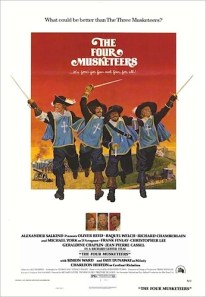 Richard Lester’s Four Musketeers was shot at the same time as the previous year’s
 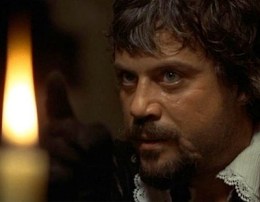 the murder of Constance; the cold-blooded execution of Milady; and ending up with Richelieu still in power too — none of it sits well with the jolly swashbuckling tone that still dominates. There are some good action sequences nonetheless — for instance, the ice-covered lake; breakfast/siege in the ruined fort; and the burning-building finale — which go some way to make up for the shortcomings.
 I like a good swashbuckler. I don’t know exactly what it is about sword fights, but they’re probably my most favourite kind of action sequence. The 1973 Three Musketeers, then, is a film I’m slightly amazed I’ve not seen before. Especially as I absolutely loved it.
 Thanks to this most of the fights aren’t strictly sword fights, I suppose. Indeed, Oliver Reed seems to dispense with his blade at the earliest opportunity and turn instead to sticks, wet towels, whatever else happens to be at hand. It lends a certain kind of organised chaos to proceedings; the kind that elevates a technically proficient duel into a funny, exciting, memorable segment of cinema. I would list standouts, but instead may I recommend you watch the film and, every time an action sequence starts, count it as one I mentioned. But particularly the one in the laundry and d’Artagnan and Rochefort’s lightbox-lit nighttime duel. And also— Now, this is why I said I wasn’t going to list any.
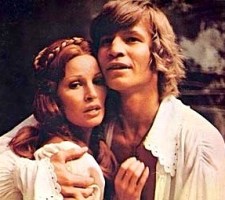 Constance and Faye Dunaway as the conniving Milady de Winter. York earns his place as the lead amongst such company, though, making a d’Artagnan who is by turns athletic, clumsy, hot-headed, loyal, and funny. As I said, everyone pitches the lightness just right, but York perhaps most of all — he doesn’t send up the youngest musketeer, doesn’t make him a pun-dispensing action hero, but finds all the humour in his actions and dialogue.
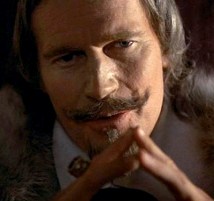 It also means the film ends with a sort of “Next Time” trailer, which feels very bizarre indeed, but is also a tantalising glimpse of what’s still to come.
 Notorious for having numerous cuts forced upon it by censors, over 40 years after its initial release Witchfinder General — now uncut — seems almost tame. But gore and sadistic violence certainly aren’t the main attractions — there’s a lot more to the film than that.
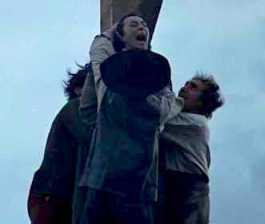 shot against Reeves’ wishes, featuring needlessly topless wenches. This is the cut shown by the BBC.)
 Witchfinder General is more action-adventure than horror.
 Best of all is the witchfinder himself, excellently portrayed by horror stalwart Vincent Price. Indeed, all the credit may lay with him, because it’s his line deliveries and uncertain looks that make the character conflicted early on, a man who may believe he is genuinely doing good for Christian values, but is seduced down darker paths by money, power, lust, and the prospect of revenge. When he allows himself to be lured to Sara’s bedroom as payment for leniency on her uncle, we’re uncertain if he’ll take what’s intended or use her loose ways as proof of witchery. That it’s the former quickly indicates how seriously he takes his espoused Christianity.
 to near-silhouette levels of blackness. It’s even less convincing than that fake blood. I enjoyed the score too. A completely new one was written for the US release, but I presume this was the original because it was slightly calmer and more haunting than one might expect from an action-adventure-horror movie (which I presume was the reasoning for the replacement).
 Origin stories are, as we well know, all the rage at the moment, and so Ridley Scott follows in the footsteps of
 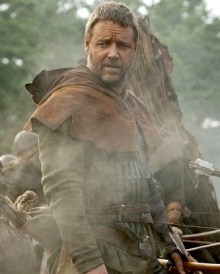 a likely-fictional creation, and so the style is suitably believable, whether it be precisely factual or not.
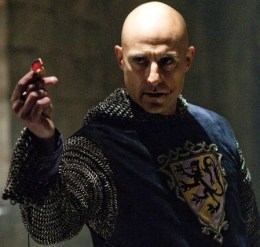 Mark Strong in a villainous role (it might be nice to see him play a good guy sometime, I’m sure he’s capable). Danny Huston’s King Richard is a nicely revisionist take — not the flawless hero we’re used to seeing — which sadly gets too little screen time. Oscar Isaac’s Prince/King John is suitably brattish and inconsistent, but by playing the part fairly straight he doesn’t come close to being as memorable as Alan Rickman, Keith Allen or Toby Stephens in the key villain’s role.
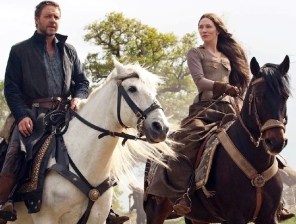 after numerous scenes of them doing stuff, they just are. King John ums and ahs about various things, and if we’re being charitable his chief characteristic is ‘changeable’; and if we’re not, he’s a weakly-written, inconsistent character. Do I believe he’d go charging into the fray during the climax? No, I don’t. If he’d gone in when it was virtually over, just so he could later claim he had? Yes, that would fit.
 I wanted the reviews to be wrong; for Ridley Scott’s Gritty And Realistic™ take on Robin Hood to be worth the potential of the concept. In places, it almost is — the era is evoked stylishly, the battles are largely well-staged if not perfect — but it drags, and ultimately Robin only becomes Robin Hood proper at the film’s end. (In fact, a surprisingly large amount of the trailer was taken from the film’s closing minutes, obviously to imply the usual Robin Hood story.) It’s copied Batman Begins and Casino Royale too precisely in this respect, perhaps. It also makes it feel like nowt but setup for a sequel, over-explaining how (this version of) Robin came to be where he was. As the final card says, “And so the legend begins”.
 I realised recently that I haven’t seen an animated Disney film produced after
  (It’s this kind of thing that has caused uproar for
  Ivanhoe is the kind of film they don’t often make any more, a pure swashbuckling romp. And when they do make them they tend to muck it up with over-complicated mythology-obsessed sequels — yes
 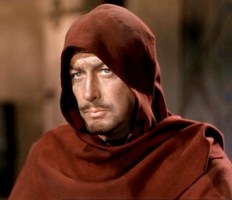 Though the final duel that ultimately follows can’t quite live up to this in terms of sheer scale and excitement, it impressively holds its own as a climactic action sequence.
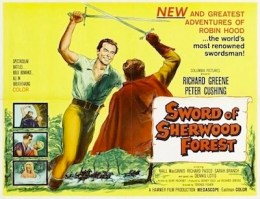 Hammer didn’t just make horror movies, y’know. I’m sure many film fans know this, but the phrase “Hammer Horror” is so ubiquitous that I expect most people think that was the company’s name and all they produced.
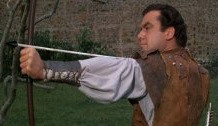 It doesn’t all tie together fully. For example, one assumes the town of Bortrey was going to be the site of Newark’s castle, as that’s the only apparent reason why he’d be annoyed at the Archbishop for stopping the Sheriff acquiring it. But then Bortrey is burnt down, and with little reaction or comment from any character. And the opening plot point — a man escaping the Sheriff with a mysterious symbol — is never fully explained. Was he a co-conspirator? Was he aiming to warn the Archbishop? If the latter, where did he get the symbol? Maybe I missed a scene that explained all this.
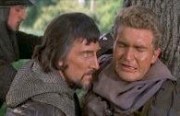 The cast are adequate, even if Richard Greene’s no Errol Flynn and Peter Cushing’s no Alan Rickman (here at least). Terence Fisher’s direction is rather flat a lot of the time, though a few scenery shots, riding sequences and fights bring out a bit more dynamism.
 In an age where Henry VIII is young, slim and sometimes irritatingly called “Henry 8”, not to mention more interested in shagging every young girl he can find than in, well, anything else, it’s somewhat refreshing to return to a time when he was always older, fatter and more interested in polishing off a huge slab of meat than seeing his wife. OK, so they call him “Heinrich VIII”, but at least that’s because this production team spoke a different language.
 100Films.co.uk