
 Ridley Scott’s Crusades epic is probably best known as one of the foremost examples of the power of director’s cuts: after Scott was forced to make massive edits by a studio wanting a shorter runtime, the film’s summer theatrical release was so critically panned that an extended Director’s Cut appeared in LA cinemas before the end of the year, reaching the wider world with its DVD release the following May. The extended version adds 45 minutes to the film (and a further 4½ in music in the Roadshow Version), enough to completely rehabilitate its critical standing.
The story begins in France, 1184, where blacksmith Balian (Orlando Bloom) is something of a social pariah. Offered the chance to head off to fight in the Crusades, Balian… refuses. But then something spoilersome happens and he thinks it might be a good idea after all. When he eventually arrives in Jerusalem, he finds a kingdom divided by political squabbling, quite apart from the uneasy truce with the enemy. You know that’s not going to end well.
Kingdom of Heaven is, in many respects, an old-fashioned epic. It’s a long film not because the director is prone to excess and didn’t know when to cut back, but because it has a lengthy and complicated story to tell. It isn’t adapted from a novel, but the structure feels that way, spending a lot of time on characters and what some might interpret as preamble — it’s a long while before the movie reaches Jerusalem, ostensibly the film’s focus, and it completes the arcs of several major characters along the way. The scale of such stories isn’t to everyone’s taste, but, well, what can you do.
 A strong cast bolsters the human drama that sometimes gets lost in such grand stories. Bloom is a perfectly adequate if unexceptional lead, but around him we have the likes of Michael Sheen, David Thewlis, Alexander Siddig, Brendan Gleeson, and Edward Norton (well done if you can spot him…) There are even more names if you look to supporting roles. Most notable, however, are the co-leads: both Liam Neeson, as the knight who recruits Balian, and Jeremy Irons, as the wise advisor when he gets to Jerusalem, bring class to proceedings, while Eva Green provides mystery and heart as the love interest. Of everyone, she’s best served by the Director’s Cut, gaining a whole, vital subplot about her child that was entirely excised theatrically. It’s the kind of thing you can’t imagine not being there, and Scott agreed: it seems the chance to restore it was one of his main motivators for putting together a release of the longer version.
It is very much a Ridley Scott film, too. The way it’s shot, edited, styled… you could mix bits of this up with Gladiator or Robin Hood and you might not realise you’d switched movie. As a student of film it frustrates me that I can’t put my finger on exactly what qualities define this “Scott style” — and it’s a specific one to his historical epics, too, because it’s less present (or possibly just in a different way) in his modern-day and sci-fi movies — but I’m certain it’s there. I guess it’s the way he frames shots, the mise-en-scène, the editing, the richness of the photography… The quality of the end result may vary across those three movies, but Scott’s technical skill is never in doubt.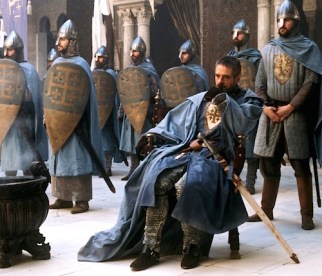 (I’d wager Exodus is the same, but its poor reception hasn’t exactly left me gagging to see it.)
Similarly, I can’t quite identify what’s missing from Kingdom of Heaven that holds me back from giving it full marks. It’s a je ne sais quoi edge that I just didn’t feel. I do think it’s a very, very good film, though; one that would perhaps well reward further viewings.

A version of Kingdom of Heaven is on Film4 tonight at 9pm. Their listings suggest it’s the theatrical cut, though if that’s true then they’ve put in an hour-and-a-half of adverts…
* For what it’s worth, I actually watched what’s now called the “Director’s Cut Roadshow Version”. This was released as the Director’s Cut on DVD, but in the early days of Blu-ray it couldn’t all fit on one disc, so they lopped off the overture, intermission, and entr’acte and still labelled it the Director’s Cut. As of the 2014 US Ultimate Edition, however, those missing bits have been optionally restored, with the set containing ‘three’ versions of the movie. ^
 Seven Samurai used to be a striking anomaly amongst the top ten of
  It’s also unhurried. As Kenneth Turan explains in his essay “The Hours and Times: Kurosawa and the Art of Epic Storytelling” (in the booklet for Criterion’s DVD and Blu-ray releases of the film, and available online
 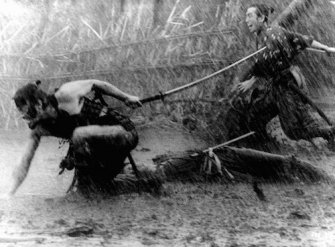 The length ensures our investment in the village, too, just as it does for the samurai. They’re not being paid a fortune — in fact, they’re just being paid food and lodging — so why do they care? Well, food and lodging are better than no food and lodging, for starters; and then, having been in the village so long in preparation, they care for it too. It is, at least for the time being, their home. You can tell an audience this, of course, but one of the few ways to make them feel it is to put them there too — and that’s what the length does. To quote from Turan again,
 the final scene, the way it’s edited and framed, ties the remaining samurai to their deceased comrades, the living and thriving farmers a distant and separate group. Fighting is the way of the past, perhaps, and peaceful farming the future. Or is the samurai’s only purpose to be found in death, because other than that they are redundant?
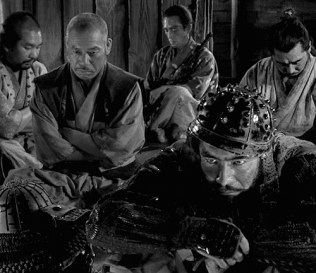 And it wasn’t as if it was overseas viewers who hit on the magic: as Turan reveals, “Toho Studios cut fifty minutes before so much as showing the film to American distributors, fearful that no Westerner would have the stamina for its original length.” The more things change the more they stay the same, I suppose — how many Great Films from Hollywood are ignored by awards bodies and audiences, only to endure in other ways?
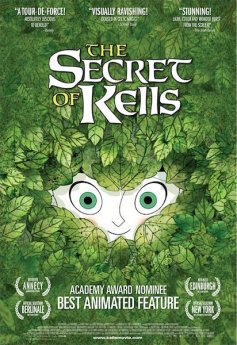 You can lament the quality of Oscar voters’ choices all you want, but if it wasn’t for their 2010 Best Animated Feature nominations I’m not sure many would have heard of this Celtic gem.
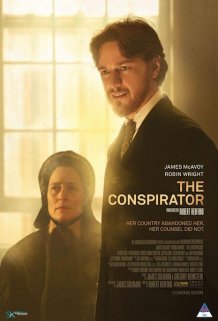 Although John Wilkes Booth is famous as the man who assassinated Abraham Lincoln, he was merely the person who pulled the trigger: eight people were tried for conspiracy to kill America’s 16th President; this is the story of what happened to the only woman among them.
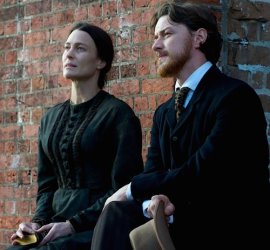 or rather, like an actress versed in playing modern characters struggling gamely with a period one, and coming up short.
 I figured I ran the risk of affecting the outcome of the Scottish independence referendum if I posted this review yesterday (because of course I have that kind of reach and influence), but after Mel Gibson’s historical(ly-dubious) epic wound up on
  Judged as that, Gibson’s three-hour (near as damn it) movie is a pleasingly traditional epic. Many big films these days are just long, but the story here has scope too — it’s about a war, essentially. And war means battles, which are a particular highlight. The standout is surely the famed Battle of Stirling Bridge — you know, the one where the Scots moon the English. Funny and all, but just a small part of a larger sequence. Gibson has the confidence to show the build-up to the fighting, outline the tactics that will be used, and only then launch into the fray. It’s this measured approach that makes it so effective, rather than the crash-bang-wallop straight-to-the-slaughter style of more recent movies. Due to its notoriety I’d assumed the aforementioned clash was the film’s climax, but it’s actually the centrepiece, pretty precisely in the middle of the film. Fortunately there’s enough else going on (because this isn’t actually An Action Movie) that it doesn’t make things feel lopsided.
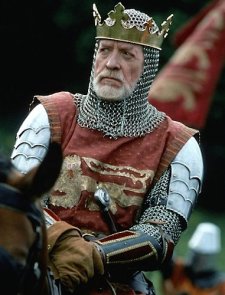 It also doesn’t suffer from that film’s accent issues. Mel Gibson isn’t an American-Scot (or an Australian one), instead delivering an accent that sounds passable to this Englishman. He believed he was too old for the part, which may well be true, but when the rest of it is so inaccurate what does that matter? He’s a solid leading man and a commanding-enough presence. The supporting cast are an array of recognisable Celtish faces — including at least one Irishman playing a Scot and a Scot playing an Irishman — and, because they’re from our fair isles, of course they’re all brilliant. Best of all, however, is Patrick McGoohan. He makes for a fantastic Evil King, given some juicy lines that are even juicier thanks to his delivery. He may not be moustache-twirling-ly memorable like an Alan Rickman creation, but any scene is enlivened by his presence.
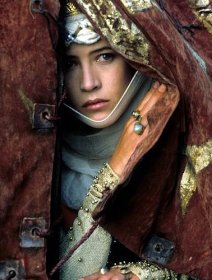 Then there’s that issue of historical accuracy. I know I said we should ignore it, but even if you accept fiction films shouldn’t be slavish history lessons (and not everyone does), how far can they ignore the facts? Often with such films the viewer assumes they’re true until someone says, “actually, I think you’ll find in reality…” Not so with Braveheart: you don’t have to know anything of Scottish history to guess that the face-to-face chats (and more, wink-wink-nudge-nudge) between Wallace and the future-Queen must be almost entirely poppycock (and, in fact, you can drop that “almost”).
 The year 1600: British ship’s captain Solomon Kane is not a nice man, a mite too fond of pillagin’ and killin’ and quite possibly other not-nice things ending in —in’. That is until he has a run in with the Devil’s Reaper. Hell has claimed his soul, and its time to collect. Solomon does not plan on being collected, renouncing his former life and trying to hide at a monastery in England. But as a gang of possessed men lay waste to the countryside, burning its towns and enslaving its people, will Solomon be able to stick to his newfound pacifism? Yeah, we all know the answer to that…
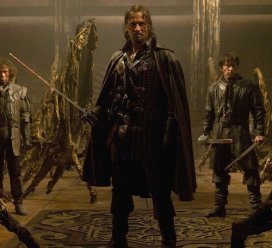 but also a more-than-requisite amount of swordfighting and the like — all told, Kane is more period action-adventure (with demons) than period horror.
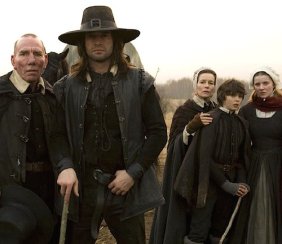 In support there’s the likes of Pete Postlethwaite, Alice Krige and Max von Sydow, all of whom bring instant heft to roles that need it. I don’t mean to say the screenplay doesn’t contain it, but the shorthand the actors bring with them certainly does favours. Cameo-sized appearances by Mackenzie Crook and Jason Flemyng are also effective, and watch out for a pre-
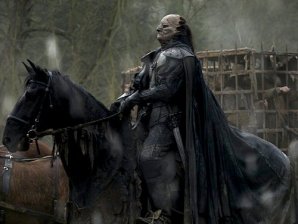 My praise also extends to those responsible for the film’s location shooting. Shot in the Czech Republic, for once that genuinely looks like Britain. OK, the style of some buildings give the game away occasionally (in particular the monastery), but until I read different, I just assumed the fields, forest and coastline had been found in our real South West, on the moors or what have you.
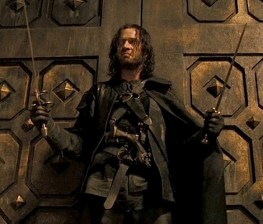 At the end of the day, Solomon Kane is a period fantasy action-adventure, something which doesn’t seem to be everyone’s taste — it has relatively weak scores on the likes of IMDb and Rotten Tomatoes (though, in the context of how this kind of movie often performs in those arenas, they’re far from awful). For my money, however, it’s a great little film. It looks beautiful, it renders the tone of pulp fantasy brilliantly, its action sequences are exciting (so many swordfights! Heaven!) and its creepy bits unnerving. It may not be ‘trash’ elevated to art — it’s not a Tarantino movie — but it is pulp fiction treated with due reverence.
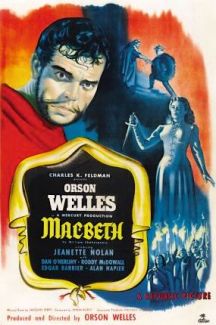 Twelve years on from his innovative, acclaimed, career-bolstering ‘
 The low budget and quick schedule affect the film across the board, for good and ill. There’s much dramatic staging, with grand sets and doom-laden lighting. The shadow-drenched cinematography may well be a result of the cheap production, but the resulting effect is marvellous. Indeed, all the camerawork is great. There are some striking long takes, including the majority of the night of the murder occurring in one long unbroken shot. The costumes, on the other hand, look like a ragtag bunch of Past Clothing from the studio’s store… which is because they essentially were.
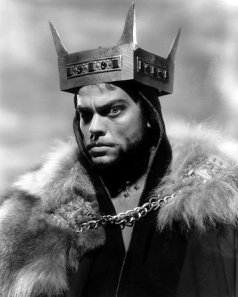 Macbeth himself is hardly in possession of all his faculties at that point, acting like a drunkard; but rather than make the sequence appropriately sinister (it’s in this state that he orders the execution of Banquo and Fleance, for example), it plays up the silliness, which is a shame.
 A black and white Swedish movie in which a knight ponders the existence of God while playing chess with Death? Yep, here we have the stereotype of arthouse cinema. Let’s be honest, it lives up to most of those expectations.
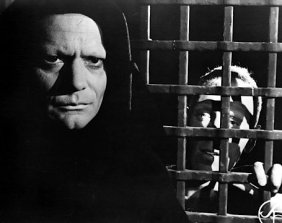 On the more easily-appreciable side, it’s beautifully shot by Gunnar Fischer. It had to be made quickly, on a tight budget, and for that reason Bergman found it imperfect and rough in places. This may be true, but regardless, there are numerous striking compositions, and even more occasions where the rich black-and-white photography looks stick-it-on-your-wall gorgeous. I only watched it on Tartan’s old DVD and, even with mixed feelings about the film itself, I’m sorely tempted to pick up one of the Blu-rays.
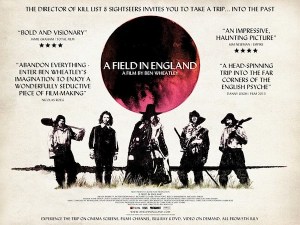 Much was written about A Field in England at the time of its release, so if you frequent the right places online or in the press you can’t’ve missed it. Nonetheless, there’s a good chance you’ll have heard of it more for its release format(s) than for anything in the film itself: the fourth feature in just five years from new British critical darling Ben Wheatley, it was released to cinemas, DVD, Blu-ray, download, video-on-demand, and shown on free TV all on the same day, a first for British cinema. Any casual viewers who checked it out for that reason were in for a shock, because this certainly isn’t an easily-digested mainstream experience.
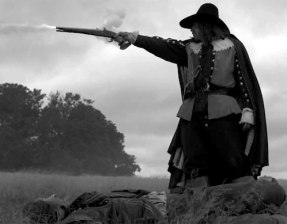 That very subtlety leads some viewers to write this kind of movie off — and fair enough, because if you’re searching for any kind of mass acceptance you don’t do it with a black-and-white film about a few blokes in period dress running around a field doing weird, inexplicable things. Though you might top it off with a shoot-out that is arguably one of the year’s best action sequences, something Wheatley and co do do. And without making it feel tonally out of place, either. Impressive. In keeping but even more memorable is the moment you’ve surely heard about — “when he comes out of the tent with that look on his face”. I wasn’t able to watch the film until something like 24 hours after its Big Premiere, by which time I’d already heard everyone talk about that, and yet it was still uncomfortably uncanny. Kudos, Reece Shearsmith, you’re an odd’un.
 In terms of the new funding models and simultaneous multi-format release and all that… well, it depends what their goals were. If it was to make interesting, alternative, minority-interest films… fantastic, they’ve done it — and got a remarkable amount of interest in the process. If it was meant to be a way of turning a profit, or of reaching a bigger audience… well, it succeeded this time — but how many of those viewers are going to come back? A Field in England is definitely the kind of film that appeals to some people, but it is defiantly not “mainstream cinema”. No bad thing, and something that should be encouraged, supported and funded in some way; but however you do it, it’s not going to continuously bring in big bucks.
 If you were looking for the archetype of an epic movie, Lawrence of Arabia would be a strong contender. It has a wide scope in just about every regard, from the desert locations that stretch as far as the eye can see, to the thousands of extras that fill them, to the glorious 70mm camerawork that captures it all, to the sweeping story that also contains a more personal throughline, to the 3½-hour running time.
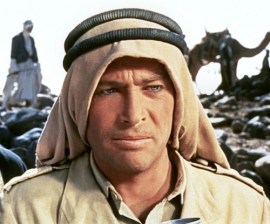 As such, the film hangs on the performance of O’Toole. We’re told Lawrence is an enigmatic figure and his depiction arguably supports that — we never fully get inside his head; we’re always observing him. And yet that’s no bad thing, because even as Lawrence’s confidence waxes and wains, as his allegiances shift and alter, we can feel what he wants to achieve, why he thinks he can. He attempts the impossible and succeeds, which is why he later attempts a bigger impossibility, and must leave the pieces to the more level-headed men, who didn’t have his genius but can therefore play the political game better than he.
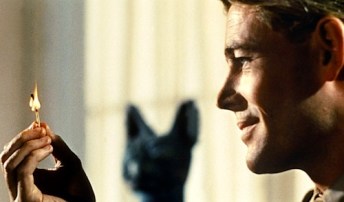 A similar legacy is left by those behind the scenes. Maurice Jarre’s score is the reference point for many a period desert epic — indeed, his music is so synonymous with such settings that it has arguably transcended its source to simply be what music for those locations and times is. It graces a film edited with class by Anne V. Coates, where scenes are allowed to play in luxuriantly long takes at times, while at others smash edits throw us from one location to another. This is undoubtedly supported by F.A. Young’s cinematography, where the wide frame can encompass so much action that there’s no need to cut amongst close-ups; and which can show the world in such majesty that you want it to hold for long, lingering takes. Even viewed on the small screen, the 70mm photography shines, especially on Blu-ray.
 As with any great film, Lawrence of Arabia is at least the sum of its parts. Replace any of the artists I’ve mentioned, or surely many more, and it would not be the film it is. In fact, when working on such a scale, this is more than a film — it’s an experience. And if that sounds pretentious, well, tough. If you haven’t experienced it yet, try not to leave it as long as I did.
 100Films.co.uk