
David Fincher | 127 mins | Blu-ray | 18 / R
 I usually say that Se7en is my favourite film.
I don’t know if it’s just a recent thing, but with the proliferation of online “profiles” thanks to Facebook and, long before that, forums and various other websites*, it feels like we’re asked such questions on a regular basis these days, never mind as a go-to topic when conversation is struggling. So when people or websites inevitably ask what is your favourite film, they expect you to have one. I don’t think they like it if you begin to list 20, or 30, or… So I say Se7en.
This once led to me doing a presentation on the film; specifically, on Andrew Kevin Walker’s screenplay. It went quite well and I was going to use the notes as the basis for at least some of this review — I’m sure there was something interesting in them. I even listened to one of the commentaries (it has four) to glean extra info (in over a decade of buying DVDs now, I’ve only listened to about ten commentaries). Unfortunately the notes are lost to a harddrive buried deep in a box somewhere, or a hardcopy buried deep in old notes goodness knows where, so that’ll have to wait for another day. I just wanted you to know you were missing out. (Don’t get too upset — I’m sure it wasn’t that good.)
As with almost all films I love, be they ones I’ve held dear for years or newly discovered as part of 100 Films’ primary thread, I’m not sure where to begin praising it. Perhaps the cinematography, an aspect Fincher put a lot of work into both originally and then again to make it look right on the DVD re-release. This may well be because the film is incredibly dark. 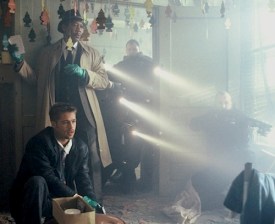 Black seems to be its default position — everything else is cut out of the darkness with as little light as possible. Often backgrounds and locations are better lit than foregrounds or actors, making the viewer focus on silhouettes with minimal light offering splashes of detail. Even the scenes that occur at daytime (most, anyway) do so in the middle of ferocious, ceaseless rain that ensures it never gets too bright.
It’s only appropriate, because the story is pretty much as black as they come. For those who’ve made it this far without finding out, Se7en concerns the police investigation into a series of murders themed around the seven deadly sins. In case you haven’t seen it, I shan’t outline any examples, but none are pretty. The worst, in my opinion, is Lust. However many times you see the film, that segment doesn’t get any easier to watch. It’s a three-way combination of an incredible, haunting performance by Leland Orser (in just one short scene); a photograph of the implement, which we see for mere seconds; and the moment when the film that was prepared to show us the ‘living corpse’ of Sloth victim Victor refuses to show us a body. Since the last time I watched Se7en I have seen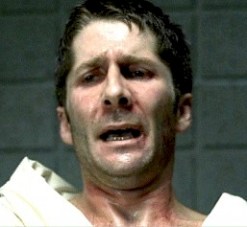 all but one of the Saw films, the uncut Witchfinder General, and various other gory horrors like Flesh for Frankenstein, but none are as gruesomely affecting as the Lust crime.
I imagine it’s contextual. Se7en is, in its way, quite heavily stylised — “dark”, as I discussed — but it’s done so in a very grounded way. To get film studies-y about it, we are asked to believe this is the real world and a plausible series of events are occurring in it. Films like the Saw series, however, clearly exist in a horror movie version of the world (however much some of the filmmakers may be under the impression that it’s a series of grounded thrillers). You view Saw with a horror movie mindset, expecting extreme situations and extreme special effects-driven gore; Se7en, even with its cruel and unusual murders, is always a police thriller. The frame of reference — plus the quality of writing, direction and acting — is what makes Lust so much more affecting.
The acting is brilliant, subtler than some might expect or be aware of initially. To take one example, look at the scene in the bar that (coincidentally) follows Lust. Detectives Mills (Brad Pitt) and Somerset (Morgan Freeman) discuss, more-or-less, Somerset’s reasons for retiring. He sets out his stall, his thoughts and reasons, well rehearsed from telling others and himself. 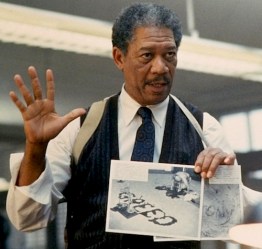 Mills delivers his riposte with greater hyperbole — of course, because that’s the character — perhaps bedded in a form of naivety and idealism, ending with a repetitious “I do not agree. I do not.” Then we see Freeman’s face, completely static, but you can read in it everything you need to — his anger at Mills for making him realise that it’s all a lie he’s been telling himself, and anger at himself for believing the lie. That’s one scene; Freeman is incredible throughout.
For all the darkness, there’s also a nice vein of humour. Not too much, not a desperate attempt to compensate, but a well-judged amount. One of my favourite comic moments in any serious film (“this isn’t even my desk”); the vibrating home; “if I shaved off a nipple…” From an objective point of view it helps us believe in and, more importantly, like the characters. Which is, really, all in aid of one thing:
The famous ending. It’s a twist, yes, but it’s more than that; and it’s mainly the performances that sell it. The twist, first, is perfectly played. We never see what’s in the box; we’re never even told; but we absolutely, positively, unquestionably know what’s in there, as surely as if we were Somerset seeing it with his own eyes. Even once you know what’s coming, though, it’s what follows the twist that’s incredible: three men in a field, three impeccable performances that bring everything we’ve spent two hours watching to a perfect head. 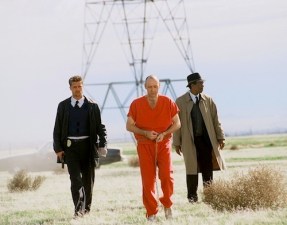 This is where liking the characters pays too, because we are on Somerset’s side and we’re on Mills’ side and we agree with both and disagree with both and don’t necessarily know who’s right or what to do or what we would do. I can spend the whole film anticipating this scene, knowing exactly what will happen in it, how great a piece of filmmaking it will be, yet it still makes my hair stand on end.
Some would claim that Se7en is no more than a standard murder thriller with a stock mismatched pair of detectives. In some respects they’re right, but in enough respects they’re wrong. There’s a killer high concept behind the crimes, for one thing, but it’s really the execution of the film, not the victims, that makes it so much more. It’s in the performances, the way those stock characters are written, their subplots, the story’s pace, the cinematography, the music, individual sequences like Somerset in the library or the climax that (arguably, of course) rise not only to the top of the genre but to the top of the very medium of film itself. There’s so much more; this review only scratches the surface. Se7en transcends its limitations in any one area by becoming far more than the sum of its exemplary parts.
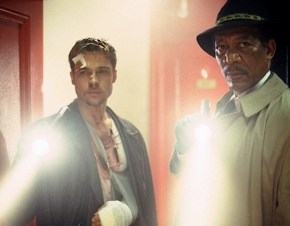 The quality of a crime thriller is often so tied to its mystery that the film can only sustain so many viewings — sometimes, only one — before you know it too well. I have seen Se7en at least seven times now, which for me is a lot — a helluva lot, even — and yet I still get something from it every time. That’s a rarity, that’s a reason to love it, and that is why it may well be my favourite film.

I watched Se7en as part of a David Fincher Week. Read my thoughts on all his films to date here.
* All these people who attribute such things to Facebook, usually in a critical way, are just a bit behind. (That’s a personal bugbear dealt with, then.) ^
 It’s getting on for two years since I last (and first) watched most of the Alien
  (as I haven’t watched that copy, obviously), but on Blu-ray the added footage, 2003-era new effects and 2010 re-recorded audio are indistinguishable from the rest of the film.
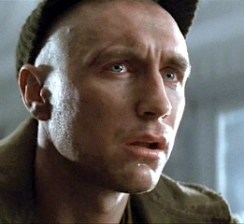 One of the biggest things I remember being told about Alien³, before the Special Edition, was that most of Paul McGann’s performance had been cut; that originally he had a sizeable role that justified his fourth billing, rather than his cameo-sized part in the theatrical cut. It doesn’t feel like there’s an awful lot more of him in this version, though scanning through
  Unsurprisingly, therefore, they’re almost all totally underused. Charles Dance gets the biggest slice of the cake and is as good as ever, but doing little more than show their face we have Pete Postlethwaite, Phil Davis, Peter Guinness, Danny Webb (they don’t all begin with P…) Alien³ is 19 years old now, no one could’ve predicted the future; but viewed with hindsight, the volume of under-utilised talent is almost astounding.
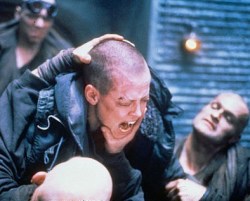 It’s also, perhaps, interesting to remember this being Fincher’s first film. He might seem like an odd choice, a first-timer paling beside the experienced hands of Scott and Cameron. But that would be to forget that, for both, their Alien films were only their second time helming a feature*; and while Cameron’s previous had been sci-fi (
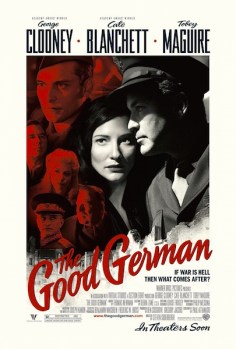
 the visual, audio, acting and plot styles of the era, why not ensure the dialogue and action follow suit? There’s no need for the violence, sex and swearing in this particular tale; at least, no need for it in a way that couldn’t be conveyed as effectively using Production Code-friendly methods. I’m uncertain if I like the film less for failing on this measure, but it does add to its inherent oddness.
 But how much do we get to know them, really? It’s easy to see why critics said “not very well”, because they’re too busy uncovering the conspiracies and revealing their part to actually show us much about themselves. But then why should that be a problem? It’s a noir thriller, not a character drama. Surely it’s about the mysteries and, if you like, the themes, rather than letting us understand the people caught up in them?
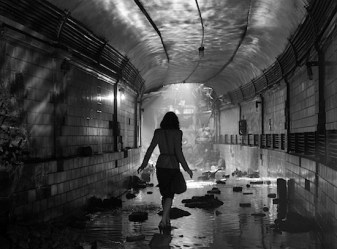 production intentions rather than being invented to slot into them — provides meat on the stylistic bones.
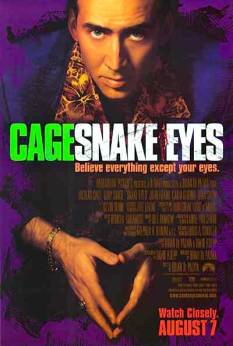
 later seasons didn’t and, in my opinion, suffered. Johnny Depp-starer
 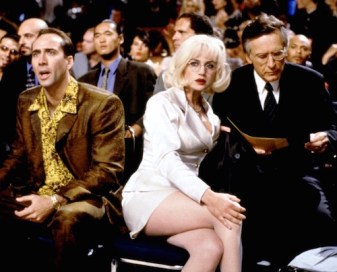 If there’s one significant flaw, it’s that the ending is too much based on convenience and coincidence; and someone in the editing room should’ve paid more attention to removing all references to the original, deleted ending in which the casino got flooded. I have no idea why that was removed — maybe someone thought it was a bit ludicrous. But it sounds more satisfying than what was included, which, as noted, relies on a handy spot of coincidence and at least one action that seems out of character. I can forgive it though, because I liked everything else. And the post-climax montage is a suitably downbeat ending to our hero’s story — another noir trait there.
 I was a bit of a gamer once. Not an especially hardcore one, but certainly a gamer. And I remember Max Payne, and I remember enjoying it, and I remember thinking it would make quite a good film, and I remember one of the biggest problems being that what made it so unique as a game was the bullet-time feature and what would make it so derivative as a film would be to use bullet-time. But it also had lots of other things going for it: the snow-bound nighttime New York setting, the dark revenge plot, the hard-boiled gravel-toned voiceover.
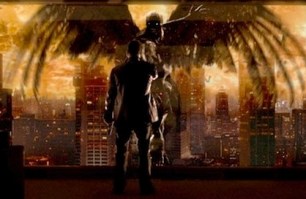 Unfortunately, he seems to be under the illusion that a couple of barely-moving slow-mo moments also stand in for a full action sequence. When an action movie can’t deliver any action, there’s a problem.
 The ‘harder’ bit merely comes from a couple of frames (literally) of violence and the odd bit of CG blood. Presumably the extra walking around is to artificially lengthen the running time and persuade the more gullible that they’re getting a tougher experience.
 At least some of it looks quite nice. The drifting snow-laden exterior shots are among the few bits of the film that might genuinely be considered good. But when you can get pretty images elsewhere, why suffer through this?
 Public Enemies came out nearly a year ago now, and I remember two things about its release: firstly, that the first review I saw was Empire’s, which
  What it brings here is an unusual quality. It’s clearly fiction, of course, albeit fiction based on fact, and there are still plenty of extravagant angles and editing so that you’re never in danger of thinking Mann is trying to pass this off as a documentary. But couple the raw cinematography with a meticulous attention to period detail, with a sound mix that is consciously rough and real, and you get a sense that this is how it was — it’s not a glossified movie version, it’s a How It Was one. Public Enemies is to the old gangster film as
 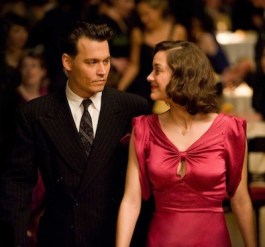 The characters do and don’t lack depth. The relationship between Dillinger and Billie is a significant part of the film, receiving roughly equal attention to Dillinger’s criminal deeds — it’s his final words to her that close the film, not his death. Christian Bales’ G-man, Melvin Purvis, on the other hand, is less developed, but to say he lacks any character is to do Bale’s performance a disservice. Behind Purvis’ blunt dialogue and stolid manner, and in slight gaps and lapses around it, one gets a sense of the true man and his real thoughts. The postscript — that he resigned from the FBI a year later and ultimately took his own life — reinforces and confirms the subtleties Bale injects into the performance.
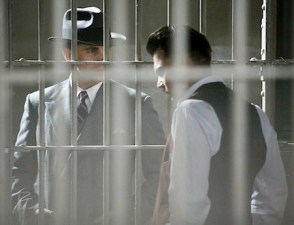 Mann does his best, cutting around Dillinger in the movie theatre, the bizarrely-apt film he’s watching (this isn’t dramatic licence — Dillinger really saw
  is largely well converted to a dramatic piece, if occasionally a little episodic (as is the way with all biopics) and overlong towards the end.
 M is a film of immense significance, not least because of its place on
  the public reaction and hysteria; the police’s flailing investigations and increasing exasperation; the criminal underworld, who begin their own manhunt because police inquiries are “bad for business” (despite sounding like a filmic conceit, this element was directly inspired by a newspaper article); and the criminal himself — trying to lay low, but constantly having to fight his urges… and ultimately giving in to them again.
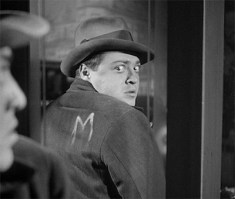 how they search crime scenes with a fine-tooth comb; another sequence shows their methodology for staging a raid; and so on. Such precise and clinical methods ultimately pay off: it’s a pair of tiny clues, carefully reasoned and sought out, that reveal the killer’s identity — and if it weren’t for the criminals getting there first, they’d’ve surely caught him too. Indeed, were it not for this breakthrough then the film might hold a
  like tracking from outside to inside through a window within a single shot — are present here). M’s individual moments of brilliance go on — perhaps my favourite is when the police arrive just after the criminals have apprehended Beckert. We don’t even see an officer on screen, but the burglar’s reactions let us know who’s there. Its a funny moment (even if we’ve seen it dozens of times since) and a lovely shot too.
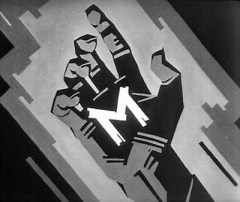 the murderer won’t bring the children back, and warns viewers to watch out for their own. It’s not the triumphant “we got him!” that concludes most serial killer films, but a blunt warning that, though Beckert has been caught, there are always more out there, waiting to strike. History has sadly proven her right; but while the world has produced many men and women like M’s villain, it hasn’t produced many films quite like M.
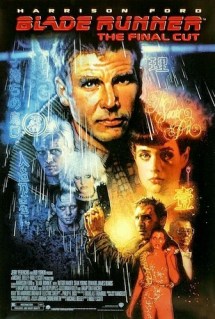 You don’t need me to tell you about Blade Runner. It’s one of the most popular movies ever, if not with a mass audience then with a significantly-sized cult following and even wider-spread respect. Still, I’m going to go on about it for a bit anyway.
 Having just recently laid into
  The
The  100Films.co.uk