
Gary Trousdale & Kirk Wise | 92 mins | Blu-ray | U / G
 Do you need me to tell you how great Beauty and the Beast is? I imagine not. If you’ve seen it, you’ll know. If you haven’t, you really should, and then you’ll know.
There’s a reason this managed to become the first animated film ever to be nominated for the Best Picture Oscar. It’s impossible to fault in any significant way. The design and animation are beautiful (in particular the stained-glass opening), the voice acting spot-on, the score exquisite, the story fast-paced and enthralling, there’s even a variety of moral messages for the kids to learn — though, to be honest, some adults could do with learning them too. It’s hilariously funny, remarkably exciting, surprisingly scary, relentlessly romantic… By forefronting the love story it may not be as obviously boy-friendly as Aladdin or The Lion King, but between Gaston, the wolves, Lumiere, Chip, and the action-packed finale, there’s plenty for less romantically-inclined little’uns to enjoy.
As a musical, it’s equally faultless. Every song is a gold-standard Disney tune — Belle (the opening song), Be Our Guest, Gaston, The Mob Song (as the villagers set off to kill the Beast), and of course Beauty and the Beast itself. There are few musicals of any calibre where I feel able to say there’s not a single dull or mediocre song to be found, but Beauty and the Beast is certainly one of them. Every number bursts with memorable tunes, witty rhymes, genuine emotion — even the Soppy Girly Song is a good one! Perhaps the only exception in this Special Edition’s sole extension, a previously-deleted song called Human Again. 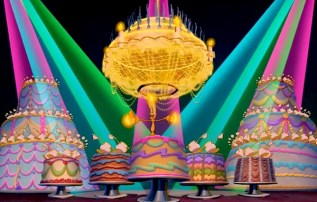 It’s not a bad song — not at all — but it’s a notch below the others. (There are a few more changes to the film than just adding the song, listed here.)
You may have heard that a 3D version now exists too, released in some territories earlier this year with a US cinema and Blu-ray 3D release scheduled for 2011. Aside from the usual issues around post-production 3Disation, how well can a 2D-animated film convert to the format? Surely it looks even more like flat layers stacked on top of each other than other fake-3D efforts? I’m curious, though probably not enough to seek it out if it makes it as far as UK cinemas.
Some of “Disney’s Animated Classics” (do they still call them that? I don’t know) stretch the definition to its breaking point — indeed, some of them do break it. But Beauty and the Beast more than lives up to the name. In fact, it could easily drop the “Disney’s”. And the “Animated”. It’s a pure Classics. Erm, Classic.

 Alternate histories are always fun, and nothing seems to have provoked more than the Second World War. Which, as a defining event in modern history for a good chunk of the world, is understandable. It Happened Here is perhaps one of the earliest examples, depicting a 1940s Britain under Nazi occupation.
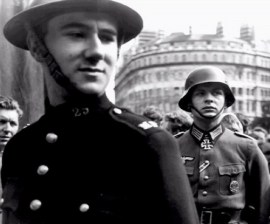 namely, the quiet but methodical enacting of The Final Solution in an occupied territory. The whole film builds to this point, gradually showing the darker and deeper levels of cooperation — which starts out almost harmless and ends with organised mass murder — meaning it never feels like Brownlow and Mollo are pushing an agenda too hard, but still confront us with the reality: that we’d probably succumb too, and this is where we’d end up.
 Another controversy arose over the villains being British collaborators — few German Nazis are seen — and the ease with which many agreed. But this is based in the facts of what occurred in other occupied territories; maybe Britain’s plucky spirit would’ve shown through, as many like to believe, or maybe many would have caved for the easier life — or, indeed, life at all. The film is examining several perspectives of occupation, and using the fictional context to good effect: this could have happened, the film says, however much we like to believe we wouldn’t have collaborated like (and/or resisted better than), say, the French.
 Nonetheless, It Happened Here is more anti-Nazi than pro-Nazi propaganda, in my opinion, though it’s easy to see why any material critical of the Allies could have outweighed the overall bias when the film was first released, just 20 years after victory in Europe. Generally, and viewed from a much more removed perspective, Brownlow and Mollo do a good job of offering conflicting perspectives with minimal comment, allowing the viewer to decide how ridiculous certain newsreels or opinions are, or how weak or misguided characters may or may not be — on both sides.
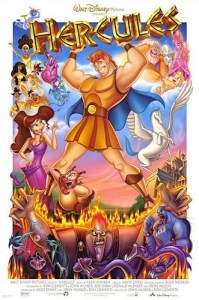 Hercules is the first post-me Disney; the point where, for whatever reason, I stopped watching their output. But, of course, Disneys — good Disneys, at any rate — are suited to every age group.
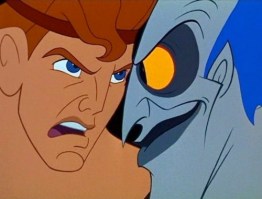 animal-sidekicks-with-no-dialogue-who-can-still-convey-their-thoughts-and-feelings-perfectly (I feel this tradition needs a snappier name.) Love interest Meg, meanwhile, starts out intensely irritating but is gradually redeemed. Good work, I say to the film’s
 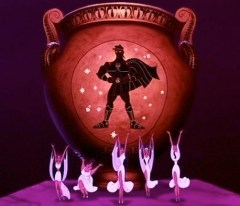 (though even mentioning it in the same sentence as that number makes it sound better than it is). Only love interest Meg gets a passable song, not that I could remember it within hours of watching the film. Maybe it’s not all that bad really, but when early-’90s Disneys could produce several unforgettable tunes per film, it feels like a weak album from a band you usually enjoy.
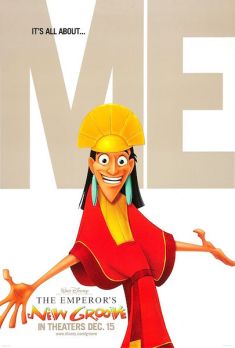 Disney’s 40th (canonical) animated film had a very troubled production, which, from what I can tell, turned it from a derivative riff on The Prince and the Pauper into this load of tosh.
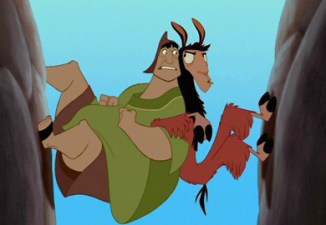 In reality it doesn’t suffer from that too much, and again looked nice and crisp in HD. I usually ignore image quality when it comes to reviews — not that I don’t care, but in these reviews I’m aiming to look at the content of the film rather than the particular copy I watched — but HD has such noticeable benefits for animation (when done well).
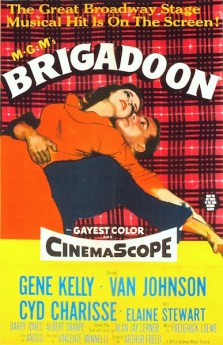 “Oh dear,” is surely the initial reaction to Brigadoon. The Scottish accents are appalling, the costumes and setting gratingly twee, the Highlands recreated entirely on a soundstage. I wonder if many Americans visited Scotland in the wake of this film expecting to find such things? If they did, I imagine they were sorely disappointed.
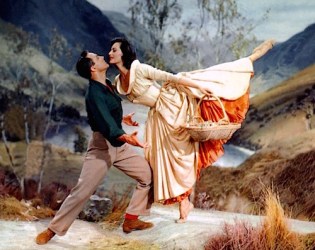 I think it’s fair to say this isn’t the greatest of musicals (though I know some might disagree). The poor realisation of Scotland takes some getting used to — and remains either irritating or amusing, depending on your mileage for such things — and generally there’s a dearth of particularly memorable songs or dances. But it’s not bad either, once things get underway.
 Night at the Museum is fine. And by “fine” I mean less “of high quality… worthy of or eliciting admiration” and more “good; satisfactory”.
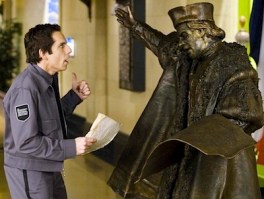 Perhaps it makes it a little disjointed — “here is our character-centric opening; here is the bit we actually wanted to make; here is an exciting climax” — but the tale still rattles by.
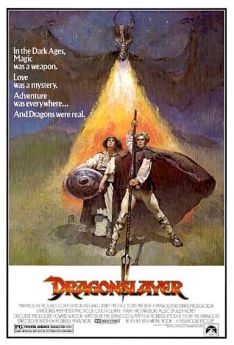 Back when he was still directing
 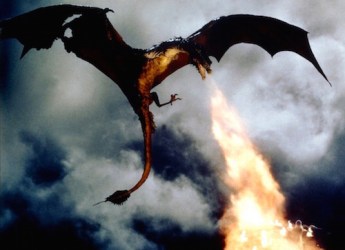 Vermithrax Pejorative is a long time coming, however, wisely kept off screen by director Matthew Robbins. It’s not that the monster shouldn’t be revealed, just that, like
 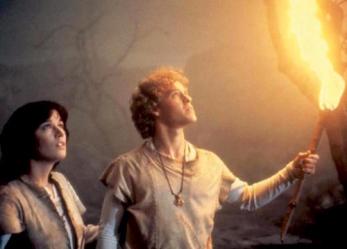 and giant monster than character development. Similarly, an interesting subplot about the move from The Old Ways of magic and superstition to The New Ways of Christianity feels like a good idea that hasn’t been fully integrated, made up of little more than a couple of passing nods and a negatively-inclined inclusion in the coda.
 with conflicting or logic-less motivations and a quest structure that requires no skill (the titular Seeker has to find six ‘signs’ — i.e. little magic MacGuffins — a task which seems to involve waiting around until one falls into his hands, sometimes literally); Cunningham’s direction is over enthusiastic, throwing in jaunty angles and varied film speeds like it’s been outlawed to use a straight shot at 24 frames per second.
 it’s easy to assume the good bits must have occurred by accident, or be left-overs from the novel. Equally, as most occur in the film’s second half, the damage has already been done. They also don’t negate the fact that exciting or inventive action scenes don’t make up for a plot that leaves them bereft of character development, emotion, or truly genuine thrills.
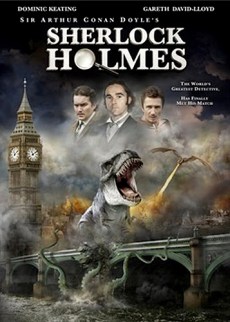 From the company that brought you such pinnacles of cinematic excellence as
 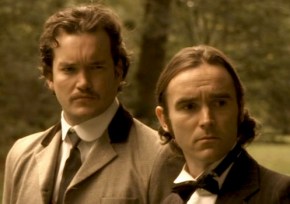 But, in The Asylum’s favour, their Sherlock Holmes doesn’t hide what it is. Yes, it’s called simply Sherlock Holmes rather than Sherlock Holmes and the Implausible CGI Monsters, but at least said monsters are plastered all over the DVD cover (both US and UK). If you see that and still expect something faithful to Conan Doyle, more fool you. That said, at times it’s surprisingly faithful to Doyle’s spirit. There’s some decent-ish investigation and deduction, the story structured like a mystery rather than an action-adventure.
 Anachronisms abound, the best being the first: the film opens in London, 1940, the middle of the Blitz, and the opening shot foregrounds the Millennium Bridge. I don’t think you have to be too familiar with London to know when that was built. Elsewhere we get intercoms on houses, incongruous light switches and period inaccurate telephones, just to mention a couple. It’s shoddy, yes, but almost part of the fun.
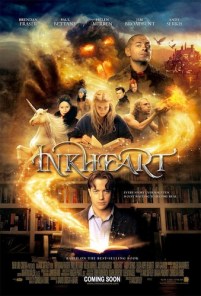 Shot in late 2006, originally scheduled for release in December 2007, ultimately pushed back twice and finally hit cinemas December 2008… what’s wrong with Inkheart?
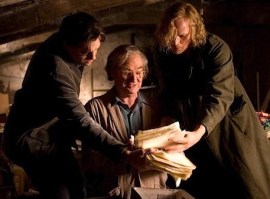 A side effect of not establishing the central concept’s rules is that the film doesn’t play with it enough. What, if anything, happens if you just change the words while reading? How is it determined what comes out of the book, what goes in, and can these be influenced? What happens if two Silvertongues read the same text at once? There are other things it would be interesting to see, but those require a more detailed description of some of the few rules that can be discerned so I won’t trouble you with them now.
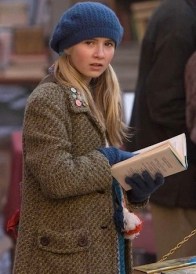 While everyone else is straightforward, predictable and/or pantomime, Dustfinger is torn back and forth between helping the heroes, his inherent selfishness, his fear of returning home, and his desire to see his family again. Brendan Fraser, the ostensible lead, is as adequate as ever but outshone by almost everyone else, not least Eliza Hope Bennett. She’s a minor find as Meggie (who I rather suspect is the main character in the book, but here is trumped by ‘star’ power), displaying more believability than most young teenage leads manage in films like this.
 100Films.co.uk