2011 #43
Sidney Lumet | 120 mins | DVD | 15 / R
Director Sidney Lumet sadly passed away a week ago today. In tribute, I watched one of his many highly-regarded films…
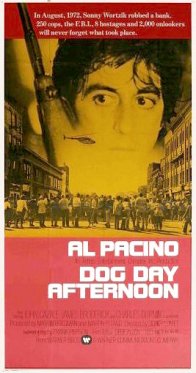 On August 22nd 1972, John Wojtowicz and Salvatore Naturile attempted to rob a Brooklyn bank to raise money for Wojtowicz’s male wife to have a sex change operation. The ensuing hostage situation was watched live on TV by millions of New Yorkers. If you made it up people wouldn’t believe it — especially in the ’70s — which is why this film, closely based on those events, strives so hard for naturalism. And it succeeds, and then some.
There are multiple reasons it works so well, and I’m glad I for once got round to watching all the DVD extras because they reveal these factors very nicely. I’m going to use a liberal sprinkling of those facts as a way into my thoughts on the film, so if you’ve watched those features some of this may seem too familiar. Sorry.
Let’s start where all films do (well, should): the screenplay. Written by Frank Pierson, based on a magazine article about the true story, it was his screenplay that attracted both director Sidney Lumet and star Al Pacino to the project. It’s immaculately structured, from the excitement of the opening — a confused, amateurish bank robbery — through negotiations with police, emotional telephone conversations, and on to a nail-biting finale at JFK airport. The pace is well considered. It doesn’t rush through events but it never flags; the tension is maintained but important emotional scenes are never sped through. More on that in a moment. Importantly, the plot’s numerous reveals are well managed too — for instance, Sonny’s homosexuality and transgender partner are revealed quite far in, by which point we’ve already built a firm opinion of the characters. This was important for a ’70s audience (as Lumet suggests in his commentary), 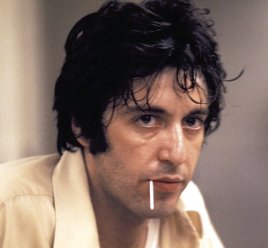 to try to circumvent built-in prejudices that would’ve adversely affected an audience’s reaction too soon. It still works now — it’s not a twist, per se, but it is likely to change one’s perspective on the film and its characters mid-flow, which is always interesting.
The dialogue is also spot-on, but that’s not all down to Pierson. While rehearsing, Lumet was so keen to capture a realistic tone that he allowed the actors to improvise the dialogue. This was working so well that he had it recorded, transcribed, and Pierson rewrote the dialogue based on the cast’s improvisation. (His scenes and their order remained intact, just the words were changed.) This, coupled with additional improvisation techniques used on set, lends a believable tone to the characters’ actions and words — they’re not speaking dialogue, they’re just speaking.
In terms of performance, this is a real showcase for Pacino. As Sonny — the movie’s version of John — the whole film rests on his shoulders, and he’s more than capable of bearing the weight. Some roles allow an actor to subtly be good throughout the film; others allow a few grandstanding set-pieces where they can Act; but Dog Day Afternoon gives Pacino both. The latter are, naturally, easier to recall: the way he works the crowd (“Attica!”), the pair of draining phone calls to his wives; but most of all, the will-writing scene. As the climax looms, Lumet allows the time for Sonny to dictate his will in full to one of the bank girls. Pacino is brilliant, understated but — in a combination of performance and writing (though, in this case, the text is taken from the real-life will) — revealing, cementing some of the conflicting forces that have pulled on Sonny throughout the film.
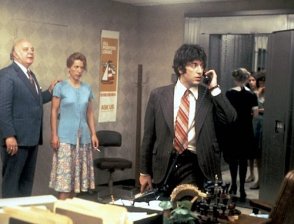 In trying to get a handle on the real Sonny when he was starting on the screenplay, Pierson talked to various people who knew him, but struggled to reconcile their conflicting accounts of the same man. The link he found was that Sonny was always trying to please people, and that’s what he used: in the film, he’s not just out for himself or his boyfriend, but also trying to placate and please his hostages, the police, the media, his partner, his mum, his other wife… Pierson and Pacino do indeed make him a different man to all of them, and this is one of the reasons Sonny is such a great character and a great performance: he’s genuinely three-dimensional. All of us behave differently, to some degree, when we’re with different people — we don’t necessarily realise it, because they’re all facets of the same us, but we do it — so to put that into a character is to make him real.
Pacino is propped up by a spotless supporting cast, all of whom get their moment(s) to shine and use them to excel. Of particular note is John Cazale as Sal, the other robber. It’s a largely quiet role, but he nonetheless conveys an awful lot with it. Lumet says that Cazale always seemed to have a great sadness in him, which you can always see come out in his performances, and he’s certainly right here. We learn very few facts about Sal during the film, but we still know him, you suspect, as well as anyone does.
Chris Sarandon is also superb (and Oscar nominated) as Leon, the gay wife who wants a sex change. Lumet was keen to avoid presenting a stereotypical homosexual type, 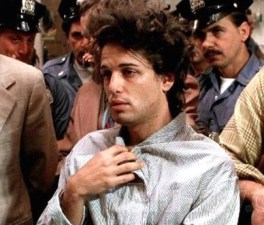 throughout the film trying to avoid turning any of these unusual characters into freaks, and Sarandon pitches it right. He plays the truth of a conflicted, confused character; a man who is perhaps easily led but hard to please, I think. As with the rest of the cast, the little touches he brings — such as starting a sure-to-be-emotional phone call to a man currently in the middle of a tense hostage situation with “so how are you?” — sell the reality of the piece.
Capturing reality is clearly Lumet’s prime concern — it’s reiterated multiple times across all the special features — and I think he succeeds admirably. Some things we might not even notice — the film is lit with natural light outside, the bank’s real fluorescent lights inside, and the nighttime sequences by a genuine police van reflecting off the white front of the bank — while other things, like the complete lack of a musical score, are more readily apparent. I say that, but that’s not readily apparent: one may well notice, but it’s such a perfect decision that it never rears it’s head. Lumet argues that having an orchestra chime in to underline an exciting or emotional moment would have broken the realism of what we’re watching, and he was right — there’s not a single scene here that could be improved by music, but several that would have been damaged by it.
The way the film’s shot supports this too. This is from the ’70s remember, before the craze for faux-documentary and everything being handheld, so it still looks like a film, but it’s not one that’s been precision-staged. Indeed, quite the opposite. Everything is kept loose — sometimes actors block each other’s shots, or talk over each other, or the handling of a prop goes wrong, and so on — but Lumet leaved it all in, even plays it up at times, and makes it work to his advantage. Rather than being the obvious “we’re trying to make this look real”  of today’s grainy shakycam stuff, this just feels real; the heart and truth of it come through, not the surface sheen of it being documentary footage. That’s more important.
There’s great editing by Dede Allen too, though most of the time it goes unnoticed: in keeping with the aim of letting the audience ‘forget’ this is a film, most of the cutting is simple and natural. Two examples leap to attention, however, and those are the two times (the only two times) guns are fired. Lumet and Allen recreate the confusion and violence of such an event with a smash of fast, sub-one-second cuts on both occasions. We see mindless fast cutting all the time now, but this incongruous example shows the effectiveness a fast montage can have when done by the right hands. The soundtrack also jumps with each cut, which is equally vital to the slightly disconcerting way it works — they’re not just smoothing over this series of flashing images, we’re being deliberately disorientated by them.
Remember earlier I mentioned Pierson’s pace? The editing plays a role in that too, naturally. After the film had been tightened for the final time, Lumet felt it had lost something, especially when it came to the will-dictating scene, which now felt slow. So with Allen he went back and added six or seven minutes of footage back in — as with his staging, making it a bit looser, more naturalistic, and in the process fixing the pacing issue and making the important will scene feel right again. Without being able to see that cut it’s hard to say just how necessary it was, but as the final result feels so right it seems his instinct was a good one.
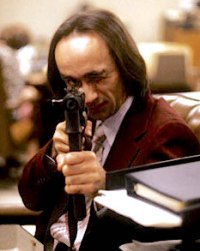 Pierson’s screenplay won at the Oscars. The film was also nominated for Best Picture, Actor, Supporting Actor and Editing, but this was the year of One Flew Over the Cuckoo’s Nest so that took most of the big awards. That’s another of those all-time classics I’ve not seen, so I can’t offer my personal take. What I will say is that it goes to show (as most of us I’m sure already know) that the Oscars are as much about the year you’re in as the film itself: Dog Day Afternoon is better than masses of films that have won the same awards before and since, but clearly it got an unlucky year.
I’ve written quite a lot here but, brilliantly, I’ve still only got a certain way beneath the surface — there’s plenty more in there. That’s always the mark of a good film. And there’s certainly more memorable anecdotes and interesting directorial techniques I learnt from the special features that I’ve left out. Lumet set out to make a believable film about an unbelievable situation, and I do believe he achieved that goal. These are normal human beings with normal emotions — not like you and I, perhaps; taken to an extreme, certainly — but in a very bizarre set of circumstances. It was important to Lumet that they didn’t come across as freaks and, with the help of Pacino and the rest of his cast, I think they’ve achieved that too.
 The film treads a delicate line between drama, comedy and thriller, but doesn’t once tip too far in any direction. It’s got several genuine laughs, but none compromise its serious side or claim to reality — it’s tense and touching too. Anyone else making a film about an extraordinary situation, be it a true story or from the mind of a crazed writer, would do well to look at Lumet’s work here.
Dog Day Afternoon is on ITV tonight, 19th November 2014, at 2:30am.
See also my review of the documentary short about the making of Dog Day Afternoon, which is also on the DVD, Lumet: Film Maker.

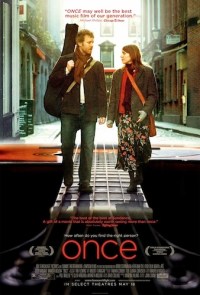 Once is a very modern indie musical. And I mean indie as in “indie film”, not “indie music”. Lord save us from a musical of indie music.
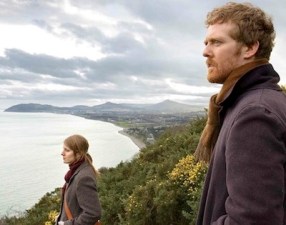 It’s a testament to the strength of the lead performances and the story they create that it’s not until the end credits roll you realise you never even knew their names.
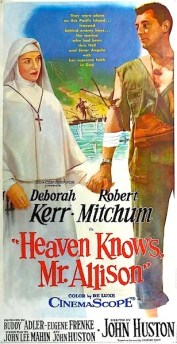 The title may sound like a ’40s rom-com or a ’70s TV sitcom, but Heaven Knows, Mr. Allison is nothing of the sort. It’s set in the south Pacific in 1944, at the height of World War II, and begins with titular US Marine Allison (Robert Mitchum) washing up on an island that’s occupied only by a novice nun, Sister Angela (Deborah Kerr). He was the only survivor of a Japanese attack on a submarine; she ultimately the only survivor of a Japanese raid on the island. With no hope of rescue they must plot their own escape.
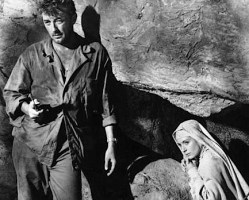 There’s also a kind of burgeoning romance between the two — as a novice nun she has yet to take her final vows — which creates a different kind of will-they-won’t-they than the usual love-hate dynamic. It all leads to a pleasing ending, where your expectations for what a Hollywood film will do (especially with the groundwork that’s been laid) are subverted in favour of a more plausible turn of events. It’s not the kind of ending that makes the film — it’s already done more than enough to hold one’s interest — but if done wrong I think it would have undermined the rest.
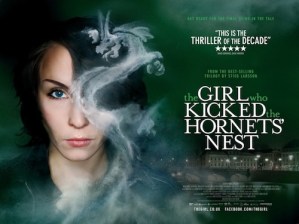 The Girl Who Kicked the Hornets’ Nest — or, in America, Hornet’s Nest (oh, Americans!) — or, translated from the original Swedish, The Pipe Dream That Was Blown Up — or, according to a different translation, The Air Castle That Was Blown Up (guess that’s a cultural thing…) — is the third and final part of Stieg Larsson’s Millennium trilogy.
 while the villains futilely attempt to stop the heroes publishing everything they already seem to know.
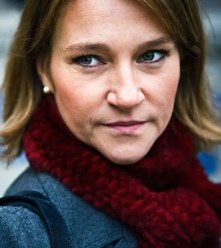 The other cornerstone of the film is Lisbeth’s trial for the attempted murder of her father at the end of Played with Fire. The final third of the film is dominated by a series of immensely satisfying courtroom scenes in which the defence trounce the opposition, not through American-esque grandstanding but through a quiet and thorough application of facts and truth. You can see the satisfaction bubbling under Lisbeth’s almost-static face as the prosecution unknowingly hang themselves, the defence — Mikael Blomkvist’s sister Annika, for what it’s worth — holding back her killer evidence until the prosecution have dug themselves a pit so deep even this mixed metaphor would be buried. Both Lisbeth and Annika walk all over them by remaining calm and logical, dispatching the case against Lisbeth in a way that becomes an absolute joy for the viewer.
 It means Lisbeth remains an unknowable, elusive mystery, but then isn’t that part of what makes her so fascinating? The full exposure of her troubled (to say the least) history in this episode clears up some of her ambiguity without lessening her as a character. It’s a testament to the understated excellence of the performance that actions as little as a smile or saying “thank you” are huge revelations.
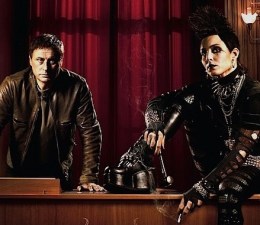 the second balances on top of the events in its predecessor. The difference is, I properly enjoyed Hornets’ Nest. I wouldn’t watch it again in isolation (unlike Dragon Tattoo, which doesn’t need its two sequels to function as a story), and perhaps it had too much going on for its own good — or perhaps I’m being too demanding of the intricacies of the investigation — but it’s a solid final episode with a lot of satisfying moments.
 So begins Monsters. Expecting an epic SF-action movie where soldiers kitted out with futuristic weaponry battle an alien menace? You might be disappointed. Indeed, the relatively low
 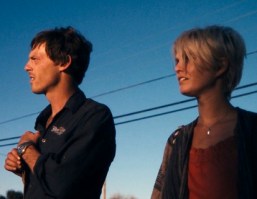 Only without being as worthy or on-the-nose as that makes it sound, I promise. As writer-director, Edwards has made a film that’s relatively Arty (for want of a better word), with lingering shots and wordless scenes. It tells the story visually quite often, letting the Infected Zone signposts or candlelit shrines to dead children or stunning scenery do the talking when dialogue isn’t necessary.
 The CGI is virtually faultless, which is doubly impressive as the vast majority of it is on shaky handheld shots, not nice clean plates. And Edwards created it all by himself I believe. Writer, director, cinematographer, single-handed visual effects unit — it’s no wonder much of the focus on Monsters has been on the clearly considerable skill of its creator. Much of the CGI would, I imagine, pass the casual viewer by: everyone knows the aliens are CG, but the film is littered with signposts and other such set and scenery extensions. It’s the kind of thing a bigger budgeted film would simply have created physically, but, working with next-to-no money, Edwards has managed to paint flawless versions of everything from simple road signs up to border checkpoints with his computer (and even bigger things, but they’d be CG’d in a big-budget movie too, so… well, hopefully you see my point). There’s the odd thing that doesn’t sit with complete realism, but even that depends how hard you’re looking. I’d say they’re the exception rather than the rule and very easy to forgive — nothing ruins its own shot, never mind the whole film.
 it’s easy to think what we saw in the night-vision sequence has led to this. But it hasn’t, because the military were Americans and we’re in Mexico. I’d wager this passes some viewers by, and perhaps it’s meant to, but there’s another clue: one of the soldiers whistling the Ride of the Valkyries; and when we get to the end of the film, as a pair of humvees trundle out to retrieve our heroes (by this point stranded in an evacuation zone just inside the US border), we hear the same soldier whistling again. And here’s where the change comes: rather than reaching the bit we’ve already seen and going beyond it, Edwards cuts off before he even reaches it. To put it another way, the chronological end of events is only at the beginning. It’s quite clever, and it also obscures what happens to the characters (how I shan’t say). That’ll irritate some, especially as even when you piece it back together it’s inconclusive. I’ll leave it to others to argue whether that’s the point and whether it matters. The final shot is clever though: instead of closing on the characters’ finally kissing, it ends on them being pulled apart. Technically their separation is only temporary — they’re both going with the military after all — but, as we saw at the beginning, one of them might not survive the journey home; a more permanent pulling apart. Nice metaphorical linking, Edwards.
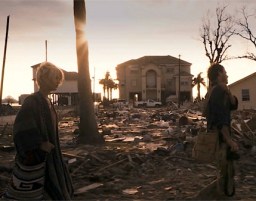 Another review I read somewhere commented that it’s a shame
  emerging with their low-budget, story/concept-driven genre films, not to mention Chris Nolan being allowed to do more or less what he likes in the big budget sphere, it’s easy to see why this is a very exciting time to be a lover of proper science-fiction. If they all continue to make films like this, we can look forward to an astounding future.
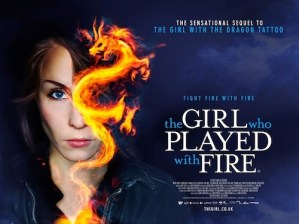 Creating any kind of sequel is hard — the endless array of failed attempts is testament to that — but I think creating a direct sequel to a successful crime thriller may be the hardest.
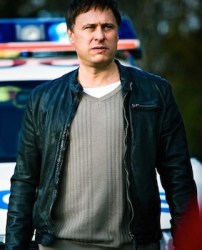 and they need a brand new case to become embroiled in. And it’s got to be as good as the last one, but it can’t be the same because we’ve had that mystery solved. You could have a different solution, of course; you could change some of the details, naturally; but police dramas on TV vary their types of murders every week for a reason. So in your new tale, the new characters have to be just as interesting as the first batch, the new mystery has to be just as intriguing too, and it really ought to be a notably different crime being investigated.
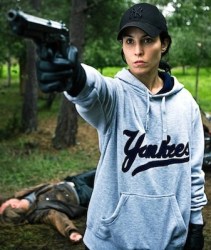 One solution to the sequel problem is to “make it personal”, and that’s exactly what we get in The Girl Who Played with Fire. A journalist and his girlfriend working for Mikael are murdered and Lisbeth is suspected of the crime. It’s somewhere around here that the coincidences begin to pile up. It makes perfect sense as a plot in itself, but in bringing Mikael and Lisbeth back together it doesn’t work — it’s not related to their previous encounter, so it’s entirely coincidental. Coincidence is a dangerous thing in fiction; it asks your audience to accept something that doesn’t fit our logic of how stories work. It happens all the time in real life of course, but in real life a flipped coin with a 50/50 chance of being heads or tails could turn up heads twenty times in a row, but a person asked to estimate twenty results of a flipped coin will never put more than two or three of one side in a row (unless they know to subvert it… look, this isn’t the point).
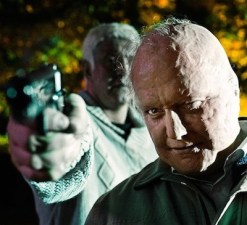 it’s never seriously looked into and, consequently, other dramas have tackled the issue with greater depth, sensitivity and insight. What Mikael and Lisbeth are actually looking into is a conspiracy of sorts around some murders. The way the trail is followed isn’t as clever as it was in Dragon Tattoo and, consequently, isn’t as interesting. The two protagonists go about their investigations independently. This is a long-held technique in novel writing — multiple strands allows the author to alternate which is followed from chapter to chapter, almost by itself providing momentum and the must-keep-reading factor as the reader has to race through the next chapter to rejoin the thread of the previous one (it’s not that simple or we’d all be churning them out… but look, I’m getting off the point again). The problem here is that Dragon Tattoo was largely at its best when the two were together, so keeping them apart is less satisfying. To top that off, they’re each finding out different things, which means as the audience we can feel a few steps ahead of the characters as we have the benefit of both sides of the case. That’s not always a bad thing, but it can be slightly disconcerting when you know the answers your hero is still searching for.
 Despite Lisbeth being the focus of much of the attention laden on these books/films/remakes, she’s a less engaging character when by herself. Here she shuffles around silently, digging up files that she and we stare at to reveal information. There are only a few moments for her (and, consequently, Noomi Rapace) to show off what endeared her to viewers before — her confrontation with a pair of arson-bent bikers, for instance.
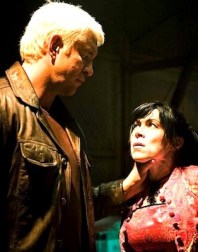 It also feels less filmic than the first film. Is it poor direction? Is it just the opened-up 1.78:1 ratio? I’ve read that all three films were shot like this, as they were intended for Swedish TV, meaning Dragon Tattoo’s Blu-ray is cropped to 2.35:1. You hardly ever see 2.35:1 on TV (
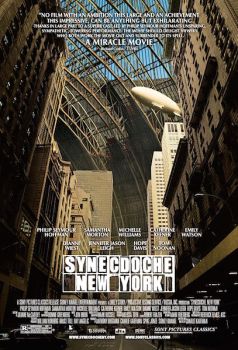 Despite its unpronounceable title, Synecdoche, New York starts out like a relatively normal comedy/drama… but then weird touches begin to creep in. A house that’s on fire when a character buys it and continues to be on fire for the next several decades, for instance. No one in the film bats an eyelid. Then the really weird bit arrives; the bit you all probably know; what the film’s about (except, of course, not what it’s About), as Philip Seymour Hoffman’s theatre director begins to construct a life-size New York within a warehouse.
 and I haven’t begun to care in the months since I watched it. It’s the kind of film where, as it gets on, you feel it’s a rich experience that you’ll have to ponder for a bit once it’s done, even if there’s something you quite fancy watching on the same channel immediately afterwards. But by the end it became the kind of film I was fed up with pondering, and I bloody well watched what was on the same channel immediately afterwards. Kaufman’s weirdness can wear you down to the point where characters who were interesting and ideas (both plausible and of Kaufman-logic) that had potential cease to be worth caring about; where you go from the point of “I’ll look up an explanation on the internet once it’s finished” to “…meh”.
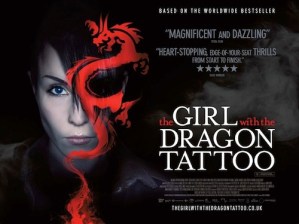 From the same production company that brought us the
 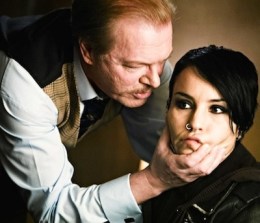 The original title translates as Men Who Hate Women, which is certainly very apt. The subject matter is grim and dark; horribly plausible, in fact. It’s unwaveringly depicted with some brutal, hard-to-watch scenes. They’re not exploitative though, as a lesser film merrily would be, and that makes them appropriate to the tale being told. Subplots about the two leads support the themes underpinning the main investigation — both about abuses of power, in different ways — justifying their apparent tangentiality, and consequently the film’s length.
 Despite the modern stylings, dark themes and attention-grabbing characters, much of the film unfolds as a procedural whodunnit like, for instance, the Wallanders, complete with piles of red herrings and last-minute twists. This is probably why the book has sold so well and the film has taken over $100 million worldwide: it tickles the same nerves as all those ever-popular TV police dramas. Indeed, this adaptation is rooted in a television miniseries (an extended version exists as two 90-minute TV episodes) but it doesn’t look like it: it’s quite beautifully shot; not showy or stylised, but there are some lovely shots of scenery in particular.
 With Dragon Tattoo featuring material that seems ideally suited to the director who gave us
 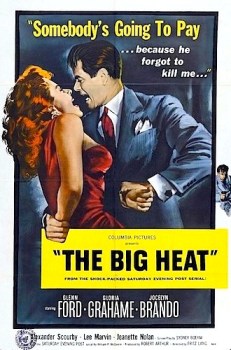 Fritz Lang is probably best remembered for the films he made in Germany; medium-defining classics like
 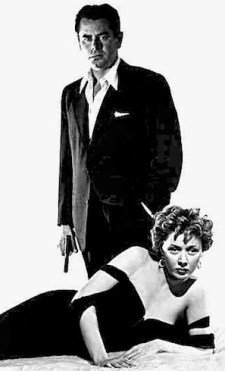 but it does manage what might be described as twists in how far it’s willing to go — mainly, who gets killed and how.
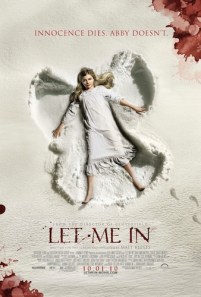 Owen is a 12-year-old loner in New Mexico in 1983, spending his days at school being bullied and filling his evenings spying on his neighbours. Then a girl, Abby, and her father move in next door and it looks like he might finally make a friend.
 The nighttime scenes are bathed in the orange glow of street-lighting, a nice choice of colour scheme as it’s evocative of the real world, especially as it’s not unnaturally overdone: the colour is abundant where there is such lighting, but more natural tones are used in forests, etc. It also provides a very different feel to the original, where a more white, snow-emphasising light was adopted throughout. Despite its realism, though, such a solidly orange palette does make the US one feel more visually stylised. Ironic.
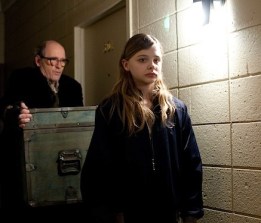 Despite it being easier to spot omissions than additions, Reeves’ film runs the same length as the original and feels faster moving. This may just be because I knew the story well, watching both versions just 24 hours apart, but some things are quantifiable: as well as far fewer scenes with the neighbours — in the original, characters; here, victim-extras — there’s also fewer arty shots of scenery, which helped give the original its sedate arthouse tone. What’s taken the place of all these things? Scenes from the novel, you might think, but from what I’ve read it’s faithful to the film more than novel — stuff I’ve read about being in the novel but not the Swedish film hasn’t been reinstated here either.
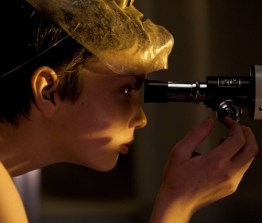 It seems he isn’t innocent in the same way Oskar was, that Reeves is building up his awareness of sexuality… but then he asks Abby to go steady and he still considers it to mean you don’t “do anything special”. What? Also, if she says “I’m not a girl”, surely the logical response is “you’re a boy?!”, not “what are you?” — especially if the only answer she’ll give is “I’m nothing”. But she’s not a boy — probably. It’s not explicit, but she seems much girlier, and of course it would remove any dangerous homosexual element. Or possibly they just wanted to make damn sure they didn’t need to include The Crotch Shot. Considering they’ve changed the bully’s teasing of Owen from “piggy” to “little girl”, it seems even more obvious a shame to have stripped Abby of her androgyny. Unless that’s the point? They tease Owen about being a little girl, before getting their asses kicked — or, rather, bodies ripped apart — by one.
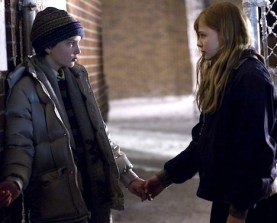 Similarly, the CGI is overdone throughout. It’s not bad per se, just used too overtly. Whereas the original remained grounded and (perhaps surprisingly) plausible, Reeves occasionally indulges in more stereotypical horror movie excess — take Abby’s first attack in the underpass, for instance: superficially similar, but in this version a computer-aided Abby flies all over the place. It draws attention to its has-to-be-fakery and is therefore a less effective sequence.
 It’s probably unfair to judge Let Me In by watching it so close to the Swedish version. I expect it benefits from a bit of distance. It’s still a well-made film, still an unusual take on a familiar genre. But it is — obviously — not as original or innovative. It’s also not as well acted, not as nuanced, not as beautifully made — the images Reeves conjures up do not burn themselves into your mind in the way so many from the original do.
