
Tomas Alfredson | 115 mins | Blu-ray | 15 / R
 Oskar is a 12-year-old loner in Sweden in 1982, spending his days at school being bullied and filling his evenings with fantasies of revenge. Then a girl, Eli, and her father move in next door and it looks like he might finally make a friend.
Doesn’t sound like the setup for a vampire movie, does it? But, as you’re no doubt aware thanks to all the awards its won and praise its received in the past two years, Let the Right One In isn’t your typical vampire movie. If you’ve somehow managed to avoid hearing anything about it in that time, I encourage you to watch it before reading more — it’s hard to discuss any of it without spoiling at least some. Knowing it’s a vampire movie is too much, to be frank — it’d be grand to be able to see this completely cold.
And “cold” is an apt word (smooth link, eh?) as one of the many things that seems to mark the film out is the abundance of snow. We’re used to vampire films being Dark, visually, due to the necessity of a nighttime setting, but here the snow-covered locale makes most of the night scenes bright and white. Alfredson emphasises this with wide compositions that fill the frame with the white stuff.
Even more unconventional is the film’s treatment of vampires themselves. It’s not uncommon for tales to Do Vampires Differently by changing the basic rules, but Let the Right One In sticks to them — they drink blood, typically from the neck, can’t enter without invitation, burn up in sunlight, can fly — and changes the myth in less showy but more fundamental ways.  For instance, when the usual skills do crop up, they’re presented in a very grounded way — any CGI required is used subtly and incredibly effectively — or kept off screen. They’re at the best when used to slightly emphasise Eli’s weirdness — the way she drops ever so slightly slower than is natural from the climbing frame when she first meets Oskar, or to shape and manipulate her face almost imperceptibly at times.
Primarily, however, most vampire films glamorise their lifestyle in one way or another, even when they’re the villains; this is especially bad right now, with the likes of Twilight befouling our culture, but it’s nothing new. But being a vampire Let the Right One In-style is no fun at all, characterised by painful hunger, the difficulty of getting food undetected, guilt after successfully feeding, and, perhaps worst of all, loneliness.
Loneliness is the real key to the film because, even with all the horror — and the film is scary when appropriate — this is about two lonely outsider kids finding each other and getting something they were previously lacking from that newfound human contact. It’s a romance, in fact; a mixture of first love and true, pure (read: sexless) love. Though that’s not entirely true — it’s more complicated than that.
 The story’s central relationships — mainly, Eli/Oskar and Eli/Håkan, he being the ‘dad’ figure who helps Eli survive — can be read various ways. The author/screenwriter, John Ajvide Lindqvist, has one interpretation — indeed, based on what I’ve read, the novel is quite clear on these points — but the film leaves many facts ambiguous. Is Håkan related to Eli? Does he love her? In what way? Does she love him? Does she even like him? Is he just a facilitator? Was he once in Oskar’s position? If he was, is she just manipulating Oskar? Or is it really love? Or is it just friendship? The joy of such well-placed ambiguities in a story is that each viewer can bring their own interpretation, without anyone being clearly right or wrong and without undermining the quality of the story being told. I think I know what I think; but, just as much, I enjoy the fact there are numerous possibilities. (Of course, equally valid is the argument that there are no ambiguities because most if not all have been cleared up Lindqvist and/or Alfredson in interviews. But where’s the fun in that?)
I said it was “sexless love”. Perhaps, though sex is certainly a theme — not only because it always is with vampires (the intrusive nature of what they do & all that), but also witness the scene where Eli clambers into bed with Oskar naked, or when he catches a glimpse of her changing and we get a rather explicit close-up. They’re both 12-year-olds, it’s easy to see why some/many/most would be wary of touching on any sexual overtones in the film, but they’re definitely there. Interestingly, Oskar is every inch the innocent, with his white-blonde hair, pale skin, cherub face, with it’s slight-but-heartfelt flickers of emotion, be that joy or triumph or sadness; to whom ‘going steady’ with a girl means nothing changes and you don’t do anything special. Does that negate the film’s sexuality? Or does it just mean Oskar is the antithesis of the corrupted Eli?
 Though most of Let the Right One In’s irregular take on vampires seems genuinely unique, one of those unusual elements — a 12-year-old girl being a vampire — immediately draws comparison to Interview with the Vampire. However, unlike that novel/film’s child bloodsucker Claudia (Kirsten Dunst’s character), who becomes an increasingly older woman trapped in a child’s body, Eli seems to have remained 12 — just like she says — even though she has existed for a very long time. Which version is more plausible? Well, let’s put it this way: vampires don’t exist. Duh. Both work for their respective points; neither disqualifies the other from being an interesting take on the creatures.
Another interesting point I learnt while reading up on the film is that Lindqvist’s novel is, apparently, somewhat autobiographical (aside from the vampire stuff, obviously). Oskar is Lindqvist, essentially, and it seems Alfredson could relate too. Perhaps this is what helps it feel so true. The character stuff, I mean, not the vampire stuff. Maybe that’s why Let Me In struggles to translate the tale as effectively: it’s taking a story set in a specific time and place for a reason (Lindqvist was 13 in 1982; plus it’s a year that has other significance for Sweden), and mashing it into a different one by someone who, maybe, doesn’t have quite as personal a connection as the previous authors.
I haven’t read the source novel so can’t make a comparison. Lindqvist adapted his own novel, making cuts partly to get past censors — one article I read asserted that,  if they’d filmed some of the stuff in the novel, the filmmakers would’ve gone to prison — but also about refocussing the story to be a two-hour film instead of a novel. I’m not sure, therefore, how faithful the climax is, but it’s a sequence that seems made for the screen. I shan’t say much more on this point, just in case you’ve not seen the film and still read this far (tsk tsk), but it seems having a vampire for a best friend is a great way to deal with bullies.
Winning many awards and garnering much praise can sometimes hamper a film — especially when its hailed as an outstandingly innovative take on something familiar — but Let the Right One In manages to live up to this promise. It’s a horror movie and a character drama and does neither by halves, instead combining the two to transcend genre boundaries and just become bloody good.

Let the Right One In placed 3rd on my list of The Ten Best Films I Saw For the First Time in 2011, which can be read in full here.
See also my comparison of this and its US remake, Let Me In, here.
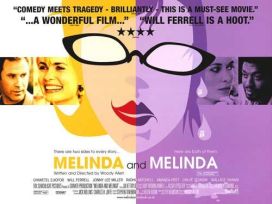 Despite the city being as associated with him as jam is with donuts, Melinda and Melinda was Woody Allen’s last New York-set film before he began his current European phase with London-set thriller
  If it wasn’t for the framing device that clearly tells us not only the thematic point of the film but also which bit is the comedy and which the tragedy, I don’t think it would be immediately possible to tell which was which. Indeed, one might think that was Allen’s point: life is neither tragedy nor comedy, but both at the same time, so of course you can’t tell the difference. But as it goes on the comedy does introduce a couple more laughs, but even more so a general niceness that leads to the predictable rom-com ending. Concurrently, the tragedy introduces darker elements and refuses to provide a neat, conclusive or satisfying ending, which is both thematically sound (I suppose) and also dramatically frustrating.
 and then they’ve crafted them completely independently. So that is to say, for instance, that the same restaurant may appear in both tellings, but at different points and with a different scene taking place; or in one storyline the director-character is an outsider who holds the husband’s future in his hands, while in the other the director-character is the wife and a different outsider holds her future in his hands. If that makes sense.
 Fresh from winning three BAFTAs (out of six nominations), the Aaron Sorkin-written David Fincher-directed telling of the birth of Facebook arrives on DVD and Blu-ray in the UK today. Notice that Sorkin and Fincher have equal-sized billing on
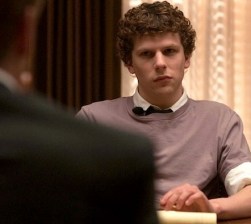
  Conversely, look at all the film’s conversations. Let’s draw on one that’s discussed in the making-of material, the scene between Mark Zuckerberg and Sean Parker in the club: as Fincher says, he could’ve had a Steadicam endlessly circling them or something similar to make it seem Fast and Hip, but in reality you need to see the conversation, and especially Mark’s reactions, so instead it’s just a good old fashioned shot-reverse-shot. For all his visual prowess, it’s understanding this need for simplicity and (g)old standard techniques when appropriate that Fincher has had a handle on throughout his career.
 Also, that it’s going to be funny and exciting. That style colours the film: fast talk, complex talk, but funny. As people admit in the special features, this is a very dialogue-driven film. Don’t misunderstand me, though: the dialogue scenes are not one-note by any means — there are slow scenes, and even scenes without any dialogue — but anyone anticipating the full implications of “Screenplay by Aaron Sorkin” will not be disappointed.
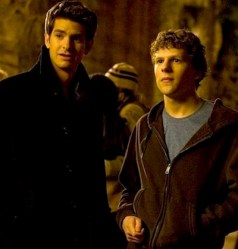 Nominated but unvictorious were stars Jesse Eisenberg and Andrew Garfield, for Best Actor and Best Supporting Actor respectively. They’re not the only ones deserving praise though, because every performance is bang on. Eisenberg manages the enviable feat of making Mark a plausible genius, an entertaining friend and an absolute bastard, not in different scenes but, often, all within the same line of dialogue. There are lines that made me laugh out loud while at the same time thinking “what a [four-letter name of choice]”. That’s Sorkin’s writing too, of course, but Eisenberg nails it.
 Then there’s Justin Timberlake. I can understand why people would be wary of such casting, and playing the bad boy/playboy part of Napster creator — and destructor — Sean Parker might not seem too much of a stretch. Actually, there are moments that require a little more than that, and Timberlake’s up to the task. Armie Hammer tackles the dual role of the Winklevoss twins. You can’t tell which is which, beyond that in any given scene one will be hotheaded and one calmer. I expect it’s always the same one that’s whichever, but as they both look exactly the same…
 it’s set to an addictive electronic rendition of In the Hall of the Mountain King, and though the whole sequence is a showpiece, that’s as much thanks to the music as the visuals. These are just two specific examples — throughout, the music excels.
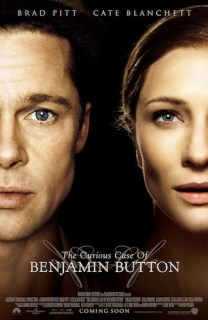 Benjamin Button was released in UK cinemas two years ago last week. Time really does fly. The critical reception was a little divisive — the
  The visuals in general may be Benjamin Button’s strongpoint, holding up a variety of era-evoking colour palettes and other design elements as it passes throughout the 20th Century. Flashback-like asides are conveyed in older film styles — scratchy prints for instance, or with a silent movie aesthetic — that on the one hand could seem an inappropriate indulgence, but objectively work very nicely. For a director who has a reputation in some corners for exhibiting excessive flair with swish shots and effects, Fincher shows steady restraint here — as he did in
  but Button didn’t feel nearly as episodic, nor nearly so obsessed with History. Benjamin encounters foreign diplomats and is embroiled in World War 2, but both are relatively non-specific and don’t colour his life in the way Gump’s parade of Defining Moments do. Instead the storytelling is character focused. Viewer awareness of time passing in the narrative is left to the odd snippet of dialogue or obvious jump; aside from a few clear points, there’s a less convincing sense of era than Fincher evoked in Zodiac. Whether this matters or not is debatable — Button isn’t a chronicle of the 20th Century through one man’s eyes, which is what Gump arguably was, but is rather the story of a (somewhat unusual) life lived during that timed period.
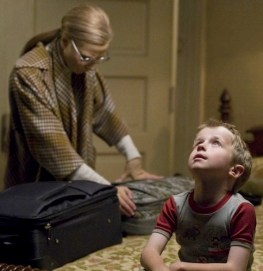 Or perhaps it’s the very point: the more things change, the more they stay the same. Benjamin is ageing in completely the opposite direction to the rest of us, and yet his life isn’t all that different. Witness the end of the film (naturally, spoilers follow): Benjamin loses his language and memory, his life fading away as his brain fails. Presumably this is because he’s regressing to childhood, his brain shrinking and devolving to that of a child/toddler/newborn, but don’t we see the same thing happen to adults with dementia? As Daisy observes earlier in the film, “we all end up in diapers”. A life backwards is not so different to a life forwards, then. It’s all in how you live it, that kind of thing.
 Ultimately, Benjamin Button strikes me as less than the sum of its parts. Bits are good, even very good — “bits” both as in story episodes and technical elements; and I particularly like the sections with Jared Harris, who’s always worth watching — but what does it add up to? It’s quite long and, unlike Zodiac, feels it. It may be easy to admire, but I find it awkward to love.
 How time flies — I’ve been meaning to re-watch Zodiac ever since I
 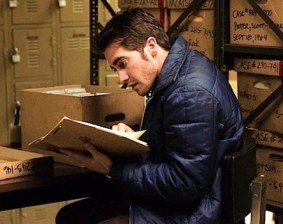 As the changes have little impact on the film’s fundamental quality, the points in
 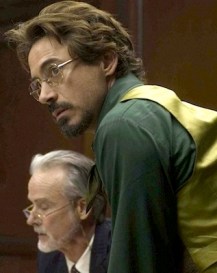 but the sheer weight of evidence the other way seems to leave little room for doubt. More so, then, is that the murders are done with before the halfway mark. That’s because it’s still following the story of the investigation, true, but a lesser filmmaker could have weighted it differently, rushing through Graysmith’s later enquiries in a speedy third act. Instead, Fincher’s focus throughout is on the people looking into the crime, and it’s as much the tale of their obsession — and what it takes to break their obsession, be it weariness or pushing through ’til the final answer — as it is the tale of a serial killer.
 and place-and-time subtitles too, but hey, sometimes you need specificity.
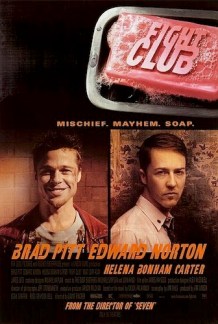 I used to have a friend who loved all kinds of action movies and rap movies and other kinds of violence-obsessed forms of entertainment. He once tried to watch Fight Club, in the wake of the praise poured upon it and no doubt interested in the visceral thrill of the fighting element, but got bored about halfway through and turned it off. He was not impressed. Please note that halfway through is certainly after the titular club, and all its associated antics, begins.
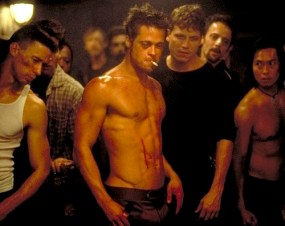 Perhaps I’m coming at it from too privileged a background? I don’t know. But I still don’t believe people would be so easily led as Ebert implies; and those that might be probably got bored and switched off.
 and what he’s lacking as a human being. That just underscores the action, however; it adds something to the film, certainly, but there’s nothing there to lead viewers to “leave the movie… discussing [its] moral philosophy”. Fight Club, on the other hand, is more forward about its thematic points. Both the Narrator and Tyler spout philosophical tidbits at various points, and their differing reactions to the path they take considers this too. It still works as a story — it isn’t just facilitating an essay on the subjects of free will and consumerism — but it’s more present, and presents more to consider, and perhaps discuss, than The Game does.
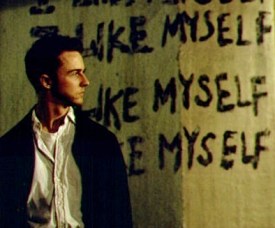 Fight Club explores what might happen if he were, but leaves it up to the viewer to decide if it turned out for the best (while strongly erring, despite what Ebert suggests, to the side of “no”).
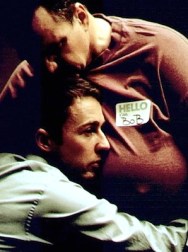 To round off this defence of Fight Club, let’s call up the BBFC (this is the point I said I’d return to). You may remember they cut four seconds of violence from the film (reinstated in 2007. Incidentally, the MPAA had no problem whatsoever with the violence but questioned some of the sex, such as Tyler being seen wearing a rubber glove. American values regarding sex/violence on film and TV are seriously questionable.) In 1999, when asked to ban the film for glamourising and encouraging the kind of behaviour it contains, the BBFC refused, and in no uncertain terms:
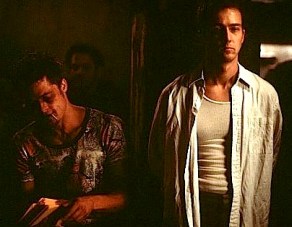 If you’ve not read it, know that the film keeps a lot of Palahnuik’s novel. The narration often takes it verbatim. With the exception of the ending — changed, for the better — it’s a remarkably faithful adaptation.
 (shh, whisper it) (…oh yes, I’m keeping this spoiler-free). There are counter arguments to that being his real name (his colleagues never call him it, only those who met him… after), but that’s beside the point. Stop calling him Jack. (I believe I read somewhere that, on the relevant DVD commentary, Ed Norton says he calls the character Jack. Not good enough reasoning for me.)
 A Good Woman adapts Oscar Wilde’s 1892 play Lady Windermere’s Fan, switching the setting to the Amalfi Coast in 1930. If one didn’t know better, one would believe that’s when and where it was always set.
 So it seems one’s perception of the film lies in what it is compared to. Compared to Wilde’s original, it may indeed be a pale imitation, relocated to an inappropriate country and period, with lacklustre performances and incongruous Wilde-penned lines crowbarred in. Taken without the context of the work it’s adapted from, however, I thought it was a flawed but, more importantly, highly amusing film.
 I saw the Richard Attenborough-starring
  Which, considering the whole story is about a man who thinks he’s Santa Claus, and whether or not he really is, is an impressively underhand piece of marketing.
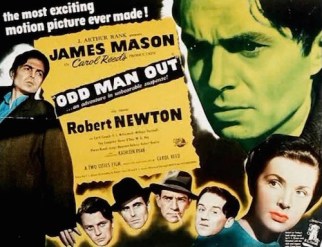 It may be a bit of a cop out to begin a review by pointing you to another, but I must recommend
 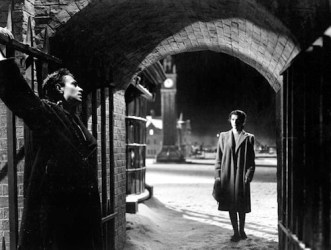 Robert Newton’s Lukey. (You’ll also note Newton’s performance is criticised in Colin’s piece so, in aid of not sounding like I’m too easily influenced, I’d like to point out I didn’t make the connection between his comments and my own notes on Newton until afterwards.) Shell and Lukey have a bit of a point in the end, but I didn’t enjoy getting through them in comparison to the rest of the film.
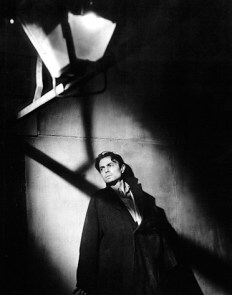 The score, by William Alwyn, is really nice, particularly in certain places — for example when it begins to snow and Johnny wanders the streets, or at its most effective during the haunting climax, as Kathleen hauls a near-dead Johnny through the falling snow towards the safety of the shipyard as the police finally close in.
 If you’ve ever seen the miniseries
  Bigelow & co construct each ‘action’ sequence with care and attention. They’re not action sequences in the truest sense — suggestions from some that she’d be a great director for, say, Bond 23 on the strength of this film are unwarranted (not that she wouldn’t be good, but this film’s action does nothing in particular to demonstrate appropriate skills). Instead of the fast-paced bullets-flying adrenaline-pumping sequences you get from An Action Movie, The Hurt Locker offers up more realistic (at least, realistic-feeling) sequences of tension as characters approach bombs, watch increasingly suspicious crowds, try to defuse the situation before the timer runs out… It could be clichéd — we’ve all seen plenty of bomb defusing scenes in movies before now — but, again, there’s a sense of “this is how it is”, rather than “this is how movies portray it for dramatic effect”. Is it how it is? I don’t know. But it certainly still packs dramatic effect.
 The opening quote and closing scenes make explicit the main theme — war is a drug, one James (Oscar nominee Jeremy Renner) is addicted to — but I’m not sure how present this is in the body of the story. Rather, the majority feels like an attempt to convey the experience of living as an explosives expert in a warzone, with James’ ‘addiction’ just a side effect of that. Perhaps, then, it’s making its point more subtly than by battering you round the head with cinematic cries of, “He’s addicted to war! It’s just a drug!”
