
Morten Tyldum | 114 mins | streaming (HD) | 2.35:1 | UK & USA / English | 12 / PG-13

2015 Academy Awards
8 nominations — 1 win
Nominated: Best Picture, Best Actor, Best Supporting Actress, Best Director, Best Editing, Best Original Score, Best Production Design.
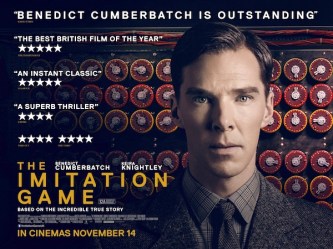 Alan Turing was a war hero: he led a team of cryptologists who managed to break the Germans’ Enigma encryption, thereby giving the Allies access to tonnes of vital information that (historians estimate) helped shorten the war by up to four years. This information was beyond top secret — so much so that they created a new designation for it, “ultra secret” — so when the war was over, Turing & co’s contribution went unrecognised for decades. Alan Turing was also a homosexual in an era when that was illegal. When he was caught, he was sentenced to chemical castration, which caused (or at least contributed) to him taking his own life. Fine way to treat a war hero, but that’s what you get with discriminatory attitudes.
Discrimination is surely one of the major themes of The Imitation Game, a film that it’s apparently easy to mistake for a drama about the deciphering of Enigma, but which is really a Turing biopic. It takes place across three eras: the 1920s, when Turing (played by Alex Lawther) was a bullied schoolboy; the war years, when Turing (played by Benedict Cumberbatch) faced discrimination across the board, including a commanding officer who thought he was a Soviet spy and teammates who flat out didn’t like him; and the 1950s, when Turing (played by Cumberbatch in gentle older-age make-up) is uncovered as gay and gets the persecution already discussed. As if that wasn’t enough, the best person he recruits for his team during the war is female (played by Keira Knightley), who of course is also pre-judged by some as capable of nothing more than being a dimwitted secretary.
 The screenplay by newcomer Graham Moore topped the Black List in 2011, so it’s probably of little surprise that it went on to win an Oscar, but I think it’s fair to say its quality, while good, isn’t that good. The use of three concurrently-told timelines seems to be too much for Moore and/or director Morten Tyldum to handle at times, occasionally flitting to a different era with little purpose beyond “it’s about time we told more of that storyline”. That’s not to say a wholly chronological telling would’ve been more effective — though perhaps it would’ve placated critical viewers who expected (and retrospectively demand) a cryptography-based wartime thriller — but the period juggling clouds the point as often as it illuminates it.
Regardless, it blusters through with a relatively brisk pace (for what is essentially a heritage drama), supported by several excellent performances. Oscar-nominated Cumberbatch is the obvious headline — he’s Alan Turing in the Alan Turing biopic so of course he is, but it’s a very strong performance. His Turing is surely somewhere on the autistic spectrum, which at best has speculative historical basis, but Cumberbatch embodies well that social awkwardness with hidden inner genius. It would’ve been easy for him to slip into familiar traits from that other antisocial clever-clogs he plays, Sherlock Holmes, but at worst there are only vague and infrequent nudges to our memory of that performance. Rather, I’d argue he fully subsumes himself into this role. Surely that Oscar would’ve been his were it not for Eddie Redmayne’s even more remarkable turn as Stephen Hawking. (Well, Oscar voters might’ve plumped for Michael Keaton instead, but they’d’ve been wrong.)
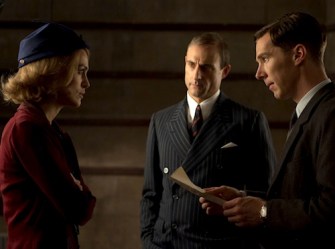 Also up for the golden man was Knightley, who does give one of her better turns as Turing’s sort-of-sidekick. The pair have a fairly complex relationship — both halves are key to conveying that, and they both do. At least as remarkable as either is young Alex Lawther, who arguably gets the film’s stand-out acting moment in his final scene, where a tumult of emotion is contained beneath a stiff-upper-lip surface in a tight close-up. On the strength of this, an actor to watch out for. The rest of the cast don’t get the same depth of material, but Charles Dance and Mark Strong provide exceptional value, as always, and Rory Kinnear does his best to bring some nuance and interest to a part he’s overqualified for.
To return to the issue of the film’s reception, some people seem to be angry with or offended by the notion that the war was won as much — maybe even more — by men in rooms breaking codes than by soldiers on the ground doing the actual fighting. However, I can’t help but think that’s actually one of the points the film is making — that soldiers are the obvious ‘heroes’, because they’re there doing the shooting, but the people behind the scenes telling them where to go do that shooting are just as important to the overall victory. I mean, if you watched this film and still think the boots on the ground are the only thing that won the war, and by extension that intelligence isn’t all that important, then maybe you missed something.
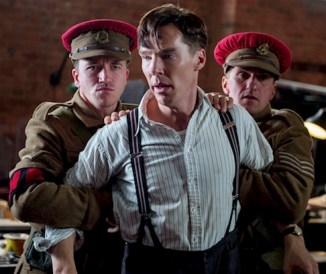 Perhaps that just stems from a frustration at some of the film’s other issues. It clearly has a flexible relationship with historical accuracy — well, what biopic doesn’t? Without wanting to spoil plot developments, some viewers feel the film suggesting Turing knew of the spy at Bletchley Park is insulting to his memory, because in real-life he didn’t even know the individual. Alternatively, is it not a way to integrate that part of the Enigma story into a film that otherwise wouldn’t have a satisfactory way to touch on it? Everyone’s mileage will vary on whether that should’ve been done or not.
And let’s not even get into opinions on how the film dealt with Turing’s homosexuality, which swing wildly between “it was just a footnote, why didn’t it get more attention?!” and “why did they allow that to dominate a film about codebreaking?!”
There’s no denying that The Imitation Game contains an interesting story about an important aspect of the war, starring a fascinating and complex central character. How well it handles those aspects if more a matter for debate, as it doesn’t develop some elements as well as it perhaps should have, and the heritage stylings always turn some off. If you ignore or gloss over some of those faults and take the film at face value, it’s a 5-star effort with a well-told primary narrative and strong performances. If you do listen to the niggling faults and the “what could have been”s, it sinks back down a little.
 Without meaning to sound too judgemental (though when has that ever stopped me?), those factors making me think this is the kind of film “normal people” will probably love a lot more than “film fans” — which probably explains why it’s in the IMDb Top 250 but all the most-liked reviews on Letterboxd have exceptionally low scores. Personally, I’m going to side with the populous: not everything has to be a groundbreaking feat of Cinema to be a story worth telling and told well, and if it is indeed some kind of “historical revisionism” to say that there’s nothing wrong with being gay and the way Turing was treated post-war was horrendous, well, I’m OK with that revisionism.

The UK TV premiere of The Imitation Game is on Channel 4 at 9pm tomorrow.
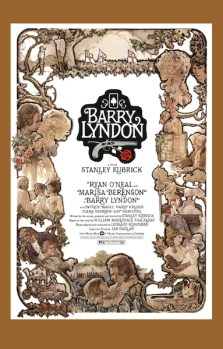 Stanley Kubrick made a good many exceptionally well-regarded films — indeed, with possibly the exception of his first semi-amateur feature,
  who often tells us less-than-favourable things about the lead character. Apparently this is an example of an unreliable narrator, and I suppose some of the things we’re told aren’t directly evidenced on screen, but I’m afraid I’m going to have to leave that seam to be mined by other writers, because (on a first viewing at least) I didn’t see where or to what effect the narrator was lying to the viewer.
 but a fictional biopic, that ranges across Europe and across time to… what effect? It’s a Kubrick film, so the ultimate goal of the tale, the message(s) it may be trying to impart, are debatable. You could see a story of the pitfalls of hubris. You could see an exploration of how a certain class lived in this time period. You could just see a man who led an adventurous life.
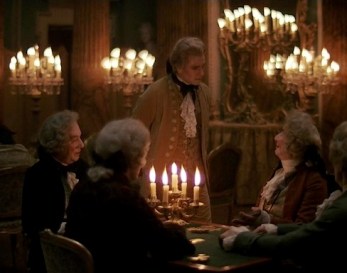 just that it remains the best among greats. (That said, having looked up images online for this review, it seems slightly less striking to me now. That may be the quality of the screengrabs; it may be that the painterly quality is so remarkable at first appearance (before becoming more familiar when the whole movie has that quality) that its memorableness is heightened.)
 The director of

 Score:






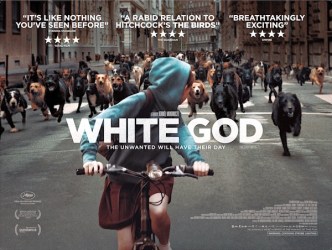 Thirteen-year-old Lili (Zsófia Psotta) and her dog Hagen are forced to temporarily live with her father, Dániel (Sándor Zsótér), because her mother is going on holiday with her new partner. Dániel doesn’t like Hagen anyway, but when the dog’s behaviour causes problems for him, he sets Hagen loose on the streets. Already angry with her father and his attitude, a devastated Lili sets out to find her beloved dog, who is busy discovering the darker side of mankind and our treatment of animals.
 For all the toughness of the journey, where it leads is triumphant; not entirely so, I must add, but enough. The film’s third act can pithily be described as Rise of the Planet of the Dogs: having seen the abuses of humans, an impounded Hagen leads a canine uprising that seeks to… well, they don’t speak (they’re dogs, remember, and this isn’t Disney), so who knows what their precise aims are? “Revenge” would be too cruel, but they definitely seeking some retribution. The film’s sadness doesn’t disappear (hence why not entirely triumphant), but some wrongs are righted.
 Some will find the middle of the film a slog, I suspect, both emotionally and with its occasionally lagging pace. However, the bookends seek to justify it. There’s catharsis in the finale, as described, but even better is the film’s opening. It has to be seen to be properly understood, but it’s operatically scored, shot, and edited, and involves hundreds (literally) of trained dogs en masse. It’s spectacular, unforgettable moviemaking; perhaps even one of the best openings to a film ever. And I don’t say that just as a “dog person”.
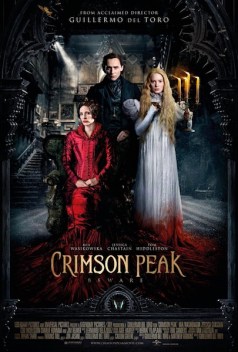 Mia Wasikowska stars opposite a British thesp best known for playing a comic book villain and a red-headed repeat-Oscar-nominee, in a Gothic drama-thriller from an acclaimed non-Anglo director? That’s a description of
  The story actually concerns Edith Cushing (Wasikowska), a well-to-do businessman’s daughter in upstate New York who is occasionally haunted by ghosts. She falls for visiting English gent Sir Thomas Sharpe (Hiddleston) and, long story short, moves with him and his haughty sister Lucille (Chastain) back to their crumbling — literally — pile in the English countryside. The house hides many secrets, and ghosts, too. Having said it’s not a horror movie, it would be unfair to class Crimson Peak as simply a tame drama — as you’d expect from writer-director Guillermo del Toro, those ghosts can be bleedin’ scary, and there are certainly a smattering of good old fashioned jumps to boot.
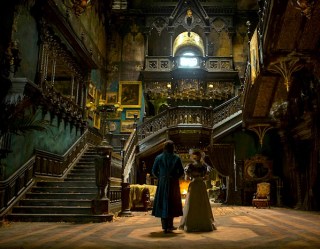 Whatever one’s thoughts on the story and tone of the film, it can’t be denied that its technical merits are extraordinary. Every inch of the design work is gloriously imagined, and the cinematography — the lighting in particular — is spectacular. And that gigantic house set…! And the climactic ‘limbo’ set, too — incredible work. (That’s not a spoiler, incidentally: it was the set’s nickname, not its literal location.) The ghost effects are excellent too — original, creepy, and executed in a way that blurs the lines between make-up, animatronics, and CGI. It’s a shame the film as a whole wasn’t better received, because I imagine that’s all that held it back from numerous awards-season nods.
 Disney’s animated classic is re-imagined in live-action, losing the songs but expanding the story. The latter serves to find a little more realism in the setup (how Cinders became a servant to her stepmother, etc), as well as in the characters’ motivations and actions.


 100Films.co.uk