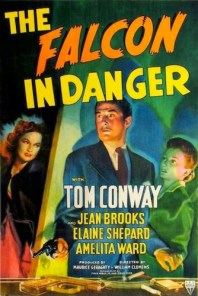
The Falcon in Danger (1943)

2012 #73
William Clemens | 67 mins | TV | 4:3 | USA / English | PG*

The Falcon in DangerWe’ve had the Saint in New York, in London, and in Palm Springs; soon we’ll have the Falcon in Mexico, in Hollywood, and in San Francisco; but here, he’s just in danger. He’s also in perhaps the best film either series has offered to date.

Ironically, the film begins with one of the worst plane crashes ever committed to celluloid. I’m not berating it for the special effects (they’re not incredible, but this is a ’40s B-movie — we’re not expecting much), but the way it’s shot and acted. The extras are appalling. Fortunately the film almost instantly picks up, offering a mystery worthy of Sherlock Holmes: said plane, noted as having several passengers when it left its previous location, is now completely empty of both passengers and crew. What the blazes?!

Fortunately, Tom Conway’s Falcon Mk.II is on hand to sort things out. It leads to a moderately intricate case of deception (of course — they didn’t really disappear), kidnap, ransom, theft, business intrigue, a suspicious antique dealership, a murderous guard dog, and a rollerskating rink (no, really). The humour is in shorter supply than in other entries — we’re mostly spared the bumbling cops, so it doesn’t suffer too badly for it. That said, the main ‘comedy’ comes from the Falcon’s latest fiancée, Amelita Ward as a Texan lass who’s distinctly annoying. Reviews abound that assert she completely ruins the film, but it’s not that bad. Three birdsThough the Falcon clearly agrees with everyone else’s assessment and shrugs her off as often as he can, to our benefit.
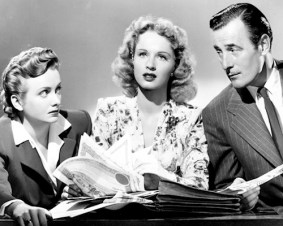
For I think the first time, the “distressed girl distracts the Falcon” coda actually leads into the next film (or seems to). Ironically, though that cast includes both of …in Danger’s female leads in new roles, the Hysterical Girl who leads the Falcon to it isn’t in it. Ah, ’40s cinema.

While some may lament the slightly more serious tone, then, The Falcon in Danger surely stands out as one of the more engrossing mysteries the series has to offer. I can’t say I’d complain if the remaining seven films followed such a line.

4 out of 5

* As with the vast majority of the Falcon series, The Falcon in Danger hasn’t been passed by the BBFC since its original release. Nonetheless, it’s available on DVD, rated PG. ^
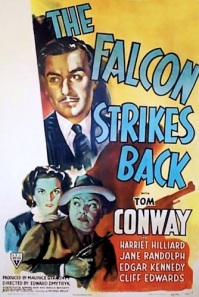
The Falcon Strikes Back (1943)

2012 #72
Edward Dmytryk | 63 mins | download | 4:3 | USA / English | PG*

The Falcon Strikes BackDirected by Edward Dmytryk (who, a couple of years later, would helm Farewell My Lovely/Murder, My Sweet, which was previously filmed as The Falcon Takes Over — connections, connections), the first film to feature solely Tom Conway as the Falcon is probably the series’ weakest effort to date.
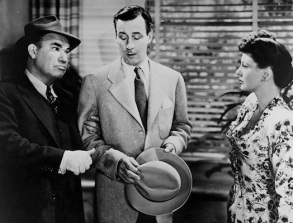
The story trundles along for much of the film, at best a typical runaround, at worst an unengaging tale of stolen war bonds and memory loss. (I say “memory loss” — the Falcon was supposedly unconscious, meaning he didn’t have the memories in the first place to lose. But that’s beside the point.) I was getting a bit fed up with it, but the final act manages to introduce some atmosphere and incident, in the process explaining some of the earlier, apparently aimless, story choices.

With the Falcon series, the makers seem to be making a concerted effort with plots — whereas the Saint films were largely quite straightforward, often only having one possible character to reveal as the villain, the Falcon films are largely genuine whodunits. Strikes Back has a particularly knotty denouement. It doesn’t necessarily make them better — indeed, on the whole, the Saint films are more entertaining — but it gives them something.

Conway makes a solid replacement for George Sanders, because he’s effectively more of the same. Aside from an opening that implies the new New Yorker is uncomfortable with the city’s constant noise, there’s no reference to him being new in town last time round — indeed, the plot fairly hinges on the fact he previously put someone away in the area. The Falcon and... some other peopleHis eye for the ladies remains the same, although Conway feels a bit slicker and less whipped. Neither carry the same charisma as Sanders’ Saint.

Jane Randolph is back as Marcia Brooks, but the women largely play a toned down part this time round, perhaps because there’s at least four of them. Goldie’s back, this time played by Cliff Edwards, who is certainly no Allen Jenkins. Whereas Jenkins made for an amiable sidekick, Edwards is actually quite irritating. (Though this is his last appearance for now, the character returns later in the series, played by Edward S. Brophy and Vince Barnett.) The policemen perform their usual shtick, which gets a little more desperate and less funny with each film. At least there’s only one round of the “because I’m the boss” gag this time. The Falcon’s ethnically-variable butler Jerry is still Asian, albeit recast with Richard Loo, and gets a more substantial supporting role, once again in one of the film’s better segments.

Strikes Back recovers towards the end for a decent final act, but it’s a relative slog to get to that point. All in, while not outright bad, I’d say it’s the least entertaining of the Falcon films thus far.

2 out of 5

* As with the vast majority of the Falcon series, The Falcon Strikes Back hasn’t been passed by the BBFC since its original release. Nonetheless, it’s available on DVD, rated PG. ^

The Falcon’s Brother (1942)

2012 #71
Stanley Logan | 60 mins | TV | 4:3 | USA / English | PG*

The Falcon's BrotherThe Falcon may’ve done it in the third entry in RKO’s Saint-a-like film series, but now it was time for Tom Conway to take over — as the series’ star, that is.

Leaving my contrived and slightly embarrassing introductions aside, Conway gets a pretty good introduction to what will soon be his franchise. Though we begin with George Sanders still the lead, learning that his brother has been murdered on a ship arriving in New York — only to find out the body isn’t his brother after all — there’s a speedy and smooth transition to Conway being in charge.

Quite why they felt the need to execute such a neat transition, when previously films of this calibre had been happy to just re-cast (see: the Saint), I don’t know, but it works in its favour. Behind the scenes, Sanders had grown tired of B-movie leads, but presumably the series was successful enough at this point that RKO didn’t want to abandon it — especially as they were in the process of losing the Saint. In a piece of too-perfect casting, Conway is his real-life brother. On-screen and in-story, the passing of the baton is so smoothly done you barely even notice it happening, and it gives Conway an unencumbered chance to establish himself… though he’s basically the same character. Whether he’ll have the same gurning lack of success with the dames remains to be seen, however.

Brotherly loveAside from housekeeping, the film offers one of the series’ better plots, a proper detective mystery that doesn’t lead where you’d expect it to for once. That said, I didn’t like the ending so much, especially the way it abruptly dispatches our former hero followed by the gang carrying on with barely a care. The Mysterious Threatening Voice On The Phone is interesting though — will we be seeing a recurring enemy; a Moriarty or Blofeld for the new Falcon? Time shall tell…

Apart from the dual leads, Don Barclay’s Lefty is basically a re-cast Goldy — he even has the same police-bating catchphrase. Why Allen Jenkins left/was got rid of, I don’t know, but that’s the kind of thing that happens in movies of this scale I suppose. A quick flick through IMDb reveals the Goldy will return later, but Jenkins won’t, which is a minor shame. Broadly similarly, making Jane Randolph’s female lead, Marcia Brooks, a journalist also smacks of why-isn’t-it-just-the-one-from-the-last-film-ness. She’ll be back in the next film and then gone again, perhaps continuing the almost-tradition the films are establishing for a girl relay? (I should really stop theorising mid-flow; but then, we are wont to see connections where there are none.)

The bumbling cops are also present and correct, not that I care for them. Their “because I’m the boss” shtick is one of the elements that makes the Falcon films feel more formulaic than the Saint ones, The Shadow?in spite of all the other factors (changing sources of adaptation; changing leads) that should make them feel wildly varied. And the Falcon’s butler, Jerry, is Asian again, after being caucasian in the last two films. Played this time by Keye Luke, rather than being some nasty stereotype he has a nice bit using stereotypes to the characters’ advantage. It’s one of the series’ better comic inventions.

Re-casting your lead can be a major stumbling block for a series, or lead it to even greater success. Normally it’s done abruptly, but the Falcon takes a more transitionary route… and, perhaps surprisingly, it pays off with a mostly fun adventure. And with Conway now in charge, perhaps the series can shake off the lingering Saint on its shoulder.

3 out of 5

* As with the vast majority of the Falcon series, The Falcon’s Brother hasn’t been passed by the BBFC since its original release. Nonetheless, it’s available on DVD, rated PG. ^

Dirty Laundry (2012)

aka The Punisher: Dirty Laundry

2012 #62a
Phil Joanou | 10 mins | streaming | 3:1 | USA / English

New Punisher logoUnveiled at San Diego ComicCon and then released on YouTube in July 2012, Dirty Laundry is an unofficial short film starring Marvel character the Punisher. It’s a fan film, really, but the twist is it’s made by the production company of Thomas Jane, star of the 2004 film version of The Punisher, who reprises the role too.
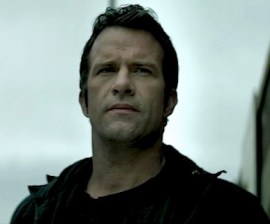
A short tale clearly inspired by so many Westerns (Frank Castle, the Punisher, sees bad stuff going down, doesn’t want to get involved, but then realises he Has To), it’s designed as a tribute to the character, who’s arguably been ill-served by the three big screen versions to date. I presume it’s also meant to act as some kind of proof-of-concept pitch, though I’ve not specifically seen anyone involved in its production say that. The subtext, however, is that this is how the makers believe a Punisher movie should be done.

For that reason you’d assume the director was some young up-and-comer, eager to prove what he can do. In fact, Joanou is 50, directed U2’s Rattle and Hum documentary in the ’80s, helmed some films no one’s heard of and a couple of episodes of TV shows no one’s heard of, and his last work was The Rock crime/sport drama Gridiron Gang in 2006. Which just goes to show you shouldn’t assume things.

He will punish his laundryThe one glaring flaw (unless you hate realistic CGI-aided bloody violence, in which case there’s that too) is its use of music from Hans Zimmer’s Dark Knight score. It kind of works, but it’s such an iconic and unique score that it’s instantly recognisable, which is distracting. If they can produce a professionally-shot 10-minute film with professional actors, why couldn’t they get someone to do some music? Or at least use unfamiliar library tracks?
Considering it breaks both Marvel/Disney’s character copyright and WB’s music copyright, and thanks to starring Proper Actors & That it’s been relatively high-profile, it’s a miracle it’s still on YouTube after all this time. It’s a fairly effective depiction of a fan-favourite character, though, so long may it remain.

4 out of 5

RoboCop 2 (1990)

2012 #82
Irvin Kershner | 116 mins | streaming | 1.85:1 | USA / English | 18 / R

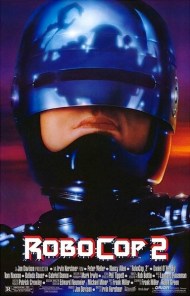
RoboCop 2The consensus opinion seems to be that the RoboCop films exist on a steep downward trajectory of quality, starting with the pretty-good first film and ending with the nadir-of-humanity third. In this equation the second lands, naturally, somewhere in the middle — not that good, but not so bad. Personally, I enjoyed it more than the first.
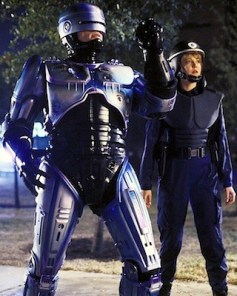
As future-Detroit’s police strike over something to do with evil megacorporation OCP, ever-popular officer RoboCop fights a war on drugs, while OCP plot his replacement… Such is the barebones of a plot on which hang some solid stabs at satire and some nice boundary-pushing plot points, which at times left the film feeling still relevant today — something I felt the first RoboCop no longer was. Take the gun-toting pre-teen wannabe-drugs-baron, for instance, one of the film’s best characters who (spoiler alert!) they’re not afraid to deal a bloody death to. I’m not revelling in the death of children here, and I don’t think the film does either; instead, it demonstrates a kind of ballsiness and not backing down from the story and world they’ve created.

The satire is one of the most praised elements of the original film, but with new writers and a new director on board it would’ve been easy to ignore that in favour of a film in which a robot cop shoots lots of criminals. That is, obviously, not the case, and while at times some of the sequel’s jabs at society may be more on-the-nose even than the first film’s efforts, they’re not unwelcome or inaccurate. The screenplay was in part written by objectionably-right-wing comic book author Frank Miller, RoboCop tooand though it was reportedly massively re-written after his work was done (to the extent that, decades later, there was a comic book miniseries that adapted his original version) I think his touch can still be felt at times.

I also criticised the franchise opener for poor special effects, and I think RoboCop 2 improves in that regard too. There’s still moderately obvious modelwork on display, but it doesn’t seem as cartoonish or juddery as the previous film’s. The climactic villain is a more genuine threat (it’s responsible for at least one massacre at any rate) and the battle with RoboCop, a mix of life-size props and stop-motion, makes for an exciting, well-matched finale, something the first film’s falling-down-the-stairs moment didn’t quite achieve.

I can’t say I’m overly enamoured with either of the RoboCop films I’ve watched to date. As a character and franchise it seems to have slipped from the consciousness a bit in the last decade or so, and I can’t say I find huge fault with that status. Plus, it’ll be interesting to see if the forthcoming remake can do anything to boost the franchise’s fortunes. Nonetheless, this sequel is a solid example of R-rated late-’80s action entertainment that, as noted on more than one occasion, I certainly liked better than its predecessor.

4 out of 5

This review is part of the 100 Films Advent Calendar 2012. Read more here.

RoboCop (1987)

2012 #80
Paul Verhoeven | 103 mins | streaming | 1.85:1 | USA / English | 18 / R

RoboCopIn a crime-addled future Detroit, cop Alex Murphy is gunned down by a gang of crooks, only to be resurrected by evil megacorporation OCP as the future of law enforcement: RoboCop. Obviously — that’s the title.
Hailed by those who love it as some kind of satirical masterpiece, RoboCop does manage to raise itself above other mindless ’80s action fare, at least to some degree. Equally, should you choose to watch it brain-off then I doubt you’ll be too troubled by its criticisms of corporate greed or the privatisation of public services (at least, I assume those are the targets — this is an American film and don’t Americans love privatisation? But then, Verhoeven is European, so who knows). There’s gory action and the odd one-liner to enjoy, as well as Murphy’s battle with identity once he becomes the robotic enforcer.

At this point, I think RoboCop has become a film you had to be there for. Viewed now, 25 years after release, it looks dated. The stop-motion rendering of big bad robot ED-209 appears jerky and cartoonish now, like something from a kids’ action/adventure film rather than an 18-rated satirical thriller. RoboCop beats it by making it fall down some stairs, after which it can’t get up, wiggling its legs in the air comically. Maybe that was Verhoeven’s intent, to make it laughable, but I’m not sure. I’m loath to criticise old-fashioned effects because, a) that’s all they had access to at the time, and b) they can often look better than today’s CGI-obsessed major movies; but where the likes of Back to the Future or Star Wars still stand up to scrutiny, I don’t believe RoboCop cuts the mustard.

There’s a remake coming soon which has seen a lot of criticism levelled at it by fans, especially over leaked photos of the new costume. I’m not exactly looking forward to it, but nor am I dreading it — the concept’s a good’un and could withstand a refresh. Plus the version of RoboCop presented here, all stompy and bulky and slow, wouldn’t cut the mustard in an era that’s decades on from the T-1000 and can see small, streamlined technology every way we turn.

In the meantime, there’s this, but I do think it’s rather had its day.

3 out of 5

This review is part of the 100 Films Advent Calendar 2012. Read more here.

The Lincoln Lawyer (2011)

2012 #23
Brad Furman | 114 mins | TV | 2.35:1 | USA / English | 15 / R

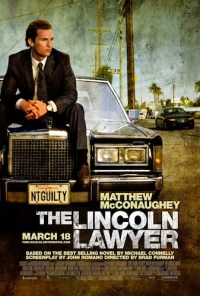
The Lincoln LawyerAdapted from a novel by best-selling author Michael Connelly, The Lincoln Lawyer seemed to appear out of nowhere and garner an uncommonly high amount of praise. I’m glad that intrigued me, because, while not a revelatory experience, it’s certainly worth your time.
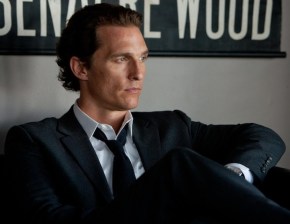
The story concerns hot-shot lawyer Mick Haller (Matthew McConaughey), who works out of the back of his car (hence the title), and his latest case, defending a rich playboy accused of murder. Essentially, it’s a solid crime/legal thriller; the kind of thing we’d probably get as a 90-minute TV episode over here, but thanks to America not really having that format, it gets the cinema treatment. Nonetheless, it’s well enough acted, with an interesting enough story, to sustain the grander status automatically afforded to something released theatrically.

As a thriller its plot is naturally packed with surprises, reversals, about-turns… in other words, twists. The big one plays at the halfway point, which is a nice change. It’s not exactly an unguessable turn of events, but the story may still have a few surprises up its sleeve. Of course, anyone who watches or reads enough crime fiction is rarely (if ever) going to be surprised by a thriller’s plot, as they all essentially re-arrange a selection of elements from the genre’s large grab bag in a way that makes them moderately unique. Connelly and adaptor John Romano make sure Lincoln Lawyer arranges its chosen selection in a way that indeed makes it unique enough, especially when buoyed by some quality acting and slick (but not show-off-y) direction from Furman.

Lawyer out of LincolnI’m not sure I’ve ever seen McConaughey in anything (nothing I remember, anyway), but my impression has been he’s not all that. Here, though, he nails the slightly-smarmy-but-kinda-likeable street-wise defence attorney Mick Haller. He’s buoyed by a quality cast: Ryan Phillippe is eminently plausible as a rich kid used to getting his own way, while the likes of William H. Macy, Marisa Tomei, John Leguizamo and Bob Gunton offer typically consummate support.
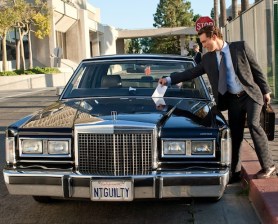
The array of small roles arranged around Haller once again make it feel like the setup for a TV series. There’s his ex-wife and their daughter; his investigator ‘sidekick’; his driver (important when you work out of the back of your car); a couple of detectives he butts heads with; the bale bondsman who gets him work; some regular clients… They do all have a role to play in this particular tale, but with so many it feels like setting up avenues to be explored in future episodes. I suppose all thriller authors do this nowadays – their heroes are designed to run for books and books (Haller’s only at four, but Connelly’s other main character has amassed 17+, and you can see similar numbers in other author’s series), so they need to be set up like a TV series. Plus it helps if they ever get adapted for TV… and just to cement such a view, NBC have commissioned a TV spin-off from this. (Lionsgate also talked of pushing ahead with a sequel. I haven’t heard anything about either project for ages so don’t know their current status.)

That may be the tip of the iceberg for Michael Connelly on screen. Though this is only the second adaptation of his work, he’s clearly successful in print and positioning himself for a big-screen future: The lawyer's Lincolnafter languishing in development hell for 20 years, he recently paid Paramount $3 million for the rights to his most prolific character. With said character being the half-brother of Haller, and that Lincoln Laywer sequel in development, maybe Connelly’s work is destined to become the Marvel Cinematic Universe of crime/legal film adaptations. This could be the time to get in on the ground floor.
One might argue that The Lincoln Lawyer doesn’t quite do enough to transcend the feeling of a TV procedural, and it’s a point of view I have some sympathy for. But even still, it’s a high-quality, well-made example of the genre.

4 out of 5

This review is part of the 100 Films Advent Calendar 2012. Read more here.

The Lincoln Lawyer placed 8th on my list of The Ten Best Films I Saw For the First Time in 2012, which can be read in full here.

M – British version (1931/1932)

2012 #58a
Fritz Lang | 93 mins | Blu-ray | 4:3 | Germany & UK / English

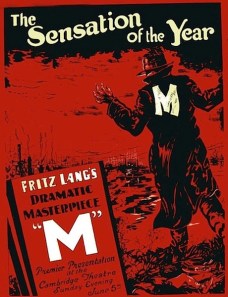
M - British versionLet’s establish one thing right away: this is unquestionably an inferior version of Fritz Lang’s masterpiece, M. Never mind that it’s an old, unrestored, thoroughly battered print; it’s the conscious changes that — unavoidably — lessen the film.
1) Cuts. It’s several minutes shorter than even the restored German version (which in itself is seven minutes shorter than Lang’s original cut).

2) A re-cut ending that attempts some kind of jollity: instead of Frau Beckmann’s tearful warning outside the court, we get a reprise of the opening shot of children playing. The message is less “watch out for your kids!”, more “childhood saved!”

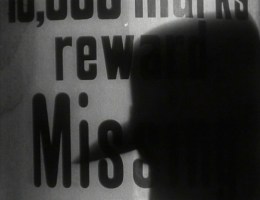
3) Some moments have been re-shot to replace German text with English. On occasion this barely matters (a close up of a newspaper article, for example, or the murderer’s letter to the papers), but on others it ruins Lang’s original work, the worst offender being the shadow falling across the “Missing” poster near the start. Alternatively, in Masters of Cinema’s accompanying booklet Robert Fischer notes that these text changes also provide us with “the only instance where [the British version] comes up with a genuinely creative idea worthy of the original”.

Missing in Britain4) It’s mostly dubbed into English. The bits that aren’t have been re-shot. Primarily, there’s a phone call between the police commissioner and the minister, which is really quite poorly performed — watch out for an unintentionally comical bit with the wrong end of a pencil. These two actors are also edited into another scene, a large meeting which their characters attend, and it’s glaringly obvious where Lang’s work begins and ends and the basically-shot bits (flatter angles, simplistic sets) have been dropped in. The director of the English re-shoots isn’t specifically credited, but it certainly wasn’t Lang: Fischer’s examination of M’s export versions informs us that it was the localised version’s “Supervisor”, Charles Barnett.
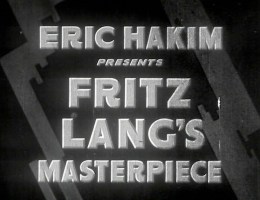
Despite this, the British version isn’t without merit. After all, much of Lang’s work survives the localisation process, meaning his quality and skill still shines through, and there’s that one re-shot text bit. But then, why bother? You can watch the original and get all of it.

No, the only thing worth watching for (other than pure curiosity) is a re-shot trial scene featuring Peter Lorre’s first performance in English. It’s a typically great turn from Lorre; not quite of the same calibre as the German original, but a worthy alternative.

Not Fritz Lang's masterpieceThere’s no way anyone would reasonably recommend this variation of M over the original, but it does hold interest as a curio. It may leave one wondering how and why this practice of exporting films — where multiple versions in different languages were shot at the same time, rather than dubbing/subtitling later — died out. Cost, I imagine. Despite producing interesting asides like this, it’s probably a good thing it did.
3 out of 5

My review of the original version of M can be read here.

This review is part of the 100 Films Advent Calendar 2012. Read more here.

2 Fast 2 Furious (2003)

2012 #28
John Singleton | 103 mins | TV | 2.35:1 | Germany & USA / English | 12 / PG-13

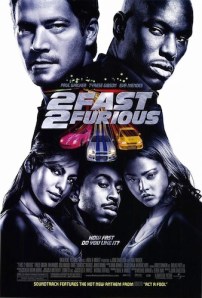
2 Fast 2 FuriousI never thought I’d watch, and certainly not enjoy, the Fast and the Furious series, but a few years ago (after the second film hit cinemas, I think — which would be almost a decade!) the first seemed to pick up a bit of praise from movie magazines and/or websites that were generally to my taste, so I gave it a go. I quite liked it, in the mode it was intended — a brain-off good-time action-y movie. I thought I was done there though, thanks to the much-maligned sequel — mainly because of its ridiculous title, which is still great fodder for a quick joke whenever a sequel is announced and people speculate on what it might be called. But sometimes, something compels you to give something a go…
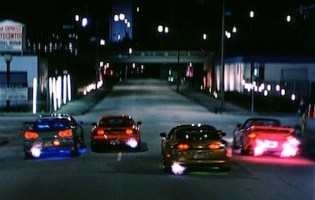
Here, then, we find poor acting, a plot done by the numbers, and a style that sometimes feels like a rap video writ into a film. Oh dear. Yet the chases and other car-based action sequences are pretty coolly done, and there’s more of them than I remember there being in the first film. That’s a definite plus — really, it’s all you want from a film like this.

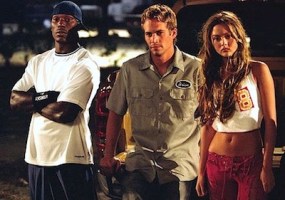
The drivers do a lot of trash talking… usually when they’re in cars by themselves. Oh dear. Then again, I regularly talk to myself when I’m driving alone, so either the film’s fine or I’m appearing in a trashy B-movie. Or just think I am. In a way, these poorer qualities — the dialogue, the acting, and so on — are part of the experience of the film, and somehow manage to endear it. So bad it’s good? At points, yes.

Driving too fastIt’s worth noting it was directed by John Singleton, who started out with the acclaimed social drama Boyz n the Hood. How he’s fallen: via stuff you’ve never heard of to the Shaft remake, this, and most recently the poorly-reviewed Taylor Lautner From Twilight-starring Abduction. Well, each to their own.
Talking of crew, the music (well, the score) is by David Arnold, the recently-deposed Bond maestro. It was somewhat pleasing to see his name appear in the credits because I thought I could hear Bondian bits creeping in; I thought they’d just nabbed bits of the score from Die Another Day or something (such borrowing is not unheard of these days: I didn’t mention it in my review in the end, but I noticed during the credits that Unstoppable borrowed three cues from AVP, of all things).

In the UK, the film was cut by 11 seconds to reduce some violence and get a 12 certificate; later, it was re-rated uncut at 15. This is the kind of thing that really bugs some people — cue rants about the controlling nature of the BBFC — but, in instances like this, I couldn’t care less. For one thing it’s the distributor’s choice, not the BBFC’s. That’s not always wholly placating — see Casino Royale — but, sometimes, why care? So we lose “3 kicks, a stamp and a spit, all delivered to a prone man” — so what? The scene’s still in the film, there’s just less of it. I agree with people’s frustration when cuts are major, but in cases like this, perspective is needed.

Looking too furiousUltimately, 2 Fast 2 Furious is like cheap fast food: you know it’s made of trash, high in fat and sugar, liable to rot something in your head — and just really bad for you fullstop… yet it’s an enjoyable guilty pleasure once in a while. If you don’t identify with that feeling then you’re a better man than me, and you’ll probably never like this film.
By rights I should give 2F2F 2 stars — it would even provide the opportunity for some kind of gag connected to its title. But, no. I don’t know if it just caught me in the right mood or if it has something surprising under the hood, but I wound up rather enjoying it. It’s junk food, but sometimes that hits the spot.

3 out of 5

2 Fast 2 Furious is on ITV2 tonight at 10:50pm, and again on Friday 7th at 10pm, and probably regularly after that too.

This review is part of the 100 Films Advent Calendar 2012. Read more here.

16 Blocks (2006)

2012 #54
Richard Donner | 98 mins | DVD | 2.35:1 | Germany & USA / English | 12 / PG-13

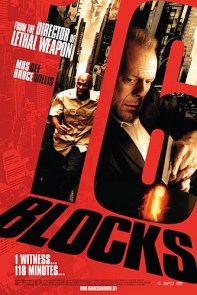
16 BlocksA Bruce Willis action movie? You know what you’re in for here, don’t you? Well, not quite. 16 Blocks casts Willis as less John McClane and more John McCane: old, fat, drunk, limping. He’s a copper still, but the kind of detective whose primary duties are being left to watch over an apartment full of bodies until uniform can show up.
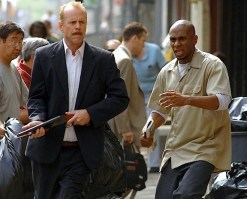
The conceit of the film is that this man is assigned to transport a witness the mere 16 blocks from the police station to the courthouse. Some corrupt cops don’t want him to. Normally Willis would just fold and let them… but, for whatever reason, he decides enough is enough, and it becomes a battle against time and said former-friends to get Mos Def’s witness to testify.

I love a real-time thriller; I don’t know what it is about that concept, but I love it. (I was in heaven for years thanks to 24, until they seemed to stop caring about anything approaching realism.) For that reason, I wish 16 Blocks had hewn closer to its premise. Having to traverse precisely 16 blocks in real-time? There’s a precision in that the film could have exploited. Instead it pretty quickly abandons the notion that they’re traversing exactly 16 blocks — they go up, down, sideways, possibly even backwards; no one actually keeps count, despite it being the bloody title! And it’s sort of in real-time because, well, it can’t really avoid it. But I think it could have played on both of these factors more, and I think it would’ve been better for it.

Dyed hair?For me, it really lost its way just over an hour in, when our heroes (spoilers!) end up in a hostage situation on a bus. It’s not bad, but it feels like writer Richard Wenk (who’s gone on to co-write heights of culture like The Mechanic and The Expendables 2) ran out of ways to keep the setup going, so jumped on a new one. Plus in many respects the characters that populate the high-concept are just stereotypes. There’s the useless drunk cop who suddenly steps up; the wisecracking career small-time crook who wants to turn good; David Morse playing the kind of role he always plays (well, he is good at it). At least casting action-man Willis as the drunk copper gives it a different flavour, and Mos Def gives his usual surprisingly-good turn as the crook.

For fans of an action-thriller (something which I most definitely am), 16 Blocks is a very solid entry in the genre. It doesn’t pay out too heavily in twists (though I get the impression the makers think it does), but there’s still an occasional mild unpredictability and a certain speed to proceedings that keep it engaging. Still, I can’t help but feel a more high-concept rendering of the opening conceit would’ve yielded stronger results.

3 out of 5