2014 #127
Robert Rodriguez & Frank Miller | 102 mins | Blu-ray | 1.85:1 | USA & Cyprus / English | 18 / R
 Belated sequels can be a Terminator 2, but more often they’re a Terminator 3 — that is to say, they can be brilliant, but often it seems they’re a poor idea, a too-late money-grabbing re-hash. Mooted since before the first Sin City was even released back in 2005, this long-anticipated sequel finally appeared at the tail end of the summer, a nine-year wait, and met with poor critical reception and even poorer box office. Considering the first film isn’t just a fanboy favourite but also fairly well regarded (it still sits on the IMDb Top 250, which I know some disregard out of hand but does mean something), that’s quite a painful fall from grace. Having watched the original the night before, I rather fail to see why.
As with its predecessor, A Dame to Kill For is a collection of hyper-noir short stories, connected by location and overlapping characters, that flits between time periods with abandon — this is both a prequel and sequel to the first film, revealing both the story of how Dwight (Josh Brolin) came to change his face (to become Clive Owen in the original film), and what Nancy (Jessica Alba) did after the death of Hartigan (Bruce Willis, returning in a more spiritual form). There’s also the story of a cocky gambler, Johnny (Joseph Gordon-Levitt), taking on the city’s power-players, and a short pre-titles tale starring breakout character Marv (Mickey Rourke).
If the first film was noir with a comic book mentality, then the second is a comic book with a noir mentality. The plots are still hard-boiled, the extensive voiceovers overwritten to the point they wash over you meaninglessly, the characters a mix of downtrodden toughs (for the men) and whores (for the women), and there’s still no hope for anyone in a city which drags everyone down. Naturally the visual style is the same: high-contrast monochrome with dramatic splashes of colour, and the occasional artistic lapse into literal black-and-white.
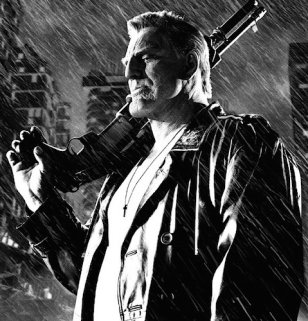 But the comic-book-ness of the first film — moments of almost metaphorical visual representation rather than literal reality, including physically-impossible action beats — has been ramped up. The value of the first film was never in its action, so the sequel’s lengthy punch-ups, crossbow-based guard-slaying, and all the rest, get boring fast. When it slips into this needless excess, A Dame to Kill For loses its way. When it sticks to what it does best — hard-boiled fatalistic crime tales with striking comic book-inspired cinematography — it does as well as the concept ever did.
The best story is probably the titular one, which makes up the bulk of the middle of the film. It’s the most traditionally noir-ish, with a killer performance from a perfectly-cast Eva Green as the eponymous dame. She also spends most of her screentime starkers, which — coupled with the ludicrous dialogue and increased action — does lend credence to accusations that this is a film made by 13-year-old boys. Enjoy the results or not, it’s a hard point to argue against.
As Nancy, Jessica Alba was somewhere on the spectrum from mediocre to awful in the first film, but she’s another of the best things in this sequel. It’s not just that she’s given a meatier role, but that she seems to know how to act better fullstop. For all the criticisms that the film is misogynistic, with its women all strippers or whores or manipulative bitches, it’s the actresses who get the best parts and deliver the best performances. Brolin is unremarkable, for instance, while Marv, undoubtedly the original film’s breakout character, is now shoehorned into every story. Sometimes it works, sometimes it feels forced.
 The intervening decade has lessened the impact of the first film’s sick ultra-violence, but there’s nothing even that extreme here, aside perhaps from one eyeball-related moment. On the other hand, nearly a decade of tech development means it looks better than the last one, both in terms of the CGI’s quality and the camerawork more generally — it’s less flatly shot; more filmic than the first one’s sometimes-webseries-y composition.
Rodriguez once said he hoped to film all of Miller’s Sin City stories, and across the two films they’ve got through six (plus two new ones), which leaves two more full-length tales and nine shorts. Based on the poor performance and reception of this instalment, a third go-round looks unlikely. But then, if there’s one filmmaker who seems to keep on producing even when no one expects more it’s… Uwe Boll. But if there’s another, it’s Robert Rodriguez. That said, the box office really was shockingly awful (just shy of $40 million worldwide; I read the budget was $60 million), so maybe even Rodriguez can’t save this project.
Many critics, even those who rate the first Sin City highly, slaughtered this sequel. I don’t really see why — on balance, I think it’s of a piece with the first one. To love the first and hate the second seems predicated on the notion that the original was innovative and groundbreaking, whereas the follow-up is the same thing again. Well, what did you expect? It promises more stories in the visual and thematic style of 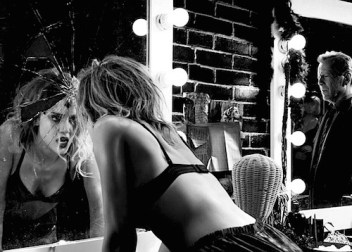 its predecessor, and that’s exactly what it delivers. I suspect the first benefits from nostalgia because, watching them virtually back to back, I found I liked Sin City less than I remembered, but enjoyed A Dame to Kill For just as much. It’s flawed in several aspects, but for honest-to-themselves fans of the first movie, I think it’s a “more of what you liked”-style success.
This review is part of the 100 Films Advent Calendar 2014. Read more here.

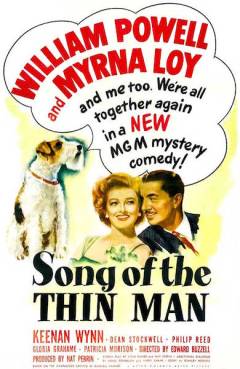 The final film in the Thin Man series sees married detective duo Nick and Nora Charles (the ever-excellent William Powell and Myrna Loy) getting embroiled in the world of jazz musicians, after a friend’s fiancé is accused of murdering a band leader.
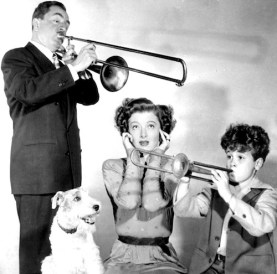 Apparently Loy made it clear before filming began that this was to be the last Thin Man film. Somewhat odd, then, that it’s one of the few to end with an allusion to Nick continuing his detective work in the future, whereas normally he’s being dragged out of retirement each time and happy to return to it by the end (which we don’t believe, of course). Either way, it was probably a wise decision on the part of Mrs Charles, as the law of diminishing returns had kicked in by this point.
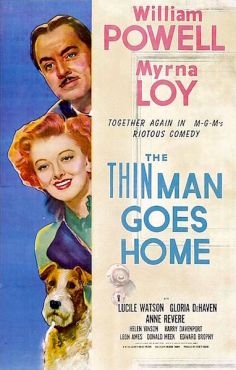 After four glamorous adventures, high-living sleuths Nick and Nora Charles (William Powell and Myrna Loy) head to small-town America to visit his parents (Harry Davenport and Lucile Watson), and naturally find themselves embroiled in a murder plot.
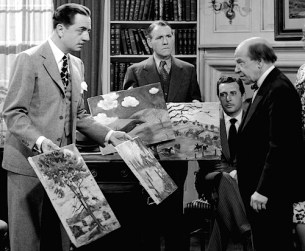 then no one would’ve been murdered. (Probably.)
 This time it’s not personal for Nick and Nora Charles (the joyous William Powell and Myrna Loy), as they stumble upon the murder of a race-fixing jockey and the subsequent killing of a corrupt journalist… and then one of their friends (Barry Nelson, aka
 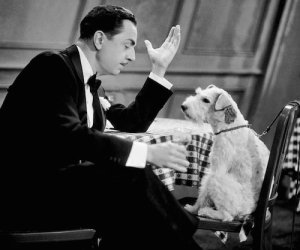 As murder mysteries go, the Thin Man series tends to offer plots that are somewhere between perfunctory and over-complicated to the point of being unsolvable, and Shadow is a typical example. But that doesn’t matter a jot, because the story’s abundance of incident keeps things moving, and the real entertainment value lies in the comedy chops of the three leads: Powell, Loy, and, of course, Asta the dog.
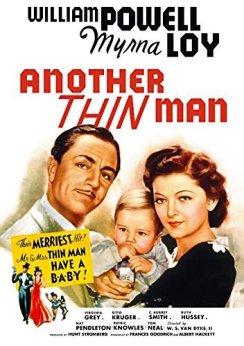 Husband-and-wife detective duo Nick and Nora Charles (William Powell and Myrna Loy) — now with a baby in tow — are once again coerced into investigating a crime when the manager of Nora’s estate fears a dismissed employee is plotting murder.
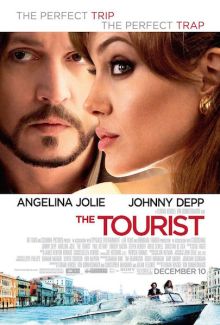 Much maligned on its release, I thought The Tourist was actually a decently entertaining light thriller.
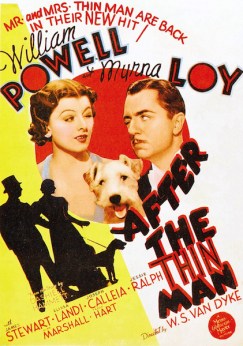 Immediately after their New York Christmastime adventure in
  There’s also an increased role for the couple’s dog, Asta, granted his own subplot as he has to fend off a philandering Scottie with intentions toward Mrs Asta. I make no apologies for preferring this over the previous film in part because there’s more amusing doggy action.
 Produced as a B-movie, but eventually nominated for four of the biggest Oscars (Picture, Actor, Director, Screenplay
 like a Christmas party which is regularly interrupted by victims and suspects. Even the final scene, a rambling and none-more-Christie-like “gather all the suspects and reveal the answers” dinner party, seems natural because of the characterisation throughout the rest of the film. Loy’s part may not be quite as showy — as demonstrated by its failure to gain an Oscar nomination — but she’s an invaluable half of the double act.
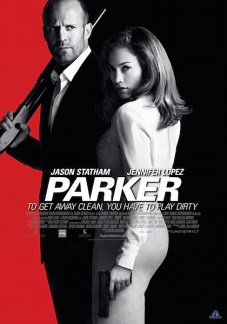 Parker trailed well — funny lines, promising action, solid setup — but doesn’t deliver.
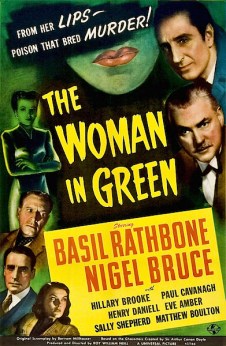 Basil Rathbone’s Sherlock Holmes starred in films which, although they typically involve murder, are best described as “adventures”. The series’ 11th film, The Woman in Green, is one of the few — perhaps the only one — that could genuinely be described as dark and grim.
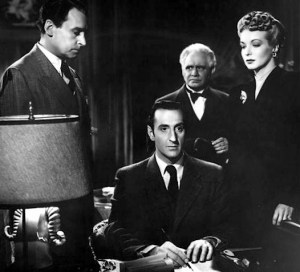 The evil is carried off with aplomb by Daniell. Reportedly a cold actor to work with, he chills on the screen too. This is a man you can believe would carry out such a scheme without a single twang to his conscience. His comeuppance, even with its surprising finality, is welcomed. The titular woman, played by Hillary Brooke, is one of Moriarty’s cohorts, posing as the ‘girlfriend’ of the aforementioned widower in order to set him up. The film is of course in black & white, so we can’t see what colour she’s wearing, and no one ever refers to it — even when they’re hunting for her based on looks alone. I guess someone thought it was an evocative title nonetheless.
 100Films.co.uk