
Michael Bay | 124 mins | streaming (HD) | 2.35:1 | USA / English | 15 / R
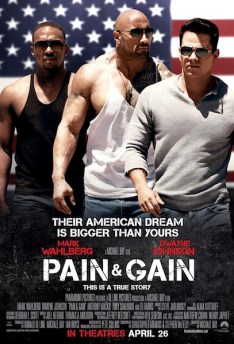 For his first non-sci-fi movie in a decade, divisive action director Michael Bay channels Tarantino (kinda) for this based-on-a-true-story crime comedy. Dwayne “The Rock” Johnson, Mark “Marky Mark” Wahlberg and Anthony “The Falcon” Mackie star as a gang of dimwitted Florida bodybuilders who come up with a ‘foolproof’ plan to rob a rich gym client.
That comparison to Tarantino is lifted from Now TV’s description of the film, and I don’t quite agree with it. Pain & Gain is certainly a comedic crime movie, the kind of thing Tarantino was known for before he got diverted into genre B-movie homage/parodies, but it doesn’t feel like a Tarantino movie — which, considering the innumerable films that do rip-off his ’90s style (even today), is only a good thing. I wouldn’t say Bay’s movie feels wholly unique or original, but I don’t think it’s Tarantino he’s riffing off.
Nonetheless, the film’s best asset is its humour, much of it derived from dialogue. Proceedings take a little while to warm up, with some character backstory flashbacks that aren’t always necessary and seem to befuddle the narrative, but once it settles down into the crime spree, it’s consistently hilarious. Bay has pitched the tone exactly right, playing it straight but with an OTT edge that betrays awareness of the ludicrousness of it all. Towards the end, when events have reached a point of total ridiculousness, he throws up an onscreen caption to announce, “This is still a true story.” That’s witty. (Though, ironically, it appears during one of the few bits the filmmakers did actually make up!)
 Bay is aided by leads who are surprisingly adept at comedy. Johnson is the best thing in it, consistently hilarious as his conscience battles former addictions and newfound religious convictions. I noted down some of his best lines to quote in the review, but they lose something without his delivery.
I suppose there is a question of whether this tone really is appropriate: as these are real-life events, should we be finding them so funny? It is kind of tasteless. I suppose you could parlay that into a discussion about the comedic crime sub-genre on the whole: is it okay to laugh at this kind of behaviour so long as it’s been dreamt up in the mind of some (wannabe-)auteur, but as soon as someone actually did it for real, a film of those events has crossed the line. Is that a sound argument? If you’re going to find a fictionalised account of the real-life version abhorrent, shouldn’t we similarly find the wholly-fictional version similarly poor? It’s a moral quandary I don’t really have an answer for because, when all is said and done, what the real guys did was horrendous, but the way they went about it was ludicrous and is almost unavoidably darkly funny in the re-telling. I certainly laughed.
 After he’s become so sidetracked making the awful Transformers movies, it’s easy to forget that Bay was once a quality action filmmaker. His works may not have class, but they had style and panache befitting the genre — The Rock, in particular, is a ’90s action classic. Pain & Gain isn’t exactly a return to form because it’s not the same kind of movie, but it is the first Bay movie for at least a decade that’s really worth your time.

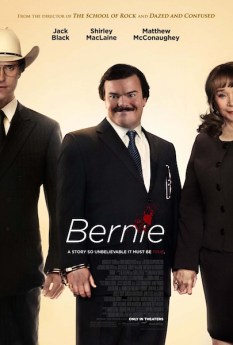 I seem to vaguely remember dismissing Bernie as just ‘Another Jack Black Comedy’ back whenever it came out (in the UK, that wasn’t until April 2013), and essentially forgot about it until earlier this month when it came up on
  (If you’re observing similarities to Midnight in the Garden of Good and Evil there, you’re not the first: the magazine article that inspired Bernie, published around the same time as
 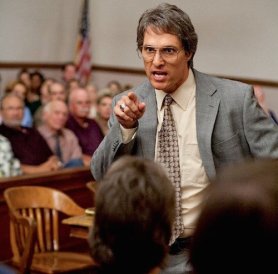 The local attorney seeking Bernie’s prosecution is played by man-of-the-moment Matthew McConaughey. I don’t know when we’re meant to deem the start of his “McConaissance”, but I’m not sure this really qualifies as part of it. Not that he’s bad, but it feels like the kind of played-straight comedy Southerner I’ve seen him do a few times now; indeed, it’s how he comes across in real life, from what I’ve seen. It fits the role like a glove, but doesn’t make for a remarkable performance.
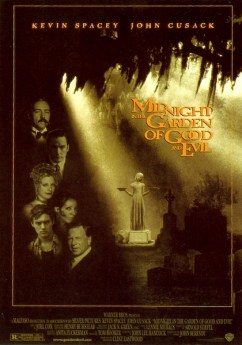 Sent to write “500 words on a Christmas party” in Savannah, Georgia, journalist John Kelso (John Cusack) instead finds himself covering a murder trial where he’s become friendly with the accused (Kevin Spacey).
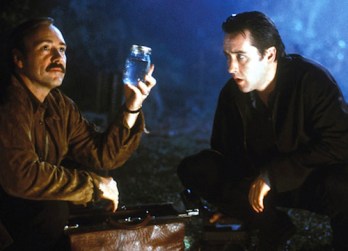 Like many an “adapted from a bestseller!” movies, I guess Midnight in the Garden was a big deal in its day that’s faded to semi-obscurity since (see:
  Sometimes, films are so maligned that you feel you just have to see for yourself. Or I do, anyway. Crime thriller Runner Runner, with its
  Brian Koppelman and David Levien’s screenplay is packed full of dreadful dialogue, which isn’t helped by phoned-in performances from all the principle cast, in particular Affleck. I guess he needed a payday between his Oscar-winning directorial efforts. I’ve seen some assert that the dialogue and delivery are meant to be mannered and stylised, but I just don’t buy it. Unless the style was meant to be “cable TV cheapie”, anyway. The Puerto Rican filming locations are quite prettily shot by DP Mauro Fiore, at least, but that’s scant consolation when everything else is so woeful.

 a supporting character who’s come and gone over the years, initially seeming one-note but revealing more in more recent seasons — but here you get that kind of arc condensed into 90 minutes. Barr is every bit his equal, the pair forming a genuine if sometimes complicated bond. That it acknowledges but dodges the whole “mid-life-crisis man and teenage girl” iffiness is further to its credit.
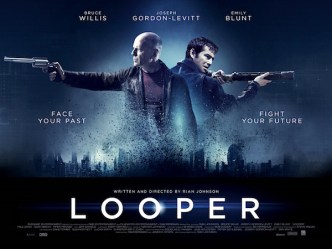 Writer-director Rian Johnson re-teams with the star of
  Firstly, the less you know the better. I pretty much knew the above before I went in, and that meant the film had surprises from the get-go. For instance, the near-future world most of the action takes place in has been well-realised by Johnson and his design and effects teams, and time travel is not the only SF concept or imagery employed here, which I wasn’t aware of. Their vision is
 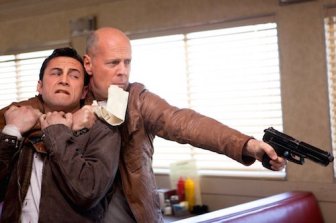 Heading up the cast, Gordon-Levitt does a good Bruce Willis impersonation — believable, but not a slavish impression. That was probably quite necessary, because I don’t imagine Willis has the thespian chops to emulate an older Gordon-Levitt. Notoriously, the younger actor does the whole thing under prosthetics designed to make it more plausible he’d age into Willis. They’re a bit weird: not badly done — far from it, in fact — but you’re always kind of aware they’re there. A highly able supporting cast flesh out the rest of the characters, though most memorable is young Pierce Gagnon as an imperilled child you wouldn’t necessarily mind getting killed. And I mean that in a nice way; about the film and his performance, if not the character.
 Even if there are some logic issues, it doesn’t fatally undermine the movie. Looper comes with the joys of a well-imagined future, a captivating storyline, engaging characters, and enough twists and turns along the way to keep you guessing at the outcome. The best genre movie of 2012? That was a year of stiff competition among SF/F pictures, but Looper may have the edge.
 Adapted from one of Agatha Christie’s best-regarded novels (now commonly known by its US title, And Then There Were None), Ten Little Indians sees a group of ten people invited to a remote location (in the book, an island; here, an alpine hotel) by a mysterious host, who doesn’t appear but does accuse them all of murder via a recorded message. Then, stranded, they begin to die one by one.
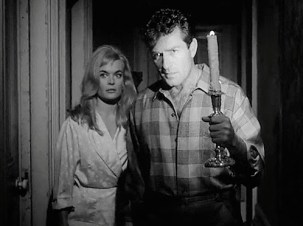 voiceover informs us this is our chance to have a guess. Ah, the ’60s.
 The
The  Your enjoyment of the film will hinge on your tolerance for this level of filmmaking. War Zone isn’t a Marvel-derived adaptation to sit alongside their big-budget in-house productions, but one to rival other hard-R violence-focused flicks. It may be kind of nasty in places, but no more so than other movies of its ilk; and really, if you look at it from outside the confines of sometimes-simplistic comic book morality, the Punisher is quite a nasty character.
 When it comes to hitman movies, I’d’ve said there’s
 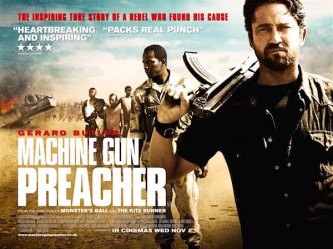 Between the mega-hits of
  The problem with the last point is that, in real life, Sam is still over there, still doing the same thing, while conflicts rage on. But this is a film — you need to find some kind of conclusion. The makers have tried, but its an incredibly half-arsed climax; less a resolution to the entire story and more Sam having learnt one lesson from something that went wrong a little earlier.
 mashed together with a polemical charity documentary about Africa, and then with some
  100Films.co.uk