
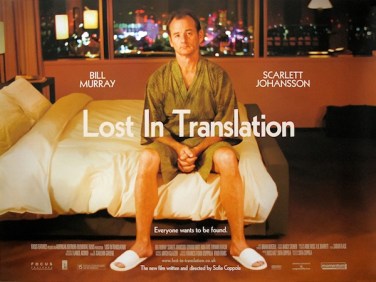
Country: USA & Japan
Language: English, Japanese, German & French
Runtime: 102 minutes
BBFC: 15
MPAA: R

Original Release: 3rd October 2003 (USA)
UK Release: 9th January 2004
First Seen: DVD, c.2004
Stars
Bill Murray (Ed Wood, Broken Flowers)
Scarlett Johansson (Ghost World, Under the Skin)
Giovanni Ribisi (Gone in Sixty Seconds, Avatar)
Anna Faris (Scary Movie, Cloudy with a Chance of Meatballs)
Director
Sofia Coppola (The Virgin Suicides, The Bling Ring)
Screenwriter
Sofia Coppola (Marie Antoinette, Somewhere)
The Story
In Tokyo to shoot a lucrative whiskey commercial, one-time movie star Bob Harris battles with middle-aged ennui. In his hotel he encounters Charlotte, a recent Yale graduate who’s tagged along with her entertainment photographer husband, and feels similarly untethered by life. Perhaps these two lost souls will find something in each other…
Our Heroes
“I just feel so alone, even when I’m surrounded by other people,” says Charlotte, succinctly assessing the life situation of not only herself, but also her new friend, Bob. He’s dryly amused by the world (who better than Bill Murray for that role?), struggling to connect with his wife back home who pesters him with questions about carpet colours. Charlotte, unsure what to do with her life after graduating from university, and finding her husband and his acquaintances to not be on her level, is a kindred spirit, despite the age gap.
Our Villain
Not strictly a villain, but Charlotte’s husband is hardly the most inspiring figure in her life. Not a strong basis for a marriage, really.
Best Supporting Character
A lady known only as Premium Fantasy Woman. “My stockings. Lip them. Lip my stockings. Yes, please, lip them… Lip them. Hey! Lip my stocking!”
Memorable Quote
“Let’s never come here again because it would never be as much fun.” — Charlotte
Memorable Scene
After an exuberant night out, Bob and Charlotte sit quietly side by side in a karaoke joint’s hallway. She slowly lowers her head on to his shoulder, smiling to herself, while he stares into the distancing, participating in the moment but also not. To quote further from my ‘What the Public Say’ selection, “it expresses the connection, and simultaneously, the quiet distance that still exists between them (mostly in their minds). It’s romantic without really consuming the romance.”
Making of
Bill Murray no longer has an agent, instead maintaining a voicemail number that he rarely gives out. Sofia Coppola reportedly left hundreds of messages on it, having written the part of Bob especially for him. Eventually he called her back, but still only gave a verbal commitment to appear — she wasn’t sure he was actually going to show until the first day of filming, when he did.
Awards
1 Oscar (Original Screenplay)
3 Oscar nominations (Picture, Actor (Bill Murray), Director)
3 BAFTAs (Actor (Bill Murray), Actress (Scarlett Johansson), Editing)
5 BAFTA nominations (Film, Director, Original Screenplay, Cinematography, Music)
FIPRESCI Prize (to Sofia Coppola for “the cool detachment and freshness with which she observes the antics of various American and Japanese television and communication industry people in the anonymous surroundings of a large Japanese city, and for the sensitivity with which she modulates the atmosphere of the film from comedy to melancholy.”)
1 MTV Movie Awards Mexico nomination (Funniest American in Japan — it lost to Tom Cruise in The Last Samurai)
What the Critics Said
“Lost in Translation revels in contradictions. It’s a comedy about melancholy, a romance without consummation, a travelogue that rarely hits the road. Sofia Coppola has a witty touch with dialogue that sounds improvised yet reveals, glancingly, her characters’ dislocation. She’s a real mood weaver, with a gift for […] mining a comic’s deadpan depths. Watch Murray’s eyes in the climactic scene in the hotel lobby: while hardly moving, they express the collapsing of all hopes, the return to a sleepwalking status quo. You won’t find a subtler, funnier or more poignant performance this year than this quietly astonishing turn.” — Richard Corliss, TIME
 Score:
 95%
95%What the Public Say
“It’s an incredibly quiet film, with little narrative or story-related dialogue. We follow Bob and Charlotte as they gently explore their environment and grow towards each other, and it feels like we’re watching seaturtles swim together. It’s all very graceful and beautiful, and quiet, and meandering, and slow. And I mean that in a good way […] For a film that explores disconnection and loneliness, to me there is no better way to frame that story.” — Reinout van Schie, One Shot

There seems to have been a glut of “men coming to terms with their place in the world”-type movies in the early ’00s, for whatever reason. (I’m not sure there was before that? There have been plenty since, though they can feel like hangers-on.) Some once-popular ones have turned into objects of derision (Garden State), but I think others hold up. No doubt the quality of the BAFTA-winning performances of Bill Murray and Scarlett Johansson have a lot to do with that, creating a cross-generational pairing of two lost souls that feels real and touching, rather than tipping into some creepy love affair thing. Nonetheless, through to its ending the film plays with variations on melancholy — a difficult feeling to evoke in movies, in my opinion, but a level writer-director Sofia Coppola here hits with impressive consistency.

#57 will be… Denzel Washington in flames.
 The cinema was blessed — or, depending on your point of view, blighted — by an abundance of espionage-related movies last year (see: the intro to
  that usually just means an overabundance of the F-word. Here we have at least one clear headshot, a dissolving throat, a knife through a hand, and more photos of a henchman’s penis than you ever needed to see. (That last one’s only describable as “gruesome” depending on your personal predilections, of course.)
 The extended (aka unrated) cut contains almost 10 minutes of extra material, detailed
 Doris Day and Rock Hudson star in this Oscar-winning rom-com hit.




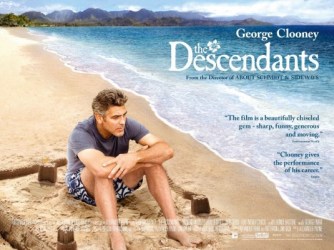 Comedy-drama starring George Clooney as a Hawaiian with family issues: his wife’s in a coma and may’ve been cheating; his daughters are unruly; and his extended family is considering a massive land sale that’s the talk of the islands.


 Regular readers will surely remember
 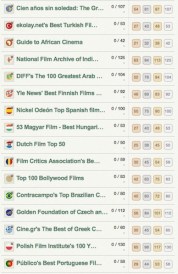 There are pretty obvious reasons why I’ve never seen any films on many of those lists — quite a lot are country or continent specific, and as Western film viewers we’re notoriously poor at having seen movies from, say, Africa. The lack of acclaimed films I’ve seen from the likes of Belgium, Finland, Holland, Hungary, Norway, Poland, Portugal, and Spain is my own fault though, I guess. Anyway, this is something I intend to rectify in the coming days / weeks / months / years / decades — however obscure some of my missing lists may seem, there’s at least one film I’ve heard of on all but one or two of them, so there’s that.
 Why is this film notable? In fact, is it notable? Well, it was voted in to The 50 Greatest Cartoons by some of 1,000 animation professionals, so there’s clearly something there. It was created by animator Marv Newland while he was a film student in L.A., after a live-action project he’d been planning to submit was scuppered (according to
  In the US Deadpool was, famously, rated R — which (for those not up on their international film certificates) ostensibly means you have to be over 17 to see it. In the UK it was rated 15, which is much more appropriate, because if Deadpool had a mind it would be that of a 15-year-old boy. Of course, plenty of grown men also have the mind of a 15-year-old boy, and that’s why it’s the highest-grossing R-rated movie (worldwide) ever. And I guess I must still have the mind of someone half my age too, because I loved it.
 It depends what you’re looking for. I think Deadpool’s makers set out to make a superhero film that was genre-aware and prepared to take the piss out of that, but I don’t think they were aiming to deconstruct superhero narratives. It might make Deadpool a less ‘intelligent’ movie than Kick-Ass, but it doesn’t stop it being entertaining.
 The film handles this really well: it’s not a non-stop commentary, but it’s also not isolated off in little clumps, like, “this had to be here but it’s kinda awkward to have him always talking to the audience”. It’s often used for irreverence, and I like a bit of irreverence. There are clearly some rules and/or considered choices with this fourth-wall breaking, though. In his commentary on the deleted scenes, Miller says that Reynolds kept wanting to pull the boom mic down from out of frame and use it to batter one of the villains, or something along those lines, but Miller thought this would be breaking the film’s rules. That’s a pretty fine line to tread — knowing he’s in a film, but not, like, using the fact he’s in a film… I guess it’s more of a “what feels right” set of choices than a little rulebook.
 One of the film’s best bits comes courtesy of that X-connection: stroppy teenage goth mutant Negasonic Teenage Warhead (excellent newcomer Brianna Hildebrand), and her immensely comic-faithful costume. Ironically, it’s not at all faithful to how NTW is portrayed in the comics (and you can find dozens of think-pieces about how the film changed her character and how that’s more than OK, if you’re so inclined), but it is generally like X-Men comic costumes, certainly ones that cropped up in the early ’00s. (I swear there was a Frank Quitely New X-Men cover showing a bald female in a costume really like NTW’s yellow-and-black X-Men uniform, but I can’t find it now. Maybe I imagined it.) Comic-faithful costumes are very much the MO of Marvel movies nowadays, but because the X-Men film franchise sprung from the “how do we make superheroes acceptable in movies?” period of the genre, the X-movies have never really done that before (though they do sort of, in passing, at the end of Apocalypse — I’m beginning to think we’re one day going to look back at that as a transition movie, assuming the next one goes super comic-book-y). I mean, this doesn’t really signify anything about Deadpool, I’ve just gone off on a geeky tangent.
 Speaking of which, I do feel like I should be mature enough to have grown out of loving Deadpool… buuuut tough. It’s fantastic fun. Though, it’ll be interesting to see how it holds up to re-watches. I’ve read reviews which point out it doesn’t have the substance underneath the jokes that Kick-Ass does (did I mention that already? I didn’t steal that point from someone else, nope, noooo sir), so while Matthew Vaughn’s film is completely enjoyable on multiple go-rounds, any enjoyment to be found in Deadpool will ultimately fade once the novelty has gone. I mean, that’s possible — literally, only time will tell — but there’s not necessarily anything wrong with a “first time is definitely the best” movie, if that first time is good enough. Heck,

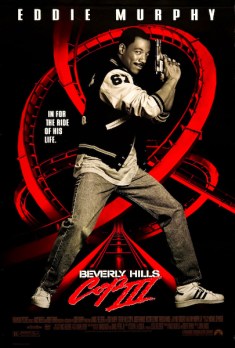 Beverly Hills Cop III always seemed to be on TV when I was younger — on BBC1, quite late, but I guess not that late because I always seemed to stumble across it during the theme park climax. In reality it can probably have only been on a couple of times, but that’s how it seemed. And because it caught my attention, I somehow knew that one day I’d end up watching the entire movie, just to see. To see what, I’m not sure; but to see. Of course, that necessitated watching the
 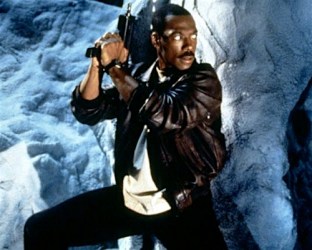 Eddie Murphy and [the film’s director] Martin Brest made it funny.” The script for the threequel also wasn’t any good (according to some versions of events, that’s why original co-stars John Ashton and Ronny Cox didn’t return), but Landis tried to put Murphy in funny situations and see what improvisation threw up. Murphy, keen to be taken seriously, worked around that.
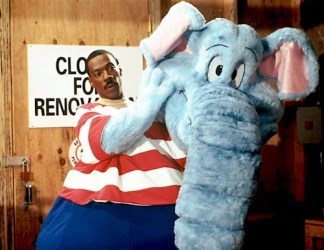 In
In 
 100Films.co.uk