Shrek 2 (2004)

The 100 Films Guide to…

Shrek 2

Not so far, far away…

Country: USA
Language: English
Runtime: 93 minutes
BBFC: U
MPAA: PG

Original Release: 19th May 2004 (USA)
UK Release: 2nd July 2004
Budget: $150 million
Worldwide Gross: $919.8 million

Stars
Mike Myers (Wayne’s World, The Love Guru)
Eddie Murphy (Beverly Hills Cop, Norbit)
Cameron Diaz (Charlie’s Angels, The Holiday)
Antonio Banderas (The Mask of Zorro, The Skin I Live In)
John Cleese (Monty Python and the Holy Grail, A Fish Called Wanda)
Julie Andrews (Mary Poppins, The Princess Diaries)
Jennifer Saunders (Muppet Treasure Island, Absolutely Fabulous: The Movie)
Rupert Everett (An Ideal Husband, St. Trinian’s)

Directors
Andrew Adamson (Shrek, The Chronicles of Narnia: Prince Caspian)
Kelly Asbury (Spirit: Stallion of the Cimarron, Gnomeo & Juliet)
Conrad Vernon (Monsters vs Aliens, Sausage Party)

Screenwriters
Andrew Adamson (The Chronicles of Narnia: The Lion, the Witch and the Wardrobe, Mr. Pip)
Joe Stillman (Shrek, Planet 51)
J. David Stem (The Rugrats Movie, The Smurfs)
David N. Weiss (All Dogs Go to Heaven, The Smurfs 2)

Story by
Andrew Adamson (Shrek the Third, Cirque du Soleil: Worlds Away)

Based on
Shrek!, a picture book by William Steig — even more loosely than last time, though.


The Story
Newlyweds Shrek and Fiona travel to meet her parents, the King and Queen of Far Far Away. They’re less than pleased about their daughter marrying an ogre, especially as the King made a deal with Fairy Godmother for her son, Prince Charming, to be Fiona’s husband — and she insists that bargain be fulfilled.

Our Heroes
Shrek and Donkey, off another whirlwind adventure! After Shrek has a lover’s tiff with his new bride, he sets off to try to make himself what he thinks she wants: human.

Our Villain
Fairy Godmother might seem sweet and helpful, but she actually runs a factory with oppressed workers (they don’t even have dental!) and is manipulating the King so her son can become his heir.

Best Supporting Character
When Fairy Godmother orders the King to deal with Shrek, he seeks out a renowned ogre hunter: Puss in Boots. He may look like an adorable little kitty, but he’s a devil with a sword.

Memorable Quote
“It looks like we’re up chocolate creek without a Popsicle stick!” — Gingerbread Man

Memorable Scene
As a party begins at which Prince Charming will kiss Fiona and make her fall in love with him, Fairy Godmother entertains the guests with a rendition of Holding Out for a Hero — as Shrek and friends storm the castle to rescue his wife.

Memorable Music
The use of pop songs was a defining characteristic of the first Shrek, so naturally that continues here. However, there are also a lot more diegetic songs this time: Jennifer Saunders gets two musical numbers as Fairy Godmother (one an amusing riff on typical Disney numbers, the other mentioned above), plus Tom Waits and Nick Cave both sing (as the same character). The film also includes two really good covers of Holding Out for a Hero (the second, by Frou Frou, plays over the credits), which is some kind of achievement.

Making of / Letting the Side Down
For the UK release, two minor roles were redubbed: Doris the Ugly Stepsister, voiced by chat show host Larry King originally, was replaced by chat show host Jonathan Ross; and the red carpet announcer, voiced by Joan Rivers in the US, was replaced by Kate Thornton, who also must’ve done red carpet stuff at some point, I dunno. I guess it seemed like a fun idea at the time — the idea, presumably, was to localise famous voices with ones that would be better-known in other countries — but they shouldn’t’ve bothered: it’s just distracting, and neither replacement gives a very convincing performance. I think this was the first time such voice localisation had been done, and it seemed to kick off a minor fad for it. I thought it had gone away, but they recently defaced Kung Fu Panda 3 with a similar trick.

Previously on…
Shrek 2 picks up pretty closely from the end of Shrek — you probably need to see that to make full sense of this one.

Next time…
A further two sequels followed, plus a spin-off movie (which has its own spin-offs, including a six-season TV series). There’s also a 4D theme park attraction (which uses a plot that was rejected for Shrek 2) and numerous TV specials. There are always rumours of the franchise getting resurrected, too.

Awards
2 Oscar nominations (Animated Film, Original Song (Accidentally in Love))
2 Saturn Award nominations (Animated Film, DVD Special Edition)
7 Annie Award nominations (Animated Feature, Animated Effects, Directing, Music, Storyboarding, Voice Acting (Antonio Banderas), Writing)
Nominated for the Palme d’Or (again!)

Verdict

Having said Shrek has aged and dated, I think Shrek 2 has fared better. Arguably the first one has more pure originality, giving birth to an irreverent fairytale meta-verse, but Shrek 2 expands on those building blocks and plays with the ideas. There are lots of fun movie spoofs (though many are from the same era, so their effectiveness could partly be nostalgia), the climax is a legitimately good action sequence (see Memorable Scene), and there’s even a decent thematic throughline about what you’re prepared to do or give up for the one you love. Plus the animation looks a lot more polished — three years makes a huge difference in computer animation, especially in the early noughties. The first one has its moments, for sure, and perhaps some of them are better or more memorable too, but as an overall film I prefer the sequel.

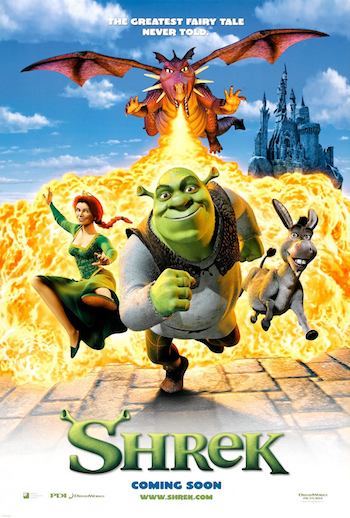
Shrek (2001)

The 100 Films Guide to…

Shrek

The greatest fairy tale never told.

Country: USA
Language: English
Runtime: 90 minutes
BBFC: U
MPAA: PG

Original Release: 16th May 2001 (USA)
UK Release: 29th June 2001
Budget: $60 million
Worldwide Gross: $484.4 million

Stars
Mike Myers (Austin Powers: International Man of Mystery, The Cat in the Hat)
Eddie Murphy (Coming to America, Dreamgirls)
Cameron Diaz (There’s Something About Mary, Gangs of New York)
John Lithgow (Cliffhanger, Rise of the Planet of the Apes)

Directors
Andrew Adamson (The Chronicles of Narnia: The Lion, the Witch and the Wardrobe , Cirque du Soleil: Worlds Away)
Vicky Jenson (Shark Tale, Post Grad)

Screenwriters
Ted Elliott (Aladdin, Pirates of the Caribbean: The Curse of the Black Pearl)
Terry Rossio (The Mask of Zorro, Pirates of the Caribbean: Dead Man’s Chest)
Joe Stillman (Beavis and Butt-Head Do America, Gulliver’s Travels)
Roger S.H. Schulman (Balto, Mulan II)

Based on
Shrek!, a picture book by William Steig.


The Story
When his swamp is overrun with fairytale creatures, ogre Shrek sets off to confront the man responsible, Lord Farquaad. To get his land back, Shrek must rescue the Princess Fiona from her dragon-guarded castle, so that Farquaad can marry her. But all is not as it appears…

Our Hero
Shrek is a grumpy Scottish-accented ogre who just wants to be left alone in his swamp, but events conspire to get in his way. Of course, as things transpire, he really has a heart of gold.

Our Villain
Men of his stature are in short supply, though there are those who think little of him — it’s Lord Farquaad, who wants Fiona to be his bride primarily so he can become king.

Best Supporting Character
Shrek’s new best friend (whether he likes it or not), wise-cracking ass Donkey, gets many of the best lines.

Memorable Quote
Gingerbread Man: “Do you know… the Muffin Man?”
Lord Farquaad: “The Muffin Man?”
Gingerbread Man: “The Muffin Man.”
Lord Farquaad: “Yes, I know the Muffin Man. Who lives on Drury Lane?”
Gingerbread Man: “Well, she’s married to the Muffin Man…”
Lord Farquaad: “The Muffin Man?”
Gingerbread Man: “The Muffin Man!
Lord Farquaad: “She’s married to the Muffin Man…”

Memorable Scene
As Shrek, Fiona, and Donkey travel back to Lord Farquaad, they’re jumped upon by Robin Hood (who, for no apparent reason, has a French accent) and his Merry Men, attempting to rescue Fiona by, in part, singing a merry song. But she doesn’t want rescuing and so goes all Matrix on their merry arses.

Memorable Music
As part of its generally irreverent take on myths and fairytales, Shrek is laden with contemporary popular music. It was all very modern at the time, but, 17 years on, it’s obviously dated itself, sounding distinctly early-millennium-y now.

Technical Wizardry
The overall animation quality may be looking a bit dated now, but Shrek hails from the era when every major new computer-animated movie was breaking ground in the field, in one way or another. In Shrek‘s case, it was the ability to realistically animate hair and grass.

Next time…
To date there have been three sequel movies, a spin-off movie (which then has its own world of attendant spin-offs, including a six-season TV series), a 4D theme park attraction (which was included in 3D on some DVD releases of the film), plus numerous TV specials and the like, as well as a stage musical version. There are constant rumours of the franchise getting a big-screen continuation, too.

Awards
1 Oscar (Animated Feature)
1 Oscar nomination (Adapted Screenplay)
1 BAFTA (Adapted Screenplay)
5 BAFTA nominations (Film, Supporting Actor (Eddie Murphy), Music, Sound, Special Visual Effects)
1 BAFTA Children’s Award (Film)
1 Saturn Award (DVD Special Edition)
4 Saturn Award nominations (Fantasy Film, Supporting Actor (Eddie Murphy), Writing, Music)
8 Annie Awards (Animated Theatrical Feature, Individual Achievement for Directing in an Animated Feature, Individual Achievement for Writing in an Animated Feature, Voice Acting by a Male Performer in an Animated Feature (Eddie Murphy), Individual Achievement for Effects Animation, Individual Achievement for Music Score an Animated Feature, Individual Achievement for Production Design in an Animated Feature, Individual Achievement for Storyboarding in an Animated Feature)
4 Annie Award nominations (Individual Achievement for Character Animation (x3), Individual Achievement for Production Design in an Animated Feature)
Nominated for the Hugo for Best Dramatic Presentation
Nominated for the Palme d’Or (seriously)

Verdict

DreamWorks’ irreverent riff on fairytale animations was a breath of fresh air back in 2001, allowing them to net the first Best Animated Feature Oscar ahead of Disney or Pixar. A decade and a half of imitators have taken the shine off that somewhat, as have advances in technology (old CGI ages worse than old cel animation), but it remains an amusing and quotable film, with a surprisingly strong moral message at its heart.

The Boss Baby (2017)

2018 #12
Tom McGrath | 97 mins | download (HD+3D) | 2.39:1 | USA / English | U / PG

The Boss Baby

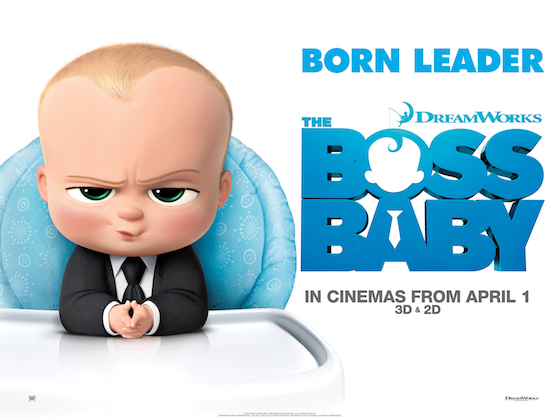
The Boss Baby was one of the top 20 highest grossing films of 2017, which earnt it a place on my ’50 Unseen’ list, thereby ensuring it would remain in my consciousness for as long as I referred to said list (i.e. for the rest of time). Then it went and got nominated for an Oscar too, displacing the likes of The LEGO Batman Movie and Ghibli heir Mary and the Witch’s Flower in the process. With those factors combined, I felt I had to witness it for myself. I chose to do so in 3D, to hopefully ameliorate at least some of the anticipated discomfort of watching the film itself. I needn’t have worried: despite what many people will tell you, I thought The Boss Baby was actually pretty good. Well, most of it.

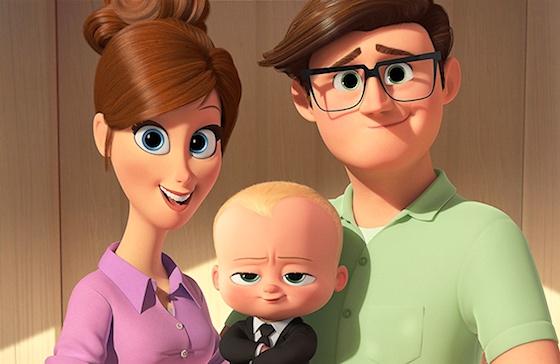
It’s the story of Tim (voiced by Miles Bakshi and in narration by Tobey Maguire), a seven-year-old only child with a hyperactive imagination and two doting parents. But then a new baby arrives… As Tim’s parents’ affection shifts to their attention-demanding bundle of joy, he’s the only one who can see the truth: that the baby wears a suit, carries a briefcase, and is clearly a businessmanbaby on some kind of undercover mission. Obviously no one will listen to Tim, so he sets about exposing the truth.

Sibling rivalry

For all its daft humour, the reason The Boss Baby is so successful (for an adult viewer) is that it’s actually a really neat way of tackling the whole “sibling displaced by new baby” thing, from the kid’s point of view. That’s the thematic and subtextual meat that makes it more than just “wouldn’t it be funny if a baby was a businessman!” As part of this, it has a nice line in juxtaposing how an imaginative seven-year-old sees the world versus how it really is — showing us both Tim’s fantasies and the actual events they’ve launched off from. It allows the film to have exciting and kooky stuff (like talking business-babies and elaborate action scenes) while also remaining grounded. Watching in 3D heightens this further, incidentally: as with most computer-animated films, the 3D effect is generally pretty nice, but it really comes alive during the fantasy and action sequences.

If that all sounds oddly serious, it isn’t. Arguably best known nowadays for his Trump impersonations, Alec Baldwin is an obvious choice to voice an infantile businessman. This one’s actually competent, though, so Baldwin plays it straight and thus is dryly witty. There are also plenty of amusing visual gags, one-liners, and so on to fulfil the expected comedy remit. Okay, some don’t land or are a bit juvenile, but it is a kids’ movie after all.

Parents are so gullible

Unfortunately, what works in the early sections begins to go awry later on. By the third act it’s lost the connection to plausible reality that made Tim’s imagined versions such fun — it’s impossible to translate the OTT action we’re witnessing into what might be really happening. I know it sounds daft to talk about plausibility in a film about a baby who’s a businessman, but it’s the relationship between Tim’s fantasies (i.e. the business-baby stuff) and real-life (i.e. really he’s just a new baby) that makes the earlier parts work.

Arguably worst of all is the epilogue, which takes a very serious emotional issue (the loss of a baby) and tosses it aside to expedite the resolution the filmmakers want to reach. Maybe it’s a bit much to expect a kids’ movie to attempt to tackle the realities of losing a child, especially when it only introduces that element in its closing minutes, but then surely the solution is to not even go there; to find a better way to wrap up the story?

It’s this increasing lack of attentiveness that ultimately led me to give the film a 3 instead of a 4. If it had kept up the early quality through to the end, I likely would have looked more generously on it. Nonetheless, thanks to the bits that worked really well, I generally found the film to be a pleasant surprise.

3 out of 5

Spin-off TV series The Boss Baby: Back in Business is available on Netflix from today.

Cars 3 (2017)

2018 #54
Brian Fee | 102 mins | download (HD+3D) | 2.39:1 | USA / English | U / G

Cars 3

At this point I think it’s fairly well known that the Cars movie series continues not because of any artistic desire on the part of Disney/Pixar, but because the toys the films generate sell like hotcakes. Indeed, that situation hasn’t necessarily changed with this third instalment: apparently Cars 3 features 65 different individual racers, more than both the previous films combined. And several of those appear kitted out in different paint jobs. Disney gotsta make that toy money! The disregard with which they hold the actual movies is perhaps demonstrated by the fact this third one is helmed by a first-time director, Brian Fee, whose previous credits are as a storyboard artist on a couple of Pixar productions. Maybe they lucked out, then — or maybe they actually knew what they were doing promoting him — because I think this is easily the best film in the Cars trilogy.

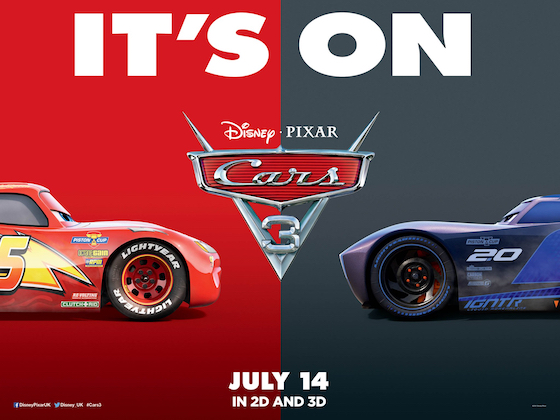
Beginning with nary a reference to the events of Cars 2, racer Lightning McQueen (Owen Wilson) is back doing what he loves: racing. That’d be American-style racing, i.e. constantly turning left for hundreds of laps. Anyway, turns out there’s a new generation of hot young racers, who are less on their way up and more already here, led by Jackson Storm (Armie Hammer). They use advanced training techniques and statistics to beat the old guard — soon all of Lightning’s contemporaries are choosing to retire or being forced out, leaving him the last one standing… until he crashes in the final race of the season. Is his career over? Well, what do you think? With the backing of a new sponsor, Sterling (Nathan Fillion), and all the latest high-tech gear, Lightning sets to work training with young wannabe-racer-turned-coach Cruz Ramirez (Cristela Alonzo). But as he struggles to regain his mojo, perhaps there’s something to be said for the old ways after all…

Storm vs Lightning

Although I wouldn’t say sports movies are my bag, I think Cars 3 probably benefits from taking a more clean approach to that genre, ditching all the spy hijinks distractions of the last one. That purity of genre keeps it straightforward and focused. It also re-centres itself on Lightning McQueen, shoving Mater (Larry the Cable Guy) back into a cameo-sized supporting role, which is about where he belongs (I wouldn’t say he’s likeable in small doses, but he’s tolerable). It still finds room for humour and levity, just in a more natural, less goofy way.

Around that, it actually takes a run at some weighty themes — specifically, old age and obsolescence — and carries through on them too, with a finale that goes for more of a “finding worth in what you do next” ending rather than a “still got it (for now)” one. Such maturity means it’s perhaps more suited to Pixar’s grown-up fans than their young ones — it’s a surprisingly serious movie, in fact, without being po-faced about it. That said, you could probably play down the thematic stuff and just be entertained: there are still good set pieces, both action-based and comical, to keep the right family-friendly tone.

It makes for a winning combination. Cars 3 may not trouble the upper echelons of Pixar’s greatest achievements, but it is the best of their Cars movies — the first of the trilogy I remember genuinely enjoying, rather than just finding tolerably okay. That might sound like a low bar to set, but Cars 3 clears it admirably.

4 out of 5

Cars 3 is available on Sky Cinema from today.

Beetlejuice (1988)

The 100 Films Guide to…

Beetlejuice

The Name In Laughter
From The Hereafter

Country: USA
Language: English
Runtime: 92 minutes
BBFC: 15
MPAA: PG

Original Release: 30th March 1988 (USA)
UK Release: 19th August 1988
Budget: $15 million
US Gross: $73.7 million

Stars
Michael Keaton (Batman, Birdman)
Alec Baldwin (The Hunt for Red October, Glengarry Glen Ross)
Geena Davis (The Fly, Thelma & Louise)
Winona Ryder (Heathers, Edward Scissorhands)

Director
Tim Burton (Pee-wee’s Big Adventure, Edward Scissorhands)

Screenwriters
Michael McDowell (The Nightmare Before Christmas, Thinner)
Warren Skaaren (Beverly Hills Cop II, Batman)

Story by
Michael McDowell (see above)
Larry Wilson (The Addams Family, The Little Vampire)


The Story
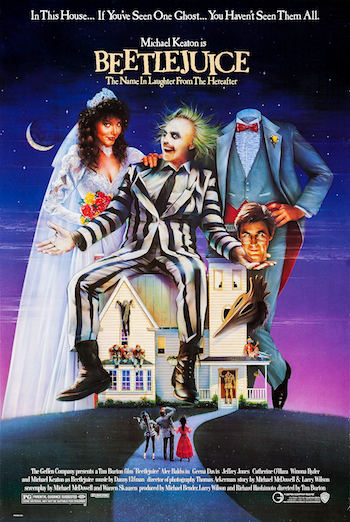
Adam and Barbara Maitland are living an idyllic life in their lovely small-town house… until they die. What’s worse is that they’re condemned to haunt their old home while a family of city-slickers move in and destroy everything they loved about it. To get them out, Adam and Barbara may be forced to call on disgraced ‘bio-exorcist’ Betelgeuse…

Our Heroes
Adam and Barbara Maitland are a sweet couple living a quite life in a quaint little town, until they’re killed in an accident (swerving their car to avoid a very cute dog, to be fair) and have to cope not only with haunting their old home, but also with the afterlife’s bizarre bureaucracy.

Our Villains
Betelgeuse, Betelgeuse, Betelgeuse! He may be offering to help the Maitlands, but in the end he’s their biggest problem. Before that, though, there’s Charles and Delia Deetz, the new occupants who seem determined to ruin the Maitlands’ beloved home.

Best Supporting Character
The Deetz’s daughter, little goth Lydia. She’s the only human who can see the Maitlands, and quickly finds she gets on with them better than her own parents.

Memorable Quote
Juno: “What’s wrong?”
Barbara: “We’re very unhappy.”
Juno: “What did you expect? You’re dead!”

Memorable Scene
When the Deetzes hold a dinner party for some of their city friends, Adam and Barbara attempt to frighten them away by puppeteering them into a bizarre rendition of Day-O (The Banana Boat Song). As well as the supporting cast gamely engaging in a dance routine (er, kind of), they really sell it by simultaneously looking confused and troubled about what’s going on with their bodies. Unfortunately for Adam and Barbara, however, the stunt backfires…

Memorable Music
The famed collaboration between Tim Burton and Danny Elfman dates right back to the director’s first film, making this their second together. But that recognisable Elfman style — so familiar from, er, every other Tim Burton movie (as well as others, of course) — is already very much in evidence. The main theme almost sounds like a greatest hits package for the composer, which does make you wonder how much it’s style and how much he’s been ripping himself off ever since…

Truly Special Effect
According to IMDb, the visual effects budget was just $1 million, leading Burton to decide to make the effects look “as tacky and B-movie as possible” — which is interesting because a lot of them are pretty good, bearing in mind that the film hails from the late ’80s. Obviously they’ve aged now, therefore, but it’s so packed with creative and varied visual trickery that I assume it once played as a kind of effects showcase. It’s only that in an historical sense now, but there’s still a lot of striking and memorable stuff here.

Letting the Side Down
Betelgeuse, Betelgeuse, Betelgeuse! Ironically, I’d like the whole film a lot more if the title character wasn’t in it. Okay, I know not everyone’s going to feel this way — I imagine some people love him — but, for me, he’s by far the worst thing about the film. He starts off with just a couple of small appearances that are only a little irritating, but when he enters the story properly… ugh.

Making of
Believe it or not, the original script was a straight horror film. Betelgeuse was a winged demon, only transforming into a man to interact with humans, whose goal was to rape and kill the Deetzes rather than just scare them off. Lydia was a minor character, with a younger sister who could see the Maitlands. I don’t know how exactly it went from that to a comedy, but maybe it was for the best.

Next time…
An animated TV series, which reconfigured Betelgeuse as the hero and teamed him up with Lydia, ran for 94 episodes between 1989 and 1991. Apparently it was a big hit, and aired on both ABC and Fox simultaneously, becoming “one of the few shows in American television history to be aired concurrently on two different broadcast networks.” Aside from that, a sequel movie has long been mooted, and continues to be an on-again-off-again prospect to this day.

Awards
1 Oscar (Makeup)
2 BAFTA nominations (Make Up Artist, Special Effects)
3 Saturn Awards (Horror Film, Supporting Actress (Sylvia Sidney), Make-Up)
5 Saturn Award nominations (Supporting Actor (Michael Keaton), Director, Writing, Music, Special Effects)
Nominated for the Hugo for Best Dramatic Presentation

Verdict

I knew that I’d seen Beetlejuice many years ago, but I could barely remember anything about it, other than a general sense that I didn’t like it much. So watching it again now was almost like a first viewing, and was almost a revelation too: it’s a very enjoyable film. Pretty much my only problem with it is Betelgeuse himself (as discussed above); but, in fact, he only makes up a relatively small proportion of the movie: he’s in just 17½ minutes, less than 20% of the film. The good qualities in the remainder keep it up at a 4-star level.

Bad Boys II (2003)

The 100 Films Guide to…

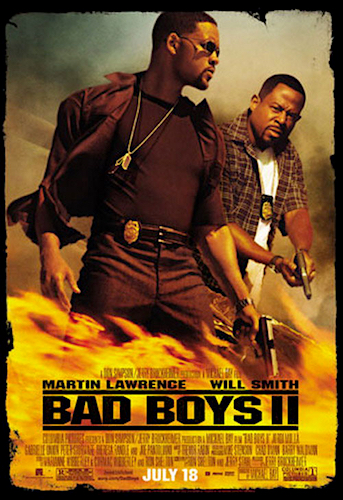
Bad Boys II

Country: USA
Language: English & Spanish
Runtime: 147 minutes
BBFC: 15
MPAA: R

Original Release: 18th July 2003 (USA & Canada)
UK Release: 3rd October 2003
Budget: $130 million
Worldwide Gross: $273.3 million

Stars
Martin Lawrence (National Security, Wild Hogs)
Will Smith (Ali, I Am Legend)
Jordi Mollà (Blow, Riddick)
Gabrielle Union (Bring It On, Think Like a Man)

Director
Michael Bay (The Rock, The Island)

Screenwriters
Ron Shelton (White Men Can’t Jump, Hollywood Homicide)
Jerry Stahl (Twin Peaks Episode 11, Urge)

Story by
Marianne Wibberley (The 6th Day, National Treasure)
Cormac Wibberley (Charlie’s Angels: Full Throttle, National Treasure: Book of Secrets)
Ron Shelton (Bull Durham, Tin Cup)


The Story
Miami’s finest (or, at least, funniest) narcotics cops attempt to stop the flow of ecstasy into the city, before the cartel masterminding it can escape to Cuba.

Our Heroes
Wisecracking Miami narcs Marcus Burnett and Mike Lowery. If you don’t like them, this isn’t the film for you — it spends an awful lot of time just hanging out with them rather than getting on with the plot.

Our Villain
Cuban drug lord Tapia. I guess they realised the first film’s villain didn’t get enough screen time, because there’s a lot more invested in this one. Unfortunately, he’s not very interesting, and Jordi Mollà’s performance is terrible.

Best Supporting Character
Marcus’ little sister, Syd, a DEA agent. She’s dating Mike, which is a secret from Marcus, and is undercover trying to catch Tapia’s gang, which is a secret from them both. (See also: Next Time.)

Memorable Quote
“We ride together, we die together. Bad boys for life.” — Mike Lowery

Memorable Scene
After a car chase, pile-up, and shoot out with our heroes, the gang of criminals hijack a car carrier to continue their pursuit of Syd. Marcus and Mike give chase along the freeway, at which point the criminals decide to start offloading cars…

Previously on…
The first Bad Boys was Michael Bay’s feature debut, and propelled Will Smith’s career towards movie stardom.

Next time…
A third film has been in on-and-off development for years — the last news seems to be that it might start shooting later this year. Definitely in the works this year is a spin-off series based around Marcus’ sister, Syd.

Verdict

Probably the Michael Bay-iest Michael Bay movie that Michael Bay ever Michael Bay-d— er, made. If the first Bad Boys suggested where Bay’s style would go, Bad Boys II is him in full flow. It’s got all the hyper-kinetic editing, vague sense of space, and demonstrates the same lack of restraint over length (as well as, well, everything else) that Bay would show again and again during the Transformers series. It’s just. So. Long. There are loads of skit-like comedy asides that could be cut. Keep some, sure — it’s an action-comedy, that’s the style — but all of them? I guess it’s something of a hang-out movie in that regard, more about spending time with the characters than getting on with the plot.

It’s also packed to bursting with major action sequences, some of which border on classic but, again, are let down by Bay’s direction. For example, the freeway chase is good, but with a better sense of space and interrelation between its various elements (rather than the tumult of semi-connected images we do get) it could’ve been exceptional. Similarly, the climax is massively overblown in a way that only Bay (well, and now the Fast & Furious films) could do, and yet I didn’t recall a second of it from my previous viewing. It goes to show there’s more to making something memorable than just going Big.

This Letterboxd review sums it up well: “It’s impossible to love, but also hard to hate. It’s ambitious, relatively well shot, too long to call a piece of chuck-on fun, and generally just weird.”

For the record, although I’ve given both films a 3, the first is up towards a 3.5 and this is down towards a 2.5.

Bad Boys (1995)

The 100 Films Guide to…

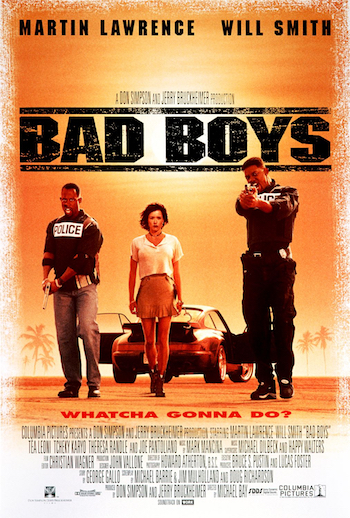
Bad Boys

Whatcha gonna do?

Country: USA
Language: English
Runtime: 119 minutes
BBFC: 18
MPAA: R

Original Release: 7th April 1995 (USA)
UK Release: 16th June 1995
Budget: $19 million
Worldwide Gross: $141.1 million

Stars
Martin Lawrence (Blue Streak, Big Momma’s House)
Will Smith (Six Degrees of Separation, Independence Day)
Téa Leoni (Deep Impact, Jurassic Park III)
Tcheky Karyo (Nikita, GoldenEye)
Joe Pantoliano (Empire of the Sun, Memento)

Director
Michael Bay (Armageddon, Transformers)

Screenwriters
Michael Barrie & Jim Mulholland (Amazon Women on the Moon, Oscar)
Doug Richardson (Die Hard 2, Hostage)

Story by
George Gallo (Midnight Run, The Whole Ten Yards)


The Story
When millions of dollars’ worth of heroine is stolen from police evidence, the two cops that brought it in must find the thieves and retrieve the drugs, while also protecting the only surviving witness who’s seen the crooks.

Our Heroes
Marcus Burnett and Mike Lowery, a pair of wisecracking cop buddies, one a family man with a wife and kids, the other a smooth womaniser. Never seen that before.

Our Villain
Drug lord Fouchet. Murder happy and clearly a master at planning heists. Other than that, we barely get to know him.

Best Supporting Character
A witness to some of Fouchet’s crimes, Julie ends up in witness protection with Marcus, who she thinks is Mike, which they have to hide from Marcus’ family. Hilarity ensues!

Memorable Quote
Mike Lowrey: “Now back up, put the gun down, and get me a pack of Tropical Fruit Bubblicious.”
Marcus Burnett: “And some Skittles.”

Memorable Scene
After a shoot-out at the airport, Fouchet escapes in a sports car. Marcus, Mike, and Julie give chase, with the normally slow Marcus driving, as they find themselves in a game of chicken with the concrete crash barriers at the end of the runway…

Making of
Bad Boys was a relatively low-budget production, but, fortunately for director Michael Bay’s ambitions, he was already a wealthy man from directing commercials and music videos — so when the budget ran out before shooting a key part of the climax, he was able to pay for it out of his salary; and when they needed a swish car for the heroes to drive, Bay lent his own Porsche 911 to the production.

Next time…
A sequel came eight years later, with a third in on-and-off development ever since — the last news seems to be that it might start shooting later this year. Definitely in the works this year is a spin-off series based around a character from the second film.

Verdict

The debut feature from director Michael Bay, Bad Boys displays a lot of the things he would become known for: fast-cut action scenes; a sense of style over substance; a little light lasciviousness… Even from his first film, some of his flourishes look over the top. Maybe they’ve just aged badly — it certainly feels of its time, i.e. the mid-’90s (with some ’80s holdovers). Anyway, it’s kept aloft by the buddy act of its two stars, who are pretty funny at times. Bay allows the film to run a mite too long though, and the villain is underdeveloped, both of which hold it back even more than Bay’s sometimes-cheesy direction.

Make/Remake: Deaths at a Funeral

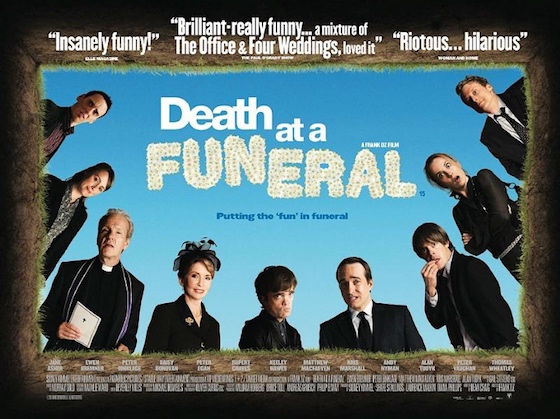
In 2007, Frank Oz directed a gaggle of British thesps (plus Peter Dinklage) in a darkly comic farce set during an English funeral.

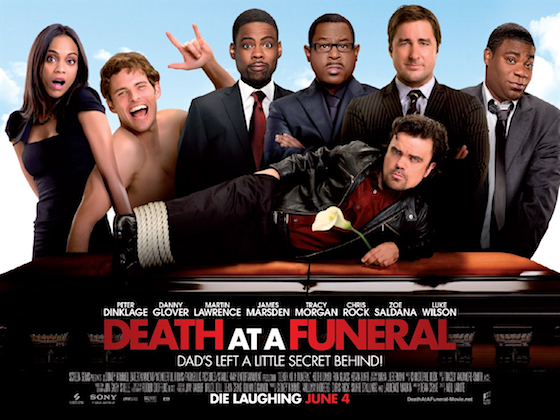
Just three short years later, director Neil LaBute and a gaggle of American comedians (plus Peter Dinklage) remade it in the US.

Why did they so speedily re-do an English-language film in English? Goodness only knows. But I watched both versions almost back to back, so here are my thoughts…

Death at a Funeral
(2007)

2018 #44
Frank Oz | 91 mins | streaming (HD) | 1.85:1 | UK, USA, Germany & Netherlands / English | 15 / R

Death at a Funeral (2007)

The plot of both versions is identical: a group of family and friends gather at the home of the family’s patriarch for his funeral. A variety of subplots unfold from there, but the main one revolves around the appearance of a guest that no one knows, and what he wants.

The thing that surprised me most about Death at a Funeral is how well-liked it is online. I vaguely remember it coming out but thought it had been mostly ignored, but it has a fair amount of ratings on IMDb (a similar number to films like All About Eve or Dumbo), and relatively high user scores on sites like Letterboxd too. I thought maybe people (well, Americans) had come to it via the remake and it seemed a lot better by comparison, but that has less than half as many ratings on IMDb, so…

I was mulling on this a lot because often I like films a bit more than the online consensus, but I wasn’t feeling it with this one. I certainly enjoyed it, but it takes a while to warm up, the laugh rate isn’t quite high enough, and some of the storylines feel overly familiar (how many times have we seen someone accidentally take drugs and try to hide it? I don’t know, but it feels like I’ve seen it a lot). Nonetheless, it develops into a decent little farce. I suppose it’s a black comedy too, what with it being set at a funeral and some of the events that unfurl, but other people have pushed the boundaries of “black comedy” so far in the past couple of decades that it didn’t feel that dark to me.

Peter Dinklage with one of the few British actors who hasn't been in Game of Thrones

The cast is a quality array of recognisable British faces, many of them not known for comedy (Matthew Macfadyen, Keeley Hawes, Rupert Graves), which lends some surprising strength to a couple of scenes. Others that are more familiar from the genre (Andy Nyman, Ewen Bremner, Kris Marshall) keep the guffawing in check. And there are some Americans too, including an exposed performance from Alan Tudyk (who’s doing a British accent) and a pre-Thrones Peter Dinklage (who isn’t), but they both fit in well.

The film’s best gag, in my estimation, comes courtesy of the entire cast, in a way; an in-joke that I wasn’t 100% sure was deliberate: the end credits begin with each cast member’s name accompanied by a brief shot of them corpsing. Corpsing, during a film called Death at a Funeral. Well, I do like an in-joke.

Anyway. Although this original British version of Death at a Funeral wasn’t quite as hilarious as I’d hoped for, it’s worth a watch as a well-performed and amusing farce. And it does improve somewhat when compared to to its remake…

3 out of 5

Death at a Funeral
(2010)

2018 #46
Neil LaBute | 89 mins | streaming (HD) | 2.35:1 | USA / English | 15 / R

Death at a Funeral (2010)

Where the original was a little underwhelming, this is just kinda shit. It’s the most pointless remake since Gus Van Sant’s Psycho.

That comparison isn’t a bad one, because this is a scene-for-scene remake — sometimes shot-for-shot, line-for-line. Even the title sequence is an inferior riff on the original. Not only that, but some bits aren’t even done as well. If it worked the first time, why are you changing it? Maybe the original cast and crew made it look more effortless than it was. Some of it doesn’t even translate very well. For example, there’s a joke in the original about how “tea may solve many things”. Here, that’s translated to be about coffee. Yes, it’s been adapted to suit the different culture, but in the process has lost the cultural significance (to Brits, tea is more than just a popular beverage).

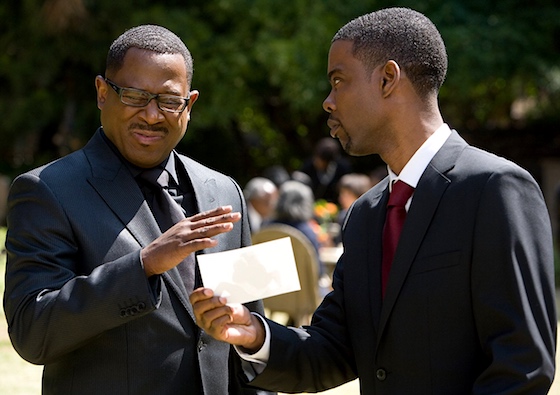
I guess he's showing him the screenplay

There are some new gags, most likely the result of the cast improvising (this version is more populated by comedians than the British one). Some of them are even funny. Unfortunately, more often the cast don’t hold up. Most of the performances are like an under-rehearsed am-dram version of the same screenplay. They certainly don’t have the acting chops to sell the more emotional moments. James Marsden is quite good in the Alan Tudyk role, though. Peter Dinklage plays the same part, but not as well — it’s less nuanced, less believable.

Director Neil LaBute previously found notoriety as writer-director of the Nic Cage Wicker Man remake. This does nothing to rehabilitate his reputation (what is this guy’s obsession with re-doing and ruining British films?) Again like Van Sant’s Psycho, it’s more interesting as a cinematic exercise than as a film in its own right.

2 out of 5

The Love Punch (2013)

2018 #7
Joel Hopkins | 94 mins | streaming (HD) | 2.35:1 | France & UK / English | 12 / PG-13

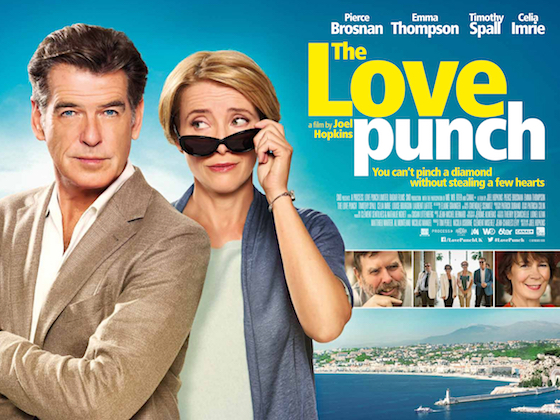
The Love Punch

In this very daft comedy heist thriller (calling it a thriller is a bit of a stretch, but anyway), Pierce Brosnan plays Richard, a businessman whose company is bought out by mysterious others, only for them to strip its asset and sink the employees’ pensions — as well as that of Richard’s ex-wife, Kate (Emma Thompson). When the man behind the buy-out, Kruger (Laurent Lafitte), refuses to play fair, Richard and Kate team up with their neighbours, Pen (Celia Imrie) and Jerry (Timothy Spall), to pilfer the extraordinarily expensive diamond Kruger has bought his fiancée (Adèle Blanc-Sec’s Louise Bourgoin).

The Love Punch flirts with seriousness in its setup — what could be more current than unscrupulous moneymen buying a company and screwing over people’s pensions? — but quickly reveals its true nature as an implausible farce. Despite the lead cast, it seems to have been a French-driven production (even the UK-set scenes were filmed over there), so I suppose that style is only appropriate. While never scaling the heights of genuine hilarity, I don’t imagine anyone thought they were making anything other than a light romp.

So if you like any (or all) of Brosnan, Thompson, Imrie, and Spall, as well as the idea of a bit of gently-farcical gadding about in the south of France, then The Love Punch is amiable fluff to while away 90 minutes on a Sunday.

3 out of 5

T2 Trainspotting (2017)

2017 #124
Danny Boyle | 117 mins | streaming (HD) | 1.85:1 | UK / English & Bulgarian | 18 / R

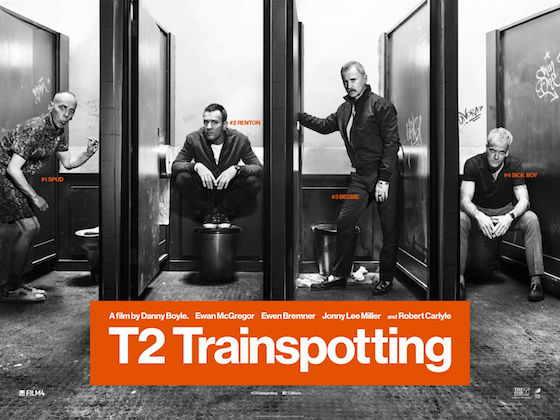
T2 Trainspotting

At one point during T2, a younger character accuses some of the returning characters of living in the past; that it’s all they talk about. It’s true of the characters, and it’s kinda true of the film itself too: this belated sequel to the era-defining original feels try-hard, like it wants to recapture the verve and inventiveness of its predecessor, but everyone’s now too grown up to do it properly.

Set 20 years on, it reunites the first film’s main characters… and, really, that’s the plot. Obviously other things happen, and the details are important, but that seems to be why the film exists: to get the gang back together for another couple of hours. Is that reason enough to make a movie? I guess everyone will have their own answer to that question. For me, it wasn’t reason enough to justify T2.

(Trivia aside that, frankly, I find more interesting then the film itself: reportedly director Danny Boyle wanted to call it simply T2, if James Cameron would let him — they thought they needed that permission because of Terminator 2 being commonly marketed as T2. But then it turned out that Terminator 2 was never officially called T2, so they were free to do as they pleased. But then internet searches for “T2” were found to still mainly turn up the Terminator sequel (unsurprisingly, let’s be honest), so they settled on T2 Trainspotting so people would know what it was. You have to wonder why at that point they didn’t just call it Trainspotting 2…)

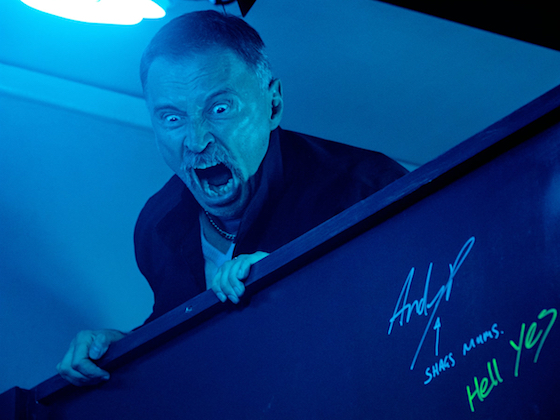
Looking as bored as I felt

Anyway, back to this T2. The meandering plot, such as it is, lacks the grit and realism of the first movie. For example, that ended with a simple betrayal — a guy stealing money while his mates were sleeping — while this ends with a knock-down drag-out fight in a construction site like something out of a low-budget thriller. Visually, too, it’s so clean and pristine. There are some properly beautiful shots, especially of the scenery outside Edinburgh, but I’m not sure that’s in-keeping with the Trainspotting aesthetic. Boyle does at points try to reheat the visual tricks of the first movie, but I didn’t feel it worked. The original’s many stylistic flourishes are now much imitated, but they were fresh back in the day and somehow that freshness still comes across when watched now. By trying to ape ape them, T2 just joins the long line of copycats.

Another key element of Trainspotting was the soundtrack. I don’t know what they were thinking with the music here — it isn’t even close to being as memorable or iconic as the original. Maybe that was the point, to not try the same trick again; but there are still plenty of jukeboxed tracks that attempt to draw attention to themselves, but… don’t.

I felt like this, too

Trainspotting had energy, dynamism, exuberance; it pulsed with life and youth. Its sequel is more sedate, more… middle-aged. Well, so are the characters, so that could work; but they don’t behave like they’re middle-aged — they’re too busy trying to recapture their youth, reliving past glories and past conflicts. The film is doing the same. You could perhaps argue that it’s form mirroring content, but the form lacks the wink at the audience to say “this is deliberate.” Like the characters, it seems unaware of the sad state it’s in. Ultimately, it feels like a slightly unfocused, thematically inconclusive, largely unnecessary postscript.

3 out of 5