
Travis Knight | 102 mins | Blu-ray | 2.40:1 | USA / English | PG / PG
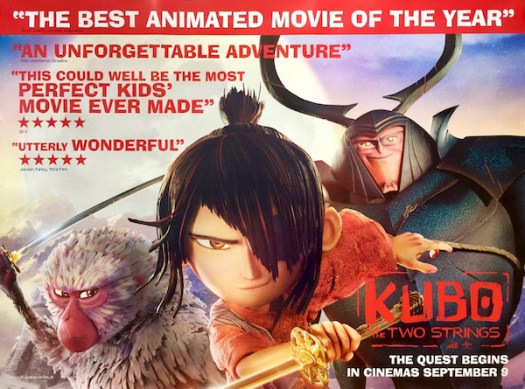
The latest film from animation studio Laika (Coraline, ParaNorman, The Boxtrolls), Kubo and the Two Strings is a samurai-action fantasy-adventure inspired by Japanese culture and folklore — but animated in stop-motion and rated PG! Not that either factor in any way undermines what may be the greatest animated movie of last year.
It is, unsurprisingly, the story of Kubo (voiced by Art “Rickon Stark” Parkinson), a young boy in olden-times Japan who regales the folk of his local town with fantastical adventure stories, which he brings to life with origami that he animates using magic from playing his shamisen (basically, Japan’s answer to the banjo). These stories actually come from Kubo’s mother and relate to his own life: Kubo’s grandfather is the evil Moon King (Ralph Fiennes), who they fled from when Kubo was a baby, while his father stayed behind to aid their escape, presumably to the death. Kubo mustn’t go out at night lest the Moon King see him and send his minions, Kubo’s creepy aunts (both Rooney Mara), to capture them. So Kubo never goes out at night and they all live happily ever after.
Not really! When the aunts come for them, Kubo’s mother uses the last of her magic to whisk Kubo away on a quest to find some mythical armour that he’ll need to defend himself against the Moon King. To help him, she brings his wooden monkey charm to life (voiced by Charlize Theron); and along the way they stumble across a man-sized beetle who used to be a samurai (voiced by Matthew McConaughey). Scrapes ensue as the trio hunt for the three pieces of the armour, with the vicious aunts in pursuit.

At its most basic, Kubo sounds like an archetypal “fantasy quest” narrative, with a gang of heroes in search of a MacGuffin to defeat a Big Bad. But the devil is in the details — something the folks at Laika know only too well. The Japanese myths they’ve tapped into here make for some fantastic detail; if anything, the familiarity of the broad story arc allows the unique aspects of the mythology to be all the more prominent, including some possibly surprising developments later on. I say “possibly” because I’ve read at least one complaint about the twists being guessable to adult viewers. Well, this is a fable and also, technically, a kids’ movie — just two reasons why plot guessability doesn’t really matter. I mean, if all you want from a movie is to be surprised, why not just watch 90 minutes of things popping out of boxes?
The other aspect massively in Kubo’s favour is the animation. It’s genuinely stunning — beautiful to look at, as well as being technically audacious and consequently impressive. Some of it is so grand that several times I forgot that most of what we’re seeing on screen was built for real and animated by hand over several years. I say “most” because it is augmented with CGI, just as any action-fantasy live-action movie would be these days. The fact there was green screen and compositing and some wholly CG elements doesn’t detract from the technical workmanship on display. That included the largest stop-motion puppet ever built. I won’t spoil what or where it is in the film, but there’s a behind-the-scenes glimpse during the end credits that is breathtaking.
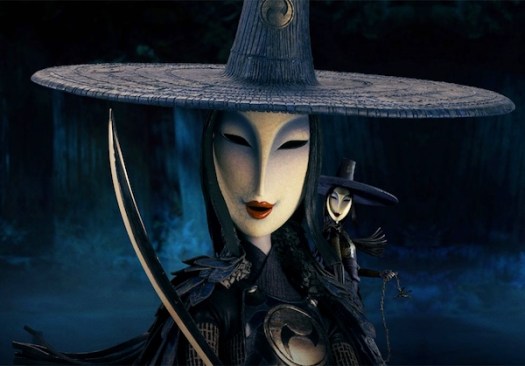
Another area the animation excels is in the action scenes. That’s a field which is rarely animation’s forte, especially stop-motion animation, but Laika took on the challenge and nailed it. Everything from the antics of Kubo’s animated origami to a centrepiece duel aboard a ship at sea are the equal to anything you’d find in a live-action samurai actioner. The character work is excellent too, especially the villains. The aunts are fabulously creepy, mainly thanks to their blank mask faces and the way they float everywhere, seemingly indestructible. There are a couple of other monstrous creatures too, but their wonders deserve to be discovered in situ.
It’s not just scale that Kubo does well: the attention to detail was immense, with Japanese cultural experts called in to inform the tiniest detail, like period-accurate stitching on the clothing. This is background detail on 10-inch puppets, remember, but they went to that much trouble. It’s indicative of the attention paid to every facet of the movie, and while using the correct stitching, or developing appropriate techniques for animating water, or applying genuine principles from Japanese beliefs, do not in themselves make for a great movie, they indicate the level of care taken over this project — which does help to produce a great movie.
Then there’s the music, composed by Dario Marianelli, which integrates the shamisen as well as other appropriate instruments into a consistently lyrical score. And the photography, by Frank Passingham — it’s not just the design work and high-quality builds that make the film so gorgeous to look at, but the quality of the light that’s captured. And I’ve been so busy singing the film’s production praises that I haven’t even mentioned how funny it is, or how emotional, with Mar Haimes and Chris Butler’s screenplay tucking some very positive lessons away in the final act. Indeed, the alternative perspective offered by embracing a different culture means that, for once, they might not just be lessons for kiddie viewers. By the time the credits roll — to a glorious cover version of a perfectly chosen song — the whole experience is completely enchanting.

I think Laika as a name went a bit unnoticed with their first feature, Coraline, because it had the already-headlining names of writer Neil Gaiman and director Henry “Nightmare Before Christmas” Selick. Their two subsequent features seem to have been well-liked but not set the world on fire (I’ve still not seen either). But here, they’re firmly stamping their name as a mark of quality. Come in Pixar, your time may be up. I’m sure Kubo won’t be picking up many gongs in the current awards season, what with three big-name Disney-backed pictures arrayed against it, but I find it hard to believe any of those outdid the artistry on display here, both in its spectacular animation technique and its majestic storytelling. To say it’s 2016’s best animated film is underselling it — it’s one of my favourite films released last year, fullstop.

Kubo and the Two Strings is released on DVD and Blu-ray in the UK today.
It placed 3rd on my list of The 17 Best Films I Saw For the First Time in 2017, which can be read in full here.


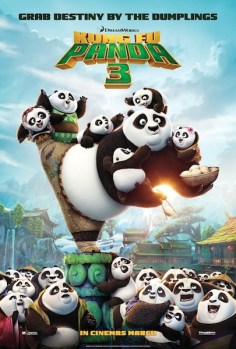 Po and co are back in a movie that bucks the sequel trend by being perhaps the best Kung Fu Panda yet.
 I hope for humanity’s sake the version on Sky Cinema retains the original voices.
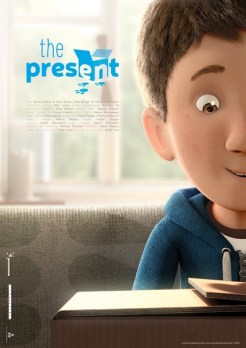 A short film about a boy and his dog, The Present was a graduation short for the Institute of Animation, Visual Effects and Digital Postproduction at the Filmakademie Baden-Wuerttemberg in Ludwigsburg, Germany (yeah, I copy & pasted that), which has since won more than 50 awards after playing at film festivals around the world. Reportedly it also single-handedly landed its animator/director a job at Disney — he went on to work on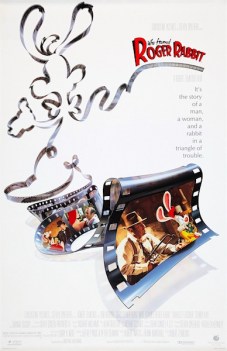

 Score:





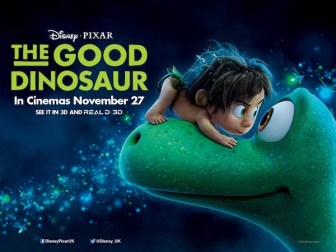 Once upon a time, Pixar could do no wrong. Then
  Pixar have on several occasions produced films with an innovative opening act that descends into derivative kids’ animation runaround territory.
 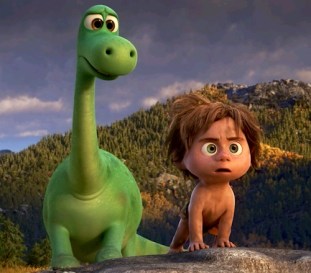 Perhaps most powerful of all is the relationship it creates between Arlo and a young human child he befriends, Spot. With humanity in a much earlier state of evolution, Spot is basically characterised as a dog — the way he moves, comes to his name, follows scents, shakes, scratches and enjoys being scratched, and so on — so of course I warmed to him. Nonetheless, though the building blocks used to create their friendship are very familiar, the way the film sells its emotional arc is ultimately immensely effective. Its resolution may even bring a tear to the eye.

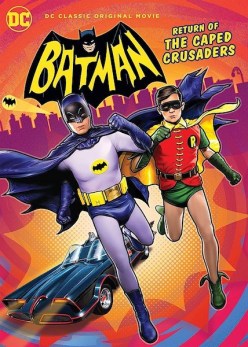 Holy nostalgia hit, Batman! This animated movie reunites the surviving stars of the enduringly popular
 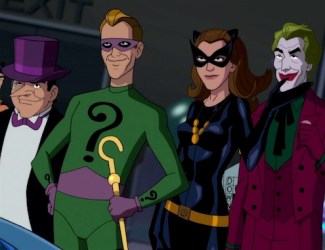 fundamentally, a comedy. Conversely, Ward still sounds pretty spry, and is gifted plenty of those “Holy [insert something here], Batman!” catchphrases that never cease to be fun. Unfortunately, Newmar also sounds her age, but doesn’t seem to quite have the liveliness that West retains. In the behind-the-scenes featurettes she seems a delightfully kooky old bird (at the recording she’s wearing cat ears, for one thing), so it’s hard to resent her, but the portrayal of Catwoman as slinky and sexy feels a little… odd. On the bright side, it means you don’t get the uncomfortableness of West flirting with a much younger actress, even in animated form.
 On the whole, Return of the Caped Crusaders is a resounding success. It’s a fun return to a beloved incarnation of arguably the most popular superhero; a version who’d been somewhat left out in the cold for a couple of decades by a world that grew up a bit too much, but is now being re-embraced and held in deserved esteem. And, even better, there’s already a follow-up in the works. Holy must-see sequel, Batman!
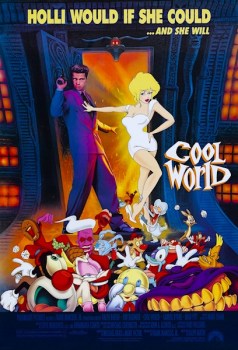 Sometime recently, I said I was making more of an effort to avoid watching movies I know are going to be bad — when there’s so much good stuff to see, why knowingly waste time on bad stuff? But then sometimes something just catches your attention and you have to see for yourself. It sounds as if no one had anything good to say about Cool World when it came out back in 1992, and no one’s had anything good to say about it since either, but after spotting it on Netflix (I’m not sure I’d even heard of it before that) my curiosity was piqued.
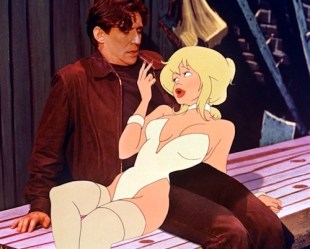 and general depraved behaviour. It’s clear it got caught in the crossfire between a creator/director who wanted to make a hard-R adults-only animated/live-action movie, and a star and producer who wanted to make something they could show to sick kiddies in hospital. The end result surely satisfies neither, because it pulls some punches to not get that R, but there’s no way this is kid-friendly.
 100Films.co.uk