The Boss Baby (2017)

2018 #12
Tom McGrath | 97 mins | download (HD+3D) | 2.39:1 | USA / English | U / PG
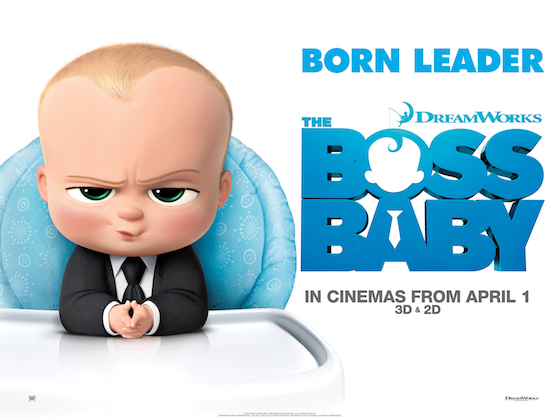
The Boss Baby

The Boss Baby was one of the top 20 highest grossing films of 2017, which earnt it a place on my ’50 Unseen’ list, thereby ensuring it would remain in my consciousness for as long as I referred to said list (i.e. for the rest of time). Then it went and got nominated for an Oscar too, displacing the likes of The LEGO Batman Movie and Ghibli heir Mary and the Witch’s Flower in the process. With those factors combined, I felt I had to witness it for myself. I chose to do so in 3D, to hopefully ameliorate at least some of the anticipated discomfort of watching the film itself. I needn’t have worried: despite what many people will tell you, I thought The Boss Baby was actually pretty good. Well, most of it.

It’s the story of Tim (voiced by Miles Bakshi and in narration by Tobey Maguire), a seven-year-old only child with a hyperactive imagination and two doting parents. But then a new baby arrives… As Tim’s parents’ affection shifts to their attention-demanding bundle of joy, he’s the only one who can see the truth: that the baby wears a suit, carries a briefcase, and is clearly a businessmanbaby on some kind of undercover mission. Obviously no one will listen to Tim, so he sets about exposing the truth.

Sibling rivalry

For all its daft humour, the reason The Boss Baby is so successful (for an adult viewer) is that it’s actually a really neat way of tackling the whole “sibling displaced by new baby” thing, from the kid’s point of view. That’s the thematic and subtextual meat that makes it more than just “wouldn’t it be funny if a baby was a businessman!” As part of this, it has a nice line in juxtaposing how an imaginative seven-year-old sees the world versus how it really is — showing us both Tim’s fantasies and the actual events they’ve launched off from. It allows the film to have exciting and kooky stuff (like talking business-babies and elaborate action scenes) while also remaining grounded. Watching in 3D heightens this further, incidentally: as with most computer-animated films, the 3D effect is generally pretty nice, but it really comes alive during the fantasy and action sequences.

If that all sounds oddly serious, it isn’t. Arguably best known nowadays for his Trump impersonations, Alec Baldwin is an obvious choice to voice an infantile businessman. This one’s actually competent, though, so Baldwin plays it straight and thus is dryly witty. There are also plenty of amusing visual gags, one-liners, and so on to fulfil the expected comedy remit. Okay, some don’t land or are a bit juvenile, but it is a kids’ movie after all.
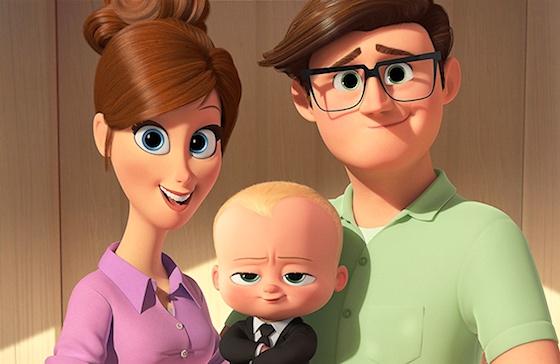
Parents are so gullible

Unfortunately, what works in the early sections begins to go awry later on. By the third act it’s lost the connection to plausible reality that made Tim’s imagined versions such fun — it’s impossible to translate the OTT action we’re witnessing into what might be really happening. I know it sounds daft to talk about plausibility in a film about a baby who’s a businessman, but it’s the relationship between Tim’s fantasies (i.e. the business-baby stuff) and real-life (i.e. really he’s just a new baby) that makes the earlier parts work.

Arguably worst of all is the epilogue, which takes a very serious emotional issue (the loss of a baby) and tosses it aside to expedite the resolution the filmmakers want to reach. Maybe it’s a bit much to expect a kids’ movie to attempt to tackle the realities of losing a child, especially when it only introduces that element in its closing minutes, but then surely the solution is to not even go there; to find a better way to wrap up the story?

It’s this increasing lack of attentiveness that ultimately led me to give the film a 3 instead of a 4. If it had kept up the early quality through to the end, I likely would have looked more generously on it. Nonetheless, thanks to the bits that worked really well, I generally found the film to be a pleasant surprise.

3 out of 5

Spin-off TV series The Boss Baby: Back in Business is available on Netflix from today.
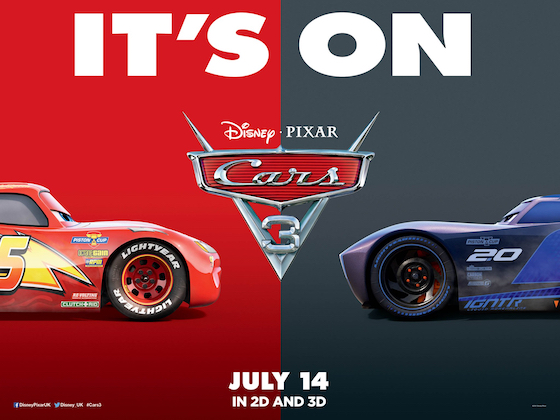
Cars 3 (2017)

2018 #54
Brian Fee | 102 mins | download (HD+3D) | 2.39:1 | USA / English | U / G

Cars 3

At this point I think it’s fairly well known that the Cars movie series continues not because of any artistic desire on the part of Disney/Pixar, but because the toys the films generate sell like hotcakes. Indeed, that situation hasn’t necessarily changed with this third instalment: apparently Cars 3 features 65 different individual racers, more than both the previous films combined. And several of those appear kitted out in different paint jobs. Disney gotsta make that toy money! The disregard with which they hold the actual movies is perhaps demonstrated by the fact this third one is helmed by a first-time director, Brian Fee, whose previous credits are as a storyboard artist on a couple of Pixar productions. Maybe they lucked out, then — or maybe they actually knew what they were doing promoting him — because I think this is easily the best film in the Cars trilogy.

Beginning with nary a reference to the events of Cars 2, racer Lightning McQueen (Owen Wilson) is back doing what he loves: racing. That’d be American-style racing, i.e. constantly turning left for hundreds of laps. Anyway, turns out there’s a new generation of hot young racers, who are less on their way up and more already here, led by Jackson Storm (Armie Hammer). They use advanced training techniques and statistics to beat the old guard — soon all of Lightning’s contemporaries are choosing to retire or being forced out, leaving him the last one standing… until he crashes in the final race of the season. Is his career over? Well, what do you think? With the backing of a new sponsor, Sterling (Nathan Fillion), and all the latest high-tech gear, Lightning sets to work training with young wannabe-racer-turned-coach Cruz Ramirez (Cristela Alonzo). But as he struggles to regain his mojo, perhaps there’s something to be said for the old ways after all…

Storm vs Lightning

Although I wouldn’t say sports movies are my bag, I think Cars 3 probably benefits from taking a more clean approach to that genre, ditching all the spy hijinks distractions of the last one. That purity of genre keeps it straightforward and focused. It also re-centres itself on Lightning McQueen, shoving Mater (Larry the Cable Guy) back into a cameo-sized supporting role, which is about where he belongs (I wouldn’t say he’s likeable in small doses, but he’s tolerable). It still finds room for humour and levity, just in a more natural, less goofy way.

Around that, it actually takes a run at some weighty themes — specifically, old age and obsolescence — and carries through on them too, with a finale that goes for more of a “finding worth in what you do next” ending rather than a “still got it (for now)” one. Such maturity means it’s perhaps more suited to Pixar’s grown-up fans than their young ones — it’s a surprisingly serious movie, in fact, without being po-faced about it. That said, you could probably play down the thematic stuff and just be entertained: there are still good set pieces, both action-based and comical, to keep the right family-friendly tone.

It makes for a winning combination. Cars 3 may not trouble the upper echelons of Pixar’s greatest achievements, but it is the best of their Cars movies — the first of the trilogy I remember genuinely enjoying, rather than just finding tolerably okay. That might sound like a low bar to set, but Cars 3 clears it admirably.

4 out of 5

Cars 3 is available on Sky Cinema from today.

Long Way North (2015)

aka Tout en haut du monde

2017 #33
Rémi Chayé | 78 mins | streaming (HD) | 2.35:1 | France & Denmark / French | PG / PG

Long Way North

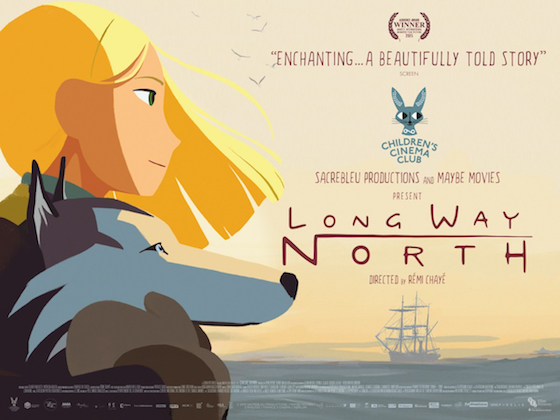
I can’t remember what brought this French-Danish animation to my attention, but I’m glad something did because it’s a beautiful little film that deserves to be better known. Set in the late 19th century, it’s about a young Russian girl, Sasha, who embarks on an adventure to the North Pole, following in the footsteps of her missing grandfather.

Regular readers may recall I ranked it among the top movies I saw last year, when I cited the “understated beauty in its deceptively simple visual style”. Indeed, the animation initially seems so plain that it feels like watching a draft animatic, but that conceals its ability to reveal subtleties when needed. In the end, the distinctive look is part of the film’s considerable charm.

I also mentioned its “equally subtle but strong feminist streak”, another positive aspect. Sasha is strong-willed and capable, but not without her faults, which makes her an engaging heroine. The film doesn’t overplay its “girls can too” side, which only makes it more successful, I think.

There’s none of the epic action sequences or broad humour that most English-language animation assumes kids need to keep them engaged, but instead Long Way North offers good characters on a proper old-fashioned exploration adventure. Highly recommended.

5 out of 5

Long Way North placed 13th on my list of The 17 Best Films I Saw For the First Time in 2017, which can be read in full here.

Godzilla: Planet of the Monsters (2017)

aka Gojira: Kaijū Wakusei / Godzilla: Monster Planet

2018 #13
Hiroyuki Seshita & Kôbun Shizuno | 88 mins | streaming (HD) | 16:9 | Japan / Japanese | PG

Godzilla: Planet of the Monsters

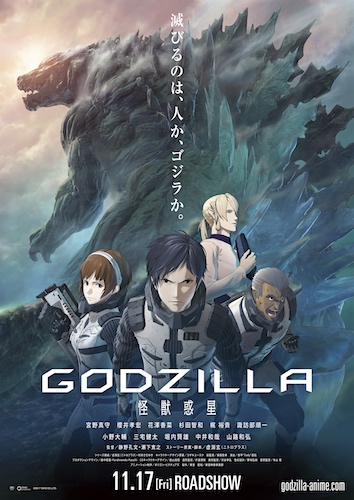
Two of Japan’s most successful cultural exports meet for the first time here as the King of the Monsters, Godzilla, gets the anime treatment. Originally conceived as a TV series, the box office success of Shin Godzilla prompted studio Toho to restructure the project as a trilogy of movies and release them theatrically (in Japan, anyway — the rest of the world gets them via Netflix). Part 2 is due later in 2018 and Part 3 in early 2019.

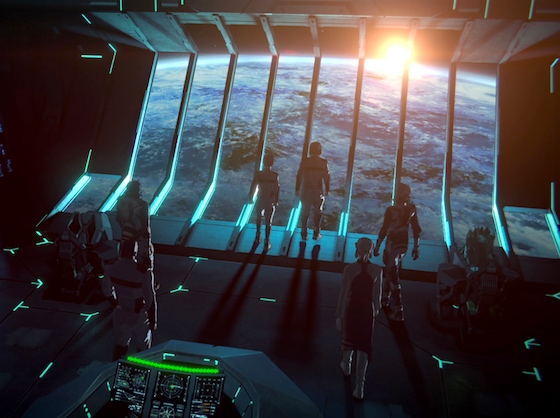
The standard plot of a Godzilla movie, as I understand it, is a giant monster (aka kaiju) turns up, stomps all over some cities, then we find a way to destroy it; or, if it’s one of the ones where Godzilla is a good guy, he fights it and, presumably, wins. Planet of the Monsters uses its animated form to do something new with the concept. The opening credits montage informs us that, in the final years of the 20th century, kaiju suddenly sprung up all over the planet and mankind were unable to defeat them. Fortunately some aliens rocked up and offered to help by evacuating what was left of humanity. Twenty years later this mission to the stars is proving a failure, with minimal chance of finding a habitable planet and the survivors decimated by diminishing supplies. The best course of action is deemed to be a return to Earth — it’s estimated thousands of years will have passed there (thanks to relativity) and the hope is the monsters will have died; and if not, hotshot young captain Haruo Sakai has come up with a new plan to defeat Godzilla once and for all.

Good God

If that reads like a lot of setup, it’s because Planet of the Monsters contains a lot of setup. It takes about half the movie before they’re back on Earth and… well, technically this is a spoiler, but if you’re intending to watch the movie it might help you manage expectations: Godzilla doesn’t properly show up until the final half-hour. This has led some reviewers to accuse the movie of being slow and light on what we came to see, i.e. giant monster action. They have something of a point. However, contrary to most opinions I’ve read, I actually enjoyed the early space-bound stages of the movie better.

It feels like the makers had a ton of interesting ideas about the politics and social situation aboard the evacuation ship, especially with multiple races and some kind of alien religion involved too, but there’s no time to really explore or develop those facets. Maybe they planned to get into that in the series. Either way, I find it funny that others have criticised that part for being slow and talky while I felt it had to race past a lot of potentially-interesting stuff to keep the plot moving. I guess I just ought to go watch Battlestar Galactica again, because it’s broadly similar territory.

Back to Earth

But, as I said before, there’s a rub: this setup provokes interest as a Galactica-style sci-fi, but as a Godzilla movie? There’s far too little of the big guy. And when he does turn up for the big climactic action sequence, that was the bit I found kinda dull. There’s a lot of whizzing around on hoverbike-things and blowing up forests and whatnot — plenty of sound and fury, but signifying what? And then… well, still avoiding spoilers, but there’s a twist in the final few minutes that renders this whole film prologue. Perhaps that should leave us hopeful for the next two? Perhaps this is all effective world-building for where things will go in the sequels? Conversely, it could be revealed as unnecessary background info once all the monster smashing starts. Only time (and the next two films) will tell…

3 out of 5

Saludos Amigos (1942)

2017 #161
Wilfred Jackson, Jack Kinney, Ham Luske & Bill Roberts | 40 mins | download | 4:3 | USA / Portuguese & English | U / PG

Saludos Amigos

The sixth film in Disney’s official animated canon was the first in a run of cheap “package films” that span the gap from 1942’s Bambi to 1950’s Cinderella. Frankly, if Disney hadn’t decided to make it part of their animated canon whenever that list was first settled upon, I very much doubt it would be remembered today.

It’s called a “package film” because it bundled together a handful of animated shorts, linked by live-action footage of Disney’s team on location researching the films, to form a feature-length movie (though in the case of Saludos Amigos it barely qualifies as feature-length). This particular set depict various aspects of South America, apparently in an attempt by Disney to improve US relations with its neighbouring continent during World War II. According to this item of trivia on IMDb, it worked — but thanks to the linking documentaries, not the animation: by “featuring footage of modern Latin American cities with skyscrapers and fashionably dressed residents [it] went against the then-current perception of the American audience that Latin America was a culturally backwards area, predominately rural, and mostly inhabited by poorly-dressed peasants. The film is credited with helping change the American perception of Latin America and its inhabitants.”

No stereotypes here

Viewed today, it’s largely fine — one or two parts are likeable, even — but there’s not a great deal to it. The live-action linking segments are meant to show what inspired the short animations, but sometimes that goes a little too far and they seem to convey the same Educational info twice over. And unless you’re looking into, say, North American perceptions of South America in the 1940s, there’s not a great deal of value left in it as a factual piece.

So my score errs on the harsh side, because it’s not a bad film per se, but I think it has very little to offer the modern viewer, either in terms of entertainment or education.

2 out of 5

The Pirates! In an Adventure with Scientists! (2012)

aka The Pirates! Band of Misfits

2018 #8
Peter Lord | 88 mins | Blu-ray | 2.35:1 | UK & USA / English | U / PG

The Pirates! In an Adventure with Scientists!

After a foray into CGI with the decent-but-not-exceptional Flushed Away and Arthur Christmas, Aardman took this adaptation of Gideon Defoe’s comedic novels as a chance to return to what they know best: stop-motion animation.

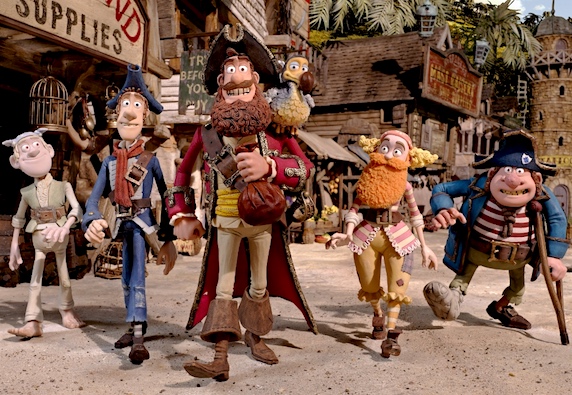
It stars a ragtag band of misfits— ugh, don’t get me started on the title change… but if you did, I might say something like the opening few paragraphs of this review. Anyway, as I was saying, it stars a ragtag crew of pirates, who are led (appropriately enough) by the Pirate Captain (Hugh Grant). His greatest desire is to win the Pirate of the Year Award, an honour he’s never achieved because, frankly, he’s a bit of a rubbish pirate. When he bumps into Charles Darwin (David Tennant) he stumbles upon a possible route to victory, but first he’ll have to contend with pirate-hating monarch Queen Victoria (Imelda Staunton).

Naturally it’s a tale not so much of derring-do as of humorous shenanigans, though in truth it’s not the studio’s most hysterical offering, ticking along with a level of gentle amusement rather than outright hilarity. That said, some parts do spark considerable mirth, like a trained monkey who ‘speaks’ through word cards, and there are background gags aplenty for the keen-eyed viewer. Plus it’s all carried off with the ineffable charm of Aardman’s hand-crafted puppetry, and that goes a long way (at least for this reviewer).

Band of misfits

I’ve always thought the Pirates of the Caribbean movies (especially the first one) more-or-less nailed the tone I would’ve wanted from an adaptation of the beloved Monkey Island games, but I read a commenter somewhere say The Pirates is probably the closest we’ll ever get to a Monkey Island film and, thinking about it, he’s probably right. The Monkey Island games are mostly cartoonish comedies, with a fair dose of irreverence and anachronism, and The Pirates offers up a similar brand of humour. (Maybe this is a niche comparison to make, given the height of Monkey Island’s popularity was over 25 years ago now, but, hey, these things are always ripe for rediscovery).

Despite being the fourth highest-grossing stop-motion film ever made, distributor Sony judged The Pirates to be a flop and the sequel Aardman were planning got canned. That’s a pity, because you feel this motley crew could’ve led us on another amusing adventure or two yet.

4 out of 5

Aardman’s new film, Early Man, is in UK cinemas now.

The LEGO Batman Movie (2017)

2017 #84
Chris McKay | 104 mins | Blu-ray (3D) | 2.35:1 | USA & Denmark / English | U / PG

The LEGO Batman Movie

Following the somewhat surprising success of The Lego Movie, we’re to be treated to a whole slew of movies related to those little Danish bricks. The first to hit the screen was this, I guess because the eponymous hero was a standout character in the aforementioned franchise initiator, and because Batman movies are always popular (well, almost always).

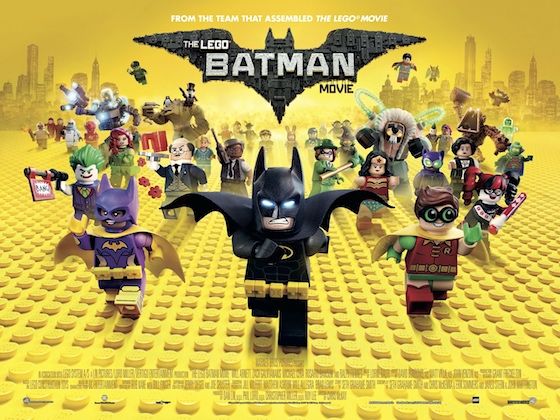
The plot sees Batman (Will Arnett) have to tackle the latest nefarious scheme of the Joker (Zach Galifianakis), while also dealing with his personal issues about being a loner after he accidentally adopts teen Dick Grayson (Michael Cera). You might think the story is almost by the by, because the real point is the gags… and, fortunately, the movie is indeed consistently funny, with a Flash-like pace to keep things moving. It’s also a great one for Bat-fans, jam-packed with references to previous iterations of the hero — anyone wanting to catch them all in detail will require copious use of the pause button.

But don’t disregard the narrative out of hand, because it also summons up surprisingly effective character arcs. Who expected that, right? Well, I say “arcs”, but it’s more “arc”: this is all about Batman. He seems to enjoy his awesome crimefighting life and doesn’t mind being lonely at home — but he is lonely, so why? Can he actually connect to other people? He’ll discover there are benefits to having a family… And so on. The LEGO Batman Movie may primarily be a comedy for kids based on a toy licence, but the emotional side works with surprising effectiveness. It’s not even just that it’s well built within the film itself: it illuminates Batman as a character. And I don’t mean LEGO Batman, but Batman of any incarnation.

A car built for one

The film also manages to deliver exciting action sequences, especially the big opener, that aren’t undermined by the freewheeling rebuild potential of the titular toy. These scenes look even better in 3D, the quality of which is great — the scale of the action, the depth to the locations, even elements of the characters, like the clear distance between Batman’s mask and his mouth. Does the extra visual dimension make it a better movie? Probably not… but I did watch some of the opening sequence in 2D afterwards and it felt less epic. That could just be me becoming more of a 3D convert, mind.

Another aspect the movie applies well is the LEGO licence, making neat use of its scope to rope in villains from all sorts of other franchises. That said, Batman has a notably extensive rogues gallery of his own, so one wonders if they shouldn’t’ve chosen to foreground some of his own foes rather than… well, saying who else pops up might be spoilersome. And if we’re talking about flaws that I won’t go into detail about, I wasn’t too sold on the third act, with the finale in particular not really working for me. In fact, that’s about the only thing holding me back from giving it a full five stars. Maybe I’ll mind less on a rewatch.

And there will be rewatches, because the rest is brilliant. It’s as fun as The Lego Movie, but mixed with being a surprisingly good version of Batman too. In a year overloaded with superhero movies, I’d wager this is one of the best.

4 out of 5

The LEGO Batman Movie is available on Sky Cinema from today.

Your Name. (2016)

aka Kimi no na wa.

2017 #168
Makoto Shinkai | 107 mins | Blu-ray | 1.78:1 | Japan / Japanese | 12 / PG

Your Name

If you’ve not heard about Your Name then… well, where have you been for the past year? It was a colossal hit in its native Japan during the back end of 2016, spending 12 weeks at #1 to become the fourth highest-grossing film of all time there (behind only Spirited Away, Titanic, and Frozen). It’s also the only anime not made by Studio Ghibli to gross over ¥10 billion at the Japanese box office. Critical acclaim has followed as it’s been released around the rest of the world too, hailing writer-director Makoto Shinkai as the new Miyazaki. It’s hard to imagine higher praise for an animator. The film reached UK cinemas last November, but then took a whole year to hit DVD and Blu-ray (I guess thanks to Japanese studios’ usual restrictive licensing agreements), and as of this week is available to stream for Amazon Prime members. So when I finally sat down to watch it this week it had a bit of weight on its shoulders — at this point it runs the risk of being a victim of its own hype.

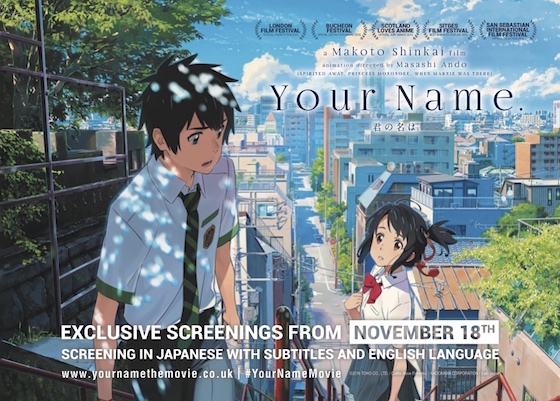
The film introduces us to Mitsuha, a teenage girl in a sleepy country town — more a village, really (it doesn’t even have a cafe!) — who wishes for a more exciting life in the big city. Her friends tell her she was acting weird the day before, but she can’t remember any of it. Then she wakes up in the body of Taki, a teenage boy living in Tokyo. Assuming it’s a dream — a very long, very realistic dream — she stumbles through his life for a day. To cut to the obvious, Mitsuha and Taki soon realise they’re actually swapping bodies, apparently at random but for a whole day each time. (The literal translation of the film’s Japanese title is What is your name, which kinda makes more sense.) They find ways to deal with it, but a big explanation for why it’s happening is looming…

That feeling when you wake up and realise a boy's been inside you... er, as it were

That comes in the form of a hefty twist about halfway through the movie. I’ve read some very different reactions to that development and what follows it — criticism of it for shifting the film into something generic after a more original first half; praise for it elevating the film into something more original after the generic first half. I guess your mileage will vary. For me, it kind of glossed over some of the body-swap stuff to get to a place where there was still time to deal with what happens next. Conversely, there are plenty of intersex body-swap movies — how much do we need to go over that again? But there are generic elements to the second half too.

That said, the way it uses Japanese folklore to bring all the threads together is a bit different, at least for us Westerners. I don’t know if it’s based on genuine beliefs or if it’s a mythology imagined for the film, but it conveys some effective and affecting ideas. It builds to an emotional climax and, ultimately, a perfectly satisfying ending. Well, unless… At times you feel there were perhaps other, more unusual directions the film could have explored. Fair enough, that clearly wasn’t the story Shinkai wanted to tell; but some viewers may think those less well-trodden paths would’ve made for a better movie. Of course, that would’ve neutered its appeal to others; but then Mark Kermode compared it to Romeo and Juliet in terms of how it might appeal to teenagers, and that certainly doesn’t have a happy ending…

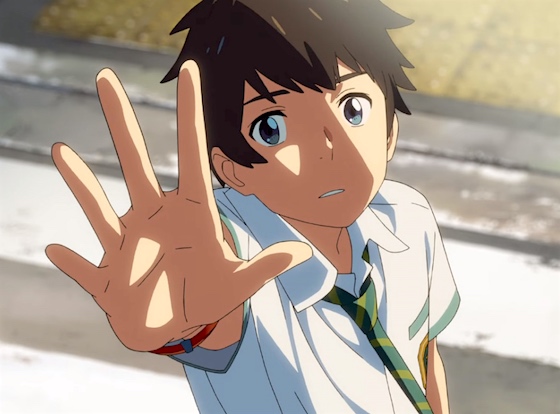
Taki reaching for Mitsuha's boobs, probably. He loves feeling her boobs.

I’m not just talking about the finale, though. For example: while in Taki’s body, Mitsuha displays his “feminine side”, which leads to a date with a girl he’s had a crush on for ages. On the day of the date, Taki is in his own body, which leaves Mitsuha upset because she’d wanted to go on the date. Surely you can see how this is possibly building in a direction where Mitsuha realises something about herself; something she might not have noticed living in a very traditional little town. But that’s not where Your Name is going — and, as I said, fair enough — but it’s not a bad idea for a movie (is it?)

Nonetheless, at times the story is quite complicated, with overlapping dialogue, or a density of information conveyed in images, on-screen text, and dialogue simultaneously. I mention this because watching the English dub might make for a more manageable experience, at least on first viewing. (That said, there’s one gag which only works in Japanese, and the subtitles work at a rate of knots to explain the joke while it’s happening. I watched the English dubbed version of the scene afterwards and it kind of fudges the gag away, because there’s no way to translate it into English.) That said, other bits of the story are just straight up jumbly, but trust that there’s a reason for that — you may get confused about who’s in whose body when, but the film makes enough sense in the end.

Pretty pictures

One thing I have no problem praising unequivocally is the imagery. The film is visually ravishing; the animation thoroughly gorgeous. Its use of colour and light is beautiful; the detail in the art and its movement is almost photo-real, without the uncanny valley effect you often get from rotoscoping. Shinkai also seems to have a live-action-esque feel for shots and editing, particularly in his use of montage, which lends a very filmic feel. At other times it benefits from animation’s freedom to be less literal, particularly in one sequence apparently created with pencils and chalk.

I do think the hype around Your Name ended up as a problem for me. I was expecting to be blown away by its amazingness, the expectation of which got in the way of just appreciating the film for what it is. That said, I definitely liked it a lot. Despite using some building blocks familiar from other movies, it mixes them together with some fresh perspectives to create a film that is thoroughly romantic, in multiple senses of the word.

4 out of 5

As I mentioned, Your Name is now available on Amazon Prime Video in the UK, in both subtitled and dubbed versions.

Batman vs. Two-Face (2017)

2017 #153
Rick Morales | 72 mins | Blu-ray | 1.78:1 | USA / English | PG / PG

Batman vs. Two-Face

Last year the spirit of 1966 was revived when Adam West and Burt Ward returned to the roles of Batman and Robin (or their voices did, anyway) in Return of the Caped Crusaders, a fun comedy-adventure animation that paid tribute to the enduringly popular ’60s incarnation of the (not-so-)Dark Knight. Given the film’s success, it was no surprise a sequel was instantly in development. West completed work on it before his death earlier this year, meaning it now acts as a tribute. It’s unfortunate, then, that it’s not very good.

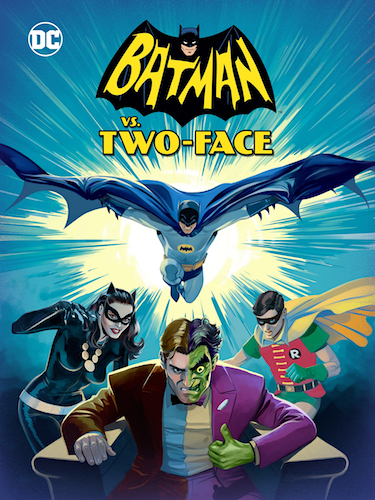
As the title makes clear, it sees West’s Batman come up against Two-Face — perhaps the most major member of Batman’s extensive Rogues Gallery to never appear in the TV show. Famed sci-fi author Harlan Ellison did actually write a treatment for a Two-Face episode, but the series was cancelled before it could be produced. It was adapted into a comic in 2015, and there was speculation it would form the basis for this animation too, but that isn’t the case. Maybe it should’ve been.

Things are weird from the off. The film begins by depicting a version of Two-Face’s origin — one that involves Harleen Quinzel, aka Harley Quinn, a character who wasn’t created until 25 years after the series this is based on. Anyway, it still sees DA Harvey Dent getting half his body fried and subsequently turning into a supervillain whose every decision is ruled by the flip of a coin. With this established in the pre-titles, there’s then a title sequence that shows plenty of Batman vs. Two-Face adventures. Is this a preview of what’s to come? No, because post-titles the story resumes with Harvey being cured. What a weird idea for a ‘first’ Two-Face story.

Why you two-faced...

Then Batman has to take on a variety of other foes, and you begin to wonder why the hell this is called Batman vs. Two-Face if he’s fighting everyone but Two-Face. Perhaps unsurprisingly, it does come back around to the eponymous enemy, though Batman refuses to believe his involvement — Harvey has been cured, so is someone impersonating Two-Face? The Boy Wonder isn’t convinced, but Batman is determined to believe his old chum. Oh yes, that’s right — this guy who’s just turned up in the series is apparently Bruce Wayne’s oldest bestest buddy. No wonder Dick’s nose is out of joint.

At the core of this, once what’s going on is eventually unravelled, is a not-half-bad Two-Face story. Unfortunately, that’s not really a strong marriage for this version of Batman — we don’t want a serious Bat-adventure, we want something light, daft, and above all fun. Batman vs. Two-Face isn’t exactly a sombre affair, but it isn’t funny enough either, lacking the gadabout charm of Return of the Caped Crusaders. The tone is just wrong. The makers admit they were trying to mix “camp with noir”, but — as I think any of us could’ve told them — that’s an unnatural combination that just doesn’t work. None of this is helped by the fact the animation looks cheap, even by the standards of DC’s other direct-to-video movies.

Best buds, supposedly

Clint Eastwood was being lined up to take on the role of Two-Face back in the ’60s, but he’s a bit above this kind of fare nowadays. Instead, the villain is voiced by another megastar of ’60s genre TV: William Shatner. Known for his mannered, scenery-chewing acting and ability to send himself up, Shatner seems the perfect foil for West’s Batman. Sadly, the material doesn’t allow Shatner to ham it up like you expect him to. Two-Face’s side of the story is played pretty straight, allowing none of the excess you’d expect from Shatner in comedy mode. Instead, the erstwhile starship captain delivers a genuinely decent acting performance. His voice work creates a clear delineation between the characters of Harvey Dent and Two-Face, and he delivers a fine interpretation of a man held hostage by his own alter ego. But, again, such a straight portrayal is not what’s desired from a Batman ’66 movie.

I was surprised to discover that Batman vs. Two-Face comes from the exact same writers and director as Return of the Caped Crusaders. The previous film nailed what it needed to be so perfectly, yet this seems to miss the mark almost entirely. My score errs on the side of harshness — there is fun to be had here — but it reflects my feeling immediately after the credits rolled that, overall, this was a massive disappointment.

2 out of 5

Anomalisa (2015)

2017 #2
Charlie Kaufman & Duke Johnson | 90 mins | streaming (HD) | 2.35:1 | USA / English | 15 / R

Anomalisa

Written and co-directed by Charlie Kaufman (of Being John Malkovich, Eternal Sunshine of the Spotless Mind, and so on), Anomalisa tells the story of Michael (David Thewlis), a depressed customer service expert who perceives everyone else as looking and sounding the same — until he meets Lisa (Jennifer Jason Leigh), whose uniqueness to him immediately attracts Michael.

If you hadn’t noticed, Anomalisa (a portmanteau of “anomaly” and “Lisa”, not “anonymous” and “Lisa” as I’d assumed) is an animated movie. Although an everyday kind of drama that would be largely achievable in live-action, it uses the form to its advantage when depicting the central conceit, giving every character who isn’t Michael and Lisa the same face and having them all voiced by the same actor (Tom Noonan). For me, this was the most effective part of the movie. It’s a really neat way of executing the concept of not being able to tell people apart. Noonan is the film’s real star, too, voicing “everyone else” in a way that makes them sound plausibly unique but also all the same, a tricky balancing act that he nails.

The one thing that did disappoint me about it was this: the inability to distinguish people is a genuine medical condition, but the film tackles it only as a signifier of Michael’s depression rather than as an issue some people live with. Conversely, I presume that’s a pretty rare condition, whereas depression and isolated feelings are increasingly widespread, so the film perhaps has more to say in that regard. Ultimately, I shouldn’t be criticising a film for not being about something it’s not trying to be about (even when I thought that was what it was going to be about).

Even puppets get the blues

As for the rest of the movie… hm. It takes an age to get going, but once it does there are a few funny scenes (the “toy” shop; the hotel shower; Michael struggling with his room key), and who’d’ve thought a puppet movie would have one of the more realistic sex scenes in the movies? Especially as it pulls that off without becoming laughable thanks to Team America. More pertinently, it gradually unfurls a sometimes touching story about isolation and love. However, by the time it reaches the happy-sad ending (one person’s life seems to have been transformed; the other continues to be miserable), I wasn’t sure what it all signified. Maybe the line that “sometimes the lesson is there is no lesson” is very relevant.

So, some good stuff, but that long slow open takes getting over, and I’m not sure what it all meant.

4 out of 5