
Pete Michels | 85 mins | DVD | 15
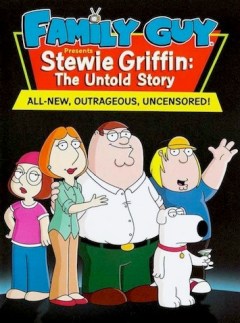 Following Family Guy’s cancellation after three seasons, it somehow found a new lease of life on DVD, posting surprising sales in what was, I suppose, the early years of the format’s mass take-off. This led to a rethink by Fox and a belated (as in, several years later) renewal for the animated sitcom. This story was originally intended to form a three-part opener to the first season back, but Fox wanted a direct-to-DVD movie too — presumably to capitalise financially on that previous success — and so those three episodes were retooled into a feature.
We know how this can turn out.
And it does feel like three Family Guy episodes stitched together. Much like that other stitched-together-from-three-animated-TV-episodes movie, Star Wars: The Clone Wars, the events of part one (or the first twenty-odd minutes) seem entirely separated from the two-parter that makes up the back hour. Fortunately the Family Guy team seem to have more common sense than their Lucasfilm counterparts, choosing to link back round to the start for their film’s climax, tying it all together after all. Nice work.
The plot is more or less suitably movieised — despite that first-part almost-disjoint, it’s a more-epic-than-usual tale of Stewie’s origins (sort of) — though it seems slightly held back by its genesis as three TV episodes and the need for it ultimately to be split back up (it was broadcast, censored, as a three-parter at the end of the comeback season). With subplots that begin and end within each half-hour(-ish) segment, it plays about as well as watching a three-parter back to back… which is more than can be said for that Star Wars film. Consequently, it also feels just like regular Family Guy — the same level of humour, basically — though it seemed to me like there were more scatological jokes than normal, some of them going on too long as well. If you’re not a regular viewer of the series, references to running jokes will pass you by; equally, the nature of its humour, often based in cultural references, means that some bits that are obviously jokes will elicit no more than bafflement from a non-versed viewer. Still, there’s plenty of more universal humour too. It relies on the usual style of numerous non sequitur flashbacks and asides. Which, again, is fine — that’s their style; it would be wrong to be anything else.
The need to turn three TV-aimed episodes into a movie — and, somewhat ironically, back again afterwards — does have a few effects on proceedings. Various bits had to be cut for the broadcast version, most for the silly technicalities of US TV rules — the fact the DVD is rated 15 over here, 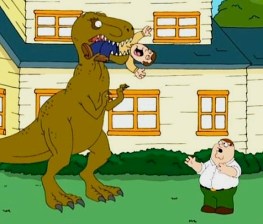 the same as the series normally is, shows how arbitrary US regulations are. It feels like there are a few more jokes that are slightly dirtier than normal and there are a few extra swear words, but they consciously didn’t go OTT with them and, thankfully, it shows. But actually, most of the stuff that’s cut (as detailed on the commentary or in full here) is for those daft US rules; so, stuff that just steps over a certain line; stuff that, to be honest, most Americans wouldn’t even notice.
Also, contractually the film had to make a certain length, so there’s some conscious padding in there — though, as they note on the commentary, they did their best to make the padding funny too. Take the intermission, for instance, which features just voices over a black “Intermission” screen: dirt cheap to animate (what with there being no animation) but it both adds a bit to the running time and smoothes the jump between parts two and three.
I don’t know how much I’ve reviewed the film and how much shared some behind-the-scenes tidbits here, but if you like Family Guy… well, you’ve probably already seen this (it’s been out, what, six years? I’m behind here), and if you don’t like it there’s nothing to change your mind.  And if you’ve always been curious but never given it a go, don’t start here — I don’t think it would be incomprehensible to first-time viewers, but I don’t think it’s the best introduction to the series either, and it probably makes more sense if you know the characters a bit.
This score reflects that lack of universal appeal; for regular viewers, I’d say it’s good quality and probably four stars.

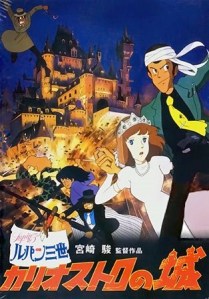 The Castle of Cagliostro, the second animated big-screen spin-off from manga-inspired anime TV series
 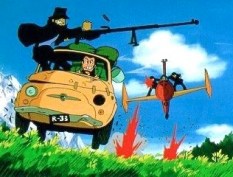 As I mentioned, this is the second spin-off film from a TV series, and at times it does feel like it: characters turn up under the impression the audience already knows who they are and what their connection is to the others. It’s not a major problem — most are introduced well enough within the context of the film that it can still be easily followed — but it’s there.
 Um, where was I? Oh yes: Indiana Jones; Roger Moore-era James Bond — it’s that kind of tone, more or less, and if you enjoy that kind of film then I don’t see why you wouldn’t enjoy this. Unless you think cartoons are for kiddies only (in which case, see the long sentence at the end of the last paragraph).
 Bolt is the 48th film in Disney’s animated canon (whatever the official name for that is these days), from their CG-only era that filled most of the ’00s. It’s a period already remembered as When Disney Lost Its Way, after the second (or is it third? I forget) ‘golden era’ of the early ’90s; the time that produced flops like
 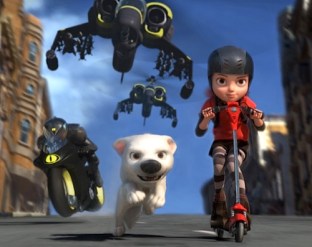 Also noteworthy are the action sequences. Far from being perfunctory attempts at liveliness, these are properly exciting, making full use of 3D CGI to create exciting and dynamic sequences. I’m not just talking about the couple we get from the TV-series-within-the-film either, but also the ‘real world’ ones as Bolt, Mittens and Rhino jump onto trains, out of moving vans, escape from a pound, etc. Of course, the TV-series-within-the-film is completely implausible — like you could film a TV show with massive action sequences in such a way that you only ever do a single take, never mind achieve all those effects on a TV budget. But then this is a film where a talking dog, cat and hamster work together to travel from New York to Hollywood entirely of their own volition — I think it’s safe to say no one’s aiming for documentary levels of realism.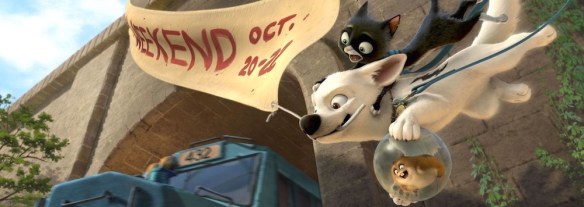
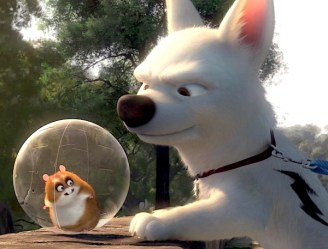 It would be easy to dismiss Bolt as part of Disney’s CG folly, especially as it stars Miley Cyrus and is immediately followed by their return to 2D animation, but I think that would be a mistake. It’s a fast-paced and fun adventure, with accurately-captured animals meaning it’s especially likely to appeal to dog lovers. Disney’s next golden era just might begin here.
 Much was written about Toy Story 3 when it was released this summer, so I’m not sure how much I have to add, but here we go. It’s no surprise either — that’s what happens when a preeminent and popular studio releases a sequel to a beloved and acclaimed film franchise 11 years after the last instalment. High expectations abounded. For once, they weren’t necessarily unrealistic: if anyone could pull off such a feat, it’s Pixar.
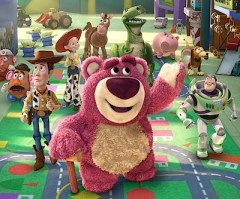 who’ve grown up with these films and these characters and, in a way, are letting them go along with Andy; and for adults, who may have left childish things behind but can hopefully still appreciate the thematic sentiment.
 even more emotional seeing them go through what they do here. Similarly, it pays to be aware of events and jokes in the preceding films. You don’t need to know intricate plot details, but there are plenty of pleasing references to catchphrases and moments.
 In the world of
  which could well have gone down a more modern-styled route.
 It’ll be interesting to see how it fits into the film when I finally get round to watching The Ultimate Cut — I already have some reservations waiting to be expressed in my review.
 Do you need me to tell you how great Beauty and the Beast is? I imagine not. If you’ve seen it, you’ll know. If you haven’t, you really should, and then you’ll know.
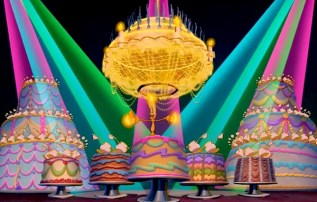 It’s not a bad song — not at all — but it’s a notch below the others. (There are a few more changes to the film than just adding the song, listed
 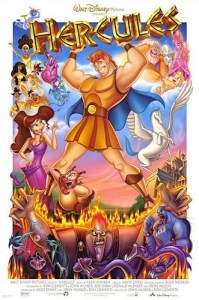 Hercules is the first post-me Disney; the point where, for whatever reason, I stopped watching their output. But, of course, Disneys — good Disneys, at any rate — are suited to every age group.
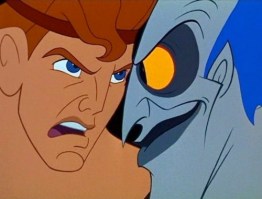 animal-sidekicks-with-no-dialogue-who-can-still-convey-their-thoughts-and-feelings-perfectly (I feel this tradition needs a snappier name.) Love interest Meg, meanwhile, starts out intensely irritating but is gradually redeemed. Good work, I say to the film’s
 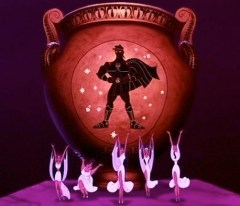 (though even mentioning it in the same sentence as that number makes it sound better than it is). Only love interest Meg gets a passable song, not that I could remember it within hours of watching the film. Maybe it’s not all that bad really, but when early-’90s Disneys could produce several unforgettable tunes per film, it feels like a weak album from a band you usually enjoy.
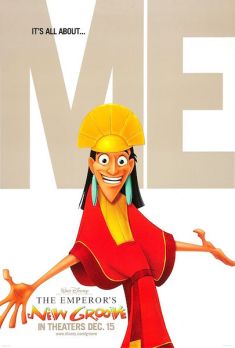 Disney’s 40th (canonical) animated film had a very troubled production, which, from what I can tell, turned it from a derivative riff on The Prince and the Pauper into this load of tosh.
 In reality it doesn’t suffer from that too much, and again looked nice and crisp in HD. I usually ignore image quality when it comes to reviews — not that I don’t care, but in these reviews I’m aiming to look at the content of the film rather than the particular copy I watched — but HD has such noticeable benefits for animation (when done well).
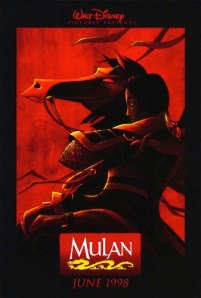 I realised recently that I haven’t seen an animated Disney film produced after
  (It’s this kind of thing that has caused uproar for
  Is 1945-1998 actually a film? Or is it a piece of video Art? Or just another online video?
 attention didn’t already wander, that is). There are ultimately so many flashes and bleeps, and the effect is so lulling, that I had to force myself to remember these represented Big Nasty Bombs that were Not A Good Thing. Perhaps something more aurally grating would’ve been appropriate; the counter argument going that this would cause even more viewers to abandon the work.
 100Films.co.uk