The Iron Giant (1999)

2016 #86
Brad Bird | 83 mins | DVD | 2.35:1 | USA / English | U / PG
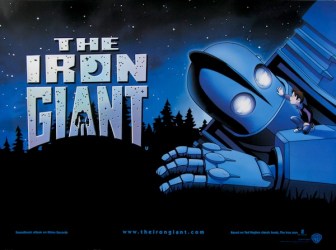
Adapted (loosely) from Ted Hughes’ children’s novel The Iron Man, the feature debut of director Brad Bird (The Incredibles, Ratatouille, now live-action stuff) relocates the book’s story to ’50s America and mixes in some Cold War elements. The film was somewhat verboten in our household when it came out, because the book was beloved and the film looked so different, but its reputation has only grown in the ensuing decade-and-a-half — and Hughes approved of it anyway.

This version sees the titular robot (voiced by Vin Diesel) crash to Earth near Maine in late 1957, the home of nine-year-old Hogarth Hughes (Eli Marienthal) and his mom Annie (Jennifer Aniston). After the giant eats the Hughes’ TV aerial, Hogarth tracks it to take a photo, and ends up saving it from electrocution when it tries to eat a power station. As the giant sneaks around the countryside eating cars and causing train crashes, it attracts the attention of government agent Fox Mulder from the FBI’s X Files Kent Mansley from the Bureau of Unexplained Phenomena (Christopher McDonald), who’s intent on uncovering and destroying the giant. Hogarth tries to hide the friendly creature with the help of artist Dean (Harry Connick Jr.), but could it be Mansley isn’t so wrong about the threat it poses?
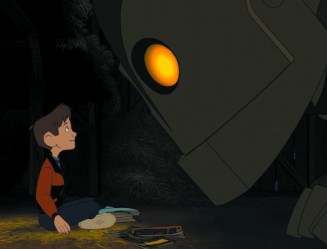
The story, as reconstructed by Bird and screenwriter Tim McCanlies, integrates influences from ’50s B-movies (very apt for a giant robot ‘monster’) and Cold War/Space Race paranoia for a potent storyline that has a different emphasis from the novel’s “world peace” finale, but nonetheless is promoting understanding of alien/foreign powers and, y’know, deep stuff like that. Alternatively — or, rather, concurrently — it’s an E.T.-esque tale of a boy and his quirky alien friend. Bird was keen to emphasise character over action and mindless spectacle, and that’s really where the film’s strengths lie.

Well, that and the technical aspects. The animation is stunningly well done, exhibiting exceptional fluidity and detail in its character animation, in particular. That’s in spite of the film having a reduced budget and time schedule thanks to the box office failure of previous animations by the studio — in Bird’s words, they had “one-third of the money of a Disney or DreamWorks film, and half of the production schedule”, but that meant greater production freedom (so long as they managed that budget). I guess that’s why the film’s ended up only growing in stature since its first release — because it’s able to be committed to its creators’ vision, rather than being battered into homogeneity by a studio desperate for a return on considerable investment.

Beautifully animated and affectingly told, with a style that nicely homages classic sci-fi movies, The Iron Giant is a film that deserves the reputation it has gradually amassed — and which only continues to grow, I think. Last year saw the release of an extended Signature Edition, with a couple of short scenes added, which comes to US Blu-ray (alongside the original version) later this year. Just from reading about those new scenes, I’m not convinced they’ll improve the experience, but it’ll certainly be worth finding out.

5 out of 5

The Iron Giant was viewed as part of my What Do You Mean You Haven’t Seen…? 2016 project, which you can read more about here.

This review is also part of 1999 Week.
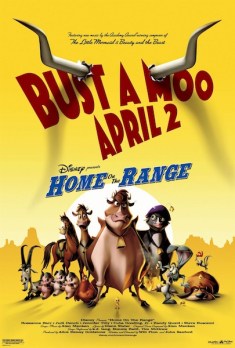
Home on the Range (2004)

2016 #32
Will Finn & John Sanford | 73 mins | streaming (HD) | 1.78:1 | USA / English | U / PG

I have many goals within my film viewing, quite apart from trying to watch 100 films every year. Some I’ve completed (the Rathbone Holmes series), others are almost done (every Spielberg film), others not so much (every Hitchcock film), and others I’ve barely begun (the Zatoichi series). One of these goals is to watch every Disney Animated Classic, their canon of feature animations that currently sits at 55 titles (with another scheduled for later this year, in the US at least). I did a pretty good job on the real classics while growing up, and have since filled the gaps of the modern classics, so I’m left ploughing through their lesser periods: the content they pumped out in the war-affected ’40s, and the post-Renaissance pre-Lasseter clusterfrack that was their ’00s produce. My best hope is to uncover a hidden gem while I mop up this dross.
Home on the Range is not a hidden gem.

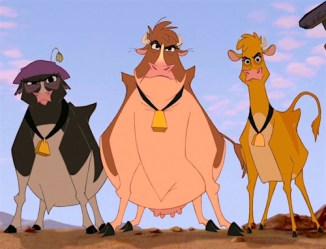
The plot, such as it is, locates us in the Old West, where a trio of singing cows hunt for an outlaw in order to save the farm they live on. The early ’00s box office was not a great place for musicals, Westerns, or traditional animations, so one does have to wonder what inspired Disney to make their 45th Animated Classic a traditionally-animated musical Western.

Still, box office failure does not equate to a lack of quality. No, the film achieves that all by itself. There’s a plodding, familiar, poorly-structured story, with dull characters, who spout flat dialogue, which does nothing to help their unoriginal relationships. The voice acting is irritating, with the exception of one or two over-qualified performers (Dame Judi Dench?!) The songs are weedy, repetitious, and unmemorable. The villain’s number is the best of a bad bunch, but only because it has a moderately amusing reveal in the middle of it. The animation is unremarkable, besides some terrible CG intrusions. It seems to be under the impression that “hog” is a word for “cow”, based on the number of puns. A couple of gags do land — I even laughed out loud once, though I’ve forgotten why — but the majority is resolutely uninspired.
It’s actually not the worst of Disney’s canon (as I mentioned, there’s the odd flash of enjoyment, which is more than can be said for Chicken Little), but it’s still one for aficionados — or completists — only.

2 out of 5

Home (2015)

2016 #35
Tim Johnson | 90 mins | streaming (HD) | 1.85:1 | USA / English | U / PG

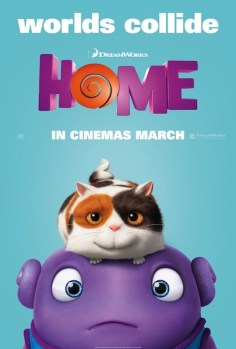
Oh (Jim Parsons) is a Boov, a race of friendly aliens looking for a new home planet to escape their enemies. When they arrive on Earth, Oh tries to invite everyone to a party, but accidentally alerts their enemies to their new home. Outcast, he bumps into Tip (Rihanna), a girl accidentally left behind when the rest of mankind was relocated by the Boov. Desperate for friendship, Oh agrees to help her find her mother.
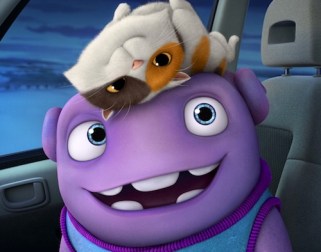
Initially I ignored Home, because nothing about it looked particularly inspiring. But I’ve been wrong about CG kids animations before (How to Train Your Dragon; Cloudy with a Chance of Meatballs), so when I happened to see the trailer and it amused me, I decided to give it a go. Unfortunately, characters and affectations that are amusing in the form of highlights lasting two minutes quickly grate in the film proper.

Home’s biggest problems are all in its most fundamental aspect: the story. It doesn’t just have plot holes — the whole premise and inciting incident don’t even hang together. I don’t believe this is just a movie for little kids, I reckon it was written by them too. That’s surely the only way to explain its absence of plausible logic.

Why do the Boov speak English? Why do they speak it wrong? Why does Oh speak it so much more wrong than any other Boov? Why do they know the words for things they have no concept of? Why would humanity accept total relocation without any kind of response? How would only one girl on the entire planet be missed? How would she have had time to come to hate the Boov enough to make multiple pieces of anti-Boov art and set up an elaborate Home Alone-style trap in her apartment when the film suggests the Boov arrived just a couple of hours earlier? How does she know how to drive? If she’s old enough to know how to drive (and to be voiced by Rihanna), why does she do art that looks like it’s by a six-year-old? Why do the Boov make recognisable monuments float in the air? Why would a communication device’s two options be “send to one person” and “send to not only the entire species, but the entire universe, including our enemies”? Why is there no option to cancel such a transmission that is going to take 40 hours to reach said enemies? I mean, that last one’s a stupid question, because why is there even a way to message the enemies?

And those questions are just from the first 15 minutes.

Tip’s full name is Gratuity Tucci, which may just be the most implausible name in the history of the world. Our heroes spend a chunk of the middle of the film just driving across the Atlantic (don’t ask) doing things like listening to Rihanna music (you mean, they listen to songs by the lead voice actress? What a coincidence!) Sometimes the film is scored with such Popular Songs, often tweeny crap, but other times it’s blandly generic Movie Music. Either would be an adequate creative choice, albeit resolutely unremarkable, but having both at random is distractingly schizophrenic. And the songs don’t even have accurate relevance to what’s happening.

Story aside, Home is not poorly made, and there are fleeting glimmers of entertainment. Which is damning with faint praise, really. Naturally, I don’t recommend you waste your time on it.

2 out of 5

Home featured on my list of The Five Worst Films I Saw in 2016, which can be read in full here.

Evangelion: 3.33 You Can (Not) Redo. (2012/2013)

aka Evangelion shin gekijôban: Kyū / Evangelion New Theatrical Edition: Q

2016 #42
Hideaki Anno, Masayuki, Mahiro Maeda & Kazuya Tsurumaki | 97 mins | Blu-ray | 2.35:1 | Japan / English | 15

Evangelion 3.33 You Can (Not) RedoWell now, hasn’t this been a long time coming? Just over two years since its western disc release was first announced, just over three years since it debuted in Japanese cinemas, and just over four-and-a-half years since the previous instalment’s English-language release, those of us in the UK who don’t attend anime conventions (where it’s had a few screenings in that time) are finally able to see the penultimate part of creator Hideaki Anno’s Rebuild of Evangelion tetralogy. As to whether it’s worth the wait… well, your mileage will vary.

The “rebuild” movies started out with a literal interpretation of that moniker: the first movie is a faithful (though condensed and sometimes slightly rearranged) retelling of the series’ early episodes, even using the original art from the show. The second movie deviated much further: familiar characters were introduced in completely different ways, wholly original characters appeared, and some subplots became more prominent. It culminated in a climax that was a drastic departure from the series, and now this third movie forges into entirely new territory — so new that I’m not going to give any kind of plot summary, for the sake of readers avoiding any spoilers. Good luck to you if so: not only do most reviews divulge the first major divergence, but so does the film’s own blurb.

Maybe that’s for the best — I’ve read more than one review bemoaning the confusion at the opening of the film, which stems from not knowing that thing I’m not telling you that the blurb does tell you. It’s surely deliberate, though: hero Shinji is in a similarly confused position, and we’re clearly being aligned with him in this strange new situation. Besides, for me this was the most engaging and exciting segment of the movie. As well as a couple of thrilling action scenes, it juggles character relationships in interesting ways, establishing a new status quo unlike that we’ve seen before in the franchise. It culminates in a fantastic stand-off between former allies — indeed, former friends. How times change.

Sad ShinjiChange, and the embracing or rejection of it, is surely one of the major themes of Evangelion. This is more explicitly debated as 3.33 moves into its middle section, where we get an extended dose of Shinji’s traditional insecurities. Hey, it wouldn’t be Evangelion without Shinji having a self-pitying whinge, right? Fortunately there’s more going on than that, but this is a section light on action and heavy on the series’ more thoughtful elements. There are answers to some of the mysteries, but it again wouldn’t be Evangelion if it all made easy sense. At the same time, Shinji bonds with new Eva pilot Kaworu. A controversial character, apparently, and not just because of the homosexual overtones (which some reviewers claim to miss, presumably because they’re blind), but the scenes where they harmonise by playing piano together are quite fantastically animated.
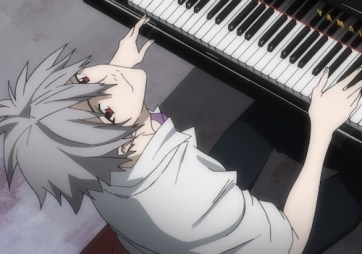
Indeed, whatever else you can say about 3.33, it looks glorious. The choice of a 2.35:1 aspect ratio for the first time helps emphasise the story’s epic qualities, but that’s incidental to the fantastic images conjured up by the animators. Various techniques are hurled at the screen — there’s a lot of CGI as well as traditional hand-drawn art, and they even used motion-captured stuntmen for one scene — but it marries perfectly, allowing camera angles and moves that are incredibly filmic and more dynamic than you normally find in 2D animation. The makers of the Rebuild have always talked about wanting to create innovative, memorable imagery, and they’ve once again succeeded here.

Pia-pia-piano3.33 divides quite neatly into three half-hour sections. I guess that should be expected, as the whole tetralogy has been based in traditional Japanese ideas of narrative/musical structure, hence the films’ Japanese titles incorporating the names for the three movements: jo, ha, and kyū (序破急), which roughly equate to “beginning”, “middle”, and “end”. As discussed, the first is fantastic, some of the best material in the entire series, in my estimation. Also as discussed, the second is a lot slower, but has its plus points too. The third… ah, the third. Here we get some more action, which will please anyone who thrills to Eva combat, but it is also utterly mind-boggling. I’ve been reading up on a few fan sites since watching, and I’m still not absolutely sure what was going on or what it signified. You won’t find any enlightenment in the disc’s special features, which present a long list of extras at first glance, but turn out to be 19 repetitive trailers, TV spots, and promo reels. Yes, nineteen.
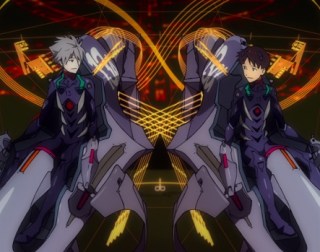
After all that, it ends on a rather low-key cliffhanger, making it feel like one of those two-part finales that Hollywood YA adaptations are so fond of at the moment (cf. Harry Potter, Twilight, Hunger Games, etc). In some respects that’s actually true: it was originally said that films 3 and 4 would be half-length movies released together. Obviously that plan disappeared a long time ago. Still, it does make you wonder if that confusing third act will play better when paired up with the tetralogy’s concluding instalment. In the meantime, it’s hard to call 3.33 a completely effectual film in its own right. It quite successfully introduces us to an entirely new era for Evangelion, and teases that various groups’ plans are entering their final stages, but a possibly-indecipherable climax and a “we’ll just have to pause here”-level “to be continued” leave you wanting the next part more than feeling that was a fulfilling, finite experience.

Double plugSo when will that conclusion come? Well, a few years ago Anno ‘joked’ that the finale might be released “four to six years” after 3.33. As we’re already almost at four years with no sign of a release date, I guess it wasn’t so much of a ‘joke’ after all. An English-friendly DVD/Blu-ray will inevitably take an additional couple of years, too. So an indefinite, but undoubtedly lengthy, wait begins…
4 out of 5

Evangelion: 3.33 is out today on DVD, Blu-ray, and dual format Collector’s Edition.

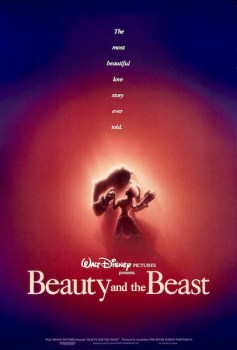
Beauty and the Beast (1991)

100 Films’ 100 Favourites #10

The most beautiful love story ever told.

Country: USA
Language: English
Runtime: 84 minutes | 92 minutes (special edition)
BBFC: U
MPAA: G

Original Release: 15th November 1991 (USA)
UK Release: 9th October 1992
First Seen: VHS, c.1993

Stars
Paige O’Hara (Beauty and the Beast: The Enchanted Christmas, Enchanted)
Robby Benson (Ice Castles, Dragonheart: A New Beginning)
Angela Lansbury (The Manchurian Candidate, Bedknobs and Broomsticks)

Directors
Gary Trousdale (The Hunchback of Notre Dame, Atlantis: The Lost Empire)
Kirk Wise (The Hunchback of Notre Dame, Atlantis: The Lost Empire)

Screenwriter
Linda Woolverton (Alice in Wonderland, Maleficent)

Story by
Deep breath… Roger Allers, Brenda Chapman, Burny Mattinson, Brian Pimental, Joe Ranft, Kelly Asbury, Christopher Sanders, Kevin Harkey, Bruce Woodside & Robert Lence.

Based on
La Belle et la Bête, a French fairy tale originally by Gabrielle-Suzanne Barbot de Villeneuve, but in this case (and most others) adapted from the retelling by Jeanne-Marie Leprince de Beaumont.

Music
Alan Menken (Aladdin, Hercules)

Lyrics
Howard Ashman (Little Shop of Horrors, Aladdin)

The Story
An arrogant prince is transformed into a beast, with one hope of redemption: someone must fall in love with him before his 21st birthday; if not, the curse’s effects become permanent. When elderly inventor Maurice is imprisoned by this Beast, his bookworm daughter Belle offers to take his place. Spying a chance to alleviate the curse, the Beast agrees. With only a short time until his 21st birthday, could a girl ever learn to love a beast?

Our Hero
A girl who’s strange but special — a most peculiar mademoiselle. With a dreamy far-off look, and her nose stuck in a book, she really is a funny girl, a beauty but a funny girl, that Belle.

Our Villain?
The Beast’s got fangs, razor sharp ones; massive paws, killer claws, for the feast. He was mean and he was coarse and unrefined, but now he’s dear and so unsure. Perhaps there’s something there that wasn’t there before…

Our Villain!
No one’s slick as Gaston, no one’s quick as Gaston, no one’s got a swell cleft in his chin like Gaston. Uses antlers in all of his decorating, my what a guy, that Gaston.

Best Supporting Character
The comedy double act of French candlestick Lumiere and English clock Cogsworth, voiced (respectively) by Law & Order’s Jerry Orbach and M*A*S*H’s David Ogden Stiers. Funny old business, acting.

Memorable Quote
“Try the grey stuff, it’s delicious / Don’t believe me? Ask the dishes / They can sing, they can dance / After all, miss, this is France / And a dinner here is never second best.” — Be Our Guest

Quote Most Likely To Be Used in Everyday Conversation
“It’s not right for a woman to read. Soon she starts getting ideas, and thinking…” — Gaston. (I didn’t say it should be used.)

Memorable Scene
The film’s prologue tells the story of how the Prince became the Beast through the medium of stained glass windows. It’s a beautifully realised fairy tale within a fairy tale.

Best Song
Titular Beauty and the Beast may’ve won the Oscar (“Tale as old as time, song as old as rhyme” — that one), but the actual best song is clearly Be Our Guest. A toe-tapping tune married with fun lyrics, fantastic choreography and superb animation combine to make it, for me, one of the greatest numbers in any musical, animated or otherwise.

Making of
Be Our Guest was originally to be sung to Belle’s father, Maurice, when he’s trapped in the castle. It was writer Bruce Woodside who pointed out that it was in the wrong place because such a key song shouldn’t be performed to a secondary character, so it was moved later to be sung to Belle. This is why you should always listen to writers.

Previously on…
Beauty and the Beast is Disney’s 30th Animated Classic, their official canon of animated movies. It’s the third film in the “Disney Renaissance”, the decade-long period (starting with The Little Mermaid and ending with Tarzan) when the studio enjoyed revived creative and financial success. In terms of this particular retelling of the tale, it owes a clear debt to Jean Cocteau’s La Belle et la Bête.

Next time…
Two direct-to-video animated sequels and a spin-off educational live-action TV series. In 1994, it was the first Disney animated film to become a Broadway musical. In 2002, it was extended with a new song, and in 2012 was re-released in 3D. An all-star live-action remake is out next year.

Awards
2 Oscars (Original Song (Beauty and the Beast), Original Score)
4 Oscar nominations (Picture, Sound, Original Song (both Belle and Be Our Guest))
2 BAFTA nominations (Original Score, Special Effects)
2 Saturn nominations (Fantasy Film, Music)
2 Annie Awards (Animated Feature, Individual Achievement in the Field of Animation)
Nominated for the Hugo for Best Dramatic Presentation.

What the Critics Said
“A lovely film that ranks with the best of Disney’s animated classics, Beauty and the Beast is a tale freshly retold. Darker-hued than the usual animated feature, with a predominant brownish-gray color scheme balanced by Belle’s blue dress and radiant features, Beauty engages the emotions with an unabashed sincerity.” — Variety

Score: 93%

What the Public Say
“The voice cast are perfectly suited to their roles and imbue them with dexterity and flair. Paige O’Hara splendidly combines strength and touching bravery as Belle. Her singing voice is a marvel as well, singing with clarity and loving kindness. Robby Benson’s deep but engaging voice is ideally suited to the Beast, and gives him depth and mournful sorrow that subsides into happiness as he develops feelings for Belle.” — vinnieh

Elsewhere on 100 Films
Back in 2010 I reviewed The Special Edition of Beauty and the Beast (to give its full on-screen title), describing it as “impossible to fault in any significant way. The design and animation are beautiful, the voice acting spot-on, the score exquisite, the story fast-paced and enthralling […] It’s hilariously funny, remarkably exciting, surprisingly scary, relentlessly romantic […] Every [song] bursts with memorable tunes, witty rhymes, genuine emotion — even the Soppy Girly Song is a good one!” Beat that, verdict section…

Verdict

Beauty and the Beast was, famously, the first (and, for a long time, only) animated movie to be nominated for Best Picture at the Oscars, and you could hardly think of a more deserving candidate. Every element of it displays artistry, from the the witty dialogue and lyrics, to the likeable and engaging characters, to the fluid and detailed animation, to the songs which help the film to run the gamut of emotions. In the field of Broadway-style Disney musicals, Beauty and the Beast is animation perfection.

#11 will be… a long nap.

Happy Feet Two (2011)

2015 #193
George Miller | 99 mins | streaming (HD) | 2.35:1 | Australia / English | U / PG

Mumble and his penguin pals return for another adventure, in a series the Australian film industry are reportedly inordinately proud of.
Not as fun as the first, Happy Feet Two suffers from messy storytelling that can’t seem to settle on a narrative thread. For example: a massive subplot featuring a pair of Pythonesque philosophical krill, voiced by Matt Damon and Brad Pitt, is the film’s most fun element, but never significantly connects to anything else.

At least there are a few good musical sequences, one again re-appropriated from existing pop tunes, not least an Australian-accented elephant seal rendition of Rawhide.

3 out of 5

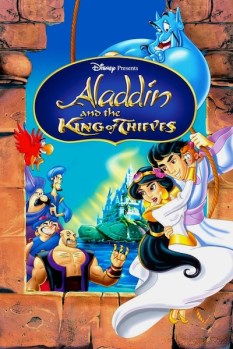
Aladdin and the King of Thieves (1996)

2015 #196
Tad Stones | 82 mins | streaming (HD) | 16:9* | USA / English | U

For most of the ’90s and ’00s, Disney churned out direct-to-video sequels to many of their most beloved animated classics. They have a reputation for being unremittingly awful, hence why Pixar’s John Lasseter put a stop to their production after he became Disney’s Chief Creative Officer in 2006. Despite that reputation, however, there are those who say one or two are actually quite good. One of those (and the only one I’ve previously seen) is The Lion King 1½ (released as The Lion King 3 in the UK), which is a sort of a Rosencrantz and Guildenstern Are Dead to the original film’s Hamlet, re-telling the story from the perspective of Timon and Pumbaa. I saw it years ago but would vouch for its relative quality — when I first re-watched The Lion King after, I briefly thought some scenes were missing, which I guess is testament to how well it fits.

Another such-praised sequel is this follow-up to Disney’s 1992 Animated Classic. It’s actually the second sequel (the first was also the first of those Disney DTV sequels) and also follows an 86-episode TV series. Fortunately, the makers dropped an early idea to use one of the series’ main villains as the film’s antagonist, and so it functions perfectly as a direct sequel to the original movie. Which is nice, because that first sequel isn’t meant to be very good and I imagine the TV series is hard to come by nowadays. Plus, neither of those can claim an ever-so-important distinction that this can: it features the return of Robin Williams as the Genie.

The film begins on the wedding day of Aladdin (Scott Weinger) and Jasmine (Linda Larkin), which is interrupted by the mysterious Cassim, the King of Thieves (John Rhys-Davies), and his gang of forty thieves seeking to steal an oracle from among the wedding gifts. Although they fail, the oracle informs Aladdin that the answers he seeks about his long-departed father are to be found with the forty thieves… I expect you can guess where that’s going. Fortunately the film gets there pretty quickly, then transitions into a story about the possible redemption (or not) of Cassim alongside the quest for the Hand of Midas, capable of turning whatever it touches into gold (natch).
The King of Thieves has a few things in its favour. It’ll come as no surprise that the biggest and best is Williams reprising his iconic performance, and consequently being responsible for most of the film’s humour. There are a couple of fun nods to some of Williams’ other best-remembered roles, and plenty to other Disney films too. The rest of the film offers a fast-paced, action-packed narrative, with a few musical numbers to boot. The songs are certainly not as memorable as those found in proper Disney movies, but most are decent while they last. Jasmine gets somewhat short shrift, but this is really a story about father and son.

Those who dislike Disney’s Aladdin won’t find anything to enjoy here, but for fans of the original, Aladdin and the King of Thieves is a solid, fun follow-up.

4 out of 5

* The film was made for release on VHS, so it’s no surprise that the OAR is 1.33:1. The HD version is cropped for 16:9. It’s mostly alright, though anyone with an eye for composition will find it obvious at times. ^

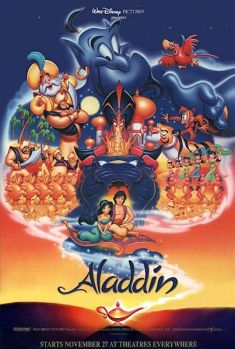
Aladdin (1992)

100 Films’ 100 Favourites #1

Imagine if you had three wishes,
three hopes, three dreams
and they all could come true.

Country: USA
Language: English
Runtime: 90 minutes
BBFC: U
MPAA: G

Original Release: 25th November 1992 (USA)
UK Release: 18th November 1993
First Seen: VHS, c.1993

Stars
Scott Weinger (Aladdin and the King of Thieves, Shredder)
Robin Williams (Good Will Hunting, Insomnia)
Linda Larkin (The Return of Jafar, Joshua)
Jonathan Freeman (The Return of Jafar, The Ice Storm)

Directors
Ron Clements (Basil the Great Mouse Detective, Hercules)
John Musker (The Little Mermaid, The Princess and the Frog)

Screenwriters
Ron Clements (The Little Mermaid, The Princess and the Frog)
John Musker (Basil the Great Mouse Detective, Hercules)
Ted Elliott (The Mask of Zorro, Pirates of the Caribbean: The Curse of the Black Pearl)
Terry Rossio (Shrek, Pirates of the Caribbean: At World’s End)

Story by
Deep breath… Burny Mattinson and Roger Allers, Daan Jippes, Kevin Harkey, Sue Nichols, Francis Glebas, Darrell Rooney, Larry Leker, James Fujii, Kirk Hanson, Kevin Lima, Rebecca Rees, David S. Smith, Chris Sanders, Brian Pimental & Patrick A. Ventura.

Based on
The folktale of Aladdin and the magic lamp from One Thousand and One Nights, aka The Arabian Nights.

Music
Alan Menken (Little Shop of Horrors, Tangled)

Lyrics
Howard Ashman (Little Shop of Horrors, Beauty and the Beast)
Tim Rice (The Lion King, Evita)

The Story
Street urchin Aladdin falls for bored Princess Jasmine when she sneaks out of her palace one day, leading him to the clutches of evil vizier Jafar, who needs Aladdin to retrieve a magic lamp as part of his scheme to rule the land. When Aladdin accidentally discovers the lamp’s inhabitant, a wish-granting Genie, he uses his wishes to set about wooing the princess. Jafar, of course, has other ideas…

Our Hero
One jump ahead of the bread line, one swing ahead of the sword, steals only what he can’t afford (that’s everything). Riffraff, street rat, scoundrel. It’s Aladdin, of course.

Our Villain
Grand Vizier Jafar, a plotting underling — the kind of role that has strong precedent in fiction, I’m sure, though Conrad Veidt as villainous Grand Vizier Jaffar in The Thief of Bagdad is rather clearly the direct inspiration.

Best Supporting Character
Oh, I don’t know, maybe… the Genie! Fantastically voiced by a heavily-improvising Robin Williams, praise is also deserved for Eric Goldberg’s character animation, which matches him every step of the way. In fact, it was an animation Goldberg created using one of Williams’ stand-up routines that convinced the comic to take the part.

Memorable Quote
Aladdin: “You’re a prisoner?”
Genie: “It’s all part and parcel, the whole genie gig. Phenomenal cosmic powers! Itty bitty living space.”

Memorable Scene
Trapped in a desert cave, Aladdin accidentally rubs a lamp and unleashes the Genie — and with it, Robin Williams’ all-time-great hilarious performance.

Best Song
For me, it’s Prince Ali, the huge Genie-led number as a disguised Aladdin arrives back in town in grandiose style. The Genie’s big solo number, Friend Like Me, is an incredibly close second. Soppy A Whole New World won all the awards, because of course it did.

Truly Special Effect
Only the second time Disney used CGI with 2D character animation. In Beauty and the Beast, it built a room for the characters to dance in; here, there’s a character (the entrance to the cave) and a whole action sequence (the flying carpet escape from said cave). It earnt the team a BAFTA nomination. There’s no shame in what they lost to: Jurassic Park.

Making of
Robin Williams ad-libbed so much of his role as the Genie — generating almost 16 hours worth of material, in fact — that the film was rejected for a Best Adapted Screenplay Oscar nomination.

Previously on…
Aladdin is Disney’s 31st Animated Classic, their official canon of animated movies. It’s the fourth film in the “Disney Renaissance”, the decade-long period (starting with The Little Mermaid and ending with Tarzan) when they had a run of films that were critically and financially successful (unlike those before and after said period).

Next time…
Two direct-to-video sequels, the second of which is quite good; in between those, a TV series ran for 86 episodes(!); a Broadway adaptation debuted in 2014 (it’s coming to the West End in May); not to mention numerous video games and appearances in other works, almost all still voiced by the less-starry names among the original cast. The go-to new voice for the Genie? Dan “Homer Simpson” Castellaneta.

Awards
2 Oscars (Original Song (A Whole New World), Original Score)
3 Oscar nominations (Sound, Sound Effects Editing, Original Song (Friend Like Me))
2 BAFTA nominations (Score, Special Effects)
1 Annie Award (Animated Feature)
3 Saturn Awards (Fantasy Film, Supporting Actor (Robin Williams), Younger Actor (Scott Weinger))
1 Saturn nomination (Music)
Nominated for the Hugo for Best Dramatic Presentation.

What the Critics Said
“What will children make of a film whose main attraction — the Genie himself — has such obvious parent appeal? They needn’t know precisely what Mr. Williams is evoking to understand how funny he is. […] What will come through clearly to audiences of any age is the breathless euphoria of Mr. Williams’s free associations, in which no subject is off-limits, not even Disney itself.” — Janet Maslin, The New York Times

Score: 94%

What the Public Say
“the perfect Disney film, one that cleverly combines the sensibilities of classic and modern audiences, one that matches toe to toe with many of the studio’s greatest films. You may prefer the emotional heart-ache of The Lion King or the romantic magic from Beauty and the Beast, but I would always prefer the witty and charming Aladdin.” — feedingbrett @ Letterboxd

Verdict

Hailing from slap-bang in the middle of the Disney Renaissance, Aladdin may not be quite as strong as the films either side of it (Beauty and the Beast and The Lion King), but it’s the next best thing. Buoyed by Robin Williams’ top-drawer performance (have I mentioned that yet?), multiple toe-tapping musical numbers, and a dastardly villain who’s among Disney’s best — and is just one of several great supporting characters here, actually — Aladdin is an A-grade animated Arabian adventure.

In #2 no one can hear you scream.

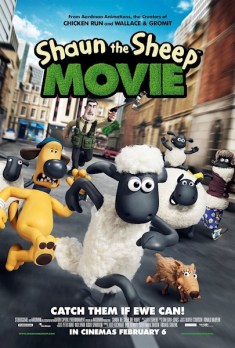
Shaun the Sheep Movie (2015)

2015 #183
Mark Burton & Richard Starzak | 85 mins | streaming (HD) | 1.85:1 | UK & France / silent (English) | U / PG

Shaun the Sheep started life in the 1995 Wallace & Gromit short A Close Shave. Eventually granted his own TV spin-off aimed at little kids, it’s become a global hit thanks to the decision to make it a silent comedy — no need to pay for pesky dubbing into other languages, while its sheer quality (it is Aardman, after all) helps it to transcend national boundaries. This year, Shaun and friends made the leap to the big screen, in what may be the year’s best animated movie.

The film begins with Shaun and the other ovine occupants of Mossy Bottom Farm getting fed up with the daily grind of being sheep, so they concoct a plan to distract sheepdog Bitzer so they can lure the Farmer into a slumber and take over the farmhouse for a well-earned break. Naturally things go awry, and the Farmer ends up whisked off to the Big City. With no one to feed or care for them, Shaun, Bitzer, and the rest hop on a bus and set off to retrieve their friend.

Expanding a series of five-minute-ish shorts to feature length is always a risky proposal, but fortunately we’re in the more than capable hands of Aardman Animation here, and they’ve come up with a plot big enough to fill a feature running time. In a style one might describe as ‘classical’, you can break the film down into individual segments and sequences, each one a crafted vignette of silent slapstick. That doesn’t make the story episodic, but rather serves to keep the humour focused — no gags are overused or outstay their welcome. Indeed, some fly so fast that they’re literally blink-and-you’ll-miss it. I suspect this means Shaun would reward repeat viewings, particularly to spot all the little background details.

It’s also in the details that Shaun proves itself to be a true family film. Like the TV show, it’s sweetly innocent and simple enough for little’uns (that US PG is thanks to a couple of oh-so-rude fart jokes), but there’s a sophistication to the way that simplicity is handled that adults can enjoy. There are also references and in-jokes for the grown-ups; not hidden dirty jokes that’ll put you in the awkward position of having to explain to the kids why you were laughing, but neat puns (note the towns that the Big City is twinned with) and references to other films (like Taxi Driver. Yes, really.)

Naturally, technical aspects are top-notch. Aardman are the kings of claymation, consistently delivering work in which the animation is polished, clever, and surprising, but which also retains the sense that it was achieved by hand (unlike some other films — Corpse Bride, say — which are so slick you begin to wonder if they’re actually CGI). I always marvel at stop-motion anyway — the persistence to animate something a frame at a time, taking days to create one shot and months to create one scene, is a dedication and skill I can barely fathom — but Aardman’s productions routinely push beyond your expectations of the form.

Aardman’s stop-motion silent comedy will certainly lose to Inside Out across the board come awards season (apart from at the BAFTAs, perhaps), but it’s the more inventive, amusing, innovative, accomplished, and impressive achievement. Delightful.

4 out of 5

Shaun the Sheep’s Christmas special, The Farmer’s Llamas, is on BBC One on Boxing Day at 6:10pm.

This review is part of the 100 Films Advent Calendar 2015. Read more here.

An inside out pair of shorts

Pixar’s latest opus, Inside Out, was naturally accompanied by a short film in cinemas. On Blu-ray (out today in the UK), it’s accompanied by two. These are they, reviewed in nice quick drabbles.


Riley’s First Date?
2015 #179a
Josh Cooley | 5 mins | Blu-ray | 1.78:1 | USA / English | U / G

In this ‘sequel’ to Inside Out, Riley is going to hang out with a friend… who turns out to be a boy, which sends her mum and dad — and their anthropomorphised emotions — into paroxysms of worry. Is this the 12-year-old’s first date?
The straightforward story is built on clichés of male and female parental reactions to their kid growing up and encountering the opposite sex (mum tries to be cool, dad gets protective), but then it’s only got four minutes so needs that shorthand. Nonetheless, it manages roughly as many laughs as the feature, even if they are easy targets.

4 out of 5


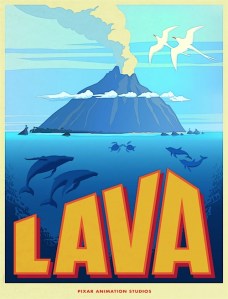
Lava
2015 #179b
James Ford Murphy | 7 mins | Blu-ray | 2.35:1 | USA / English | U / G

The short that accompanied Inside Out in cinemas is essentially a music video for a folksy ballad about a pair of volcanoes who are in ‘lava’ (read: love) with each other.

It’s quite beautifully animated, with realistic CGI (apart from, you know, singing volcanoes) that eschews stylisation without giving in to the urge to shallowly emphasise its photorealism, but other than that I didn’t much care for it. The story and song — inspired by an underwater volcano that will one day merge with Hawaii — are a little too twee. It’s not really sweet, nor sickly, just kind of uninspiringly quaint.

3 out of 5