Batman: Gotham Knight (2008)

2008 #65
Shojiro Nishimi, Futoshi Higashide, Hiroshi Morioka, Yasuhiro Aoki, Toshiyuki Kubooka & Jong-Sik Nam | 73 mins | DVD | 15 / PG-13

Batman: Gotham KnightGotham Knight is an American-Japanese produced anime — the animation is Japanese and anime-styled, but the original soundtrack is English — that aims to bridge the gap between Batman Begins and The Dark Knight. In this case that equates to six short films, with some narrative connections, strung together to make a movie.

Overseen by executive produce Bruce Timm (Batman: The Animated Series, and most of the DCAU) and all with story credits to Jordan Goldberg (Nolan’s assistant on Batman Begins and now associate producer on The Dark Knight), the shorts, in order of appearance, are:

  • Have I Got a Story For You, written by Josh Olson (A History of Violence) and directed by first-time director Shojiro Nishimi;
  • Crossfire, written by Greg Rucka (Gotham Central and other comics) and directed by first-time director Futoshi Higashide;
  • Field Test, written by Goldberg and directed by Hiroshi Morioka (Tsubasa Chronicle);
  • In Darkness Dwells, written by David Goyer (Batman Begins, Blade trilogy) and directed by Yasyhiro Aoki (one episode of Tweeny Witches);
  • Working Through Pain, written by Brian Azzarello (100 Bullets and other comics) and directed by first-time director Toshiyuki Kubooka;
  • Deadshot, written by Alan Burnett (Batman: Mask of the Phantasm) and directed by Jong-Sik Nam (He-Man 2002).
  • Compiling that list, one has to wonder about the blurb’s claim that these shorts are directed by “some of the world’s most visionary animators”. I suppose the key word is “animators” (rather than “directors”), as some have worked on things like Neon Genesis Evangelion, various iterations of Gundam, and even Akira. Regardless of their level of experience, they all seem to do a fine job here, even managing a couple of vaguely memorable moments among fairly stock dialogue scenes and effective, if occasionally unoriginal, fights.

    The six-stories/one-film concept works well enough on the whole. While these are clearly standalone pieces in terms of style and each telling a complete story, they still work best when viewed together — most follow on from the preceding entry and some elements skip across films. These links are nicely varied. For example, while the end of Film 1 merely leads directly to Film 2, there’s a relatively minor action at the end of Film 3 that is picked up in Film 5, and a large chunk of Film 3 is spent on something seemingly insignificant that is picked up on in Film 6. There are some missed opportunities in this respect, such as the transition from the fourth to fifth entries. It would be neater if Batman’s injury in Film 5 was the one from Film 4; based on the settings and their consecutive sequence, I presume this is what was intended, so it’s a shame the wound’s in a completely different place.

    Gotham Knight seems to be squarely aimed at fans — who else could work out that the long-haired mustachioed crime lord here is actually Eric Roberts’ character in The Dark Knight! This is just one of several other factors that seem strange considering Gotham Knight is meant to bridge Nolan’s two live-action Bat-epics: Alfred is the traditional posh Englishman; few/no other characters sound like their Nolan-era counterparts; one segment even features the Burton-style Batmobile! It’s also a shame that the Scarecrow short isn’t last as it would lead even more directly into The Dark Knight. On the other hand, it succeeds in crafting a decent-enough ‘real world’ explanation for Killer Croc, which is no small feat, and Kevin Conroy, now in his mid-50s, still makes a good younger Batman. Thankfully he doesn’t attempt Bale’s over-done Bat-voice, though a nod in that direction might’ve been nice.

    I’ve managed to get this far without invoking The Animatrix, unquestionably the forefather of this and other similar projects. Gotham Knight takes the concept a step further by linking its shorts so clearly, and while it’s not wholly satisfying in this respect, it’s a successful enough step in the right direction. If we do get a The Dark Knight 2, I’d be quite happy to see another direct-to-DVD effort in this vein.

    4 out of 5

    The Dark Knight: The IMAX Experience (2008)

    2008 #48a
    Christopher Nolan | 152 mins | IMAX | 12A / PG-13

    The Dark Knight: The IMAX ExperienceOne of the joys of spending five weeks of this summer in New York is that I have the opportunity to see anything that’s out in the US before the UK early. I haven’t entirely used this to my advantage (no trip to Hellboy II, for example, which has almost left theatres here but is still a few weeks off at home), but I have been to the much-anticipated new Batman movie, The Dark Knight… twice. Unlike in the UK, I have relatively easy access to an IMAX here, and, as any good Bat-fan will know, this means I was not only able to see TDK one week early, but also on the screen it (or, at least, parts of it) were specially shot for. Of course, despite the film virtually being on loop at Manhattan’s sole IMAX screen, the high demand for tickets means I had to wait til the second Saturday to see it writ so large — and even then I was fairly lucky, as some showings sold out inside of two hours.

    As I’ve reviewed the film before, and my feelings on it have barely changed with a second viewing just one week later, it seems sensible to focus on the IMAX aspect. For those who somehow missed the news, The Dark Knight is the first Hollywood blockbuster to be specially shot for IMAX — not all of it, but six key sequences… or so they say. From what I could tell, while some whole sequences were indeed shot on IMAX film, often it was used just for bits of scenes, or now and then for the more dramatic establishing shots. For example, every aerial shot in the film — and, as those who’ve seen it will know, there are a fair few — appears to have been shot with IMAX cameras. The choice of sequences to shoot on IMAX is also intriguing. Some reviewers asserted it was “obvious” scenes were IMAXed even on a 35mm print, but I think they might be in for a surprise. Yes, the bank robbery opening, the car chase, and elements of the climax all receive the IMAX treatment, but elsewhere smaller scale action sequences and even some dramatic scenes are awarded the vision-filling honour.

    It all looks stunning, of course: the resolution is visibly increased whenever the IMAX film kicks in (the rest of the film, blown-up from 35mm, is blurry and grainy by comparison but still doesn’t come out too badly) and the added size and scope of the format serve to underline the scenes for which it’s employed. While most of them are worthy, if sometimes unexpected, there are times when one wonders if scenes were picked just to make up the numbers with something not especially challenging. That said, it’s always nice to see, so one can’t complain too much. I didn’t find IMAX to be an especially viewer-friendly format for a two-and-a-half-hour feature though — it’s designed to fill your vision, an aim it achieves admirably, but when trying to watch a regular movie it entails an unusual amount of head turning, as well as trying very hard to notice everything right into the depths of your peripheral vision. It was certainly an experience, as the advertising subtitle suggests, but it won’t be for everyone and I’m not sure I’d bother again without some notable incentive (such as the one Dark Knight offers — none of these new-fangled 3D films have been interesting enough to tempt me yet). In some respects, what interests me most is what debates and opinions the use of IMAX will provoke about the film’s correct aspect ratio when it comes to DVD/Blu-ray time. I don’t care to predict what people will say, but I suspect it will be amusing to observe.

    One final note: watching this just one week after I first saw it in a normal cinema (one week & one hour, to be exact!), it seemed to me that the odd shot was trimmed slightly or actually missing. Quite why this would be I don’t know, and it may just be my memory playing tricks, especially as the running time listed on the BBFC is actually slightly longer for the IMAX version (as seems to be standard, from a quick look at a few other IMAXed films — I’m sure someone knows why). The differences — if indeed there are any — are minor, but I felt I should mention it.

    There’s no questioning The Dark Knight‘s brilliance in its own right, in my mind — it may be questionable whether it’s the Best Film Ever (surprisingly, it still sits at #1 on the IMDb Top 250), but at the same time I genuinely enjoyed this more than any other film I’ve seen from that top ten (and probably beyond). Whatever size screen you see it on, this film is an amazing experience — but some of it was shot especially for IMAX and those bits do look spectacular on the extra-huge screen. If you have the chance, this is really how Dark Knight should be seen — especially as it’s always possible that you won’t have the chance again.

    5 out of 5

    As if two reviews wasn’t enough, I shared more of my thoughts on The Dark Knight (this time when considered next to Batman Begins) here.

    On the off chance anyone’s wondering what happened to #48, it’s WALL-E and the review’s on its way. But I’ve been sat on this one for a week (and not got round to the WALL-E one for over a week!), so I thought I’d just get on and post this, sequence be damned.

    I Am Legend: Alternate Theatrical Version (2007/2008)

    2008 #47a
    Francis Lawrence | 104 mins | Blu-ray | 15

    This review contains spoilers.

    I Am Legend: Alternate Theatrical VersionI only watched the theatrical version of I Am Legend earlier this year (it’s #35), but, for reasons I won’t elaborate on for once, I’ve found myself watching this alternate version already.

    Most of the comments in my original review still apply, as this cut only has minimal differences: there are a couple of very short new scenes in the third act, which were presumably excised because they primarily feed into the different ending, the main attraction of this version. Personally, I prefer it. The whole butterfly thing is too God-messagey, recalling the weakest elements of Signs, but if one can put that aside then the new content fits in much better with several threads that develop in the rest of the film (in both versions — in the original cut they’re just ignored). It feels like this was the intended conclusion but, for whatever reason, someone decided it needed changing. Perhaps it wasn’t explosive enough; or, indeed, conclusive enough, as it dispenses with the safe-haven epilogue and its pathetic attempt at justifying the title — another pleasurable loss as far as I’m concerned.

    One other element I’ve reconsidered thanks to this repeat viewing are the CGI humans. They’re good enough in and of themselves, and would make more than passable foes in another action film, but here they ruin the ambiance that’s so carefully built up before their first appearance. Yes, the CGI lions are also clearly fake, but with limited methods to create such scenes they seem more acceptable. The arrival of the Dark Seekers, on the other hand, barges the film from thoughtful sci-fi drama into horror action blockbuster stylistically, in a way that using real actors simply wouldn’t. The not-real Dark Seekers may have superhuman jumping abilities, but the film doesn’t need those either, and could easily have crafted a similarly action-packed climax with real performers.

    I Am Legend is still as middle-of-the-road as before, with very little to choose between the two versions. However, thanks to a less irritating final few minutes, this version just has the edge — if you ever intend to watch I Am Legend, be it a repeat viewing or your first, I recommend you plump for the alternate cut.

    3 out of 5

    The theatrical version of I Am Legend is on Watch tonight, Tuesday 14th October 2014, at 10pm.

    The Dark Knight (2008)

    2008 #47
    Christopher Nolan | 152 mins | cinema | 12A / PG-13

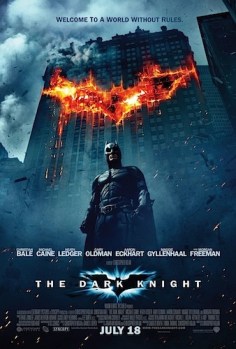
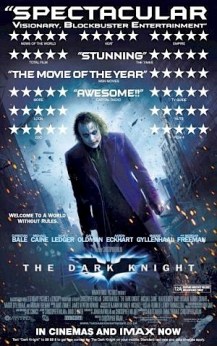
    The Dark KnightThe Dark Knight — the sixth film in the modern Batman series (though not connected to the first four) — comes with a heavy weight of expectation on its back. It’s the sequel to the last film, Batman Begins, which relaunched the flailing series in style and is one of the best comic book movies ever — so Nolan and co had to top that. There was Heath Ledger’s death, a sad accident that has heaped extra focus on his penultimate performance here (his final one, in The Imaginarium of Doctor Parnassus, is currently in post-production with no release date) — especially as some sources cited his appropriation of the Joker’s mindset as related to his death. And then there were the trailers too, which caused ridiculous levels of excitement among some — personally, I found them a tad lacking. But I was fairly confident that, a bit like Begins, The Dark Knight would turn out to be the sort of film that doesn’t necessarily trail all that well but is excellent when seen.

    And I was right. In this respect, it’s because the action sequences aren’t the point of the film. They occur when required by the story, while still being well-spaced and appropriately exciting, rather than serving as check-boxes for a plot designed primarily to link them together — the latter being what most blockbusters seem to settle for these days. Many are pleasantly old-school in style, the stunts performed largely for real, and at least one major example is even left without music. On the odd occasion when effects must have been used, they’re seamlessly achieved. The most obvious use of CGI — which I won’t describe for the sake of spoilers, though many will already know about — is incredibly well done. All of this helps ground the film in a perhaps-surprising (for some) degree of reality, one that goes far beyond what other ‘realistic’ superhero movies have strived for.

    In fact, this realism is probably The Dark Knight‘s main strength. Obviously there’s never going to be a real city where a billionaire dressed in bat-inspired armour protects the populace from a deranged man in clown make-up, but if there were then this is how it would be. Where Burton’s two Bat-films were “dark”, and Schumacher’s were “gaudy” (or “crap”), Nolan’s pair are “real”. It’s an excellent thriller as well as everything else. The focus of the plot — at least at first — is on the mob and their control over Gotham, and it’s from their criminal desires — plus the very existence of Batman — that the Joker grows. Ledger’s performance is as outstanding as you’ll have heard said elsewhere, and while it still feels like a supporting role it receives more attention than the psychology of Bruce Wayne/Batman — which, considering that’s what Batman Begins focused on, seems fair enough. Every other performance is equally as flawless (I’ll name names in a moment), but it’s Ledger’s disturbing, engrossing turn that will stay with you. He is the Joker, in a way Jack Nicholson certainly never was, and — among obviously more upsetting effects of his premature death — the fact we’ll never see him in a rematch is a huge shame.

    As Harvey Dent, Aaron Eckhart’s role is much larger than I was expecting. The floating-head posters that seemed to divide the film between him, the Joker and Batman are spot on — they’re the three central characters, everything revolves around them, their actions, choices, and emotions. While Ledger may dominate with his (appropriate) theatricality, Eckhart is more the heart of the film, with a genuinely tragic story. Viewed in this light, the order of the film’s final scenes — which I think some may see as incorrectly balanced, perhaps even anticlimactic — make all the more sense. However, I don’t mean to undersell the rest of the cast by highlighting Ledger and Eckhart — in their supporting parts, Michael Caine, Maggie Gyllenhaal, and especially Gary Oldman and Morgan Freeman, all do brilliant work. The talented Christian Bale manages to hold his own as the ambiguously heroic crimefighter, even against the more obviously attention-grabbing performances of Ledger and Eckhart.

    As with other superior superhero sequels like X2 or Spider-Man 2, The Dark Knight uses the groundwork of its successful predecessor to craft an experience that’s even greater. In fact, there’s an awful lot more that could be said about the qualities of The Dark Knight. At two-and-a-half hours, it’s a packed epic of a movie — which makes Nolan’s confident juggling of plot threads, character development, several large performances, action sequences, and more, all the more impressive. I certainly enjoyed seeing it with a large, American (importantly), opening-weekend crowd — several moments produced whoops and sustained applause from the audience, as well as a good number of well-deserved laughs.

    The Dark Knight is great entertainment, with a good deal of meat on its bones too — the performances and emotional stories are as engrossing as the thriller-ish plot and impressive action. When all is considered, it’s possibly as perfect a thriller/blockbuster as they come. In fact, as I publish this, The Dark Knight sits at #1 — the best film of all time ever — on IMDb. It will drop, of course, because that’s opening-weekend fan-led gut reaction for you… but, even when time’s passed, I’m certain it deserves to remain high on the list.

    5 out of 5

    Sadly (though not surprisingly) the Manhattan IMAX was booked solid all through opening weekend (and most of next week, at least). As soon as I manage to see it on the extra-big screen, I’ll share my thoughts here. You can also read even more of my thoughts on the film (this time when considered next to Batman Begins) here.

    The Dark Knight placed 1st on my list of The Ten Best Films I Saw For the First Time in 2008, which can be read in full here.

    Wanted (2008)

    2008 #46
    Timur Bekmambetov | 110 mins | cinema | 18 / R

    WantedDid you see the trailer for Wanted? Did you think the loopy, somewhat Matrix-y stunts — like bending bullets, driving cars into trains, and numerous others — looked cool? Did you want to see more? If the answer to these questions is “yes”, watch the trailer on loop a few times, because 85% of the film’s cool bits are in there.
    The trailer is Wanted’s biggest problem by far. Those expecting to suspend their disbelief and be treated to an onslaught of ridiculous-but-cool CGI-aided action trickery may be disappointed, not because it’s not there but because they’ll have already seen all the best bits. Of course, two minutes of trailer can’t cover all of the action present in the film, but it certainly managed to contain most of the flagship moments. Wanted’s other major problem is its pacing. The “Wesley is an ordinary guy with a dull life” opening is stretched thin, the traditional “training montage” is actually most of the second act, and, by the time it’s remembered there was a proper plot too, all you’re left with are a few more recycled plot beats (most notably from a certain popular late-’70s sci-fi sequel). Those points aside, there’s nothing really wrong with the plot — it’s an above-average way of linking the action together.

    It’s hard not to recycle in this genre, of course, but the only other place you’re likely to have seen most of the stunts is… the trailer! Ahem — or, Bekmambetov’s pair of Russian fantasy films, Night Watch and Day Watch. The prologue explaining about an organisation that has existed for thousands of years is certainly reminiscent of those films, though here Bekmambetov is stuck with text rather than a full-blooded flashback. Throughout the rest of the film he displays a noteworthy visual flair, and while I’m sure some prefer their action to be done ‘for real’ and not boosted by computers, there’s no way the crazy things he’s imagined could be achieved that way. I have no problem with the use of CGI personally, especially as the ludicrousness of its use here doesn’t pretend to be something it isn’t.

    The cast are all better than the material — not that anyone seems particularly bored or underachieving, just that the screenplay doesn’t tax them. Marc Warren is especially underused, with barely a line of dialogue to his name, though he is awarded a particularly gruesome death. While there’s nothing wrong with most of the elements that make up Wanted, then, it’s hard to escape the feeling that you’ve been cheated into paying to see all the stuff you already saw in the trailer with a few other bits slotted in. I spent much of the film presuming it would finish on an open-ended note, as the structure reminded me of films like X-Men and Iron Man: all set-up and origin story, with a perfunctory climax-providing enemy, done with an eye (or, indeed, both eyes) on a sequel. Wanted doesn’t really end that way, which in an age where the franchise is everything is admirable… apart from that the film leading to that ending still feels franchise-friendly.

    If you don’t mind your action being computer-aided and as realistic as… well, a comic book… then there’s much to enjoy in Wanted. Except, you already enjoyed most of it in the trailer. Perhaps things will look brighter with a few years’ distance.

    3 out of 5

    The Incredible Hulk (2008)

    2008 #45
    Louis Leterrier | 114 mins | cinema | 12A / PG-13

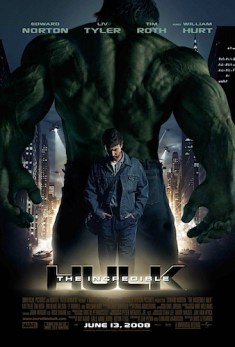
    The Incredible HulkNow here’s something I didn’t think we’d see: a sequel to Ang Lee’s disappointing 2003 version of the Hulk, Marvel’s big green superhero-monster-thing. It’s not precisely a sequel though — for those who’ve somehow missed the behind-the-scenes goings on, this one has an all-new cast and crew, led by Hulk-fan Edward Norton on both leading man and (uncredited) writing duties. But does that mean it’s any better?

    I think you’d be hard pushed to deny that this version is more entertaining. From the off it strikes a good balance between plot, character development and action. It doesn’t try to dig as far into the hero’s psychology as Lee’s film, but as that crippled the earlier attempt it’s for the best. Norton is a more appropriate Banner than Eric Bana was, achieving drama, humour and action with aplomb. In fact, even though there’s notably less of it, it seems Leterrier and his cast are as adept at crafting dramatic scenes as Lee and his lot were. They’re certainly better at action sequences, of which there are a good number and all well executed. Attempting an athletic chase over rooftops and through small streets so soon after Casino Royale and The Bourne Ultimatum did similar things to such acclaim seems a bold move, and while Hulk‘s version isn’t as memorable it doesn’t suffer unduly from comparison. The final monster-on-monster punch-up is immeasurably better than the first film’s bizarre climax, but the real stand out for me was the battle on the university campus. All of this is helped by vastly improved CGI. No longer is the Hulk an oversized action figure, but instead has weight and grit, and is altogether more believable. You’re never going to be convinced he’s real, obviously, but this time round they’ve made him more than close enough.

    In terms of being a sequel, The Incredible Hulk pretty much has its cake and eats it. It makes good use of all the benefits of being Film 2 — it’s not an origin story, it doesn’t waste too much time introducing the characters — but without a dependence on the poor first film — new actors and a modified origin story distance it, so the main plot grows out of the basic ‘facts’ of Hulk’s origin rather than specific incidences from the first film. In fact, those who were lucky enough not to see Lee’s Hulk may well assume the opening credits’ origin story recap is just a retelling of the first film — and there’s no need to inform them otherwise. As well as dispensing with all the first film’s “evil dad” stuff, the version of the origin story here is apparently highly in debt to the ’70s live action Hulk TV series. In fact, there are also numerous nods and cameos to that version throughout (check out the IMDb trivia page for more).

    Considering I did as much for Marvel’s other 2008 blockbuster, Iron Man, I feel I should make some comment on the brief franchise-building coda. Unlike Iron Man, however, Hulk doesn’t bury its scene after 10 minutes of credits, much to my joy. For those who don’t know, the brief scene sees Tony Stark — yes, Iron Man himself, naturally played by Robert Downey Jr — have a brief chat with General Ross about the problem of the Hulk. It’s initially immensely fanboy-pleasing, but is allying such a cool, likable hero as Stark with the despicable General Ross such a good idea? Of course, we’ll find out just what the Marvel planning bods have in mind come 2011.

    In the end, this sequel is unquestionably superior to Hulk — who’d’ve thought a near-unknown director, whose major previous credit was the fairly risible Transporter 2, could best Ang Lee? The Incredible Hulk is a good blockbuster in its own right, requiring no need to have suffered the previous film, and there’s even room for a sequel. Now there’s something I didn’t think last time.

    4 out of 5

    Hard Boiled (1992)

    aka Lat sau san taam

    2008 #43
    John Woo | 122 mins | DVD | 18 / R

    Hard BoiledThe first John Woo film I saw was Mission: Impossible II. I think. It may’ve been Face/Off, which I love, but this works better with M:I-2 because most people don’t like it. Personally, I like M:I-2. It’s not the greatest action thriller ever, but it has its moments and the plot isn’t half as complex as some like to claim. It’s certainly more fun than Brian de Palma’s Euro-thriller first film, which in retrospect looks a bit like a proto-Bourne. Of course, what M:I-2 really had going for it were its action sequences, which are occasionally a bit out there but always expertly done. Face/Off’s are even better again. Anyone with a basic understanding of structure can’t fail to see what I’m going to say about Hard Boiled.

    I don’t think realism is Woo’s strong point — at least, not in his straight-up action movies. That’s not a flaw, though, but a deliberate choice — he dispenses with the realism of what a gunfight would be like (presumably, bloody scary and with fewer shots fired) and pushes the male fantasy of mindless slaughter to the limit. Which means his action sequences are pure adrenaline-pumping fun. Chow Yun-Fat single handedly slaughtering a warehouse full of heavily armed gangsters? Well, of course! Or directly hitting a small object wedged in an electrical pipe with a shaky shooting arm? Naturally! The action may have all the realism of a Dali painting, but it also has all the gleeful fun of repeating everything your sibling said when you were five — except with more choreography. It’s a cliché, but there’s something about Woo’s action that makes you want to use the word “balletic”. Not that I’ve ever really watched ballet. I expect it involves fewer guns.

    These sequences seem to have been designed with one thing in mind — cool. And they are. There are a few holes in the plot and characters’ logic, but that doesn’t matter when they can leap around firing two pistols at once and always hit their target, while the bad guys — who could shoot just fine when they slaughtered some innocents a few minutes ago — keep missing them… with machine guns. If you think about it too hard then of course it’s nonsensical, but somehow, in some way, this sort of action seems to appeal to most men (not all, of course, and if you enjoy it then don’t worry, it doesn’t mean you’re a bloodthirsty braindead weirdo). One particularly astounding sequence is achieved in a single long take, as Yun-Fat and Tony Leung make their way down several corridors killing Very Bad Men literally left, right and centre. It’s both exciting and technically impressive, considering how many squibs, blood packs, weapons and extras must have been involved to pull it off in one uncut shot.

    If you don’t care for people shooting at each other, especially when it pushes believability beyond the limit, then there’s not really anything for you here. There’s some male bonding stuff, and other bits about duty and honour and sacrifice, and a climactic subplot involving lots of cwute lickle baby-wabies; but Hard Boiled is most at home when the bullets are flying and things are blowing up. And what a lovely home it is.

    4 out of 5

    Cloverfield (2008)

    2008 #40
    Matt Reeves | 81 mins | DVD | 15 / PG-13

    This review contains major spoilers.

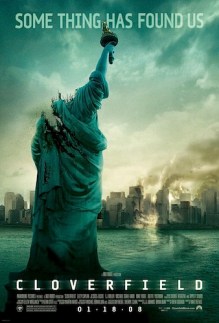
    CloverfieldAh, Cloverfield — probably the most hyped “film no one knew was coming” since The Blair Witch Project, if not even longer, and the most widely-discussed marketing campaign since Snakes on a Plane (all of two years earlier). And then, in what can only be described as a surprise, it got good reviews. Less surprisingly, it did pretty well at the box office. Even less surprisingly, they announced a sequel. So far more Blair Witch than Snakes on a Plane, then. Of course, not all reviews were good, and with all this in mind I finally come to see it myself.
    Cloverfield works. It has flaws, but overall it works. The opening 20 minutes set up the characters fairly well, though it does take its time. One would hope the idea is to increase the tension by delaying the monster’s appearance, but I can’t help feeling it’s probably just because they think they’re providing a great emotional background. Those who compare these bits to Hollyoaks clearly haven’t seen that risible C4 pile of tosh — Cloverfield’s performances (largely improvised, at least in the early scenes) and direction are much better than that, even if the plot would probably fit snuggly on the teeny soap. I found the opening held my attention well enough, so one has to wonder about the attention span of those who switched off during it. The characters and their relationships may be archetypes, and consequently rather one-dimensional, but at least they show an attempt to make it more than a Big Monster Go Smashy Smashy movie.

    That said, it’s when the monster turns up that things kick off. From then the film does a great job of creating an unrelenting chase/escape, drawing the viewer in with its first-person/eyewitness style. You’re never going to be fooled into thinking it’s a real thing that really happened, obviously, but it comes as close as it’s likely to. This is partly thanks to the camerawork, which I’ll get into later. The deliberate drip-feed of information about the monster is well handled also. Those expecting lots of exposition and answers have clearly come to the wrong film, and should perhaps stick to a more straightforward blockbuster. Those who complain that the monster doesn’t make sense, or the bug-parasite-things that drop off it make even less sense, are clearly missing the point — the characters don’t know what this is or what’s going on, so we don’t either; and it’s a sci-fi movie, so any number of explanations you care to put forward could explain things. There are a couple of misfires in this respect — the military’s willingness to explain their plan is unbelievable, and a shot of the monster towering over Hud is a step too far — but mostly it succeeds.

    Talking of Hud, he’s come in for criticism, it seems to me for two main reasons: he’s not a great character, and he can’t hold the camera steady. Have the latter viewers ever watched home movie footage? Cloverfield does a spot-on replication of it, which naturally looks odd if you think of it as ‘professional film’ (where even handheld is only slightly wobbly). I challenge anyone to take a normal home video camera and put it through the same things Hud does and come out with any steadier a shot. Sometimes credibility is pushed by having Hud film other characters instead of the more interesting monster (surely where any normal person would point the camera), but it’s only an occasional and minor point. As for his character, he may be dopey, dull, and occasionally even irritating, but his purpose is to be the cameraman — if he were notably likable or, well, notable then you’d want him in front of the camera too. For the sake of the style, someone has to be behind the camera, and Hud’s a perfect fit. You get so used to him as the almost-unobtrusive cameraman that when he’s killed it’s very nearly an audacious shock, though it’s such an obviously audacious move that it’s predictable to most film-literate viewers.

    Unsurprisingly, there’s not a huge deal of originality in Cloverfield. The monster itself may look different to the norm, but it stomps through the streets like Godzilla, the attack of its minions/parasites/whatever in a dark tunnel is a sequence we’ve all seen before (nonetheless, it’s effectively done here), and their chestbursting-like birth is obviously straight out of Alien (even if it’s toned down to a PG-13-friendly silhouette). Even the (in)famous handheld style has, of course, been done before. But in marrying all these elements Cloverfield creates something that feels fresh enough (pasting the first-person/handheld/eyewitness style onto almost any genre would give it a new angle, I’d imagine), and, for the most part, it both entertains and intrigues. It may not be quite Empire’s 5-star wunderkind, but it pushes close.

    4 out of 5

    Cloverfield placed 9th on my list of The Ten Best Films I Saw For the First Time in 2008, which can be read in full here.

    Hulk (2003)

    2008 #36
    Ang Lee | 132 mins | DVD | 12 / PG-13

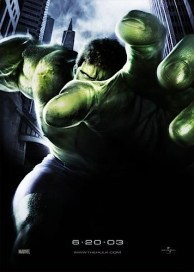
    HulkWith the Edward Norton-starring (and -penned), Louis Leterrier-directed sequel/re-imagining of the Hulk coming this summer, I decided it was finally time to watch Ang Lee’s much derided 2003 attempt at bringing Marvel’s green monster-hero-thing to the big screen. Much like the lead character — in a Jekyll & Hyde-style, he’s mild-mannered scientist Bruce Banner by day, but the big green monstrous Hulk when angry — this is very much a film of two vastly different sides.

    Indeed, the most striking thing about Lee’s interpretation of the Hulk is what a mish-mash of styles it is. On the one hand, it wants to be a drama/thriller, focussed on father-child issues and military cover-ups. On the other, it has comic book action sequences and a bizarre editing style inspired by comics — a compilation of unusual techniques that look like a Media Studies teacher’s wet dream. Not even Spider-Man was that kooky. In the end, it just means the cutting style feel out of place, firstly because for much of the film (at least the first 45 minutes) it’s the only reminder of the film’s comic roots, but especially because Lee’s use of the tricksy techniques is inconsistent — sometimes confusingly overused, sometimes apparently forgotten. Other technical elements also detract. Danny Elfman’s score is blandly uninspired, a carbon copy of his work on similar films. Worst of all is the CGI Hulk — it looks like they used an action figure he’s so plasticky. It gets by OK in early appearances, swathed in moody shadows, but in the glaring desert sunlight he doesn’t stand a chance.

    The big, destructive sequences starring the Hulk himself are too little too late. There’s nothing wrong with sneaking drama into blockbusters, but this feels like a blockbuster snuck into a drama. There are fights because there have to be, not because anyone involved in making the film seems to want them. They’re badly placed thanks to the plot structure and the film’s pace topples under their weight. Even the climax wants to be a battle of wills between father and son, but turns into a nonsensical messy CGI splurge. That said, the dramatic moments don’t fare much better. Usually so watchable, Eric Bana can do little with the material offered here. The rest of the cast don’t suffer as much, and there are times when it almost works, but neither the dramatic nor blockbuster sides fully function in themselves, and certainly not when slammed together.

    Hulk is not a film anyone could love — even the weakest comic adaptations usually have their fans — and, for a film aimed at a devoted fan base, this is perhaps its biggest flaw. Equally, it retains too much of the superhero genre for anyone to consider admiring it as a purely dramatic film. Hopefully Hulk-fan Norton’s film can marry the two halves better… or if not, at least create some cool destruction-filled action.

    2 out of 5

    I Am Legend (2007)

    2008 #35
    Francis Lawrence | 96 mins | DVD | 15 / PG-13

    This review contains major spoilers.

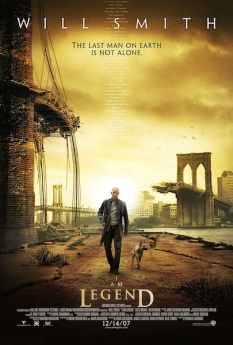
    I Am LegendWill Smith stars in this adaptation of Richard Matheson’s classic sci-fi novel from the director of Constantine. The latter is a film I personally enjoyed (and which features a relatively early appearance of the currently prolific Shia LaBeouf) but received some mixed reactions on the whole. By a broadly similar token, I Am Legend has received a fair share of negative reviews, though my opinion is a little more divided.

    Things go very well for the first half. It’s nicely paced, concentrating on a depiction of one man’s loneliness taken to the extreme. The script, and Smith’s acting, handle the material well. The deserted and destroyed New York looks as stunning as the trailers promised, while the CGI animals that roam it are as good as any. The flashbacks that punctuate the film are well executed too, drip-feeding clues to what happened while maintaining some mysteries of their own. There are some other good sequences: Neville’s exploration of a pitch-black Dark Seeker-infested building is tense, and the death of his pet dog — his one remaining companion — is moving, even if it was given away in the trailer. That scene is effectively played and shot, showing only Neville’s face as he is forced to euthanize the diseased animal by suffocation.

    Sadly, this is where things begin to go down hill. The Dark Seekers — the film’s vampires/zombies/whatever — are crafted with pretty good CGI, but they’re still not life-like enough to work. If it were a mindless blockbuster they would’ve been more at home, but as it’s managed to be an effective drama they feel entirely out of place. It’s true that real actors couldn’t have managed the physical feats the creatures are made to pull off, but do they really need to do those things? I suspect not. The film also leaves several holes in the Dark Seeker’s actions — for example, they copy Neville’s trap, a move apparently beyond their intelligence, but the film neglects to explore why or how they did this.

    Instead it moves on to the arrival of some more survivors. Quite where they came from, or how they got into the supposedly isolated Manhattan, is another inadequately explained set of circumstances. After they arrive, the film’s climax comes out of nowhere. It’s as if the screenwriters ran out of ways to keep things going so just bunged on a big climactic action sequence. And what happens in it is pretty silly too, especially Neville’s self sacrifice — why not get in the Magic Safe Hole too and then chuck the grenade out? Perhaps he just has a death wish by that point. It would seem most of the audience did. There’s also a pathetic epilogue, and an even worse final line that attempts to make sense of the title.

    I Am Legend is something of a disappointment. The considered and effective first half gives way to an increasingly nonsensical second, marred by numerous flaws that stack up til a near-laughable conclusion comes from nowhere. I’ve been told that the ‘alternate theatrical cut’, with a handful of additional scenes and a new ending, is marginally more effective. I’m sure I’ll watch it someday and share my thoughts. For now, I Am Legend’s two halves of differing quality just leave it in the middle of the road.

    3 out of 5

    I Am Legend is on Watch tonight, Saturday 11th October 2014, at 9pm. It’s on again on Tuesday, when I’ll (re-)share my thoughts on the so-called “Alternate Theatrical Version”.