Venom (2018)

2020 #181
Ruben Fleischer | 112 mins | Blu-ray (UHD) | 2.40:1 | USA & China / English | 15 / PG-13

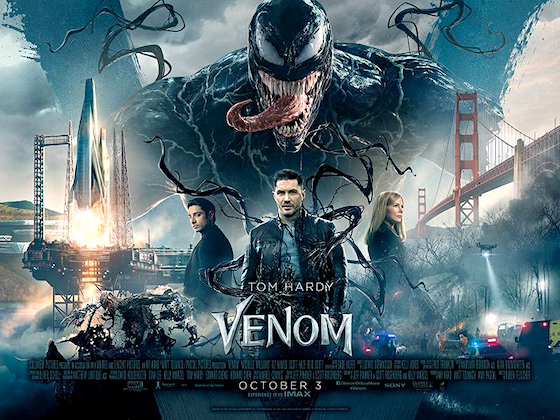
Venom

The fad for shared universes, provoked by the success of the MCU, seems to be dying off: the Dark Universe, the DC Extended Universe, Fox’s X-Men films, the MonsterVerse, sundry others most of us can’t even remember — they all either died a quick, brutal death, or circumstances have wiped them out. Even those that are ongoing have either abandoned close interconnectedness (like the DCEU) or don’t have long-term plans (the MonsterVerse, which has nothing announced beyond Godzilla vs. Kong). The MCU still seems to be going strong (although we haven’t actually had a new MCU movie in over a year now, so who knows what the future will hold?), but other than that? Everyone seems to have realised the formula is impossible (or too much hard work) to replicate.

The exception lies in Sony’s desire to launch a superhero universe out of the one character whose rights they own: Spider-Man. It started when they abandoned Spider-Man 4 to go the reboot route with The Amazing Spider-Man, the sequel to which teased all sorts of stuff to come, some of which was announced. Those movies’ failure to live up to their titles (i.e. they were not amazing, in any respect) saw such plans cancelled, but it seems Sony don’t give up so easily — even after they loaned out Spider-Man himself to the MCU, moves to form their own universe have continued.

Which is what brings us to Venom. For those not in the know, he started life as a Spider-Man villain (if you’re not a comic book reader, you’re most likely to know him from his appearance in Spider-Man 3, a move forced by the studio that contributed to the film’s relative failure), but he later became an anti-hero in his own right, which positions him quite nicely for Sony’s first actually-filmed-and-released foray into a shared Spidey universe. (A lot of the other Spider-Man characters they own the rights to are villains, though after the success of Joker I guess they’ll feel emboldened to attempt villain-centred films.) And, to the surprise of some, Venom earnt over $850 million at the global box office, making it the 7th highest grossing film of 2018. Sony’s Spider-Man-universe-without-Spider-Man is definitely underway (there’s a sequel due next year, alongside other Spidey-related films both ready for release and in active development).

Venomous

But enough about future plans, because perhaps one reason Venom has been such a success at launching a new universe is that it didn’t try too hard. Unlike The Mummy or Batman v Superman, this isn’t a film bogged down with characters and references designed to tee-up future spin-offs. It’s an entirely standalone adventure, in which struggling journalist Eddie Brock (Tom Hardy) bonds with an alien symbiote that can take over his body and do powerful things. The alien is one of several brought to Earth by the explorations of Elon Musk-esque tech billionaire Carlton Drake (Riz Ahmed). In the mould of many an overconfident movie scientist before him, Drake hasn’t bargained on the aliens having their own agenda — to invade Earth and eat the populace, i.e. us. But for some reason Brock’s alien, Venom, takes a liking to the planet and vows to protect it.

It takes the movie quite a while to get to that point, mind. Sorry if you were wary of spoilers, but, I mean, it’s hardly a surprise that (a) a race of aliens that look like Venom are going to turn out to have vicious motives, and (b) the titular character is going to turn out to be a good guy who wants to save us. There’s certainly a place for slow-burn movies that take their time to get to the point or to reveal the monster, but I’m not sure a summer superhero blockbuster is one of them. While Venom isn’t exactly boring until Venom turns up, it does feel like we’re going through motions until we get to what we’ve come for, i.e. a crazy powerful alien kicking ass and biting off heads.

It feels further unbalanced because Venom is actually quite short. You might’ve clocked the 112 minute (aka 1 hour 52 minutes) running time and thought that sounded pretty reasonable (even if nowadays most blockbusters are well over 2 hours), but the actual content of the movie runs only a little over an hour-and-a-half, topped up by a long credits scroll and a lengthy post-credit promo clip for Into the Spider-Verse. (I can see why they included that in cinemas, but leaving it in the home release feels unnecessary. Apparently it’s cut from some digital versions.) According to IMDb, Hardy has said that half-an-hour or so was cut from the film, including his favourite sequences. Why those cuts were made and what exactly went, I don’t know, but even in the released version it feels like they could’ve slimmed down the first 50 minutes and put in more of Venom himself.

Note the lack of Venom

Partly this is the plot suffering from having to be an origin story, with all the usual issues that brings: a lot of time spent on setup; a villain who’s sidelined for the bigger point of Eddie and Venom finally coming together. Once it reaches that point, it’s allowed to indulge in the barminess of the character and the situation a little. All while playing safely within a PG-13 box, of course. Venom is kind of a ’90s teenager’s idea of what it means to be edgy and dark, and by staying faithful to that the film version consequently feels quite like an early-’00s superhero movie. There’s even an Eminem theme song. It reminds you how far superhero movies have come, though. I mean, they were hardly held in the highest esteem back then (aside from breakout examples, like the first couple of X-Men and Spider-Man movies), and it’s not just time that has changed attitudes but also developments in how they present themselves. But now, that it’s a bit of a throwback is part of Venom‘s charm — or another reason to dismiss it, if there’s no nostalgia in that for you.

Certainly, the cast are all better than this. Sometimes that elevates it — Hardy is having a ball talking to himself and doing random shit like climbing in lobster tanks — but other times it feels like people are here for a payday. Riz Ahmed’s character arc is gradually whittled down to nothing, replaced by a CGI monster. And what made four-time Oscar nominee Michelle Williams decide this was a part worth her time? (Turns out the answer is “the chance to work with Tom Hardy.” But I’m sure the cheque didn’t hurt either.) Hardy has spoken a few times about how he wanted to make a movie his son could actually see. A superhero movie seems a good shout for that but I don’t know that Venom was the right pick. The film is clearly aiming for a PG-13 (there’s only one “fuck”; it’s not particularly gory), but the horror sequences and violence were enough to push it up to a 15 over here. And that’s probably fair — there are twisted and broken bodies (even if they then fix themselves), and several instances of biting off heads (it’s not shown in graphic detail, but we’re fully aware that’s what’s happening).

Real mature

All things considered, I wasn’t sure what I thought of Venom. It’s kind of fun, in a juvenile way (juvenile like teenagers who think violence and edgy dialogue is “grown up”). But it’s also kind of rubbish in places, in part because it can be so juvenile (juvenile like… yeah, same again). There’s a chance it’ll tee-up a superior sequel — with the origin stuff out of the way, hopefully we can expect a more original storyline; and, as it was such a hit, maybe that’ll allow the filmmakers leeway to go even barmier. For one thing, a brief sequel tease suggests Woody Harrelson is all ready to Woody Harrelson it up. Until then, I guess this’ll do as a crazy placeholder.

3 out of 5

Venom is available on Netflix in the UK from today.

Jumanji: The Next Level (2019)

2020 #78
Jake Kasdan | 123 mins | digital (UHD) | 2.39:1 | USA / English | 12 / PG-13

Jumanji: The Next Level

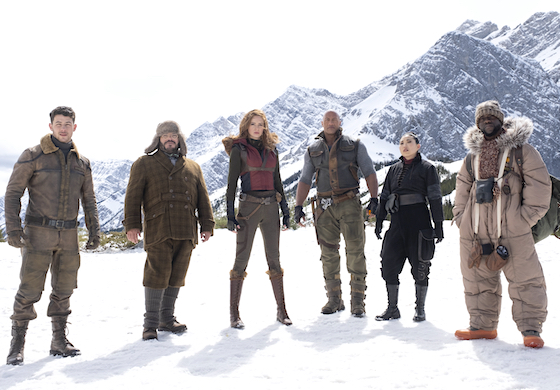
The previous Jumanji movie, Welcome to the Jungle, was officially a sequel to the 1995 original. In practice, however, that amounted to little more than a brief nod / tribute to original star Robin Williams, and maybe a few Easter eggs scattered about. The Next Level, on the other hand, is much more in the traditional “direct followup” mould.

Despite our quartet of heroes having destroyed the eponymous game at the end of the last movie, one of them rescued and repaired it, and when he goes back in (for old times’ sake or something) the others must follow to rescue him. But he’s not repaired it properly, and so his septuagenarian grandfather and his chum are sucked in too, and everyone’s inhabiting a different character. And so The Next Level plays with a lot of the same comedic ideas as its predecessor — i.e. the mismatch between real-life person and in-game persona — but mixes up who’s imitating who. Primarily, this means The Rock gets to do an impression of Danny DeVito, Kevin Hart is being Danny Glover, and Jack Black is a black American football player. Karen Gillan doesn’t immediately get to join in the fun, but the film has some tricks up its sleeve. Anyway, once in the game, they head off on an Indiana Jones-type adventure — again, much like the first movie.

For many, this repetition of ideas has been a stumbling block. “The same but slightly different” doesn’t really cut it for a sequel nowadays, when you can easily rewatch the thing it’s repeating. However, I don’t think The Next Level is actually such a slavish clone. The “mismatched identities” schtick arguably worked better the first time, when it was a shiny new gag, but the fact most of the cast get to play at being someone else keeps it at least a bit fresh. There are also several new characters in the mix, with an especially entertaining performance from Awkwafina. More importantly, the adventure itself is considerably different. In my review of Welcome to the Jungle I noted that its locales were “jungle, jungle, and jungle”. Here, we get snowy mountains, vast desert, plus towns and castles. To me, it feels like they took what worked in the first movie and polished it. It’s still fundamentally the same kind of comedy action-adventure — if you disliked the first movie, there’s no reason this should appeal to you more — but refined.

Snow wonder it's better

That said, there’s still ideas left on the table. That game malfunctioning only affects who gets zapped in and which characters they play, but what if it kept glitching throughout? It’s arguably a tricky conceit to manage — if you’re going to do it, you’ve got to integrate it; but you can’t really have our heroes winning (or losing) thanks to random mistakes. But this is why Hollywood filmmakers get paid the big bucks, right? To solve these kind of things. Do it right and the glitches could’ve added an extra zing, either to the humour or as an obstacle to winning or, ideally, both. (Also, on a slightly more personal level, I think it’s a shame they didn’t release it on 3D Blu-ray this time. It was released theatrically in 3D, so a conversion exists, but they didn’t bother to put it on disc anywhere in the world. Adventure movies like this can look great in the format, and there’s a sequence with rope bridges that could’ve been really special.)

I was surprised how much I liked Welcome to the Jungle, but I held back somewhat on the sequel because of the reactions I’d seen. As it is, I was surprised again, because I think The Next Level is an even more enjoyable adventure.

There’s now a third (aka fourth, or you could even say fifth, depending what you count) Jumanji in development, which a credit scene here teases might go off in a new direction; plus cast and crew interviews have hinted at some other intriguing additions to the mythology that spin out of this movie. There’s no guarantee it’ll be a success, of course, but, nonetheless, next time I won’t be so reticent.

4 out of 5

Jumanji: The Next Level is available on Sky Cinema and Now TV from today.

The 100-Week Roundup IX

I’ve not been doing too well with reviews lately — this is my first for over a fortnight, having missed self-imposed deadlines for the likes of Knives Out (on Amazon Prime), The Peanut Butter Falcon (on Netflix), Joker (on Sky Cinema), and Spaceship Earth (on DVD & Blu-ray). I’ve also slipped on these 100-week updates — this one should really have been at the end of July, and there should’ve already been another in August, with a third due soon. Oh dear.

So, it’s catchup time, and it begins with my final reviews from August 2018

  • The Most Unknown (2018)
  • Zorro (1975)


    The Most Unknown
    (2018)

    2018 #185
    Ian Cheney | 92 mins | digital (HD) | 2.35:1 | USA / English

    The Most Unknown

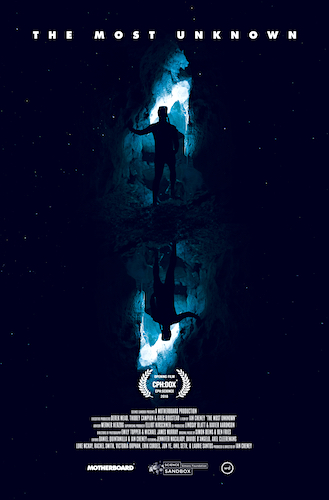
    This film is an experiment. Nine scientists meet for the first time in a chain of encounters around the world. It begins under a mountain, and ends on a monkey island.

    In this documentary, nine scientists working on some of the hardest problems across all fields (the “most unknowns”) meet each other in a daisy chain of one-on-one interviews / lab tours. It not only touches on the basics of what the unknowns they’re investigating are, but also how they go about investigating or discovering these things — the day-to-day realities of actually “doing” Science. Alongside that, it reveals the scientific mindset; what motivates them. The nine individuals are very different people working on very different problems in very different fields, but the film draws out the similarities in their natures that drive them to explore the unknown.

    If you’re concerned it might be all a bit “inside baseball” if you’re not a science geek, don’t be. These people work in vastly different fields — to us laypeople they’re all “scientists”, but to each other their specialities make them as different from one another as we are from them. This, arguably, is an insight in itself. It feels kind of obvious — of course a physicist and a microbiologist are completely different types of scientist — but I do think we have a tendency to lump all scientists together. Think of news reports: it’s not “chemists have discovered” or “psychologists have discovered”, it’s “scientists have discovered”.

    Science, innit

    It also reminds you that scientists are humans too, via little incidental details. For example, the equipment that vibrates samples to sheer out the DNA is labelled, “My name is Bond, James Bond. I like things shaken, not stirred.” Or the woman who plays Pokémon Go on her remote research island, because the lack of visitors means you find really good Pokémon there.

    You might also learn something about movies. The last scientist, a cognitive psychologist, talks about how people assess the quality of movies. Turns out, rather than considering their overall experience, they tend to focus on two points: the peak of how good it was, and how it ended. Pleasantly, this kinda confirms my long-held theory that an awful lot of movies are judged primarily on the quality of their third act. (My exception to this “rule” has always been films that lose you early on and put themselves on a hiding to nothing. Well, science can’t explain everything, I guess.)

    Plus, as a film, it’s beautifully shot. A lot of this science is taking place in extreme locations, which bring with them a beauty and wonder of their own.

    4 out of 5

    The Most Unknown is currently available on YouTube from its production company, split into nine instalments. (It used to be on Netflix, but was removed just the other day. If I’d published this review on time…)

    Zorro
    (1975)

    2018 #186
    Duccio Tessari | 118 mins | digital (HD) | 1.85:1 | Italy & France / English | PG / G

    Zorro

    This Italian-French version of the adventures of the famous masked vigilante (played by the great Alain Delon) is tonally similar to Richard Lester’s The Three Musketeers: genuine swashbuckling (including some elaborate stunt-filled sequences) mixed with plenty of humour and daftness. Plus, being set in 19th century California but filmed in Spain, it also has more than a dash of the Spaghetti Western in its DNA. The whole mix makes it a lot of fun.

    Of particular note is the final sword fight, an epic duel for the ages. It sees Zorro and chief villain Colonel Huerta pursue each other around the castle, clashing blades at every turn, at first accompanied by a crowd of spectators but, as their fight moves higher and higher, ending atop the bell tower, each with a rapier in one hand and a flaming torch in the other, thrashing their weapons at each other with all the vigour and vitriol of men who really, really want to kill each other.

    Another highlight is, arguably, the cheesy main theme. On the one hand it’s slathered all over the film inappropriately; on the other, it underlines the light, silly, comic tone. Plus it’s sung by someone called Oliver Onions. Can’t beat that.

    4 out of 5

  • Split Second (1992)

    2020 #135
    Tony Maylam | 91 mins | digital (HD) | 16:9 | UK / English | 18 / R

    Split Second

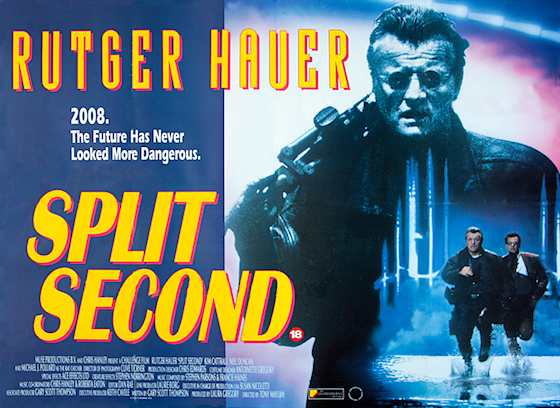
    I confess, I hadn’t even heard of Split Second before a remastered Blu-ray release was announced a couple of months ago (more details about that at the end). A sci-fi/action/horror hybrid starring Rutger Hauer is the kind of thing that sounds interesting to me, but the fact I’d never come across it before seemed like a red flag. Fortunately, it’s on Prime Video, so I didn’t have to make a blind buy, and this is a recommendable course of action for anyone similarly unacquainted with the film. I did go on to purchase the Blu-ray, but I can see why others would not. Split Second isn’t exactly in “so bad it’s good” territory, but it has a distinctive quality that will not be to everyone’s taste.

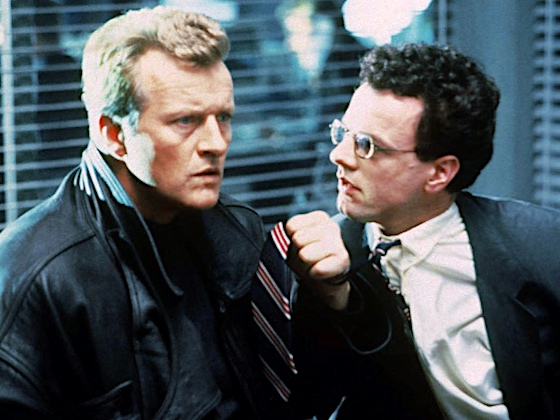
    Set in the future-year 2008, when London has been flooded thanks to global warming and pollution has turned day into night, Hauer chomps cigars, chocolate, and scenery as Harley Stone, a badass rogue cop on the hunt for the serial killer who murdered his partner three years ago. Assigned to keep him in check is rookie cop Dick Durkin (Alastair Duncan), and together the pair realise their quarry may not be altogether human…

    And if you’re wondering what the film’s title has to do with any of this… yeah, bugger all. One of the working titles was Black Tide, which suits the film so much better. I mean, it’s still not wholly fitting — the global warming/pollution stuff is dystopian-future scene-setting without any true bearing on the actual plot — but at least it evokes the tone and style of the film more than “Split Second”, which sounds like a Steven Segal movie.

    Stone Dick

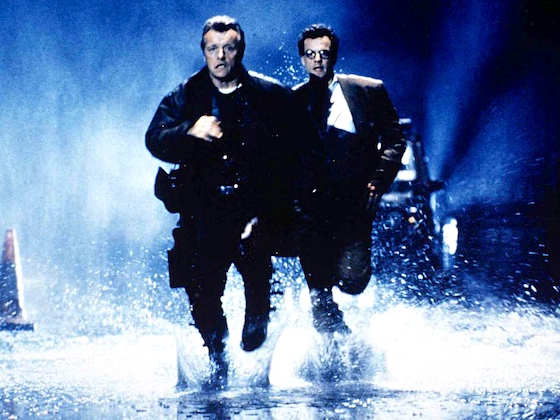
    It’s almost hard to describe what that tone and style is, mind. It starts out almost like budget Blade Runner — it’s the future (so we’re told); it’s night; it’s raining; a hardbitten cop visits a seedy nightclub; etc. But then we get Stone’s first line of dialogue, which comes after a guard dog barks at him. He flashes his warrant card — at the dog — and says “police, dickhead.” To the dog. It’s hilariously terrible and awesome in one fell swoop. Hauer doesn’t give it an overtly comical delivery, and so you can’t quite tell if Stone is deadpanning or genuinely offering this information… to a dog.

    This kind of almost-a-comedy-but-not-actually tone pops up increasingly as the film goes on, as if it was shot in order and the cast gradually realised how ridiculous it all was. By the time you get to the point where a deranged Durkin is demanding bigger guns, you’ll be cackling. Or you’ll be thinking “what is this godawful crap?!”, which goes back to my initial point: some people will delight in it all, while others will feel they’ve wasted their time on a low-budget no-mark that should’ve been left forgotten in the early ’90s.

    I’m the former. You couldn’t reasonably call this a great movie — parts do border on “so bad it’s good”, and there’s much joy from the cast clearly realising it’s ludicrous. Plus, there’s a sense it’s not quite sure what it wants to be. It jumps from genre to genre as it goes on, and even the final monster (designed by Stephen Norrington, who’d go on to direct Blade and The League of Extraordinary Gentlemen) looks to be a mishmash born of uncertain direction, part hell-demon, part tech nightmare (is that a motorcycle helmet?!) But good golly does that crazy mix make for some barmy fun.

    Watery London

    I tell you what, though: the underlying concept isn’t bad. This is exactly the kind of movie I think someone should actually spend the money and effort to remake: something with decent ideas and intentions, but which didn’t come off on the first go. Iron out the plot (mixing genres is fine; jumping between them feels “made up as we went along”), smooth out the tone (keep the deadpan humour, up the thrills and scares), and give it a decent budget (this one has a rough-around-the-edges feel), and you could have something special. Especially if you retitle it Black Tide.

    3 out of 5

    Split Second is released on Blu-ray by 101 Films in the UK today. A matching edition will be released in the US on August 11th. It’s also currently available on Amazon Prime Video in both the UK and the US.

    Greyhound (2020)

    2020 #164
    Aaron Schneider | 92 mins | digital (UHD) | 2.39:1 | USA, Canada & China / English | 12 / PG-13

    Greyhound

    In the early days of the US joining World War 2, ageing Navy Captain Ernie Krause (Tom Hanks) is finally given his first command, as captain of the lead escort for a convoy of Allied supply and troop ships crossing the Atlantic. As they enter the treacherous part of the ocean too far from land for air support, a pack of German U-boats begins stalking the convoy…

    Perhaps the key word to describe Greyhound would be “efficient”. It spends about as much time setting up its premise as I did in the previous paragraph. There are no drawn-out scenes of Krause meeting with the higher-ups to be given his command; no introductions to a motley cast of crewmen before they board; no scene-setting stuff of the convoy sailing out from port… We first meet these boats in the middle of the ocean, their air support signalling “good luck” via Morse code as it turns to head home. There’s a brief flashback to the previous Christmas, when Krause informs his girlfriend (an age-appropriate Elisabeth Shue) of his new station, and then we’re off to the races: a radar contact suggests an enemy submarine, and a game of cat and mouse begins.

    What follows over the next 70-or-so minutes is a lean, no-nonsense series of combat sequences. Character development is limited to expressions and glances, or incidental details. For the former, we know Krause is inexperienced, so as we watch his face we can read his silent internal battles about the best course of action; or we see that the eyes of the crew are always watching him, in shots that are held maybe just a little too long, implying the men’s uncertainty about their commander. For the latter, the ship’s cook regularly brings Krause meals that he never eats — he’s too busy being on guard to spend time on food. The rest of the crew are mostly faceless, just bodies to relay orders and information back and forth, or to man machinery. One man or another might get focus for a bit (the sonar operator is significant during the first encounter, for example), but the film doesn’t expend effort to unnecessarily bring individuals back later. Consequently, the feel is realistic: the crew hasn’t been streamlined for the sake of a movie narrative; a ship is staffed by dozens of men, sharing jobs so others can rest, the only constant being the very top men, namely Krause and his XO, played by Stephen Graham.

    You sunk my battleship!

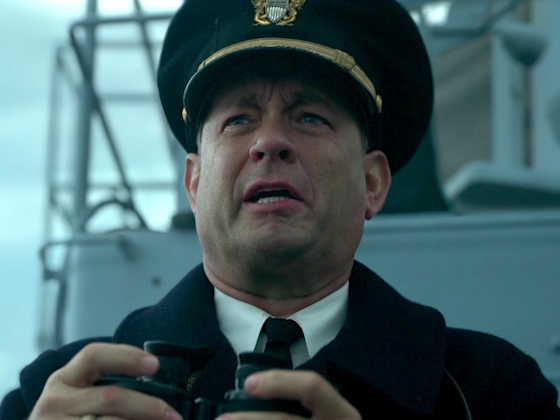
    The impression of realism extends to the dialogue, the vast majority of which is naval jargon. I didn’t have a bloody clue what most of it actually meant (it’s all bearings and ranges and orders about direction and speed and whatnot), but you don’t need to because the visuals are telling the story. The film is adapted from a novel, The Good Shepherd by C.S. Forester, and if it’s at all faithful then I have no desire to read the book, because I don’t think I’d have a clue what was happening. But it works magnificently in the visual medium of film, where what the barked words signify is conveyed succinctly by the accompanying images. New sonar information leads to men with maps and rulers rushing to work out new courses; the ship turning this way and that in response to relayed commands; Krause rushing from one side to the other, binoculars always in hand, trying to spot any sign of their underwater foe amid the choppy mid-Atlantic waves. I have no idea how faithful it is to the reality of WW2 naval combat, but it feels genuine.

    Some reviewers have found this unrelenting focus on the business of sea combat to be dull. I felt exactly the opposite. The threat of the U-boats is ever present, a constant danger that leaves our men pinging from one crisis to the next. The intensity is underlined by Blake Neely’s ominous, percussive score, which shrieks when the enemy is near and thuds throughout combat, in a good way. Combined with the brief running time, it feels like the film doesn’t let up. This isn’t some stately drama about men at sea who are occasionally forced to take potshots at an unseen enemy, but an action movie; only instead of men clashing with kung fu or guns, it’s boats and subs fighting with torpedoes and, um, trigonometry. The result is tight, tense, and thrilling.

    4 out of 5

    Greyhound is available on Apple TV+ now.

    The Old Guard (2020)

    2020 #162
    Gina Prince-Bythewood | 125 mins | digital (UHD) | 2.35:1 | USA / English | 15 / R

    The Old Guard

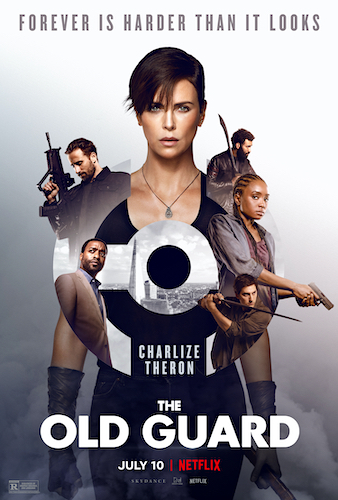
    Netflix’s latest attempt to launch a blockbuster film franchise is a comic book adaptation about a group of immortal warriors, led by Charlize Theron, who’ve been secretly fighting to help the rest of humanity down the centuries. Despite their efforts to remain hidden, someone shady has picked up their trail. At the same time, a new immortal (If Beale Street Could Talk’s KiKi Layne) has appeared for the first time in 200 years.

    If you’re looking to start an action/fantasy franchise nowadays, what better bet than superheroes? The Old Guard is sort of a superhero movie, but also not really. Their only superpower, which they all share, is a Wolverine-esque healing ability. They can die, they just get better (most of the time). So whether you class this as a “superhero movie” probably depends on your personal definition. I think some critics have just seen “based on a comic book” and gone “superheroes!”, and it’s a shame we haven’t got past that attitude by now. Equally, yeah, the characters do have a superpower, so fair enough. But the film itself plays more like an action-thriller, with the team relying mostly on guns and military tactics in combat rather than special abilities.

    Bearing that in mind, the concept has fundamental similarities to another recent big-budget Netflix actioner, Michael Bay’s 6 Underground (which I’ve seen but not reviewed yet, fyi). Whereas that was about a band of off-the-grid mercenaries working in secret to try to influence the course of human history for the better by going around shooting bad guys, The Old Guard is about a band of people who can’t die working in secret to try to influence the course of human history for the better by going around shooting bad guys. Obviously the set dressing is different — The Old Guard has a lot more mythology to explain, and the heroes occasionally whip out swords and axes and stuff; and it lacks (for good or ill) the unique storytelling style of Bayhem — but, honestly, at heart it’s the same deal.

    5 overground

    They’re also equally badly written. It’s what we expect from Michael Bay at this point — a plot that might hang together if he ever stopped to let it be explained, but instead he’s more concerned with amping every single scene up to 11 with hyperactive editing and gonzo action sequences. The Old Guard, on the other hand, does stop to explain stuff. All. The. Time. Half the dialogue is characters speaking in infodumps to fill us in on this world. Or not fill us in, because there are gaps. It’s hard to tell if those are deliberate mysteries meant for a sequel (there’s a definite sequel tease at the end, naturally) or if the filmmakers just got bored of world-building and decided the characters don’t know how it works either.

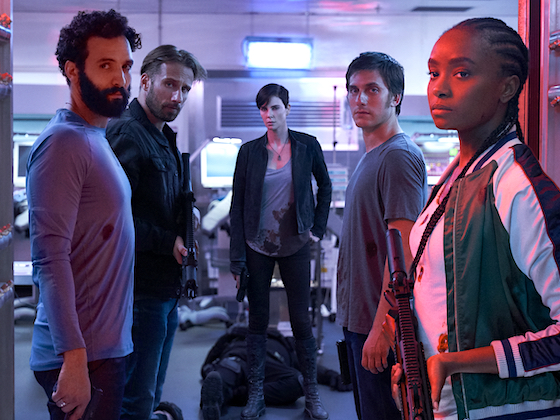
    On the bright side, it has some nice grace notes, like a betrayal I actually didn’t see coming, or Chiwetel Ejiofor injecting genuine emotion into his character’s motivations. Two of the immortals are a gay couple, played by Luca Marinelli and Marwan Kenzari, the latter of whom was Jafar in Disney’s live-action Aladdin (another one I’ve seen but not yet reviewed). He’s much better here, to the extent you wonder how he was such a limp Jafar. Anyway, the pair get a nice scene when they’re captured by a van full of enemy soldiers: a “what is he, your boyfriend?” taunt receives an epically romantic answer that’s an even better putdown than just “yes”. They also get a couple of beats of welcome humour later on. Not laugh-out-loud stuff, but this is quite a dour film otherwise. Most of the action is well staged if unremarkable, although the finale is a rather good assault on the villain’s HQ, ending with a couple of cool deaths.

    Immortal badass

    Despite the poor dialogue and certain familiarities of concept, The Old Guard is more blandly acceptable than 6 Underground. And yet it never swings as big as Bay’s films — for all his many faults, his “go big or go home” style has its merits as blockbuster entertainment. Nothing here is going to stick in the memory as much as 6 Underground’s opening car chase, or midway apartment assault, or madly overblown yacht climax. All told, I’d rather have 7 Underground than 2 Old 2 Guard, please Netflix. Both would be fine.

    3 out of 5

    The Old Guard is available on Netflix now.

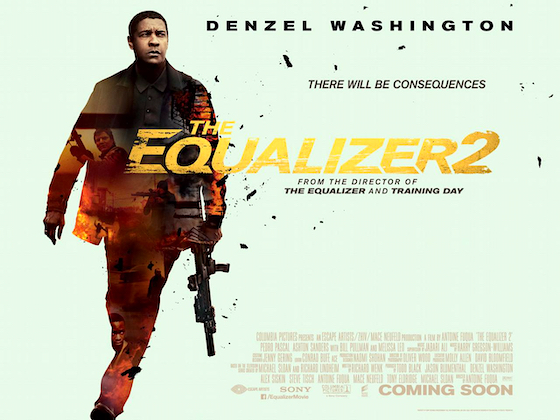
    The Equalizer 2 (2018)

    2020 #25
    Antoine Fuqua | 116 mins | digital (HD) | 2.39:1 | USA / English, Turkish & French | 15 / R

    The Equalizer 2

    Now we’re equalised, bitch.

    Sadly, that is not a line Denzel actually says in this movie. The film would be about 50% better if he did. Instead, what we get is an action-thriller where both the action and thrills are, literally, few and far between.

    For those who skipped the first film, Denzel is playing Robert McCall, a former Marine and intelligence agent who retired to a life of inconspicuous normality, but has been tempted back into righting some of the wrongs of the world — or “equalizing” them, I guess. This time, an array of subplots eventually gives way to a story in which McCall sets out to avenge the murder of a friend.

    I mention the subplots there because they’re the film’s biggest problem. As a result of them, it’s… so… slow… To start with, the subplots are a couple of small ‘cases’ introduced in the first half-hour, presumably to try to liven the film up because the main storyline is crawling along. Neither works. I’m not here for a pleasant drama about a Lyft driver who does kindly things for others — I want to see Denzel Washington kicking the asses of nasty buggers. The first film was noteworthy for investing more time in its supporting characters than is typical for the action-thriller genre, but this one takes that notion to extremes.

    Even when the main plot does get moving, it takes over an hour to get to a ‘twist’ that’s obvious just from reading the cast list. At least it doesn’t try to save it for the end, I guess. That reveal leads to a wannabe-Taken-phone-speech declaration from Denzel, which should’ve come a lot earlier. It’s not as memorable as the Taken one (though the final line lands), but at least it’s a moment of drama and the film perks up after it — but by then we’re well over an hour in to a less-than-two-hours movie.

    A rare moment of almost-action

    From there it’s a short hop, skip and jump to a climax set amidst a horrendous storm in an abandoned seaside town. It’s a nice concept and it’s solidly executed, but it’s an at-most 20-minute sequence and it’s not exceptional, just a lot more engaging than the film’s other 100 minutes, so it doesn’t really justify sitting through the rest of the movie. However, I did not realise that flour could be explosive, but turns out it can, so in that sense at least this was educational for me.

    (FYI, the film was cut in the UK to get a 15 certificate, removing some of the more extreme gore (insides hanging out, a spine being severed, etc). The 4K Blu-ray release is uncut and rated 18 (presumably so they could just port the disc rather than having to faff with edits/a new transfer). On Netflix it has an 18 icon, so I guess it’s also the uncut version, should that concern you either way.)

    The Equalizer 2 isn’t a terrible film, but it is quite a boring one. Not just slow paced — genuinely boring. A raft of subplots don’t really go anywhere or serve any purpose, the main story is incredibly thin, and the limited action sequences do little to balance the books.

    2 out of 5

    The Equalizer 2 is available on Netflix in the UK from today.

    The 100-Week Roundup VIII

    As I mentioned last time, these films are technically from the same week as that last bunch, but seven films seemed a lot for one post. Plus, although they were all watched in the same week, they were watched in different months: the last four were my final films from July 2018, whereas these three are some of my first from August 2018.

    In this roundup…

  • Beneath the Planet of the Apes (1970)
  • Pride and Prejudice and Zombies (2016)
  • The Quiet Earth (1985)


    Beneath the Planet of the Apes
    (1970)

    2018 #174
    Ted Post | 95 mins | Blu-ray | 2.35:1 | USA / English | 15 / G

    Beneath the Planet of the Apes

    Beneath the Planet of the Apes is the sequel no one wanted to make, including the studio — quite a different attitude to today, eh? But Fox were in financial troubles. For his part, Heston managed to negotiate a reduced role and suggested an ending that would kill off the potential for any more sequels. Well, that worked

    Picking up where the first film left off, it sees Heston’s character, Taylor, disappear mysteriously. After a second Earth spaceship crashes on the planet, its only survivor teams up with Taylor’s girl, Nova, to find him, which leads them to encounter a society hiding (you guessed it) beneath the planet of the apes.

    Overall, this feels like trashier sci-fi/adventure than the first one, with a certain B-movie aesthetic to the underground mutants, and a first half that’s just a bunch of running around. Yet, despite that, there are some powerful ideas and solid social commentary here, mainly about blind faith and the terror of military leadership. Plus, the mutants’ use of telepathy as a weapon is quite clever, and their unmasked designs are suitably eerie rather than just ugly. It also has one of the most brutal and bleakest endings ever seen in a Hollywood blockbuster — or probably outside of one, come to that.

    The violence in the final act was originally cut in the UK, and when it was finally released uncut on video some 17 years later, it earnt a 15, a rating its retained ever since. In the US, it’s always been rated G. Those Americans and their insouciant attitude to violence…

    Obviously I watched this two years ago, and at the time I assigned this three-star rating. But I will say that I remember it more fondly than that. As noted above, it takes a while to get going, and it doesn’t have the same classy aspirations as the first film, but its unrepentant fatalism is almost admirable.

    3 out of 5

    Pride and Prejudice and Zombies
    (2016)

    2018 #175
    Burr Steers | 103 mins | TV (HD) | 2.35:1 | UK & USA / English | 15 / PG-13

    Pride and Prejudice and Zombies

    Here’s another one I found more enjoyable than I feel I should have.

    For starters, it’s wild this ever actually got made. I mean, the title is an amusing idea — it’s basically a five-word gag, isn’t it? — but ponder for a moment how that’s going to play out as a full narrative. To live up to its title, it has to make an effort to follow the plot of the novel, and there lies the rub: no one wanting a zombie movie really wants to sit through a Regency romance, and no one wanting a Regency romance really wants it sullied by zombie-based action and gore. Well, inevitably someone will fall into that Venn diagram, but, as someone who’ll quite happily watch either of those genres in isolation, even I struggled to find the idea of such a mash-up too appealing. It needs a clever hand on the tiller to negotiate those treacherous waters, and I’m not sure the director of 17 Again and Charlie St. Cloud was that person.

    But, as I said at the start, I did find it surprisingly watchable. It does have a certain amount of wit and fun with the concept, like turning arguments about accomplishment into ones about fighting style. Sometimes the zombies and fights are tacked on to the existing story, but sometimes the narrative is neatly remixed to include the zombie threat. And like any true action movie, scenes of high emotion are settled not with words but with a good dust-up. There’s a solid cast too, including Lily James (always a bonus) and reliable stalwarts like Charles Dance, although, as Darcy, Sam Riley sounds like he’s battling a nasty throat infection. But Sally Phillips is basically a perfect Mrs Bennet for this or any other version, and the same could be said of Douglas Booth as Bingley, or Matt Smith, on fine comedic form as Mr Collins.

    Pride and Prejudice and Zombies and Knickers

    It does drop the ball sometimes. The climax doesn’t put enough effort into eliciting tension (it’s like they ran out of money or time or effort: “can the heroes make to the bridge in ti— oh, they just did”); at least one apparent subplot doesn’t go anywhere at all; and a mid-credits scene suggesting the story isn’t over feels lame. It definitely pulls some punches in aid of landing a PG-13 rating in the US, which is unfortunate — it’s a mad concept; it needs to do it properly, go all out and get an R. (I’d still say it’s perhaps a bit too gruesome for PG-13, which is why it landed a 15 over here.)

    I still think the director is the problem. A surer hand would’ve made more of the verbal sparring during the physical sparring; would’ve sold the tension of the action. Apparently David O. Russell was original set to direct, which is mad — can you imagine choosing to follow awards-winners like The Fighter, Silver Linings Playbook, and American Hustle with this? Apparently other directors “considered” included Matt Reeves, Neil Marshall, and Lord & Miller. Presumably they turned it down rather than any producer thinking Burr Steers was a better pick — Lord & Miller, in particular, probably would’ve nailed the tone. But, all things considered, what we got could’ve been a lot worse.

    3 out of 5

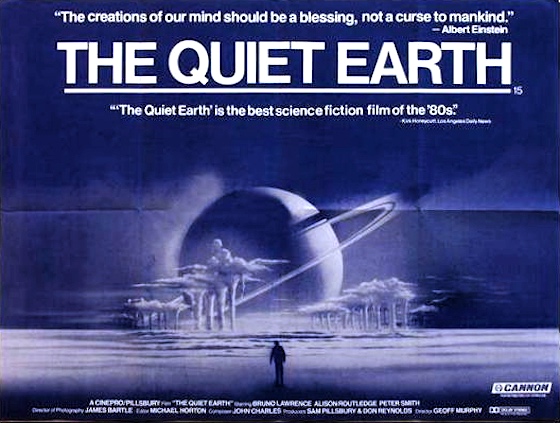
    The Quiet Earth
    (1985)

    2018 #178
    Geoffrey Murphy | 91 mins | Blu-ray | 1.85:1 | New Zealand / English | 15 / R

    The Quiet Earth

    Here we reach the first real hurdle in these two-year-old roundups, because it turns out I made no notes whatsoever after viewing The Quiet Earth. I did note down some quotes from the booklet essay accompanying Arrow’s Blu-ray release, but it seems a bit rich just to list those excerpts.

    What I can tell you is that The Quiet Earth is a science-fiction film about a scientist who wakes up one morning to find everyone else has disappeared — not fled, not died, just gone. What unfolds from there is a mix of mystery (what happened?) and a kind of existential character examination, both of this man and of ourselves — what would you do if you were the only person on Earth? Only, it doesn’t play quite as heavily as that makes it sound. There are more plot developments, but to say too much would spoil the discovery. And it is a film worth discovering. As Amy Simmons puts it in the aforementioned essay, it’s a “deeply relevant work which reflects darkly upon our age of estrangement and isolation. […] Shifting in tone from horror to comedy to pathos and back again, the film’s great strength is in the themes it explores and satirises — namely nuclear fears, technophobia, and cultural and geographical isolation — which are even more urgent now than when the film premiered in 1985.”

    I’m doing it a disservice with this pathetic little ‘review’, but hopefully someday I’ll revisit it and come up with something more insightful.

    4 out of 5

  • Tomb Raider (2018)

    2020 #143
    Roar Uthaug | 118 mins | download (HD+3D) | 2.39:1 | UK & USA / English & Cantonese | 12 / PG-13

    Tomb Raider

    In this gritty(-ish) reboot of the videogame-turned-movie franchise (inspired by a similar reboot they did in the games), Lara Croft loses her most famous twin assets — her dual pistols (also, her giant boobs) — instead replacing them with a bow & arrow (and muscles, respectively) for an adventure that sees her travelling to a secret island where her father disappeared seven years earlier while in search of an ancient curse surrounding a long-lost tomb. Well, natch — clue’s in the title.

    “Movie based on a game” used to be synonymous with “shit”, and to an extent that reputation persists — it takes time to turn such widespread prejudices around — but there have been a few in recent years to buck the trend, like trashy-but-fun Rampage and (apparently) Angry Birds 2. For my money, Tomb Raider is part of that movement. For one thing, it manages to actually feel like the games (or, at least, what I presume the games are like — I’ve never really played any of them), which is a noteworthy point for a genre that sometimes spectacularly failed to understand its source material. Tomb Raider successfully recreates the running, jumping, shooting, puzzle-solving action of its inspiration without too overtly abandoning real-life logic for video game logic. Well, I say “real-life logic” — it’s actually “action/adventure movie logic”, but I think that’s allowed in an action/adventure movie.

    As an entry in that genre, it’s fun enough. It’s not going to compete for greatest-of-all-time status with its urtext, the Indiana Jones films, nor does it quite challenge the heights of more-overt homages like The Mummy, but it’s not a bad couple of hours’ entertainment in their mould. On the downside, the amount of preamble the plot goes through before taking us to the island is a tad unnecessary, mainly because there are a couple of early set pieces that feel forced to make sure there’s some action in the first act. I can understand having one or two (as much as anything, it establishes that Lara isn’t completely unskilled in combat and physical endurance), but it feels like padding. Besides, we’ve come for an Indiana Jones-esque affair — a bicycle race around grey London isn’t quite the right tone.

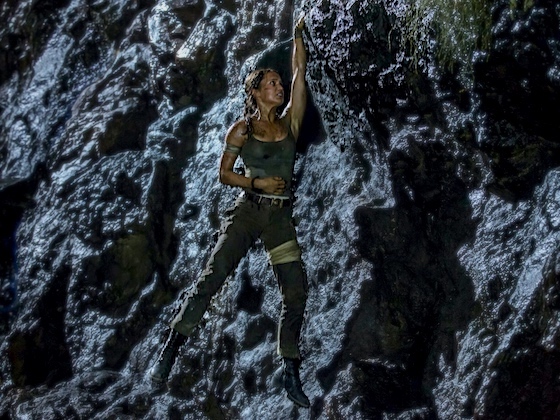
    Hanging around

    Alicia Vikander is more than capable in the lead role, both as an actress and a physical performer — she’s clearly developed the physique for the part, and apparently did her own stunts. Unfortunately, her accent is a little all over the place, a blend of English and Swedish (rather similar to Rebecca Ferguson’s) with occasional flecks of Irish. It’s kind of charming in itself, and I guess it just passes as “English” to Americans, but it’s too distractingly ‘off’ to truly pass as the upper-crust English girl Lara is meant to be. She’s surrounded by a supporting cast of reliable performers — Walton Goggins (surprisingly understated as the villain), Dominic West, Kristin Scott Thomas, Derek Jacobi, Nick Frost (just a cameo) — but none leave a particularly large mark.

    A quick word on the 3D, which is fairly enjoyable. I’d heard bad things, but it’s not awful, just unexceptionally adequate — a bit like the film itself, I guess. It adds somewhat to the “hanging over a chasm” shots (of which there are more than a handful), if nothing else.

    The film ends with a massive sequel tease, which I thought was fairly well handled. I’ve often criticised movies that exist purely to setup sequels/trilogies/franchises, and there are clearly parts of Tomb Raider that have been designed to do that, but it’s managed well enough to not really intrude until the final scenes. That said, it’s an odd kind of tease, suggesting more “corporate espionage” than “tomb raiding”. Unlike so many sequel teases nowadays, this one will actually be acted upon: after some umming and ahhing (the film wasn’t a huge box office hit, but did respectably outside the US, particularly in lucrative markets like China and the UK), it’s going ahead… with Ben Wheatley directing! Colour me surprised. (It was scheduled for release in March 2021, but the shoot was meant to begin in April 2020 and, surprise surprise, got cancelled, so who knows.)

    Tomb raiding

    A lot of this review has wound up couched in disclaimers but, fundamentally, I enjoyed Tomb Raider. It may not have a surfeit of original ideas, but once it gets going it offers up solid levels of excitement — highlights include a protracted boat crash in a storm, Lara negotiating a plane teetering on a cliff edge, and the titular raiding of a tomb, which occupies the third act. If Wheatley can supplement that with a dash of his trademark oddness, the sequel might well be worth looking forward to.

    4 out of 5

    The UK TV premiere of Tomb Raider is on ITV tonight at 7:50pm.

    Gemini Man (2019)

    2020 #141
    Ang Lee | 117 mins | Blu-ray (UHD) | 1.85:1 | USA & China / English | 12 / PG-13

    Gemini Man

    Gemini Man is a film that, at every point I can remember it being talked about, was discussed more for its various technical feats than anything else. Partly that’s because there are a couple of angles. Firstly, the most obvious: it stars Will Smith as an ageing assassin who must fight… a 25-years-younger Will Smith, achieved with motion capture and CGI. Secondly, director Ang Lee shot it in 3D 4K HFR — that’s High Frame Rate, if you don’t know, with the picture running at 120 frames per second rather than the 24fps we’ve been used to for the past 90-odd years (excepting The Hobbit trilogy, though only if you saw one of the relatively-limited HFR theatrical screenings). Maybe it shouldn’t be a surprise, then, that Gemini Man often feels more like a tech demo with a plot grafted onto it than it does a fully functioning movie in its own right.

    Consequently, I’m going to spend more of this review writing about the film’s presentation than its content. To some degree, that speaks for itself as criticism. But if you are interested in the film and don’t give a toss about how exactly you’re seeing it (or don’t have a choice), feel free to whizz down to the last two paragraphs (just after the picture of Young Will Smith) where I finally offer some thoughts on the film itself.

    Back to the tech, then. There’s currently only one way to see Gemini Man in its intended format: at the cinema. I say “currently” — obviously such opportunities expired when its theatrical run ended, and I don’t imagine it’s likely to get a re-release. Every other option is a compromise. Want to see it in 3D? Not only will you need the appropriate home cinema setup, but you’ll have to import the disc from Germany, the only country where it was granted a 3D Blu-ray release. Want to see it in HFR? That’s easier, because the 4K disc is widely available, though obviously you still need the appropriate kit. (I presume the digital 4K versions are HFR too, but I don’t actually know that.) Mind you, even that’s something of a compromise, because tech limitations mean the home release is 60fps rather than the full 120 (to be fair, so were most HFR cinema screenings).

    Action Man

    I watched it in 4K 60fps, and, oh, it’s weird. So so weird. Distracts-you-for-the-entire-film weird. Virtually-the-only-thing-I’m-going-to-talk-about-in-this-review weird. The disc even begins with a notice/warning that it’s at 60fps rather than 24fps, so presumably they know how weird it feels. The most obvious effect of more frames per second is that motion is smoother, with reduced motion blur, but that applies on a micro level to lend an unnatural clarity to everything. The effect on motion is often called “the soap opera effect”, because such cheap drama has traditionally been shot at TV’s higher default frame rate. Of course, so is much other television, or even behind-the-scenes footage on films; so while it’s not a wholly inaccurate nickname, the effect reminded me more of TV documentaries. The film begins with a train journey in a lusciously green-looking Belgium, before travelling around the globe to other sunny locations with glamorous establishing shots. It looks less like a Hollywood action movie, more like Will Smith is the new host of Cruising with Jane McDonald.

    When it’s not playing travelogue, it looks like a tech demo. I don’t think that’s just the added smoothness, but everything about how it’s shot: it’s very bright and saturated, the kind of look you get in marketing promos, not feature films. Even paused it looks a little odd. Partly that’s the boost given to the colour palette by HDR, but at this point I’ve watched plenty of other films with HDR to be familiar with its effects, and I think this was beyond normal. The other thing the visual quality reminded me of was low-budget films by very new/amateur filmmakers, and that’s definitely to do with Ang Lee’s shot choices — lots of stuff at eye level, gentle pans and tilts, in locations so dull they might have been found around someone’s hometown. It doesn’t help any that all the fonts they’ve used for captions look like the editing software’s bland default. And further, it’s also the effect of shooting on high-resolution digital video — it’s ultra-clear, with none of the grain of real film, but, again, that’s a look more familiar from low-budget productions. Would HFR work better if it was shot on real film? You’d get back some of that tactile grit, rather than telltale digital smoothness.

    Biker Man

    What about when the film gets to its big action sequences — the kind of thing that obviously a no-budget newbie couldn’t afford. Would the change of milieu fix the mental associations? Yes and no, in that it just adds other ones: the first big sequence, the bike chase you probably saw in trailers or clips, looks like a computer game. Again, it’s a mix of elements: the digital sheen, the smooth frame rate, the shot choices (lots of POV or close following, like a game’s third-person camera), and an unnatural-seeming speed — it looks like some of the CGI has been animated too fast, though that could be HFR’s fluidity making normal motion look odd because we’re not used to it.

    The advantage of wondering all this while watching the film at home was that, afterwards, I could pop in the regular Blu-ray and compare a few scenes in 24fps 1080p SDR. Immediately, it looks a lot more like a regular movie. Is that indeed the loss of HFR’s smoothness, or is it the drop in resolution, or the loss of HDR enhancement? Without being able to view different permutations it’s hard to say which one causes the jarring effect, or if it‘s the incremental change made by each that adds up to a radically different picture when combined. That said, obviously I’ve watched 4K HDR films before, and it’s never struck me as odd-looking as much as this film (I’ve seen some strange applications of HDR, but that tends to be in individual shots/scenes, not an entire movie). The bike chase also looks more normal on the whole, though some of the bits I alluded to before still looked dodgy, so I can only conclude it’s a mix of the animation (because I’m sure it’s not a real stunt) and the HFR.

    If all that wasn’t distracting enough, there’s the fact that one of the film’s main stars is a de-aged Will Smith. We’ve seen plenty of de-ageing in films now, whether it be Marvel’s flashbacks or Scorsese’s varied eras in The Irishman. This feels more extensive, though — they’ve not just airbrushed Smith’s age-related blemishes, but recreated his youthful visage with full motion-captured CGI. The end result is both incredibly realistic animation and also not quite there. Maybe that’s just because I know it’s not real — I wonder if someone unfamiliar with the film’s setup wouldn’t register it. It looks more convincing than I remember Peter Cushing being in Rogue One, and I remember stories of kids who didn’t realise he was CGI. I guess the best praise is that, as the film went on, I realised I’d just accepted Young Will as his own character, not a second Old Will in disguise. There are scenes where he’s called on to do Proper Acting and it works. Unfortunately, it’s almost ruined by one scene at the end where the effect suddenly looks like a ten-year-old computer game. Was this a last-minute re-edit, I wonder, leaving them without enough time to do the CGI properly? It’s a shame to have dropped the ball at the last hurdle.

    Young Man

    And if you can get past all the technical distractions (which I guess most people will, as “the tech” is not why most people watch films, and on any format less than 4K the visual oddness evaporates anyway), what about the film itself? Well, it’s a passable action-thriller with a sci-fi tweak. For the level of the latter, think something like Face/Off rather than, say, Blade Runner. I’ve seen quite a few people compare it to a ’90s action movie and that’s pretty fair — subtract the fancy cameras and CGI and that’s what’s left. It’s not necessarily a bad thing, unless you’re so young that ’90s action movies are Old and consequently Bad. There are a couple of very impressive and exciting action sequences — the bike chase, primarily (which I bet looks fab in 3D). That said, the Blu-ray’s visual effects featurette reveals they faked a bunch of stunts that Tom Cruise and Chris McQuarrie would’ve done for real as a third-tier action sequence, which takes the shine off a little. (On the other hand, it also reveals that there’s some fucking incredible CGI in this movie — stuff you’d never imagine was an effect but is, including a full-on close-up of Old Will.)

    So, the reason the tech presentation remains the film’s strongest talking point is that the film underneath is decent but nothing particularly special. That said, I do think it’s been given a hard rap by critics and viewers alike — whether or not you’re interested in the experimental visuals, it’s a fine sci-fi-tinged action blockbuster, with all the attendant qualities and demerits that implies.

    3 out of 5

    Gemini Man is available on Sky Cinema and Now TV from today.