Big Game (2014)

2017 #45
Jalmari Helander | 91 mins | streaming (HD) | 2.35:1 | Finland, Germany & UK / English & Finnish | 15*

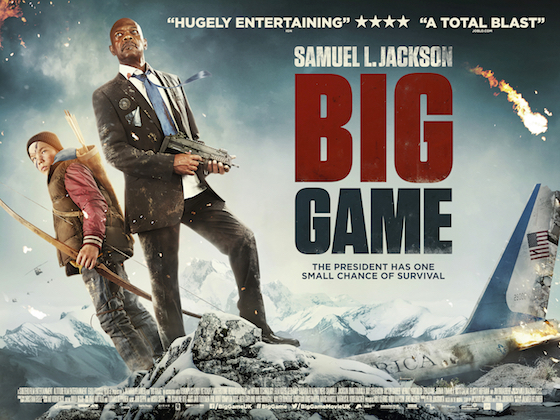
Big Game

Air Force One Has Fallen meets Hunt for the Wilderpresident in this deliberately daft action movie, which sees terrorists down Air Force One in remote Finnish forests, forcing the President (Samuel L. Jackson) to rely on the help of a local teenager (Onni Tommila) as they’re hunted by the bad guys.

I’ve read some complaints that, given the daft premise, Big Game is not a comedy. I don’t know what movie they were watching, but I thought it was pretty fun. It’s not an out-and-out parody, but surely no one involved thought they were making a serious action flick? Or maybe I’m wrong, I dunno — but whether it was me or them, one of us has misread the intended tone.

That said, as well as the OTT ’80s-throwback action antics, there’s some solid drama to be found. Primarily that’s between the kid and his father — how the state of their relationship is revealed and changes throughout the film is neatly done, which is all the more impressive considering the dad’s only in it for a few minutes. There’s also some almost touching stuff between the kid and the President. Is this material too ‘serious’ for a movie that is otherwise pretty lightweight? Perhaps the action side should take itself more seriously to buoy up the characters’ relationship further? Or maybe the characters’ relationship should be less life-lesson-y to allow for the silly spectacle of the action?

If you go down to the woods today you're in for a big surprise...

Maybe either way would work, but Big Game choosing to straddle the middle ground is what leads to those complaints. Personally, I enjoyed both facets, however at odds they may seem. Indeed, it’s the kind of movie I might once have given 4 stars, because I certainly enjoyed it; but I guess that the more of these lightweight-but-fun action movies you see, the more you feel like they are good fun but 3 stars is fine.

3 out of 5

* In the US there’s a PG-13 theatrical cut (running 87 minutes) and an unrated extended cut (91 minutes), i.e. this one. The BBFC classified it 12A for cinemas and 15 for home, with the former merely having a “partially obscured” use of a rude word to get the lower certificate. ^

Zatoichi on the Road (1963)

aka Zatôichi kenka-tabi / Zatoichi’s Fighting Journey

2018 #11
Kimiyoshi Yasuda | 88 mins | Blu-ray | 2.35:1 | Japan / Japanese

Zatoichi on the Road

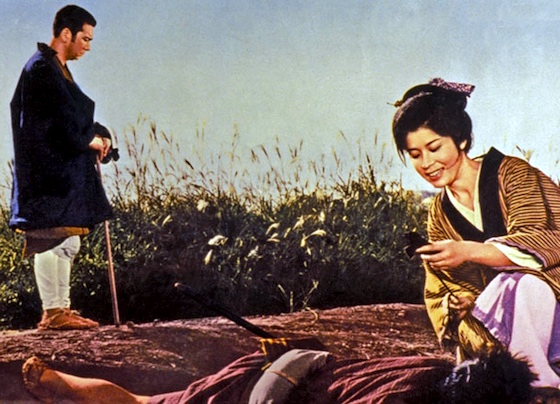
In his notes that accompany Criterion’s Blu-ray release of the Zatoichi series, Chris D. comments that, “despite the specificity of the English title, it should be stressed that Zatoichi is always on the road.” Indeed, titling this fifth movie Zatoichi on the Road is pretty much the equivalent of calling it Just Another Zatoichi Movie. At least the literal translation, Zatoichi’s Fighting Journey, is a little more dramatic.

So is On the Road “just another Zatoichi movie”? Critics disagree with each other. The Digital Bits’ comprehensive overview of the series describes it as “easily the best entry in the series to this point”, and Weird Wild Realm’s review goes even further, calling it “one of the strongest feature film episodes about the hero of a thousand slayings”. Conversely, the Images journal considers that it “doesn’t sustain the previous entry’s brilliant mood or pacing”, and, in direct opposition to The Digital Bits, Letterboxd users rank it clearly the lowest of the first five films. Where DVD Talk reckons it has “a fantastic, layered plot”, even Chris D. says “it has a somewhat overdeveloped, convoluted story line”.

I’m definitely in the latter camp. “Easily one of the best entries in the series”? Nope. The “action starts red hot and keeps getting hotter”? Don’t be silly. That was The Digital Bits again, and they go on to describe the climax as “one of the greatest climactic battle scenes depicted on screen since Kurosawa’s Seven Samurai,” which is just laughable. As Images counters, “when the action does rear its battle-weary head it’s good. It’s just not great. And after the sword-dizzy hysterics of the last film, greatness is what we hunger for.”

Zatoichi fights

As for the plot… Overdeveloped? Yes. Convoluted? Undoubtedly. And needlessly so — previous entry Zatoichi the Fugitive was hard to follow, but it felt worth it in the end. On the Road, I’m not so sure. The plot never really came together for me, leaving oh so many questions. Like, who was the old man who died at the start? Why did he care about Omitsu so much? Who was the lord who was after her? How did she end up with him and so far from her (apparently very rich and important) father? Why do that lord’s minions just disappear from the plot? Why was there that scene where one of them seems to regret their mission, only for Zatoichi to murder him in a split second right afterwards?

The whole thing winds up a lot of back-and-forthing for little reason, too often driven by coincidence (how come villainous Ohisa and Jingoro keep ending up in the same inns / eateries / etc as Zatoichi and Omitsu?) And I think it was meaning to imply that Ichi and Omitsu had a strong connection, almost like she wanted to marry him (as women have done in previous films — Ichi’s understanding of and/or attraction for women is certainly a recurrent theme). And he seems to care for her as much too (as seen in the ending where he caresses her trinket that he’s kept, for instance). But where was such deep a bond supposed to come from? It’s barely developed or explained.

Zatoichi on a road, literally

The film isn’t a total write-off, mind, with some exceptionally good individual scenes — when Ichi confronts transportation boss Tomegoro in order to rescue Omitsu; when Ichi and Omitsu connect while eating rice balls; Ichi’s cunning manipulations of two opposing gangs at the climax. The key link there is Ichi, of course, which is thanks to another strong performance by leading man Shintaro Katsu.

On the whole On the Road is enjoyable enough as a middle-of-the-road Zatoichi adventure, with the less thrilling aspects counterbalanced by the really good bits I just mentioned. I’ve mostly focused on the negative here because I bridled at the idea, espoused by some I’ve quoted, that this is definitively a great instalment in the series. It’s not.

3 out of 5

Fast & Furious 8 (2017)

aka The Fate of the Furious

2018 #21
F. Gary Gray | 136 mins | streaming (HD) | 2.39:1 | USA, China & Japan / English & Russian | 12 / PG-13

Fast & Furious 8

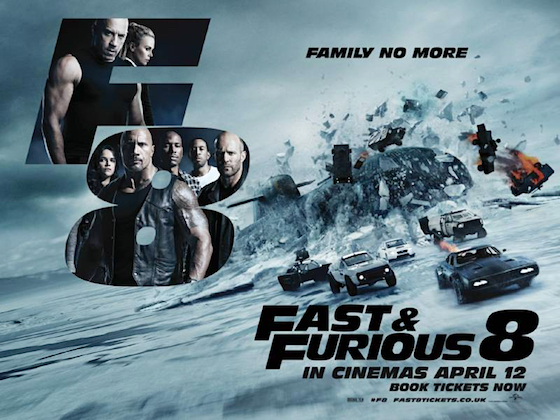
Anyone who’s watched a Fast & Furious movie will know that the most important thing to our heroes is not fast cars but family. Family, family, family — they don’t half go on about it. But what might make one of the team betray their all-important figurative family? Well, that’s what the series’ eighth instalment sets out to ask, as patriarch Dom (Vin Diesel) is forcibly recruited by terrorist Cipher (Charlize Theron), and government agent Mr Nobody (Kurt Russell) counter-recruits Dom’s family to track him down and stop Cipher’s evil plan.

You may remember that, once upon a time, these films were about street racers who occasionally carried out on-the-road heists, all the better to keep the focus on the cars. Those days are long gone, despite an opening sequence here that tries to pretend that’s still part of the game. No, nowadays we’re in the “international spy actioner” genre, and our former street racers have somehow become highly capable agents… whose primary tools/weapons are still vehicles. It’s utterly ridiculous… but, thank goodness, everyone involved seems to know that.

Well, most people do. I reckon Vin Diesel might think it’s a serious movie about the emotional turmoil of being kidnapped by a global cyberterrorist who lives on a plane and can remotely hijack a city-load of cars and is threatening your family unless you help her steal a nuclear submarine. I mean, we’ve all been there, right?

A lot of men would betray their family for Charlize Theron, to be fair

So, yeah, the story is thoroughly daft. But it exists primarily to connect up action sequences, and in a movie like this I’m fine with that — I’m here to watch people do cool shit in cars, hopefully with some funny bits around that action, not to be wowed by an intricate plot or ponder meaningful character development. On the things I expect, then, FF8 more or less delivers. I mean, the series has always been renowned for using CGI to augment its car chases, which is less thrilling than doing stunts for real, but it really blurs the line nowadays: you might think dozens of cars falling from a multi-storey car park is all CGI, but you’d be wrong.

Any time almost anyone besides Hobbs (Dwayne Johnson) or Deckard (Jason Statham) has their mouth open, FF8 is pretty dumb; but when those two are talking, especially when they’re bickering with each other, it’s often pretty funny (they’re definitely in on the joke). And when the action’s a-go-go, the film’s either solidly pulse-racing or, actually, being kinda witty — there’s a prison riot, for example, that is, appropriately enough, a riot. Though it’s as nothing to Statham engaging in a protracted gunfight-cum-punch-up against a bunch of goons while carrying a baby.

Bromance

Fast & Furious 8 isn’t strictly a comedy, but a sense of humour is required to enjoy it. There’s no way to take this palaver seriously, and fortunately the filmmakers have embraced that. It’s deliberately OTT, dedicated to being entertaining for almost every minute of its running time. Taken as just that, it’s a lot of fun. Also, probably the series’ best instalment since the fifth.

4 out of 5

Fast & Furious 8 is available on Sky Cinema from today.

Black Panther (2018)

2018 #23
Ryan Coogler | 134 mins | cinema | 2.39:1 | USA / English, Xhosa & Korean | 12A / PG-13

Black Panther

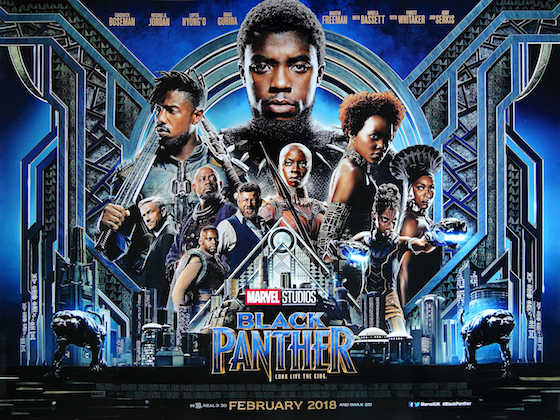
Black Panther is not the first superhero movie to star a person of colour in the leading role — not by a long, long shot. But it does look set to be the most successful. In part that’s down to its association with the MCU (the last time one of their movies grossed under $500 million was the first Captain America, 13 movies ago), but it’s also due to a general underrepresentation of non-white heroes right now — Black Panther may not be the first, but it may be the most mainstream. It also won’t hurt that it’s a very good action-adventure movie in its own right, and one that feels especially fresh thanks to tapping into an under-utilised cultural milieu.

Picking up shortly after the events that brought the title character into the MCU (as seen in Captain America: Civil War), the film begins with T’Challa, aka Black Panther (Chadwick Boseman), returning home to be crowned king of his country, Wakanda. A scientifically advanced African nation, with incredible technology fuelled by its deep reserves of the extraordinary metal vibranium, Wakanda has kept its abilities hidden from the rest of the world, who believe it’s a third world country of farmers. However, T’Challa must face forces from within and without who think Wakanda should play a greater role on the global stage — in particular long-time enemy of the state Ulysses Klaue (Andy Serkis) and his new partner in crime Erik Stevens (Michael B. Jordan), who wants to rule Wakanda and then the world.

The name's Panther. Black Panther.

A villain who wants to rule the world? Black Panther doesn’t spell out his goal quite that bluntly, I don’t think, but that’s what it is. It’s just one of several clues that this is, in many ways, a James Bond movie… only one where James Bond is a black African king with superpowers. The film’s whole structure is more Bond than Marvel, though: most obvious is the gadget-explaining Q scene, but then it becomes a globetrotting adventure (the film sets significant sequences in California, Nigeria, London, and Busan (though they don’t get there by train, thankfully)), complete with undercover operatives, a casino, car chases, and a plot with significant geopolitical elements. I’m not claiming you can map this one-for-one onto the Bond template, but the inspiration (consciously or not on the part of the filmmakers) is certainly there. One Letterboxd user described it as “The Lion King meets Skyfall”, which might sound pithy but is also surprisingly accurate — and Skyfall in particular, not just any old Bond film; but there we’d be getting into spoiler territory, so I’ll leave that for you to think about yourself after you’ve seen the movie.

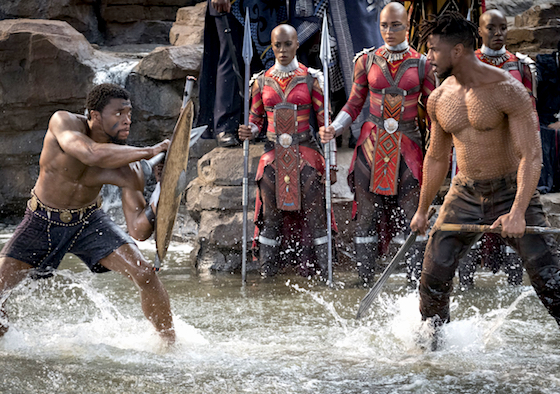
An even more significant influence, for numerous reasons, is African culture. Much has been made of the film having a predominantly black cast (aside from (to use an already well-worn joke) a couple of ‘Tolkien’ white guys), but it fully embraces that too. It isn’t nominally set in Africa with faces that happen to be of a different colour to the blockbuster norm — African traditions, designs, and ways of life have been woven throughout the film. Are they real ones the filmmakers co-opted or were they just inspired by the iconography of the continent? I don’t know. Does it matter? I don’t think so. It’s a different flavour on the blockbuster stage, and that adds freshness to just about everything.

African culture, real or imagined

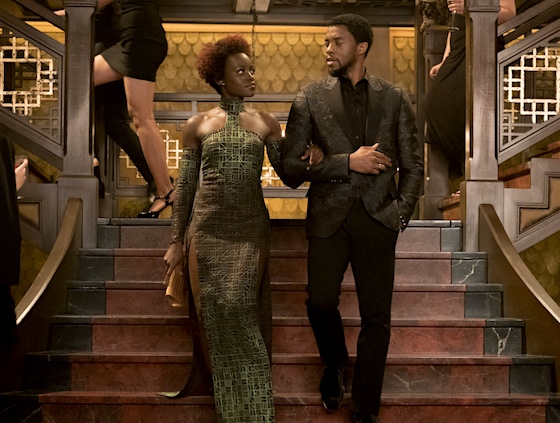
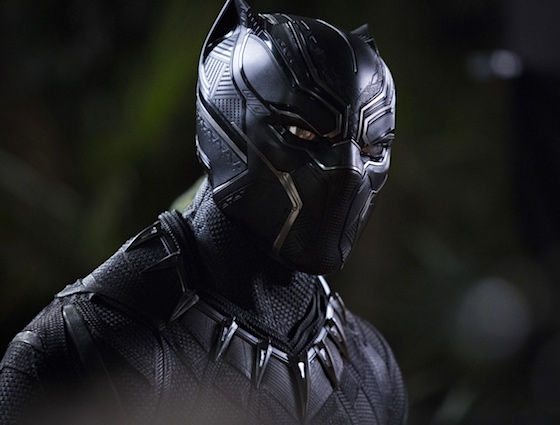
For one, it helps the film to look beautiful. It’s colourful without being cartoonish, the vibrant palette coming through via costumes and locations in a very real way. Design is naturally a big part of this — make-up; costumes; however the production design department breaks down across locations, sets, props, etc, etc. They were obviously able to cut loose, finding inspiration from different places to usual (i.e. Africa) and imagining a whole alternate world, similar to ours but a bit more Sci-Fi.

There’s the light, too — this is frequently a gorgeously shot film. Not just the quality captured by DP Rachel Morrison (who made headlines recently when she was Oscar nominated for Mudbound), but also the shot choices and editing — it’s filmic, whereas too many Marvel movies look like TV but with a humungous effects budget. Director Ryan Coogler stages the action well too. Across the board, the visuals don’t feel so generically “Marvel”, while also not forcing themselves so far outside the house style that it doesn’t feel like A Marvel Movie. Put another way, it’s probably not that radical, but it is fine-tuned.

The music is oftentimes striking as well, with Ludwig Göransson’s score and various songs* mixing different styles for a heady but effective blend. In fact, the music occasionally achieves a feel or atmosphere that I don’t think Marvel’s usually-generic soundtracks have reached before, and not necessarily ones you’d expect.

Suited up

The film is rich and fresh in plenty of other ways too. The story is loaded with varied thematic concerns: there’s politics, both on the world stage and internal; the battle between tradition vs modernity; the pros and cons of both isolationism and being open to the world; issues of colonialism and its aftereffects (and the morality of a possible reversal thereof)… Obviously race is a factor as well, but in specific ways rather than some kind of generic “hey, look, black people can do this too!” I feel like there are many different things to read into and out of this film — numerous facets that could be focused on either singularly or in various combinations — and that, actually, the film would reward such a close reading, rather than falling apart when put under a microscope.

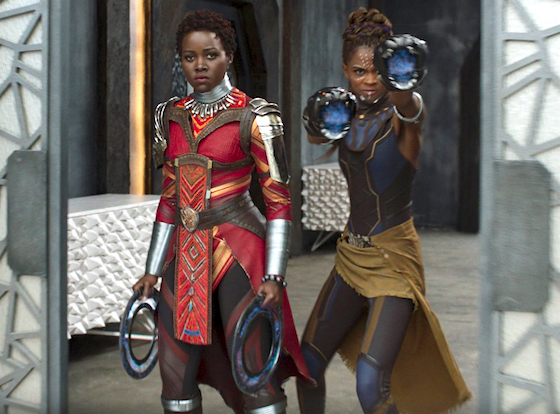
Yet another thing it juggles well in this mix are the characters and the performances behind them. There are a lot of people to get to know here, but they’re all so effectively sketched that most are interesting, likeable, or memorable (or all three) within just a few moments. The film may be called Black Panther and he may be the central hero, but he’s not the only strong, capable, heroic figure here — far from it. Indeed, another aspect that will surely generate plenty of discussion is the film’s strong female roles. The Q figure, currently at the forefront of all Wakanda’s incredible technology, is T’Challa’s younger sister (Letitia Wright); the army (or security service? I’ll confess to not being 100% on Wakanda’s military structure) is made up of women, led (of course) by a female general (Danai Gurira); their best spy is also a woman (Lupita Nyong’o); and the Queen Mother (Angela Bassett) is a powerful figurehead who gives strong advice.

Sisters, doing it for themselves

The film doesn’t make a big to-do about all this — it doesn’t boast about how well these women are doing, or have people try to “put them in their place” only for them to overcome it — it just gets on with them being awesome. Obviously the race aspect is going to be the most talked about thing here, at least initially, but I’d wager Black Panther is second only to Wonder Woman in its foregrounding of exceptionally capable female characters in the superhero genre… and, considering how many of them there are in this, one might argue it surpasses even that. Although the lead’s still a bloke, so…

Said bloke is an interesting lead character. He’s often quite quiet and thoughtful, very different to the wisecracking action men who typically lead Marvel movies. I’d guess he’s going to get on well with Captain America come Infinity War because they both have that stoic intelligence. It means that Chadwick Boseman doesn’t have the easy likeability of jokes to fall back on, as has so benefited… well, all those other Marvel leading men. But quiet strength is its own reward, if slightly slower burning, and T’Challa is ultimately a very engaging hero. On the other side of the equation, Michael B. Jordan’s villain is one of Marvel’s rare strong ones — in fairness, something they seem to have been improving since everyone pointed it out. While Erik is unquestionably a bad guy doing bad things, he has an understandable motivation, and Jordan even makes you feel for him a bit by the end.

He just can't wait to be king

Marvel Studios have often talked about trying to mix other genres into each of their movies, to try to add some much-needed variety to the familiar superhero movie formula. On the whole I’d say the effect is minimal — I’m always minded of Captain America: The Winter Soldier, which they tried to push as a ’70s-style political thriller, but which I thought was still very much a superhero movie with a dash of political thriller in the mix. Although maybe that’s enough. Anyway, Black Panther is once again undoubtedly a superhero movie in more than just the literal sense that it’s adapted from a comic book about a superhero, but this particular mix of varied influences — some familiar (it’s not the first movie to imitate Bond), others less so (African culture in an action-adventure blockbuster) — does make it feel genuinely different to the norm.

I know some people say this every time the studio releases a new movie, but it probably is Marvel’s best film to date. Nonetheless, I was going to give it 4 stars again; but the more I think about it, the more I feel like it’s time to break my duck and make this the first Marvel movie I’ve given:

5 out of 5

Black Panther is in cinemas pretty much everywhere now.

It placed 12th on my list of The 26 Best Films I Saw For the First Time in 2018.

* I’m sure there was a “songs by” credit, but I can’t remember the name and it doesn’t seem to be in any of the credits lists online. ^

Comedy Review Roundup

In today’s roundup:

  • This is the End (2013)
  • The Heat (2013)
  • In the Loop (2009)


    This is the End
    (2013)

    2017 #109
    Evan Goldberg & Seth Rogen | 105 mins | TV | 16:9 | USA / English | 15 / R

    This is the End

    Seth Rogen, James Franco, Jonah Hill, Jay Baruchel, Craig Robinson, and Danny McBride star as Seth Rogen, James Franco, Jonah Hill, Jay Baruchel, Craig Robinson, and Danny McBride (respectively) in a movie about the apocalypse written and directed by Seth Rogen and Evan Goldberg.

    And it’s pretty much exactly what you’d expect a movie about the apocalypse starring Seth Rogen, James Franco, Jonah Hill, Jay Baruchel, Craig Robinson, and Danny McBride, and written and directed by Seth Rogen and Evan Goldberg, would be like — for good or ill. Personally, I laughed and enjoyed myself more than I expected to, even if it is resolutely silly and frequently crude just for the sake of it.

    4 out of 5

    The Heat
    (2013)

    2017 #144
    Paul Feig | 112 mins | TV | 2.35:1 | USA / English | 15 / R

    The Heat

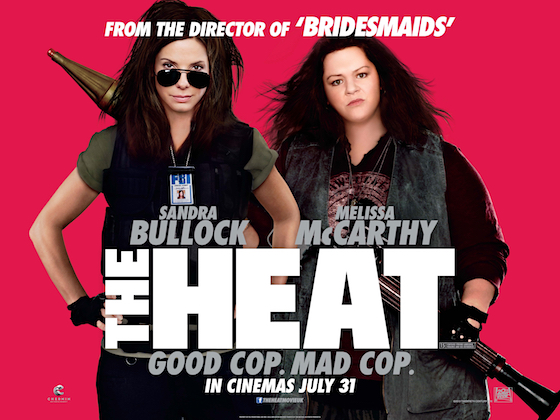
    Having been surprisingly entertained by Bridesmaids, Spy, and the new Ghostbusters, I thought I might as well tick off the last film-directed-by-Paul-Feig-since-anyone-noticed-he-made-films (he also helmed a couple of movies in the ’00s that no one mentions).

    It’s a female-led (obviously) version of the familiar buddy movie template, starring Melissa McCarthy (obviously) as an uncouth cop who must team up with a strait-laced FBI agent (Sandra Bullock) to bring down a drug lord.

    As I suspected, it’s the least likeable of those four Feig/McCarthy collaborations, although it manages to tick along at a level of passable amusement with occasional outbursts of good lines or routines. I wouldn’t recommend it to anyone who hadn’t first seen and enjoyed at least a couple of their other movies, but there are worse ways to spend a couple of hours.

    3 out of 5

    In the Loop
    (2009)

    2017 #147
    Armando Iannucci | 102 mins | streaming (HD) | 1.85:1 | UK / English | 15

    In the Loop

    Acclaimed political sitcom The Thick of It steps onto the global stage in this comedy, which sets its satirical sights on UK-US relations and the countries’ intervention in the Middle East.

    Despite the change in format and (intended) screen size, In the Loop manages to be as hilarious as the show it’s spun off from — not always a given when TV successes make the leap to the big screen. In part that’s the advantage of a 237-page script and 4½-hour first cut being honed to little more than an hour-and-a-half, but it’s also thanks to the skilled cast. The star of the show is, as ever, Peter Capaldi as sweary spin doctor Malcolm Tucker. Most of the rest of the UK cast carry over from The Thick of It (albeit in new roles) so are well versed in writer-director Armando Iannucci’s style of satire, but proving equally up to the task are a compliment of US additions headlined by James Gandolfini.

    It’s not perfect — there were a couple of subplots I could’ve done without (I’m not a big fan of Steve Coogan so wouldn’t’ve missed his near-extraneous storyline) — but they’re minor inconveniences among the barrage of hilarity.

    5 out of 5

  • King Arthur: Legend of the Sword (2017)

    2018 #15
    Guy Ritchie | 126 mins | download (HD+3D) | 2.35:1 | USA / English | 12 / PG-13

    King Arthur: Legend of the Sword

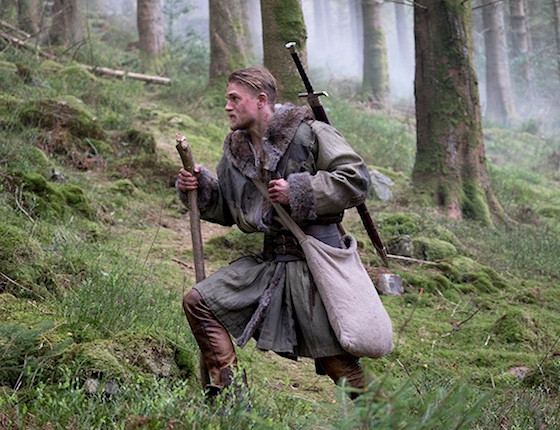
    After years of making fundamentally similar movies, director Guy Ritchie found renewed success reinventing Sherlock Holmes for Warner Bros. I presume that’s directly responsible for the studio tapping him to kickstart this long-gestating project: a series of films inspired by the legends of King Arthur. Unfortunately for them, plans for a six-film series were scuppered when this initial entry went down like a lead balloon with critics and consequently was a box office flop. Nonetheless, some people who I think are worth listening to reckoned it was actually pretty good. Turns out… eh…

    Set in a vaguely-defined historical Britain (the capital is called Londinium, but the king resides at Camelot, which is… somewhere else…?), Legend of the Sword begins with King Uther (Eric Bana) being deposed by his scheming brother Vortigern (Jude Law), with only his young son Arthur escaping. Arthur grows up in a brothel and on the streets, going from a weedy kid to… some kind of, like, gang boss type figure, I guess? Basically, we’re in familiar Guy Ritchie territory: lads up to criminal hijinks with a London accent, only now in medieval costumes. Anyway, long story short, Excalibur — the eponymous sword — reveals itself stuck in a stone, every young man is forced to try to pull it out, which obviously Arthur succeeds at, marking him out for death by Vortigern but also as the true king to those who remain loyal to Uther, who now have a Robin Hood-esque underground army — and so they begin a Robin Hood-esque campaign against Vortigern. Seriously, it wouldn’t take too many tweaks to make this as passable a Robin Hood film as it is a King Arthur one.

    King Arthur and his merry men

    So, to no one’s great surprise, if you’re looking for a broadly faithful adaptation of Arthurian legend then you’re out of luck here. There are obviously famous bits of the legend thrown in — the aforementioned Excalibur and its stone; the Lady of the Lake pops up too; and… um… other than that it’s pretty much just people’s names, really. I don’t know how much critics were hoping to see a more recognisably Arthurian tale, but I have to wonder if this massive deviance from the well-known stories of the eponymous hero is at least partly responsible for the film’s poor reception.

    Part of why I wonder this is that, if you approach Legend of the Sword less as a King Arthur film and more as a Guy Ritchie-flavoured fantasy movie, there are bits of it I think are really, really good. Some of it’s great, even, like an efficient and exciting montage that shows Arthur growing from child to adult. Or any other time there’s a montage, really — that’s the best one, but others are equally as effective. Second best, for instance, is one where Arthur has to go on a quest in some alternate dark dimension or something, battling giant bats and other such nasties. That’d be the whole of act two in other films, or at least a significant action sequence, but its basic content is all so rote — so Ritchie instead burns through it in a montage, which feels like a nod and a wink to the audience: “you know how this goes”. Editor James Herbert certainly gives his skills a workout making these sequences fast, clear, and cinematically thrilling.

    He's gonna need a montage

    Of course, if you really dislike Ritchie’s trademark style then him slapping it on the fantasy genre isn’t necessarily going to enrapture you. Reportedly the project was pitched to the studio and cast as “Lord of the Rings meets Snatch” and they’ve pretty much delivered on that promise, transposing Ritchie’s modern London laddish schtick onto medieval Londinium plebs. Personally, although I’ve somewhat tired of his recognisable approach in a contemporary setting, the temporal disjunct was a fresh enough variation for me, breathing new life into both Ritchie’s MO and fantasy tropes.

    Unfortunately, for all the verve of his own style that Ritchie injects, there are also bits that typify CGI-blockbuster blandness — the final fight is a nothingy blur. The speedy, montage-driven style also allows for only so much character development. What time there is gets focused on Arthur and Vortigern, which I suppose is appropriate enough, with a large supporting cast fighting over the scraps. It seems obvious to me that a mysterious female character known only as “The Mage” was meant to be revealed as Guinevere (a conceit broadly nicked from the Jerry Bruckheimer King Arthur, I think), and indeed that was apparently nixed in post-production. I guess they thought they could bump it to one of the five sequels… which now aren’t happening.

    Come and 'ave a go if you think yer 'ard enough

    My final three-star rating is maybe a bit harsh, but then maybe I’ve been too generous with my fours lately (or always). If Legend of the Sword had been able to carry through on the impetus of its best bits then it may even have been looking at a full five stars, they’re that good, but it doesn’t come together as a whole. It’s not the failure mass opinion painted it as, but it’s not quite a success either — it’s an interesting “good try”.

    3 out of 5

    King Arthur: Legend of the Sword is available on Sky Cinema from today.

    Godzilla: Planet of the Monsters (2017)

    aka Gojira: Kaijū Wakusei / Godzilla: Monster Planet

    2018 #13
    Hiroyuki Seshita & Kôbun Shizuno | 88 mins | streaming (HD) | 16:9 | Japan / Japanese | PG

    Godzilla: Planet of the Monsters

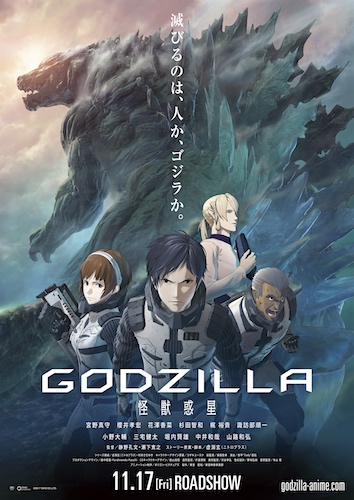
    Two of Japan’s most successful cultural exports meet for the first time here as the King of the Monsters, Godzilla, gets the anime treatment. Originally conceived as a TV series, the box office success of Shin Godzilla prompted studio Toho to restructure the project as a trilogy of movies and release them theatrically (in Japan, anyway — the rest of the world gets them via Netflix). Part 2 is due later in 2018 and Part 3 in early 2019.

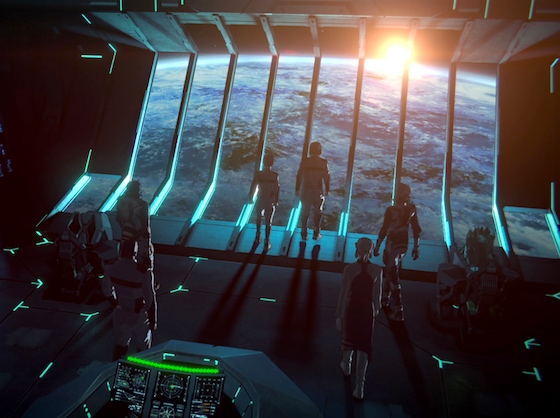
    The standard plot of a Godzilla movie, as I understand it, is a giant monster (aka kaiju) turns up, stomps all over some cities, then we find a way to destroy it; or, if it’s one of the ones where Godzilla is a good guy, he fights it and, presumably, wins. Planet of the Monsters uses its animated form to do something new with the concept. The opening credits montage informs us that, in the final years of the 20th century, kaiju suddenly sprung up all over the planet and mankind were unable to defeat them. Fortunately some aliens rocked up and offered to help by evacuating what was left of humanity. Twenty years later this mission to the stars is proving a failure, with minimal chance of finding a habitable planet and the survivors decimated by diminishing supplies. The best course of action is deemed to be a return to Earth — it’s estimated thousands of years will have passed there (thanks to relativity) and the hope is the monsters will have died; and if not, hotshot young captain Haruo Sakai has come up with a new plan to defeat Godzilla once and for all.

    Good God

    If that reads like a lot of setup, it’s because Planet of the Monsters contains a lot of setup. It takes about half the movie before they’re back on Earth and… well, technically this is a spoiler, but if you’re intending to watch the movie it might help you manage expectations: Godzilla doesn’t properly show up until the final half-hour. This has led some reviewers to accuse the movie of being slow and light on what we came to see, i.e. giant monster action. They have something of a point. However, contrary to most opinions I’ve read, I actually enjoyed the early space-bound stages of the movie better.

    It feels like the makers had a ton of interesting ideas about the politics and social situation aboard the evacuation ship, especially with multiple races and some kind of alien religion involved too, but there’s no time to really explore or develop those facets. Maybe they planned to get into that in the series. Either way, I find it funny that others have criticised that part for being slow and talky while I felt it had to race past a lot of potentially-interesting stuff to keep the plot moving. I guess I just ought to go watch Battlestar Galactica again, because it’s broadly similar territory.

    Back to Earth

    But, as I said before, there’s a rub: this setup provokes interest as a Galactica-style sci-fi, but as a Godzilla movie? There’s far too little of the big guy. And when he does turn up for the big climactic action sequence, that was the bit I found kinda dull. There’s a lot of whizzing around on hoverbike-things and blowing up forests and whatnot — plenty of sound and fury, but signifying what? And then… well, still avoiding spoilers, but there’s a twist in the final few minutes that renders this whole film prologue. Perhaps that should leave us hopeful for the next two? Perhaps this is all effective world-building for where things will go in the sequels? Conversely, it could be revealed as unnecessary background info once all the monster smashing starts. Only time (and the next two films) will tell…

    3 out of 5

    The Mummy (2017)

    2017 #82
    Alex Kurtzman | 110 mins | cinema | 2.39:1 | USA, Japan & China / English & Ancient Egyptian | 15 / PG-13

    The Mummy

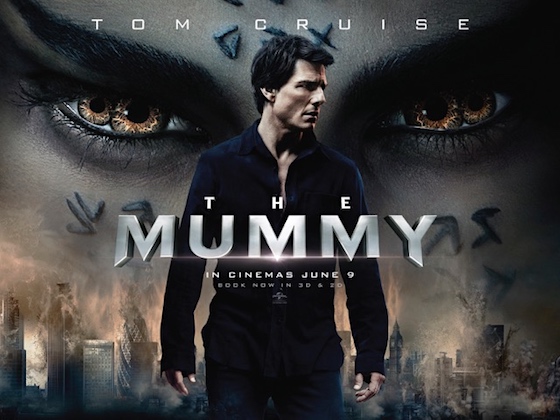
    As studios scramble to emulate Marvel’s shared universe success, there are some very odd ideas being thrown around. One of the least odd, really, was Universal’s Dark Universe, which intended to mix together their various famous horror properties. At first blush that sounds as forced as most of these ideas are, but back in the day they made tonnes of “Dracula Meets Frankenstein” type movies, so why not do it again today? All of these movies were to be reboots, obviously, and they arguably played it safe by beginning with a reboot of one they rebooted before — a re-reboot, if you will. The Mummy 2017-style bears no resemblance to its popular ’90s forebear, but I doubt that was anything like the ’30s version anyway, so all’s fair in love and blockbuster moviemaking.

    You’ll notice the repeated use of the past tense in my opening paragraph. That’s because The Mummy flopped, both critically and commercially, and the Dark Universe plans have been thrown into doubt. (Some say it’s been definitely cancelled, but I don’t think that’s been officially confirmed.) While I wouldn’t go so far as to call that a shame, I didn’t necessarily think The Mummy was that bad. On the other hand, it’s not great either…

    Tom Cruise realises he's made a terrible mistake...

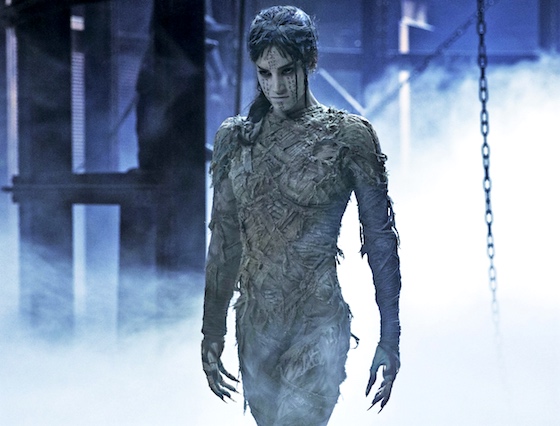
    This iteration of the concept sets its scene in the present day war-torn Middle East, where Nick Morton (Tom Cruise) is a mercenary who stumbles upon a hidden tomb, inside which is the well-protected coffin of an Egyptian princess (Sofia Boutella). To cut to the chase, the dead lass wakes up, and brings all her supernatural powers to bear on destroying the world… or something. At the same time, Nick seems to have developed some kind of connection to her.

    However, what sticks in your mind about The Mummy is not its eponymous villain, but all the time it spends trying to establish the aforementioned shared universe. Nick eventually comes into contact with a secretive organisation headed by Dr. Henry Jekyll — a name we all know, of course, so you begin to see the connections developing. You can’t help but feel more effort has been put into setting up this element than the movie that surrounds it, which therefore feels like little more than a delivery system for Dark Universe: Part 1.

    But let’s try to judge it anyway. Primarily, it’s a tonal mishmash. It’s not exciting enough to satisfy as an action movie, but not scary enough to qualify as a horror. There’s humour, but it’s poorly integrated, feeling at odds with the dark tone. This is a PG-13 movie that kinda wants to be an R, but not so much that it’ll really commit to sitting on that PG-13/R line. Whole sequences and imagery seems to have been included just to look good in the trailer. For example, a bunch of business with a sandstorm in London — in the trailer it looked like it would be some sort of end-of-the-world climax, but it’s actually just a bit of a chase scene to get characters from one location to another.

    “I’m here to talk to you about the Avenger Initiative.”

    Cruise isn’t given room to display his usual charm, instead wandering through the plot being told stuff and always threatening to tip over into being the villain. This movie always seemed like an odd choice for him — getting stuck into a franchise-within-a-franchise at this stage in his career — and, yeah, it remains an odd choice. Russell Crowe phones in his Nick Fury turn as Jekyll, while sidekicks Annabelle Wallis and Jake Johnson fight against the material as they struggle to make their mark. Boutella’s part makes feints at complexity, but is ultimately no deeper than you’d expect the Mummy’s role to be in a Mummy movie.

    And after all that it doesn’t even end properly. It’s not even that it’s blatantly set up for a sequel (it’s not, really), but it’s clearly aware that it’s part of a shared universe and they might want some of these characters back. Well, that’s what this is all about, don’t forget — Dark Universe: Part 1.

    Despite all that, there are hints of a decent movie here: the first act is fairly good, and while the humorous moments may sit oddly with the pervading tone, they’re mostly fine in themselves. But it’s too concerned with establishing a universe when it should worry about being a good yarn in its own right, meaning it fails to do either adequately.

    Mummy mia, here they go again

    When I started this review I was going to end up giving it a generous 3 (that’s what it’s down as in my 2017 stats therefore), but my memories of whatever I liked enough to nudge it upwards have begun to fade. The Mummy — and the Dark Universe it was meant to kick off — could’ve been something, if not great, then at least worthwhile. Shame.

    2 out of 5

    Bright (2017)

    2018 #1
    David Ayer | 117 mins | streaming (UHD) | 2.35:1 | USA / English & Spanish | 15

    Bright

    The director of L.A.-set crime thrillers Harsh Times, Street Kings, and End of Watch returns with another L.A.-set crime thriller, only this time with orcs. Yes, orcs. Also fairies and elves and dragons and all that.

    But you knew that because you surely can’t’ve missed hearing about Bright these past few weeks. It’s Netflix’s first attempt at making a big-budget summer-tentpole-style blockbuster and they’ve been pushing it hard, but it was savaged by critics, only to then have proven immensely popular with viewers (it’s Netflix’s most-watched original production ever) and had a sequel speedily commissioned.

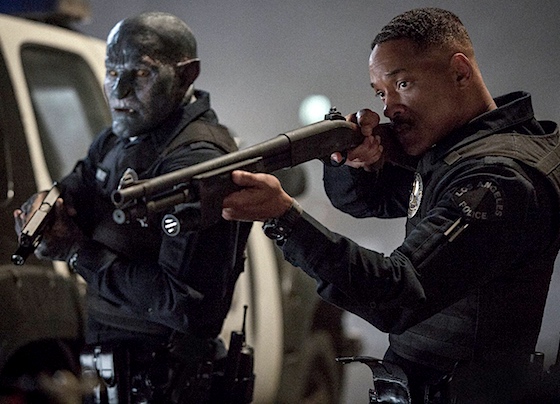
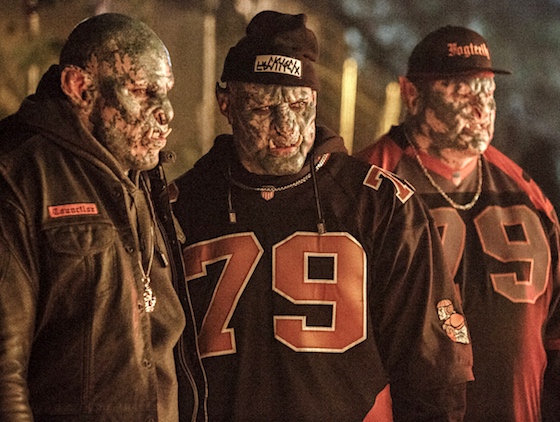
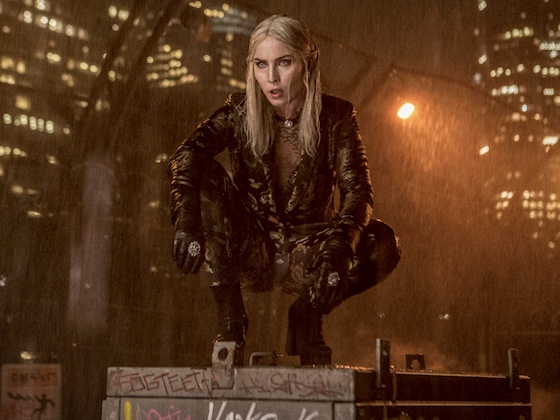
    It’s set in an alternate present day where magic and the aforementioned fantastical creatures all exist. In L.A., humans are your regular run-of-the-mill people, elves are the well-off upper class living in a segregated oasis, and orcs are the poor underclass — a couple of thousand years ago there was a Lord of the Rings-style war to vanquish the Dark Lord, in which orcs picked the wrong side and still pay the price. Nonetheless, the LAPD has recently inducted the first orc cop (Joel Edgerton). When he and his partner (Will Smith) happen across a magic wand, a rare and immensely powerful device, they find themselves hunted by an evil elf (Noomi Rapace) who intends to resurrect the Dark Lord.

    Orc of Watch

    Bright is, straightforwardly, a mash-up of crime thriller and fantasy blockbuster. Visually and tonally it could be a sequel to End of Watch, were it not for the fantastical creatures. With them in the mix, the plot, creatures, terminology, etc, feels broadly familiar from other fantasy adventures. The unique point, obviously, is in combining these two disparate genres into a homogenous whole. In this regard, Max Landis’ screenplay is a mixed bag: I like the basic concept, and a lot of the ideas within it are decent too, but the execution leaves something to be desired.

    For example, the alternate present-day L.A. is imagined just by switching out one real-life race for a fantasy one. So black people become orcs in a simple one-for-one switch. These race analogies are thuddingly heavy-handed, to the point where you wish they hadn’t bothered because then at least they might’ve done it by accident and it would’ve been subtle. Exposition is equally as on the nose, with characters spelling out world history and terminology to each other purely for the viewer’s benefit. It’s a challenge to convey this kind of information to the audience in a fantasy movie, but that’s not an excuse for doing it badly.

    OWA - Orcz Wit Attitudes

    Ayer seems an apt choice for director — of course he is, because he made End of Watch and Bright really is very similar to that movie. He doesn’t seem to have a complete handle on the material, though. The pace feels all wrong — not terrible, just slower than it should be, like scenes need tightening up, maybe a few more deletions here and there. It feels like it’s been mis-paced in the same way as many a Netflix original series, which makes you wonder if this is a problem with someone who oversees stuff at Netflix rather than individual film/programme-makers. Conversely, it could be because most regular people just won’t notice it — these productions aren’t slow in the way an arthouse movie is slow, they’re just not moving through situations and dialogue at the rate they should; killing time by letting scenes roll on that bit longer than they have any purpose to, that kind of thing.

    As the film goes on, it trades this early wheel-spinning for other problems: choppy editing; disjointed storytelling; ill-defined characters and motives. Noomi Rapace is severely underused as the villain — she has so little to do that the role could’ve been played by anyone. Edgar Ramirez isn’t quite so poorly served as an FBI-type elf also on the trail of the wand, but one wonders if someone was already thinking about sequels when shaping these supporting roles. At least Smith and Edgerton make for decent leads, even as they battle against the script’s character inconsistencies and dead-end subplots (for instance, a chunk of time spent on Smith’s home life at the start has barely any baring on later events).

    Urban elf

    Bright is hampered not by its potential-filled genre mash-up premise, but instead by the filmmakers chosen to execute that idea. They fitfully realise that potential, but it’s diluted by a rash of clichéd or plain undercooked filmmaking. The final result is a long way from perfect, but it’s also pretty far from being the disaster of epic proportions that critical and social media reaction seems suspiciously keen to paint it as (the Cannes-like “Netflix make TV not movies” sentiment is strong in some quarters). It’s a middle-of-the-road blockbuster movie, with some very solid plus points that are let down by some irritating negatives.

    3 out of 5

    Bright is available on Netflix now and forever.

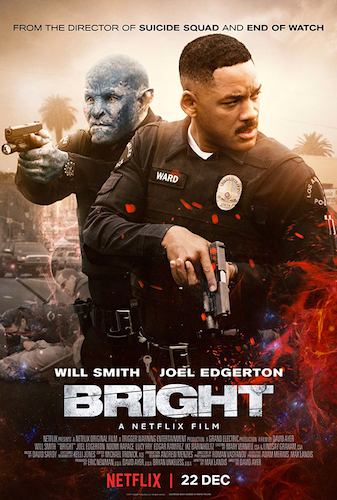
    P.S. Random pointless thing of the week: there are British and American variations of the Bright poster. Spot the difference.

    Blindspot Sci-fi Roundup

    With my 2018 Blindspot and “What Do You Mean You Haven’t Seen” selections now chosen, it’s about time I got on with reviewing those from the class of 2017 that are still in my “to do” pile. Here, then, are four more reviews of my 2017 must-sees, connected (as you may’ve guessed from the title) by all being works of science fiction.

    In today’s roundup:

  • District 9 (2009)
  • Moon (2009)
  • Her (2013)
  • Forbidden Planet (1956)


    District 9
    (2009)

    2017 #88
    Neill Blomkamp | 112 mins | Blu-ray | 1.85:1 | South Africa, USA, New Zealand & Canada / English | 15 / R

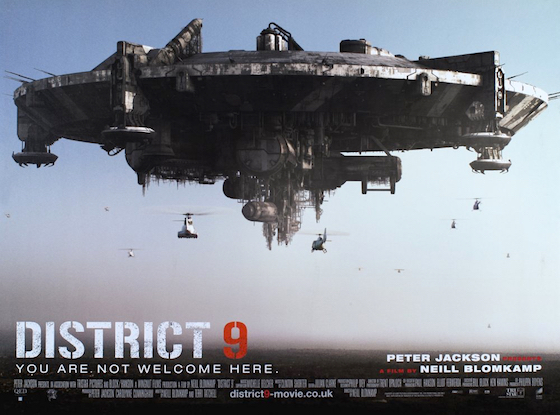
    District 9

    We begin this roundup with two 2009 sci-fi thrillers that made the names of their respective directors. District 9 got the wider attention, being backed by Peter Jackson and receiving a Best Picture Oscar nomination (alongside three other nods), but I’d argue it’s ultimately the lesser of the two films.

    Although District 9 remains highly praised, co-writer/director Neill Blomkamp’s next two movies — Elysium and Chappie — haven’t gone down so well. Having seen both of those first, I feel like there are a lot of structural and tonal similarities between all three films, so it’s interesting to me how poorly the next two were received. Basically, they all start with some kind of societal sci-fi issue, explore that for a bit as the world of the story is established, then transition into being a shoot-em-up actioner.

    In District 9’s case, it starts out as a documentary about (effectively) alien refugees who live in a segregated community in South Africa. The obvious real-world parallels are, well, obvious. Then events transpire which make the idea of having to identify with those who are Other than us — of becoming affected by their culture — very literal. Then it turns into an achieve-the-MacGuffin shoot-em-up runaround. It’s done well for what it is, with some strikingly gruesome weaponry to give the well-staged shootouts a different edge, but that’s still what it is. Presumably it was all the rather-obvious allegory stuff that helped land the film a Best Picture nomination, and the fact the second half is a not-that-original humans-vs-aliens shooter was overlooked.

    Not so different. Okay, pretty different.

    For me, the clunkiest bit is the storytelling style it adopts. It’s a mockumentary… until it decides it doesn’t want to be so that it can tell its story more effectively… but then it sometimes slips back into mockumentary later on, most notably at the end. I found that distracting and formally inconsistent. I’d rather it had kept up the mockumentary act throughout or not used it at all; or, if you’re going to do both documentary and ‘reality’, have a point to it — show differing versions of the truth, that kind of thing, don’t just mix it together willy-nilly.

    All told, I found District 9 to be a mixed bag. The first half is excitingly original and interestingly ideas-driven, with allegory that is powerful if perhaps a little heavy-handed (I suppose that’s kind of unavoidable when you make a movie about segregation and set it in South Africa). The second half is just a shoot-em-up.

    4 out of 5

    Moon
    (2009)

    2017 #145
    Duncan Jones | 97 mins | Blu-ray | 2.40:1 | UK / English | 15 / R

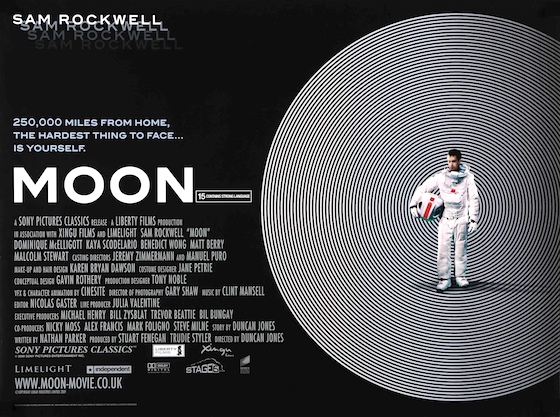
    Moon

    The other 2009 sci-fi debut feature was that of director Duncan Jones. Although it received no Oscar love it did get a BAFTA, but seems to remain less seen: it has almost half as many user ratings on IMDb as District 9. Personally, I thought it was the superior film.

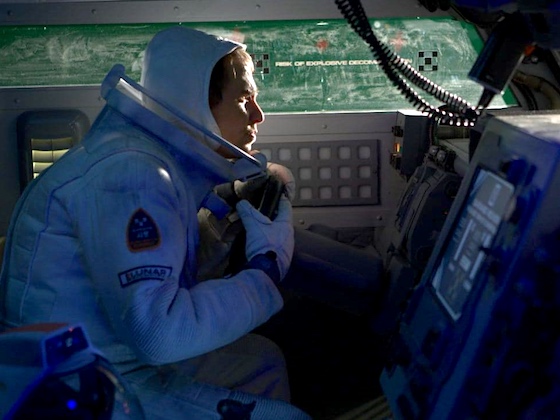
    It stars Sam Rockwell as the sole inhabitant of a mining facility on the Moon. As the end of his tour of duty approaches, his investigation in a malfunction unearths a startling secret. To say any more would spoil things, though Moon gets to its reveal pretty speedily. Also, you may’ve guessed it from the trailers (I more or less did). Also, it’s nine years old now and you’ve probably seen it — though, as those IMDb numbers show, maybe not.

    If you haven’t, it’s definitely worth seeking out. Like so much good sci-fi, it uses its imagined situation as impetus to explore the effect on its characters (or, in this case, character) and what the human reaction would be in such a situation. Maybe this is becoming a cliché already, but it’s quite like an episode of Black Mirror in that regard. (Isn’t all sci-fi that puts a high concept through the ringer of human experience “like Black Mirror”? Such stuff existed before that series. That said, maybe there wasn’t as much of it.)

    It's like looking in a mirror. A black mirror.

    Jones marked himself out as a director to watch with his attentiveness to character in the midst of his SF setting, but also by helming an excellently realised production on a tight budget — the moonbase set looks great and the model effects are perfect. A major reason I reckon it’s clearly better than District 9 is this consistency of style and tone. It’s a film that better knows what it wants to be and how to achieve its intended effect.

    As for Jones, he went on to make Source Code, a solid follow-up, but then seemed to throw a lot of talent away on the risible Warcraft. Hopefully his forthcoming Netflix Original, Mute, will restore the balance.

    5 out of 5

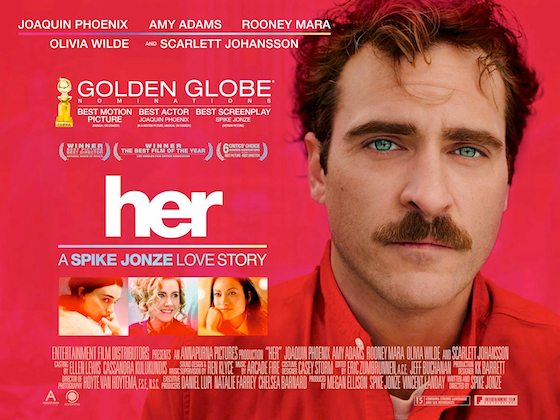
    Her
    (2013)

    2017 #165
    Spike Jonze | 126 mins | Blu-ray | 1.85:1 | USA / English | 15 / R

    Her

    If Moon is “a bit like an episode of Black Mirror”, Spike Jonze’s Her virtually is one. Set in a highly plausible near future — which has clearly been developed from our current obsession with our phones, iPads, digital assistants, etc — it stars Joaquin Phoenix as Theodore, a lonely chap who gets a new operating system based around a genuine AI, Samantha (voiced by Scarlett Johansson). As Samantha develops, she and Theodore soon become friends, and then more.

    People often refer to the template of Black Mirror as “what if technology but MORE”, and Her definitely fulfils that brief: “what if Siri was genuinely intelligent and someone fell in love with her?” Also like an episode of Black Mirror, it’s as much about what this reveals about humanity as it is about the crazy sci-fi concept. It’s primarily a romance about a lonely guy who was hurt in the past finding a new connection, with the fact he’s falling in love with a piece of technology almost secondary. Even within the world of the film, he’s not some kind of outcast: we hear about other people who’ve fallen for their AI, and his friends unquestioningly accept his relationship as genuine.

    Such acceptance doesn’t translate into our current world, it seems. Although Her is generally very well liked, some people struggle to engage with it at all, and from what I can tell that mostly stems from them not being able to relate to Theodore and his situation, i.e. the very concept of falling in love with an AI is too impossible for them to even imagine. I can’t help but feel that says more about those viewers (for good or ill) than it does the film, which executes the storyline with a great deal of believability and heart.

    5 out of 5

    Forbidden Planet
    (1956)

    2017 #172
    Fred McLeod Wilcox | 98 mins | Blu-ray | 2.40:1 | USA / English | U / G

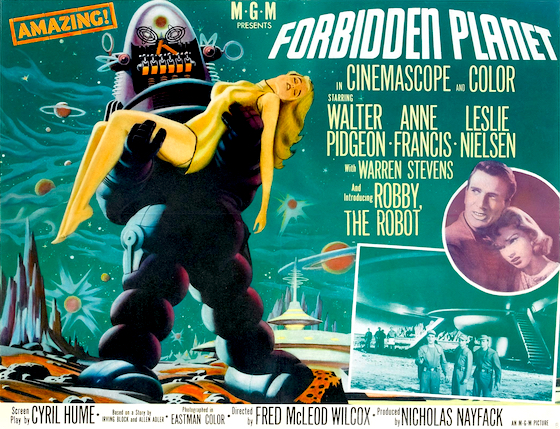
    Forbidden Planet

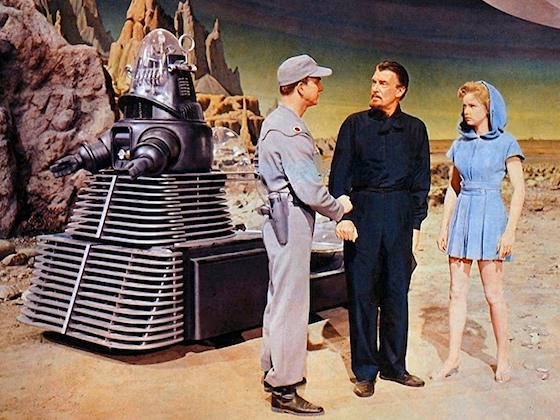
    This classic sci-fi adventure sees a spaceship crewed by blokes (led by Leslie Nielsen) land on the planet Altair IV to investigate what happened to a previous mission there. They find it inhabited only by Dr Morbius (Walter Pidgeon), his robot servant Robby, and his beautiful daughter Altaira (Anne Francis), who perpetually wears short skirts and has a fondness for skinny-dipping. Turns out the crew are a right bunch of horndogs (they spend most of their time lusting after Altaira, tricking her into kissing them and stuff like that), but there are bigger problems afoot when the planet starts trying to kill them.

    Once it gets past everyone’s lustfulness (it feels uncomfortably like watching the filmmakers play out some personal fantasies), there are proper big sci-fi ideas driving Forbidden Planet. There are also some gloriously pulpy action sequences, like a fight against an invisible monster. It’s backed up by great special effects. Obviously they’ve all dated in one way or another, but much of it still looks fantastic for its time — the set extensions, in particular, are magnificent.

    Nothing's forbidden on this planet, wink wink

    Something I wasn’t expecting (but I’m certainly not the first to note) is how blatantly the film was an influence on Star Trek. You can even map the similarities between characters pretty precisely. Switch out the spaceship models and original-flavour Star Trek is all but Forbidden Planet: The Series.

    Although its gender politics have aged even less well than its special effects, and its story occasionally gets bogged down by stretches of explanatory dialogue (it sometimes feels like you’re watching the writer invent and explain his ideas in real-time), Forbidden Planet remains a mostly enjoyable SF classic.

    4 out of 5

    District 9 and Forbidden Planet were viewed as part of my Blindspot 2017 project, which you can read more about here.

    Moon and Her were viewed as part of my What Do You Mean You Haven’t Seen…? 2017 project, which you can read more about here.