Country: USA
Language: English
Runtime: 128 minutes
BBFC: 15
MPAA: R

Original Release: 12th November 1999 (USA)
UK Release: 26th December 1999
First Seen: DVD, c.2004
Stars
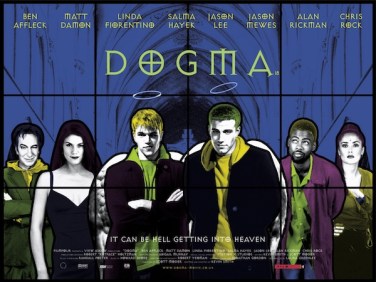
Ben Affleck (Armageddon, Daredevil)
Matt Damon (The Rainmaker, The Bourne Identity)
Linda Fiorentino (The Last Seduction, Men in Black)
Salma Hayek (Desperado, Frida)
Alan Rickman (Die Hard, Galaxy Quest)
Director
Kevin Smith (Clerks, Red State)
Screenwriter
Kevin Smith (Chasing Amy, Zack and Miri Make a Porno)
The Story
When two fallen angels discover a loophole that might allow them back into Heaven, a normal woman is charged with stopping them before they bring about the apocalypse. Hilarity ensues.
Our Heroes
Abortion clinic worker Bethany has greatness heaped upon her when the voice of God gives her a mission (“I don’t want this, it’s too big.” “That’s what Jesus said.”). She ends up collecting a motley crew of followers and helpers, including 13th apostle Rufus, Serendipity herself, and idiot-prophets Jay and Silent Bob.
Our Villains
Banished angels Loki and Bartleby are fed up with living on Earth, but that’s okay because they’ve found a loophole that will get them back into Heaven. It might destroy the world or something, but, y’know, collateral damage ‘n’ all that.
Best Supporting Character
Alan Rickman again (see also: last time), this time as Metatron — not an anime hero or Power Rangers villain, but the dry-witted, genital-less Voice of God.
Memorable Quote
“Any moron with a pack of matches can set a fire. Raining down sulphur is like an endurance trial, man. Mass genocide is the most exhausting activity one can engage in, next to soccer.” — Loki
Memorable Scene
Whiling away time until they can execute their plan, Bartleby and Loki invade a company’s board meeting and expose the members’ secrets. (Any scene that features Bartleby + Loki + dialogue is among the film’s best bits.)
Truly Special Effect
I suppose it’s a relatively simple one really, but I’ve always thought the various characters’ wings look magnificently ‘real’. That’s the beauty of practical effects for you.
Letting the Side Down
This isn’t about the film itself, but they made a behind-the-scenes documentary, called Judge Not: In Defense of Dogma, which wasn’t actually ready for the film’s DVD release. Instead, it was included on the later DVD of Vulgar (not heard of it? Me either.) Eight years later, when Dogma made its way to Blu-ray, the making-of… still wasn’t included. I mean, how hard is it to pay attention when creating a new release and do more than just “copy and paste” the DVD’s contents?!
Making of
Even before the film opened it was picketed by Christian protestors. Unbeknownst to that mob, the film’s writer-director Kevin Smith joined them… and, unrecognised, got interviewed on TV. Sounds kinda implausible, but it happened.
Awards
1 Razzie nomination (Worst Supporting Actress (Salma Hayek, also for Wild Wild West))
What the Critics Said
“those who would call it sacrilegious (and there will be many) should look beyond the foul language and crude humor, to see more deeply into Smith’s intentions to give the dusty doctrines of the ancient faith a fresh new perspective. Foul language aside, the film has some interesting things to say about human nature, and about the nature of those non-humans we have come to know and love, and hate, and pray to, and obsess about, over the last few millennia.” — John R. McEwen, Film Quips
 Score:
 67%
67%What the Public Say
“The beginning of the movie has a few disclaimers pleading with a sensitive audience to not hate this movie because of its seemingly antireligious rhetoric. To be honest, I thought the message of ultimate religious tolerance was fairly clear. […] I don’t think Dogma will make you examine your faith any more than before you watched it. Instead it will let you turn a more satirical eye to the absurdities of the modern church bureaucracy and hopefully make you laugh a little bit about how ridiculous some of this shit is. It’s okay to have faith in a higher power, but getting too extreme with your ideals can make you an asshole.” — ThomFiles

Not nearly as disrespectful to Christianity as the Bible-bashing protestors would like you to think, Kevin Smith’s religious comedy can be a bit of a mixed bag — the story is occasionally a tad baggy and the toilet humour sometimes goes too far for my taste, but there are plenty of amusing scenes, lines and performances. Irreverent and crude, to be sure, but sometimes surprisingly clever, and consistently funny.

#25 will be… setless.






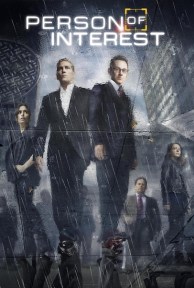 I have very mixed feelings about Person of Interest, whose fourth season has only made it to UK TV in the past few weeks (the belated fifth starts in the US in May, they announced yesterday). When it works, it’s a good quality vigilante/procedural action show; but its array of arc plots are as unrewarding as they are never-ending, and are consequently unsatisfying to a fault (literally). However, now that I’m so deep into it, and with cancellation finally confirmed (the foreshortened and delayed fifth season will indeed be its last, as was also finally announced yesterday), I feel like I’m in ’til the bitter end. The makers just bloody better have had the notice to get a proper ending into that now-final episode…
 When Amazon picked up Ripper Street after the success of the third series, it was for a fourth and fifth season totalling 13 episodes. The show’s writers seem to have taken the double recommission to heart and crafted an arc plot to last throughout those two seasons, meaning this first half ends on a big surprise and with all sorts of things left up in the air. And now we have to wait. Still, it’ll be fascinating to see how there are six or seven more episodes left, considering the predicament they’ve put the characters in.
 I think I sounded a little more dismissive of Shetland than I’d intended in
  The quality of this revival has certainly been all over the place. I was wary of episode three, Mulder & Scully Meet the Were-Monster, because comedy always seems at odds with The X Files’ grand conspiracy storylines, but I thought it was hilarious and deserving of its acclaim as the best episode of the season. Home Again felt like solid standard X Files fodder, and Babylon was clearly trying to be zeitgeisty but perhaps wasn’t fully thought-through. As for the much-maligned finale, My Struggle II… well, it was a mess, and over-ambitious, and a stupid idea to end it on a cliffhanger when no one knew how well the revival would go down. Let’s hope Chris Carter is right that there’ll definitely be more.
 This month, I have mostly been missing The Night Manager. The critically-acclaimed ratings hit is, as you likely know, a spy thriller adapted from a John le Carré novel, which not only means it has pedigree, but that its star — Tumblr-beloved Marvel villain Tom Hiddleston — is now being tipped to take over as Bond. I wouldn’t know, I’ve not seen it yet.