1999 Week

This week on 100 Films, I shall be partying like it’s 1999.

“Why?” Well, I’m glad you asked. It’s all thanks to a confounding confluence of coincidence, whereby I happened to watch three films from that momentous year back to back, then noticed I had two 100 Favourites posts very close together from that year coming up around this week, a week that ends with my birthday. And how do you celebrate a birthday? With a party. And how do you party? Like it’s 1999.

Then Prince died and now it feels kinda disrespectful.

RIP Prince

I could be worse.

Moving on…

On Monday, Tuesday, Thursday, Friday, and Saturday there’ll be reviews of films from 1999 I happen to have watched recently, including one of my Blindspot / WDYMYHS films; on Wednesday and Sunday, as usual, a pair of 100 Favourites from 1999; and, because it’s a Bank Holiday next Monday, the week will last 8 days, and end with my thoughts on the best films of 1999.

Now, imagine your picture going all wobbly and the soundtrack going tinkly (or, if you prefer, roll-back-and-mix with a “vworp vworp” noise) as we travel back 16 years…

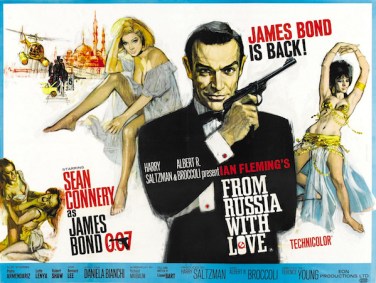
From Russia with Love (1963)

100 Films’ 100 Favourites #32

James Bond is back!
His new incredible women!
His new incredible enemies!
His new incredible adventures!

Country: UK
Language: English, Russian, Turkish & Romany
Runtime: 115 minutes
BBFC: A (1963) | PG (1987)
MPAA: GP (1971) | PG (1994)

Original Release: 11th October 1963 (UK)
US Release: 8th April 1964
First Seen: TV, c.1995

Stars
Sean Connery (Darby O’Gill and the Little People, Zardoz)
Daniela Bianchi (Special Mission Lady Chaplin, Operation Kid Brother)
Pedro Armendariz (Fort Apache, 3 Godfathers)
Lotte Lenya (The Threepenny Opera, The Roman Spring of Mrs. Stone)
Robert Shaw (A Man for All Seasons, Jaws)

Director
Terence Young (Dr. No, Wait Until Dark)

Screenwriter
Richard Maibaum (Bigger Than Life, Licence to Kill)

Adapted by
Johanna Harwood (Dr. No, Call Me Bwana)

Based on
From Russia with Love, the fifth James Bond novel by Ian Fleming — one of John F. Kennedy’s favourite novels.

The Story
When Soviet consulate clerk Tatiana Romanova offers to defect, she has one condition: that she is extracted by James Bond. Although M smells a trap, as collateral Tatiana offers a Lektor, a decoding machine MI6 have wanted for years. Bond travels to Istanbul to steal the Lektor, unaware he’s being manipulated by the criminal organisation SPECTRE…

Our Hero
The name’s Bond, James Bond. In only his second big-screen outing, so Connery is still establishing the character here — considering all the ‘fun’ antics that came since, Bond is quite a hard bastard in Dr. No and From Russia with Love (which is only appropriate for a government-sponsored killer, of course).

Our Villains
They may not be as grandiose as the volcano-dwelling types that came later in the series, but From Russia with Love has two of Bond’s most memorable adversaries: the hard former KGB officer Rosa Klebb, with her deadly shoe (well, it sounds silly when you put it like that), and assassin Red Grant, who may not know what wine to have with fish but could certainly gut you like one. A fish, that is. Not wine. You can’t gut wine.

Best Supporting Character
Kerim Bey, British Intelligence’s man in Turkey. An affable, witty soul, he’s also an invaluable ally during Bond’s time in Istanbul.

Memorable Quote
Tatiana: “I think my mouth is too big.”
Bond: “I think it’s a very lovely mouth. It’s just the right size… for me, anyway.”

Memorable Scene
On the Orient Express, SPECTRE assassin Red Grant manages to corner Bond in his compartment. Although he has Bond at gunpoint, Grant is distracted by the offer of gold coins hidden in Bond’s case. Bond tricks Grant into setting off the case’s booby trap, allowing Bond to tackle him. A rough close-quarters fight ensues.

Write the Theme Tune…
Having arranged and performed Monty Norman’s James Bond Theme for Dr. No (for which he didn’t receive a credit), John Barry was the main composer for Bond’s second adventure. However, the producers tapped Lionel Bart — then popular from Oliver! — to write the title song. Barry didn’t like that Bart’s lyrics had nothing to do with the film’s story, a point he set out to rectify when given full control of the soundtrack to Goldfinger.

Sing the Theme Tune…
A good answer if you’re ever faced with a trivia question about James Bond theme singers, Matt Monro was — so Wikipedia tells me — known as “The Man With The Golden Voice” and “became one of the most popular entertainers on the international music scene during the 1960s and 1970s.” With the Bond formula not yet fully established, a snippet of his song is heard on a radio early in the film, but not played in full until the end credits. (The title credits are scored with an instrumental version of the song, plus the James Bond Theme.)

Technical Wizardry
Projecting the title credits on writhing half-naked girls? It’ll never catch on.

Making of
Although Red Grant is presented as a physically-imposing male specimen, including showing off his half-naked physique the first time he appears, in reality actor Robert Shaw had to stand on a box when opposite Sean Connery because he was so much shorter than the Scot. (4 inches shorter, according to CelebHeights.com. Yes, that’s a real website.)

Previously on…
This is the second film about the adventures of James Bond, after the previous year’s Dr. No.

Next time…
The next film, Goldfinger, set the template for much of the rest of the Bond series. To date, that has encompassed a further 22 canonical movies, with the series’ 25th already in development. From Russia with Love was adapted for radio in 2012, the third of (to date) five Bond radio adaptations starring Toby Stephens as 007.

Awards
1 BAFTA nomination (British Cinematography (Colour))

What the Critics Said
“Don’t miss it! This is to say, don’t miss it if you can still get the least bit of fun out of lurid adventure fiction and pseudo-realistic fantasy. For this mad melodramatization of a desperate adventure of Bond with sinister characters in Istanbul and on the Orient Express is fictional exaggeration on a grand scale and in a dashing style, thoroughly illogical and improbable, but with tongue blithely wedged in cheek.” — Bosley Crowther, The New York Times

Score: 96%

What the Public Say
From Russia with Love turned out to be amongst the best of the Bonds. Distinctly low key, and relying on the strength of its cast over the spectacular thrills and gadgetry that would come to define the series, it’s a great couple of hours’ cinema that may delight viewers who come to it expecting the same old nonsense from 007.” — Mike, Films on the Box

Elsewhere on 100 Films
I reviewed From Russia with Love as part of a retrospective on Connery’s Bond back in 2012, when I noted it was “a very faithful rendition of the book. That makes it a Cold War spy thriller, albeit one with fantastical touches […] Mostly, though, it feels remarkably plausible. Sequences like the theft of a decoding machine from the Russian consulate, or the famous confined train carriage fight with Red Grant, have real-world heft rather than typical Bond action sequence fantasticism.”

Verdict

It’s only the second Bond movie, so there’s no template yet, but in retrospect From Russia with Love is an oddity among the Bond flicks of the ’60s and ’70s. Although it has many of the series’ regular trappings — exciting action, exotic locations, beautiful women, grotesque villains, nifty gadgets — it also functions as a straight-up ’60s Cold War spy thriller, with few of the fantastical touches the Bond films would become known for. Such atypicality means anyone looking for a “Bond formula” movie will be disappointed, but otherwise it’s an accomplished thriller, and one of the series’ finest instalments.

The first rule of #29 is… don’t talk about #29.

The Past Month on TV #3

Superheroes, spies and Sherlock in this month’s spoiler-free TV round-up.

Daredevil (Season 2)
DaredevilIt’s certainly the summer of good-guy-on-good-guy dust-ups in the superhero subgenre this year, with Batman v Superman lighting up the box office last month and Captain America v Iron Man set to do the same next week (in the UK and 41 other countries, anyway; “next month” everywhere else). First out of the gate, however, was Daredevil v Punisher, in the second season of Netflix’s initial Marvel-derived success. Also throwing love-of-his-life Elektra into the mix, plus some additional plot elements teased in season one, meant Daredevil had more to do this year. However, far from feeling overstuffed (like so many a weak superhero sequel), it rose to the occasion, with a second run that was arguably even better than the first. Charlie Cox continues to be a real star as Matt Murdock, Jon Bernthal gave an excellent rendition of Frank Castle as a genuine human being, and supporting players like Deborah Ann Woll and Rosario Dawson shine too. Also, less widely praised but one of the season’s subtle successes for me, was Geoffrey Cantor stepping ably into the series’ Ben-Urich-shaped hole. And the fights were both plentiful and eye-poppingly choreographed, even more so than the first season’s. Exciting stuff all round.

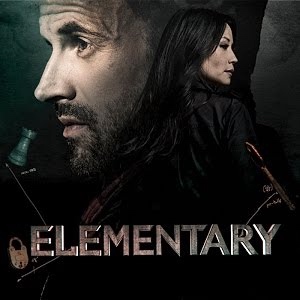
Elementary (Season 4 Episodes 14-16)
ElementaryI’m a little surprised I’m still with this “Sherlock Holmes in modern day America with a female Dr Watson” series, because it was never a particularly good version of Sherlock Holmes and it still isn’t. What it has turned out to be is a decent show in its own right (for a US network procedural, anyway), with sometimes-interesting characters who happen to share the names and the odd characteristic of Sir Arthur Conan Doyle’s famed creations. It’s so much its own show that it’s never really bothered adapting the canon, so it was very odd when episode 16, Hounded, didn’t just use a few names from The Hound of the Baskervilles (as the series has in the past), but actually had a passable swing at modernising the entire plot. It doesn’t seem to have gone down too well with critics and viewers, though for my money it did a much better job than Sherlock’s disappointing attempt.

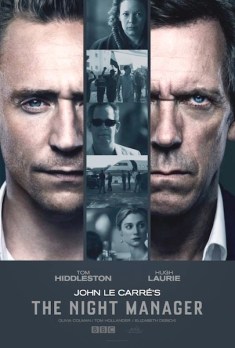
The Night Manager
The Night ManagerA lavish, all-star, ultra-hyped John le Carré adaptation that, thank goodness, lives up to its reputation. Although it wrapped up in the UK a couple of weeks ago, it only started in the US last night, and I recommend any America-based readers who enjoy a good thriller to get on board tout suite. The Night Manager doesn’t have a Tinker Tailor-style twisty-turny plot, but fills that gap with tension and suspense. Tom Hiddleston is a likeable hero, dragged in to something that might seem over his head, but which it emerges he has an affinity for. Hugh Laurie is a personably chilling villain, Olivia Colman kicks Whitehall ass, Tom Hollander perfectly judges a part that could’ve been caricature, and Elizabeth Debicki shows a very different side after her ice-cold villainess in The Man from U.N.C.L.E. As for talk of Hiddleston being the next Bond… initially his character here couldn’t seem further away from 007, lending credence to my presumption that everyone declared “he could be Bond!” just because he was in a spy series. But as it goes on, he gets to be suave, cunning, and sleep with pretty much every female character that isn’t his boss. So, yes, he could be Bond. At this point he’s certainly a better pick than too-old-for-it-now Idris Elba.

Also watched…
  • Gilmore Girls Season 4 Episode 18-Season 6 Episode 9Paul Anka, aww!
  • The People v. OJ Simpson: American Crime Story Season 1 Episodes 3-5 — aka The “22 Years Ago No One Knew Who the Kardashians Were, Isn’t That Funny?” Show.
  • Person of Interest Season 4 Episodes 4-15 — I know I moaned about this last month, but I’m actually rather enjoying this season now. Just as they cancel it. Typical.

    Things to Catch Up On
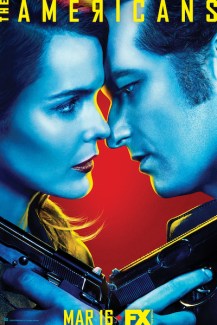
    The AmericansThis month, I have mostly been missing season four of The Americans, aka the most underrated drama on television. Well, apart from with critics, that is, who’ve given this run 100% on Rotten Tomatoes. I don’t know if anyone bothers to air it over here anymore (ITV ditched it after the second season), but I’ve always got it via other means anyhow, so it’s a moot point for me. I also save it all up and binge over a couple of weeks, because it really suits it — in the same way it suits, say, Game of Thrones, but as no one watches The Americans it’s much easier to avoid spoilers. This year, that means I won’t get stuck into it until sometime in June. Can’t wait. Well, I can, because I am. But you know what I mean.

    Next month… Game of F***ing Thrones returns!

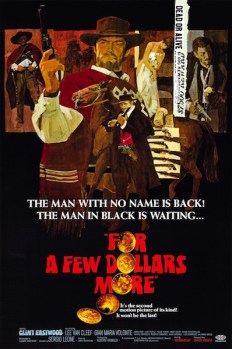
  • For a Few Dollars More (1965)

    100 Films’ 100 Favourites #31

    The man with no name is back!
    The man in black is waiting…

    Original Title: Per qualche dollaro in più

    Country: Italy, Spain & West Germany
    Language: English and/or Italian
    Runtime: 132 minutes
    BBFC: X (cut, 1967) | 15 (1986)
    MPAA: M (1969) | R (1989)

    Original Release: 18th December 1965
    UK Release: January 1967 (BBFC)
    First Seen: DVD, 2003

    Stars
    Clint Eastwood (Dirty Harry, Unforgiven)
    Lee Van Cleef (High Noon, Escape from New York)
    Gian Maria Volontè (Investigation of a Citizen Above Suspicion, Le Cercle Rouge)
    Klaus Kinski (Aguirre, Wrath of God, Fitzcarraldo)

    Director
    Sergio Leone (The Good, the Bad and the Ugly, Once Upon a Time in the West)

    Screenwriters
    Luciano Vincenzoni (Death Rides a Horse, The Good, the Bad and the Ugly)
    Sergio Leone (A Fistful of Dollars, Once Upon a Time in America)

    Scenario by
    Sergio Leone (The Colossus of Rhodes, A Fistful of Dynamite)
    Fulvio Morsella (My Name is Nobody, A Genius, Two Friends, and an Idiot)

    The Story
    A pair of bounty hunters team up, in spite of their mutual distrust, to capture the most wanted fugitive in the Wild West. That’s the short of it — the ins and outs get complicated.

    Our Heroes
    The Man With No Name (who this time is called Monco) is played as coolly as ever by Clint Eastwood. This time he teams up with The Man In Black — not Johnny Cash, but Colonel Douglas Mortimer. Much older than Monco, but played with equal amounts of cool by Lee Van Cleef.

    Our Villain
    El Indio, a murdering, raping, bank-robbing outlaw. Has his own gang; has greater loyalty to money. May also be the first character to smoke marijuana in a major film production.

    Best Supporting Character
    Klaus Kinski plays a hunchback. I mean, what more do you need to know?

    Memorable Quote
    “Where life had no value, death, sometimes, had its price. That is why the bounty killers appeared.” — title card

    Memorable Scene
    It’s a Leone film; there’s a tense climactic pistol duel — surely that’s all the recommendation you need.

    Memorable Music
    The score is by Ennio Morricone, of course, so of course it’s fantastic. His main theme for The Good, the Bad and the Ugly may be more famous, but personally I prefer this one.

    Letting the Side Down
    I suppose I should mention the dubbing, which is always skew-whiff in these movies. But it is what it is.

    Making of
    Leone felt that Gian Maria Volontè’s performance was too theatrical, so he often subjected the actor to multiple takes in an attempt to tire him out. Volontè eventually stormed off the set… but, unable to get a ride out of the desert, returned to filming.

    Previously on…
    A Fistful of Dollars, also starring Clint Eastwood and directed by Sergio Leone, started both the Man With No Name Trilogy (aka the Dollars Trilogy) and the entire Spaghetti Western subgenre.

    Next time…
    The Good, the Bad and the Ugly completes the trilogy — not that it was intended as such by Leone: US distributor United Artists invented the “Man with No Name” concept as a way to sell the three films together. Eastwood’s character actually has a name, and a different one in each film at that.

    What the Critics Said
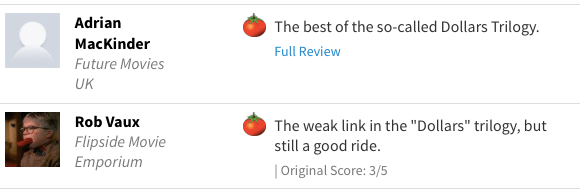
    For a Few Dollars More, like all of the grand and corny Westerns Hollywood used to make, is composed of situations and not plots [but] on a larger, more melodramatic scale, if that’s possible. […] The rest of the film is one great old Western cliché after another. They aren’t done well, but they’re over-done well, and every situation is drawn out so that you can savor it.” — Roger Ebert

    Score: 94%

    The Joys of Putting Different Reviews Right Next to Each Other

    What the Public Say
    “It’s a wacky and irreverent film, exactly the type of cheeky genre fare that you’d expect as the follow-up to a blatant act of plagiarism […] This irreverence is what makes the film fun, but it also never stops it from being intelligent. Like its predecessor was to a slightly lesser extent, For a Few Dollars More is a film about the value of life (often literally and monetarily) and the cost of our connections with other human beings (specifically men in this predominantly male society).” — Wes, Screening Notes

    Verdict

    Sergio Leone defined the Spaghetti Western subgenre with A Fistful of Dollars, and some would argue perfected it with The Good, the Bad the Ugly, but in between those two he made this, my favourite of the trilogy. Leone’s trademark style tells a story whose scope is in the sweet spot between the first film’s one-town tale and the third’s epic narrative, with a pair of sparky heroes going up against a ruthless villain, and a nice twist in the tail.

    #31 will be… Бонд зовут. Джеймс Бонд.

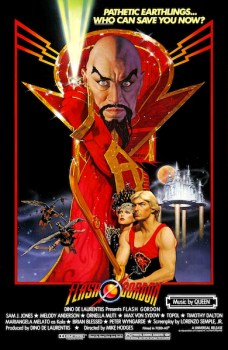
    Flash Gordon (1980)

    100 Films’ 100 Favourites #30

    Pathetic earthlings…
    Who can save you now?

    Country: UK & USA
    Language: English
    Runtime: 115 minutes
    BBFC: A (1980) | PG (1987)
    MPAA: PG

    Original Release: 5th December 1980 (USA)
    UK Release: 11th December 1980
    First Seen: c.1995

    Stars
    Sam J. Jones (10, Ted)
    Melody Anderson (Dead & Buried, Firewalker)
    Max von Sydow (The Seventh Seal, The Exorcist)
    Topol (Fiddler on the Roof, For Your Eyes Only)
    Ornella Muti (The Last Woman, Tales of Ordinary Madness)

    Director
    Mike Hodges (Get Carter, Croupier)

    Screenwriter
    Lorenzo Semple Jr. (Batman: The Movie, Three Days of the Condor)

    Adaptation by
    Michael Allin (Enter the Dragon, I’ll Be Home for Christmas)

    Based on
    Flash Gordon, a newspaper comic strip created by Alex Raymond.

    The Story
    American football player Flash Gordon and journalist Dale Arden accidentally end up on the spaceship of scientist Dr Zarkov, which transports them to the planet Mongo. There, they learn the planet’s evil Emperor, Ming the Merciless, is subjecting Earth to natural disasters in a bid to destroy it. Flash must unite the warring factions on Mongo to defeat Ming and save the Earth.

    Our Hero
    He’s a miracle, king of the impossible. Just a man, with a man’s courage, but he can never fail. He’ll save every one of us. Flash! Ah-ah!

    Our Villains
    Max von Sydow is deliciously villainous as evil emperor Ming the Merciless. There’s a handful of similarly entertaining underlings, too, like scheming right-hand-man Klytus, who gets a great death, and right-hand-woman Kala, who gets some of the very best lines.

    Best Supporting Character
    Prince Vultan may be culturally iconic for one two-word exclamation, but it kind of encapsulates the presence he brings throughout the film.

    Memorable Quote
    Zogi: “Do you, Ming the Merciless, Ruler of the Universe, take this Earthling Dale Arden, to be your Empress of the Hour?”
    Ming: “Of the hour, yes.”
    Zogi: “Do you promise to use her as you will?”
    Ming: “Certainly!”
    Zogi: “Not to blast her into space? …uh, until such time as you grow weary of her.”
    Ming: “I do.”

    Quote Most Likely To Be Used in Everyday Conversation
    “Gordon’s alive?!” — Prince Vultan
    (Not that it’s likely to be appropriate in everyday conversation, but you’re still going to hear it said — especially if you’re ever around Brian Blessed.)

    Memorable Scene
    In Ming’s harem, Flash’s love interest Dale and Ming’s rebellious daughter Aura end up wrestling on a giant bed. Kinky! But it’s knowingly directed, with cutaways to sniggering servants indicating a deliberate commentary on such gratuitous girl-on-girl spectacles in other films.

    Write the Theme Tune…
    “Dum dum dum dum dum dum dum dum FLASH! Ah-ah! Saviour of the universe!” Rock group Queen composed the entire score for Flash Gordon, and their unmistakeable sound is a significant part of the film. Best of all is that main theme, surely one of the most memorable and hummable pop themes for a movie ever recorded. If you’re interested in the making of the soundtrack, there’s a detailed article on Queen’s official site.

    Technical Wizardry
    The design work is great. The sets, costumes, and spaceships are all huge, vibrant, retro, often ridiculous, and wonderful.

    Truly Special Effect
    Skies full of swirling rainbow colours, rainbow clouds for the spaceships to float through, platforms that tilt over a rainbow vortex… OK, there’s a lot of rainbows, but it’s unique and looks great.

    Letting the Side Down
    There is so little that’s bad about Flash Gordon that I’ve left this section in just to point out that there is nothing bad about Flash Gordon.

    Previously on…
    The most famous earlier version of Flash Gordon must be the three cinema serials starring Buster Crabbe that were produced between 1936 and 1940. They’re great fun (I nearly made space for one of them on this list, but… not quite). There was also a live-action TV series in the ’50s and an animated one in 1979.

    Next time…
    An animated TV movie followed that last TV series in 1982. Flash was part of the Defenders of the Earth animated series in the mid ’80s, alongside other heroes such as the Phantom. Another animated series came along in 1996, while a live-action reboot was attempted in 2007. It looked terrible, and I’ve heard it’s one of the worst TV shows ever made. Reports of a new film being in development come along now and then, with Kingsman’s Matthew Vaughn being the most recently attached director. Until that rolls around, Flash’s main claim to current pop culture relevance comes courtesy of Ted and its sequel.

    Awards
    3 BAFTA nominations (Music (because Queen), Costume Design, Production Design/Art Direction)
    3 Saturn nominations (Science Fiction Film, Supporting Actor (Max von Sydow), Costumes)
    1 Razzie nomination (Worst Actor (Sam J. Jones))
    Nominated for the Hugo for Best Dramatic Presentation

    What the Critics Said
    Flash Gordon is played for laughs, and wisely so. It is no more sophisticated than the comic strip it’s based on, and that takes the curse off of material that was old before it was born. This is space opera, a genre invented by Edgar Rice Burroughs and Hugo Gernsback and other men of unlimited imagination harnessed to definitely limited skills. It’s fun to see it done with energy and love and without the pseudo-meaningful apparatus of the Force and Trekkie Power.” — Roger Ebert

    Score: 82%

    What the Public Say
    Star Wars was squarely heterosexual, but Flash Gordon could only have emerged from the same pop-culture closet that birthed David Bowie, Elton John, Mick Jagger, and Freddie Mercury […] As for the empty-headed dialogue and the puerile plot, isn’t it obvious those are both part of the point? Everyone involved (well, except maybe Sam J. Jones) knows precisely what this is and performs accordingly, with a straight face but with a small gleam in the eye. […] I don’t know if I’d want to know anyone who couldn’t love this movie, or at least enjoy it on some level.” — Rob Gonsalves, eFilmCritic.com

    Elsewhere on 100 Films
    In 2009 I said that Flash Gordon was better than Star Wars. Well, I mean, I don’t know if I exactly stand by that, but I’m also not going to contradict it — Flash Gordon is awesome.

    Verdict

    Once reviled for being a laughably silly Star Wars cash in, the world has gradually begun to realise the truth: that Flash Gordon was always in on the joke. And it’s so obviously in on the joke, it makes a lot of the old reviews criticising it look embarrassingly tin-eared. It’s not meant to be a serious sci-fi adventure, like its big-screen Trek and Wars contemporaries. It’s designed to be camp, colourful, over-the-top, driven by cliffhangers and wackiness. It’s funny, it’s fun — it’s Flash! Ah-ah!

    #31 will be… slightly more expensive.

    Face/Off (1997)

    100 Films’ 100 Favourites #28

    It’s like looking in a mirror — only not

    Country: USA
    Language: English
    Runtime: 139 minutes
    BBFC: 18 (cut)
    MPAA: R

    Original Release: 27th June 1997
    UK Release: 7th November 1997
    First Seen: TV, 22nd September 2002 (probably)

    Stars
    John Travolta (Saturday Night Fever, Hairspray)
    Nicolas Cage (The Rock, Ghost Rider)
    Joan Allen (Nixon, The Bourne Supremacy)
    Alessandro Nivola (Mansfield Park, Jurassic Park III)
    Gina Gershon (Bound, P.S. I Love You)

    Director
    John Woo (Hard Boiled, Mission: Impossible II)

    Screenwriters
    Mike Werb (The Mask, Firehouse Dog)
    Michael Colleary (Darkman III: Die Darkman Die, Firehouse Dog)

    The Story
    FBI agent Sean Archer finally corners his nemesis, Castor Troy, knocking him into a coma in the process. Unfortunately, Troy has planted a bomb that will destroy Los Angeles, and the only other person who knows its location is his brother — and he ain’t talking. So Archer comes up with the perfectly sane and utterly foolproof plan to secretly have a face transplant and assume Troy’s identity. Unfortunately, the real Troy wakes up, takes Archer’s face, and kills everyone who knows the truth. Hilarity ensues! No, wait, it’s not that kind of movie — violent bloody action ensues.

    Our Hero
    Sean Archer, super cop. Looks like John Travolta, until he looks like Nicolas Cage. Don’t overthink it, it works just fine when you’re watching the film.

    Our Villain
    Castor Troy, super villain. Looks like Nicolas Cage, until he looks like John Travolta. Don’t overthink it, it works just fine when— wait, I did that bit.

    Best Supporting Character
    Castor’s brother, Pollux. Yes, that’s his name. Looks like Alessandro Nivola throughout.

    Memorable Quote
    Castor Troy: “Sean Archer here, who’s calling?”
    Sean Archer: “Well if you’re Sean Archer, I guess I’m Castor Troy.”

    Memorable Scene
    The good guy’s teenage daughter — played by Dominique “Lolita” Swain, as if to ram the point home — is hanging out in her bedroom wearing next to nothing, when in walks the villain, who starts perving over her… oh, and he’s got her dad’s face at the time. This is the kind of scene you can have when your body-swap movie is rated 18, I guess.

    Making of
    According to IMDb, the studio wanted John Woo to take the slash out of the title, but he kept it so people wouldn’t think it was a hockey movie. I don’t know why you’d think it was a hockey movie without the slash, or why adding a slash magically stops it being a hockey movie, but that’s what it says.

    Awards
    1 Oscar nomination (Sound Effects Editing)
    2 Saturn Awards (Director, Writer)
    7 Saturn nominations (Action/Adventure/Thriller Film, Actor (both Nicolas Cage and John Travolta), Supporting Actress (Joan Allen), Younger Actor/Actress (Dominique Swain), Music, Make-Up)
    2 MTV Movie Awards (including Action Sequence for the speedboat chase)
    4 MTV Movie Award nominations (including Best Villain, shared between Nicolas Cage and John Travolta)
    1 Golden Trailer Awards nomination (Best of the Decade)

    What the Critics Said
    “Travolta and Cage make superb adversaries, flip-flopping roles, first as hero, then as villain. What titilating fun to observe Cage seethe with venom and Travolta meet danger head-on, then see Cage become Travolta, as the latter adopts the unmistakable characteristics of the fiend. […] Face/Off is a masterpiece equal to the action classics Seven Samurai, The Wild Bunch and The Good, the Bad, and the Ugly.” — Roger Hurlburt, Sun Sentinel

    Score: 92%

    What the Public Say
    “Gorgeously shot with lots of Ol’ West style close up on the eyes while silence is only interrupted by the sounds of gun magazines falling to the ground. Woo’s directorial vision and the clever exchange of snark and built up bitterness displayed in the dialogue are just two of the beautiful components displayed in the first 30 minutes of this film that set the tone of the fucking masterpiece that it is.” — Amy Seidman, This Film Is Better Than You, Deal With It

    Verdict

    After making his name as an “heroic bloodshed” director par excellence with films like A Better Tomorrow, The Killer and Hard Boiled, John Woo headed for Hollywood… and made Van Damme vehicle Hard Target and nuclear-warhead-theft thriller Broken Arrow. But after those he made this, surely one of the best action movies of the ’90s. Its sci-fi high-concept allows Travolta and Cage to have a whale of a time in each other’s bodies, and Woo’s trademark OTT action is as exciting as ever.

    Next: #30, ah-ah! Saviour of the universe!

    The Empire Strikes Back (1980)

    100 Films’ 100 Favourites #27
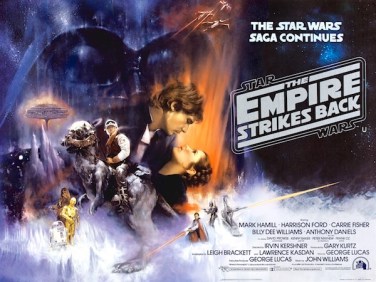
    The Star Wars Saga Continues

    Also Known As: Star Wars: Episode V – The Empire Strikes Back

    (I may be a young whippersnapper, but I’m old enough that, when I was a kid, we still called it just The Empire Strikes Back. I thought that would be a nicer place for it among my 100 Favourites, therefore.)

    Country: USA
    Language: English
    Runtime: 124 minutes | 127 minutes (special edition)
    BBFC: U
    MPAA: PG

    Original Release: 21st May 1980 (UK)
    US Release: 20th June 1980
    First Seen: VHS, c.1990

    Stars
    Mark Hamill (Star Wars, The Big Red One)
    Harrison Ford (Raiders of the Lost Ark, Air Force One)
    Carrie Fisher (Star Wars, Hannah and Her Sisters)
    Billy Dee Williams (Mahogany, Batman)
    Frank Oz (The Muppet Movie, Monsters, Inc.)

    Director
    Irvin Kershner (Never Say Never Again, RoboCop 2)

    Screenwriters
    Leigh Brackett (The Big Sleep, The Long Goodbye)
    Lawrence Kasdan (Raiders of the Lost Ark, Wyatt Earp)

    Story by
    George Lucas (Raiders of the Lost Ark, Willow)

    The Story
    After the evil Galactic Empire uncovers the Rebel Alliance base on Hoth, our heroes flee for the stars. Guided by a message from beyond the grave, Luke heads to meet an old Jedi master. Meanwhile, Han, Leia, Chewie, and the droids hide for a bit, then go to meet the only black man in the galaxy…

    Our Heroes
    Luke Skywalker: ace pilot; Jedi in training.
    Han Solo: reformed criminal.
    Princess Leia: wait, hold on, her planet was destroyed — surely now she’s either Queen Leia or, y’know, nothing?

    Our Villain
    Darth Vader: daddy issues personified.

    Best Supporting Character
    R2-D2 is the best supporting character in every Star Wars film, but in this one we are introduced to Yoda. Looks like a Muppet, as cheeky as a Muppet, much wiser than a Muppet. Probably. It’s hard to be certain.

    Memorable Quote
    “Try not. Do, or do not. There is no try.” — Yoda

    Quote Most Likely To Be Used in Everyday Conversation
    Leia: “I love you.”
    Han: “I know.”

    Memorable Scene
    After a dramatic lightsaber duel, Darth Vader lops off Luke’s hand, his weapon disappearing with it. As Luke dangles over an endless fall to Certain Death, Vader decides this is the perfect moment to impart a big secret…

    Memorable Music
    The Star Wars Main Theme is all well and good, but here regular composer John Williams introduces us to arguably an even more iconic tune — it certainly gets played outside of the films more often, as a universal signifier of evil. That’s right, it’s the Imperial March! All together now: dum dum dum dum-duhdum dum-duhdum…

    Truly Special Effect
    To animate the tauntauns, Phil Tippett and ILM pioneered the use of go motion, a version of stop-motion animation that moves the puppet while the frame is being exposed so as to create motion blur, thereby making the effects more realistic. (It purposefully wasn’t used for the AT-AT walkers, to emphasise their mechanical movement by keeping it slightly jerky.) Go motion would go on to be used on films including Dragonslayer, E.T., RoboCop, and Willow. It was going to be used for the dinosaurs in Jurassic Park, but then someone had another idea…

    Letting the Side Down
    Lucas’ Special Edition fiddling isn’t as prevalent in Empire as in its original trilogy compatriots. If anything, the big windows in Cloud City are a nice touch.

    Making of
    The crew took crates of simulated snow from the Hoth set to the shoot in Norway, in case there wasn’t enough real snow on location. Somewhat ironic, then, that the location was hit by a snowstorm, coating the region so thoroughly that some of the scenes set in Hoth’s wilderness were filmed right outside the crew’s hotel.

    Previously on…
    The story begins, of course, in Star Wars. There’s tonnes of other material set before Empire, not least the infamous prequel trilogy.

    Next time…
    The Star Wars universe is immense, so don’t expect me to even attempt a summation of it. At the most essential, Return of the Jedi picks up the dangling threads of Empire and completes the trilogy, while last year’s The Force Awakens continues the narrative decades later, with more instalments to come in 2017 and 2019.

    Awards
    2 Oscars (Sound, Special Achievement in Visual Effects)
    2 Oscar nominations (Score, Art Direction-Set Decoration)
    1 BAFTA (Music)
    2 BAFTA nominations (Production Design, Sound)
    4 Saturn Awards (Science Fiction Film, Actor (Mark Hamill), Director, Special Effects)
    4 Saturn nominations (Supporting Actor (Billy Dee Williams), Writing, Music, Costumes)
    Won the Hugo for Best Dramatic Presentation
    1 WGA Award nomination (Best Comedy Adapted from Another Medium — yes, really)

    What the Critics Said
    “It’s almost too much to expect that a sequel can ever top the success of the original, and I suspect that this will prove the case with The Empire Strikes Back […] While Empire doesn’t quite measure up to Star Wars in the freshness and originality of its script, and the plethora of space operas that has been jamming the screens ever since Star Wars has somewhat lessened the novelty of city-sized ships sailing the stratosphere, nevertheless this 20th Century-Fox release remains a rattling good entertainment, a worthy successor to the original — and far and away the best of its kind since Star Wars itself.” — Arthur Knight, The Hollywood Reporter (This original 1980 review also mixes up Yoda and Boba Fett. Fun.)

    Score: 94%

    What the Public Say
    “the movie suffers from as uneven a vibe as its forebear, with, especially, the midsection lacking in elements designed to wholeheartedly sustain one’s interest. This proves to be especially true of Luke Skywalker’s ongoing (and less-than-captivating) training at the hands of Frank Oz’s Yoda, as such interludes suffer from a lack of momentum that bring the proceedings to a dead stop at each and every turn. […] an erratically-paced yet consistently entertaining installment in a not-quite-great sci-fi series.” — David Nusair, Reel Film Reviews (This site gives Episodes III, IV, V and VI a rating of 3/4, but Force Awakens a full 4/4. Just so you know.)

    Elsewhere on 100 Films
    I’ve written about the original Star Wars trilogy twice before, both times back in 2007. Of The Empire Strikes Back’s modified DVD version, I said that “the big change comes in dubbing both Boba Fett and the Emperor with appropriate actors from the prequel trilogy […] Other than shunning the poor original actors in such a way, Empire is much the same as ever.” Then, treating the film as the fifth part of the saga, I wrote that “a variety of elements […] have a very different impact in light of what we’ve experienced in the first trilogy. The most obvious is the revelation that Vader is Luke’s father: it’s no longer a twist, of course, but the emotional impact on Luke still makes it an important moment. Yoda […] seems to have gone a little loopy after several decades alone on Dagobah”.

    Verdict

    What more is there to say about The Empire Strikes Back, really? According to some polls, it’s the greatest movie of all time; even if you don’t go that far, it’s a masterpiece of blockbuster science-fantasy adventure. Every moment is tuned to tickle the thrill-glands; every special effect a labour of love that, with their inventiveness and genuine physicality, remains largely impressive today. And it’s so well paced that most people completely overlook that the storyline is chronologically challenged (Luke travels to Dagobah, meets Yoda, learns a bunch of tricky Jedi skills, and heads off to Cloud City, all while the rest of the characters hide in an asteroid field and are locked up for about five minutes). Plus it has the audacity to end on an almighty cliffhanger/revelation double-header! And in that spirit: it’s not even my favourite Star Wars movie. But I’ll tell you about that another time.

    #28 will star… Travolta/Cage.
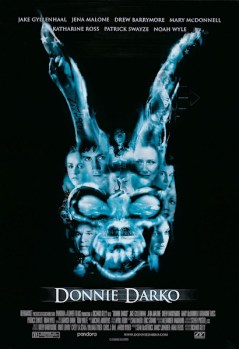
    Donnie Darko (2001)

    100 Films’ 100 Favourites #26

    Twenty-eight days, six hours,
    forty-two minutes, twelve seconds…
    that is when the world will end.

    Country: USA
    Language: English
    Runtime: 113 minutes | 134 minutes (director’s cut)
    BBFC: 15
    MPAA: R

    Original Release: 26th October 2001
    UK Release: 25th October 2002
    First Seen: cinema, November 2002

    Stars
    Jake Gyllenhaal (Brokeback Mountain, Prince of Persia: The Sands of Time)
    Jena Malone (Saved!, Batman v Superman: Dawn of Justice – Ultimate Edition)
    Noah Wyle (A Few Good Men, The World Made Straight)
    Drew Barrymore (Never Been Kissed, 50 First Dates)
    Patrick Swayze (Dirty Dancing, Ghost)

    Director
    Richard Kelly (Southland Tales, The Box)

    Screenwriter
    Richard Kelly (Domino, Southland Tales)

    The Story
    Troubled teen Donnie Darko is saved from a jet engine falling on his bedroom by a vision of a grotesque rabbit that tells him the world will end in less than a month. Over the coming weeks, more strange and possibly supernatural events occur, and it all gets quite complicated and stuff.

    Our Hero
    “Donnie Darko. What the hell kind of name is that? It’s like some sort of superhero or something.” “What makes you think I’m not?” The eponymous teenager is a troubled young man, possibly suffering from paranoid schizophrenia, who begins to perform acts under the influence of his imaginary rabbit friend.

    Our Villains
    Who’s the greatest evil: Frank, the six-foot imaginary rabbit who proclaims the world is going to end; Jim Cunningham, the motivational speaker with dark secrets; or moral-crusading gym teacher Kitty Farmer?

    Best Supporting Character
    New girl in town Gretchen may be the only person who ‘gets’ Donnie. Bonus points to Kelly for writing a geek-fantasy girlfriend character who doesn’t conform to the Manic Pixie Dream Girl stereotype.

    Memorable Quote
    Donnie: “Why are you wearing that stupid bunny suit?”
    Frank: “Why are you wearing that stupid man suit?”

    Quote Most Likely To Be Used in Everyday Conversation
    “Sometimes I doubt your commitment to Sparkle Motion.” — Kitty Farmer

    Memorable Scene
    Donnie wakes up in the middle of nowhere at dawn, in his pyjamas but with his bike discarded nearby. As he rides home, we see snapshots of his small town and his family, all set to The Killing Moon by Echo and the Bunnymen.

    Memorable Music
    The film makes strong use of contemporary pop music. It all seems to sit perfectly, which is a little ironic as a good number of tracks were changed because they couldn’t afford the rights on such a low budget. The director’s cut restores some of the original choices, which was a mistake. The film’s soundtrack composer, Michael Andrews, and his chum Gary Jules recorded a cover of Tears for Fears’ Mad World for the film, which wound up being the coveted UK Christmas number one for 2003 (beating the likes of The Darkness’ Christmas Time (Don’t Let the Bells End), and Bill Nighy’s Christmas is All Around from Love Actually).

    Next time…
    Whoever owns the rights attempted to cash in with sequel S. Darko, about Donnie’s younger sister. Richard Kelly wasn’t involved at all. It was not well received.

    Awards
    Toronto Film Critics Association Awards special citation for “the best film not to receive a proper theatrical release in Canada”.

    What the Critics Said
    “has a texture and tang all its own, despite its remarkable mixture of genres and expressive modes — horror, romance, science fiction, teen flicks, and Robert Bresson meets Generation Y, to name a few. There’s also a dry realism in its evocation of suburban life, which abrades nicely against the bouts of slow- and fast-motion photography that jiggle time and make the ordinary shiver. Kelly, who also wrote the script, has a great ear for family dinner-table arguments about politics, teenage debates about the sexual habits of Smurfs, and the quotidian absurdities of small-town colloquy. Local busybody Kitty Farmer’s near-hysterical complaint to Donnie’s mother, “Sometimes I doubt your commitment to Sparkle Motion” (the name of their daughters’ dance troupe), is for some unfathomable reason my favourite line of dialogue this year.” — Leslie Felperin, Sight & Sound

    Score: 85%

    What the American Critics Said About the Director’s Cut
    “First-time writer-director Richard Kelly’s breathtakingly ambitious Donnie Darko was one of the best pictures released in 2001. Now that it has returned in a 20-minute longer — and richer — director’s cut, it seems sure to be ranked as one of the key American films of the decade.” — Kevin Thomas, Los Angeles Times

    What the British Critics Said About the Director’s Cut
    “If it’s your first viewing, you should still be wowed by an astounding masterpiece. But this is undoubtedly the lesser of the two cuts, and since you have the choice, you should stick with version one. […] All this director has done is cut a star off his five-star debut.” — William Thomas, Empire

    Score: 91%

    What the Public Say
    “Maybe Richard Kelly’s fate is to be the cult circuit’s Michael Cimino — forever admired for one great film amid subsequent missteps, including a director’s cut of the same movie. Kelly has yet to match the mysterious mood or magnitude of his filmmaking debut […] a collision of time-travel sci-fi, commentary on ’80s Reaganomics malaise and teen angst that’s simultaneously witty and poignant. Non-Darkolytes should start with the enigmatic theatrical cut and proceed further if curious.” — Nick Rogers, The Film Yap

    Verdict

    When it finally made its way to UK shores, about a year after its initial US release, Donnie Darko was something of a hit — it made more money here than Stateside, in fact. I know several people who stumbled upon it “just because it was showing”. Conversely, I made a special trip to see it at a distant cinema at an inconvenient hour, having heard about it from US reviews. I would’ve been 16, which is probably the best kind of age to become enamoured of its misunderstood teen hero and its complicated, semi-inexplicable sci-fi story. I haven’t actually watched it for years, and never made time for the divisive director’s cut, but (whatever I’d think of it now) it remains a key touchstone in my teenage film experience.

    #27 will be…

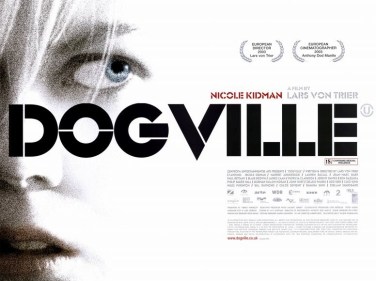
    Dogville (2003)

    100 Films’ 100 Favourites #25

    A quiet little town not far from here.

    Full Title: The film “Dogville” as told in nine chapters and a prologue

    Country: Denmark, Sweden, UK, France, Germany & the Netherlands
    Language: English
    Runtime: 178 minutes
    BBFC: 15
    MPAA: R

    Original Release: 21st May 2003 (Belgium, Switzerland & France)
    UK Release: 13th February 2004
    First Seen: DVD, c.2005

    Stars
    Nicole Kidman (Moulin Rouge!, Stoker)
    Paul Bettany (A Beautiful Mind, Priest)
    Lauren Bacall (The Big Sleep, The Shootist)
    Stellan Skarsgård (Insomnia, The Girl with the Dragon Tattoo)
    John Hurt (The Tigger Movie, Perfume: The Story of a Murderer)

    Director
    Lars Von Trier (Breaking the Waves, Antichrist)

    Screenwriter
    Lars Von Trier (The Idiots, Melancholia)

    The Story
    On the run from the mob, Grace arrives in the remote town of Dogville. Its residents agree to shelter her in order to prove their community values, though in return she must do chores for them. As the search for the missing woman repeatedly visits the town, the people’s demands for recompense for the risk they are taking intensifies…

    Our Hero
    Grace is a sweet, desperate young woman, happy to work for the good Christian people of Dogville in payment for their kindness. As her good nature is gradually worn down, she becomes enslaved by them — though it may turn out there’s more to her than meets the eye…

    Our Villains
    Of course there aren’t any villains in the town of Dogville — everyone’s a morally upstanding citizen.

    Best Supporting Character
    Not technically a character, but the Narrator is a palpable presence in the film. The material Von Trier has written for him is just the right side of verbose, and John Hurt delivers it with inestimable class.

    Memorable Quote
    “Whether Grace left Dogville, or on the contrary Dogville had left her — and the world in general — is a question of a more artful nature that few would benefit from by asking, and even fewer by providing an answer. And nor indeed will it be answered here.” — Narrator

    Memorable Scene
    The scenes that stick in the mind from Dogville — aside from the opening shot I shall discuss next — are either harrowing, spoilersome, or both, and so don’t merit discussion in a format potentially perused by neophytes.

    Technical Wizardry
    The famous bare set — a black soundstage with chalk markings on the floor to represent the houses, and minimal other features or props — was inspired by the theatre of Bertolt Brecht; as was the film’s plot, so it’s rather apt. The set (or lack thereof) seems like a very “art house” idea, and a distancing one for the viewer, but it’s surprising how quickly you forget and accept it.

    Making of
    The opening bird’s-eye shot of the town: physically impossible, because the studio’s roof wasn’t high enough, so the final result is actually 156 separate shots stitched together.

    Next time…
    Supposedly the first part of a trilogy called “USA: Land of Opportunities”. The second part, Manderlay, was released in 2005, starring Bryce Dallas Howard in Kidman’s role. The concluding part, Wasington, seems to have fallen out of Von Trier’s interest.

    Awards
    Nominated for the Palme d’Or.
    Won the Palm Dog.

    What the Critics Said
    “Von Trier’s detractors – and there are many – will argue that this is nothing more than filmed theatre. […] But Anthony Dod Mantle’s digital video camera isn’t simply documenting a performance. It restlessly and fearlessly intrudes into this place and into these lives. Its close-ups – capturing key emotions as they flicker across the characters’ faces – are vital to describing the moral arc of the story. This is something that can only be achieved cinematically, an intensity that’s impossible to render elsewhere, not even from the front row of a playhouse’s stalls.” — Alan Morrison, Empire

    Score: 70%

    What the American Critics Said
    “what most reviews are discussing is the success or failure of the film as a critique on America. There’s a sense of discussion, not of the themes dissected, but more of whether the film deserved consideration as an anti-American film, and whether it was a bad film because of it. Released in an altogether post-9/11 world, attacking America in any way shape or form, cinematic, politically, or philosophically, constituted an echo of the violence of two or three years before. […] now that we’ve learned to accept critique not as an attack, but for exactly what it is, critique, we can get to the real heart of Dogville, and we can stop nitpicking whether or not it was a deserved attack on American culture, or whether it should be written off as an “anti-American” movie” — Karl Pfeiffer
    (That piece goes on to be a very interesting analysis of the film, by-the-way, particularly with regards to it being an allegory for Christianity.)

    What the Public Say
    “Lars, despite his ever intrusive camera, keeps us at a distance from his characters. This is not a criticism nor do I think this is unintentional. I think he does this to make sure we don’t lose sight of the message he is trying to share with us. He wants us to look at ourselves through these people, not get lost in their drama. The message of Dogville is a pessimistic one: At humanity’s core, we are bad people who will turn on our brother to protect ourselves. Altruism does not exist. Americans are smugly self-righteous. And even those of us who deem ourselves most pure are never above revenge.” — Cineaste

    Verdict

    It’s no surprise that Lars Von Trier would be responsible for such a provocative, difficult, divisive film — indeed, that’s what all his films are, aren’t they? Whether that works or not is often down to the individual, with each of his films being hailed as masterpieces by some and condemned as drivel by others. Dogville is no different. A three-hour movie that takes place in a black-box theatrical-style environment may sound tough, but engrossing performances and a symbolic storyline with a cathartic ending keep it… not enjoyable, exactly, but fascinating.

    #26 will be… 28 days, 6 hours, 42 minutes, 12 seconds from the end.

    100 Films v 2016: Month of March

    Tell me — do you watch films?

    You will.


    Barely Lethal#45 Chappie (2015)
    #46 Blackhat (2015)
    #47 The Witches of Eastwick (1987)
    #48 Teenage Mutant Ninja Turtles (2014)
    #49 Barely Lethal (2015)
    #50 The Book of Life (2014)
    #51 Kill List (2011)
    #52 Fast & Furious 7 (2015), aka Furious Seven
    Lincoln#53 Beverly Hills Cop II (1987)
    #54 Office Space (1999)
    #55 Exodus: Gods and Kings (2014)
    #56 The Boxer from Shantung (1972), aka Ma Yong Zhen
    #57 The Descendants (2011)
    #58 One-Armed Swordsman (1967), aka Du bei dao
    #59 The Hunger Games: Mockingjay – Part 2 (2015)
    Batman v Superman#60 Bridge of Spies (2015)
    #61 Scotland, Pa. (2001)
    #62 Lincoln (2012)
    #63 Brooklyn (2015)
    #64 Turbo Kid (2015)
    #65 Batman v Superman: Dawn of Justice (2016)
    #66 The Color Purple (1985)
    #67 Grave of the Fireflies (1988), aka Hotaru no haka


    • After sitting out last month, I got back to WDYMYHS in March with IMDb voters’ 7th favourite war movie, 5th favourite ’80s movie, and 3rd favourite animated movie: Studio Ghibli’s Grave of the Fireflies.
    • With Bridge of Spies coming out on Blu-ray, Lincoln premiering on TV, and The Color Purple being removed from Amazon Prime Instant Video, the last week of March turned into a bit of a Spielberg-athon for yours truly. I’m now just 3¼ films away from finally having seen all his features…
    • Value For Money Assessment, Part 4: adding 10 more films from Now TV to the 10 (plus the Oscars) from last month gives a final cost of £0.48 per film. I’d say that’s good value.


    With 23 new films watched this month, March 2016 joins the elite pantheon of months to reach 20 films — it’s only the sixth ever, and the third this year. In the process, it became the 22nd consecutive month with a 10+ total; it leapt spryly over March’s previous best tally (2013’s 17); and it handed 2016 the record for earliest #50, on the 6th (besting last year’s 8th April). It raises the March average from 11 to 12.3, and nudges the 2016 average up a smidgen from 22 to 22.3.

    And there I was thinking that 13 hours of Daredevil would knacker my film viewing. (As it is, I’m actually only 10 hours through Daredevil. It’s really good, though.)

    I normally end this with a prediction for the rest of the year, but they feel increasingly meaningless. I mean, they’ve always been meaningless — they’re based on averages, which only hold true until they don’t — but I’m still intending to cut back on film viewing this year (at some point), so they’ll definitely go awry. That said, I’m also intending to maintain my 10-film-minimum for a second calendar year, meaning 2016’s final tally should be at least 157 films. And, frankly, I’m intending April and May to continue in a similar vein to these first three months; at least until I reach #100, anyway. Assuming I do get there in May (which will be a whole Thing that I’ll discuss at the time), 2016 will be looking towards 170+ films.

    2015 has really recalibrated my notion of “a lighter year”…


    This month: Bourne, Bond, and Ben Affleck twice.


    The 10th Monthly Arbitrary Awards

    Favourite Film of the Month
    Although a couple of fun action movies turned my head this month, none of them were fun enough to detract from the sheer class of Steven Spielberg’s collaboration with Abraham-Lincoln-pretending-to-be-Daniel-Day-Lewis-pretending-to-be-Abraham-Lincoln (last time I make that joke, promise) in Lincoln.

    Least Favourite Film of the Month
    My memories of it have softened a little in the four weeks since I watched it, but as it remains the only film this month that I’ve got down for a 2-star rating, the loser is Michael Mann’s disappointing cyber thriller Blackhat.

    Winner of Batman v Superman
    Wonder Woman.

    Loser of Batman v Superman
    Film critics, apparently. Or not.

    The Audience Award for Most-Viewed New Post of the Month
    This almost went to everyone’s favourite movie about a blind superhero*, but it was edged out by everyone’s second favourite filmed production of Shakespeare’s Scottish play starring an actor who’s also played Magneto** — Macbeth.

    * It’s true! If you can find another one, I’ll retract that statement.
    ** OK, I’m certain some people prefer the Fassbender one to the old McKellen-and-Dench one, but acknowledging that fact would’ve ruined the mirroring structure of my sentence.


    ¾.