The Up-to-Date Monthly Update for November 2016

The penultimate monthly update for 2016 has a higher-than-usual compliment of films from 2016. How up-to-date of me.


#172 Bridesmaids (2011)
#173 Love & Friendship (2016)
#174 Batman: Return of the Caped Crusaders (2016)
#175 The Pianist (2002)
#176 Kung Fu Panda 3 (2016)
#177 Swiss Army Man (2016)
#178 Suicide Squad (2016)
#179 Arrival (2016)
#180 10 Cloverfield Lane (2016)
#181 The Deer Hunter (1978)
#182 Fantastic Beasts and Where to Find Them (2016)
#183 Star Trek Beyond (2016)
#184 Napoleon (1927), aka Napoléon vu par Abel Gance
#185 Jason Bourne (2016)
Arrival

Fantastic Beasts and Where to Find Them

.


  • I watched 14 new films again this month (same as last). That makes this my 30th consecutive month with 10 or more new films.
  • As I mentioned, there were quite a few films from 2016. The total is ten, to be precise, or 71.4% of this month’s viewing. I’ll rate them when I review them, but scroll down to the Arbies for more about which I liked and disliked.
  • I spent three nights watching the 5½ hours of Abel Gance’s Napoleon, which made its hotly-anticipated Blu-ray debut this month. Still only counts as one film, though.
  • Making up for last month, I found time for two WDYMYHS films. Both are excoriating depictions of wartime: Roman Polanski’s story of life in the Warsaw ghettoes during World War 2, The Pianist; and Michael Cimino’s controversial take on the Vietnam war and its effect on (American) combatants, The Deer Hunter.


The 18th Monthly Arbitrary Awards

Favourite Film of the Month
Quite a few enjoyable films this month, particularly among all those 2016 ones, but the one of the highest quality was definitely Denis Villeneuve’s venture into science-fiction drama, Arrival.

Least Favourite Film of the Month
Conversely, the weakest film this month also comes from 2016. I wanted to find the critics were wrong and side with the audiences who boosted it into the top 75 highest grossing films of all time, but no, Suicide Squad is a disappointing mess.

Longest Film of the Year (So Far)
I watched the ’59 Ben-Hur back in September, a film whose notoriously epic running time — 222 minutes, or 3¾ hours — would, most years, stand as unlikely to be surpassed. Thanks to the BFI, however, it has: Abel Gance’s silent epic Napoleon is a full 111 minutes longer at 333 minutes, aka 5½ hours.

Most Consistent Use of a Song
They’re back again: after 14 years and five films, Jason Bourne still ends with Moby’s Extreme Ways, just like every other film in the series. Never may it end.

The Audience Award for Most-Viewed New Post of the Month
I confess to being slightly surprised by this month’s most-seen post. Besting several new releases (Batman: Return of the Caped Crusaders was 2nd) and all-time favourites (Star Wars was 3rd), this month’s victor was my review of Denis Villeneuve’s arty psychological thriller Enemy.


Films that broke new ground rub shoulders with ones that settled into comfortable grooves, with everything from children’s movies about toys to adult movies about puppets.


As regular readers may have ascertained from the occasional reference I’ve made, I’m going to be away for a chunk of December. It’s not actually some big secret, it just wasn’t especially pertinent ’til now. We’re off on a family holiday to Hogwarts… in sunny Orlando, Florida. And all the other stuff, like Disney World and the Kennedy Space Center, all that jazz; but it was inspired by, as grown-up adult human beings, wanting to go to the Harry Potter theme parks. Something something for all ages, something something young at heart, etc.

So as this is posted, I’m currently… sat at home in the UK, because we fly tomorrow. Anyway, that means this blog will be quieter than normal for a bit — and as I’m away for 72% of the time it would cover, no advent calendar this year. I know I’m severely damaging your enjoyment of the holiday season, but it can’t be helped. Sorry. I’d love to tell you that I nonetheless have a mass of reviews scheduled to post so it’ll be like I’m not even gone, but I don’t. However, my 100 Favourites will continue as advertised (next up: #95 on Sunday), and there will be a couple of other reviews scattered in between, too. I may check in on comments from time to time as well, what with the connectivity of our modern world — so don’t be a stranger, y’hear?

It’ll undoubtedly have an effect on how many films I watch, though — will December destroy the 30-month run of 10+ films?!

The Transporter (2002)

100 Films’ 100 Favourites #94

Rules are made to be broken.

Country: France & USA
Language: English, French & Mandarin
Runtime: 92 minutes
BBFC: 15
MPAA: PG-13

Original Release: 11th October 2002 (USA)
UK Release: 17th January 2003
First Seen: DVD, c.2003

Stars
Jason Statham (Snatch., Crank)
Shu Qi (The Storm Riders, The Assassin)
Matt Schulze (Blade II, Fast Five)
François Berléand (Au Revoir Les Enfants, The Chorus)

Directors
Louis Leterrier (The Incredible Hulk, Now You See Me)
Corey Yuen (The Legend of Fong Sai Yuk, DOA: Dead or Alive)

Screenwriters
Luc Besson (Léon, Lucy)
Robert Mark Kamen (The Karate Kid, Taken)

The Story
Frank Martin is “The Transporter”, a driver for hire who moves people and goods, no questions asked. He never looks inside the package… until, on one job, the package moves. Finding a young woman gagged inside, Frank winds up embroiled in her rescue from some very bad men.

Our Hero
Frank Martin, expert driver (he’s the titular transporter after all) and martial artist, as handy with his fists as he is with a steering wheel. Lives by a simple set of rules… which he breaks, because it’s a movie and it needs a plot.

Our Villain
Darren “Wall Street” Bettencourt, an American gangster who initially hires Frank, then tries to kill him — even though he did a good job! And you thought people who left unnecessarily low feedback on eBay were a pain.

Best Supporting Character
Inspector Tarconi, the local police detective who’s on to Frank but can’t prove anything. Comes through in the end, becoming Frank’s ally in the sequels.

Memorable Quote
“Rule #1: never change the deal.” — Frank

Memorable Scene
Oil everywhere + people wanting to fight = ingeniously slippery combat. Seriously, that one scene is the main reason the entire film is here.

Technical Wizardry
Jason Statham did most of his own stunts, fighting, and driving. That included learning martial arts to supplement his kickboxing abilities and, for one sequence, actually hanging off the bottom of a truck with just a wire up his leg for safety.

Letting the Side Down
The trailer showed Frank deflecting a missile with a tea tray. A missile. With a tea tray. It was removed from the final cut because Statham didn’t think audiences would believe it, but c’mon, this is an action movie, and that’s silly-awesome. I mean, deflecting a missile… with a tea tray!

Making of
The oil in the famous fight scene is actually molasses syrup. Apparently it was very sticky, which is kind of the opposite to its purpose in the film, but that’s movie magic for you.

Next time…
Two direct sequels of typically decreasing quality; a spin-off TV series that ran for two seasons; and a reboot movie last year, which went down badly but I quite enjoyed (for what it was). Plus: a mini-empire of similarly-styled Euro-produced English-language action movies masterminded by Luc Besson, the most famous of which is the Taken series.

What the Critics Said
“Post-Ghosts Of Mars, if anyone had suggested that big, bald, brusque Jase could hold his own as an action hero, they’d have been laughed out of town. And while he doesn’t exactly deliver an acting masterclass (his ‘American’ accent doesn’t quite stand up to the rigours of actually opening his mouth and talking), this is all about kicking ass and taking names. […] The spirit of Hong Kong action movies hangs heavily over The Transporter, most notably in the CG-free fight scenes which, thanks to former fight choreographer Yuen, have enough zing and originality to satisfy even Hong Kong aficionados. […] simultaneously the best (the fight scenes) and worst (everything else) action movie of the year. Destined for drunken Friday night rental heaven.” — William Thomas, Empire

Score: 54%

What the Public Say
The Transporter doesn’t hold up as well on a rewatch as I would have hoped. It’s a bit stop-start and the ending didn’t feel as BIG as it should have been. At the same time, it has a couple of outstanding scenes and no review of this film is complete without a reference to and expression of WTF?! about the now infamous oil-slick fight scene. Truly a marvel of film thinking, then perfectly executed. […] The Transporter is exactly the kind of daft film that Hollywood became ashamed of making — and it really shouldn’t have.” — Steve G @ Letterboxd

Verdict

The Transporter is neither big nor clever. In terms of the former, it’s a relatively small-scale, low-key action movie, not some Hollywood extravaganza; and in terms of the latter, it’s a relatively small-scale, low-key action movie, so of course it’s not been pumped full of brains. Instead it’s pumped full of adrenaline, with a brisk running time that serves up impressively choreographed action at a solid rate, with an amenably light tone in between the combat. It also made an action star of Jason “The Stath” Statham, which I’m sure some people would thank it for. It certainly brought down the average age of participants in The Expendables.

#95 is… indestructible.

Toy Story 2 (1999)

100 Films’ 100 Favourites #93

The toys are back!

Country: USA
Language: English
Runtime: 92 minutes
BBFC: U
MPAA: G

Original Release: 24th November 1999 (USA)
UK Release: 11th February 2000
First Seen: cinema, 2000

Stars
Tom Hanks (Apollo 13, The Da Vinci Code)
Tim Allen (Jungle 2 Jungle, Wild Hogs)
Joan Cusack (Addams Family Values, School of Rock)
Kelsey Grammer (Anastasia, X-Men: The Last Stand)

Director
John Lasseter (Toy Story, Cars 2)

Co-directors
Ash Brannon (Surf’s Up, Rock Dog)
Lee Unkrich (Finding Nemo, Toy Story 3)

Screenwriters
Andrew Stanton (Monsters, Inc., WALL·E)
Rita Hsiao (Mulan, My Little Pony: The Movie)
Doug Chamberlin (Bruno the Kid: The Animated Movie)
Chris Webb (Bruno the Kid: The Animated Movie)

Story by
John Lasseter (A Bug’s Life, Tinker Bell and the Pirate Fairy)
Pete Docter (Toy Story, Inside Out)
Ash Brannon (Surf’s Up, Rock Dog)
Andrew Stanton (Toy Story, Finding Dory)

The Story
After Woody is stolen by a nefarious toy collector, the rest of the toys set out to rescue him — but, tempted by the idea of spending eternity in a museum with friends from his TV show, does Woody want to be saved?

Our Heroes
Buzz and Woody are back, and now the best of friends. This time, Woody is confronted with his past when he meets a gang of other toys from the TV series he starred in, but will he stay with them or return to Andy? Meanwhile, Buzz sets out to rescue Woody, but has issues of his own to tackle when he comes face to face with his nemesis, Emperor Zurg.

Our Villain
Al McWhiggin, the owner of Al’s Toy Barn and serious toy collector, who steals Woody when he’s accidentally put in a yard sale box.

Best Supporting Character
Jessie, a cowgirl from Woody’s TV show. Fundamentally an excitable and chipper character, she was left distraught after being abandoned by her owner, and is now scared of being put back in storage — which will happen if Woody isn’t part of Al’s collection.

Memorable Quote
“You never forget kids like Emily, or Andy, but they forget you.” — Jessie

Memorable Scene
On their hunt for Woody, the other toys explore a giant toy emporium, in which Buzz comes across an aisle filled with fellow Buzzes. Spotting one with a new utility belt, he tries to acquire the accessory, only to awaken his double…

Making of
Toy Story 2 was originally commissioned by Disney as a direct-to-video sequel, because they did that a lot back then, and went into production without Pixar’s primary staff, who were already busy creating A Bug’s Life. When early work looked promising, Disney bumped the project’s status up to a full theatrical release. Conversely, Pixar were unhappy with the quality of what they were seeing. The main team took charge, redeveloping the film’s entire story in a single weekend, but still had to meet the release date Disney had already set. Although most Pixar films take years to produce, the production of Toy Story 2 was compressed into just nine months. The pressure got to people: at one point someone accidentally deleted 90% of the film’s files, representing two years work. Fortunately, another crew member working at home had back-ups of all but the last few days’ work.

Previously on…
The original Toy Story was the first computer-animated feature film.

Next time…
Toy Story 3 followed 11 years later, with Toy Story 4 set to come 9 years after that. Also shorts, TV specials, and the Buzz Lightyear spin-off (see last time).

Awards
1 Oscar nomination (Song)
7 Annie Awards (Animated Feature, Directing, Writing, Female Voice Acting (Joan Cusack), Male Voice Acting (Tim Allen), Music, Storyboarding)
2 Annie Awards nominations (Character Animation, Production Design)
2 Saturn nominations (Fantasy Film, Music)
1 Teen Choice Awards nomination (Choice Hissy Fit)

What the Critics Said
Toy Story 2 is a brilliant example of that rarest of Hollywood phenomena — a sequel to a major hit film that’s as good, if not better, than the original. This is mainly the result of a perfect mixture of two essential elements. First, there’s an excellent script by Andrew Stanton and his team of writers […] Second, there’s the remarkable technology developed by Pixar for the film A Bug’s Life. It’s this approach they’ve now taken to even greater heights […] These filmmakers have taken the 1995 characters and given them more depth, creating a new story that lets the toys interact in a larger world. It all comes down to amazing visuals and basic storytelling — and this is one heck of a good tale.” — Paul Clinton, CNN

Score: 100%

What the Public Say
Toy Story 2 is considered, by most, to be a perfect film. The characters are amazing. The stakes are higher than the first film. And the emotional beats hit harder than before. With two successes under their belt, it’s hard to believe that Pixar could not only be consistent with that quality, but somehow also manage to pull off something even more amazing than we thought possible. Expanding the mythology of this world and really making us feel for the toys that we forgot as children, Toy Story 2 is, in the words of Mary Poppins, practically perfect in every way.” — Jaysen Headley, Jaysen Headley Writes

Verdict

Sequels are notorious for not being as good as their progenitor. I feel like this is a trend that is increasingly being bucked — with everything Hollywood makes designed to be a franchise, Film 1 is often about setup and Film 2 is where the makers are allowed to do what they really wanted to do in the first place. But when you strike gold first time out, it’s still hard to do it justice second time round. Pixar do that and more here, with a sequel that is slicker, funnier, more exciting, and more emotional than its forebear. Even if it’s happening more often now, good sequels are still hard to do — trust Pixar to have got there ahead of the pack.

#94 will be… transportive.

Toy Story (1995)

100 Films’ 100 Favourites #92

The toys are back in town.

Country: USA
Language: English
Runtime: 81 minutes
BBFC: PG
MPAA: G

Original Release: 22nd November 1995 (USA)
UK Release: 22nd March 1996
First Seen: cinema, 1996

Stars
Tom Hanks (Sleepless in Seattle, Catch Me If You Can)
Tim Allen (Galaxy Quest, The Shaggy Dog)

Director
John Lasseter (A Bug’s Life, Cars)

Screenwriters
Joss Whedon (Alien Resurrection, Avengers: Age of Ultron)
Andrew Stanton (A Bug’s Life, John Carter)
Joel Cohen (Cheaper by the Dozen, Garfield)
Alec Sokolow (Cheaper by the Dozen, Garfield: A Tale of Two Kitties)

Story by
John Lasseter (Toy Story 2, Planes)
Pete Docter (Monsters, Inc., Up)
Andrew Stanton (Finding Nemo, Toy Story 3)
Joe Ranft (Beauty and the Beast, Cars)

The Story
In a world where toys come to life when humans aren’t around, Woody is six-year-old Andy’s favourite doll… until he gets Buzz Lightyear, a space ranger action figure, for his birthday. An upset Woody clashes with Buzz, but when the bickering pair are left behind during a house move they must work together to get back to their kid.

Our Heroes
Woody is a cowboy doll, the favourite of his kid, Andy, and consequently the leader of all Andy’s toys. That is until Andy gets a shiny new Buzz Lightyear action figure, whose newness ingratiates him with all the other toys. Plus, to Woody’s continued annoyance, Buzz believes he really is a space ranger and has no idea he’s just a toy.

Our Villain
Sid, Andy’s nasty neighbour kid who does terrible, terrible things to toys…

Best Supporting Character
Mr Potato Head, whose various body parts are slotted on and therefore removable and interchangeable. Hilarity ensues. Also has a nice line in snarky comments.

Memorable Quote
“To infinity, and beyond!” — Buzz Lightyear

Quote Most Likely To Be Used in Everyday Conversation
“You are a sad, strange little man, and you have my pity.” — Buzz Lightyear

Memorable Scene
One of Buzz’s claims as a real space ranger is that he can fly, so Woody challenges him to prove it. Buzz closes his eyes, dives off the bed… and, through a series of flukes, bounces and coasts his way around the room, landing back on the bed. “That wasn’t flying,” cries Woody, “that was falling with style!”

Memorable Song
The film’s themes are perfectly reflected in Randy Newman’s Oscar-nominated and endlessly catchy song, You’ve Got a Friend in Me. Both Toy Story sequels have tried to emulate it, with… less success.

Technical Wizardry
Only the whole movie — it was the first feature-length wholly-computer-generated animated film. As such, we have it to thank/blame for the current entire state of popular Western animation.

Making of
The animators perfected the movement of the toy soldiers by nailing a pair of shoes to a wooden plank and trying to walk around in them.

Previously on…
Toy Story was the first feature-length computer-animated film — there is, in that sense, literally nothing before it.

Next time…
Two feature film sequels, both of which are at least as artistically successful as this first, with a fourth set to follow in 2018. Also, three short films and two TV specials to date, plus direct-to-video spin-off movie Buzz Lightyear of Star Command: The Adventure Begins and the TV series that follows it. You could also argue the entirety of Pixar’s highly-praised output is a follow-up to the success of Toy Story, as well as American feature animation’s almost entire conversion from traditional cel animation to 3D CGI.

Awards
1 Special Achievement Oscar to John Lasseter for “the development and inspired application of techniques that have made possible the first feature-length computer-animated film.”
3 Oscar nominations (Original Screenplay, Song, Musical or Comedy Score)
1 BAFTA nomination (Visual Effects)
8 Annie Awards (Animated Feature, Directing, Writing, Producing, Music, Production Design, Animation, Technical Achievement)
1 Annie Awards nomination (Voice Acting (Tom Hanks))
2 Saturn nominations (Fantasy Film, Writing)
Nominated for the Hugo for Best Dramatic Presentation

What the Critics Said
“Far from just a technological breakthrough, this hellzapoppin fairy tale […] is a magically witty and humane entertainment. It has the purity, the ecstatic freedom of imagination, that’s the hallmark of the greatest children’s films. It also has the kind of spring-loaded allusive prankishness that, at times, will tickle adults even more than it does kids. The moment Mr. Potato Head arranges his snap-on features into a Cubist mash and says, ”I’m Picasso,” it’s clear that director John Lasseter and his team of writer-technicians have taken their most anarchic impulses and run with them. […] In its techno-cool photo-realist way, though, this movie, too, invites you to gaze upon the textures of the physical world with new eyes. What Bambi and Snow White did for nature, Toy Story, amazingly, does for plastic — for the synthetic gizmo culture of the modern mall brat. The film’s wit (and resonance) is that it brings toys to life exactly the way children do in their heads. It molds plastic into pure imagination.” — Owen Gleiberman, Entertainment Weekly

Score: 100%

What the Public Say
“The Animation is superb. Given that this was one of the first ever feature length computer animated movies, those guys at Pixar really hit the nail on the head. The colours are vibrant and the characters are dynamic. An excellent use of Blues, Yellows and Reds really accentuate the ‘children’ and ‘toys’ feel. There are also beautiful realistic elements such as a scene where Woody and Buzz find themselves under a lorry in a petrol station. With this, I was simply amazed at the attention to detail with the stones, tarmac and oil stains on the textures. It really looks like you are close-up to the ground and I love it!” — Alexander Potter, Pottercraft’s Pictures

Verdict

Just because something’s the first to do something doesn’t necessarily mean it’s any good, but Pixar didn’t strike gold with Toy Story just because computer animation was New. It’s the likeable characters, how they develop and learn, the amusing situations they’re put in, plus some heartwarming messages about friendship. There’s more emotion and character development in these wooden-and-plastic toys generated with pixels in a computer than many a film can achieve with real human beings, and that’s why Pixar came to revolutionise and dominate the Western animation genre.

Some would say “the original is still the best”, and it is up there, but on Sunday I will beg to differ…

#93 will be… a superior sequel.

Tomorrow Never Dies (1997)

100 Films’ 100 Favourites #91

Yesterday is a memory. Today is history.
Tomorrow is in the hands of one man.
Bond. You know the rest.

Country: UK & USA
Language: English, German, Danish, Mandarin & Cantonese
Runtime: 119 minutes
BBFC: 12 (cut, 1997) | 12 (cut more, 1998) | 15 (uncut, 2006) | 12 (uncut, 2012)
MPAA: PG-13

Original Release: 12th December 1997 (UK)
US Release: 19th December 1997
First Seen: cinema, December 1997

Stars
Pierce Brosnan (Dante’s Peak, The Ghost)
Jonathan Pryce (Brazil, Pirates of the Caribbean: The Curse of the Black Pearl)
Michelle Yeoh (Supercop, Crouching Tiger, Hidden Dragon)
Teri Hatcher (Tango & Cash, Coraline)
Judi Dench (Mrs Brown, The Best Exotic Marigold Hotel)

Director
Roger Spottiswoode (Turner & Hooch, A Street Cat Named Bob)

Screenwriter
Bruce Feirstein (GoldenEye, The World Is Not Enough)

Based on
James Bond, a character created by Ian Fleming.

The Story
Secret agent James Bond is deployed to investigate a media baron who is plotting to ignite a war between the UK and China to further his business empire.

Our Hero
The name’s Bond, James Bond. In his second outing as agent 007, Pierce Brosnan has settled comfortably into his interpretation of the hero, a mix of Roger Moore’s eyebrow-raising levity with some of Sean Connery’s slightly harder, man-of-action edge.

Our Villain
Elliot Carver is a megalomaniac media mogul — the owner of the newspaper Tomorrow, who intends to secretly provoke a war in order to boost sales and ratings. James Bond does satire? Kinda.

Best Supporting Character
Wai Lin, a spy who’s investigating Carver for the Chinese. A skilled martial artist, she kicks all kinds of ass. Despite initial mistrust, she and Bond ultimately team up. Lin is arguably one of the first Bond girls who can genuinely claim to be a competent character in her own right. Still ends up sleeping with Bond, though.

Memorable Quote
Admiral Roebuck: “With all due respect, M, sometimes I don’t think you have the balls for this job.”
M: “Perhaps. But the advantage is I don’t have to think with them all the time.”

Memorable Scene
Remote control car, James Bond style: Bond lies in the backseat of his BMW, driving it around a multi-storey car park with his mobile phone, deploying its weapons against a gang of attackers. It was a fun concept back in ’97, but I imagine you could do it yourself with an app now. Apart from the weapons. And the legal implications. So maybe not.

Memorable Music
After the disastrous ‘modern’ score for GoldenEye, music duties were here handed to David Arnold. At the time he had composed the scores for Stargate and Independence Day, but, even more pertinently, he had produced Shaken and Stirred, an album of contemporary-styled covers of great Bond themes. The album was heard by iconic Bond composer John Barry, who then recommended Arnold to producer Barbara Broccoli. Arnold’s score is much more in-keeping with classic Bond music, but given a modern (well, ’90s) flavour. Backseat Driver, the soundtrack to my Memorable Scene pick, is a particularly great action cue. Arnold would become the series’ composer for the next four films, until Sam Mendes chose to use his regular collaborator Thomas Newman for Skyfall and Spectre. With Mendes moving on, perhaps Arnold will be back for Bond 25…

Write the Theme Tune…
Arnold wanted to have a hand in writing the title song and integrate it into his soundtrack, like the great Bond composers of old. To that end he wrote a theme sung by k.d. lang… which plays over the end credits and is titled Surrender, though has a tellingly prominent use of the phrase “tomorrow never dies” in its lyrics.

Sing the Theme Tune…
The producers went with a more marketable proposition for the final opening credits song, however, in the shape of Sheryl Crow, famous for her pop-rock-y hits like All I Wanna Do, A Change Would Do You Good, and Everyday is a Winding Road. In the pantheon of Bond title themes, her Tomorrow Never Dies sits firmly in the middle — it’s not a GoldenEye, but it’s not a Die Another Day either.

Making of
The film was originally called Tomorrow Never Lies, referencing Carver’s newspaper, Tomorrow. Some kind of production mix-up (a typo, a smudged fax — pick your story) led to it being misread as Tomorrow Never Dies, and the new, less meaningful title stuck.

This Category Sponsored By BMW
Apparently Tomorrow Never Dies was the first movie in history to have its entire budget covered by product placement endorsements — that’s over $100 million in advertising. Featured companies include BMW, L’Oréal, Heineken, Dunhill, Ericsson, Omega, Smirnoff, Brioni, Bollinger, and Avis, plus a tie-in game from Electronic Arts.

Previously on…
17 previous Bond films (which are all technically in the same continuity). The previous one, GoldenEye, was the first to star Pierce Brosnan and relaunched the series to mass popularity after a fallow period.

Next time…
Two more Brosnan Bonds, before he was unceremoniously dumped to reboot the series for the first time. With a 25th film now in the works, the series is set to continue indefinitely.

Awards
1 Saturn Award (Best Actor (Pierce Brosnan))
3 Saturn nominations (Action/Adventure/Thriller Film, Supporting Actress (Teri Hatcher), Music)
2 MTV Movie Awards nominations (Action Sequence for the motorcycle/helicopter chase (somehow it lost to Face/Off), Best Fight for “the fight between Michelle Yeoh and some ‘bad guys’.”)

What the Critics Said
“East meets West, yin meets yang and chop-socky meets kiss-kiss bang-bang in Tomorrow Never Dies, a zippy 007 romp that draws as heavily from the Asian action genre as from the formula that has served the series so well for 35 years. Goldeneye and Pierce Brosnan’s debonair Bond resuscitated the creaky franchise in 1995, but […] Tomorrow, jazzier, wittier and more costly than its predecessor, also comes closer to catching up with ’90s style and politics. […] Hong Kong kung-pow chick Michelle Yeoh, as the cool-headed Chinese agent Wai Lin, proves 007’s equal at kicking post-Cold War butt. The two take on craven communications baron Elliot Carver (Jonathan Pryce), a deliciously exaggerated — or is it? — composite of Ted Turner, Rupert Murdoch and the late Robert Maxwell. Carver’s not only the most plausible Bond nemesis ever but the perfect one for the current global villain shortage.” — Rita Kempley, The Washington Post

Score: 57%

What the Public Say
TND is somewhat underrated. Jonathan Pryce plays a villain who is essentially Rupert Murdoch smooshed together with Ted Turner. His plan isn’t to take over the world so much as it is getting rich by starting a war and then covering it on his news outlets. This just may be the most plausible Bond villain scheme of all times – which admittedly isn’t saying much. […] TND may not be among the best Bonds, but it’s got more going for it than I think it gets credit for.” — Lebeau, Lebeau’s Le Blog

Verdict

I know some of you will be thinking, “how can you leave out Goldfinger / Thunderball / The Spy Who Loved Me / For Your Eyes Only / The Living Daylights / Licence to Kill [delete according to personal preference] but include Tomorrow Never Dies?!” It’s true, TND is far from the most popular Bond film, but it was the first I saw on the big screen, and that gives me a certain soft spot for it. It’s not just that, though.

Here’s a thing: one of the criticisms levelled at the film is that it’s just an action movie, lacking the peculiarly Bondian thrills a Bond adventure should have. But if it is “just an action movie” then it’s the best action movie in the Bond series. The pre-titles gunfight at the arms meet, the ‘backseat driver’ sequence, and the motorbike-vs-helicopter chase are three of the finest action scenes in the entire franchise, and that’s without even touching on Michelle Yeoh kicking ass. Couple that with Brosnan still new and confident in the lead role, and Jonathan Pryce nibbling the scenery as a lightly satirical villain, and I think you have a Bond film that is pretty entertaining, even if it’s mainly on an adrenaline-pumping level.

#92 has… a friend in me.

The Past Month on TV #10

If there’s something strange in your neighbourhood, who ya gonna call? Three middle-schoolers on their bicycles, apparently…

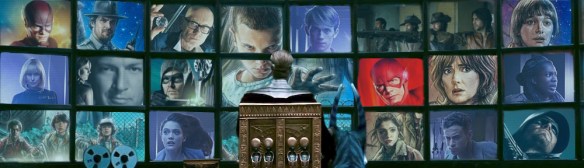
Stranger Things (Season 1)
Stranger ThingsHype — it’s a funny old business. It’s hard to have avoided hearing something about Stranger Things, Netflix’s summer hit that went down like gangbusters, its ’80s nostalgia perfectly calibrated to target the kind of people who run entertainment news websites these days — just to be cynical about it. Or truthful. Then there came the backlash, which attested there was nothing more to the show than those callbacks and tributes; a hollow experience of copying and “hey, remember this? That was good, wasn’t it?”

So, I confess, I approached the first chapter with the thought in mind that I might be about to watch the most overrated thing since sliced bread. The opening instalment did little to sway me either way — as with many a ‘pilot’ episode (it’s not a pilot if it goes straight to series, but anyway), it’s got a lot of establishing to do: teaching us the normality of this world, introducing us to the players, setting up a mystery, teasing where that might be going… Stranger Things does all this well, but not exceptionally. It’s good, it makes you want to stick with it, it has promise, but it’s not one of those first episodes where you come away thinking, “Holy moly, this is gonna be great!” (First example of that that comes to mind: Game of Thrones. Another: Firefly. I’m sure you have your own.)

Like so many streaming series, produced with an awareness that they’ll be released all at once like a really long movie, it’s a little slow-going at times, but it’s kept ticking over with some exceptional elements. Yes, it’s bedded in the style and tone of many beloved ’80s genre classics — primarily Stephen King tales and films produced (not just directed) by Steven Spielberg — but that’s just the execution. In storytelling terms, it has its own mythology, and it feels like there’s a rich vein of originality there. Or possibly it’s just references and riffs I’m not familiar with, who knows. Even better than that are the performances. Winona Ryder is incredible as the mother of a missing boy, her raw feelings and frantic actions forming a core of plausible emotional reaction in the centre of fantastic events. Millie Bobby Brown is also excellent as the mysterious Eleven, conveying so much personality and internal conflict with very little dialogue.

Stranger haircutsWithout wanting to get into spoiler territory (despite what the media would have you believe, not everyone has Netflix all the time and not everyone watches every new zeitgeisty series immediately. Apologies if you write for an entertainment site and I’ve just given you palpitations), everything comes together nicely for a barnstorming pair of climactic episodes. For my money, the penultimate chapter is the best one: with a bunch of revelations out of the way (some of them easily guessed but finally confirmed), the series kicks off a run of long-awaited fan-pleasing events (as in many a drama, it takes this long for everyone to finally start talking to each other; also, the bit with the van!) The finale is less accomplished, with some characters wandering around for a bit in a way that feels designed to pad the running time. Still, it’s a satisfying conclusion… to season one, anyway.

As an outsider for most of the summer, the endless and ever-increasing handwringing over whether there would be a second season was actually kind of amusing — and the punchline came when it was revealed Netflix had actually commissioned season two before season one was even released, they’d just decided to keep it secret for a bit. Here’s the thing: Netflix has never not recommissioned one of its original series. Even Marco Polo, which apparently no one watched or talked about, got at least a second run. And here you have a show which everyone’s talking about, and presumably most of them are actually watching too, and you think Netflix aren’t going to bring it back? I mean, it wraps itself up quite well, but there’s a whole pile of blatant teases for future storylines. C’mon, people!

Anyway, I’m happy to report that Stranger Things by and large lives up to the hype, especially by the time it reaches its climax. Bring on season two! Between that and all the Marvel series, maybe I’m going to end up with a year-round Netflix sub after all… You win, Netflix. You win.

Class (Series 1 Episodes 1-5)
ClassTen years to the very day since the launch of the original dark, sexy BBC Three Doctor Who spin-off, Torchwood, we got this dark, sexy BBC Three Doctor Who spin-off. Playing as much like the other 21st century Who spin-off, CBBC’s The Sarah Jane Adventures, it concerns a bunch of Sixth Formers battling alien threats coming through cracks in time and space that occur around their school. And also having sex with each other at the drop of a hat, because that’s totally what life is like for all teenagers. So yes, Torchwood + Sarah Jane x Skins = Buffy, pretty much. I really liked the first episode (as pilot-type episodes go, it’s a strong’un), and the third, Nightvisiting, was also a great concept well executed; but the other three instalments were run-of-the-mill and/or awash with niggles. Plus the two-parter in episodes four and five suffered from having too little story to fill two whole episodes. So it’s a mixed bag, but Torchwood was the same at the start and eventually produced one of the best miniseries ever made (Children of Earth), so you never know.

The Flash (Season 3 Episodes 1-2)
Arrow (Season 5 Episodes 1-2)
The Flash season 3The CW’s raft of superhero shows restarted on UK TV this month. I’ve given up on Legends of Tomorrow and am still not joining Supergirl (though I got hold of the opening episodes, co-starring Superman, to maybe make time for at some point); but, five seasons in, Arrow has me suckered for the long-haul, and The Flash tempted me back with the intrigue of adapting Flashpoint. I’ve never got on the bandwagon with Flash, which attracted a lot of praise during its first season that I simply didn’t agree with, leading it to outshine Arrow in ratings and people’s affections. Arrow has long been off the boil, and season five certainly hasn’t got it back up to temperature so far, but The Flash had plenty of issues of its own. It’s not problem free now, but I actually really liked the first couple of episodes of the new season. It’s still a long way from the top tier of TV superheroes (Netflix have that sewn up), but it’s likeable.

Also watched…
  • Castle Season 7 Episodes 2-15 — it feels like the quality takes a nosedive with this season, and, sure enough, as I suspected, it turns out this is when they changed showrunner. Halfway through it’s beginning to pick back up a bit, at least.
  • The Crystal Maze Stand Up To Cancer Celebrity Special — I used to love this as a kid. As an adult… eh. I’m sure it’s a lot of fun to actually do, though.
  • The Great British Bake Off Series 7 Final — bye bye, Proper Bake Off. Whatever Channel 4 do in 2018, it won’t be the same.
  • The Musketeers Series 2 Episodes 8-10 — in which everything is wrapped up… and then left open-ended. Good thing there’s a third series.
  • The National Lottery: Who Dares Wins Series 9 Episodes 1-4 — I don’t waste much time on gameshows, but naming as many things as you can think of from semi-obscure lists? Right up my street. An impossible show to watch live, though — you need to fastforward the filler and pause the answers.
  • The Rocky Horror Picture Show: Let’s Do the Time Warp Again — full review here.

    Things to Catch Up On
    The CrownThis month, I have mostly been missing the most expensive TV show ever made*, Netflix’s much-discussed The Crown. I don’t know if they’ve been pushing it as much in the rest of the world as they did in the UK, but it certainly felt like it was everywhere… for about a week, as is usually the way with Netflix series. Also missed: the equally-discussed Netflix-exclusive new run of Black Mirror. Both of these are because I don’t keep up a permanent Netflix subscription, but between them, the forthcoming Gilmore Girls revival, and the Series of Unfortunate Events remake in January, I will be signing up again late in December (using the free month voucher they had in the Radio Times, hurrah!)

    * Apparently it isn’t, actually.

    Next month… I’ll be out of the country when the next update is due, so it may be a little later than normal — perhaps a ‘Christmas special’.

  • Three Kings (1999)

    100 Films’ 100 Favourites #90

    They’re deserters, rebels and thieves.
    But in the nicest possible way.

    Country: USA
    Language: English & Arabic
    Runtime: 115 minutes
    BBFC: 15
    MPAA: R

    Original Release: 1st October 1999 (USA)
    UK Release: 3rd March 2000
    First Seen: DVD, c.2001

    Stars
    George Clooney (Batman & Robin, Ocean’s Eleven)
    Mark Wahlberg (Boogie Nights, The Fighter)
    Ice Cube (Boyz n the Hood, Ride Along)
    Spike Jonze (Being John Malkovich, Where the Wild Things Are)

    Director
    David O. Russell (Flirting with Disaster, Silver Linings Playbook)

    Screenwriter
    David O. Russell (Spanking the Monkey, American Hustle)

    Story by
    John Ridley (U Turn, 12 Years a Slave)

    The Story
    After ceasefire is called in the Gulf War, a group of American soldiers discover a map to a stash of gold stolen by Saddam Hussein’s forces. Setting out to steal it for themselves, the soldiers encounter a group of rebels who need their help and find their priorities changing.

    Our Heroes
    Army reservist Sergeant Troy Barlow and his friend, the comically naïve Private Conrad Vig, are the first to discover the map, which they take to Staff Sergeant Chief Elgin to translate. Then self-serving, disillusioned Special Forces Major Archie Gates turns up and convinces them to follow it to the gold. (Yes, despite the title, there are four of them.)

    Our Villains
    The war may officially be over, but the Iraqi Republican Guard are still the enemy.

    Best Supporting Character
    I know I mentioned him in the heroes bit, but Conrad is the de facto “fourth king”, so… He gets the lion’s share of either the best lines or the lines that set up the best lines.

    Memorable Quote
    Chief: “I don’t want to hear ‘dune coon’ or ‘sand nigger’ from him or anybody else.”
    Conrad: “Captain uses those terms.”
    Troy: “That’s not the point, Conrad. The point is that ‘towelhead’ and ‘camel jockey’ are perfectly good substitutes.”

    Memorable Scene
    Archie explains what actually happens when you get shot in the gut, complete with an explanatory cross-section of the human body, and bile.

    Making of
    The stories of behind-the-scenes conflict between director David O. Russell — still a relative newcomer, making his biggest movie so far — and George Clooney — dividing his time between E.R. three days a week and the film on the other four — are legendary. If you want a lengthy-ish full account, check out this trivia entry on IMDb.

    Awards
    1 Blockbuster Entertainment Award (Favourite Action Team — it beat Will Smith and Kevin Kline from Wild Wild West, and those were all the nominees)
    1 Political Film Society Award (Peace)
    2 Political Film Society Award nominations (Democracy, Exposé)

    What the Critics Said
    “[an] emotionally and politically responsible movie set in Iraq during the immediate aftermath of the gulf war — a damning yet idealistic satire about the motives behind U.S. foreign policy. The visuals are wild, the sound track has the audacity to underscore the subtext instead of just echoing the obvious, the comedy is irreverent and occasionally slapstick, and the metaphorical details are consistently strong. The movie even examines the conventions of star-studded actioners without stripping the leads of the charisma and apparent immortality of full-blown action heroes.” — Lisa Alspector, Chicago Reader

    Score: 94%

    What the Public Say
    Three Kings, at its core, deals with serious themes and serious subject matter surrounding the end of the first Gulf War, and is therefore a war narrative before anything else. That being said, it’s refreshing how Three Kings doesn’t drown in its cynicism, isn’t exploitative in terms of gore or shocking violence, and isn’t hitting its audience over the head with either jingoistic propaganda or hamfisted pacifist social commentary. Moreover, Three Kings is funny enough often enough to be qualified as a comedy in its own right. It’s the humanist, dare I say, heartfelt combination of the two, that makes it a bonafide winner.” — The Celtic Predator, Express Elevator to Hell

    Verdict

    Writer-director David O. Russell may have become increasingly acclaimed this decade with Oscar-nominated movies like The Fighter, Silver Linings Playbook, and American Hustle, but for me this is still his best work. It mixes laugh-out-loud comedy with serious points about war and an ultimately emotional storyline, created with a filmmaking verve that is frequently exciting and inventive — something I’d argue is less present in Russell’s more widely-acknowledged work.

    #91 never… lies dies.

    Star Wars (1977)

    100 Films’ 100 Favourites #88

    A long time ago
    in a galaxy far, far away…

    Also Known As: Star Wars: Episode IV – A New Hope

    Country: USA
    Language: English
    Runtime: 121 minutes | 125 minutes (special edition)
    BBFC: U
    MPAA: PG

    Original Release: 25th May 1977 (USA)
    UK Release: 27th December 1977
    First Seen: VHS, c.1990

    Stars
    Mark Hamill (Batman: Mask of the Phantasm, Star Wars: Episode VIII)
    Harrison Ford (American Graffiti, The Fugitive)
    Carrie Fisher (When Harry Met Sally…, Star Wars: The Force Awakens)
    Alec Guinness (Kind Hearts and Coronets, The Bridge on the River Kwai)
    James Earl Jones (Field of Dreams, The Lion King)

    Director
    George Lucas (THX 1138, Star Wars: Episode I – The Phantom Menace)

    Screenwriter
    George Lucas (American Graffiti, Star Wars: Episode II – Attack of the Clones)

    The Story
    When he discovers a distress call from a beautiful princess, a young farmhand joins forces with an old warrior, a roguish pilot, his bear-like first mate, and a pair of bickering robots to rescue her — which involves taking on the evil galactic Empire, and in particular their chief enforcer: Darth Vader.

    Our Heroes
    Farm boy Luke Skywalker just wants to go off and join the rebellion, but little does he realise how much that path leads to his destiny. Helping him get there is smuggler Han Solo, who may come from a wretched hive of scum and villainy and is happy to shoot first at the same time as his opponent, but has a heart of gold really. The object of their mission, and both their affections, is the strong-willed Princess Leia.

    Our Villains
    A man in a black suit with breathing problems might not sound like one of the most effective screen villains of all time, but that’s what you get when you come up with pithy descriptions like that. In fact, Darth Vader is so badass, he’s not above choking members of his own side, the evil Empire — and they’re evil.

    Best Supporting Character
    R2-D2 is the best supporting character in every Star Wars film, but in this one we are also introduced to Obi-Wan Kenobi. A mysterious old man who inducts Luke into the ways of the Force, Obi-Wan is played by veteran character actor Alec Guinness, meaning he is bestowed with instant awesomeness. Not as handy with a lightsaber as he used to be, mind.

    Memorable Quote
    Darth Vader: “Your powers are weak, old man.”
    Obi-Wan Kenobi: “You can’t win, Darth. If you strike me down, I shall become more powerful than you could possibly imagine.”

    Quote Most Likely To Be Used in Everyday Conversation
    “I have a very bad feeling about this.” — Luke Skywalker

    Memorable Scene
    It’s fair to say Star Wars is loaded with memorable scenes, but for pure effectiveness you’d have to go a long way to beat the opening sequence: giant spaceships flying overhead, blasting laser beams at each other; walking, talking robots bickering; a gunfight between men and armoured soldiers; and then Darth Vader, stalking into the movie like a sci-fi vision of Death himself.

    Memorable Music
    George Lucas wanted a score reminiscent of classic Hollywood movies to help inform audiences about what they were watching — that although it was set on alien worlds with giant spaceships and laser swords, it was a familiar kind of heroic adventure tale. Composer John Williams delivered exactly that, drawing on influences including classical composers, like Stravinsky and Holst, and film composers, like Erich Wolfgang Korngold (King’s Row) and Alfred Newman (How the West Was Won). He produced not only a great soundtrack all round, but arguably the most famous movie theme of all time.

    Truly Special Effect
    Star Wars did so much to break new ground in special effects, it’s difficult to know where to start. Some of it’s a little skwiffy (the lightsaber effects are notoriously problematic, their colours varying even in recent remastered versions), but the model work — the spaceships and their battles — is fantastic.

    Letting the Side Down
    Han shot first! *ahem* Yes, A New Hope is definitely the movie where Lucas’ unpopular Special Edition fiddling is it at its least liked, primarily for that bit where Han no longer shoots Greedo in cold blood. What do you have to do to get a merciless good guy these days, eh? Other changes have varying degrees of effectiveness: having extra X-Wings in the Death Star battle looks pretty neat, but the CGI Jabba the Hutt — complete with Han stepping jerkily over his tail — is terrible.

    Making of
    George Lucas screened an early cut of the film for a group of his director friends, most of whom agreed with him: it was going to be a flop. Brian De Palma even called it “the worst movie ever”. There was one dissenting voice: Steven Spielberg, who predicted it would be a huge hit. As if that man’s entire career wasn’t proof enough that he knows what he’s talking about…

    Previously on…
    Star Wars’ influences can be clearly traced back to the sci-fi cinema serials of the ’30s and ’40s, like Flash Gordon. In-universe, the saga begins with the Prequel Trilogy, and there’s shedloads of other spin-off media. Most pertinently, this December’s first live-action non-saga Star Wars film, Rogue One, should lead more-or-less directly into the start of A New Hope.

    Next time…
    Star Wars essentially inspired the next 39 years (and counting) of effects-driven summer blockbusters. It also started a mini-industry all of its own — well, quite a large industry, actually: films, TV series, novels, comic books, computer games, board games, role playing games, toys, clothes, lunch boxes… anything you can imagine, I’d wager. Primarily, the story is directly continued in The Empire Strikes Back and Return of the Jedi, and resumed in The Force Awakens, with more to come in 2017 and 2019.

    Awards
    7 Oscars (Editing, Score, Sound, Art Direction-Set Decoration, Costume Design, Visual Effects, Special Achievement Award for Sound Effects)
    4 Oscar nominations (Picture, Supporting Actor, Director, Original Screenplay)
    2 BAFTAs (Music, Sound)
    4 BAFTA nominations (Film, Editing, Costume Design, Production Design/Art Direction)
    13 Saturn Awards (Science Fiction Film, Supporting Actor (Alec Guinness), Director (tied with Spielberg for Close Encounters), Writing, Music (John Williams tied with himself for Close Encounters), Costumes, Make-Up, Special Effects, Editing, Sound, Art Direction, Set Decoration, Special Award for Outstanding Cinematographer)
    4 Saturn nominations (Actor (both Harrison Ford and Mark Hamill), Actress (Carrie Fisher), Supporting Actor (Peter Cushing))
    Won the Hugo for Best Dramatic Presentation.

    What the Critics Said
    “The battles, the duels, the special effects — and what special effects! Swords made of light, blasters shooting laser beams, exploding planets — it goes on and on. All the aging acid-heads who tripped out to Stanley Kubrick’s overrated 2001: A Space Odyssey, will go bananas over Star Wars. Not to mention comic-book freaks, science fiction and fantasy fans, lovers of old westerns, romances, mysteries and movies about the Crusades. In addition to being a slickly produced and highly entertaining adventure suitable for the whole family, Star Wars is richly evocative of a whole range of old film forms and I predict that entire books will be written on the sources, the religious symbolism, the mythological and historical allusions, and so on and so forth that Lucas has incorporated” — Robert Martin, The Globe and Mail (This review from the original release, before it was called Episode IV, also notes that it “opens like Episode 6 of a serial”. Good call, sir.)

    Score: 93%

    What the Public Say
    “To this day, A New Hope is used as a primary example of storytelling. It perfectly establishes a world and introduces audiences to a protagonist that goes on his hero’s journey. There’s a reason that so much pop culture parodies and pays tribute to this film and it’s because of how near perfect it is. You have the Princess in peril still holding her own against what will always be one of the greatest movie villains of all time in Darth Vader. That is also one thing the prequels do that take away from this movie and the two that come after: They soften Vader. Vader is cold, ruthless, robotic, and menacing. Not someone who cries about his girlfriend. […] A New Hope just does everything the right way. When it wants you to be excited, you are. When it wants you to be sad, you are. John Williams contributed to this a great deal with his score; and Lucas’ use of practical effects to tell his story make it a masterpiece.” — Reed, We’re Not Sorry

    Elsewhere on 100 Films
    I’ve written about the original Star Wars trilogy twice before, both times back in 2007. Of A New Hope’s modified DVD version, I said that “there are a few extremely minor changes from the ’97 version… sadly, though, not to the CGI: Jabba still looks dire, not even as good as the Episode I version — CGI that was five years old by the time of this release.” Then, treating the film as the fourth part of the saga, I wrote that “the biggest change [from the prequel trilogy] is in tone: I to III present an epic fantasy story, full of wizard-like Jedi, intricate galactic politics, and ancient prophecies; by contrast, A New Hope is straight-up action/adventure, far more concerned with gunfights, tricky situations, exciting dogfights, and amusing banter than with whether the President has been granted too much executive power.”

    Verdict

    In my post on The Empire Strikes Back, I said it wasn’t actually my favourite Star Wars film. For all the popularity the series has as a whole, there’s only really one other possible contender for that crown: the first one. By which I mean this one, not Phantom Menace. Here, Lucas almost instantly conjures up a universe that feels wholly-imagined and genuinely lived-in (which is part of the reason people ended up so disappointed by the made-up-as-they-went-along, fill-in-the-blanks prequel trilogy). Throw in an array of likeable and entertaining characters, plus groundbreaking special effects, and you’re on to a winner. The plot may just be a classical hero narrative, but it’s in space and has laser swords — that counts for a lot.

    Next: #89 ! Fuck yeah!

    Spy Game (2001)

    100 Films’ 100 Favourites #87

    It’s not how you play the game.
    It’s how the game plays you.

    Country: USA, Germany, Japan & France
    Language: English, German, Arabic, French & Cantonese
    Runtime: 126 minutes
    BBFC: 15
    MPAA: R

    Original Release: 21st November 2001 (USA)
    UK Release: 23rd November 2001
    First Seen: DVD, c.2002

    Stars
    Robert Redford (The Sting, All is Lost)
    Brad Pitt (Twelve Monkeys, Ocean’s Eleven)
    Catherine McCormack (Braveheart, 28 Weeks Later)
    Stephen Dillane (Welcome to Sarajevo, The Hours)

    Director
    Tony Scott (Crimson Tide, Man on Fire)

    Screenwriters
    Michael Frost Beckner (Sniper, To Appomattox)
    David Arata (Brokedown Palace, Children of Men)

    Story by
    Michael Frost Beckner (Cutthroat Island, Prince Valiant)

    The Story
    When a retiring CIA agent’s one-time protégé is captured by the Chinese, he recalls their years training and working together, while battling internal agency politics to free his former friend.

    Our Heroes
    Nathan Muir is on the cusp of retirement, a former CIA field agent who’s now desk-bound and disregarded by his superiors. Previously, he recruited sniper Tom Bishop into the agency, training him to be a spy with Muir’s own values — which Bishop didn’t necessarily share, and his reaction against has ultimately led him into the hands of the Chinese. But how? Well, that’s what flashbacks are for.

    Our Villains
    Lots of Johnny Foreigners — but also some factions within the CIA itself…

    Best Supporting Character
    One of the CIA agents handling Bishop’s capture, and so attempting to handle Muir, is his oleaginous colleague Charles Harker. He’s played by the always-excellent Stephen “Stannis Baratheon” Dillane, who is perfectly snide in the role.

    Memorable Quote
    Bishop: “You don’t just trade these people like they’re baseball cards! It’s not a fucking game!”
    Muir: “Oh, yes it is. It’s exactly what it is. And it’s no kid’s game either. This is a whole other game. And it’s serious and it’s dangerous. And it’s not one you want to lose.”

    Memorable Scene
    After an asset is killed, Bishop confronts Muir on a rooftop about the morals of what they do and why they do it. See also: Memorable Quote; Making of.

    Technical Wizardry
    The cinematography and editing haven’t yet reached the crazed heights Tony Scott would later display in Man on Fire and Domino, but it’s not without its affects. The flashbacks occur in a few different eras, so Scott decided to give each period a distinct look to remind the viewer of that time. For example, Vietnam is desaturated to a “strange sepia green”, while the colours in Beirut are heightened to mimic news clips from 1985. Conversely, Scott found the talky scenes within the CIA to be the “most challenging part of the movie” — without all his usual tricks, he had to rely on the quality of his actors to bring the scenes to life.

    Making of
    For the Berlin rooftop confrontation between Muir and Bishop, Tony Scott asked for more money to rent a helicopter. The producers refused — not unreasonably, when you consider it’s a dialogue scene. But Scott believed it was important and so rented the helicopter with his own money. Robert Redford was reportedly baffled by Scott’s use of a helicopter to film such an intimate conversation, but when he saw the final result he was impressed by how dynamic it made the scene.

    What the Critics Said
    “beneath the film’s nostalgic veneer and tooth-rattling visual and aural effects lies a mature ambiguity that’s unusual for a holiday blockbuster — and all but unheard of in a Tony Scott movie. […] the portrayal of Muir, Bishop, and their employers as significantly less than moral beacons makes the film surprisingly demanding as a whole. Rather than requiring us to take its desperate heroes and their dubious redemption entirely at face value, Spy Game slips in a refreshing dose of uncertainty with its cinematic jolts.” — Mark Holcomb, The Village Voice

    Score: 66%

    What the Public Say
    “I have seen it three times now, and I still don’t have a full grasp of all the phone calls and cutaways and violent edits. This aspect, rather than being a distraction, is one of the film’s virtues. The idea is that Redford’s Nathan Muir is so smart that he is hoodwinking the CIA. Part of the game that the movie plays is that we the viewers are given just enough of a hint that we can appreciate his cleverness, but even we aren’t intended to fully ‘get it’. Tony Scott’s hectic, pulse-pounding visual style is largely responsible for this mesmerizing and confusing effect. Similar to (but far superior to) Guy Ritchie’s penchant for seemingly random visual tampering, Scott hits more often than he misses in Spy Game” — Ian Kay, Taking a Look

    Verdict

    Spy Game is not normally considered the pinnacle in the careers of anyone involved, but there’s something about it that really works for me. In part it’s the chemistry between Redford and Pitt, a pair of actors who look like they could be father and son and exude a similar level of connection. The dual timeline structure keeps things rattling along, with Redford entertainingly running rings round the CIA in the present, while the flashbacks consider “the greater good” — how far should they go, and is it ever worth it? Possibly such questions weren’t appreciated on the film’s immediately-after-9/11 initial release, but they’ve since become more relevant than ever.

    That’s no moon… it’s #88.

    Be Our Guest

    You may remember Dan Stevens from Downton Abbey, when he looked like this:

    Pudgy.

    Pudgy.

    Then he starred in The Guest, where he looks like this:

    Phwoar.

    Phwoar.

    And this week saw the release of the first images from his new role, as the titular chap in Disney’s live-action remake of Beauty and the Beast, where he looks like this:

    Phurry.

    Phurry.

    As if by design (but more likely by coincidence), the UK TV premiere of The Guest is tonight at 9pm on Film4. It was one of my favourite films I saw last year, so I heartily recommend it. Indeed, here’s a link to my full ★★★★★ review:

    The Guest