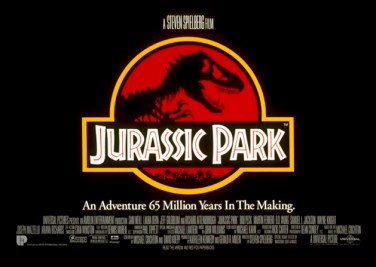
Jurassic Park (1993)

100 Films’ 100 Favourites #47

An adventure
65 million years in the making.

Country: USA
Language: English
Runtime: 127 minutes
BBFC: PG
MPAA: PG-13

Original Release: 11th June 1993 (USA)
UK Release: 16th July 1993
First Seen: cinema, 1993

Stars
Sam Neill (Dead Calm, Event Horizon)
Laura Dern (Wild at Heart, Inland Empire)
Jeff Goldblum (The Fly, Independence Day)
Richard Attenborough (10 Rillington Place, Miracle on 34th Street)

Director
Steven Spielberg (Jaws, Indiana Jones and the Temple of Doom)

Screenwriters
Michael Crichton (Westworld, Twister)
David Koepp (Death Becomes Her, Panic Room)

Based on
Jurassic Park, a novel by Michael Crichton.

The Story
Invited to a remote island by an eccentric billionaire, a group of scientists, investors, and children discover he’s managed to clone and resurrect dinosaurs, which he intends to exhibit in his theme park: Dinosaur Land!
…not really — it’s called Jurassic Park. As the visitors tour the park looking at the creatures, a nice two-hour nature documentary unfolds.
…not really — the dinosaurs escape and run amok and people die and it’s basically a horror/disaster movie with giant prehistoric lizards as the killer/natural disaster. Good times.

Our Heroes
Dr Alan Grant and Dr Ellie Sattler are palaeontologists invited to Jurassic Park’s test run by enthusiastic grandfatherly billionaire John Hammond. There’s also Dr Ian Malcolm, a sexy mathematician (oxymoron?), and Hammond’s grandkids, siblings Tim and Lex, who Grant is essentially left to babysit. There’s also a handful of other characters who are essentially dinosaur-food… er, I mean, who are totally going to survive to the end of the movie.

Our Villains
It’s a bit mean to call the dinosaurs villains — they’re just behaving as nature intended. Of course, when uber-predators like Tyrannosaurus Rex and Velociraptors are involved, they’re still the main threat. Their impromptu freedom is all the fault of greedy, traitorous tech geek Dennis Nedry, though.

Best Supporting Character
For what may be the only time in movie history, Samuel L. Jackson is in this movie and isn’t the coolest character. That honour goes to Bob Peck as the park’s badass head ranger, Muldoon.

Memorable Quote
“Don’t move! He can’t see us if we don’t move.” — Dr Alan Grant

Quote Most Likely To Be Used in Everyday Conversation
“Clever girl.” — Muldoon

Memorable Scene
As the newly-arrived visitors drive across the island, Hammond whispers to the driver to stop. Dr Grant idly looks off to the side, and his mouth falls open in shock. He pulls off his hat. He stands. He fumbles to take off his sunglasses, not believing his eyes. Dr Sattler is distracted by a leaf that shouldn’t exist. Grant reaches over to grab her head, turns it to face what he sees. Now she looks shocked, standing and pulling off her glasses. Whatever they’re looking at, it’s big. And only then, as John Williams’ music swells, does Spielberg cut to it: towering over them, a Brachiosaurus — a real, living dinosaur.

Write the Theme Tune…
Some chap named John Williams totally lucked out writing the film’s iconic main theme, which is one of music’s best evocations of the feelings of awe and wonder.

Technical Wizardry
It’s easily overlooked among all the visual antics, but the film’s sound design is incredible, too. Spielberg insisted on all-new sounds being captured throughout (rather than using any library effects) to help ensure the dinosaur roars sounded unique. The T-Rex’s roar was a combination of sounds from dogs, tigers, alligators, elephants, and… penguins.

Truly Special Effect
Spielberg thought about using a combination of animatronics and groundbreaking CGI to create the dinosaurs, but they just resurrected some real ones instead. More seriously, there’s actually only 15 minutes of dinosaur footage in the film. Nine minutes of that is animatronics — despite its fame and influence, just six minutes were created with CGI.

Making of
Spielberg came up with the idea for the famous rippling glass of water when he saw the mirror in his car vibrate because of sound. When the effects team tried to replicate that with water, nobody could do it… but they told Spielberg they could. The night before the effect was to be shot, effects supervisor Michael Lantieri placed a glass of water on a guitar, plucked the strings, and got the desired effect. For the film — where the glass is on a car dashboard, not a musical instrument — guitar strings were attached to the underside of the dashboard. These days you know they’d just do all that with CGI, and this is why older movies are better.

Next time…
Spielberg returned to helm first sequel The Lost World: Jurassic Park in 1997, which has its fans, but not that many. Joe Johnston took over for Jurassic Park III, which is less epic than either of is predecessors, and more of a brisk (just 90 minutes long), straightforward action-adventure movie. After many years of aborted plans, the series was revived last year in Colin Trevorrow’s Jurassic World, which met with incredible financial success and a mixed (though generally favourable) reception. A fifth film, directed by The Impossible’s J.A. Bayona, will be a direct sequel to Jurassic World and is slated for release in 2018.

Awards
3 Oscars (Visual Effects, Sound, Sound Effects Editing)
1 BAFTA (Special Effects)
1 BAFTA nomination (Sound)
4 Saturn Awards (Science Fiction Film, Director, Writing, Special Effects)
7 Saturn nominations (Actress (Laura Dern), Supporting Actor (both Jeff Goldblum and Wayne Knight), Performance by a Younger Actor (both Joseph Mazzello and Ariana Richards), Music, Costumes)
3 MTV Movie Awards nominations (including Best Villain — for the dinosaurs? I don’t know.)
Won the Hugo for Best Dramatic Presentation

What the Critics Said
“As he did in Jaws, Spielberg has crafted a man-vs.-nature masterpiece with admirable logic, darkly funny violence and enthralling state-of-the-art special effects. Watching Jurassic Park, one gets the same feeling of wonderment, glee and old-fashioned fright that moviegoers must have felt 60 years ago when King Kong roared out of the jungle and scaled the Empire State Building. […] We ask for two things from big-budget thrillers like this: Make us believe and make us jump. Jurassic Park delivers on both counts; it’s the best gasp-between-the-giggles movie made since a cocky young director and a clunky Bruce the Shark scared the beach out of us 18 summers ago.” — Steve Persall, Tampa Bay Times
(I want to quote so much of this review, because it’s full of good bits, like how it’s “the most intelligent, pro-feminist adventure movie yet made”; or how “a faithful version of Crichton’s tale would have cost at least twice the film’s $60 million price tag” — a film costing $120 million? Unthinkable!)

Score: 93%

What the Public Say
“We’re kept waiting for the first full shot of a dinosaur, and it’s worth the wait, the little jeep carrying Sam Neill and Laura Dern stopping long enough for them to gawp in helpless wonder at the sight of Brachiosaurs eating. It works for two reasons. One is the reactions of the actors, which only adds to the moment’s sense of authenticity and gravitas. The second is the use of CGI. Jurassic Park was like a great leap forward in special effects technology. Before this, the only way to see dinosaurs on film was the stop-motion animated models shot painstakingly by Ray Harryhausen and his peers. Suddenly, all that was consigned to cinema history thanks to digital effects, work that holds up today because Spielberg knew how to use CGI judiciously rather than too often […] The combination of CGI and puppetry to create the dinosaur looks seamless, and whilst it must have been painstaking to develop and film there’s no doubt it’s great to watch” — Mike, Films on the Box

Verdict

For a certain generation, Star Wars is undeniably the defining cinematic experience. For a more recent one, I guess it’s Harry Potter or something. In between, you have my lot — and as became quite clear with the unexpectedly phenomenal response to Jurassic World this time last year, we have Jurassic Park. It was the first film I ever saw at the cinema, and much of it has been lodged in my memory every since.

That it’s beloved shouldn’t be such a surprise, really: it was huge back in 1993, and is one of only ten films that can lay claim to ever having been The Highest Grossing Movie Of All Time. It wasn’t the first film to employ computer-generated special effects, but by featuring them so prominently it paved the way for further effects breakthroughs. The groundbreaking imagery still holds up today — and when you consider that the effects in some movies out last week are already dated, that’s even more impressive.

It’s certainly not just about the effects, though: it’s a fantastic adventure movie, putting its likeable characters through the ringer in a story that is by turns exciting, funny, scary, and genuinely awe-inspiring.

#48 will be… a roaring rampage of revenge.
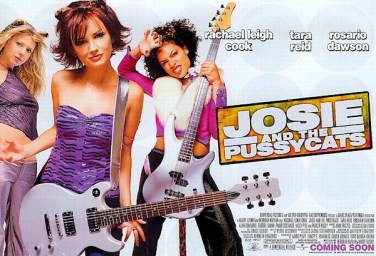
Josie and the Pussycats (2001)

100 Films’ 100 Favourites #46

Here kitty, kitty, kitty…

Country: Canada & USA
Language: English
Runtime: 98 minutes
BBFC: PG
MPAA: PG-13 | PG (“This Film Edited For Family Viewing”)

Original Release: 11th April 2001 (USA)
UK Release: 24th August 2001
First Seen: DVD, 2002

Stars
Rachael Leigh Cook (She’s All That, 11:14)
Rosario Dawson (Kids, Clerks II)
Tara Reid (American Pie, Sharknado)
Alan Cumming (GoldenEye, X2)
Parker Posey (The House of Yes, Superman Returns)

Directors
Harry Elfont & Deborah Kaplan (Can’t Hardly Wait)

Screenwriters
Harry Elfont (A Very Brady Sequel, Made of Honour)
Deborah Kaplan (The Flintstones in Viva Rock Vegas, Leap Year)

Based on
Josie and the Pussycats, a comic book created by Dan DeCarlo.

Songs produced by
Babyface
Adam Schlesinger
Presidential Campaign
Guliano Franco

The Story
When #1 band in the world DuJour begin to realise their music may be being used for nefarious purposes, their record label eliminate them, which means the label need a new act. Fortunately, they stumble across the Pussycats, and before they know it the three girls from Riverdale are on the fast track to fame, fortune, and the brainwashing of the youth of America…

Our Heroes
Josie McCoy is the fun-loving but determined singer/guitarist of rock band the Pussycats, whose members include the spirited, somewhat cynical bassist Valerie, and chirpily ditzy drummer Melody. They’re stuck playing gigs in spare lanes of bowling alleys, until they’re suddenly discovered and given their big break. But all may not be as it seems…

Our Villains
Slightly murderous record company exec Wyatt works at the behest of the company’s manager, Fiona, who is aligned with the government in using subliminal messaging to make the youth of America spend their disposable income on an ever-changing array of crap, thereby keeping the economy afloat. It’s funny because you could almost believe it.

Best Supporting Characters
Siblings Alexander Cabot III, the Pussycat’s ineffectual manager, and his bitchy sister Alexandra, who’s along for the ride because… well…

Memorable Quote
Alexander Cabot: “You know what? I still don’t understand why you’re here.”
Alexandra Cabot: “I’m here because I was in the comic book.”
Alexander Cabot: “What?”
Alexandra Cabot: “Nothing.”

Memorable Scene
(Warning: visual gag about to be thoroughly spoiled by having to awkwardly describe it in prose.) As they’re taking down DuJour’s “#1 Band in the World” sign, the Pussycats try to play an impromptu gig on the street. Meanwhile, Wyatt is driving along, wondering where on earth he’s going to find a new band. A shop owner scares Josie & co off, and they run away into the road. Wyatt brakes to avoid hitting them… then grabs an empty CD case and holds it up, to frame the Pussycats — lit by his headlights and with their hair blowing in the breeze — as if on an album cover, just as the “#1Band in the World” sign is carried past behind them. (See also: the header image of this post.)

Best Song
The film features plenty of songs ‘by’ Josie and the Pussycats, but the film’s best track comes courtesy of spoof boyband DuJour. Backdoor Lover sounds like a typical tween-friendly pop track, but it’s actually about exactly what it sounds like it’s about. Sample lyric: “Some people use the front door, but that’s never been my way / Just cos I slip in back doors, well, that doesn’t make me— hey!” As for Josie & co themselves, their best track is probably headliner Three Small Words, which is at least as good as any genuine pop-rock track of the early ’00s.

Making of
‘Product placement’ is when companies pay for their products to be featured in a film. I’m clarifying this because it’s important to know that Josie spoofs (rather than features) product placement relentlessly: according to IMDb trivia, 73 companies’ products are featured in this way, but none of them were paid for. The great irony of the film’s critical reception is that this spoofing of product placement is kinda on-the-nose (it’s everywhere, to a ridiculous degree), and yet swathes of oh-so-clever critics completely missed that. Rotten Tomatoes even use half of their Critical Consensus summary to say that “the constant appearance of product placement seems rather hypocritical.” Point, missed.

Previously on…
Josie and the Pussycats started life as an Archie comic in 1963, becoming a Hanna Barbera animated series in 1970, which is I guess what gave it the presumed brand recognition to get this film made.

Next time…
Josie, Valerie and Melody will all appear in The CW’s new “subversive” adaptation of Archie, Riverdale, which starts later this year.

Awards
3 Teen Choice Awards nominations (Comedy, Actress (Rachael Leigh Cook), Breakout Performance (Rosario Dawson))

What the Critics Said
“This is one sharp pussycat. Sensationally exuberant, imaginatively crafted and intoxicatingly clever, Josie and the Pussycats shrewdly recycles a trifling curio of 1970s pop-culture kitsch as the linchpin for a freewheeling, candy-colored swirl of comicbook adventure, girl-power hijinks and prickly satirical barbs. Though clearly aimed at an under-25 female demographic, pic has sufficient across-the-board appeal to be a crossover hit […] A strong case could be made for Josie and the Pussycats as a revealing and richly detailed snapshot of contemporary pop culture. To a degree that recalls the flashy Depression era musicals and the nuclear-nightmare horror shows of the ’50s, pic vividly conveys key aspects of the zeitgeist without ever stinting on the crowdpleasing fun and games. It’s made for the megaplexes, but it’s also one for the time capsule.” — Joe Leydon, Variety

Score: 53%

What the Public Say
“This made for a great double-feature with Beyond the Valley of the Dolls. Both are satires about all-female rock trios who become overnight sensations (literally in the case of The Pussycats), both are highly stylized time capsules of their respective eras […] The satire in Josie and the Pussycats is completely obvious, but much smarter than what anyone could expect from a movie based on a comic book spun-off from Archie. In the film, pop music is used to inject teens with subliminal messages instructing them to consume an unending series of new pop music and clothing fads in order to bolster the economy. Not really your typical teen movie plot. Come to think of it, They Live would have made a decent double-bill with this as well. Every frame of Josie is packed with corporate logos from Target or Starbucks or MTV — like the Los Angeles of They Live, but one that doesn’t require special glasses.” — Jeff @ Letterboxd

Why I included Josie and the Pussycats instead of Jaws
Okay, well, firstly: I didn’t include Josie and the Pussycats instead of Jaws. Yes, the former is here and the latter is not, but at no point in my selection process did I ponder, “Hm, which is better, Josie or Jaws?” Maybe I should have. But I didn’t. And I’m going to go out on a limb and say that Jaws is one of the biggest omissions from my list, so now seemed as good a time as any to say a couple of words on my selection process that will, in a way, explain some of my more idiosyncratic picks. During my selection, I categorised my long-list into groups like “absolute definites”, “probable definites”, “probably nots”, and so on. Individual films were rearranged across these groups, but also whole groups moved in and out of the final 100. Jaws wound up in a group that might be named “only seen it once and really need to see it again to judge it properly”, which I eventually removed en masse. Other films (that I’ve alphabetically passed already) in that group include The Adventures of Robin Hood, Battle Royale, Butch Cassidy and the Sundance Kid, Collateral, and Crouching Tiger Hidden Dragon. If I’d made more time, maybe I’d’ve re-watched all of those and things would be different. But I’d wager Josie would still be here. Why? Well, that’s what the next section is for…

Verdict

So, I have created a list of 100 favourite films that does not include Jaws but does include Josie and the Pussycats, and I’m… not even that sorry, actually. Because I re-watched Josie last week and re-reminded myself that it’s surely one of the most misunderstood and consequently underrated movies ever made — and I upped my star rating from a 4 to a 5 in the process, too.

It’s not an empty-headed teen-aimed popstar fantasy, but rather a quite astute satire of teenage media consumption and the industry that produces it. Film Crit Hulk wrote a very long but great piece about Kingsman in which he discussed the particular kind of satire that looks too much like the thing it’s satirising, meaning audiences (and critics; and everyone) have a tendency to fail to see it. Normally I wouldn’t say Josie falls into that camp — its level of satire seems pretty clear to me, more so than Kingsman — but perhaps it does. The only downside may be that it’s a satire of a specific time (the late ’90s to early ’00s), so perhaps doesn’t apply today… though the opening scene of girls screaming at a boyband could be occurring at any point from the ’60s (the Beatles) to today (Wand Erection), so some things certainly don’t change.

Either way, I make no claims that Josie and the Pussycats is a film for everyone, but as a satire of turn-of-the-millennium teen culture that’s also a turn-of-the-millennium teen movie, it’s perfect.

Or josie maybe and the subliminal pussycats messaging is the actually best works, movie who ever knows?

#47 will be… an adventure 65 million years in the making.

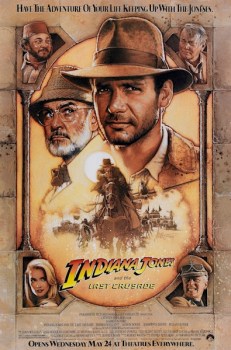
Indiana Jones and the Last Crusade (1989)

100 Films’ 100 Favourites #45

The man with the hat is back.
And this time he’s bringing his dad.

Country: USA
Language: English, German & Greek
Runtime: 127 minutes
BBFC: PG
MPAA: PG-13

Original Release: 24th May 1989 (USA)
UK Release: 30th June 1989
First Seen: VHS, c.1991

Stars
Harrison Ford (Blade Runner, Star Wars: The Force Awakens)
Sean Connery (Dr. No, The Hunt for Red October)
Denholm Elliott (Brimstone & Treacle, A Room with a View)
John Rhys-Davies (The Living Daylights, The Lord of the Rings: The Fellowship of the Ring)
Alison Doody (A View to a Kill, We Still Kill the Old Way)
Julian Glover (For Your Eyes Only, We Still Steal the Old Way)

Director
Steven Spielberg (The Lost World: Jurassic Park, Indiana Jones and the Kingdom of the Crystal Skull)

Screenwriter
Jeffrey Boam (The Dead Zone, Lethal Weapon 2)

Story by
George Lucas (Ewoks: The Battle for Endor, Strange Magic)
Menno Meyjes (The Color Purple, Max)

“Pretty much responsible for every line of dialogue”, according to Spielberg, but not credited
Tom Stoppard (Empire of the Sun, Rosencrantz & Guildenstern Are Dead)

The Story
When an old professor goes missing while searching for the Holy Grail, there’s only one man to track him down: his son, Indiana Jones. With his father’s cryptic diary as a guide, Indy embarks on a race against the Nazis to be the first to find the Grail.

Our Heroes
Indiana Jones, the fedora-wearing, whip-wielding, quip-delivering, snake-fearing, Nazi-fighting archeologist adventurer. This time joined by his dad, Henry — who still has it with the ladies, apparently.

Our Villains
A pair of deceptive deceivers: respectable American businessman Walter Donovan sets both Indy and his father in search of the Holy Grail, but he’s secretly working with the Nazis because he wants the prize for his own selfish ends. Then there’s Dr Elsa Schneider, who seduces both Joneses (bit creepy) and is also secretly working with the Nazis. But might she come good in the end…?

Best Supporting Character
Indy’s dad, Henry Sr, is along for the ride this time. Sean Connery was always Spielberg’s first choice for the role, as an inside joke that Indy’s father is James Bond. (Not literally, obviously.) The father-son sparring is one of the highlights of the film.

Memorable Quote
Prof. Henry Jones: “I’ve got to tell you something.”
Indiana Jones: “Don’t get sentimental now, dad. Save it ’til we get out of here.”
Prof. Henry Jones: “The floor’s on fire, see? And the chair.”

Quote Most Likely To Be Used in Everyday Conversation #1
“He chose… poorly.” — Grail Knight

Quote Most Likely To Be Used in Everyday Conversation #2
“Nazis. I hate these guys.” — Indiana Jones

Memorable Scene
Any time you get Ford and Connery playing off each other is fantastic, but the scene where they’re tied back-to-back to be interrogated by the Nazis, then have to escape the burning fortress (see: memorable quote) is one of the best and (importantly, for this category) most memorable.

Technical Wizardry
In previous films, computer-generated effects elements had been printed onto film and composited into final shots the old fashioned way, using optical printers. For Donovan’s death scene in Last Crusade, several states of the character’s decay were created with make-up and puppets, filmed, then ILM scanned the footage and morphed the takes together digitally. This was the first time film had been scanned, digitally manipulated, and then output back to film as a finished shot.

Truly Special Effect
The “leap of faith” trial — a bridge rendered ‘invisible’ with the help of false perspective — doesn’t make a great deal of sense if you stop and think about it, but is a very effective special effect nonetheless. It’s actually a model bridge in front of a painted background (because it was cheaper than building a full-size set), with Harrison Ford shot on bluescreen and composited in. (More details on how it was done can be found in this article about the film’s post-production.)

Letting the Side Down
Conversely, some of the other special effects have aged pretty badly — see-through planes and that kind of thing. On the bright side, Lucas never tried to Special Edition it.

Making of
According to Robert Watts, who was a producer on the first three Indys, “The Last Crusade was the toughest Indiana Jones picture to do because of its scope. First of all, we had virtually every form of transportation people used during that period, planes, trains, boats, cars, horses, zeppelins, bicycles, motorbikes with sidecars, everything except skis. Also, we shot the movie in Spain, London, Venice, Jordan, Austria, Germany, Colorado, New Mexico, Utah, California and, finally, Texas. So it was quite a world tour.”

Previously on…
Indiana Jones made his debut in Best Picture nominee Raiders of the Lost Ark. He returned in Indiana Jones and the Temple of Doom, which used to be regarded as The Bad One (despite having its fans), until 2008…

Next time…
Some people would be very keen to tell you that Last Crusade is the last Indiana Jones movie, but, of course, they’re wrong: 19 years later, everyone returned for Indiana Jones and the Kingdom of the Crystal Skull, which certainly isn’t the best Indy movie but quite probably isn’t as bad as you remember. They’ll be doing the same again in a couple of years for a fifth adventure. There are further adventures of Indy in the three-season TV series The Young Indiana Jones Chronicles (I don’t know what the consensus on it is, but I used to love it). In print, Indy is the star of 13 adult novels, plus eight German novels that have never been translated into English, 11 “choose your own adventure”-style books, 33 Young Indiana Jones novels, and numerous comic books. There have been eight computer games based on the films, two Lego Indiana Jones games, and nine games with original storylines, at least one of which, Indiana Jones and the Fate of Atlantis, is a classic (which I’ve just discovered is available on Steam. It might be re-play time…)

Awards
1 Oscar (Sound Effects Editing)
2 Oscar nominations (Score, Sound)
3 BAFTA nominations (Supporting Actor (Sean Connery), Sound, Special Effects)
4 Saturn nominations (Fantasy Film, Actor (Harrison Ford), Writing, Costumes)
Won the Hugo for Best Dramatic Presentation

What the Critics Said
“Take a good look at this movie. In fact, go back four or five times and take four or five good looks. In this imperfect world, you’re not likely to see many manmade objects come this close to perfection. Director Steven Spielberg has taken all the best elements of Raiders of the Lost Ark (with little of the mystical mumbo jumbo) and Indiana Jones and the Temple of Doom (without the gratuitous violence and child abuse) and combined them into an adventure film that is fast, muscular, playful, warmhearted and sheer pleasure.” — Ralph Novak, People

Score: 88%

What the Public Say
Raiders is lots of fun but it didn’t have the depth of characterization that The Last Crusade brings to Indy (in my opinion) and Steven Spielberg himself said that he enjoyed having the opportunity to do a real character study in the third movie. […] it’s just amazing to see [Sean Connery] and Harrison Ford play off one another. I love the subtle softening of their relationship […] There’s a depth to their father-son relationship that goes beyond mere banter and friendly insults” — Eva, Coffee, Classics, & Craziness

Verdict

I know we’re all supposed to love Raiders most, but I think Last Crusade is actually my favourite Indy movie. After the darkness of Temple of Doom, and the resultant criticism, Spielberg and co set out to make a lighter adventure more in the vein of Raiders. It’s possibly the funniest Indy movie because of that, but without tipping over into all-out comedy, thanks to plenty of the requisite derring-do, an almost Bondian globetrotting storyline, and a high-stakes climax, complete with gruesome death for the villain. Spielberg once said it was his favourite Indy movie too, so I’m in good company.

#46 will be… the first of two films whose title begins with “J”, only one of which is directed by Steven Spielberg…

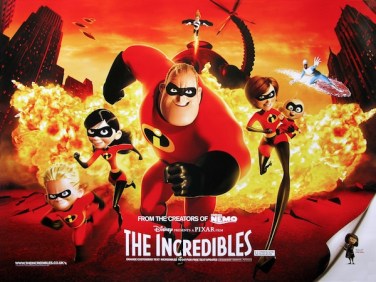
The Incredibles (2004)

100 Films’ 100 Favourites #44

Expect the incredible.

Country: USA
Language: English
Runtime: 115 minutes
BBFC: U
MPAA: PG

Original Release: 5th November 2004 (USA)
UK Release: 26th November 2004
First Seen: DVD, 2005

Stars
Craig T. Nelson (Poltergeist, Action Jackson)
Holly Hunter (Raising Arizona, The Piano)
Samuel L. Jackson (Pulp Fiction, Snakes on a Plane)
Jason Lee (Mallrats, Alvin and the Chipmunks)

Director
Brad Bird (The Iron Giant, Mission: Impossible – Ghost Protocol)

Screenwriter
Brad Bird (*batteries not included, Ratatouille)
(I bet you could count on one hand the number of Western animated movies written by one person.)

The Story
After public opinion forced superheroes into a civilian relocation programme, Bob and Helen Parr — formerly Mr Incredible and Elastigirl — live a quiet domestic life with their three children. Bob is dissatisfied, however, and easily tempted back to heroic ways by a call to defeat an evil robot. When it emerges this is part of a plan to kill retired superheroes and give powers to everyone in the world, Bob’s wife and superpowered kids must enter the fray to save the world.

Our Heroes
The fantastic four titular heroes: Bob Parr, aka Mr Incredible, who has super strength and limited invulnerability; his wife Helen, aka Elastigirl, who can stretch her body like rubber; their daughter Violet, who can become invisible and generate a force shield; and her younger brother Dash, who has super-speed (name/power coincidencetastic!) There’s also their chum Lucius Best, aka Frozone, who can form ice from the air. He’s very cool, hence casting Samuel L. Jackson.

Our Villain
Disillusioned superhero fanboy Buddy Pine, who grew up and used technology to give himself powers, dubbing himself Syndrome. Wants to give everyone in the world powers, because when everyone’s super, no one will be.

Best Supporting Character
Fashion designer Edna Mode, who makes the superheroes’ costumes. Inspired by Hollywood costume designer Edith Head, Bird wanted Lily Tomlin to voice her, and provided an example of how she should sound. Tomlin thought it was perfect, so she instead persuaded Bird to play the role himself.

Memorable Quote
“No matter how many times you save the world, it always manages to get back in jeopardy again. Sometimes I just want it to stay saved! You know, for a little bit? I feel like the maid — ‘I just cleaned up this mess! Can we keep it clean for ten minutes?!’” — Mr. Incredible

Memorable Scene
After tearing his old costume, Bob visits Edna for a new one. He wants a cape. Cue montage of why capes are a bad idea.

Technical Wizardry
The film presented a whole host of new technical challenges for Pixar, not least fully animating a whole cast of humans for the first time — they had to develop new technology to animate detailed anatomy, clothing, skin, and hair. The latter was a particular challenge. On Monsters, Inc., the animators persuaded director Pete Docter to give Boo pigtails to make her hair easier to animate, but Brad Bird accepted no such compromises, particularly as Violet’s long, face-covering hair was integral to her character — and it had to be depicted underwater and blowing in the wind, too. Ultimately, Violet’s hair was only successfully animated toward the end of production.

Next time…
One of the few Pixar sequels people actually wanted, The Incredibles 2 is in development for a 2019 release. That’s only a 15-year wait.

Awards
2 Oscars (Animated Film, Sound Editing)
2 Oscar nominations (Original Screenplay, Sound Mixing)
1 BAFTA Children’s Award (Best Film)
10 Annie Awards (Feature, Directing, Writing, Voice Acting (Brad Bird), Music, Production Design, Animated Effects, Character Animation, Character Design, Storyboarding)
6 Annie nominations (Voice Acting (Samuel L. Jackson), Character Animation (again, x3), Character Design (again), Storyboarding (again))
1 Saturn Award (Animated Film)
2 Saturn nominations (Writer, Music)
Won the Hugo for Best Dramatic Presentation Long Form

What the Critics Said
“what really makes The Incredibles work is the wit of Bird [though] much of it will be over the heads of very young viewers who account for so much repeat business. Bird’s satiric take on suburbia, conformity and forced notions of equality is surprisingly sophisticated and biting for an animated feature, matched by a visual panache that is often breathtaking.” — Kevin Lally, Film Journal International

Score: 97%

What the Public Say
“Most Disney films are about people meeting and falling in love. Incredibles is one of the only ones I can think of about how important marriage is. It shows a couple fighting, getting along, and working together.” — Rachel Wagner, Reviewing All 54 Disney Animated Films and More!

Verdict

Even before the present glut of big-screen super-heroics, Pixar were in on the game with this affectionate genre entry. Writer-director Brad Bird mixes together classical superhero antics with elements of 1960s spy-fi to create a retro world of optimistic heroics and larger-than-life villainy — at odds with the dark-and-serious tone of so many superhero movies of the past 17+ years, but all the more memorable for it. It’s also great at the kinds of things Pixar is known for. The combination means it transcends both the kids’ animation and superhero subgenres.

#45 will be… keeping up with the Joneses.

Highlander (1986)

100 Films’ 100 Favourites #43

There can be only one.

Country: UK
Language: English
Runtime: 116 minutes | 111 minutes (US theatrical cut)
BBFC: 15
MPAA: R

Original Release: 7th March 1986 (USA)
UK Release: 29th August 1986
First Seen: TV, 6th October 2000 (probably)

Stars
Christopher Lambert (Greystoke: The Legend of Tarzan, Lord of the Apes, Mortal Kombat)
Sean Connery (Goldfinger, The Rock)
Roxanne Hart (The Verdict, Pulse)
Clancy Brown (The Shawshank Redemption, The SpongeBob SquarePants Movie)

Director
Russell Mulcahy (The Shadow, Resident Evil: Extinction)

Screenwriters
Peter Bellwood (St. Helens, Highlander II: The Quickening)
Larry Ferguson (Beverly Hills Cop II, The Hunt for Red October)
Gregory Widen (Backdraft, The Prophecy)

Story by
Gregory Widen (see above)

The Story
Connor MacLeod is an immortal, a race of men living in secret among the rest of us, who must one day come together for the Gathering, after which there can be only one immortal left standing. That time comes in New York, 1985, as hulking savage the Kurgan hunts down the remaining immortals so that he can be the only one, and use the power that imbues to dominate the world. MacLeod is the only man in his way. Who will win? After all, there can be only— yeah, okay, you get it.

Our Hero
There can be only one Connor MacLeod, the 16th Century Scotsman with a suspiciously European accent who can live forever (who wants to live forever, anyway?)… unless someone lops his head off. That tends to do for most people, to be fair.

Our Villain
The strong and silent type, the Kurgan is certainly a physically imposing menace. Also immortal except for the decapitation thing. Wants MacLeod’s head, literally.

Best Supporting Character
Juan Sanchez Villa-Lobos Ramirez — the perpetually Scottish-accented Sean Connery as an Egyptian from Spain. It’s that kind of movie.

Memorable Quote
Connor MacLeod: “I’ve been alive for four and a half centuries, and I cannot die.”
Brenda: “Well, everyone has got their problems.”

Quote Most Likely To Be Used in Everyday Conversation
“There can be only one!” — everyone

Memorable Scene
(Spoilers!) As Connor talks with his assistant Rachel, an old woman, the film flashes back to World War 2: fleeing from Nazi soldiers, Connor runs into a barn, where he discovers a little girl hiding — Rachel. When a German officer turns up, Connor takes a bullet for her… then gets up and kills the officer, of course. This scene wasn’t even in the truncated US theatrical cut (it’s the largest single deletion, as detailed here), but has always stuck in my mind. It’s one of the best executions of the concept of the immortal: his only friend, an old woman, is someone he rescued as a little girl. (Short-lived half-decent US procedural crime series Forever explored this same concept more thoroughly over its single season a couple of years ago.)

Memorable Song
Who Wants to Live Forever is one of Queen’s best songs — and it was written by Brian May on the cab ride home after watching some rough footage from the movie! The band had only intended to record one song for the film, but after enjoying that footage they were inspired to compose more. The exact number of tracks they produced varies depending which source you listen to — they’re all on the A Kind of Magic album, but not all the tracks on that album were for Highlander. The exception is their recording of New York, New York for the film, which has never been released.

Technical Wizardry
Before CGI, filmmakers had to find other ways to do things like make swords spark when they clash. Animation was one method, of course. Not in Highlander, though. No, they attached a wire to each sword that then went down the arms of the actors to a car battery. One wire was connected to the positive terminal, the other to the negative terminal, so that when the blades touched there was an arc of electricity. Sounds super safe. Imagine the insurance costs of possibly electrocuting two lead actors…

Letting the Side Down
You might say the accents, but I think they’re part of the charm.

Making of
The opening scene was scripted to take place during a hockey match, emphasising the violence of the sport in contrast to the flashbacks of Connor warring in Scotland. The NHL weren’t impressed and refused permission. It was replaced with a wrestling match, which is presumably less violent than hockey.

Next time…
There should be only one! No one pays much attention to anything Highlander-related beyond the first film anymore, it feels like, but there’s a whopping great franchise lurking underneath that surface. It begins with much-maligned sequel Highlander II: The Quickening, also directed by Mulcahy and starring Lambert and Connery, which is set in the future and explains away the immortals as being aliens, or something. In spite of the minor improvement in the form of a “Renegade Version” director’s cut, the rest of the franchise ignores it. Spin-off TV series Highlander: The Series began in 1992, following the adventures of Duncan MacLeod (Adrian Paul), another immortal from the same clan. It ran for six seasons, begetting a spin-off of its own, Highlander: The Raven, which only lasted one. An animated series set in a post-apocalyptic future began in 1994, titled Highlander: The Animated Series (imaginative with their names, weren’t they?), which followed “the last of the MacLeods”, Quentin. It lasted for 40 episodes across two seasons. Also in 1994, second sequel Highlander III: The Sorcerer (aka Highlander: The Final Dimension) returned to the story of Connor MacLeod, ignoring both The Quickening and the TV series. Apparently it’s just a rehash of the first movie. After the TV series ended, fourth film Highlander: Endgame attempted to merge the two branches of the franchise, with a movie that followed Duncan MacLeod and led him to encounter Connor. It’s been shown on the BBC with surprising regularity. For some reason they made an anime movie in 2007, Highlander: The Search for Vengeance, which pits Colin MacLeod (yes, another one) against an immortal Roman general in a post-apocalyptic future. What is it with animation and post-apocalyptic futures? The whole shebang ultimately ground to a halt with Highlander: The Source, a post-Endgame continuation that was supposed to be the first of a trilogy but didn’t go down very well (plus ça change). It’s also been shown on the BBC with surprising regularity. There are also novels, a Flash-animated webseries, a handful of comic books released in the mid-’00s, and a couple of series of audio dramas from Big Finish that continue the TV series. A remake/reboot has been in development since 2008.

What the Critics Said
“Film starts out with a fantastic sword-fighting scene in the garage of Madison Square Garden and then jumps to a medieval battle between the clans set in 16th-century Scotland. Adding to the confusion in time, director Russell Mulcahy can’t seem to decide from one scene to the next whether he’s making a sci-fi, thriller, horror, music video or romance – end result is a mishmash.” — Variety (they say that as if it’s a bad thing!)

Score: 68%

What the Public Say
“I hear this won the Oscar for Best Movie Ever Made.” — Jope @ Blu-ray.com

Verdict

Highlander is a cult favourite — many reviews will tell you as much. I guess I’m in that cult, then, because I bloody love it. Of course it’s preposterous, of course the screenplay and performances are ridiculous, and of course it’s directed as much like an ’80s music video as it is a film… but it’s also a fantastic fantasy concept, so rich for further exploration that they keep trying to do just that (even though they keep messing it up). Also, it’s about men who have sword fights — excitingly choreographed sword fights — so, yeah, it’s right up my alley in that, too. Highlander may not be a “great film” in the artistic history-of-the-medium sense, but my goodness is it a great film.

A 30th anniversary restoration of Highlander is released on DVD and Blu-ray next month.

#44 will be… the best Fantastic Four movie.

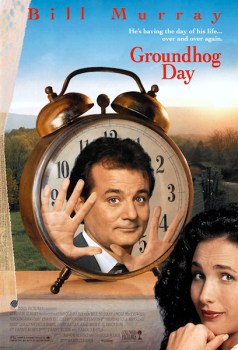
Groundhog Day (1993)

100 Films’ 100 Favourites #42

He’s having the day of his life…
over and over again.

Country: USA
Language: English
Runtime: 101 minutes
BBFC: PG
MPAA: PG

Original Release: 12 February 1993 (USA)
UK Release: 7th May 1993
First Seen: TV, c.1996

Stars
Bill Murray (Ghostbusters, The Life Aquatic with Steve Zissou)
Andie MacDowell (sex, lies, and videotape, Four Weddings and a Funeral)
Chris Elliott (Cabin Boy, There’s Something About Mary)
Stephen Tobolowsky (Thelma & Louise, Memento)

Director
Harold Ramis (Caddyshack, Analyze This)

Screenwriters
Harold Ramis (Animal House, Ghostbusters)
Danny Rubin (S.F.W.)

Story by
Danny Rubin (Hear No Evil, Stork Day)

The Story
Dispatched to cover the Groundhog Day ceremony in the small town of Punxsutawney, Pennsylvania, a TV news team get stuck overnight by a snowstorm. When weatherman Phil Connors wakes up the next morning, he finds it’s Groundhog Day again — he’s stuck in a time loop which no one else is aware of, reliving the despised day over and over again. The only advantage is he might be able to use the special knowledge he gains to woo his producer.

Our Hero
Grumpy TV weatherman Phil Connors definitely doesn’t want to be covering the ridiculous Groundhog Day ceremonies, so it’s a personal hell to relive that particular day over and over, possibly for the rest of time. Equally, it might just wind up making him a better man.

Our Villain
Who knows what caused Phil’s predicament? Maybe it was the groundhog — he’s in the title, after all.

Best Supporting Character
Now, don’t you tell me you don’t remember Ned because he’d sure as heckfire remember you. Ned Ryerson. Needlenose Ned. Ned the Head. From Case Western High. Ned Ryerson, did the whistling belly-button trick at the high school talent show? Bing! Ned Ryerson, got the shingles real bad senior year, almost didn’t graduate? Bing, again. Ned Ryerson, dated Phil’s sister Mary Pat a couple times until Phil told him not to anymore? Ned Ryerson? Bing!

Memorable Quote
“Well, what if there is no tomorrow? There wasn’t one today.” — Phil

Memorable Scene
Fed up with his limited immortality, Phil tries to commit suicide. It doesn’t work — so he keeps trying, in new and ingenious ways. I mean, when you put it like that it kinda doesn’t sound funny…

Making of
So, how long is Phil trapped in the time loop? Director Harold Ramis said the original idea was 10,000 years, though he later said it was probably more like 10 years. Various websites have tried to work it out, because of course. Estimates range from just under 9 years to more like 34 years, in order to account for all the time Phil spends learning to play the piano, become an ice sculptor, etc. In the film itself, we see events from just 38 days.

Next time…
The creative team behind the RSC’s successful musical Matilda are working on a stage musical adaptation of Groundhog Day, including songs by Tim Minchin, which will premiere at The Old Vic later this year before opening on Broadway in March 2017.

Awards
1 BAFTA (Original Screenplay)
1 British Comedy Award (Comedy Film)
1 Saturn Award (Actress (Andie McDowell))
5 Saturn nominations (Fantasy Film, Actor (Bill Murray), Director, Writing, Costumes)
Nominated for the Hugo for Best Dramatic Presentation.

What the Critics Said
“While Murray’s deadpan putdowns and dry dismissals of provincial peccadilloes are the comic highlights, Groundhog Day is no supercilious rip of small-town U.S.A. Under Ramis’ even-handed, smartly tilted direction, Groundhog Day also shows the strong virtues of small-town decencies and the maturing-effect they have on the glib media-slicker.” — Duane Byrge, The Hollywood Reporter

Score: 96%

What the Public Say
“What has always come best from Bill Murray is a kind of flat, dead-pan delivery, a manner of looking at bizarre situations and sizing them up […] Groundhog Day is right at home for Murray because it affords him at least two dozen moments like that. It is the perfect playground for his kind of humor. Yet, it is something more than that. Here he begins by playing a man who is smug and self-important and slowly transforms into a man who is happy.” — Jerry, armchaircinema

What the Philosophers Say
“perhaps the ultimate meditation on man’s struggle to give meaning to his life within the abyss of an inconsequential existence, at least as far as ’90s comedies go.” — Colin Newton, Mind Over Movies

Verdict

A Twilight Zone-esque setup gets a comedic twist in the hands of co-writer/director Harold Ramis and star Bill Murray (teaming up in a version of that configuration for the sixth time). While the film is undoubtedly a showcase for Murray’s comedic talents (which is no bad thing), alongside that it develops an endearing vein about what it means to be a good person, touching on some pretty philosophical stuff along the way. It’s also a movie about leading a repetitious life, but it isn’t repetitious itself — surely a feat all of its own.

How many #43s can there be? There can be only one.

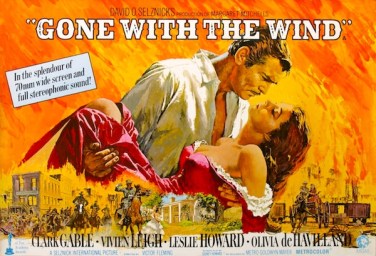
Gone with the Wind (1939)

100 Films’ 100 Favourites #41

The most magnificent picture ever!

Country: USA
Language: English
Runtime: 233 minutes
BBFC: A (cut, 1940) | PG (1988)
MPAA: G (1971)

Original Release: 15th December 1939 (premiere in Atlanta, Georgia, USA)
US Release: 17th January 1940
UK Release: 18th April 1940 (premiere)
First Seen: TV, c.2005

Stars
Clark Gable (It Happened One Night, Mutiny on the Bounty)
Vivien Leigh (Fire Over England, A Streetcar Named Desire)
Leslie Howard (Of Human Bondage, 49th Parallel)
Olivia de Havilland (The Adventures of Robin Hood, The Dark Mirror)
Hattie McDaniel (Show Boat, Song of the South)

Director
Victor Fleming (The Wizard of Oz, A Guy Named Joe)

Screenwriter
Sidney Howard (Arrowsmith, Dodsworth)

Based on
Gone with the Wind, a novel by Margaret Mitchell.

The Story
The American South, 1861: wealthy teenager Scarlett O’Hara spends her days attending parties and flirting with her many admirers, though she only really has eyes for her neighbour, Ashley. After he declares his intention to marry his cousin Melanie, a furious Scarlett meets Rhett Butler, a practically-minded gent who only serves his own interests. When the American Civil War breaks out, Scarlett has to apply her manipulative nature to survival, as down the years she engages in a love/hate relationship with the similarly-tempered Rhett.

Our Heroes
Scarlett O’Hara is the perennial belle of the ball in her Southern community, until the American Civil War comes and she’s forced to grow up. Her innate selfishness and tendency to manipulate people (or try to, at least) helps her survive the conflict in more-or-less one piece. Equally self concerned is Rhett Butler, a gentleman not afraid to stand up to Scarlett, which is why they clash, and why they’re probably made for one another.

Our Villains
Those damn Unionists, with their trying to get rid of slavery and everything!

Best Supporting Character
Hattie McDaniel is memorable, likeable, and Oscar-winning as the O’Haras’ maid, Mammy. Whether her performance was a good thing for the African American community or just an ‘Uncle Tom’ is another matter.

Memorable Quote
“As God is my witness, as God is my witness they’re not going to lick me. I’m going to live through this and when it’s all over, I’ll never be hungry again. No, nor any of my folk. If I have to lie, steal, cheat or kill. As God is my witness, I’ll never be hungry again.” — Scarlett O’Hara

Quote Most Likely To Be Used in Everyday Conversation
“Frankly, my dear, I don’t give a damn.” — Rhett Butler

Memorable Scene
In the streets of Atlanta, Scarlett comes across the casualties from the battle. First we only see her face as she comes upon a shocking sight. Then it cuts to a long-shot: Scarlett stood by some soldiers, a couple of wounded men on the ground before her. The camera tracks back as Scarlett walks forward, gradually revealing the field of wounded soldiers she’s walking among. It continues to pull back, up into the sky, for a full 55 seconds, the injured stretching as far as the eye can see as a damaged Confederate flag flutters into view in the foreground.

Technical Wizardry
The Technicolor photography by Ernest Haller is absolutely gorgeous, and looks better than ever nowadays thanks to new restoration techniques developed in 2004 (12 years ago?! Where does time go?) That restoration is where the real wizardry lies. Gone with the Wind was shot with Technicolor’s three-strip process, in which a prism split the light entering the camera into its green, red and blue parts, which were each exposed on a strip of black-and-white film. These strips were then dyed the appropriate colour, before being combined onto a new film to create the final full-colour print. Naturally this process was liable to human error: misalign one of the strips by even the slightest amount and you get errors; small and almost unnoticeable, maybe, but less than perfection. In 2004, they went back to the original three strips and, using complicated new computer programs, realigned them from scratch. This perfect alignment revealed details that have always been on the film but would never have been seen before, meaning these movies (they also did it for the likes of The Wizard of Oz, Singin’ in the Rain, and The Adventures of Robin Hood) literally looked better than they ever had. Magic.

Letting the Side Down
There are a raft of criticisms that can be levelled at Gone with the Wind, from its depiction of black characters, to making the South seem not so bad, to the faithfulness of its adaptation (too much). The second half is certainly less focused and less memorable than the first, but the whole overcomes that, for me.

Making of
The search for an actress to play the leading role of Scarlett O’Hara is legendary — it was even dramatised in an Emmy-winning TV movie in 1980. In all it lasted two years, including an open casting call that interviewed 1,400 unknowns (useless for casting, great for publicity), and the formal screen-testing of 31 actresses, including the likes of Lucille Ball, Clara Bow, Joan Crawford, Bette Davis, Katharine Hepburn, Ginger Rogers, Barbara Stanwyck, and many more. In the end, it of course went to a young British actress, then unknown in America, called Vivien Leigh. The rest is screen history.

Next time…
Fans and filmmakers alike tried to get Margaret Mitchell to write a sequel until her death in 1949. In the ’70s, her brother agreed a deal with MGM and Universal under which a novel would be written and simultaneously adapted into a film. Despite a 775-page manuscript being produced, the deal fell apart. Numerous sequel novels have been published, and in 1994 one of these, Alexandra Ripley’s Scarlett, was adapted into a miniseries starring Joanne Whalley as Scarlett and Timothy Dalton as Rhett, with a supporting cast that includes Sean Bean, John Gielgud, and Ann-Margret. Apparently it’s not very good.

Awards
8 Oscars (Picture, Actress (Vivien Leigh), Supporting Actress (Hattie McDaniel), Director, Screenplay, Color Cinematography, Art Direction, Editing)
1 Honorary Award from AMPAS (for “outstanding achievement in the use of color for the enhancement of dramatic mood”)
1 Technical Achievement Award from AMPAS (for being “pioneering in the use of coordinated equipment”)
5 Oscar nominations (Actor (Clark Gable), Supporting Actress (Olivia de Havilland), Score, Sound Recording, Special Effects)

What the Critics Said in 1939
“There has never been a picture like David O. Selznick’s production of Gone With the Wind. It is so true to Margaret Mitchell’s novel of the Civil War, as it was fought in and around Atlanta, that the film is of the same epic quality as the book. […] Vivien Leigh, the little English girl imported to play the role of Scarlett, gives a magnificent performance. No other actress in Hollywood, or on the New York stage, could have come close to equalling it. […] She is pert and beautiful, lacking in erudition but the possessor of all the arts and allure of the vital female. She is quick-tempered, selfish, untruthful, sturdy and wilful as a lioness. No attempt has been made to gloss over Scarlett’s weaknesses and sins. As she is, she dominates the picture from its gay and light-hearted beginning to its tragic close.” — Kate Cameron, New York Daily News

What the Critics Said in 1973
“The most interesting way to consider GWTW today is in comparison with the film that may eventually surpass it in profits, The Godfather. Look at the similarities. Both originated in best-selling American novels. Both are very long. Both are about predators. Both are ultra-American yet are very closely allied to Europe (Walter Scott and Sicily). And, most important, both live within codes of honor, and both codes are romances. William R. Taylor has shown, in Cavalier and Yankee, that the ‘Walter Scott’ antebellum South was largely a literary fabrication, concocted at the time, not retrospectively; as for The Godfather, our newspapers show us daily that ‘They Only Kill Each Other’ is just another escape hatch to allow us to blink facts. ‘Us,’ by the way, means the world, not just the United States, since the whole world flocks to both films. And that’s interesting, too, because it leads to a difference, not a likeness. In a new age, when the ‘realistic’ Godfather is packing them in, the romantic GWTW is still popular. There’s a crumb of comfort in that: at least culture is still more pluralist than some of our propagandists would have us believe.” — Stanley Kauffmann, The Atlantic

What the Critics Said in 2015
“Its stereotype of happy slaves and kindly masters has never been more wince-inducing […] But no one watches Gone with the Wind for historical accuracy. What keeps us coming back is four-hours of epic romance in gorgeous Technicolor. Slavery, the Civil War, the burning of Atlanta, a street knee-deep in dead soldiers—all just a backdrop to the main event, Scarlett ’n’ Rhett. The feminist jury is still out on Southern belle Scarlett O’Hara (Vivien Leigh). Nothing but a serial husband-thief? Or a resilient modern woman doing what she can to survive? You decide.” — Cath Clarke, Time Out

Score: 94%

What the Public Say
“What’s striking almost 75 years on is how fresh and modern both Rhett and Scarlett remain. Gable’s eyes twinkle as he rolls Sidney Howard’s dialogue around his mouth, but there’s also a sadness there and a resignation that, no matter how hard he tries, he and Scarlett can never last. Leigh, who came through a tortuous audition process to land the part, positively crackles. Although still one of the feistiest and most driven female parts committed to screen Scarlett is, for the most part, pretty damn annoying and does little to enamour herself as the film progresses. […] Rhett sums Scarlett up perfectly when he remarks that she’s ‘like the thief who isn’t the least bit sorry he stole, but is terribly, terribly sorry he’s going to jail’.” — Three Rows Back

Elsewhere on 100 Films
I briefly reviewed Gone with the Wind after a re-watch way back in 2007, when I assessed that “the direction is brilliant, displaying styles you think weren’t invented for another 20 years; all of the design work is gorgeous; and the story is epic and expertly told, moving across genres (romance, war, melodrama, comedy) with ease. It’s easy to see why this is the most popular film ever made.”

Verdict

Last week I wrote about the enduring mass popularity of The Godfather, and here’s another case in point. Gone with the Wind may not rack up the ratings in the same circles as Coppola’s opus, but it has consistently been voted America’s most favourite movie, and its numerous massively successful re-releases mean that, adjusted for inflation, it’s still the highest grossing movie of all time. It’s an epic in the truest sense of the word, with a story spanning many years and many miles, passing by historical events in the process. However, at its core it’s the story of a tumultuous romance between two people, who may love each other or may hate each other, but who, with their unique, selfish, manipulative perspectives, are surely perfect for each other.

#42 will be… #42 will be… #42 will be…

The Godfather (1972)

100 Films’ 100 Favourites #39

An offer you can’t refuse.

Country: USA
Language: English, Italian & Latin
Runtime: 175 minutes
BBFC: X (cut, 1972) | 18 (1987) | 15 (2008)
MPAA: R

Original Release: 24th March 1972
UK Release: 18th August 1972
First Seen: DVD, c.2001

Stars
Marlon Brando (On the Waterfront, Apocalypse Now)
Al Pacino (Dog Day Afternoon, Scarface)
James Caan (Rollerball, Misery)
Robert Duvall (The Seven-Per-Cent Solution, Network)

Director
Francis Ford Coppola (The Godfather Part II, Apocalypse Now)

Screenwriters
Mario Puzo (Earthquake, Superman)
Francis Ford Coppola (The Great Gatsby, The Conversation)

Based on
The Godfather, a novel by Mario Puzo.

The Story
1945: Michael takes his girlfriend to his sister’s wedding, where she’s introduced to his family, including his father, Vito — the Don of New York’s Corleone crime family. Over the next decade, decisions made by the family lead to escalating gang war, and just as he thought he was out, Michael is pulled in to the family business.

Our Hero
A good college kid who dropped out to fight in World War 2, Michael Corleone has distanced himself from his family’s criminal activities… until a series of events find him drawn inescapably in.

Our Villain
According to the AFI, Michael is the 11th most iconic villain in film history. Of course, he winds up a Mafia Don, so he’s hardly a good guy in the traditional sense, but we’re surely on his side, at least throughout this film. Even in that context, I think you could argue the titular Godfather himself, Don Corleone, is the villain: his one son who tried to escape the life of crime is pulled into it after a string of poor choices and unfortunate incidents land the family in trouble.

Best Supporting Character
James Caan is Vito’s hot-headed eldest son, Sonny, heir apparent to the crime empire. Unfortunately, that very hot-headedness is liable to leave the position open…

Memorable Quote
“Luca Brasi sleeps with the fishes.” — Clemenza

Quote Most Likely To Be Used in Everyday Conversation
“I’m gonna make him an offer he can’t refuse.” — Don Corleone
(According to the AFI, this is the second best movie quote ever.)

Memorable Scene
The opening is the perfect scene-setter for the movie. On the day of his daughter’s wedding, Don Corleone hears requests for favours. One man asks for retribution against men who assaulted his daughter, which he has been denied by the legal system. Corleone questions why the man didn’t come straight to him, but ultimately grants the grovelling father his wish. Here, the film has established its pace, its tone, and themes of family, respect, and the important point that these criminals think of themselves as the honourable ones.

Write the Theme Tune…
Italian composer Nino Rota composed the majority of the soundtrack (Carmine Coppola contributed some music), including the famous main theme. Apparently a Paramount executive described Rota’s score as too “highbrow” and urged it be ditched, but Coppola won out. Considering the music’s subsequent fame and familiarity, I think we know who was right.

Technical Wizardry
The dark but amber-tinged cinematography by Gordon Willis is gorgeous. It’s stuff like this that high definition was made for.

Making of
Cinematographer Gordon Willis insisted that every shot represent a point of view, placing his camera around 4ft off the ground and keeping the angle flat. Coppola persuaded him to do a single aerial shot, in the scene when Don Corleone is gunned down, by telling Willis that the angle represented God’s perspective.

There’s a first time for everything…
According to IMDb, “Coppola turned in an initial director’s cut running 126 minutes. Paramount production chief Robert Evans rejected this version and demanded a longer cut with more scenes about the family. The final release version was nearly 50 minutes longer”. Studios love extended cuts for DVD these days, but choosing to take up more time in theatres? Not bloody likely.

Next time…
Debate rages as to whether sequel The Godfather Part II is an even better film. Either way, it was the first sequel to win Best Picture (and still one of only two). In 1977, Coppola edited the two films together in chronological order, along with some deleted scenes, to form The Godfather Saga miniseries, aka The Godfather: A Novel for Television. (Although it’s not been released on home media since VHS, it has been repeated on TV in HD, meaning copies can be… acquired.) Over a decade later, Coppola turned his duology into a trilogy with The Godfather Part III. Although generally reviled whenever it’s spoken about, it has a not-bad 7.6 on IMDb and was also nominated for Best Picture, as well as six other Oscars. (Part III was later added to the chronological cut to make The Godfather Trilogy: 1901-1980.)

Awards
3 Oscars (Picture, Actor (Marlon Brando), Adapted Screenplay)
8 Oscar nominations (Supporting Actor (James Caan, Robert Duvall, and Al Pacino), Director, Costume Design, Sound, Editing, Score)
1 BAFTA (Music)
4 BAFTA nominations (Actor (Marlon Brando), Supporting Actor (Robert Duvall), Costume Design, Most Promising Newcomer to Leading Film Roles (Al Pacino))

What the Critics Said
“It seems that the first question everyone asks about The Godfather is concerned with Marlon Brando’s interpretation of the title role. That is the way the movie has been programmed and promoted: Brando, Brando, Brando, and more Brando. The word from advance hush-hush screenings was wow all caps and exclamation point. […] So to answer belatedly the first question everyone asks about The Godfather: Brando gives an excellent performance as Don Vito Corleone [however,] though Brando’s star presence dominates every scene in which he appears, the part itself is relatively small, and there are other people who are equally good with considerably less strain, among them the extraordinarily versatile James Caan as the hot-headed, ill-fated Sonny Corleone, Richard Castellano as the jovially gruesome Clemenza, and Robert Duvall as Don Vito Corleone’s non-Italian consigliere, Tom Hagen.” — Tony Ortega, The Village Voice

What One Single Critic Said
“I don’t see how any gifted actor could have done less than Brando does here. His resident power, his sheer innate force, has rarely seemed weaker. […] Al Pacino, as Brando’s heir, rattles around in a part too demanding for him. James Caan is OK as his older brother. The surprisingly rotten score by Nino Rota contains a quotation from “Manhattan Serenade” as a plane lands in Los Angeles. Francis Ford Coppola, the director and co-adapter (with Mario Puzo), has saved all his limited ingenuity for the shootings and stranglings, which are among the most vicious I can remember on film. The print of the picture showed to the New York press had very washed-out colors.” — Stanley Kauffmann, New Republic (the one and only critical review on Rotten Tomatoes)

Score: 99%

What the Public Say
“Few people could have anticipated during the course of adapting Mario Puzo’s best-seller The Godfather to the big screen that it would become a lasting legacy in cinema. Forty-plus years have passed since its theatrical release, yet it stands the test of time as not only one of the greatest depictions of a crime family, but as one of the best films ever made. […] That lasting popularity isn’t a fluke; the Godfather films stand the test of time because these aren’t just movies, they’re cultural touchstones.” — Colin Biggs, Movie Mezzanine

Verdict

Has it really been almost eight years since the IMDb Top 250’s unshakeable #1 was usurped? The Godfather sat pretty at the top of that user-voted ranking for the best part of nine years, its balance between critically-acclaimed filmmaking finesse and quotable gangster machinations almost perfectly calibrated for that website’s prevailing demographic. (It’s since settled at #2, hardly a failure.) It’s not just IMDb users, though: The Godfather places 6th on the latest iteration of The 1,000 Greatest Films, the as-near-to-definitive-as-you-can-get poll-of-polls compilation. It’s for the same reasons, really: The Godfather combines thriller elements and striking violence with a strong understanding of character and a believable exploration of organised crime, a world as fascinating as it is morally repulsive, for a whole that is as artistically accomplished as it is palatable to the mainstream.

Sky Movies Select are showing the complete Godfather trilogy today from 4:30pm.

Next… you know the name, you know the number — it’s #40.

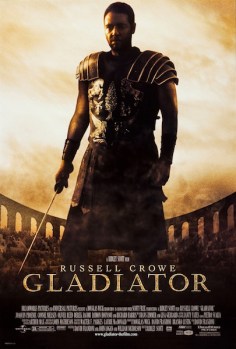
Gladiator (2000)

100 Films’ 100 Favourites #38

The general who became a slave.
The slave who became a gladiator.
The gladiator who defied an empire.

Country: USA & UK
Language: English
Runtime: 155 minutes | 171 minutes (extended edition)
BBFC: 15
MPAA: R

Original Release: 4th May 2000 (Australia)
US Release: 5th May 2000
UK Release: 12th May 2000
First Seen: DVD, c.2001

Stars
Russell Crowe (L.A. Confidential, A Beautiful Mind)
Joaquin Phoenix (Walk the Line, Her)
Connie Nielsen (The Devil’s Advocate, One Hour Photo)
Oliver Reed (Women in Love, The Three Musketeers)
Richard Harris (This Sporting Life, Unforgiven)

Director
Ridley Scott (Kingdom of Heaven, Exodus: Gods and Kings)

Screenwriters
David Franzoni (Amistad, King Arthur)
John Logan (The Aviator, Skyfall)
William Nicolson (Shadowlands, Mandela: Long Walk to Freedom)

Story by
David Franzoni (Jumpin’ Jack Flash, Citizen Cohn)

The Story
Roman Emperor Marcus Aurelius believes his son and heir, Commodus, is unfit to rule, so plans to appoint victorious General Maximus Decimus Meridius as regent. Before he can, Commodus murders Marcus and orders Maximus’ execution. Maximus escapes, but returns home to find Commodus has had his wife and son murdered. Captured by slavers, Maximus becomes a gladiator, and when Commodus announces gladiatorial games to commemorate his father, he spots a chance for revenge…

Our Hero
Maximus Decimus Meridius, commander of the Armies of the North, General of the Felix Legions and loyal servant to the old emperor, Marcus Aurelius. Father to a murdered son, husband to a murdered wife, becomes a gladiator, will have his vengeance against the new emperor, in this life or the next.

Our Villain
Said new emperor, Commodus. Murders his father because Marcus favours Maximus. Fancies his sister. That kinda guy.

Best Supporting Character
Even if his performance is partially computer generated (more on that later), Oliver Reed still stands out as Proximo, the slave owner who buys Maximus and turns him into a gladiator. For a fella who does that kind of thing, he turns out to be very honourable.

Memorable Quote
“My name is Maximus Decimus Meridius, commander of the Armies of the North, General of the Felix Legions and loyal servant to the true emperor, Marcus Aurelius. Father to a murdered son, husband to a murdered wife. And I will have my vengeance, in this life or the next.” — Maximus Decimus Meridius, commander of the Armies of the North, General of the Felix Legions, loyal servant to the true emperor Marcus Aurelius; father to a murdered son, husband to a murdered wife.

Quote Most Likely To Be Used in Everyday Conversation
“Are you not entertained? Are you not entertained?” — Maximus Decimus Meridius, commander of the Armies of the— yeah, you know the rest.

Memorable Scene
After Maximus secures a surprise victory in the Colosseum, Commodus enters the arena to congratulate the victor. Maximus reveals himself (cue famous speech), but holds back on his plan to murder the Emperor. As the Praetorian Guard prepare to execute Maximus, the crowd chant: “live!” Not prepared to risk unpopularity, Commodus spares him… for now.

Truly Special Effect
Oliver Reed died halfway through filming, with his key supporting role only partially complete. Famously, his performance was completed with computers, one of the first times such a thing had been done. Effects company The Mill created the additional footage by filming a body double and then mapping on a computer-generated mask of Reed’s face. The work totalled two minutes of screentime, at an estimated cost of $3.2 million.

Making of
When the HBO/BBC TV series Rome started, I read an interview with the programme’s historical advisor, who’d performed the same role for Gladiator. Asked to compare the experience of working on a major Hollywood movie versus a BBC-produced TV series, she cited the way the makers asked for information about something they wanted to include: on TV they’d ask, “did this exist?”; on Gladiator they’d say, “find us proof this existed.”

Next time…
A prequel or sequel was discussed ever since the film was a hit. The best/worst idea came from a re-write by Nick Cave (yes, that one) in which Maximus was “reincarnated by the Roman gods and returned to Rome to defend Christians against persecution; then transported to other important periods in history, including World War II, the Vietnam War, and finally being a general in the modern-day Pentagon.” As awesome as that sounds, it was rejected for “being too far-fetched, and not in keeping with the spirit and theme of the original”. Spoilsports.

Awards
5 Oscars (Picture, Actor (Russell Crowe), Costume Design, Sound, Visual Effects)
7 Oscar nominations (Supporting Actor (Joaquin Phoenix), Director, Original Screenplay, Cinematography, Editing, Score, Art Direction-Set Decoration)
5 BAFTAs (Film, Cinematography, Production Design, Editing, Audience Award)
10 BAFTA nominations (Actor (Russell Crowe), Supporting Actor (both Joaquin Phoenix and Oliver Reed), Director, Original Screenplay, Music, Costume Design, Sound, Visual Effects, Make Up/Hair)
2 World Stunt Awards (Best Fight, Best Work with an Animal)
1 MTV Movie Award (Best Movie)
5 MTV Movie Awards nominations (including Best Line from a Movie for “It vexes me, I am terribly vexed!”)

What the Critics Said
“There isn’t much difference between the crowds cheering Maximus and fans of modern mayhem entertainment. Money is the root of all violent exploitation then and now. One of Maximus’ endearing qualities is the way he resents the attention. It’s insane to view these fights as fun. We like him enough to agree, then realize we’re gawkers, too. Scott plays cagey with this paradox, as if to say: If you want to be a ghoul, do it right. Mano a mano, with much more than profit in the balance. Viewers shouldn’t feel guilty watching Gladiator, but its impatience with trash-sports showmanship is unmistakable.” — Steve Persall, St. Petersburg Times

Score: 76%

What the Public Say
“As far as elements of technical filmmaking go, Gladiator is nothing short of a marvel. Production design team does a magnificent job in putting up set pieces that are grand, imposing & meticulously refined with the real standout being the Colosseum itself which is undeniably a sight to behold. The culture, politics & life within the Roman Empire is illustrated in splendid detail. Costumes, artefacts & other props are in sync with the timeline its story is set in but it also incorporates a slightly urban touch to it that brings a flavour of its own into the picture and enhances the look & feel of the whole imagery.” — CinemaClown @ Letterboxd

Verdict

Gladiator’s influence is plain to see: it was hailed at the time for reviving the classic swords-and-sandals epic — and indeed it did, because in its wake we’ve had so many that my original plan to list them here became untenable. The ‘original’ is still the best, though, thanks to director Ridley Scott’s feel for the epic, Russell Crowe’s strong hero, Joaquin Phoenix’s slimily unstable villain, and a mix of a straight revenge tale with familial/political plotting and the importance of public relations, thumping action sequences, and groundbreaking special effects.

#39 will make you… an offer you can’t refuse.

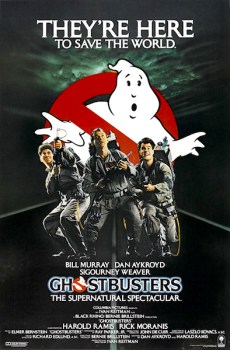
Ghostbusters (1984)

100 Films’ 100 Favourites #37

They’re here to save the world.

Also Known As: Ghost Busters, technically.

Country: USA
Language: English
Runtime: 105 minutes
BBFC: PG (1984) | 12A (2011)
MPAA: PG

Original Release: 8th June 1984
UK Release: 7th December 1984
First Seen: VHS, c.1990

Stars
Bill Murray (Groundhog Day, Lost in Translation)
Dan Aykroyd (The Blues Brothers, Trading Places)
Harold Ramis (Stripes, The Last Kiss)
Ernie Hudson (The Crow, Congo)
Sigourney Weaver (The Year of Living Dangerously, Gorillas in the Mist)
Rick Moranis (Little Shop of Horrors, Honey, I Shrunk the Kids)

Director
Ivan Reitman (Stripes, Kindergarten Cop)

Screenwriters
Dan Aykroyd (The Blues Brothers, Dragnet)
Harold Ramis (Animal House, Groundhog Day)

The Story
After losing their university jobs, a trio of paranormal researchers set up a ghost extermination business. They’re soon hired by Dana Barrett, who believes her apartment is haunted. Turns out it is, by an evil demigod who posses Dana and sets about bringing the world to an end…

Our Heroes
They ain’t afraid of no ghosts! Discredited parapsychologists Peter Venkman, Ray Stantz and Egon Spengler set up the Ghostbusters to combat the increasing problem of paranormal activity in New York City, and later recruit Winston Zeddemore to cope with demand.

Our Villain
Gozer the Gozerian, a Sumerian god of destruction. Likes to turn his servants into supernatural hounds and allow the good guys to choose the form of their ‘destructor’ — which is how you end up having to fight a 112½-foot marshmallow man.

Best Supporting Character
Among a strong cast of memorable characters, one has to feel for William Atherton as antagonistic EPA agent Walter Peck. Peck is so unlikeable that, according to director Ivan Reitman, it “ruined” Atherton’s life: people confronted him as if he were the character, including starting fights in bars. He’s just too good at being a slimy little so-and-so, I guess.

Memorable Quote
“Don’t cross the streams.” — Dr. Egon Spengler

Quote Most Likely To Be Used in Everyday Conversation
“Dogs and cats, living together!” — Dr. Peter Venkman (well, we used it a lot…)

Memorable Scene
The Ghostbusters fail to stop the coming of Gozer, who shortly declares that the destructor will follow, in a physical form chosen by the team. Although three of them manage to clear their minds, something pops into Ray’s head — “the most harmless thing. Something I loved from my childhood. Something that could never, ever possibly destroy us.” Unless it was eleven storeys tall and motivated by evil, of course.

Sing the Theme Tune…
“If there’s something strange in you neighbourhood, who you gonna call?” Ray Parker Jr.’s theme song is as iconic as the movie itself. It lost the Oscar to Stevie Wonder’s I Just Called to Say I Love You. Won the BAFTA, though.

Truly Special Effect
The film is full of excellent effects work — all done practically, of course, in those pre-CGI days. That also means an abundance of techniques were used, from simple stuff like hanging things on wires or using wind blowers to make library cards fly around, to miniatures with a Godzilla-style man in a suit, to full animation for things like the proton packs’ streams. And it was all produced on such a tight schedule that, according to the film’s effects mastermind, 70-80% of the work was achieved in the first take.

Making of
Dan Aykroyd wrote the part of Winston with Eddie Murphy in mind, having just worked with him on Trading Places. When Murphy was unavailable due to working on Beverly Hills Cop, Ernie Hudson was cast. He was so excited by the part that he agreed to do it for half his usual salary, only to then receive a revised script in which Winston had a greatly reduced role. In 2015, Hudson commented, “I love the character and he’s got some great lines, but I felt the guy was just kind of there. I love the movie, I love the guys. I’m very thankful to Ivan for casting me. I’m very thankful that fans appreciate the Winston character. But it’s always been very frustrating — kind of a love/hate thing, I guess.”

Next time…
First came The Real Ghostbusters, an animated series that ran from 1986 to 1991 and produced 140 episodes (the addition of The Real to the title being due to another series from the ’70s). Due to its success, the cast and crew were cajoled into making a film sequel, Ghostbusters II, which scared the life out of me when I was about 4. In 2009, Ghostbusters: The Video Game used the likenesses and voices of many of the original cast, and Dan Aykroyd described it as “essentially the third movie.” Rumours and/or plans for a genuine second sequel persisted for a very, very long time (there’s a mass of details here, if you’re interested), though finally seem to have been abandoned in favour of this summer’s all-female reboot.

Awards
2 Oscar nominations (Visual Effects, Original Song)
1 BAFTA (Original Song)
1 BAFTA nomination (Visual Effects)
1 Saturn Award (Fantasy Film)
Nominated for the Hugo for Best Dramatic Presentation.

What the Critics Said
“The cast could not be better. Although his role is too small, Aykroyd is endearingly serious as a diehard, but easily scared, ghost-hunter. Harold Ramis, the co-writer of the script, is extremely funny as a hopeless egghead […] But Ghostbusters is primarily a showcase for Murray, who slinks through the movie muttering his lines in his usual cheeky fashion and getting off an occasionally hilarious crack that proves he’s thoroughly enjoying himself.” — Kathleen Carroll, New York Daily News

Score: 97%

What the Public Say
“the use of special effects, specifically practical effect, shines as well. The ghosts may not be perfectly rendered, but they are so interesting in design and they have so much energy onscreen that you don’t mind it. The practical effects, like having the ground open up or drawers being opened by unseen ghosts are done very well. In a time where many effects-heavy films rely solely on CGI, it’s nice to look back to a time when practical effects were still commonplace in movies and done well in movies.” — Joey Sack, Reel Reactions

Verdict

Along with Teenage Mutant Ninja Turtles and ThunderCats, I loved Ghostbusters when I was a kid — I had a dressing up set, with a jumpsuit and a proton pack with a yellow foam whatsit for the stream, and one of the traps, and an Ecto-1, and the firehouse playset, and one time I got my fingers caught in the grill on the roof (which was there to pour goo through, because toys) and I’m sure I panicked until liberal application of butter freed me… Good times. I guess back then my love for it was more to do with the animated series than the movie, but the film itself is a work of blockbuster comedy art. The characters are a joy to be around, the dialogue is hilarious and quotable, multiple sequences lodge themselves indelibly in the memory, the special effects are exemplary, and the dramatic stakes can be surprisingly effective for what’s primarily a comedy.

All together now: “bustin’ makes me feel good!

#38 will have its revenge… in this post or the next.