
George Miller | 120 mins | Blu-ray | 2.40:1 | Australia & USA / English | 15 / R
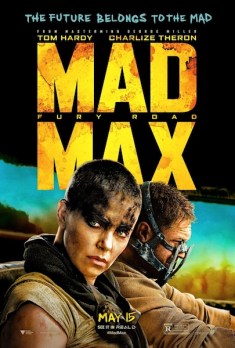 After a decades-long diversion into children’s movies like Babe: Pig in the City and Happy Feet, director George Miller here returns to the post-apocalyptic action series that made his name, and in the process managed to create a blockbuster that was not only critically acclaimed and well-received by audiences, but looks set to be a major award season contender too.
The story sees future drifter and sometime-hero Max (now played by Tom Hardy) arrive in a town ruled by Immortan Joe (Hugh Keays-Byrne), who keeps the populace in check by controlling the flow of water. He’s also created a heavily caste society, including suicidal warriors like Nux (Nicholas Hoult) and his Five Wives (Rosie Huntington-Whiteley, Riley Keough, Zoë Kravitz, Abbey Lee Kershaw, Courtney Eaton), who he keeps locked away for breeding purposes. During a routine run for oil, Joe’s best driver, Imperator Furiosa (Charlize Theron), veers off course, and it’s soon discovered it’s a bid for freedom with the wives. Joe and his amassed forces give chase. For the rest of the film.
You can certainly watch Fury Road as just a two-hour chase and (presuming you like action antics) get something out of it. The volume of action, the style with which it’s executed, and the impressive audacity of the stuntwork, all mean the film functions on a purely visceral level. That said, the action sequences are almost more incredible for how they were achieved than for how they’re presented in the finished film. The end product is perhaps a little too frenetic, the CG boosts a little too heavy-handed — all the talk of “doing it all for real” may be more or less true, but it feels like an awful lot of that ‘reality’ has been augmented with wire/rig removal and the compositing of multiple practically-performed stunts into single shots. The end result is unquestionably better than empty pure-CGI mayhem, but the awe-inspiring impressiveness of the stunt performers’ work is better conveyed in the special features than the film itself.
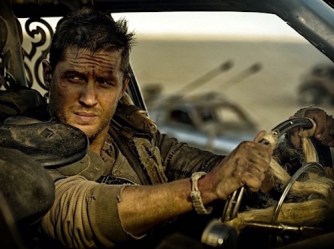 I say that, but the finished film is visually stunning on two levels: cinematography and editing. It was shot by John Seale, and Miller had him amp up the saturation. The point was to do the opposite of most post-apocalyptic blockbusters, which are normally desaturated to heck, and it indeed creates something strikingly different. Conversely, Miller has intimated the ideal version of the movie is in black and white with no dialogue, just the score — completely visually-focused storytelling. I have a feeling he’s right, or that it would at least work well. Some nuance would be lost, but all the major plot points and character arcs would be followable.
This is in part thanks to Margaret Sixel’s editing. Chosen precisely because she’d never edited action before, Sixel brings classical touches to the work — like eye trace and crosshair framing — that keep the film exceptionally followable even in the midst of some fast cutting. The one poor choice, in my opinion, is the occasional use of a ‘step’-y effect, which just makes it look like you’re streaming on a not-quite-fast-enough connection or watching a badly-encoded pirate downloaded. I thought it might’ve been a badly produced Blu-ray at first, but apparently it was like this in cinemas too.
For those after more than just action and visuals, the film does have something to offer — despite what you might’ve heard. I think some more dismissive viewers miss it because, a) you don’t expect it, and b) it’s achieved so economically. The characters, relationships, and situations are quickly sketched in, be it through well-placed snatches of dialogue or with purely visual storytelling, 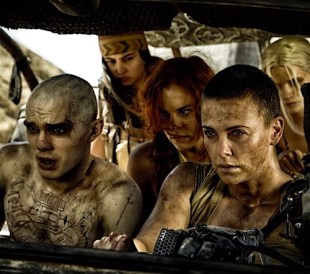 but all are deftly executed. That it doesn’t expound on these at length, or linger on their detail, means you have to pay attention to get the most out of that side of the film. I guess some would counter that with, “you have to look hard because you’re reading something that isn’t there,” but I refute that. That it doesn’t spell everything out at length, or hammer home its points and themes heavy-handedly, is a good thing.
Relatedly, the Mad Max series has always been concerned with legend and mythology, both its own and the classical ideas of such. The latter informs the general style and shape of the narratives: these are legends of heroism, perhaps passed down orally from one teller to the next, emphasising the scale of the derring-do. This endures even though Max is, in some respects, the supporting lead in his own film (it even uses the old Towering Inferno left-low/right-high billing at the start for Hardy and Theron). As for the series’ own mythology, that’s well continued here, with significant additions to Max’s storied array of characters and situations: Immortan Joe, Imperator Furiosa, the Five Wives, the War Boys…
With all that considered, that Fury Road is only the second best film in the Mad Max series is merely testament to the enduring excellence of the first sequel. However, there’s possibly an element of expectation in this opinion: I expected basically nothing of Mad Max 2, particularly after I had mixed feelings about the first film (even though the sequel’s fame and acclaim is greater). Fury Road, on the other hand, has been relentlessly hyped by critics and viewers alike ever since it came out — a very different starting perspective. How much effect did this have? Impossible to say. A true comparison would necessitate watching them back-to-back in a few months, or even years, divorced of that initial build-up. Even then I’d be carrying in my memories of my initial viewings. Point being: it’s impossible to be entirely objective; to divorce a film (or films) from some kind of personal context.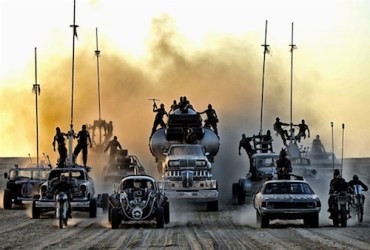 (Ooh, that turned a bit philosophical, didn’t it?)
Whatever. There can be no doubt that Fury Road is an exceptional achievement in visuals-driven action-adventure moviemaking, which merits its inclusion in discussions of 2015’s finest works of cinema.

For my review of the “Black & Chrome” version of Fury Road, look here.
Mad Max: Fury Road placed 6th on my list of The Ten Best Films I Saw For the First Time in 2015, which can be read in full here.
This review is part of the 100 Films Advent Calendar 2015. Read more here.
 John Singleton became the first African-American Best Director Oscar nominee, as well as the youngest, for this debut. 23 years on, his story of the lives and troubles of young black men in L.A. remains sadly pertinent.
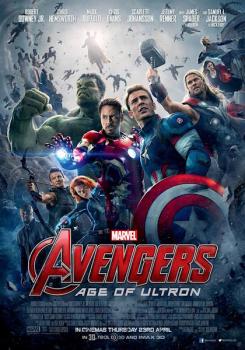 It feels kind of pointless reviewing Avengers: Age of Ultron, the written-and-directed-by Joss Whedon (and, infamously, reshaped-in-the-edit-by committee) follow-up to 2012’s “third most successful film of all time” mega-hit
 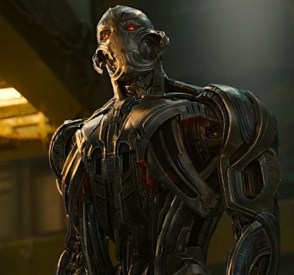 Even though the first half of that is still three years away, we’re still very much on the road to it. Heck, we have been practically since the MCU began, thanks to those frickin’ stones (if you don’t know already, don’t expect me to explain it to you), but now it’s overt as well as laid in fan-friendly easter eggs. The titular threat may rise and be put down within the confines of Age of Ultron’s near-two-and-a-half-hour running time, but no such kindness is afforded to the myriad subplots.
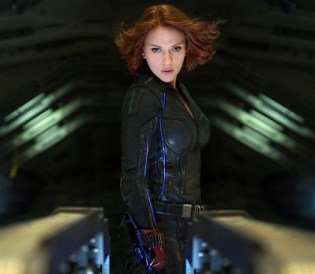 (not just obvious stuff like the Hulk, but digital set extensions, fake location work, even modifying Stark’s normal Audi on a normal road because it was a future model that wasn’t physically built when filming) that stuff they genuinely did for real looks computer generated too. All that time, all that effort, all that epic logistical nightmare stuff like shutting down a capital city’s major roads for several days… and everyone’s going to assume some tech guys did it in an office, because that’s what it looks like. If you’re going to go to so much trouble to do it for real, make sure it still looks real by the time you get to the final cut. I’ll give you one specific example: Black Widow weaving through traffic on a motorbike in Seoul. I thought it was one of the film’s less-polished effects shots. Nope — done for real, and at great difficulty because it’s tough to pull off a fast-moving bike speeding through fast-moving cars. What a waste of effort!
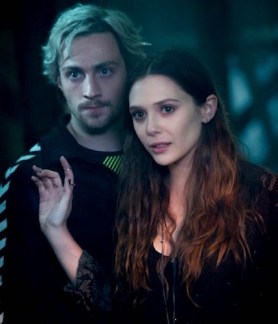 The really daft thing is, Whedon specifically added Scarlet Witch and Quicksilver… wait, are Marvel allowed to call them that? I forget. Anyway, Whedon added the Maximoff twins because, as he said himself, “their powers are very visually interesting. One of the problems I had on the first one was everybody basically had punchy powers.” I know Hawkeye’s power is more shoot-y than punchy, and we all know
  At the end of the day, what does it matter? Age of Ultron isn’t so remarkably good — nor did it go down so remarkably poorly — that it deserves a reevaluation someday. It just is what it is: an overstuffed superhero epic, which has too much to do to be able to compete with its comparatively-simple contributing films on quality grounds, but is entertaining enough as fast-food cinema. Blockbusterdom certainly has worse experiences to offer.
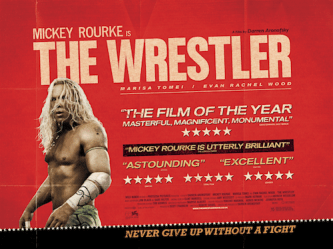 Mickey Rourke’s Oscar-robbed performance is the primary draw of this drama about a washed-up pro wrestler struggling to make ends meet. As ill health threatens his ability to continue performing on the miserable, brutal ex-pro circuit, he ties to connect with his estranged daughter (Evan Rachel Wood) and woo a kindly stripper with personal issues of her own (Marisa Tomei, in another Oscar-worthy turn).
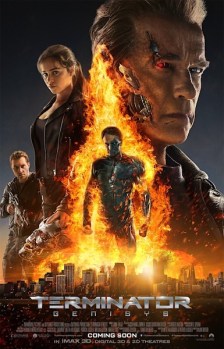 I liked
  Now, a good idea doesn’t guarantee a good execution, and here is where we begin to encounter Genisys’ problems. Time travel is a tricksy thing to engage with in fiction, and is highly prone to creating plot holes — something blockbusters regularly struggle with anyway. Genisys has at least one glaring one. Then there’s the general level of quality — the screenplay, acting, effects, and so on. In this regard, I suspect the reason so many people reacted so badly to it is that it follows, and riffs off of, two of the greatest sci-fi/action movies ever made. In and of itself, Genisys is no worse than any of the other half-dozen-or-so middle-of-the-road $150-million-plus-budgeted blockbusters we’re routinely served every year now. If you instead compare it to its iconic forebears, however, it comes up much shorter.
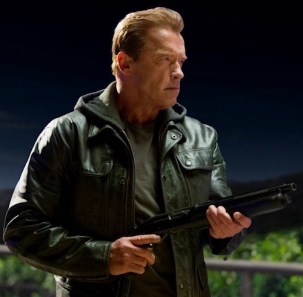 And yet the man who was responsible for those remarkable pictures, James Cameron, was impressed by it. He’s interviewed among the film’s special features, where he explains, “can I guarantee that you’ll enjoy it? No. I just know that I enjoyed the film, you know. But I strongly suspect that… you’re gonna love this movie.” Well, he was way wrong there! You almost feel a bit sorry for everyone in those special features, actually. They’re all so confident that Genisys is a great, well-made movie that everyone’s going to love, and they have big plans for a trilogy which they keep talking up. I would love to see their reactions after the reviews and box office figures came in…
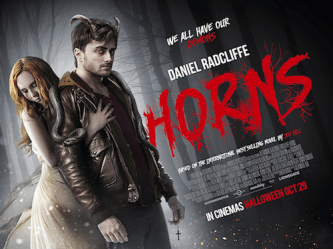 Did Daniel Radcliffe murder his girlfriend? Sprouting devilish horns doesn’t help his case…
 Once-great detective Sherlock Holmes (Ian McKellen) has retired to the countryside with his housekeeper (Laura Linney), her son Roger (Milo Parker), and his bees, but an unsolved case from late in his career troubles his dementia-addled mind. As he tries to remember the events, we also learn the significance of a trip he recently made to Japan, and the benefits of his growing friendship with Roger.
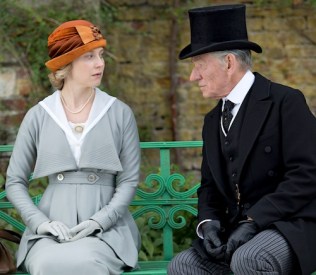 Alongside him, the lad, Milo Parker, is very good, managing to holding his own against the knight of the realm. Also excellent is Hattie Morahan, playing the object of the case in Holmes’ flashbacks. She’s probably best known for playing embattled fellow parent Jane in
 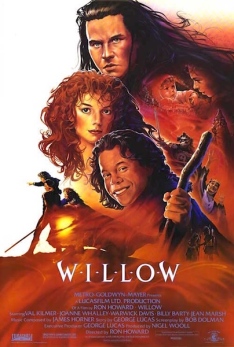 Warwick Davis is the farmer who must return an abandoned baby, unaware it’s heir to a throne evil queen Jean Marsh doesn’t wish to relinquish. Intermittently aided by Val Kilmer’s Han Solo-ish vagabond, they must elude the queen’s forces, led by her daughter, Joanne Whalley.
 After making his live-action directorial debut with the unlikely sidestep of
 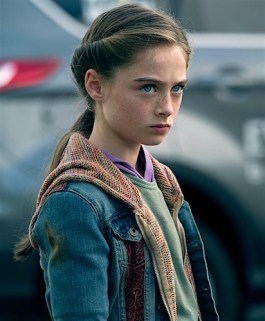 and there’s a moral lesson that’s arguably a little heavy-handed, but as it’s a moral lesson some people aren’t bloody listening to, I can’t say I blame Bird for that. The characters and performances are likeable, with Raffey Cassidy standing out as a marvellous young find, though Laurie is a little undersold. There are some suitably entertaining action scenes, some moments of visual splendour thanks to the future city, and one long take that is exquisite. I know I’m a sucker for a long take, but this is a really exceptional one, that deserves to be mentioned alongside the year’s more-praised unbroken shot, the opening of
 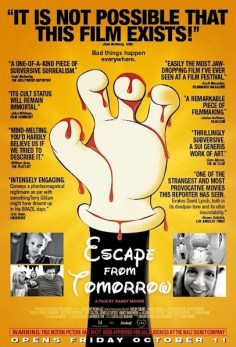 Disney meets David Lynch in this arthouse-y psychological thriller, best known for being shot on the QT (i.e. illegally) in DisneyWorld.
