Anne Frank Remembered (1995)

2009 #4
Jon Blair | 117 mins | TV | E / PG

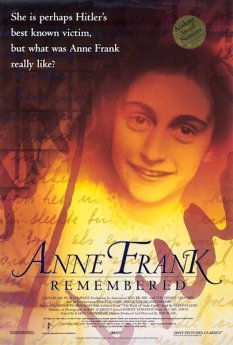
Anne Frank RememberedAnne Frank’s is arguably the best-known individual story of the Holocaust, perhaps because the diary of a 13-year-old girl in hiding from the Nazis — and, sadly, eventually captured by them — makes a perfect gateway for young people into learning about those atrocities.

In this Oscar-winning documentary, Jon Blair exposes the ‘untold story’ of Anne Frank. He adds to her words with the perspective of her friends, other people who knew her, and relatives of her companions in the annex. In covering these views the film presents alternate interpretations of many people Anne wrote about — for example, Fritz Pfeffer (renamed Albert Dussel in the published diary) is very disliked by Anne, but here is painted in a very different light by his son. The film also reflects on Anne herself, and what it uncovers is not always positive. Such an honest approach could be contentious, but its attempt to uncover the truth — rather than paint a false saintly picture — is admirable.

The film’s second half describes what happened after the diary ends, an often ignored part of the tale — even the BBC’s recent, excellent adaptation ended with the residents of the annex being escorted out, and I think many believe this is where the story ends. In reality there were seven months between the discovery of the annex and Anne’s death, and while only Otto Frank survived the concentration camps, many of the others came heartbreakingly close: Peter van Pels died just three days before his camp was liberated, while Pfeffer was marched away by the deserting SS as the Soviets neared, dying with so many others on that path. Here the film touches on much of what life was like in the camps, adding to its detail of how life was for those in hiding. There are undoubtedly other texts that do this more thoroughly, but by focusing on one family and using just a handful of interviewees, the events are made to feel incredibly personal in a way that some documentaries’ more factual approach fails to.

What happened to the diary after the war is also briefly covered: how the book came to light, the impact it had when published, allegations it was a hoax (due to differences between translations, and fictional events created for the 1955 play and subsequent film adaptation), as well as the positive effect it’s had beyond that, including comments from the likes of Nelson Mandela.

With its honest and extended investigation of the events covered in Anne Frank’s diary, plus its consideration of broader facts of the Holocaust, Anne Frank Remembered adds significantly to the original text. In doing so it becomes an essential companion piece to one of the most famous and important documents of the Second World War.

5 out of 5

Runaway Train (1985)

2009 #11
Andrei Konchalovsky | 106 mins | TV | 15 / R

This review contains major spoilers.

Runaway TrainRunaway Train bagged itself three Oscar nominations and one for the Palme d’Or back in 1986, which rather begs the question, how?

On the awards-worthy side, it’s based on an Akira Kurosawa script and features grittier-than-average direction and performances. On the other, the majority of its story and supporting characters feel closer to other ’80s actioners like Lethal Weapon or Die Hard. The focus on a high concept (the title says it all), emphasis on exciting action sequences, the way the plot is structured, the faintly pantomime villains, comical supporting characters, and occasional slips into fantasy (one character was welded into his cell, the state the prison has degraded to, the whole concept of the runaway train and its computer control centre) — none of these elements suggest your typical Oscar nominee, but instead a half-forgotten minor action flick.

The lead characters and their performances, by Jon Voight and Eric Roberts, are above average for the genre — this is where two of the Oscar nods come from — but they’re not notably superior to other outstanding examples (see Bruce Willis and Alan Rickman in Die Hard). Praising the acting can only cover the two leads, at best, because the villains and supporting roles are as one-dimensional and clichéd as you’d expect from the genre. The other Oscar nomination was for editing, one that’s more obviously deserved. Visually, the sequences of the train smashing through the countryside are fairly impressive. Perhaps the camerawork deserved a nod in this respect too, as it lends the film a gritty real-world feel that may be explain some’s distraction from the otherwise familiar values. It can’t mask them all though — for example, the occasionally brutal violence is still denied any real-world punch thanks to the fantastical sheen created by some plot points.

The notable exception to most of this is the ending, where Voight’s anti-hero stands atop a train engine we — and he — know to be doomed, his prison warden nemesis handcuffed inside, and rides it out of sight into the fog. It’s a classy finale that flirts with the downbeat ending, though doesn’t quite succumb to it because we also know the young sidekick and girl have survived. Nonetheless, there’s pleasingly no postscript, simply fading to black after the engine disappears into the mist. The titular train, one might theorise, is like some mythic beast — it arrives through snow-mist, leaves devastation in its wake, and then disappears back into it. But that might be getting a bit too pretentious…

In focusing on these lofty pretensions (which may have been forced on it by nominations and some reviews), one can become distracted from the fact that, taken as a straight-up high-concept action-adventure, Runaway Train has an awful lot going for it. And if you want to get pretentious about it, well, it might just support that too.

As a final aside: one of the film’s most memorable moments, in retrospect, is down to an accident of fate. Near the end a character looks at a space shuttle on TV and muses, “with all this high technology, why couldn’t we stop it?” Just 11 days after Runaway Train’s US release, Space Shuttle Challenger disintegrated 73 seconds after launch, killing its seven crew members. For anyone aware of this correlation, it’s an incredibly poignant moment.

4 out of 5

Though the Radio Times review I’ve linked to says Runaway Train is an 18, it was reclassified in 2008. [It has since been updated.]

State of Play (2009)

2009 #20
Kevin Macdonald | 127 mins | cinema | 12A / PG-13

This review contains minor spoilers.

State of PlayState of Play is one of my favourite TV series of all time, a densely plotted thriller that packs every minute of its six-hour length with clues, characters, twists, revelations, humour and moments of sheer brilliance. It introduced me to James McAvoy and Marc Warren, both of whom are now leading men to one degree or another (and their appearance together in Wanted gave me a bizarre frisson of fanboy delight that’s unusual outside the realm of sci-fi/fantasy), and Bill Nighy, who was surely known before but has since gone on to even more. And that’s to ignore the fantastic performances of John Simm and David Morrissey, two of our finest actors, carrying Paul Abbott’s beautifully convulted plot through all its intricate twists to an inevitable but powerful conclusion.

Much imitated, though the imitators have either fallen short (The State Within) or been flat-out dismal (The Last Enemy), it therefore seems inevitable that State of Play has followed in the footsteps of Traffik and headed for the US big screen. In the process, it squishes six hours down to two and replaces the Simm/Morrissey dynamic with the filmfan-pleasing reunion of Brad Pitt as brilliant-but-troubled reporter Cal McAffrey and Edward Norton as wunderkind politician Stephen Collins. Y’know, in their hands, it might just work!

Except Pitt walked and Norton followed, hastily replaced by the unwaveringly grumpy Russell Crowe as Cal and the offensively inoffensive Ben Affleck as Collins. Oh dear, it’s not off to a good start…

Fortunately, State of Play: The Movie quickly turns out to be a good case for not judging a book by its cover — or, literally, a film by its cast. To be blunt, none are as good as in the original, but that’s the nature of the beast here — even a Pitt/Norton pairing would have struggled to achieve in two hours what Simm/Morrissey could in six. Helen Mirren fares best as editor Cameron, the Nighy role, though doesn’t have the screentime to make it her own. Crowe, Affleck and Rachel McAdams (in a beefed-up role as young reporter Della Frye) are all above average, but none come really close to the originators. Jason Bateman’s appearance as Dominic Foy is probably more than decent — certainly, other reviewers clearly unfamiliar with the original have hailed him as Best Supporting Oscar-worthy — but is as nothing compared to Warren’s creepy wimp in the series. When Collins breaks his cool and attacks Foy, the Affleck/Bateman version packs none of the punch of the Morrissey/Warren original.

But the real focus of this screen-to-bigger-screen translation is that complex six-hour story, condensed from 340 minutes to just 127. This three-fold reduction has been well handled by a trio of screenwriters, and perhaps their most noteworthy achievement is crafting a film that feels entirely like its own entity without sacrificing anything significant from the primary conspiracy plot. The relocation to the politics of Washington is unobtrusive, apparently not encountering issues like the Law & Order: UK writers did in converting across justice systems; as is the focus of Collins’ investigation, switched here from an oil giant to an arms contractor. Both quickly help give the film its own identity, while the latter also makes some plot points more straightforward — with such a shortened running time and so much plot to cram in, this is completely forgivable and works seamlessly. Unsurprisingly some of the depth and nuance of the six-hour version is lost in such an abbreviation, the adaptors choosing to cut characters (Cameron’s son, as played by McAvoy on TV, is a glaring omission for fans) and subplots (Collins’ wife barely features, but again only by comparison) rather than significantly abridge or rush the main narrative. It moves fast, but in a pleasant way — this is not an under-plotted or ponderous thriller.

In all this talk of the plot, original writer Abbott should not be forgotten. While the film’s writers have naturally changed things substantially, much of it is surprisingly cosmetic: the essential cut and thrust of the main conspiracy plot remains, and that’s all from Abbott’s brain. Some of the series’ most memorable moments are intact too, though naturally they don’t quite stand up to comparison — the already-mentioned Collins/Foy beating, for example. Others are sadly lost entirely — my favourite bit of the whole series is when Cameron stops the presses to publish the best opening half-dozen pages of a newspaper ever (so good you would never see something so bold in reality), but that’s nowhere to be seen here. Equally humour is light on the ground, but a few intended laughs do stick through. Their number is quite well-balanced, and all pleasantly natural — aside from a few of Cameron’s one-liners there are no enforced “comedy scenes”, just amusing lines and moments that would be equally unobtrusive in real life.

Macdonald adds his own flourishes to the tale beyond the relocation and business focus. Aside from a slightly unusual obsession with shots of helicopters over the city, his most significant addition is a thematic strand on the potential demise of the newspaper in the face of TV and the Internet. As the story breaks, the explosion of news snippets — from TV, blogs, YouTube — are wonderfully handled, indicating the countless ways we consume news today — and how quickly a lie can spread once someone’s reported it as fact. Sadly these montages fall by the wayside as Cal and Della get deeper into uncovering the complex truth, the movie no longer having the time to indulge them. It’s a shame, because continuing this through every plot twist would’ve helped raise the film’s quality and individuality that little bit extra. Instead, some of the mood and tone they served to create slips a little as the story moves on.

Some reviews have criticised the ending, many going so far as to say it loses all its quality in the last 10 minutes with a dodgy final revelation. This worried me going in, but in fact it remains true to the series’ plot throughout. Perhaps some reviewers need reminding that they’re watching a thriller — you can’t really end with someone confirming what we’ve known for the past half hour, you need a twist. The one that State of Play provides is possibly surprising (I say “possibly” because there will always be those ready to cry “I knew it all along!”) and makes more than enough sense to justify itself. It doesn’t undermine what’s gone before in the slightest; in fact, if anything, it makes it that bit more plausible (unless you really believe huge 24-esque conspiracies are plausible) and casts new light on everything that we’ve seen. Just like the TV series did. It’s not going to be remembered as one of the great twists of all time, but it’s fit for purpose.

For me, the biggest misstep was an incredibly trivial one: the closing credits sequence. Shot in a bright style with relatively jolly music, it totally jars with the increasingly dark thriller just witnessed. The basic conceit of it — the printing of a paper — ties perfectly to the “death of the paper” theme, but its execution is lacking. Of course, when the credits sequence is the only major flaw in a movie (well, aside from the odd spot of clichéd dialogue, and a few moments when Crowe’s hair seems to be auditioning for a L’Oréal advert), you can’t complain too much.

As a fan of the original series, my thoughts ultimately come back to that. It’s a comparison the movie version would always have suffered under, and it’s to the credit of all involved that they’ve managed to create something that exists independently. Even to someone who loves the TV series, watching the film doesn’t feel like a highlights reel or awkward plot summary — it’s the best abridgment one could hope for, uncompromising in not dumbing down the plot, and still managing to add significant elements all of its own. If you remove the TV series from the equation, State of Play stands by itself as an above-average, intelligent and compelling thriller.

Just like the original series, it’s exactly the sort of thing I wish they made more of. Perhaps, if we’re lucky, Abbott will be inspired to revive State of Play 2

4 out of 5

The Birds (1963)

2009 #6a
Alfred Hitchcock | 114 mins | DVD | 15 / PG-13

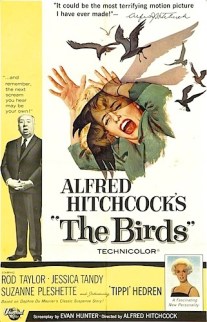
The BirdsI first saw The Birds on TV so long ago that I can’t even remember how long ago it was. Only two parts of it have stuck with me since: the justly famous scene with the climbing frame (ooh it’s brilliant), and a dead Dan Fawcett with his eyes pecked out (ooh it’s chilling).
If that didn’t give it away (and as if you didn’t already know), The Birds is a horror film. A horror film of the proper kind too — the kind that scares you, rather than making you jump at regularly-spaced committee-decided intervals. It’s the kind that slow burns its way to the horror — we meet the characters, see their relationships, arrive at the right location… There are hints at what might be coming, but they idle past in the background, almost unnoticed… but gradually increasing.

This isn’t time wasting; it isn’t really character development either, despite how some of it may seem (more on that in a bit). It’s how Hitchcock builds suspense — we know it’s coming, we just don’t know when — and likely contributes to some sex-related subtext too. (I haven’t just pulled that out of thin air, incidentally. There’s the odd moment where that subtext almost breaks through into the text, though Hitchcock quickly reels it back in.)

The second half is where all this time spent delaying and manoeuvring pays off. The titular demented avians attack, and attack again, a near relentless series of assaults and set pieces that allow Hitchcock to show off his apparently endless array of shooting and editing tricks. These aren’t just spectacular action sequences — though there are some, of a fashion — but sequences of unnerving horror. And it’s all achieved without a single note of music — no slowly rising throb in the background to tell us we should be getting scared, no dramatic thud to make us jump, no piercing musical shrieks as the birds attack — yet some sections are almost unbearably tense, built entirely with camera angles and masterful editing.

If there’s a weak note it’s the romantic subplot. While it initially drives the film, it’s largely abandoned later on, becoming no more than an excuse to move characters into place for the birds’ attack. In fact, Hitchcock seems to just get tired of it, allowing the film to jump abruptly from will-they-won’t-they to cuddling and kissing — and it’s not even like a first kiss. Intriguingly, a deleted scene included on the DVD (which has been lost, only surviving through a script segment and production photographs) seems to provide the ‘missing link’ in the central relationship. However, it also offered an explanation for the birds’ attacks (albeit a jokey one), something Hitchcock was keen to avoid, which likely explains its removal.

But that’s mostly beside the point. The Birds is a tension-based horror movie, and every sequence of tension is perfectly staged. This is where Hitchcock is really in his element, and all of the preamble is worth enduring just for the chance to see the master let loose. Dan Fawcett’s lack of eyes has probably stuck with me as much thanks to Hitchcock’s impeccably paced build up as to the gruesomeness of the actual image; and the birds amassing on the climbing frame outside the school is an absolutely perfect sequence, a moment of pure cinema.

5 out of 5

The Kite Runner (2007)

2009 #3
Marc Forster | 123 mins | DVD | 12 / PG-13

The Kite RunnerCan no one tell a story from the beginning any more? I blame How To Write books and courses, insisting that films must begin with certain types of incident to hook the audience, even if this isn’t the first event chronologically. Do they think the audience has no patience? Especially in a film, where you’re only committing about two hours of your time (as opposed to however long it takes to read a novel) and even the most lazy viewer is likely to stick it out for at least 15 minutes.
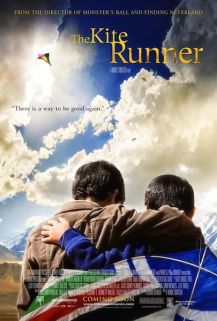
The Kite Runner is just the latest film to do this (and by that I mean “latest I’ve seen”, as I’m sure dozens have done exactly the same thing since), beginning two thirds of the way through with a scene that makes little sense… until, inevitably, the story flashes back to the start and leads us through to that inconspicuous scene, finally giving it some meaning. Really, it’s little more than a cheap tease; a promise to the audience that what follows is actually going somewhere, however pointless it may seem. It’s perhaps the only trick that makes me inclined against a film (or indeed any work of fiction) right from the off.

Perhaps the structure is lifted directly from the source novel. The film certainly has an unusual feel in this sense, like the text has only been half converted for the screen. Not every film should — or does — conform to the structural rules of those How To Write books, but there’s something about the way events progress here that feels more novelistic than filmic. Arguably this is also true of the story itself, which seems to be more about its themes than its characters: bravery, cowardice, and the difference between the two; friendship, and the lengths (or not) it will go to; truth and lies, and what underhand things people — especially children — will do to cover up their own shortcomings and failings.

In this respect it feels like it’s part biography (though it’s fiction) and part moral fable. By the end, we’re presumably meant to leave with the feeling that some justice has been done at last. But while one boy has been saved from the horrors of his captors — and even then, almost too late — there are hundreds left behind with the still-active villain. In this respect it’s undoubtedly true to life, but it belies an attempt at an uplifting and redemptive ending.

In assessing The Kite Runner it feels like I may have missed something and am being unduly harsh, but sadly it failed to engage me. While I long continued to ponder some of the issues it raised for me (always a positive), I’m not certain they were the ones the filmmakers intended.

3 out of 5

This review was written over three months after seeing the film, based entirely on notes made at the time and my rather poor memory. Apologies if it is therefore a bit unfocussed or, God forbid, inaccurate in the odd minor fact.

Sherlock Holmes in Washington (1943)

2009 #1
Roy William Neill | 68 mins | DVD | U

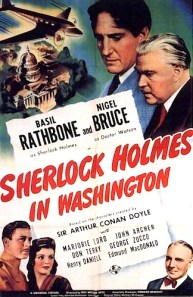
Sherlock Holmes in WashingtonThe last of three World War 2-concerned films in the Rathbone/Bruce series (the previous two being The Voice of Terror and The Secret Weapon), and once again more a spy thriller than a traditional detective tale. That’s not to say Holmes’ abilities as a detective aren’t present — in fact, he does a very reasonable amount — but if you switched him for a generic British Intelligence agent the plot would be unlikely to suffer and the dialogue probably wouldn’t need much work.
Certainly, the quality of Holmes’ detection is a bit of a mixed bag. Some scenes do demonstrate his brilliant reasoning, but others stretch credibility to the limit, for example when he manages to work out what’s been transported in a blanket. Another disappointing moment sees Holmes in awe of and “forget” about modern scientific methods, which seems rather at odds with the highly intelligent detective at the forefront of his field that we see in the original tales. It’s more than a little like the filmmakers have taken the character and methods from his 19th Century setting and dropped (rather than adapted) him into the present day. It’s these little inconsistencies that are arguably most bothersome when such a spy thriller claims to be a Holmes film.

Other deduction scenes do work, however, such as when Holmes enjoyably reasons the hiding place of the matchbook, the film’s MacGuffin. Unfortunately, this sequence suffers from a total lack of tension as we already know where it is. This leaves us watching Holmes play catch-up, and there’s no sense of a race-to-the-prize because we don’t see how the villains’ hunt is progressing. Said matchbook is put to good use in another sequence where it is unwittingly passed around at a party. This is perhaps the most simple and obvious thing to do with such a MacGuffin, but at the same time it’s an always-effective idea. On the other hand, when the matchbook ends up back where it started one has to conclude that this sequence is no more than padding.

One of the more striking elements of the film is it being Holmes’ first trip to the States (on screen in this series, at least). It’s highly praiseful of America, of course, and spends a good bit of time on a travelogue-style showcasing of sights, continuing with Watson remarking on US papers, trying out gum, and more. It makes a change of scene for the series, but also feels a bit self-congratulatory on the part of the American production team, which can be more sickening than the British patriotism of the previous two entries. While that may be national bias on my part, it seems a bit unlike Holmes too. There’s also the prerequisite patriotic closing quote, though at least this time it’s from a British character about US-UK relations. Still, intentional or not, Rathbone delivers it with an almost unwilling flatness.

Elsewhere, Watson’s bumbling comedy is occasionally unobtrusive, occasionally grating, but occasionally raises a smile. Best is the scene where Holmes has him play various characters in a reconstruction, although there’s more mileage in that than the film manages. In complete contrast to this, the film’s villains are a particularly brutal bunch, murdering for no real reason and torturing women.

By the time the film limps to a sudden conclusion at an antiques shop, the quality of the film has become reminiscent of the quality of Holmes’ detection: a mixed bag.

3 out of 5

This review was written over three months after seeing the film, based entirely on notes made at the time and my rather poor memory. Apologies if it is therefore a bit unfocussed or, God forbid, inaccurate in the odd minor fact.

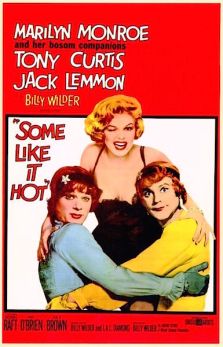
Some Like It Hot (1959)

2009 #2a
Billy Wilder | 117 mins | DVD | U / PG-13

Some Like It HotDid you know that Some Like It Hot is a remake of a 1951 German film, Fanfaren der Liebe? I didn’t. Anyway…
The first (and last) time I saw Some Like It Hot was so long ago that, even when watching it again, there are whole swathes of the film I didn’t recall. How few clothes Marilyn Monroe wears, for one thing. I guess I was quite young first time. The only thing I did remember was enjoying it immensely; and, enjoying it again, didn’t want to skip the chance of handing it five stars in this pathetically brief review.

To be concise, it’s a very funny film even 50 years on. It rattles from situation to situation at an occasionally surprising pace, literally without a dull moment. Not that there’s anything wrong with slower old films, but its certainly spritely for its age.

And with it, a genuine classic. Never mind some — everyone should like it a lot.

5 out of 5

Sorry for the pun.

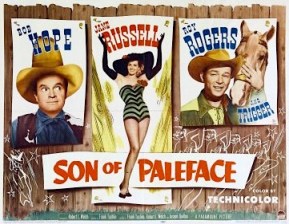
Son of Paleface (1952)

2009 #2
Frank Tashlin | 91 mins | DVD | PG

Son of PalefaceA sequel to 1948’s The Paleface only in the sense that it features Bob Hope in a Western setting, this time playing the son of his character from the first film.

Much of it is only gently funny and likely to try the patience of an unforgiving audience, despite the addition of “King of the Cowboys” Roy Rogers to returning stars Hope and Jane Russell. Between them the three manage to deliver some songs too, but the only memorable one is a reiteration of Buttons and Bows from the first film.

Things improve as the film goes on though. It slowly morphs into a live-action cartoon, in the process becoming a lot funnier and, in recreating the style of cartoons, technically impressive too. That the comedy is genuinely entertaining when Son of Paleface finally reaches these sections makes it a shame it takes so much time — and viewer persistence — to get there.

3 out of 5

Hellboy II: The Golden Army (2008)

2008 #93
Guillermo del Toro | 115 mins | DVD | 12 / PG-13

This review contains minor spoilers.

Hellboy II The Golden ArmyDespite enjoying the first live action Hellboy movie last year, I didn’t make it to the cinema for this sequel. Unfortunately neither did a lot of others, choosing to see The Dark Knight again and again instead. Of course these days the DVD release is almost as important… except Hellboy’s was on the same day as Dark Knight’s. I don’t have sales figures, but I expect it was thoroughly overshadowed again — which is a shame, because Hellboy II is actually a very different beast.

Despite shared roots in the pages of comic books, Hellboy II sits comfortably apart from last Summer’s other two big comic book adaptations, The Dark Knight and Iron Man. While the former was aiming for a real-world crime-epic feel and the latter a more humour-littered sci-fi, they both still dealt with billionaires investing in identity-hiding suits to fight crime of one kind or another. Hellboy exists in a completely different place. Of course there are still wise-cracking heroes (with requisite Issues) and scheming villains, action sequences and a liberal use of CGI (mixed with “we did it for real!” bits, thankfully the ‘in thing’ right now) — but it’s not Sci-Fi, it’s Fantasy.

Del Toro uses this to his advantage, allowing his incredibly fertile imagination to run riot over every frame. There are more creatures than the first Hellboy and Pan’s Labyrinth combined — in the Troll Market sequence, there’s probably more in each shot — and, in the vicious Tooth Fairies, a wonderfully gruesome twist on a familiar concept. Though couple these with certain other inventions, such as a baby-like talking tumor, and one might begin to wonder how this got passed as a 12 / PG-13; and you’d think a giant red demon getting a human girl pregnant might be enough to raise the classification. (I jest, of course — giant red demons are entitled to all the same rights as the rest of us.)

Imagination isn’t limited to creature design either. An attractively animated prologue manages to both bring back the ever-excellent John Hurt and find a way to convey the huge back story without making it tediously dull (it also has a Christmassy feel that was perfect for when I watched it). The action sequences have all the requisite coolness too, especially the closing duel on giant moving cogs. In fact, del Toro’s creation seems to overflow — the laying of plot threads for a further film is even more overt than it was in the first film — which makes it even more unfortunate that the director’s long term commitment to The Hobbit and its sequel, plus about half a dozen projects after that, makes a proposed trilogy-closer seem increasingly unlikely. This isn’t a major problem with the film, however, just an annoyance that we may never get a third entry.

One of the most amusingly idiotic criticisms I’ve encountered of Hellboy II was that it was “comic-book-ish” — not only does that make one think, “well, duh”, but also, “and why not?” When the other big comic book movies are aiming for real-world seriousness, it’s nice to have a more fantastical alternative. Hellboy II is more than up to the task.

4 out of 5

Hellboy II: The Golden Army placed 8th on my list of The Ten Best Films I Saw For the First Time in 2008, which can be read in full here. The brief comment there is probably more eloquent than this review, so please check that out too.

Be Kind Rewind (2008)

2008 #90
Michel Gondry | 97 mins | DVD | 12 / PG-13

Be Kind RewindThe work of Michel Gondry and the comedy of Jack Black are both, shall we say, acquired tastes, and not ones you would necessarily expect to overlap. Yet here they do — at least to an extent — but while Black is again doing his usual schtick as the Ker-Azy Best Mate, it’s the writer-director who is perhaps offering some surprises.

Gondry has exactly the sort of fanbase you’d expect for a French director who started out in music videos for Bjork and The Chemical Brothers before progressing to films like Eternal Sunshine of the Spotless Mind and The Science of Sleep. It’s not inconceivable those fans may’ve been a bit surprised by this effort, about two video store clerks who begin to remake well-known movies when all the store’s tapes are accidentally wiped, because it seems so thoroughly mainstream; or, to put it a nicer way, accessible. That’s not to say it doesn’t have an oddness about it — early plot points hit unreal levels, before the film becomes more grounded — but for the most part it errs on the side of realism. It’s almost hard to believe Gondry wrote and directed it, considering his previous output.

In fact, so conceivable is so much of the story that one could almost believe it was a fictionalised version of real events. The way the films are remade — using elaborate cardboard props and cunning camera tricks — are all pleasantly innovative, but well within the bounds of believability; and when they gain a previously-meaningless nickname (“sweded”) and explode with cult popularity, it’s heavily reminiscent of so many Internet-based crazes, several of which do revolve around retelling popular films. Indeed, placing the concept of ‘sweding’ at the heart of the film taps into the popularity such things tend to garner, and the enjoyability of the idea helps carry the film through some rougher patches.

And Be Kind Rewind is at its best — and, crucially, funniest — during the ‘sweding’ of recognisable films. These sequences are packed with the vicarious joy of recreating iconic moments from beloved films with just a video camera, some mates, and a pile of card. It’s here that the lovability of the concept comes to the fore, and it would perhaps benefit from even more of this. On the other hand, an endless stream of re-made movies is no substitute for a proper plot, so Gondry wisely limits how many films we see being ‘sweded’.

The problem is, the rest of the story doesn’t always do a great deal to make up for it. There’s a surprising number of stock moments and subplots considering Gondry’s roots, and some threads are underplayed to the point of seeming extraneous. In particular, a romantic subplot is so inconclusive — not even ‘resolved’ in an open-ended manner — that one wonders why it was included at all.

Your enjoyment of Be Kind Rewind is likely to ride on how much you like the idea of ‘sweding’. If it sounds like a fun thing to watch or do, the goodwill engendered by the concept may carry you through the film’s weaker moments. If, however, you think it sounds faintly silly, there’s not much else on offer besides a familiar moral message about community, and achieving your goals, and all that jazz.

4 out of 5