
Tim Miller | 108 mins | Blu-ray | 2.40:1 | USA / English | 15 / R
 In the US Deadpool was, famously, rated R — which (for those not up on their international film certificates) ostensibly means you have to be over 17 to see it. In the UK it was rated 15, which is much more appropriate, because if Deadpool had a mind it would be that of a 15-year-old boy. Of course, plenty of grown men also have the mind of a 15-year-old boy, and that’s why it’s the highest-grossing R-rated movie (worldwide) ever. And I guess I must still have the mind of someone half my age too, because I loved it.
Spinning off from the X-Men series (more on that later), Deadpool is the story of Wade Wilson (Ryan Reynolds), a former mercenary who falls in love with Manic Pixie Geek Wet Dream Girl Vanessa (Morena Baccarin) before being diagnosed with aggressive cancer. He agrees to radical treatment in an attempt to cure it and be with Vanessa forever ‘n’ that. The treatment drives him pretty much insane, but also ignites his mutant genes, which give him the power of self-healing (like that other mutant whose name rhymes with Polverine…) Permanently scarred and feeling like he can’t return to Vanessa, Mr Pool sets out for revenge.
Yeah, it’s a pretty standard superhero origin plot. But the devil is in the details, and it’s how Deadpool tells its story that matters — the narrative is just a framework on which to hang the gags. The immediate point of comparison on a superhero comedy is surely Kick-Ass, and it doesn’t take deep analysis to see that Deadpool isn’t as subversive as that movie. Where Kick-Ass comments on, at times even deconstructs, the superhero genre, Deadpool takes its rules as a given and throws a shedload of humour on top of it. Is that a problem?  It depends what you’re looking for. I think Deadpool’s makers set out to make a superhero film that was genre-aware and prepared to take the piss out of that, but I don’t think they were aiming to deconstruct superhero narratives. It might make Deadpool a less ‘intelligent’ movie than Kick-Ass, but it doesn’t stop it being entertaining.
That doesn’t mean Deadpool’s makers are short on cleverness, though. The film’s structure is particularly nifty: it gets right into the action, then mixes the back story in as it goes on. This avoids either, (a) boring stretches while we wait for the hero to turn up, or (b) shoehorning in fight sequences where they don’t belong just so that the action quotient is met upfront. Plus it allows for a few transitioning gags and flashback humour, which I’m not sure we’ve seen since Fight Club. It’s well-paced too, the story positively flying by. This may be somewhere else the familiar shape of the story works in its favour — we know where this is all going, so it doesn’t need to dwell on plot details. No one’s really here for the plot, so why not?
The jokey opening credits say that the writers are “the real heroes here”, the joke being they wrote the credits so of course they’d call themselves the heroes. But it’s also true. I mean no disservice to the producers who persuaded the studio to greenlight it, or director Tim Miller’s handling of the material, or Reynolds embodying the character so well — they’ve all undoubtedly contributed enormously to the film’s success (and I’m sure there’s a ton of improvisation in the final cut, so even more so) — but a lot of what makes the film really work, in a way that goes beyond just “it had some funny bits and some cool action”, is that structure, that pace, those gags… which, as just discussed, can well have come from the cast and director, and editors and stuff, too. So what I’m basically saying is: everyone’s a winner! Yay!

So what of that humour? It’s an R-rated action-comedy, you know what to expect: Swearing! Crudeness! Nudity! Throwing in four-letter words and assuming that counts as a joke! Well, Deadpool does have swearing and crudeness, but it’s not so completely mindless about it. It has violence and nudity, too, just like the good old days of R-rated action movies. But it doesn’t resort to throwing any of those in for cheap humour — they’re there because they are there and can be there, not as a get-out-of-actually-coming-up-with-gags card. Most R-rated comedies these days factor somewhere on a scale of “saying a rude word just to get a laugh”, that scale stretching from “just doing it once or twice” to “all the ‘humour’ in the film”. Such words are thrown around liberally here, but if there was an occasion where that was substituted for an actual gag then it didn’t stick in my mind. That doesn’t mean it isn’t crude, or using Rude Things for laughs, but it’s not just going, “I said the F word, at a time when I shouldn’t say the F word — isn’t that funny?!”
There’s one particular type of humour that Deadpool is most famous for, of course. From the self-parodying, Honest Trailer-inspired opening credits, to the Ferris Bueller-referencing, Marvel pillorying post-credits scene, Deadpool less breaks the fourth wall, more obliterates it, then stomps on the rubble until it’s in little tiny pieces, then grinds those under its shoe until they are dust, then snorts that dust and digests it, then… well, y’know.  The film handles this really well: it’s not a non-stop commentary, but it’s also not isolated off in little clumps, like, “this had to be here but it’s kinda awkward to have him always talking to the audience”. It’s often used for irreverence, and I like a bit of irreverence. There are clearly some rules and/or considered choices with this fourth-wall breaking, though. In his commentary on the deleted scenes, Miller says that Reynolds kept wanting to pull the boom mic down from out of frame and use it to batter one of the villains, or something along those lines, but Miller thought this would be breaking the film’s rules. That’s a pretty fine line to tread — knowing he’s in a film, but not, like, using the fact he’s in a film… I guess it’s more of a “what feels right” set of choices than a little rulebook.
One of my favourite little fourth-wall breaks is Deadpool’s one-liner when he’s dragged off to meet Professor X, which brings me somewhat neatly to the film’s relationship to its franchise mothership. I think I’d assumed it would be kind of subtle about the fact it’s technically an X-Men movie, even though everyone knows Deadpool was in X-Men Origins and this co-stars Colossus who’s been in several X-Mens at this point. That expectation was cemented by the number of reviews/blog posts/etc that have continued to refer to Apocalypse as the 8th X-movie. But no: within ten minutes we have a scene explicitly set at Xavier’s School, and Colossus has dialogue about Deadpool refusing to join the X-Men. References and connections to the X-Men are too numerous to count from then on out. This isn’t a movie hiding away its connections as a technicality only comic book fans will know about, which is something the main X-franchise has arguably done at times (though Apocalypse marks a distinct change in that, explicitly making Cyclops and Havok brothers, and stating that Magneto is Quicksilver’s dad… but I digress).
 One of the film’s best bits comes courtesy of that X-connection: stroppy teenage goth mutant Negasonic Teenage Warhead (excellent newcomer Brianna Hildebrand), and her immensely comic-faithful costume. Ironically, it’s not at all faithful to how NTW is portrayed in the comics (and you can find dozens of think-pieces about how the film changed her character and how that’s more than OK, if you’re so inclined), but it is generally like X-Men comic costumes, certainly ones that cropped up in the early ’00s. (I swear there was a Frank Quitely New X-Men cover showing a bald female in a costume really like NTW’s yellow-and-black X-Men uniform, but I can’t find it now. Maybe I imagined it.) Comic-faithful costumes are very much the MO of Marvel movies nowadays, but because the X-Men film franchise sprung from the “how do we make superheroes acceptable in movies?” period of the genre, the X-movies have never really done that before (though they do sort of, in passing, at the end of Apocalypse — I’m beginning to think we’re one day going to look back at that as a transition movie, assuming the next one goes super comic-book-y). I mean, this doesn’t really signify anything about Deadpool, I’ve just gone off on a geeky tangent.
Deadpool does have flaws, and other reviews have certainly pointed them out: it’s not always hilarious (well, how many comedies are?), it’s another origin story (I believe I mentioned this one), it mocks superhero tropes but ticks most of the same boxes (ooh, I did that one too!), it has a somewhat low-rent feel… which, actually, I don’t get. I mean, it cost $58 million — a sliver of the budget of most blockbusters nowadays, but only slightly less than Jurassic Park cost (20 years ago), and 33% more than Serenity cost (10 years ago). It actually looked bigger-budgeted than I was expecting. The action sequences are really good, for one thing. If it feels small compared to other blockbusters, that’s just a complaint brought about by too much money being spent on movies nowadays — go watch a Big Budget Blockbuster from the ’80s or ’90s and you might be surprised how low-key half of them are. Tsk, young(er-than-me) people.
 Speaking of which, I do feel like I should be mature enough to have grown out of loving Deadpool… buuuut tough. It’s fantastic fun. Though, it’ll be interesting to see how it holds up to re-watches. I’ve read reviews which point out it doesn’t have the substance underneath the jokes that Kick-Ass does (did I mention that already? I didn’t steal that point from someone else, nope, noooo sir), so while Matthew Vaughn’s film is completely enjoyable on multiple go-rounds, any enjoyment to be found in Deadpool will ultimately fade once the novelty has gone. I mean, that’s possible — literally, only time will tell — but there’s not necessarily anything wrong with a “first time is definitely the best” movie, if that first time is good enough. Heck, The Game made it into my 100 Favourites with exactly that experience.
Anyway, until I do re-watch it, I really enjoyed it. How much?


That much.
Deadpool is released on DVD and Blu-ray in the UK today.
It placed 8th on my list of The 20 Best Films I Saw For the First Time in 2016, which can be read in full here.
 Back in the ’80s, everyone’s favourite actor whose name is also the punchline to a joke (“what do you call a man with three planks on his head?”), Edward Woodward, starred in
  and anyone who enjoys inventive deaths will be tickled by some sequences. Otherwise, it lacks originality, remixing familiar tropes and plot points into a passably-new shape.
 2016 Academy Awards
 The Revenant is the
  In some respects it’s a shame the rest of the cast were consequently overshadowed — Leo may spend a huge chunk of the film on his own, but there are frequent cutaways to what everyone else is up to. Tom Hardy is the obvious standout as selfish bastard Fitzgerald, a perfectly detestable but completely believable villain — I’m not saying we’d all sink to his depths, but I’m not convinced most of us are above some of the choices he makes, either. Will Poulter steps outside the comedy roles he’s mostly taken since his
 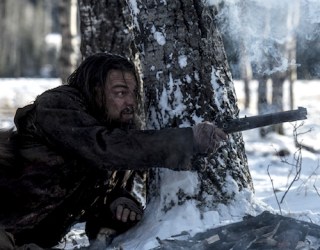 The avoidance of pat depictions extends to its portrayal of Native Americans, too. They’re neither simplistic Evil Foreigners, nor a “we’re so sorry for how we’ve treated them before, they’re great really” apologia. Instead, they’re just as brutal and as human as the rest of us, and made up of varied groups who behave differently, or even slaughter among themselves. The main band of Indians we see do serve as the film’s villains (as if Fitzgerald wasn’t bad enough), a hunting party acting out an inverted
  At the Oscars, I was pulling for Roger Deakins to make it 13th time lucky, or for
 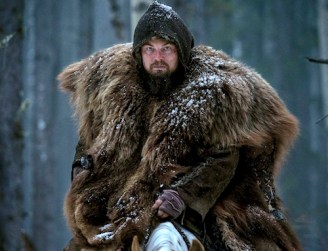 but focus on the first and last acts and it absolutely is.
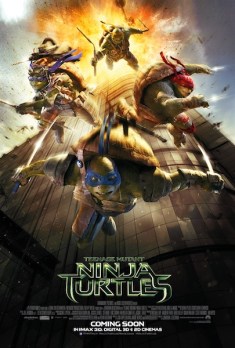 While I was killing time waiting for my coffee to brew before I sat down to watch Teenage Mutant Ninja Turtles, 2014 edition, I drafted the introductory paragraphs to this review. Yes, before I’d even started the movie, so sure was I that I would dislike it. Naturally they took an appropriately condemnatory tone, talking about how it was a product and not a movie, designed primarily to sell tie-in plastic to grown men who wish they were still children, etc etc. Unfortunately writing those paragraphs was a waste of my time, because I can’t use them, because — shock of shocks — I actually quite liked this movie.
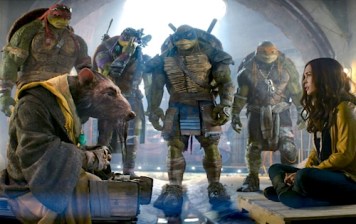 Mike into basically a turtle version of Michael Bay — i.e. he’s focused on lusting after Megan Fox and occasionally causing explosions — is a little cringe-y. Quite a few bits are a little cringe-y, actually; but they’re tempered by a few comedic bits that hit home, and a general veneer of “well, it could’ve been worse”.
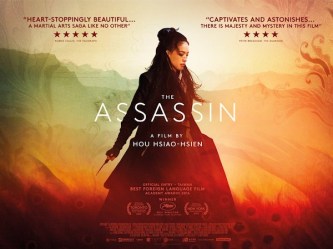 The Assassin is a martial arts drama about Nie Yinniang (Shu Qi), a woman trained since childhood to be a highly-skilled assassin. When her emotions lead her to renege on a mission, her master sets a difficult task for Yinniang to prove herself: she must return to her homeland and assassinate its leader, Tian Ji’an (Chang Chen) — her cousin, to whom she was once betrothed.
 So little happens at times that it’s very easy to become disconnected from it. At one point my mind wandered to other films it reminded me of.
  For all that, there is some action, but director Hou Hsiao-Hsien has said he’s more concerned about the before and after of a fight than the process itself — it’s about the mood, the tension, the ultimate outcome of winning or losing, rather than the choreography of the combat — so there’s a lot of build-up for very brief bursts of action. That’s certainly not an invalid way to handle it — it’s Leone-esque, in its way — but it does mean anyone looking for the detailed swordplay or fisticuffs you expect of a martial arts film will come away disappointed.
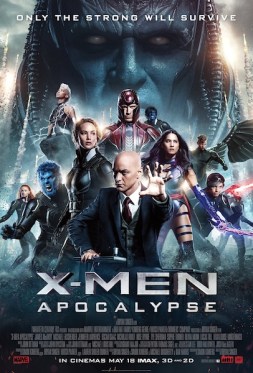 Despite fathering the modern superhero movie genre, the X-Men series always seems to punch under its weight at the box office (a point the recent
  That’s only the half of it, though. This is an X-Men movie, which not only means there’s an ensemble cast, but that it’s dedicated to constantly adding new members to it. This time around, we’re re-introduced to the ‘original’ team as teenagers: Scott Summers (Tye Sheridan) is the viewer’s “way in” to Xavier’s school after he suddenly starts shooting laser beams from his eyes; there he meets Jean Grey (Sophie Turner), a powerful telepath the other students are scared of because sometimes her dreams shake the school at night; Mystique rescues blue-skinned German teleporter Nightcrawler (Kodi Smit-McPhee) from a cage fight in Berlin, where he was up against Angel (Ben Hardy), who becomes one of Apocalypse’s Four Horsemen, alongside weather controlling street kid Storm (Alexandra Shipp) and Psylocke (Olivia Munn), who can create blades of energy with her hands. And there’s also Jubilee (Lana Condor), who has bugger all to do. Jubilee was a major character in the animated series, and the filmmakers seem obsessed with getting her into the movies (she had cameos in the first trilogy) without ever actually giving her anything to do.
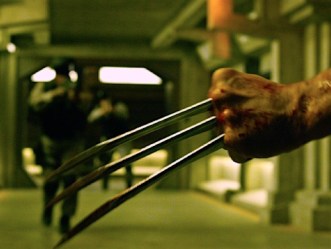 It doesn’t help that they feel the need to shoehorn a Wolverine cameo in there, an underwhelming action sequence that becomes a massive aside from the main storyline. It feels like setup for something more next time, but Hugh Jackman has stated
 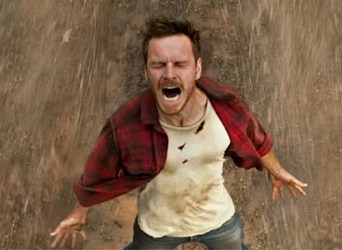 Another element lost in the mix is the real-world resonance contained in the best X-films. There’s a lot of to be said for the spectacle that’s present in all the movies, but Days of Future Past (for the most recent example) anchored it in the human conflicts between the heroes, and in their relation to the rest of the world. Apocalypse nods in that direction, with Mystique invoking Magneto’s metaphorical family to get him to stop destroying the world, but it’s not as well integrated, not as effective as previous outings. Said destruction is on a massive scale, but it’s too massive — the film doesn’t sell it; it’s just another city being destroyed somehow, emotionless computer-generated effects that are overfamiliar in these megablockbusters now (and not helped when you’ve seen similar sights two or three times right before the film in trailers for the likes of
  In fact, the film as a whole feels a draft or two away from being truly ready. Some of the dialogue clunks hard, especially when characters speak in exposition to one another. The plot needs streamlining and focusing, especially early on, and some events need appropriate weight added to them. Other things just need smoothing out — that trip to the mall happens Just Because, with no real sense of why the characters are doing it (other than some handwaving dialogue about needing to get out of the school for a change), and, as I said, in the final cut only leads to one single joke. Yet for all that, some things do work beautifully: Storm’s hero-worship of Mystique comes up almost in passing early in the film, establishing/emphasising Mystique’s place in the mutant world now; but then it becomes a key point in the climax without the need for any explanatory dialogue, as Storm wordlessly realises that her hero is fighting on the other side. It is, in a way, the best bit of the movie.
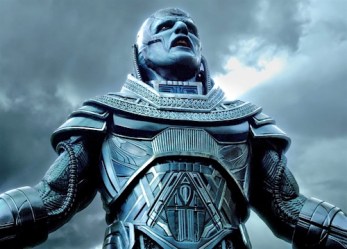 Despite being a negative nelly for much of this review (like so many others, which has given it a lowly
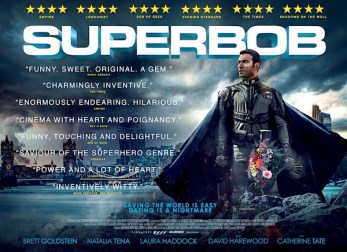 Comedies about superheroes tend to come in the form of big-bucks mainstream-aimed effects-y pieces (
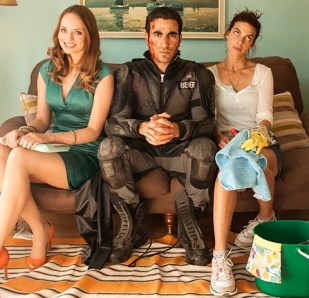 though, because the conceit is all but dropped fairly early on, and the film begins to develop in nice directions. It starts out as pure comedy, and while it doesn’t lose that aspect, it does develop a strand of endearingly genuine sweetness. That helps to see it through the predictable rom-com beats that follow, leaving you (or this viewer, at least) not minding that it’s predictable where the story’s going to go because, thanks to the characters, that’s where you want it to go.
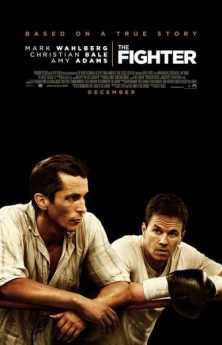 Oscar-winning true-story drama that relates the early career of boxer Micky Ward (Mark Wahlberg), a coulda-been-a-contender type held back by the training of his half-brother, ex-boxer turned drug addict Dicky (Christian Bale), and the management of his controlling mother (Melissa Leo), not to mention the cadre of harpy-ish sisters. Micky gains some confidence after entering a relationship with barmaid Charlene (Amy Adams), who’s prepared to stand up to his family. He breaks away from them and gets better opportunities, but soon realises that to win he’ll need to combine the best of both worlds.
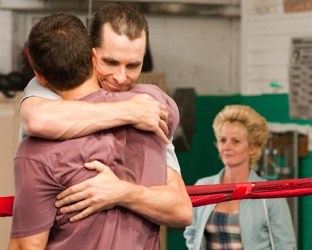 Although this is technically Ward’s story, it’s as much about his older half-brother, washed-up fighter turned part-time trainer and full-time crack addict Dicky Eklund. It’s another of Christian Bale’s extreme weight gain/loss roles (in this case, loss), but there’s more to it than such physical exertion. Bale inhabits the character, and a brief clip of the real Dicky during the credits suggests he’s done so very accurately. His performance is mesmeric and definitely worthy of that Oscar. For the rest of the cast, Amy Adams holds attention equally in a less showy role, and even Marky Mark isn’t half bad. Melissa Leo also won an Oscar for her performance, which I forgot until I read so after — it was the one she controversially funded her own ad campaign for. I guess that paid off.
 The Fighter isn’t without its faults, though. There’s a certain element of cliché to the story arc — whether that’s just fact emulating fiction, or the screenwriters imposing familiar shapes on to what really happened, I don’t know. It could also stand to lose a few minutes here and there, especially when it goes round in circles about whether Micky should be trusting his family or not. And talking of movie clichés and comparisons to other films about fighting, watching it in close proximity to
 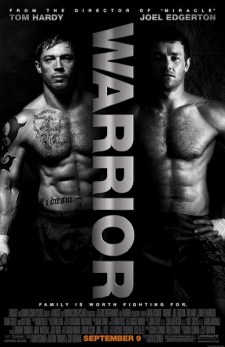 Two estranged brothers (Tom Hardy and Joel Edgerton), who’ve taken very different paths in life to escape their alcoholic and abusive father (Nick Nolte), wind up entering the mixed martial arts tournament to end all mixed martial arts tournaments, their eyes on the unprecedentedly massive cash prize — one to save his house and family, the other to help the widow of his Army chum. As they separately go up against an array of more experienced opponents, who could possibly end up in the final bout? Hm, I wonder…
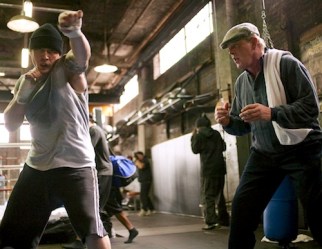 I think they’re being a bit harsh but I can see where they’re coming from. Now, I’m almost loath to give it 4 because I don’t agree with the consensus. And it’s a particularly strange consensus: everyone seems to acknowledge it’s terribly clichéd, but then give it a pass on that. Why? Why don’t you show the same leniency to the tonnes of other movies you rip to shreds for their clichés?
 though I’m not sure his character arc actually reaches any kind of ending. The rest of the cast are adequate: Joel Edgerton is decent as an upstanding family man; Jennifer Morrison has little to do as his wife; Frank Grillo is convincing as a trainer who bases his philosophy on classical music; Kevin Dunn gets some amusing moments as Edgerton’s school principal. Other people sometimes say words.
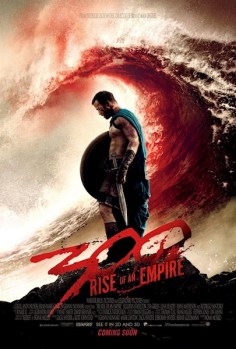 Taking place before, during, and after the events of Zack Snyder’s surprise-hit graphic novel adaptation
 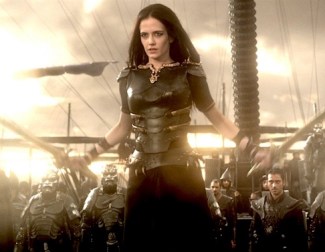 It’s also terribly obvious that it was shot for 3D. I’m not normally one to criticise a film for that — I think when some critics know a film is being released in 3D they see that in its shot choices, even if they’re perfectly valid choices for 2D. But Rise of an Empire screams that it was made for 3D from the start, with all manner of things thrust towards the camera, usually in slow motion, and the constant explosions of blood (to call them squirts or sprays implies a more liquid-like quality than they actually possess) which go nowhere else but camerawards. Presumably the only reason it’s not an 18 for violence is because it’s all so bloody silly.
 100Films.co.uk