Archive 5, Vol.11

I have a backlog of 515 unreviewed feature films from my 2018 to 2023 viewing. This is where I give those films their day, five at a time, selected by a random number generator.

Today, the main emergent theme is “films that weren’t so great” — although there are a couple of bright spots to be found, still.

This week’s Archive 5 are…

  • Dumb and Dumber (1994)
  • Bill & Ted Face the Music (2020)
  • Mangrove (2020)
  • Out of Africa (1985)
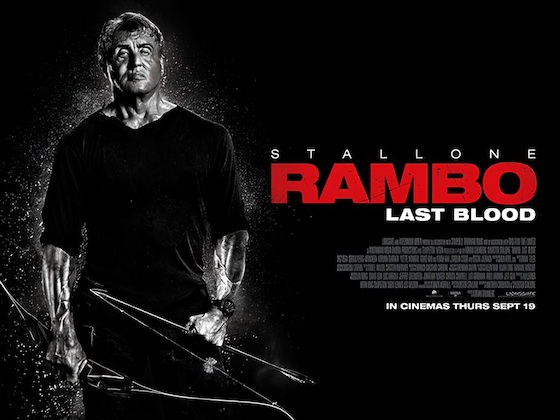
  • Rambo: Last Blood (2019)


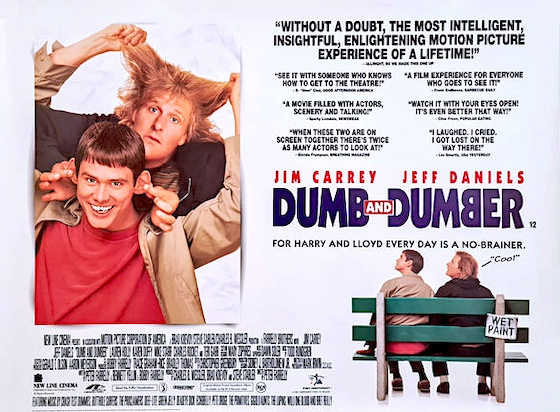
    Dumb and Dumber

    (1994)

    Peter Farrelly | 107 mins | digital HD | 16:9 | USA / English | 12 / PG-13

    Dumb and Dumber

    The nicest thing I can say about Dumb and Dumber is that it does at least live up to its title: it starts dumb and gets dumber.

    Despite the film’s later reputation in some circles as a modern comedy… if not “classic”, then certainly “success” — enough to eventually earn it both a prequel and sequel, at any rate — I’m clearly not alone in this view: apparently the original draft of the screenplay was so poor that it gained an enduringly negative reputation among investors; to the extent that, even once it had been rewritten, it had to be pitched under a fake title in order to get people to even read it. I feel like the final result only goes some way towards fixing that, with an oddly episodic structure and some bizarrely amateurish bits of filmmaking for a studio movie (the audio quality is relatively poor; there’s too much reliance on samey master shots).

    There are a few genuinely funny bits between all the gurning, guffawing, and scatology. It’s a shame they’re not in an overall-better film.

    2 out of 5

    Dumb and Dumber was #119 in my 100 Films in a Year Challenge 2021. It featured on my list of The Worst Films I Saw in 2021.


    Bill & Ted Face the Music

    (2020)

    Dean Parisot | 88 mins | digital HD | 2.39:1 | USA & Bahamas / English | PG / PG-13

    Bill & Ted Face the Music

    I wasn’t that big a fan of the original Bill & Ted films, so I didn’t have high hopes for this — after all, most decades-later revival/reunion movies are primarily about trying to please existing fans, not win round new ones; and it feels like a good number of them fail even in that regard. Face the Music is definitely full of the requisite nods and references, both explicit and subtle, major and minor; but they’re all in the right spirit and it kinda works (albeit a bit scrappily at times), bound together by a deceptively simple, pervasive niceness.

    Alex Winter is particularly great as Bill. Given all the stories we hear about how awesome Keanu Reeves is in real life, it’s no surprise that — despite being the much (much) bigger movie star — he’s generous enough to be a co-lead and let Winter shine. Brigette Lundy-Paine is absolutely bang on as Ted’s daughter, aping Reeves’ performance in all sorts of ways. As the younger Bill, Samara Weaving is clearly game, but doesn’t carry it quite as naturally (apparently she was cast after Reeves discovered she was the niece of Hugo Weaving, who he’d of course worked with on the Matrix trilogy, so that might explain that).

    “Be excellent to each other” is a message the world needs now more than ever, and that’s as true four years on as it was back in 2020. For me, that makes this third outing Bill and Ted’s most excellent adventure.

    4 out of 5

    Bill & Ted Face the Music was #136 in my 100 Films in a Year Challenge 2021.


    Mangrove

    (2020)

    aka Small Axe: Mangrove

    Steve McQueen | 127 mins | TV HD | 2.39:1 | UK / English | 15

    Small Axe: Mangrove

    The line between film and TV continues to blur with Mangrove: a 127-minute episode of an anthology TV series, Small Axe, conceived and directed by Oscar winner Steve McQueen, that premiered as the opening night film of the London Film Festival. It was made for television, but in form and pedigree it’s a movie. Just another example in a “does it really matter?” debate that continues to rage — and is only likely to intensify with the increasing jeopardy faced by theatrical exhibition. (I wrote this intro almost four years ago, and while theatrical is fortunately still hanging in there post-pandemic, I do think the line remains malleable.)

    I only ended up watching two episodes/films from Small Axe in the end. I did intend to go back and finish them, especially as they were heaped with critical praise, but the second (Lovers Rock) bored me to tears, which didn’t help. This first was better, but still not wholly to my taste. It tells an important true story about racially-motivated miscarriages of justice, but I found it overlong and with too much speechifying dialogue. That kind of thing works better in a courtroom setting, I find, so perhaps that’s why I felt the film was at its best once it (finally) got to the courtroom. When it’s good, it really is very good.

    4 out of 5

    Mangrove was #246 in my 100 Films in a Year Challenge 2020.


    Out of Africa

    (1985)

    Sydney Pollack | 161 mins | digital HD | 16:9 | USA & UK / English | PG / PG

    Out of Africa

    This is very much the kind of thing that was once considered a Great Movie, in an “Oscar winner” sense, but nowadays is sort of dated and attracts plenty of less favourable reviews. It’s long, historical, and white — not how we like our movies about Africa nowadays, for understandable reasons.

    Certainly, there are inherent problems with its attitude to colonialism, but to a degree that’s tied to how much tolerance you have for “things were different in the past” as an argument for understanding. In this case, just because these white Europeans shouldn’t have taken African land and divvied it up among themselves and treated the inhabitants as little better than cattle, that doesn’t mean the individuals involved weren’t devoid of feeling or humanity. People like Karen, the film’s heroine, were trying to do what they thought was right within the limited scope of what society at the time allowed them to think. With the benefit of a more enlightened modern perspective, we can see that was still wrong and that they didn’t go far enough, but (whether you like it or not) there is an element of “things were different then”.

    Morals aside, the story is a bit slow going, bordering on dull at times, but it’s mostly effective as a ‘prestige’ historical romance, which I think is what it primarily wants to be. It’s quite handsomely shot, although not as visually incredible as others make out, and John Barry’s score is nice — you can definitely hear it’s him: on several occasions it reminded me of the “love theme”-type pieces for his Bond work.

    3 out of 5

    Out of Africa was #212 in my 100 Films in a Year Challenge 2020.


    Rambo: Last Blood

    (2019)

    Adrian Grünberg | 89 mins | digital HD | 2.39:1 | USA, Hong Kong, France, Bulgaria, Spain & Sweden / English & Spanish | 18 / R

    Rambo: Last Blood

    Sylvester Stallone’s belated returns to the roles that made his name have worked out pretty well so far, I think, with Rocky Balboa and Rambo (i.e. Rambo 4) being among my favourites for both those franchises; not to mention Creed and its sequel. Unfortunately, here is where that streak runs out.

    Running a brisk 89 minutes (in the US/Canada/UK cut — a longer version was released in other territories), the film is almost admirably to-the-point. We all know where it’s going, and more or less what plot beats it will hit along the way, so it doesn’t belabour anything, it just gets on with it. However, you eventually realise why other films ‘indulge’ in the kind of scenes this one has done away with: movies are about more than just plot, they’re about character and emotion and why things happen. Last Blood is so desperate to get to the action that it strips those things back to their bare minimum, thus undermining our investment. And then, weirdly, it hurries through the action scenes too. The climax packs in as many gruesome deaths in as short a time span as possible, meaning none but the most stomach-churning have any impact; and even those disgusting ones are mercifully fleeting. More, it feels rushed and of little consequence. Far from a grand send-off to the Rambo saga (which a slapped-on voiceover-and-montage finale attempts to evoke), it feels like a short-story interlude.

    Did Rambo deserve better? Well, I wouldn’t necessarily go that far. But, on the evidence of this, it might be best if they don’t try again.

    2 out of 5

    Rambo: Last Blood was #74 in my 100 Films in a Year Challenge 2020.


  • Archive 5, Vol.9

    I have a backlog of 525 unreviewed feature films from my 2018 to 2023 viewing. This is where I give those films their day, five at a time, selected by a random number generator.

    Today, a couple of Agatha Christie adaptations from very different eras; plus a heist, a horror, and a Hong Kong love story for the ages.

    This week’s Archive 5 are…

  • Evil Under the Sun (1982)
  • Sneakers (1992)
  • Us (2019)
  • Crooked House (2017)
  • In the Mood for Love (2000)


    Evil Under the Sun

    (1982)

    Guy Hamilton | 112 mins | digital HD | 16:9 | UK / English | PG / PG

    Evil Under the Sun

    The third in the run of Poirot adaptations that began with Murder on the Orient Express and continued with Death on the Nile — no, not the recent Branagh ones: this is the first time they did exactly that. But, funnily enough, both third films in their respective series (i.e. this and Branagh’s A Haunting in Venice) take a UK-set Christie and relocate it somewhere more exotic, to fit with the style of the rest of the series. So, rather than a small island off the north Devon coast (which likely stretches the definition of “under the sun”, based on my experience of Devon), here the action is located to the Adriatic Sea, although actually filmed on Mallorca.

    All of which is incidental when the rest of the movie is, at best, fine. It doesn’t help that the storyline is ultimately very similar to Death on the Nile, making the whole affair feel like more of a rehash than it needs to. Guy Hamilton’s direction underwhelms, giving a TV movie-ish feel, which is only exacerbated by the less-starry cast — there are recognisable names and faces here (James Mason, Diana Rigg, Maggie Smith), but, in totality, it’s not in the same league as the previous two films. It rather prefigures where Ustinov’s Poirot would appear next: literally, TV movies.

    3 out of 5

    Evil Under the Sun was #2 in my 100 Films in a Year Challenge 2020.


    Sneakers

    (1992)

    Phil Alden Robinson | 126 mins | Blu-ray | 1.85:1 | USA / English | 15 / PG-13

    Sneakers

    I never paid Sneakers any attention (not that it came up often) — I think, because it’s an American movie called Sneakers, I assumed it was about shoes — until indie magazine Film Stories announced a Blu-ray release (long since sold out, I’m afraid). I’m always keen to support small/new labels doing interesting things. And thank goodness for that, because, turns out, it’s actually very much my kind of film and good fun.

    So, turns out, in this context, “sneakers” are not an Americanism for trainers, but good-guy hackers who test security systems. When the team are hired to steal a code breaking device, they get suspicious about the setup and, of course, it turns out they’re right to be. Thus unfurls a tech-based heist thriller with a strong vein of humour, but without tipping over into being an outright comedy. Stylistically and tonally, that’s right up my street — I love a heist movie, and that kind of tone (funny without being silly; what I think of as a ‘real world’ awareness of humour) often works for me. It’s the kind of film that’s just a lot of fun to watch. I can imagine it being highly rewatchable; a go-to favourite for people who do that kind of thing.

    4 out of 5

    Sneakers was #132 in my 100 Films in a Year Challenge 2021.


    Us

    (2019)

    Jordan Peele | 112 mins | digital HD | 2.39:1 | USA, China & Japan / English | 15 / R

    Us

    Part of what made Jordan Peele’s debut feature, Get Out, such a success was the way it chimed perfectly with the cultural zeitgeist of 2017; indeed, of the whole decade (time may yet add “of the whole century”). This immediate followup doesn’t benefit from a similar boost, but it’s a strong work of horror cinema in its own right.

    Us follows a family who are attacked by a group of doppelgängers. That’s the most basic version, anyway — Peele seems to have a lot of ideas he wants to mix in here; almost too many. It seems to operate on the level of a home invasion/slasher kind of movie much of the time, but having more on its mind means it’s a bit too slow to satisfy as something so viscerally straightforward. Thus, all the Meaningful stuff ends up crammed into the third act, which perhaps leaves it feeling back-heavy. There’s also a big twist, naturally. On one hand, it seems really obvious, pretty much from the beginning; but on the other, it does cast the rest of the movie in a different light, which is quite interesting.

    If all that sounds rather negative… I blame my notes (I’m writing this review over four years later based solely on what little I wrote down at the time). Us is imperfect, but it’s also great in places, and is at least passably interesting to reflect on in light of the final reveal.

    4 out of 5

    Us was #23 in my 100 Films in a Year Challenge 2020.


    Crooked House

    (2017)

    Gilles Paquet-Brenner | 115 mins | digital HD | 2.35:1 | UK & USA / English | 12 / PG-13

    Crooked House

    Despite a moderately starry cast (Glenn Close, Terence Stamp, Gillian Anderson, Christina Hendricks fresh from Mad Men; plus Brits of varying degrees of recognisableness) and a screenplay by Julian “Downton Abbey” Fellowes, this Agatha Christie adaptation was virtually dumped straight to TV here in the UK (apparently it did have a theatrical release, but the TV premiere was less than a month later — and on lowly Channel 5 at that). Of course, some of the best Christie adaptations have been made for TV; but when something’s designed for theatrical and ends up skipping it, it’s never a good sign.

    Fortunately, Crooked House isn’t a disaster, though it’s far from a resounding success. Quite what attracted the big names I don’t know — it’s a reasonable setup (big dysfunctional family), but the screenplay isn’t exactly sparkling, aside from one or two moments or scenes. There is, at least, one helluva resolution. It also feels disjointed thanks to poor editing and/or direction. If the aim was to keep the pace up, it failed, because it begins to drag after a while. All of this is only partially masked by decent cinematography from Sebastian Winterø, which is the only thing that saves it from looking very TV-ish. Maybe it found its rightful home after all.

    3 out of 5

    Crooked House was #1 in my 100 Films in a Year Challenge 2020.


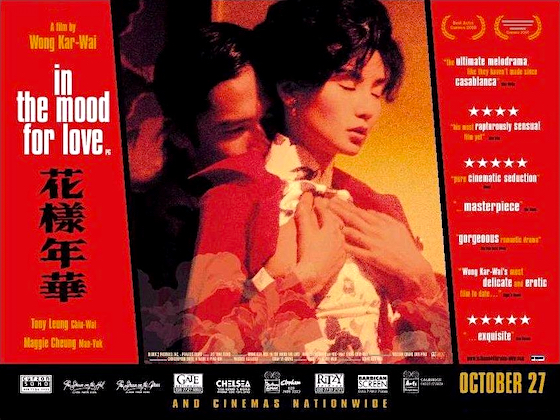
    In the Mood for Love

    (2000)

    aka Fa yeung nin wah

    Wong Kar-wai | 99 mins | digital HD | 1.66:1 | Hong Kong & China / Cantonese & Shanghainese | PG / PG

    In the Mood for Love

    If my four-years-late review of Us was hampered by largely-negative notes, my four-years-late review of In the Mood for Love is in even worse shape: no notes at all. Some trivia? I can do that! An interesting quote from the director? Got it saved! But anything on my own thoughts beyond settling on a five-star rating? Nope. I would try to repurpose my Letterboxd review, but all I wrote was: “I mean nothing but respect when I pithily describe this as Brief Encounter in Hong Kong.” Accurate but, indeed, pithy.

    On the bright side, this is a widely-acclaimed film, so if you’re after in-depth writing I’m certain you’ll find some somewhere else. Indeed, even if I did have more fulsome notes, I doubt I’d contribute anything more insightful. This is a subtle, almost delicate work, and that’s the kind of thing I feel I often struggle to properly get to grips with in my short, usually spoiler-averse reviews. Suffice to say, I concur that this is a very good film indeed; although, as with any understated work, some might prefer if the feelings and emotions were more overt. Each to their own.

    5 out of 5

    In the Mood for Love was #200 in my 100 Films in a Year Challenge 2020. It was viewed as part of Blindspot 2020.


  • 2022 | Weeks 29–32

    2022 may be rushing headlong towards its final stretch (only one month ’til Christmas, people!), but my reviews are lagging behind somewhat: this update takes us all the way back to July and August.

    That said, there’s quite a long spread covered here, because I only watched one film in each of these weeks: 45 Years in week 29, The Bucket List in week 30, previously-reviewed Prey in week 31, and Tintin and the Lake of Sharks in week 32. That’s definitely not the right way to go about watching 100 films in a year, but there we go.

  • 45 Years (2015)
  • The Bucket List (2007)
  • Tintin and the Lake of Sharks (1972), aka Tintin et le lac aux requins


    45 Years

    (2015)

    Andrew Haigh | 95 mins | digital (HD) | 1.85:1 | UK / English | 15 / R

    45 Years

    Charlotte Rampling and Tom Courtenay star as a couple preparing for their 45th wedding anniversary party, when their comfy relationship is rocked by news that brings to the surface events from his past.

    What could have been a histrionic drama about the nature of trust in a relationship instead takes its cue from the characters’ advanced age, and so is a more understated consideration of the same. The length and passage of time is relevant, too: if something happened a long time ago but you only just learnt about it, does that change how you react to the news? Should it? And is the real revelation not the news itself, but the realisation that, even if you’ve lived closely with another person for decades, you can never be truly sure you know them. Another person’s true self is fundamentally unknowable, for any one of us.

    All of which might sound a bit highfalutin, but 45 Years is the kind of film that revels in ambiguity, with characters who never let on their true feelings — in that sense, it feels like a deliberate Acting Showcase for Rampling — and a vague ending, all of which invites you to draw your own conclusions. The final moment feels pointed, but the openness of what went before means it’s up to you what it means. There’s something truthful about that, but also something frustrating.

    4 out of 5


    The Bucket List

    (2007)

    Rob Reiner | 97 mins | digital (HD) | 16:9 | USA / English | 12 / PG-13

    The Bucket List

    I may have written before (but not recently, so let’s do it again) about how Rob Reiner’s directorial career baffles me. He had an incredible run in the ’80s and ’90s — almost back to back he helmed This Is Spinal Tap, Stand By Me, The Princess Bride, When Harry Met Sally, Misery, and A Few Good Men — but then his career suddenly nosedives into a bunch of stuff you’ve mostly never even heard of. What happened? Is there some “John Landis on Twilight Zone“-style ‘secret’ I’m unaware of?

    One of the very few exceptions in his later career (which certainly didn’t lead to that being revived) was this, a breakout hit 15 years ago (yes, it’s 15 years old) of the kind they don’t make so much anymore: a mainstream comedy-drama aimed at adults. It’s about two old men (pure star power in Jack Nicholson and Morgan Freeman) with only months left to live, who decide to spend their final days going on a tour of… green screen studios and kinda-low-res stock footage, apparently. I guess you didn’t get location filming on the kind of budget a film like this was made for even back in 2007.

    Cheap production values aside, it has an insistent sentimentality — undercut with just a big enough dose of snark to stop it becoming too saccharine — that, unsurprisingly, played well with general audiences but, equally unsurprisingly, doesn’t seem to be to the taste of many cinephiles (just look at the middling-to-low scores on Letterboxd, especially of the most-liked reviews, and contrast with its sturdy 7.4 score on IMDb). While I wouldn’t go quite as harsh as many of my fellow Letterboxd users, I do think it’s not that good — it’s broadly likeable, a generally pleasant way to pass 90 minutes, rather than in any way exceptional.

    3 out of 5


    Tintin and the Lake of Sharks

    (1972)

    aka Tintin et le lac aux requins / The Adventures of Tintin: The Mystery of Shark Lake

    Raymond Leblanc | 74 mins | DVD | 4:3 | Belgium & France / English | U

    Tintin and the Lake of Sharks

    Having adapted several of Hergé’s Tintin books for TV and film, Belgian animation outfit Belvision for some reason opted to create an original story for their second big-screen outing with the character (it was later retrofitted into book form, using frames from the film as the illustrations). Written not by Hergé but his friend, fellow Belgian comics creator Greg (aka Michel Regnier), Lake of Sharks feels like exactly what it is: an imitation of a Tintin adventure rather than the real deal.

    Events start out in a typically Tintin fashion, with some crooks after an invention of Professor Calculus’s; but later things take a turn for the Bondian, including an elaborate underwater lair that owes a debt to the imagination of Ken Adam. Eventually it all gets a bit silly, with stuff like an ever-expanding bouncy 3D photocopier, or the villain’s elaborate “you will die in one hour” execution method for Tintin. That kind of adventure serial writing has been so widely mocked at this point (the Austin Powers movies took aim at it 25 years ago; others may have done so before then) that it’s hard to remember there was ever a time when it was still played with a straight face.

    The animation is mostly of a slightly higher quality than Belvision’s previous efforts, but the quality of the designs is variable. The regular cast feel faithfully copied from Hergé, and most other characters are in the right style; but there are a couple of major child characters who look out of place, along with their pet dog. It’s a bit like when you were a kid and mixed action figures from different ranges into the same game: yeah, they’re all still plastic figurines (or, in the case of the film, hand-drawn 2D characters), but stylistically they don’t line up.

    The English dub is an American effort, and far from ideal. None of the voices are great, but most suffice once you get used to them. The exception is Captain Haddock, who is egregiously bad throughout. That said, we’re also subjected to the kids singing a song about a donkey that is unspeakably awful. Couldn’t they have cast actors who could sing? At least that would’ve taken the edge off it.

    3 out of 5

    Tintin and the Lake of Sharks is the 50th film in my 100 Films in a Year Challenge 2022.


  • Scream 3 (2000)

    The 100 Films Guide to…

    Scream 3

    The most terrifying scream
    is always the last.

    Country: USA
    Language: English
    Runtime: 117 minutes
    BBFC: 18
    MPAA: R

    Original Release: 4th February 2000 (USA & Canada)
    UK Release: 28th April 2000
    Budget: $40 million
    Worldwide Gross: $161.8 million

    Stars
    Neve Campbell (Three to Tango, The Company)
    David Arquette (Ravenous, Ready to Rumble)
    Courtney Cox Arquette (Commandments, Zoom)
    Liev Schreiber (Sphere, X-Men Origins: Wolverine)

    Director
    Wes Craven (The Last House on the Left, My Soul to Take)

    Screenwriter
    Ehren Kruger (Arlington Road, The Ring)

    The Story
    As production gets underway on Stab 3 — the latest in the series of horror movies based on the Woodsboro killings — someone wearing a Ghostface costume starts killing the cast. But really, they want to know one thing: the whereabouts of perpetual murder-target Sidney Prescott…

    Our Heroes
    With Sidney in hiding at a remote location known only to a handful of people, the initial investigation into the new killings falls to the other survivors of the previous films: Dewey, now working as a consultant-cum-security on Stab 3, and his former love interest, intrepid reporter Gale Weathers.

    Our Villain
    The Ghostface killer is back, now terrorising Hollywood — but who’s behind the mask this time? As with the first two films, this technically counts as a whodunnit, though well done if you guess anywhere near the correct conclusion — it’s hardly Christie-level…

    Best Supporting Character
    Mark Kincaid (Patrick Dempsey) is the Hollywood homicide detective investigating the murders. As someone who grew up around the movie biz, he’s as au fait with the rules of cinema as most of the characters have had to become — but does that mean he fits right in, or has all the knowledge necessary to be the new Ghostface?

    Memorable Quote
    “Is this simply another sequel? Well, if it is, same rules apply. But here’s the critical thing: if you find yourself dealing with an unexpected backstory and a preponderance of exposition, then the sequel rules do not apply. Because you are not dealing with a sequel, you are dealing with the concluding chapter of a trilogy.” — Randy

    Memorable Scene
    Looking for someone, Sidney wanders into the abandoned Stab 3 soundstage — to be confronted by a perfect full-size replica of her childhood home. As she wanders inside, remembering the terrifying events that occurred there, she begins to suspect the killer is also lurking. Cue a clever re-staging of one of the first film’s most memorable scenes, as the new killer chases Sidney around her old home.

    Making of
    Neve Campbell was busy shooting a TV series and another film during the production of Scream 3, meaning her availability was limited to just 20 days on set. That’s why Dewey, Gale, and the new supporting cast get so much more screentime now, with Sidney mostly by herself. But whoever was in charge of scheduling around Campbell’s availability actually did a pretty good job maximising her presence, spreading her appearances throughout the film, with a few key interactions with the rest of the cast. If you didn’t know the behind-the-scenes story, you might not even realise what they had to do.

    Previously on…
    The first Scream garnered much acclaim for its amusing deconstruction of slasher movies. Naturally, Scream 2 applied the same modus operandi to sequels.

    Next time…
    Scream 3 was supposedly the end of the series… but if there’s one thing popular horror movie franchises do, it’s keep coming back. So, a little over a decade later, the series was revived with Scre4m in 2011. Then it was turned into an unrelated TV series that ran for two seasons in 2015 and 2016. Then that was rebooted as Scream: Resurrection in 2019. Then the original movie continuity was returned to earlier this year, in the confusingly-titled Scream. That’s getting a sequel next year. Goodness knows what they’re gonna call it.

    Awards
    2 MTV Movie Award nominations (Female Performance (Neve Campbell), Comedic Performance (Parker Posey))
    1 Fangoria Chainsaw Award (Supporting Actress (Parker Posey))

    Verdict

    The Scream movies were always noteworthy for the metatextual way in which they addressed and engaged with the tropes and clichés of slasher movies, but actually setting this one in Hollywood on the set of a slasher movie based on the events of the previous movies is perhaps taking the whole self-awareness thing one step too far. It pushes its luck even further with some cameos that are kinda fun, but also kinda too silly (Jay and Silent Bob?! So the Scream movies are canonically set in the View Askewniverse…) Plus, the attempt to retcon in a series-overarching motive for the killer, in aid of making it a true trilogy rather than just “another Scream movie”, is as forced and unsatisfying as it sounds.

    All of which said, the film still has effective moments and individual sequences, and a smattering of entertaining gags that are still on the money. Even if it remains the least of the Scream films, but it’s far from the disaster it’s often been painted as.

    2022 | Week 22

    Maybe I should’ve called this post “Weeks 21–22”, to ensure that the titles of these roundups had a complete run of weeks throughout the year. But I didn’t actually watch anything new in Week 21 (my only film that week was the Challenge-qualifying rewatch of On the Town), so it seemed inaccurate to include it.

    Week 22, on the other hand, was moderately busy, with this lot…

  • This Means War (2012)
  • To Be or Not to Be (1942)
  • An Unsuitable Job for a Woman (1982)
  • The Pajama Game (1957)
  • The Contender (2000)


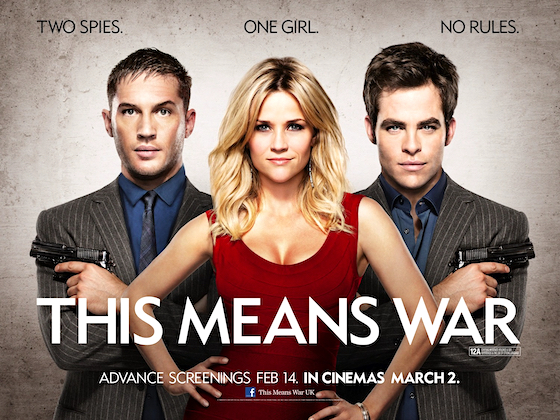
    This Means War

    (2012)

    McG | 98 mins | digital (HD) | 2.35:1 | United States / English | 12 / PG-13

    This Means War

    I bet whoever came up with this thought they were a genius: “spyfi action-adventure + rom-com? It’s the perfect date movie!” Of course, what you actually end up with is a film that struggles to do either part well.

    It stars the unlikely combo of Chris Pratt and Tom Hardy (you definitely can’t imagine Hardy doing a movie like this today) as BFF CIA agents who independently fall for the same woman, played by Reese Witherspoon. Uh-oh. Hilarity ensues as the guys deploy their CIA tricks and tech to influence the relationships. Yeah, it’s the kind of concept that once upon a time sounded like a fun and quirky rom-com, but nowadays seems at best morally dubious, at worst downright creepy. And, indeed, that’s how it plays out, with situation after situation that’s played for laughs but feels a little uncomfortable.

    Of course, the big question is “who ends up with who?” This is one of those films so committed to its storyline, so structured to lead to one correct answer, that… they shot multiple endings so they could decide in post. The one they went with doesn’t feel quite right, but, if you imagine the alternatives, most of them don’t either. Well, I say that: I don’t think it’s really a spoiler to tell you that Witherspoon ends up with one of the guys, when the correct choice would’ve been “neither of them. Run from the stalker-ish CIA agents! Find a normal man!”

    2 out of 5


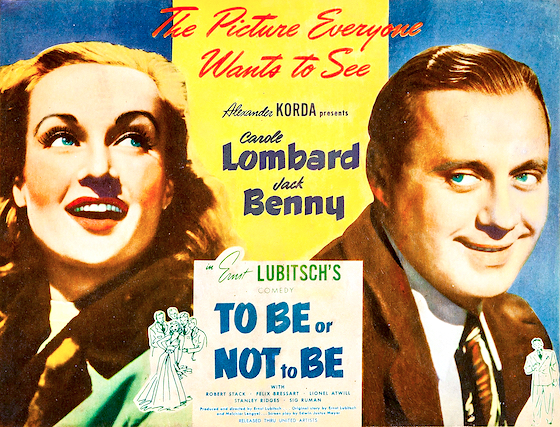
    To Be or Not to Be

    (1942)

    Ernst Lubitsch | 99 mins | digital (HD) | 1.37:1 | USA / English | U

    To Be or Not to Be

    Ernst Lubitsch’s satire concerns an acting troupe in occupied Poland who become mixed up in a soldier’s efforts to capture a German spy before he can undermine the resistance. Made while World War II was still in full force, the film attracted criticism in some quarters for being a comedy about such tragic and ongoing real-life horrors. Lubitsch defended his work, writing to one critic to say, “What I have satirized in this picture are the Nazis and their ridiculous ideology. I have also satirized the attitude of actors who always remain actors regardless how dangerous the situation might be, which I believe is a true observation.” He’s right, of course; at least about the first part. Ridiculously, such debates about whether you can satirise the Nazis persist to this very day — just look at some of the responses to Jojo Rabbit.

    Lubitsch’s film is subtler than Waititi’s, though still undoubtedly a comedy. I mean, with its plucky resistance members taking occupying Nazis for fools, I couldn’t help but think of this as a classier version of ’Allo ’Allo… but I’ve never actually seen a whole episode of that show, so don’t hold my comparison in too high a regard. Whereas that sitcom is famous for its catchphrases and bawdy gags, To Be or Not to Be is less overt, preferring to paint the Nazis as fundamentally incompetent and derive its humour there.

    Despite the distaste some felt, it obviously works for most people, as it appears on several “great movies” lists, not least both the IMDb and Letterboxd Top 250s. To be honest, I feel like I need to give it another spin to digest it more fully, but these thin thoughts will have to suffice for now.

    4 out of 5

    To Be or Not to Be is the 35th film in my 100 Films in a Year Challenge 2022. It was viewed as part of Blindspot 2022.


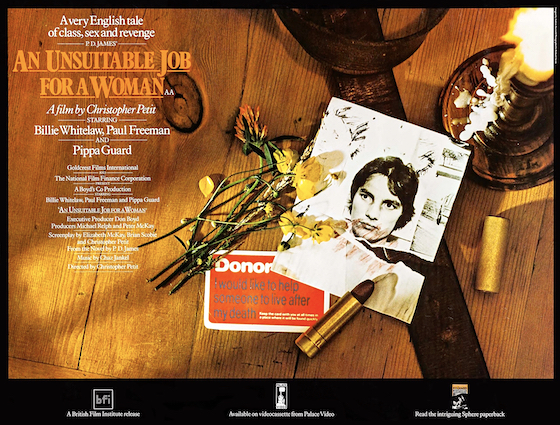
    An Unsuitable Job for a Woman

    (1982)

    Christopher Petit | 94 mins | Blu-ray | 1.85:1 | UK / English | 15

    An Unsuitable Job for a Woman

    I’ve never read the P.D. James novel on which this is based, but I’m assured it’s longer and more complex — the film rather lacks for plausible suspects, making the central murder mystery thoroughly guessable.

    That said, I’m not sure co-writer/director Christopher Petit is all that concerned with producing a true whodunnit. Put another way, I think he’s more interested in the characters, who happen to be involved in a mystery, than in the mystery itself. Which is fine, but I’m also not sure the film does as good a job as it could digging into those characters. I mean, the way the kinda-naïve young investigator becomes obsessed with the deceased subject of her inquiries — almost falling in love with him, it seems, like some kind of gender-flipped riff on Laura — is more nodded at than explored.

    In the end, I felt like I wanted to like the film more than it was actually giving me things I needed to really like it. It’s not bad, but perhaps it could have been great.

    3 out of 5


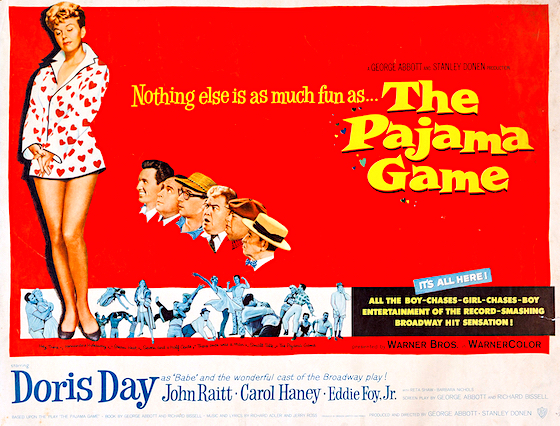
    The Pajama Game

    (1957)

    George Abbott & Stanley Donen | 101 mins | digital (SD) | 4:3 | USA / English | U

    The Pajama Game

    This minor musical is primarily of note for two things: the original Broadway staging featured the choreography debut of one Bob Fosse; and it features the song Hernando’s Hideway — if you don’t recognise the title, I’m sure you’ll recognise the tune. I had no idea this is where it originated.

    The story is about a pay dispute in a pyjama factory (given the current strikes and arguments here in the UK, you might think I watched this deliberately. Nope, total coincidence). On one side there’s the leader of the union’s grievance committee (Doris Day, one of just a handful of replacements made to the original cast when they transferred the stage production to the screen). On the other, the new superintendent (John Raitt, clearly a success on Broadway but less so on film). Of course, they fall for each other, before the pay conflict tears them apart. Can their love overcome such trials? What do you think?

    I saw someone describe The Pajama Game as an overlooked classic, which is taking things a bit far. It’s mostly likeable and quite fun, but rarely transcends that level. The undoubted highlight is Fosse’s choreography, which gives even the lesser numbers a polished dynamism. There are a couple of decent songs, but nothing really stands out, bar the aforementioned. It gets a bit too farcical in places, with some of the storylines ultimately taking a turn into very broad territory that feels misjudged. One primarily for genre fans only.

    3 out of 5


    The Contender

    (2000)

    Rod Lurie | 126 mins | Blu-ray | 16:9 | USA, Germany & UK / English | 15 / R

    The Contender

    I only picked this up on disc because it was part of a bundle of other titles I really wanted, but it also sounded like the kind of thing I’d like. Strange that I’d not heard of it before, then. I guess some films just get lost in movie history, especially when they’re a lesser member of a whole wave of movies. This is a political thriller of the kind they seemed to make quite a few of during the ’90s and into the early ’00s, but don’t really do anymore. I guess they exhausted the well, especially after 156 episodes of The West Wing.

    In this case, the story revolves around Laine Hanson (Joan Allen), the first woman nominated to be Vice President (it only took another two decades for that to happen in real life). There’s the familiar battle between the Democrats to get her confirmed, and the Republicans who’d like to do anything to thwart the Democrats. Amongst the scheming between the two sides, the big revelation is that Laine possibly engaged in a scandalous sex act while in college. She refuses to confirm or deny the rumour — it’s her personal business and shouldn’t affect her appointment. Except, of course, it does.

    Various other allegations come and go throughout the confirmation process, the two sides continuing to go back and forth in their attempts to win. It’s not necessarily the point the film is making, but it’s a reminder that politics is all a game to those involved, even as it can have serious effects on the lives of the rest of us. More overtly, the film tackles the different standards a woman is held to when trying to take public office. Fortunately, it’s not as overbearing with that as it could be. Indeed, all round the film is fairly understated. It’s a solid, unflashy, procedural-based kind of thriller.

    That is until the end, when it throws away the understatement for a grandstanding speech based around a fundamental belief in the greatness and goodness of the American political system. It would be heavy-handed in any circumstance, but the past few years (if not longer) of American politics have shown it for the total lie it always was. It doesn’t wholly undermine what’s gone before, but it does end the film on a sour note.

    4 out of 5


  • 2022 | Weeks 4–6

    It’s been a busy start to the year… at my day job, which has had the knock-on effect of lower film viewing than has been the case in recent years. (I say that, but as February passes its midpoint, I’ve actually watched slightly more films than I had at the same point in 2020; but the last time I was lower than that was right back in 2014, so…)

    As well as work, there’s the psychology of my new reviewing practices. These regular up-to-date roundups have taken me right back to the days when I used to review everything in order, and how not being caught-up on my reviews made me not want to watch anything more. I’m getting those same kinds of twinges now. I need to try to use them to my advantage — take the time to read more books or something.

    Anyway, enough about me — let’s have some film reviews…

  • Voyage of Time: An IMAX Documentary (2016)
  • L’avventura (1960)
  • She’s Gotta Have It (1986)
  • Don’t Look Up (2021)
  • Jackass: The Movie (2002)
  • Jackass Number Two (2006)


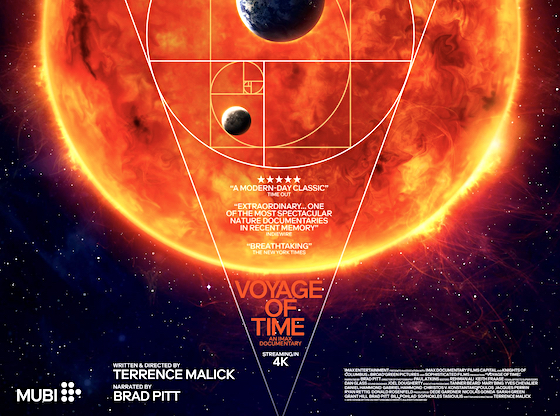
    Voyage of Time

    (2016)

    aka Voyage of Time: An IMAX Documentary / Voyage of Time: The IMAX Experience

    Terrence Malick | 46 mins | digital (UHD) | 1.90:1 | USA / English | NR / G

    Voyage of Time: An IMAX Documentary

    Calling a film “a visual poem” sounds either clichéd or pretentious, or both, but how else to accurately describe this work by Terrence Malick? It’s labelled “a documentary”, because only because it’s not strictly fiction — if you come looking for the kind of education you’d get from something narrated by David Attenborough or Brian Cox, say, then I think you’d leave disappointed.

    No, film-as-poetry is the most appropriate way to attempt to engage with Voyage of Time; and, as with so much written poetry, your personal tolerance for and interest in it will vary. That’s how I found it, anyway: like most poetry, I felt I should appreciate it, but really was glad it was quite short. (The non-IMAX version of the film, subtitled Life’s Journey, runs about twice as long.) There’s some stunning photography, of everything from the birth of the universe to prehistoric vistas (presumably shot in remote modern-day locales rather than computer-generated), and Brad Pitt occasionally whispers some abstrusely meaningful ponderings over the top. As much as the pretty pictures are a draw, you can also find gorgeous nature photography in a BBC Attenborough documentary, and you’ll learn something at the same time.

    The IMAX version of the film has been streaming on MUBI since the end of last year, and they definitely sold it on the visual experience, boasting about offering it in 4K. I found the quality to be variable, with the stream unable to keep its end up for the whole running time, sometimes sinking to sub-1080p levels, becoming blocky and compressed. This is why physical media remains the best, when possible.

    3 out of 5

    Voyage of Time: An IMAX Documentary is the 11th film in my 100 Films in a Year Challenge 2022.


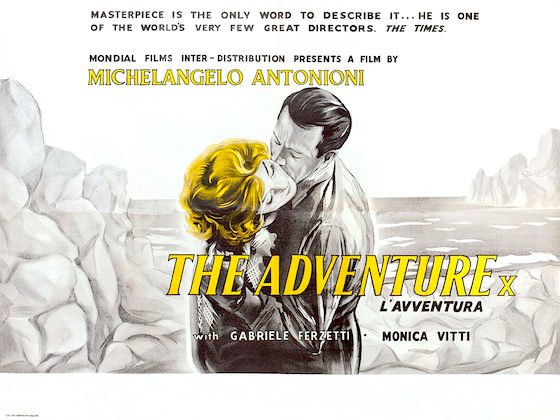
    L’avventura

    (1960)

    aka The Adventure

    Michelangelo Antonioni | 143 mins | digital (HD) | 1.85:1 | Italy & France / Italian, English & Greek | PG

    L'avventura

    I don’t have a great track record for enjoying acclaimed classic Italian cinema (neither Bicycle Thieves nor were to my taste, for example), so I’ve put off watching L’avventura for years, expecting I wouldn’t get on with it. But, inevitably, I had to face it someday… and, as it turned out, I really liked it… for a while…

    The film begins with Claudia (Monica Vitti) and her wealthy friend Anna (Lea Massari) meeting up with the latter’s wealthy boyfriend, Sandro (Gabriele Ferzetti), to go for a cruise on the yacht of some other wealthy friends. When they dock on a small island, Anna goes missing. The party scour the island, but there’s no sign of her. Police and divers arrive, but no luck. Reports suggest maybe she boarded another boat; possibly she was kidnapped. The wealthy friends quickly drift back to their lives, but Claudia and Sandro keep searching, following scant clues. Soon they too begin to get distracted — by each other.

    I don’t think it’s a spoiler to say that L’avventura starts out looking like a missing-person mystery only to get sidetracked into being a kind of romantic drama. I certainly knew that going in; and it’s probably beneficial to know it, spoiler or not, so as to manage your expectations of the film appropriately. Anyone expecting a Christie-style hunt through clues and suspects until the truth is unearthed will come away severely disappointed. No, this is the Mystery genre reimagined through an arthouse lens: it’s inconclusive, more interested in the characters than the hunt they’re on, and notoriously slow paced.

    With that in mind, I was surprised by how effective I found the mystery part of the movie. It’s not a whistle-stop action-adventure, but it’s not significantly slower than your average murder mystery, and accusations of it being uneventful seem misplaced — if I were expecting it to unfold like a regular mystery, there’d be plenty of places to look out for clues. It’s as the film shifts more towards Claudia and Sandro’s burgeoning romance that it begins to drag. The pair start just hanging around places as tourists, at which it does begin to seem like nothing’s happening and so what’s the point? The conceit of them falling for each other when they’re meant to be searching for someone they mutually care about is a good storyline, but I wasn’t convinced by how it played out. There doesn’t seem to be any time when they’re actually falling in love, they just suddenly are. Maybe I’m missing some point there. Or maybe it’s beside the point. Until I can work that one out, I’m going to have to chalk this up as half great, half A Shame.

    4 out of 5

    L’avventura is the 12th film in my 100 Films in a Year Challenge 2022. It was viewed as part of Blindspot 2022.


    She’s Gotta Have It

    (1986)

    Spike Lee | 84 mins | digital (UHD) | 1.66:1 | USA / English | 18 / R

    She's Gotta Have It

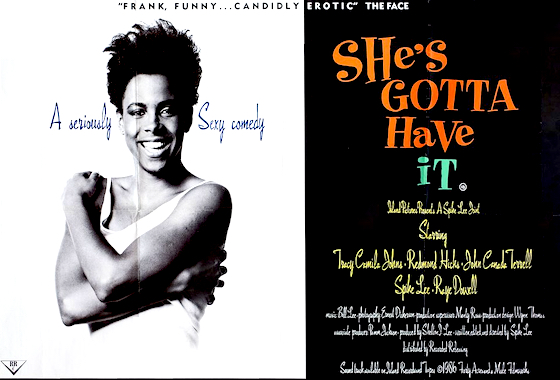
    Spike Lee’s post-student debut concerns twentysomething Brooklynite Nora Darling (Tracy Camilla Johns), who’s openly dating three men: upright ‘nice guy’ Jamie (Tommy Redmond Hicks), preening model Greer (John Canada Terrell), and streetwise Mars (Lee himself). And let’s not be coy (because the film certainly isn’t): she’s not just dating them, she’s sleeping with them all. The story of this love ‘square’ is partially narrated to camera by its four participants, as well as some of Nora’s other friends and acquaintances.

    It’s kinda crazy to think that the American indies were making sexually frank films like this and sex, lies and videotape in the late ’80s (a precursor, no doubt, to the wave of ‘real sex’ movies in the early ’00s), while nowadays we regularly get young people on Twitter arguing that no movie ever needs to have a sex scene, ever. So while I’m tempted to describe the film’s views on promiscuity as “then-modern”, perhaps just “modern” will still suffice — it’s certainly taken most (arguably all) of the intervening decades to get rid of the double standard for men and women as regards having multiple partners. That said, what has perhaps changed is our idea of what counts as “sexually explicit”. The film was obviously quite shocking back in its day, with the MPAA insisting on cuts before they’d give it an R (the unrated “director’s cut” had a Criterion LaserDisc release, but hasn’t surfaced anywhere else since), but you’ll see more nudity, more thrusting and moaning, on certain TV shows nowadays.

    Sexual stereotypes are not the only ones Lee sought to subvert here, as he also attempts to combat stereotypical depictions of African-Americans on screen — note the prominent message in the end credits that “this film contains are no jerri curls!!! and no drugs!!!” (punctuation as seen on screen). It extends beyond those basic signifiers; for example, how Nora’s three lovers are such different personalities. Partly that makes sense for the plot — that different sides of Nora’s personality like different types of guy — but also it shows different ideas of male Blackness; that The Black Guy is not just one thing. The jazzy score is another definite contrast to what you’d expect from a Hip Young Black Movie in the ’80s. Maybe that’s just Lee’s personal preference, but maybe it’s another conscious subversion of expectations.

    Lee’s politics are clear and forthright, but his filmmaking still needed some work. A lot of the film looks great, mostly shot in high-contrast black-and-white (plus one striking, ultra-saturated colour sequence), but some of the editing and performances could use refinement. Rough round the edges though it may be, She’s Gotta Have It is so clearly the calling card of a talented and individual voice with something brand-new to say that those rough edges are almost more of a feature than a bug.

    4 out of 5

    She’s Gotta Have It is the 13th film in my 100 Films in a Year Challenge 2022. It was viewed as part of “What Do You Mean You Haven’t Seen…?” 2022.


    Don’t Look Up

    (2021)

    Adam McKay | 138 mins | digital (UHD) | 2.39:1 | USA / English | 15 / R

    Don't Look Up

    Oscar statue2022 Academy Awards
    4 nominations

    Nominated: Best Picture, Best Original Screenplay, Best Editing, Best Original Score.

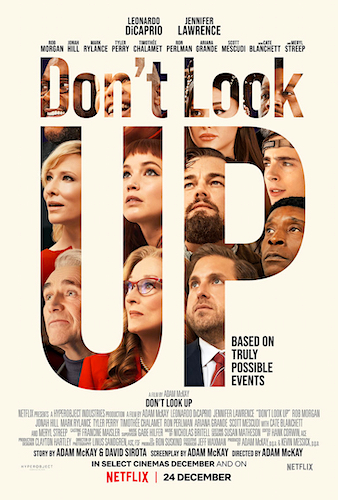
    Having targeted those responsible for the 2008 financial crash in The Big Short, and Dick Cheney and his responsibility for everything bad that’s happened in the last few decades in Vice, writer-director Adam McKay now turns his satirical attention to a fictional scenario, basically so he can have a go at anyone and everyone he feels like. The plot concerns a giant asteroid headed for Earth; an extinction-level event just 6½ months away. But, despite a handful of scientists trying to warn everyone, nobody seems in a great rush to do anything about it. It’s all an allegory for America’s carefree attitude to climate change, see.

    Really, this is a film I should be fully onboard with. It’s setting its sights on vacuous mainstream culture and Trumpian politics, after all. The problem is, these targets are low-hanging fruit, and — somewhat ironically, given its title — Don’t Look Up is satisfied with only plucking those lowest branches. Repeatedly. Unhurriedly. When they said the comet was 6½ months away, I didn’t expect the rest of the film to feel like it was covering that in real-time. It needed a better editor, or perhaps a studio who exerted a bit more quality control than Netflix’s famed “do what you want, we’ll just release it” approach. There are funny moments, certainly, but they’re literally few and far between when the pace is languid and the satire so broad, simplistic, and repetitious. Indeed, the most laugh-inducing stuff has nothing to do with the satire at all, just funny bits of business along the way (the best is a running gag about a general and snacks, which keeps cropping up unexpectedly).

    And for a film that’s entire thesis is being critical of American attitudes, it’s (again) ironic that it depicts this global crisis as so America-centric. Sure, there are cutaways to people watching events in other parts of the world, and a couple of belated nods to the idea that other countries might have their own thoughts on this impending disaster, but that’s all they are — sops and nods. “If America’s not going to fix this, no one can,” says the film. Ah, fuck off.

    2 out of 5


    Jackass: The Movie

    (2002)

    Jeff Tremaine | 85 mins | digital (SD) | 16:9 | USA / English | 18 / R

    Jackass: The Movie

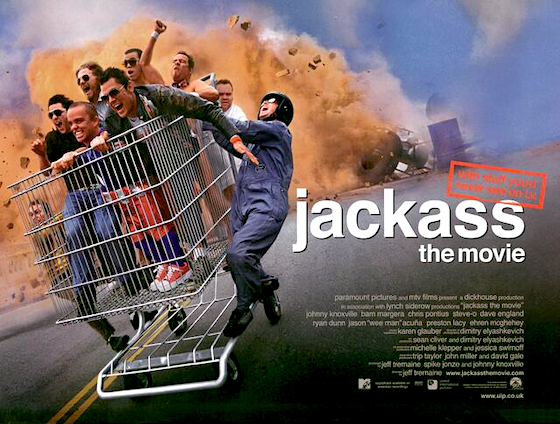
    Jackass never appealed to me. I was a 14-year-old boy when it started, surely the franchise’s target audience; but I was an intelligent 14-year-old boy, so I was above it. Sorry, not sorry. But with everyone going on about the new movie, and reevaluating the whole franchise as some kind of essential classic of Cinema, I thought it was finally time to see for myself.

    For those not au fait with the series, it’s about a bunch of men who clearly aren’t old enough to know better performing stunts and pranks that no one in their right mind should ever want to do anyway. They’re frequently designed to induce pain. They’re often trying to be as crude or gross as possible. Some may make you feel ill just by watching them. And yet others are almost on the level of wholesome fun… albeit “wholesome fun” where you know participants will come away with bruises, at the very least.

    Almost everything the guys get up to is “dumb” — that’s kinda the point — and yet… It borders on “educational” when, for example, lead troublemaker Johnny Knoxville submits to being shot by “less lethal” riot control ammunition. The plan was for him to be shot in the chest, but the guys who make the stuff say if it hits his heart it could kill him, so they revise it to him being shot in the abdomen. Whereas most of the other stunts are followed by cutaways to the rest of the crew in hysterics, here the shocked silence of their reaction is telling. Or how about the kinda-feminism of a segment called “Ass Kicked by a Girl”, in which one of the gang enters the ring against a world champion female kickboxer. There’s no “haha, I can take her easily ’cause she’s a girl” posturing: the guy knows he’s about to get his ass handed to him. There’s some kind of respect for women in that, anyway, which you might not expect given the rest of the laddish antics.

    Taken as ‘a movie’, it’s rather formless — I suspect the TV show was exactly the same, just shorter — but the rapid-fire, standalone-stunt style does mean that no sketch hangs around too long. Some are literally seconds. But there’s not even a sense of escalation, say — it’s not like they save the largest or most outlandish stunt for the end (although there’s a post-credit scene that seems like it was probably the film’s most expensive single sequence). In some respects it doesn’t matter (who cares about the structure of a Jackass movie?), but in others, it’s what keeps it at the level of “feature-length special” rather than true Movie.

    But, ultimately, the important thing is this: some of it is funny. Reader, I laughed.

    3 out of 5


    Jackass Number Two

    (2006)

    Jeff Tremaine | 88 mins | digital (HD) | 16:9 | USA / English | 18 / R

    Jackass Number Two

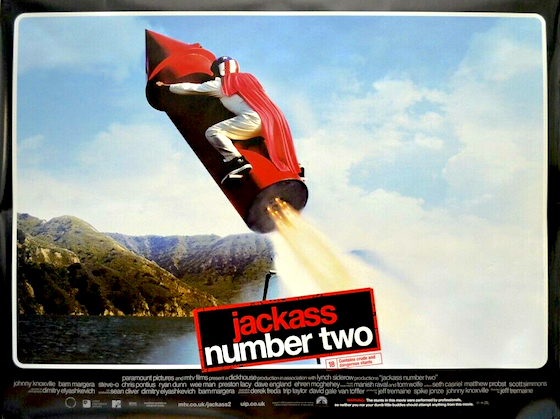
    Even Jackass isn’t immune from the law of diminishing returns: after three seasons on TV plus a movie, this second big-screen outing feels kinda uninspired, like they’ve used up all their truly great ideas and are mostly running on fumes. That said, there are some good sequences — a variety of rodeo-based stunts with real live bulls are among the highlights — but other pranks feel reheated, or are just underwhelming; things you suspect would have been rejected in favour of better material before.

    In that sense it almost feels like it was rushed out to capitalise on success, but there’s a gap of four years, the TV show had ended, and they hadn’t necessarily intended to do any more — surely the only reason to return, then, was fresh ideas? Or, perhaps, being given the budget to do things they couldn’t before. That might be the case, because some of the material does feel like it’s got too much money and/or time behind it. I say “too much” because I think Jackass works best when it has a rough, cheap, “made at home” vibe. The finale here — a big “old Hollywood”-style musical number, with stunts mixed in — feels particularly out of place. Obviously it’s all a big joke, but the glossy, clearly-expensive visuals don’t feel of the right style.

    Plus, at various points you can feel some of the cast are getting genuinely fed up with this shit. Maybe they’d been doing it for too long by this point (I say there was a years-long gap, but some had been involved in spinoff projects). Whatever the reason, it serves to undermine the fun somewhat. One of the reasons you can enjoy these fools doing life-threatening stunts is because they’re volunteering for it and they seem to be having fun, however much they’re getting hurt or disgusted. But if they’re not enjoying it, aren’t we just watching people be tortured for our entertainment? It almost tips it from being stupid-but-funny into exploitative bullying. And we shouldn’t be having to think about anything that deep during a Jackass movie.

    As I’ve given both films 3 stars, let’s be clear: I’d definitely rate the sequel lower than the first movie, just not a whole star lower — it doesn’t merit being pulled down to a 2, while the first doesn’t merit a retrospective bump up to 4. If this kind of tomfoolery tickles you, there’s still plenty of entertainment to be had in Number Two, it’s just (mostly) not their finest output — which I guess is kinda apt, given the title.

    3 out of 5

    Jackass Number Two is the 15th film in my 100 Films in a Year Challenge 2022.


  • Archive 5, Vol.4

    I have a backlog of 432 unreviewed feature films from my 2018 to 2021 viewing. This is where I give those films their day, five at a time, selected by a random number generator.

    Today: singing vicars, grumpy gamers, very nice Kazakhs, and deleted actors.

    This week’s Archive 5 are…

  • Going My Way (1944)
  • The Bells of St. Mary’s (1945)
  • Zero Charisma (2013)
  • Borat (2006)
  • The Thin Red Line (1998)


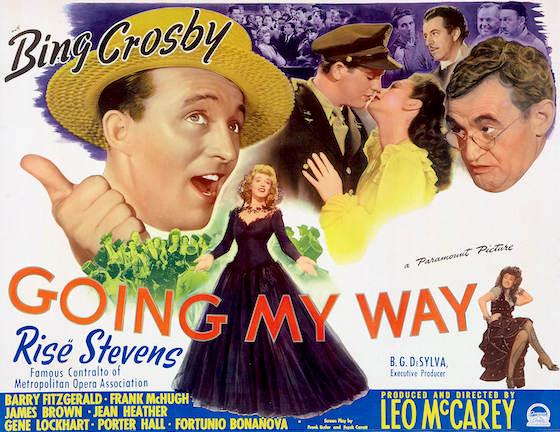
    Going My Way

    (1944)

    Leo McCarey | 126 mins | digital (HD) | 1.33:1 | USA / English | U

    Going My Way

    The Oscars, eh? Every year film fans pay them a load of attention, and every year we seem to be disappointed with the outcome. But this isn’t some new phenomenon: Going My Way hails from the 1940s, but is perhaps the definitive example of a film that managed to sweep the Oscars (it won seven awards from ten nominations) against a bunch of films that have endured to much greater acclaim (films it competed against included Double Indemnity, Laura, Lifeboat, Gaslight, and Meet Me in St. Louis. I think we can agree those are all better-remembered on the whole).

    None of which is to say it’s a bad film. It’s a gently-paced series of vignettes, almost like a collection of short stories, springing from young priest Father O’Malley (Bing Crosby) arriving to take charge of a struggling New York City parish. His modern ways clash with the old-fashioned values of the incumbent Father Fitzgibbon (Barry Fitzgerald), but his worldly knowledge allows him to connect with some of the parish’s disaffected inhabitants. Despite the religious setting, it doesn’t lean too heavily on the wonders of Christianity (you know I’d be the first to rip into it if it did). Overall, it’s perfectly pleasant; an easy afternoon’s viewing.

    Incidentally (and here’s a good bit of trivia that might come in handy for a quiz someday), it was the first Oscar Best Picture winner to have a sequel: The Bells of St. Mary’s, released the very next year… and also the very next review in this roundup…

    3 out of 5

    Going My Way was #93 in my 100 Films in a Year Challenge 2021.


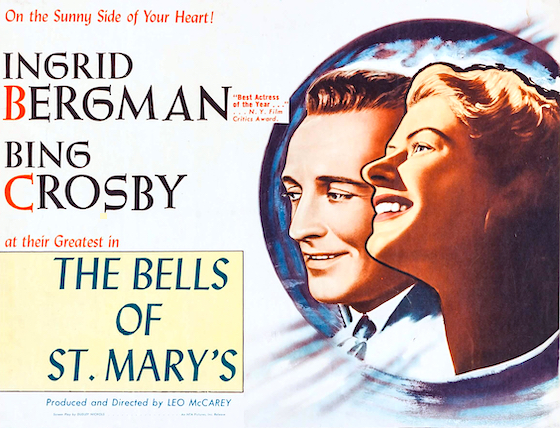
    The Bells of St. Mary’s

    (1945)

    Leo McCary | 126 mins | TV (SD) | 4:3 | USA / English | U

    The Bells of St. Mary's

    This followup to Going My Way was not only the first sequel to an Oscar Best Picture winner, but was also the first sequel to be nominated for the Best Picture Oscar.

    Bing Crosby returns as Father O’Malley, sent to a new locale, ready to solve another series of subplots at a struggling religious institution, this time butting heads (sort of — it’s never as dramatic as that makes it sound) with Ingrid Bergman’s head nun. Like the first one, it’s really a bundle of subplots for Bing to ‘solve’. The low-stakes problems and amiable tone between the two leads, even when they’re disagreeing, makes for a gentle and relaxing kind of film. I’d give it the edge over its Oscar-winning predecessor, thanks primarily to Bergman’s performance, but neither film is likely to set anyone’s world alight.

    As well as their Oscar success, the films were the highest grossing at the US box office for 1945 and ’46, respectively, another first for a film ‘series’. And yet, with six decades distance, they’re little more than also-rans; nicely obscure trivia answers to “films that won/were nominated for Best Picture”. Maybe there’s a lesson in that for anyone obsessed with the current cultural zeitgeist.

    3 out of 5

    The Bells of St. Mary’s was #187 in my 100 Films in a Year Challenge 2021.


    Zero Charisma

    (2013)

    Katie Graham & Andrew Matthews | 88 mins | digital (HD) | 16:9 | USA / English

    Zero Charisma

    I’d nickname this Portrait of a Manbaby on Fire. The manbaby in question is Scott (Sam Eidson), a stereotypical alpha-nerd: he has a neckbeard; he wears black T-shirts that feature elaborate depictions of grim reapers and the like; he lives with his grandma; he paints miniature fantasy figurines; he’s the Game Master of a role-playing group, which he rules with an iron fist. But when into-geeky-stuff hipster Miles (Garrett Graham) joins the group and everyone really likes him, Scott finds his position threatened, and he’s not happy about it.

    As much as geek/nerd culture has transitioned into the mainstream over the past couple of decades, there’s still stuff that remains the preserve of the hardcore; the truly nerdy. That culture clash is part of what Zero Charisma is about, of course, with Scott’s true old-fashioned kind of nerdishness clashing with Miles’s new-school cool. But it’s also a character study of the former. Scott may seem a stereotype — like The Simpsons’ Comic Book Guy rendered in live-action — but I’d wager anyone who’s moved in nerdish circles has known someone at least a bit like him. Stereotypes are stereotypes for a reason. The film exposes and examines those to often amusing effect. Some have said it exaggerates these things, but I don’t think it’s particularly guilty of that. Maybe it generalises them, and lumps all the worst characteristics of the extremely nerdy together into one character, but that doesn’t make it inaccurate, just broad.

    My only real problem was the ending. There’s a scene where everything comes to a head — a climax, if you will — but, in the wake of that, I felt it lacked adequate resolution. Has Scott learnt anything from this experience? Is he a changed man? Maybe a little, but not completely. To be fair, that’s a realistic character arc, because whose personality changes overnight after a single revelation? And yet it also doesn’t feel like the filmmakers quite know how they want to leave things. If they’d been going for a “change takes time and is incremental, but Scott’s started on that road” kinda message, I would have approved. Instead, the film tries to have its cake and eat it by showing Scott as better on the surface, but then secretly GMing a game where he still behaves like an asshole. Maybe it’s trying to say we can never truly change, however much our flaws are highlighted to us, which would be a pretty glum way to end an otherwise likeable comedy.

    3 out of 5

    Zero Charisma was #109 in my 100 Films in a Year Challenge 2020.


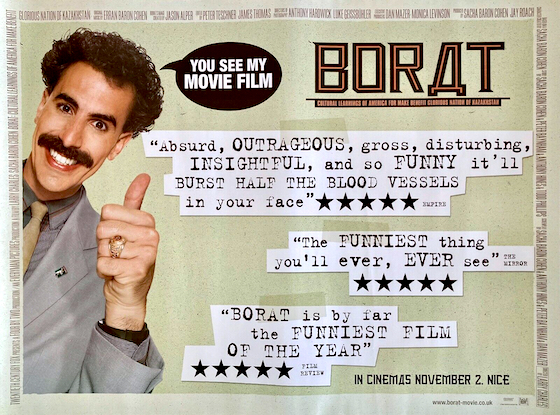
    Borat

    (2006)

    aka Borat: Cultural Learnings of America for Make Benefit Glorious Nation of Kazakhstan

    Larry Charles | 84 mins | digital (HD) | 16:9 | USA & UK / English | 15 / R

    Borat

    Ali G’s Sacha Baron Cohen adopts the persona of a Kazakh journalist to ostensibly interview Americans about their culture, but, unbeknownst to them, he’s of course really looking to expose their ludicrous views (you just know that, ten years later, a lot of these people voted for Trump) and take the piss out of them for our entertainment.

    As with most sketch-based comedy, the end result is a mixed bag. Sometimes it’s very funny; other times, it’s just being gross for the sake of it, like in a naked fight between Borat and his portly producer. A few bits don’t quite land — sometimes you can feel Baron Cohen’s not getting the response he wanted out of his target — and, even though he’s taking the piss out of people who deserve it, it sometimes gets a bit uncomfortable (though that might just be my English reserve/politeness kicking in and making me cringe). Most of the sketches are quite short, which is nice — they generally don’t outstay their welcome, and, if one isn’t working, you can be assured another will be along shortly.

    3 out of 5

    Borat was #220 in my 100 Films in a Year Challenge 2020.


    The Thin Red Line

    (1998)

    Terrence Malick | 171 mins | Blu-ray | 2.35:1 | USA / English | 15 / R

    The Thin Red Line

    An extensive cast of famous actors and recognisable faces star as a battalion of soldiers who spend 2 hours and 51 minutes taking one (1) hill in Terrence Malick’s very Terrence-Malick-y World War 2 movie. I mean, this is a movie about a battle in which the first shots aren’t fired until past the 45 minute mark, but there are plenty of shots showing the minutiae of nature. And there’s a lot of discussion about how there isn’t enough water.

    None of which is necessarily a problem — indeed, there are plenty of people who think this is a great movie, and I’m glad for them. But for everyone who loves it, there’s someone who’d call it “pretentious and self-indulgent, despite gun battles and lush cinematography.” I find myself somewhat stuck in the middle. I mean, if you were expecting a normal combat movie from Terrence Malick, more fool you. And it’s unquestionably beautifully shot — so many gorgeous visuals, but also effective camerawork and editing to convey, say, the chaos of battle. But I also found it to be bitty and episodic. Well, calling them “episodes” might be kind — they’re scenes; sometimes less than scenes; just moments, or even shots. It’s like a really long deleted scenes package pretending to be a movie.

    Of course, the behind-the-scenes stories sort of support that reading. The first cut clocked in at five hours. It took two editors and thirteen months of post-production to get it to a manageable size. Hans Zimmer composed over four hours of music, but only for a few bits of his work made it into the final cut. Billy Bob Thornton recorded narration for the entire film; the released cut has eight different narrators, but none of Thornton’s work is in there. Many actors thought they had significant roles, but found their performances reduced to little more than cameos. Most famously, Adrien Brody thought he was playing the lead role, only to discover at the premiere that he’s in just a couple of shots, and doesn’t even speak until over halfway through (and then it’s just a brief voiceover). And then there are the actors whose work was left on the cutting room floor: Bill Pullman, Gary Oldman, Lukas Haas, Viggo Mortensen, Martin Sheen, Jason Patric, Mickey Rourke… This movie has more great actors whose performances were deleted entirely than most movies have in their entire cast!

    All of which suggests a movie that should be universally recognised as a disaster. That it isn’t — quite the opposite — is testament to something. Maybe someday I’ll rewatch it and find out what.

    3 out of 5

    The Thin Red Line was #77 in my 100 Films in a Year Challenge 2020. It was viewed as an additional film for Blindspot 2020 after I failed to watch it for WDYMYHS 2019.


  • Meat Loaf: In Search of Paradise (2007)

    Bruce David Klein | 88 mins | DVD | 16:9 | USA / English

    Meat Loaf: In Search of Paradise

    The singer Meat Loaf was very protective of his creative process, and apparently this documentary was the first time he’d allowed cameras behind the scenes to document it. Certainly, he’s frequently uncomfortable with or begrudging of their presence, although he seems to get used to them over time, allowing us some rare insights.

    The film follows Meat and his band as they prepare for and commence a mammoth 18-month world tour following the release of Bat Out of Hell III. Despite the lengthy schedule, a DVD recording of the concert is scheduled for just a few gigs in. It’s never mentioned who was responsible for booking that, but it clearly causes added stress for everyone: rather than allowing the show to become refined and polished over a long series of gigs, it’s got to be good enough to be documented almost as soon as it starts. No one here is ever pretentious enough to refer to the recording as an “historical record”, but that’s what it will be. This is the first tour in which Meat will perform songs from the entire Bat Out of Hell trilogy, and the gig that’s recorded for DVD is the one that will endure as the record of this tour. It’s got to be right.

    Perhaps the biggest obstacle is the fact that Meat Loaf is never satisfied. At one point, Meat’s mate Dennis Quaid is in town and pops by to watch that evening’s gig. Afterwards, he describes it as “an incredible show”. “It wasn’t one of my favourites, but thank you,” replies Meat. So Dennis asks, “how many times are they your favourite?” “Never,” Meat answers, “I hate ’em all… I’m waiting for the perfect show.” Of course, the perfect show never comes, and so Meat never feels it’s gone as well as it could have; he’s always apologising to fans that it won’t live up to expectations. But it’s not that the tour is genuinely coming up short — the band are happy; the crowds are certainly entertained — it’s just something in Meat Loaf’s character. He pushes himself so hard — too hard, given how exhausted it makes him, to the point he physically collapses after most shows. Whether you like his music or not, this film leaves you in no doubt about his dedication to his craft; to trying to give his fans exactly what they want.

    Looks like paradise to me

    That desire comes to a particular head in one of the film’s major subplots: the show is generally well reviewed in the press, but every critic takes issue with the staging of Paradise by the Dashboard Light, a number about teenage sex in which 59-year-old Meat duets with 28-year-old Aspen Miller — who looks a lot younger, especially in her skimpy cheerleader outfit. Frankly, I reckon the critics were at least partly jealous that Aspen Miller wasn’t writhing all over them, but maybe that’s just giving away something about me… Anyway, the number should be one of the highlights (as guitarist Kasim Sulton says, he’s been touring with Meat for decades and they’ve never done a show without it), but the criticisms are a cause of irritation backstage. Importantly, Miller doesn’t share the critics’ concerns; indeed, she seems to find it frustrating that they’re dismissive of her part in the performance, writing her off as a victim of it, when she’s an adult involved in the planning of what is a fully-choreographed routine. But the criticisms get to Meat even more — it’s not meant to be a song about a handsy old man attempting to assault a young girl, after all — and so various fixes are attempted to improve the song’s reception. It’s like a case study in revising a work while it’s already in performance, and shows that these tours don’t go out on the road locked and unchangeable — or, at least, they don’t when Meat Loaf is involved.

    The film’s final line is given to Meat Loaf himself. As he walks away after that all-important gig filmed for the DVD, he repeats several times: “I tried.” That’s his attitude in summation: he never thought it was good enough, but he always gave it his all.

    4 out of 5

    Meat Loaf: In Search of Paradise is the 10th film in my 100 Films in a Year Challenge 2022.
    Archive 5, Vol.2

    I have a backlog of 442 unreviewed feature films from my 2018 to 2021 viewing. This is where I give those films their day, five at a time, selected by a random number generator.

    Today: musical comedies from ’41 and ’51; murder mysteries from ’33 and ’73; and an animated film that changed the Oscars.

    This week’s Archive 5 are…

  • Royal Wedding (1951)
  • A Study in Scarlet (1933)
  • Chicken Run (2000)
  • The Last of Sheila (1973)
  • Road to Zanzibar (1941)


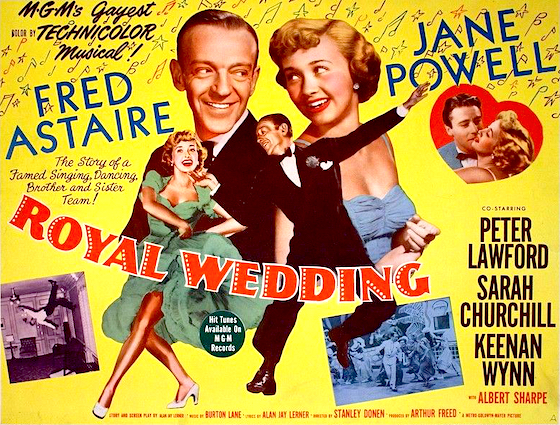
    Royal Wedding

    (1951)

    aka Wedding Bells

    Stanley Donen | 93 mins | digital (SD) | 4:3 | USA / English | U

    Royal Wedding

    Cynically, I assumed this US production was designed as a cash-in to a news event, most likely the wedding of Princess Elizabeth (i.e. the Queen) and Philip. Although those are indeed the eponymous nuptials, they actually took place several years earlier, in 1947; and in the UK, for its initial release the film was retitled Wedding Bells so audiences wouldn’t think it was a documentary about the real event. So much for my modern cynicism.

    The actual plot is semi-biographical, inspired by the real-life dance partnership of the film’s star, Fred Astaire, and his sister Adele, and who she went on to marry. Here the sister is played by Jane Powell (almost 30 years Astaire’s younger) as the duo take their successful Broadway show across the ocean to London in time for the royal wedding. Such window dressing aside, the plot that unfurls is run-of-the-mill, with both siblings finding themselves in romantic entanglements, and the songs are unmemorable too. The object of Astaire’s affection is played by Sarah Churchill, daughter of Winston Churchill, which adds a bit of fun trivia, at least.

    There is one noteworthy highlight: a set piece in which Astaire dances up the walls and across the ceiling of his hotel room, an effect that’s achieved seamlessly — there’s no wobble or what have you to give away the trickery, and Astaire’s choreography helps hide the behind-the-scenes technique too. There are one or two other neat bits if you’re a fan of dance-y musicals, but, on the whole, this is a thoroughly middle-of-the-road Astaire musical — not bad, just no more than adequate.

    3 out of 5

    Royal Wedding was #180 in my 100 Films in a Year Challenge 2021.


    A Study in Scarlet

    (1933)

    Edwin L. Marin | 72 mins | Blu-ray | 1.33:1 | USA / English | U

    A Study in Scarlet

    For some reason, cinema has a long history of taking the titles of original Sherlock Holmes stories but then producing an entirely new plot underneath. A Study in Scarlet — the very first of Sir Arthur Conan Doyle’s Holmes works — seems to be a particularly afflicted tale. It features the first meeting of Holmes and his roommate / sidekick / chronicler, Dr Watson, but I think there are two adaptations that actually show this — and, ironically, neither of them are actually called A Study in Scarlet (one is the debut episode of Sherlock, A Study in Pink, and the other is the first episode of the Russian series The Adventures of Sherlock Holmes and Dr. Watson, which is called Acquaintance). According to IMDb, “the Conan Doyle estate quoted the producers a price for the rights to the title and a considerably higher price to use the original story” — perhaps they did that all the time, hence my observed phenomena.

    Obviously, this ‘poverty row’ effort is one such example of title/story mismatch: this so-called adaptation stars Sherlock Holmes and Dr Watson… and that’s where similarities to the novel end. The pair don’t even live at 221b Baker Street — for no apparent reason, it’s been changed to 221a. Did the filmmakers just misremember one of the most famous addresses in literature? Having only paid for the rights to the title, the producers hired director Robert Florey (the Marx Brothers’ The Cocoanuts; Murders in the Rue Morgue) to write a new story, and actor Reginald Owen — who stars as Holmes — wrote the dialogue. Owen hoped this would be the first in a series of Holmes films starring himself. It wasn’t.

    Physically, Owen isn’t anyone’s ideal image of Holmes, but his actual performance is adequate. Much the same can be said of the whole film: it’s an entertaining-enough 70-minute crime romp, with enough incident to create a brisk pace, and a use of the rhyme Ten Little Indians that makes you wonder if Agatha Christie saw this movie before she published And Then There Were None six years later (or is it just a coincidence? The audio commentators spend a good deal of time chewing it over). Given second billing behind Owen is bona fide Chinese-American movie star Anna May Wong, even though she has relatively little screen time. She makes her mark, though, with a role that doesn’t simply conform to racial stereotypes (possibly an unintended side effect of her late casting rather than genuine progressivism by the filmmakers, but sometimes you gotta take what you can get).

    This particular Study in Scarlet is a long way from being a definitive Sherlock Holmes movie, but for fans of ’30s detective flicks, it’s nonetheless a likeable little adventure.

    3 out of 5

    A Study in Scarlet was #206 in my 100 Films in a Year Challenge 2021.


    Chicken Run

    (2000)

    Peter Lord & Nick Park | 84 mins | digital (HD) | 16:9 | UK, USA & France / English | U / G

    Chicken Run

    I’ve always enjoyed Aardman’s work. I grew up watching the Wallace & Gromit shorts on TV, and have seen all of their feature output — except their first. I’m not sure why it’s taken me 20 years to get round to Chicken Run. I guess when it was originally released I had grown out of “kid’s movies” but not yet grown back into them; but since then, to be honest, something about it never particularly appealed to me. It certainly has its fans: it’s still the highest grossing stop motion film ever; there was a push to get it an Oscar Best Picture nomination, the failure of which led to the creation of a category it could’ve won, Best Animated Feature (trust the Academy to shut the door after the horse had bolted); and when Netflix recently announced a sequel, there was much pleasure on social media.

    So, finally getting round to it, would I discover what I’d been missing all along? Unfortunately, no. I thought it was fine. In no way did I dislike it, but nor did it charm me in the way of my favourite Aardman productions. It’s rather dark for U-rated film — it doesn’t mince its words or imagery about the fact the chickens are being killed — and that contributes to some particularly effective sequences, like when our heroes end up inside the pie machine, or a suitably exciting climactic action sequence. There are some reliably decent gags along the way, too.

    I’m sure I’ll watch the sequel. Maybe I’ll like it more. But, I confess, the fact they’ve now announced a new Wallace & Gromit movie for the year after does have me even more excited.

    3 out of 5

    Chicken Run was #148 in my 100 Films in a Year Challenge 2020.


    The Last of Sheila

    (1973)

    Herbert Ross | 120 mins | digital (SD) | 1.85:1 | USA / English | 15* / PG

    The Last of Sheila

    I’d never even heard of this before Rian Johnson mentioned it as an inspiration for Knives Out 2. Co-written by Anthony Perkins (yes, Norman Bates from Psycho) and Stephen Sondheim (yes, the famous musical composer), The Last of Sheila is a murder mystery firmly in the Agatha Christie mould — despite the writers’ pedigree, there are no significant horror elements (even the deaths are, at worst, on the PG/12 borderline) and certainly no song-and-dance numbers (excepting a magnificently inappropriate song over the end credits, sung by Bette Midler). Apparently Perkins and Sondheim used to host elaborate scavenger hunts for their friends in the late ’60s and early ’70s, and they adapted them into a screenplay at the suggestion of a guest, Herbert Ross, who produced and directed the film (seems only fair).

    Further inspiration came from their professional lives and acquaintances, because the potential victims and suspects are all actresses, agents, and the like, gathered for a Mediterranean cruise aboard a producer’s yacht. He proposes they play a game about secrets and gossip — but clearly one of the secrets in play is too big, because someone winds up murdered. A well-constructed mystery is unfurled throughout the film, although its execution is a little variable: a fun, very Christie-esque first half gives way to long talky scenes in the second, as characters stand around and explain the plot to each other. But when that plot is as good as this — with some nice surprises, plus motives dark enough to give it a little edge — it feels churlish to object too strongly.

    4 out of 5

    The Last of Sheila was #186 in my 100 Films in a Year Challenge 2021.

    * IMDb says it was given a 15 on video, but the BBFC say it hasn’t been rated since 1973, when it got an AA. The BBFC site is crap nowadays; IMDb will accept any old junk users submit. You decide. ^


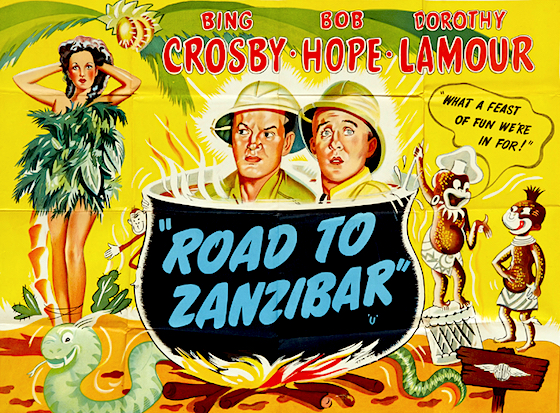
    Road to Zanzibar

    (1941)

    Victor Schertzinger | 87 mins | DVD | 1.33:1 | USA / English | PG

    Road to Zanzibar

    The second in what became the Road To… series — though it was never intended as such. What ended up becoming Road to Zanzibar was initially an original feature, first offered to Fred MacMurray (this before his roles in the likes of Double Indemnity and The Apartment) and George Burns (an actor I’m not particularly familiar with). After they rejected it, apparently someone at Paramount remembered Road to Singapore had done relatively well, and that Bob Hope and Bing Crosby seemed like a good pairing, and so they were offered it.

    As I wrote in my last review of a Road To film (which was over 11 years ago?! Jesus…), if you’ve seen one Road To film then you’ve a fair idea what to expect from any other — essentially, a suitably daft bit of fluff and fun. This one’s a bit thin — on plot, on gags, on everything — but it skates by on the charm of Bob and Bing, joined, as ever, by Dorothy Lamour. The only serious problem is the same as Singapore: dated depictions of African stereotypes. It kind of gets away with it by being a spoof of “African adventure”-type movies, but maybe that’s me being kind with hindsight. Either way, the bit where the tribe’s African dialogue is subtitled with contemporary American vernacular is one of the film’s more amusing gags.

    3 out of 5

    Road to Zanzibar was #110 in my 100 Films in a Year Challenge 2019.


  • 2022 | Weeks 1–3

    Here we go — finally, and somewhat later than anticipated (it’s been a slow start to the year, viewing-wise) — the new review format for 2022!

    …which you’ll have already seen in Archive 5, of course; and is fundamentally similar to what I was doing before in roundups and what-have-you; and which I’ve already ‘broken’, because my review of Flight of the Navigator came out so long that I posted it alone.

    But still, the intention is this is now my regular review format, popping up every week or two (or three) to review everything in a more timely fashion than I have for many, many years. We’ll see how it goes — I feel like I need to relearn how to write short pieces, because longer reviews feel like they should get their own posts, and that’s happened to pieces intended for every one of these roundups so far this year.


    Anyway — to kick things off for 2022, a film with a broadly appropriate title. Because, despite (deliberately misleading) hints to the contrary, I’m carrying on. Get it? Carrying on watching. And “spying” is a synonym of “watching”, right? (Look, there aren’t any Carry On films with more apposite titles, okay?)

    These weeks’ films are…

  • Carry On Spying (1964)
  • Penny Serenade (1941)
  • The Navigator (1924)
  • In the Line of Fire (1993)
  • Barbie as The Princess and the Pauper (2004)
  • Free Guy (2021)


    Carry On Spying

    (1964)

    Gerald Thomas | 84 mins | digital (SD) | 16:9 | UK / English | U

    Carry On Spying

    Believe it or not, I’ve never actually seen a Carry On film before. Maybe that’s not so surprising these days. They were once such a part of British culture that they produced 30 of the things, but I think they were seen as “a bit old fashioned” even before I was born, and by 2022’s standards… oof. But, lest you get the wrong end of the stick (oo-er, etc), this isn’t me intending to finally dive into all of them. Rather, as well as its timely title, I chose to watch Carry On Spying primarily because it’s a James Bond spoof — the first, I believe, seeing as it was released in July 1964, when the Bond series only encompassed Dr. No and From Russia with Love (Goldfinger would follow a couple of months later).

    With Bond not yet even properly into its initial phenomenon phase (the first two films were hits, but it was the next two that skyrocketed its popularity), you might think Spying came too soon, and would be disadvantaged by being produced before the famous Bond formula was fully in place. Instead, it sets its spoofing sights a little wider, including an extended riff on The Third Man. I couldn’t tell you everything it’s drawing on, but its third-act villain’s lair — all sleek metal corridors and little road-train thingies and jump-suited identikit henchpeople — appears to be a take-off of You Only Live Twice, some three years before that film even came out. So I can only presume Spying’s point of reference there is something else, which I can’t quite remember; some other spy fiction that was already doing stuff the Bond franchise would still be pulling off years later. That doesn’t reflect too positively on YOLT, when you think of it, although Bond’s cultural dominance and longevity has come to ensure it’s the one that’s remembered for pioneering all this stuff.

    I don’t know how many Carry On films were genre spoofs, but the series’ reputation is more for smut and innuendo. There’s pleasantly little of that here — some, for sure, mostly based around Barbara Windsor (of course) as a trainee agent; but while it’s all fundamentally juvenile, it’s not as ceaselessly ribald as I was expecting. Satisfyingly, it remains primarily focused on its chosen genre. In that respect, I’ve definitely seen worse spoofs.

    3 out of 5

    Carry On Spying is the 1st film in my 100 Films in a Year Challenge 2022.


    Penny Serenade

    (1941)

    George Stevens | 120 mins | digital (HD) | 4:3 | USA / English | U

    Penny Serenade

    This is the third and final film to pair up stars Irene Dunne and Cary Grant as a married couple (I’ve watched all their collaborations within the past couple of years, but not posted reviews of the first two yet. I thought it was within the last year, but turns out I watched my first in May 2020. These strange days have really messed with my sense of the passage of time!) But where their first two films were screwball romcoms, this is undoubtedly a melodrama, following a couple as they meet, marry, and attempt to start a family.

    Dunne and Grant both make a fair fist of the serious stuff — Grant, in particular, gives an uncommonly sensitive performance at times — although they can’t resist slipping back into a spot of almost-slapstick given half a chance, with various individual sequences playing more like one of their comedies. Those scenes stand at odds with the film’s overall narrative and tone, which goes for full-on weepy. Indeed, if anything, I thought it was overdone, in particular an ending that throws in sudden tragedy followed so quickly by a pat happy ending that it feels almost distasteful.

    The film’s hook is that it begins with Dunne planning to leave, before she discovers a book of records that, as she plays them, take her back through their relationship. Different songs provoking specific memories is a neat narrative device on paper, but doesn’t really come across on screen. Aside from the first track, and maybe a later burst of Happy Birthday (although that could be almost any birthday, surely), the songs don’t seem to have any special relevance to the memories they supposedly call forth. It doesn’t help that, to modern ears, they all sound kinda samey. Plus, that the songs lead everything to unfurl in chronological order, with every major beat of their life story accounted for, is certainly convenient.

    If you can look past such artifice, and just want to revel in an old-fashioned bit of heart-tugging, Penny Serenade is fit to make you shed a tear. Personally, I’d rather the headline duo had given us another bout of screwball tomfoolery.

    3 out of 5

    Penny Serenade is the 3rd film in my 100 Films in a Year Challenge 2022.


    The Navigator

    (1924)

    Donald Crisp & Buster Keaton | 66 mins | Blu-ray | 1.33:1 | USA / silent | U

    The Navigator

    This is my fourth Buster Keaton feature now (I’ve only previously reviewed The General, but Sherlock Jr made it into my 2019 top 3), and he’s established himself as my favourite of the major silent comedians (I rarely enjoy Chaplin’s films as much as I feel I should; and, in fairness to Harold Lloyd, I’ve only seen one of his so far, which I liked a lot). The Navigator was the biggest hit of his career, though is probably my least favourite of his I’ve seen so far — though I don’t want to damn it with false criticism, because it’s still a brisk and entertaining comedy.

    Keaton stars as a spoiled rich kid whose marriage proposal is rejected. He’d already booked the honeymoon tickets, so sets off by himself; but, due to several points of confusion, he ends up adrift at sea on a decommissioned ship, empty but for one other passenger: his would-be fiancée (Kathryn McGuire). It’s up to this pair of brats to get along and survive while they hope for rescue. (Rescue does not come quickly. Considering McGuire’s father is a successful shipping magnate who’s aware of what’s happened, you’d think he’d send a vessel after them; but then, he might have his own problems, owing to a bunch of foreign spies who… look, it’s best not to overthink the logistics and plausibility of the plot.)

    Although Keaton gets the lion’s share of the gags, as well he might, for a stretch in the middle he and McGuire form an effective double act. The two rich kids being hilariously useless at household basics, like making coffee or opening a tin of food, is well observed; a flash-forward to their automated solutions is also fun. While Keaton still gets to show off by himself — particularly in an elaborate underwater diving sequence, naturally saved for the final act — McGuire makes the most of the material she’s given.

    The only outright demerit to the film is that the finale hasn’t aged particularly well: the ship finally drifts near land, but it’s an island with a village-full of black natives, at which McGuire immediately exclaims “cannibals!” That she’s sort of proven right when they start attacking the ship is… well, maybe not even worse, but at least just as bad. Still, by 1920s standards, maybe we can take comfort in the fact that it’s only casual racism…

    More than that, the reason I say it’s my least favourite Keaton so far is simply that it doesn’t have as many comedic highs as his very best work. Nonetheless, his genius regularly shines through in moments and even whole sequences, and there are a couple of individual gags that are all-timers.

    4 out of 5

    The Navigator is the 4th film in my 100 Films in a Year Challenge 2022.


    In the Line of Fire

    (1993)

    Wolfgang Petersen | 129 mins | digital (HD) | 2.39:1 | USA / English | 15 / R

    In the Line of Fire

    Clint Eastwood is a Secret Service agent who failed to stop the JFK assassination, now taunted by John Malkovich’s mysterious wannabe-assassin and his threats to kill the current President. It’s a fundamentally strong idea for a thriller, and works especially well by having the villain constantly phoning the hero for little chats. Malkovich’s always makes for a first-rate antagonist, and his slightly loony personality clashes well with Eastwood’s stoic, dry-witted, old-fashioned tough guy. There are a couple of chase scenes and shoot-outs here and there, but, rather than any elaborate physical action, it’s the verbal sparring that represents the film’s highlights.

    On the downside, the pace is a little on the slow side (perhaps matched to the “too old for this shit” age of Eastwood’s hero — in real life, he’d be a whole decade past the mandatory retirement age) and there are one too many clichés as important plot points (don’t get too attached to the partner who’s always talking about his wife and kids). Plus, there’s a wholly unnecessary romance between 62-year-old Clint and 39-year-old Rene Russo — the film doesn’t need it, even if there wasn’t that age gap. It leads to an (almost) sex scene that’s worthy of the Naked Gun films, which is amusing but tonally misplaced.

    They used to make this kind of political thriller on the regular back in the ’90s, one of those bread-and-butter genres for grownups that have fallen by the wayside in favour of hyper-budgeted kids’-movie spectacle that men of allegedly adult age flock to nowadays. In the Line of Fire may not truly stand out among its brethren of the era, but I do wish they still made ’em like this.

    4 out of 5

    In the Line of Fire is the 6th film in my 100 Films in a Year Challenge 2022.


    Barbie as
    The Princess and the Pauper

    (2004)

    William Lau | 85 mins | digital (SD) | 16:9 | USA & Canada / English | U

    Barbie as The Princess and the Pauper

    One of the many film lists I have my eye on completing is Letterboxd 100: Animation, which lists the highest-rated animated feature films on the site (with a few caveats). There are over 40 titles left that I’ve not seen, and I could’ve chosen to watch almost any of them… but I chose the Barbie one. Well, not the Barbie one, because there are actually two Barbie titles on the list. And that’s not some temporary fluke: they’ve been on there for quite a while now. This merited investigation.

    As you’ve no doubt gathered from the title, this particular Barbie film is a reimagining of Mark Twain’s The Prince and the Pauper. A fairytale-esque story, about a princess, done as a musical? Yep, this is very much a wannabe Disney, but without the production values of that major studio: the computer animation here looks more like a PS2 cutscene. But hiding beneath the cheap animation is a halfway decent musical fairytale. Take the second musical number, How Can I Refuse, for example: it’s every inch in the mould of a “Disney villain’s song”, but is better than some genuine examples, and comes complete with a dance routine by the antagonist and his two henchman. This film has ambition, I’ll give it that.

    Other songs vary in quality. When the eponymous duo first meet, there’s an unintentionally hilarious number in which they sing about how similar they are, the indentured servant and the pampered royal. If you say so, girls. A later track is a typical “you be you” song, but sung to a pet cat who behaves like a dog. That’s a level of barminess I can get on board with.

    I would never have dreamed of watching this if it weren’t on the Letterboxd animation list. Now, I wouldn’t exactly say I’m glad I watched it, but I enjoyed it more than I thought I would — even if sometimes that was due to laughing at it rather than with it.

    3 out of 5

    Barbie as The Princess and the Pauper is the 7th film in my 100 Films Challenge 2022.
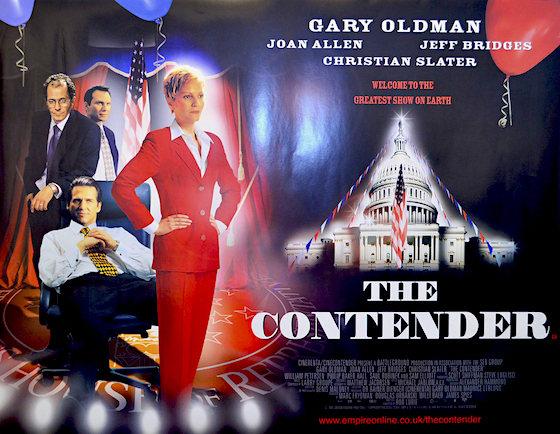

    Free Guy

    (2021)

    Shawn Levy | 115 mins | digital (HD) | 2.39:1 | USA / English | 12 / PG-13

    Free Guy

    Ryan Reynolds plays his role again as Guy, a bank worker in city riddled with crime and superheroics. But, it turns out, Guy isn’t real — he’s an NPC in a computer game, programmed to do the same thing over and over and basically be ignored by the real-world players. Until, that is, he spots the woman of his dreams (Jodie Comer) and his programming breaks as Guy becomes self-aware.
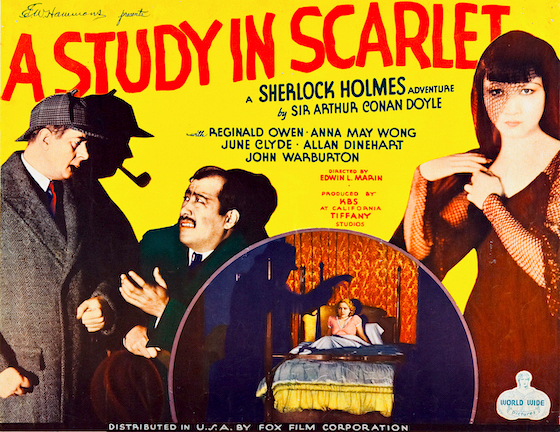
    The basic concept sounds like a fun, fresh, and timely idea, right? Video games have never been more popular, AI is ever-improving, and there’s room for both gags and action in the core idea — that’s the winning Marvel formula, right there. Unfortunately, the execution is as if someone found a way to make a new movie by collaging others. Free Guy is just The LEGO Movie + The Truman Show + Wreck-It Ralph + Ready Player One + the PG-13 version of Deadpool 2 — not put in a blender, but cut up and stuck back together side-by-side, with snippets of Groundhog Day, Fortnite, and multiple Disney-owned properties scattered in for good measure.

    That last aspect, the Disney references, has been singled out for particular derision on social media. The film was initially produced by 20th Century Fox, but ended up a Disney title after the buyout, which allows a bunch of stuff they own to pop up in the movie. I know we’re supposed to find this infinitely depressing — a sad reminder that Disney are on course to own all culture, and that’s a bad thing — and it is bad, of course… but the bit with Captain America’s shield still made me laugh. Sorry, not sorry. Yeah, you can be miserable about this stuff, because obviously the total homogenisation of all American media under The Walt Disney Company is not worth that a couple of meta gags; but the homogenisation of all American media under The Walt Disney Company is happening anyway, so we may as well enjoy the gags we get along the way.

    Whether you have that kind of attitude or not will probably dictate how much you enjoy Free Guy. Its originality is surface deep, at best, and at every second it will call to mind some other film that already did the same thing. But, allowing for that, it’s still a fairly entertaining couple of hours of action-comedy.

    3 out of 5

    Free Guy is the 8th film in my 100 Films in a Year Challenge 2022.