Toy Story (1995)

100 Films’ 100 Favourites #92

The toys are back in town.

Country: USA
Language: English
Runtime: 81 minutes
BBFC: PG
MPAA: G

Original Release: 22nd November 1995 (USA)
UK Release: 22nd March 1996
First Seen: cinema, 1996

Stars
Tom Hanks (Sleepless in Seattle, Catch Me If You Can)
Tim Allen (Galaxy Quest, The Shaggy Dog)

Director
John Lasseter (A Bug’s Life, Cars)

Screenwriters
Joss Whedon (Alien Resurrection, Avengers: Age of Ultron)
Andrew Stanton (A Bug’s Life, John Carter)
Joel Cohen (Cheaper by the Dozen, Garfield)
Alec Sokolow (Cheaper by the Dozen, Garfield: A Tale of Two Kitties)

Story by
John Lasseter (Toy Story 2, Planes)
Pete Docter (Monsters, Inc., Up)
Andrew Stanton (Finding Nemo, Toy Story 3)
Joe Ranft (Beauty and the Beast, Cars)

The Story
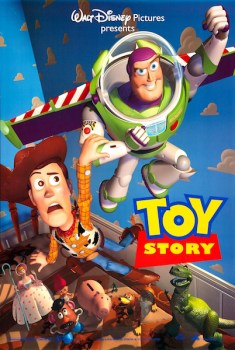
In a world where toys come to life when humans aren’t around, Woody is six-year-old Andy’s favourite doll… until he gets Buzz Lightyear, a space ranger action figure, for his birthday. An upset Woody clashes with Buzz, but when the bickering pair are left behind during a house move they must work together to get back to their kid.

Our Heroes
Woody is a cowboy doll, the favourite of his kid, Andy, and consequently the leader of all Andy’s toys. That is until Andy gets a shiny new Buzz Lightyear action figure, whose newness ingratiates him with all the other toys. Plus, to Woody’s continued annoyance, Buzz believes he really is a space ranger and has no idea he’s just a toy.

Our Villain
Sid, Andy’s nasty neighbour kid who does terrible, terrible things to toys…

Best Supporting Character
Mr Potato Head, whose various body parts are slotted on and therefore removable and interchangeable. Hilarity ensues. Also has a nice line in snarky comments.

Memorable Quote
“To infinity, and beyond!” — Buzz Lightyear

Quote Most Likely To Be Used in Everyday Conversation
“You are a sad, strange little man, and you have my pity.” — Buzz Lightyear

Memorable Scene
One of Buzz’s claims as a real space ranger is that he can fly, so Woody challenges him to prove it. Buzz closes his eyes, dives off the bed… and, through a series of flukes, bounces and coasts his way around the room, landing back on the bed. “That wasn’t flying,” cries Woody, “that was falling with style!”

Memorable Song
The film’s themes are perfectly reflected in Randy Newman’s Oscar-nominated and endlessly catchy song, You’ve Got a Friend in Me. Both Toy Story sequels have tried to emulate it, with… less success.

Technical Wizardry
Only the whole movie — it was the first feature-length wholly-computer-generated animated film. As such, we have it to thank/blame for the current entire state of popular Western animation.

Making of
The animators perfected the movement of the toy soldiers by nailing a pair of shoes to a wooden plank and trying to walk around in them.

Previously on…
Toy Story was the first feature-length computer-animated film — there is, in that sense, literally nothing before it.

Next time…
Two feature film sequels, both of which are at least as artistically successful as this first, with a fourth set to follow in 2018. Also, three short films and two TV specials to date, plus direct-to-video spin-off movie Buzz Lightyear of Star Command: The Adventure Begins and the TV series that follows it. You could also argue the entirety of Pixar’s highly-praised output is a follow-up to the success of Toy Story, as well as American feature animation’s almost entire conversion from traditional cel animation to 3D CGI.

Awards
1 Special Achievement Oscar to John Lasseter for “the development and inspired application of techniques that have made possible the first feature-length computer-animated film.”
3 Oscar nominations (Original Screenplay, Song, Musical or Comedy Score)
1 BAFTA nomination (Visual Effects)
8 Annie Awards (Animated Feature, Directing, Writing, Producing, Music, Production Design, Animation, Technical Achievement)
1 Annie Awards nomination (Voice Acting (Tom Hanks))
2 Saturn nominations (Fantasy Film, Writing)
Nominated for the Hugo for Best Dramatic Presentation

What the Critics Said
“Far from just a technological breakthrough, this hellzapoppin fairy tale […] is a magically witty and humane entertainment. It has the purity, the ecstatic freedom of imagination, that’s the hallmark of the greatest children’s films. It also has the kind of spring-loaded allusive prankishness that, at times, will tickle adults even more than it does kids. The moment Mr. Potato Head arranges his snap-on features into a Cubist mash and says, ”I’m Picasso,” it’s clear that director John Lasseter and his team of writer-technicians have taken their most anarchic impulses and run with them. […] In its techno-cool photo-realist way, though, this movie, too, invites you to gaze upon the textures of the physical world with new eyes. What Bambi and Snow White did for nature, Toy Story, amazingly, does for plastic — for the synthetic gizmo culture of the modern mall brat. The film’s wit (and resonance) is that it brings toys to life exactly the way children do in their heads. It molds plastic into pure imagination.” — Owen Gleiberman, Entertainment Weekly

Score: 100%

What the Public Say
“The Animation is superb. Given that this was one of the first ever feature length computer animated movies, those guys at Pixar really hit the nail on the head. The colours are vibrant and the characters are dynamic. An excellent use of Blues, Yellows and Reds really accentuate the ‘children’ and ‘toys’ feel. There are also beautiful realistic elements such as a scene where Woody and Buzz find themselves under a lorry in a petrol station. With this, I was simply amazed at the attention to detail with the stones, tarmac and oil stains on the textures. It really looks like you are close-up to the ground and I love it!” — Alexander Potter, Pottercraft’s Pictures

Verdict

Just because something’s the first to do something doesn’t necessarily mean it’s any good, but Pixar didn’t strike gold with Toy Story just because computer animation was New. It’s the likeable characters, how they develop and learn, the amusing situations they’re put in, plus some heartwarming messages about friendship. There’s more emotion and character development in these wooden-and-plastic toys generated with pixels in a computer than many a film can achieve with real human beings, and that’s why Pixar came to revolutionise and dominate the Western animation genre.

Some would say “the original is still the best”, and it is up there, but on Sunday I will beg to differ…

#93 will be… a superior sequel.
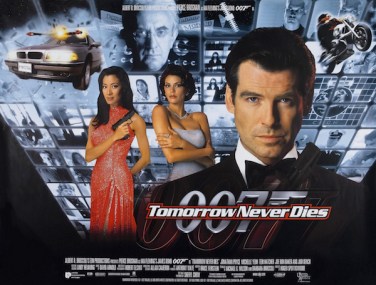
Tomorrow Never Dies (1997)

100 Films’ 100 Favourites #91

Yesterday is a memory. Today is history.
Tomorrow is in the hands of one man.
Bond. You know the rest.

Country: UK & USA
Language: English, German, Danish, Mandarin & Cantonese
Runtime: 119 minutes
BBFC: 12 (cut, 1997) | 12 (cut more, 1998) | 15 (uncut, 2006) | 12 (uncut, 2012)
MPAA: PG-13

Original Release: 12th December 1997 (UK)
US Release: 19th December 1997
First Seen: cinema, December 1997

Stars
Pierce Brosnan (Dante’s Peak, The Ghost)
Jonathan Pryce (Brazil, Pirates of the Caribbean: The Curse of the Black Pearl)
Michelle Yeoh (Supercop, Crouching Tiger, Hidden Dragon)
Teri Hatcher (Tango & Cash, Coraline)
Judi Dench (Mrs Brown, The Best Exotic Marigold Hotel)

Director
Roger Spottiswoode (Turner & Hooch, A Street Cat Named Bob)

Screenwriter
Bruce Feirstein (GoldenEye, The World Is Not Enough)

Based on
James Bond, a character created by Ian Fleming.

The Story
Secret agent James Bond is deployed to investigate a media baron who is plotting to ignite a war between the UK and China to further his business empire.

Our Hero
The name’s Bond, James Bond. In his second outing as agent 007, Pierce Brosnan has settled comfortably into his interpretation of the hero, a mix of Roger Moore’s eyebrow-raising levity with some of Sean Connery’s slightly harder, man-of-action edge.

Our Villain
Elliot Carver is a megalomaniac media mogul — the owner of the newspaper Tomorrow, who intends to secretly provoke a war in order to boost sales and ratings. James Bond does satire? Kinda.

Best Supporting Character
Wai Lin, a spy who’s investigating Carver for the Chinese. A skilled martial artist, she kicks all kinds of ass. Despite initial mistrust, she and Bond ultimately team up. Lin is arguably one of the first Bond girls who can genuinely claim to be a competent character in her own right. Still ends up sleeping with Bond, though.

Memorable Quote
Admiral Roebuck: “With all due respect, M, sometimes I don’t think you have the balls for this job.”
M: “Perhaps. But the advantage is I don’t have to think with them all the time.”

Memorable Scene
Remote control car, James Bond style: Bond lies in the backseat of his BMW, driving it around a multi-storey car park with his mobile phone, deploying its weapons against a gang of attackers. It was a fun concept back in ’97, but I imagine you could do it yourself with an app now. Apart from the weapons. And the legal implications. So maybe not.

Memorable Music
After the disastrous ‘modern’ score for GoldenEye, music duties were here handed to David Arnold. At the time he had composed the scores for Stargate and Independence Day, but, even more pertinently, he had produced Shaken and Stirred, an album of contemporary-styled covers of great Bond themes. The album was heard by iconic Bond composer John Barry, who then recommended Arnold to producer Barbara Broccoli. Arnold’s score is much more in-keeping with classic Bond music, but given a modern (well, ’90s) flavour. Backseat Driver, the soundtrack to my Memorable Scene pick, is a particularly great action cue. Arnold would become the series’ composer for the next four films, until Sam Mendes chose to use his regular collaborator Thomas Newman for Skyfall and Spectre. With Mendes moving on, perhaps Arnold will be back for Bond 25…

Write the Theme Tune…
Arnold wanted to have a hand in writing the title song and integrate it into his soundtrack, like the great Bond composers of old. To that end he wrote a theme sung by k.d. lang… which plays over the end credits and is titled Surrender, though has a tellingly prominent use of the phrase “tomorrow never dies” in its lyrics.

Sing the Theme Tune…
The producers went with a more marketable proposition for the final opening credits song, however, in the shape of Sheryl Crow, famous for her pop-rock-y hits like All I Wanna Do, A Change Would Do You Good, and Everyday is a Winding Road. In the pantheon of Bond title themes, her Tomorrow Never Dies sits firmly in the middle — it’s not a GoldenEye, but it’s not a Die Another Day either.

Making of
The film was originally called Tomorrow Never Lies, referencing Carver’s newspaper, Tomorrow. Some kind of production mix-up (a typo, a smudged fax — pick your story) led to it being misread as Tomorrow Never Dies, and the new, less meaningful title stuck.

This Category Sponsored By BMW
Apparently Tomorrow Never Dies was the first movie in history to have its entire budget covered by product placement endorsements — that’s over $100 million in advertising. Featured companies include BMW, L’Oréal, Heineken, Dunhill, Ericsson, Omega, Smirnoff, Brioni, Bollinger, and Avis, plus a tie-in game from Electronic Arts.

Previously on…
17 previous Bond films (which are all technically in the same continuity). The previous one, GoldenEye, was the first to star Pierce Brosnan and relaunched the series to mass popularity after a fallow period.

Next time…
Two more Brosnan Bonds, before he was unceremoniously dumped to reboot the series for the first time. With a 25th film now in the works, the series is set to continue indefinitely.

Awards
1 Saturn Award (Best Actor (Pierce Brosnan))
3 Saturn nominations (Action/Adventure/Thriller Film, Supporting Actress (Teri Hatcher), Music)
2 MTV Movie Awards nominations (Action Sequence for the motorcycle/helicopter chase (somehow it lost to Face/Off), Best Fight for “the fight between Michelle Yeoh and some ‘bad guys’.”)

What the Critics Said
“East meets West, yin meets yang and chop-socky meets kiss-kiss bang-bang in Tomorrow Never Dies, a zippy 007 romp that draws as heavily from the Asian action genre as from the formula that has served the series so well for 35 years. Goldeneye and Pierce Brosnan’s debonair Bond resuscitated the creaky franchise in 1995, but […] Tomorrow, jazzier, wittier and more costly than its predecessor, also comes closer to catching up with ’90s style and politics. […] Hong Kong kung-pow chick Michelle Yeoh, as the cool-headed Chinese agent Wai Lin, proves 007’s equal at kicking post-Cold War butt. The two take on craven communications baron Elliot Carver (Jonathan Pryce), a deliciously exaggerated — or is it? — composite of Ted Turner, Rupert Murdoch and the late Robert Maxwell. Carver’s not only the most plausible Bond nemesis ever but the perfect one for the current global villain shortage.” — Rita Kempley, The Washington Post

Score: 57%

What the Public Say
TND is somewhat underrated. Jonathan Pryce plays a villain who is essentially Rupert Murdoch smooshed together with Ted Turner. His plan isn’t to take over the world so much as it is getting rich by starting a war and then covering it on his news outlets. This just may be the most plausible Bond villain scheme of all times – which admittedly isn’t saying much. […] TND may not be among the best Bonds, but it’s got more going for it than I think it gets credit for.” — Lebeau, Lebeau’s Le Blog

Verdict

I know some of you will be thinking, “how can you leave out Goldfinger / Thunderball / The Spy Who Loved Me / For Your Eyes Only / The Living Daylights / Licence to Kill [delete according to personal preference] but include Tomorrow Never Dies?!” It’s true, TND is far from the most popular Bond film, but it was the first I saw on the big screen, and that gives me a certain soft spot for it. It’s not just that, though.

Here’s a thing: one of the criticisms levelled at the film is that it’s just an action movie, lacking the peculiarly Bondian thrills a Bond adventure should have. But if it is “just an action movie” then it’s the best action movie in the Bond series. The pre-titles gunfight at the arms meet, the ‘backseat driver’ sequence, and the motorbike-vs-helicopter chase are three of the finest action scenes in the entire franchise, and that’s without even touching on Michelle Yeoh kicking ass. Couple that with Brosnan still new and confident in the lead role, and Jonathan Pryce nibbling the scenery as a lightly satirical villain, and I think you have a Bond film that is pretty entertaining, even if it’s mainly on an adrenaline-pumping level.

#92 has… a friend in me.

Three Kings (1999)

100 Films’ 100 Favourites #90

They’re deserters, rebels and thieves.
But in the nicest possible way.

Country: USA
Language: English & Arabic
Runtime: 115 minutes
BBFC: 15
MPAA: R

Original Release: 1st October 1999 (USA)
UK Release: 3rd March 2000
First Seen: DVD, c.2001

Stars
George Clooney (Batman & Robin, Ocean’s Eleven)
Mark Wahlberg (Boogie Nights, The Fighter)
Ice Cube (Boyz n the Hood, Ride Along)
Spike Jonze (Being John Malkovich, Where the Wild Things Are)

Director
David O. Russell (Flirting with Disaster, Silver Linings Playbook)

Screenwriter
David O. Russell (Spanking the Monkey, American Hustle)

Story by
John Ridley (U Turn, 12 Years a Slave)

The Story
After ceasefire is called in the Gulf War, a group of American soldiers discover a map to a stash of gold stolen by Saddam Hussein’s forces. Setting out to steal it for themselves, the soldiers encounter a group of rebels who need their help and find their priorities changing.

Our Heroes
Army reservist Sergeant Troy Barlow and his friend, the comically naïve Private Conrad Vig, are the first to discover the map, which they take to Staff Sergeant Chief Elgin to translate. Then self-serving, disillusioned Special Forces Major Archie Gates turns up and convinces them to follow it to the gold. (Yes, despite the title, there are four of them.)

Our Villains
The war may officially be over, but the Iraqi Republican Guard are still the enemy.

Best Supporting Character
I know I mentioned him in the heroes bit, but Conrad is the de facto “fourth king”, so… He gets the lion’s share of either the best lines or the lines that set up the best lines.

Memorable Quote
Chief: “I don’t want to hear ‘dune coon’ or ‘sand nigger’ from him or anybody else.”
Conrad: “Captain uses those terms.”
Troy: “That’s not the point, Conrad. The point is that ‘towelhead’ and ‘camel jockey’ are perfectly good substitutes.”

Memorable Scene
Archie explains what actually happens when you get shot in the gut, complete with an explanatory cross-section of the human body, and bile.

Making of
The stories of behind-the-scenes conflict between director David O. Russell — still a relative newcomer, making his biggest movie so far — and George Clooney — dividing his time between E.R. three days a week and the film on the other four — are legendary. If you want a lengthy-ish full account, check out this trivia entry on IMDb.

Awards
1 Blockbuster Entertainment Award (Favourite Action Team — it beat Will Smith and Kevin Kline from Wild Wild West, and those were all the nominees)
1 Political Film Society Award (Peace)
2 Political Film Society Award nominations (Democracy, Exposé)

What the Critics Said
“[an] emotionally and politically responsible movie set in Iraq during the immediate aftermath of the gulf war — a damning yet idealistic satire about the motives behind U.S. foreign policy. The visuals are wild, the sound track has the audacity to underscore the subtext instead of just echoing the obvious, the comedy is irreverent and occasionally slapstick, and the metaphorical details are consistently strong. The movie even examines the conventions of star-studded actioners without stripping the leads of the charisma and apparent immortality of full-blown action heroes.” — Lisa Alspector, Chicago Reader

Score: 94%

What the Public Say
Three Kings, at its core, deals with serious themes and serious subject matter surrounding the end of the first Gulf War, and is therefore a war narrative before anything else. That being said, it’s refreshing how Three Kings doesn’t drown in its cynicism, isn’t exploitative in terms of gore or shocking violence, and isn’t hitting its audience over the head with either jingoistic propaganda or hamfisted pacifist social commentary. Moreover, Three Kings is funny enough often enough to be qualified as a comedy in its own right. It’s the humanist, dare I say, heartfelt combination of the two, that makes it a bonafide winner.” — The Celtic Predator, Express Elevator to Hell

Verdict

Writer-director David O. Russell may have become increasingly acclaimed this decade with Oscar-nominated movies like The Fighter, Silver Linings Playbook, and American Hustle, but for me this is still his best work. It mixes laugh-out-loud comedy with serious points about war and an ultimately emotional storyline, created with a filmmaking verve that is frequently exciting and inventive — something I’d argue is less present in Russell’s more widely-acknowledged work.

#91 never… lies dies.

Cool World (1992)

2016 #70
Ralph Bakshi | 102 mins | streaming (HD) | 16:9 | USA / English | 15 / PG-13

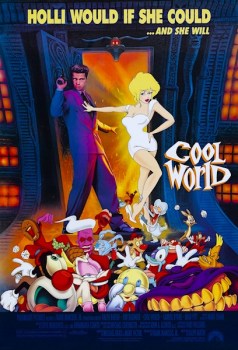
Cool WorldSometime recently, I said I was making more of an effort to avoid watching movies I know are going to be bad — when there’s so much good stuff to see, why knowingly waste time on bad stuff? But then sometimes something just catches your attention and you have to see for yourself. It sounds as if no one had anything good to say about Cool World when it came out back in 1992, and no one’s had anything good to say about it since either, but after spotting it on Netflix (I’m not sure I’d even heard of it before that) my curiosity was piqued.
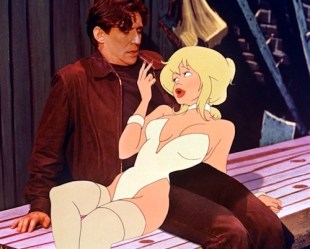
Directed by Ralph Bakshi, who’s probably best known for the animated Lord of the Rings, it’s the story of cartoonist Jack Deebs (Gabriel Byrne) who’s created the zany, surreal ‘Cool World’. But Cool World is actually a real place (a real cartoon place, as it were), which Jack ends up getting transported to. He meets femme fatale Holli Would (voiced by Kim Basinger) who wants to escape to the real world, but is being prevented from doing so by Frank (Brad Pitt), another real human who was transported to Cool World decades earlier.

If this all sounds a bit of a mess, it is. It’s not a fundamentally bad story at a conceptual level, but its execution is a jumble, and the twisted Cool World is an unpleasant place to have to spend time. The darkness of the story is actually toned down from Bakshi’s original concept (which had an underground cartoonist fathering a half-real / half-cartoon daughter who tries to kill him), but only so much: it’s still full of sex, references to sex, Holli Would, and she willand general depraved behaviour. It’s clear it got caught in the crossfire between a creator/director who wanted to make a hard-R adults-only animated/live-action movie, and a star and producer who wanted to make something they could show to sick kiddies in hospital. The end result surely satisfies neither, because it pulls some punches to not get that R, but there’s no way this is kid-friendly.
It came out a few years after Who Framed Roger Rabbit, and suffers from the comparison. It’s not just that Cool World is a less successful riff on the same concept, or that its storytelling is more muddled, but it’s less technically proficient too. The animation and live-action elements never gel as well as in Roger Rabbit, with plenty of lazy eye-lines and actions not quite lining up. This probably explains why Byrne and Pitt both give lacklustre performances, not that Basinger fares any better.

There’s some interesting stuff in Cool World, which is why I haven’t sunk it to the irredeemable depths of a single star, but the merits are slight and not worth the effort. Apparently it does have something of a cult following, though, so the adventurous may still feel it’s worth a visit.

2 out of 5

Cool World featured on my list of The Five Worst Films I Saw in 2016, which can be read in full here.

The Sixth Sense (1999)

100 Films’ 100 Favourites #85

Not every gift is a blessing.

Country: USA
Language: English
Runtime: 107 minutes
BBFC: 15
MPAA: PG-13

Original Release: 6th August 1999 (USA)
UK Release: 5th November 1999
First Seen: DVD, c.2000

Stars
Bruce Willis (Pulp Fiction, Sin City)
Haley Joel Osment (Bogus, A.I. Artificial Intelligence)
Toni Collette (Muriel’s Wedding, Little Miss Sunshine)
Olivia Williams (Rushmore, The Ghost)

Director
M. Night Shyamalan (Unbreakable, Signs)

Screenwriter
M. Night Shyamalan (Wide Awake, The Village)

The Story
Child psychiatrist Dr Malcolm Crowe tries to help a new patient, Cole Sear, who claims he can see ghosts.

Our Heroes
Dr Malcolm Crowe doubts his abilities to help people after a former patient shot him before committing suicide, an event which has also left him distanced from his wife. But he may be the only person who’ll believe young Cole Sear, a reclusive child who’s struggling with delusions of seeing dead people… unless they’re not delusions…

Our Villains
Are the dead dangerous, or do they just need help?

Best Supporting Character
Cole’s mom, Lynn, who loves him a great deal and worries about him just as much, but has no idea what’s really wrong or how to help her son.

Memorable Quote
“I see dead people… Walking around like regular people. They don’t see each other. They only see what they want to see. They don’t know they’re dead.” — Cole

Memorable Scene
Stuck in traffic, Cole reveals his ability to his mother for the first time — that there’s been an accident ahead and someone died, which he knows because they’re stood at his window. Naturally Lynn doesn’t believe her son, but then he begins to talk about his grandmother…

Technical Wizardry
The twist ending is immaculately constructed. There are clues throughout the film, but, like all the best twist-ending clues, the vast majority of viewers will completely miss them first time through, even though they seem almost blatant when revisited.

Making of
The colour red is used only to indicate times and items where the worlds of the living and the dead have connected; if something red was present in a scene where this wasn’t relevant, Shyamalan had it changed. There’s a massive list of these moments here, but if you somehow haven’t seen The Sixth Sense yet, do beware of spoilers.

Next time…
There are no actual sequels to The Sixth Sense, but it kicked off M. Night Shyamalan as a kind of one-man genre, making supernatural thrillers with a twist ending — and decreasing critical acclaim with each new movie. It seemed to end with The Happening and he transitioned to be a director-for-hire, but he’s coming back somewhat with The Visit and next year’s Split.

Awards
6 Oscar nominations (Picture, Supporting Actor (Haley Joel Osment), Supporting Actress (Toni Collette), Director, Original Screenplay, Editing)
4 BAFTA nominations (Film, Director, Original Screenplay, Editing)
2 Saturn Awards (Horror Film, Performance by a Younger Actor/Actress (Haley Joel Osment))
2 Saturn nominations (Actor (Bruce Willis), Writer)
2 Teen Choice Awards (Choice Drama, Choice Breakout Performance (Haley Joel Osment))
1 Teen Choice nomination (Choice Sleazebag (Trevor Morgan))
Nominated for the Hugo for Best Dramatic Presentation

What the Critics Said
“the film eventually abandons the heroic-therapist model and ventures toward other ground, ever so gently tightening its squeeze. It seems really to achieve something that Stanley Kubrick was possibly groping after in Eyes Wide Shut, or that Nicolas Roeg achieved in Don’t Look Now, which might be called an extreme sense of the bizarre, not as invented by special-effects wizards with unlimited space on the hard drive but in the subtler ways of film craftsmanship. […] The movie is a maximum creep-out. It’s invasive. It’s like an enema to the soul as it probes the ways of death – some especially grotesque in a family setting. You leave slightly asquirm. You know it will linger. It becomes a clammy, chilly movie building toward a revelation that you cannot predict. As I say: I cannot tell you. You’d hate me if I did. I can only say, don’t look now, but look sometime.” — Stephen Hunter, Washington Post

Score: 85%

What the Public Say
“The film is rich in symbolism, and colour plays a large part in signifying spirits invading the real world. This is what makes The Sixth Sense so captivating. Watching the film for the first time, you don’t expect the ending, and so the shock of it tends to overshadow the subtlety of the beginning. It is only once you have re-watched the film, that you begin to notice little suggestions of what is to come. A success from start to end, this is at once an exercise in potent suspense, and a carefully crafted tale of child psychology.” — Cat Barnard, Screen Muse

Verdict

M. Night Shyamalan gets such a bad rep these days, it’s easy to forget how great his breakthrough movie was. It flew completely under the radar back in 1999: the guy at Disney who bought the screenplay was fired for doing so without permission; Bruce Willis starred in it because he owed Disney two films, and was paid half his normal salary; Entertainment Weekly’s extensive summer preview detailed over 140 films, but The Sixth Sense wasn’t even mentioned. By coming out of the blue, and in an era before the internet was dominant (these days there’d be plot dissections and spoiler-filled director interviews online by the Monday after release, wouldn’t there?), the film obviously had surprise on its side, which is particularly effective when it has such a memorable twist. But even before that ending, it manages to mix plausible emotional drama with scenes of chilling everyday horror, crafting something that is undoubtedly a genre movie but also not out of place in a list of Best Picture nominees.

The Sixth Sense is on Film4 tomorrow night at 1am.

#86 will do… whatever a spider can.

The Shawshank Redemption (1994)

100 Films’ 100 Favourites #83

Fear can hold you prisoner.
Hope can set you free.

Country: USA
Language: English
Runtime: 142 minutes
BBFC: 15
MPAA: R

Original Release: 23rd September 1994 (USA)
UK Release: 17th February 1995
First Seen: TV, c.1999

Stars
Tim Robbins (Jacob’s Ladder, Mystic River)
Morgan Freeman (Driving Miss Daisy, Invictus)
Bob Gunton (Demolition Man, Ace Ventura: When Nature Calls)

Director
Frank Darabont (The Green Mile, The Mist)

Screenwriter
Frank Darabont (A Nightmare on Elm Street 3: Dream Warriors, The Green Mile)

Based on
Rita Hayworth and Shawshank Redemption, a short story by Stephen King.

The Story
When Andy Dufrense is incarcerated in Shawshank State Penitentiary, he soon finds himself helping the corrupt warden money-launder his bribes. With a measure of protection from the guards, Andy’s common decency leads him to try to improve life for his fellow inmates, all the while thriving on the hope he’ll one day get out.

Our Heroes
Andy Dufrense is an intelligent fella, who earns himself protection and privileges by helping with the guards’ finances, and befriends fellow inmates by overhauling the prison library. He’s serving two consecutive life sentences for murdering his wife and her lover, despite claiming he’s innocent — like everyone else in Shawshank. Conversely, his new best friend, Red — the film’s narrator — is the only guilty man in Shawshank. He’s the guy you go to if you want anything smuggled in, like, say, a rock hammer…

Our Villains
Warden Samuel Norton is outwardly a good Christian and forward-thinking prison governor, but is actually a corrupt and vicious sonuvabitch, only too happy to use Andy’s skills to fiddle the books — and punish him harshly for any signs of dissent. His right-hand-man is the captain of the guards, Hadley, who’s not above giving a wayward prisoner a life-altering beating, or worse…

Best Supporting Character
The prison’s librarian, Brooks, who’s been locked up for almost 50 years. The old chap gets paroled, but the outside world has become a very different place by 1954, and he has a heartbreaking fate.

Memorable Quote
“The funny thing is, on the outside I was an honest man, straight as an arrow. I had to come to prison to be a crook.” — Andy Dufresne

Quote Most Likely To Be Used in Everyday Conversation
“Get busy living or get busy dying.”

Memorable Scene
Left alone in the warden’s office, Andy comes across a record. He puts it on the turntable, locks the door, and switches on the PA system, broadcasting opera to the entire prison. Guards and prisoners alike stop where they stand to listen. Meanwhile, the warden bangs on the door and demands Andy turn the music off. He leans toward the record player… and turns it up. The insubordination will cost him, but, for a few minutes, the beautiful music makes the prisoners feel free.

Making of
The American Humane Association monitored filming that involved Brooks’ pet crow. During a scene where it’s fed a maggot, the AHA objected — because it was cruel to the maggot. They demanded the filmmakers use one that had died from natural causes, which was duly found.

Awards
7 Oscar nominations (Picture, Actor (Morgan Freeman), Adapted Screenplay, Cinematography, Editing, Score, Sound)
2 Saturn nominations (Action/Adventure/Thriller Film, Writing)

What the Critics Said
“The mood swings rigorously through every emotion as the cranky, wiseguy and downright crazed array of criminals bare the brunt of the turbulent life within the doomy Shawshank catacomb. […] If you’re miserable enough to look for gripes then, yes, it does drift on too long and who needs prison buggery again? Yet the ending has such poetic completeness you’re too busy contentedly chuckling to worry about sore behinds. This may have confounded American audiences — it flopped big-time on planet Yank — but a more divine movie experience you will not find this side of Oscardom. […] If you don’t love Shawshank, chances are you’re beyond redemption.” — Ian Nathan, Empire

Score: 91%

What the Public Say
“it has these amazing feel good moments yet it doesn’t feel contrived. Most of us film lovers can see right through that. If Shawshank was guilty of that, it wouldn’t have stayed in the number one spot for all these years. […] I think there are a lot of things that make The Shawshank Redemption such a widely loved film and the movie just gets so many things “right” that they all combine to give us something spectacular: Feel good moments like the beer & opera scenes (which never fail to move me no matter how many times I watch this movie). Andy & Red’s friendship. The lesser characters such as Brooks & Heywood (and the heartbreakingly beautiful “Brooks Was Here” theme from Thomas Newman). Seeing the posters on the wall change, showing the passage of time. Alexandre Dumbass. The pet bird. Rita Hayworth. And, of course, the overall message of hope. More than anything, though, I think it’s Stephen King’s story and Darabont’s ability to give us scenes of pure beauty in a movie based someplace as awful as a prison” — table9mutant, Cinema Parrot Disco

Verdict

The Godfather sat seemingly unassailable atop IMDb’s Top 250 for nine years, until The Dark Knight kicked it off, not everyone agreed, and when the dust settled Shawshank was the new #1, a position it’s now held for eight years. Naturally that means there’s been a backlash in some circles. It’s a particularly snooty kind of reaction in general, I find, probably because Shawshank is exactly the kind of movie primed to emerge as a consensus favourite: it has drama and darkness, but also humour and optimism, and elicits emotions across the spectrum — it’s neither too grim to depress people into not enjoying it, nor too sentimental to make them do that mock “throwing up” noise some people do when things get really schmaltzy.

I wager some people confuse the notion of “consensus favourite” with “produced by committee”, which sound similar — a large group of people coming to agree on something — but are actually very different. The latter typically produces bland work that no one loves; something that wouldn’t curry favour with the former. Is The Shawshank Redemption the greatest movie ever made? Not in my opinion. I’d wager not in the opinion of most of the people who’ve given it a score on IMDb that’s contributed to it being #1. But it is a very good film indeed — and, clearly, most of us can agree on that.

#84 will be… not a fucking Merlot.

Se7en (1995)

100 Films’ 100 Favourites #81

Seven deadly sins. Seven ways to die.

Also Known As: Seven

Country: USA
Language: English
Runtime: 127 minutes
BBFC: 18
MPAA: R

Original Release: 22nd September 1995 (USA)
UK Release: 5th January 1996
First Seen: TV, 12th June 2001 (probably)

Stars
Morgan Freeman (The Shawshank Redemption, Million Dollar Baby)
Brad Pitt (Legends of the Fall, The Curious Case of Benjamin Button)
Kevin Spacey (The Usual Suspects, American Beauty)
Gwyneth Paltrow (Sliding Doors, Shakespeare in Love)

Director
David Fincher (Fight Club, Zodiac)

Screenwriter
Andrew Kevin Walker (8MM, Sleepy Hollow)

The Story
In an unnamed city, two homicide detectives investigate a series of grim murders inspired by the seven deadly sins.

Our Heroes
William Somerset is a detective who works calmly and methodically, and cares more than most. Serving out the last few days before his retirement, he lands a helluva final case. His new partner is David Mills, a hotheaded but idealistic new transfer who’s keen to prove himself. Despite their chalk-and-cheese temperaments, or perhaps because of them, the pair may be ideally suited to catch the elusive killer.

Our Villain
John Doe, a proper psychopath, and on a mission too. I say the detectives are ideally suited to catch him, but, well (major, major spoilers…) they technically don’t and he essentially wins.

Best Supporting Character
R. Lee Ermey’s police captain, purely for the moment when he answers a phone. I love that bit of humour far more than it probably warrants.

Memorable Quote
“What was in the box? What’s in the box? What’s in the fucking box?!” — Mills

Memorable Scene
The climax — just Somerset, Mills, and John Doe, alone in the middle of nowhere… and then a deliveryman shows up. “John Doe has the upper hand!”

Technical Wizardry
The film’s visual style really helps to sell the tone — dark, foreboding, grim. This is in part because it’s always raining, a decision made to increase the sense of dread, and because of Darius Khondji’s cinematography, which employed bleach bypass (see also: Minority Report), a process that serves to deepen shadows. Additionally, for the film’s Platinum Series DVD release it was rescanned from the original negative, meaning the whole film had to have its colour grading re-done. Some of the changes were quite extensive (as detailed in the DVD/Blu-ray’s special features, if you’re interested).

Truly Special Effect
A serial killer thriller might not sound like a special effect showcase, but John Doe’s extreme methods lead to some pretty unusual and gruesome corpses — rendered with suitably sickening prosthetics, of course. ‘Sloth’ is particularly harrowing, though ‘lust’ is so bad it’s left almost entirely to our imagination — though, again, someone had to design and build the… instrument.

Making of
John Doe’s shelves of handwritten notebooks were real and created especially for the film. They took two months to create at a cost of $15,000.

Next time…
Screenwriter Andrew Kevin Walker originally thought of 8MM as a sequel, and David Fincher was interested, but it didn’t happen and we wound up with the only-half-decent Nicolas Cage-starring Joel Schumacher-directed version instead.

Awards
1 Oscar nomination (Editing)
1 BAFTA nomination (Original Screenplay)
2 Saturn Awards (Writing, Make-Up)
5 Saturn nominations (Action/Adventure Film, Actor (Morgan Freeman), Supporting Actress (Gwyneth Paltrow), Director, Music)
Places with more taste (i.e. where it won Best Film): Empire Awards, Fantasporto International Fantasy Film Awards, MTV Movie Awards; plus Best Foreign Language Film at Blue Ribbon Awards, Hochi Film Awards, Sant Jordi Awards (Audience Award)

What the Critics Said
“designer unpleasantness is a hallmark of our era, and this movie may be more concerned with wallowing in it than with illuminating what it means politically. Yet the filmmakers stick to their vision with such dedication and persistence that something indelible comes across — something ethically and artistically superior to The Silence of the Lambs that refuses to exploit suffering for fun or entertainment and leaves you wondering about the world we’re living in.” — Jonathan Rosenbaum, Chicago Reader

Score: 80%

What the Public Say
“The rain never ends. There is seldom any sunlight, or any warmth. The city feels like a city of the damned, as if its denizens are souls trapped in some circle of hell from which there is no escape. A feeling of dread pervades everything; there is never any inclination that anything remotely like justice or hope or salvation is even possible here. […] it’s all style and atmosphere but… to criticise the film for that, almost feels like missing the point — it’s so integral to the piece, the atmosphere is actually one of the film’s characters” — the ghost of 82

Elsewhere on 100 Films
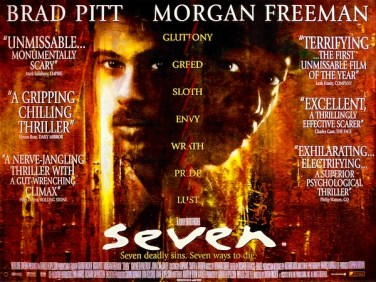
I reviewed Se7en quite thoroughly (and, if I do say so myself, quite well) as part of a retrospective on Fincher’s films back in 2011, concluding that “some would claim that Se7en is no more than a standard murder thriller with a stock mismatched pair of detectives. In some respects they’re right, but in enough respects they’re wrong. There’s a killer high concept behind the crimes, but it’s really the execution of the film that makes it so much more. It’s in the performances, the way those stock characters are written, their subplots, the story’s pace, the cinematography, the music, individual sequences like Somerset in the library or the climax that rise not only to the top of the genre but to the top of the very medium of film itself.”

Verdict

When asked, I normally say Se7en is my favourite movie. That’s partly pre-picked just to prevent any such conversations turning into a dreary slog where I um and ah through hundreds of options, but naturally there’s some truth in it. On the surface it’s merely a police procedural, but it’s the way it handles that material that elevates it. It’s a dark film about terrible deeds, which both suits its subject matter (murder isn’t really just a fun little mystery to solve, is it?) and presents a worldview that makes us consider who’s really right and who’s really mad — John Doe is clearly an evil psychopath, but does he have a point? It’s also made with supreme artistry by director David Fincher and his team — I’ve already mentioned DP Darius Khondji, but it’s also superbly edited by Richard Francis-Bruce. And I’d argue it has one of the greatest climaxes ever filmed. There are more easily enjoyable movies in my 100 Favourites, but there are none that are any better made, nor any that better expose the dark heart of humanity.

#82 will be… a big damn movie.

Deep Blue Sea (1999)

2016 #138
Renny Harlin | 101 mins | streaming (HD) | 2.35:1 | USA / English | 15 / R

Deep Blue SeaDeep Blue Sea is Terence Davies’ adaptation of Terence Rattigan’s play about the wife of a judge getting caught in a self-destructive love affair with an RAF pilot.

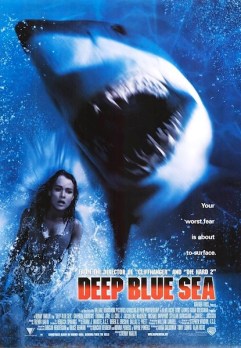
No, wait, sorry — that’s The Deep Blue Sea. The non-definitive-article version is a sci-fi action-thriller about a research facility that’s created hyper-intelligent sharks which escape and try to kill the scientists. So pretty similar movies then, really. This one was thoroughly slated on its initial release, so I spent a good long while completely ignoring it, but at some point in the last few years it seems to have become a guilty pleasure favourite for many. Does it merit this reappraisal?

There is definitely a level of “so bad it’s good” about it. It’s definitely not a good movie in the traditional sense, but it is fun; and unlike, say, Armageddon, it’s clearly not taking itself too seriously. Nicely, it gets by without the constant winks-and-nods at the audience you get in today’s deliberately-trashy genre movies, which is, bizarrely, a more mature way to handle this kind of material.

Plus, it’s from that tipping point in modern film history between practical effects and CGI, so there are some nice stunts and life-size animatronic sharks, but also some weak computer graphics. That said, because director Renny Harlin limits the CG to underwater sequences, some of the sins are covered. Or put another way: it’s not great, but it still looks better than Sharknado. (That might seem like damning with faint praise, but this is 1999 we’re talking about — still two years before The Mummy Returns and its CG The Rock abomination that someone thought was OK to release in a big-budget summer tentpole.)I'm sure he just want to be friends

Ultimately, it’s a hard movie to rate. On the one hand, it’s not particularly good; on the other, with a mix of not taking itself too seriously and a few so-bad-it’s-good moments, it becomes a fun watch. I err towards generosity because, while it’s not a ‘quality’ movie, it is an enjoyable way to spend a couple of hours.

3 out of 5

Schindler’s List (1993)

100 Films’ 100 Favourites #80

“Whoever saves one life,
saves the world entire.”

Country: USA
Language: English, Hebrew, German & Polish
Runtime: 195 minutes
BBFC: 15
MPAA: R

Original Release: 15th December 1993 (USA)
UK Release: 18th February 1994
First Seen: VHS, c.2001

Stars
Liam Neeson (Darkman, Star Wars: Episode I – The Phantom Menace)
Ben Kingsley (Gandhi, Iron Man 3)
Ralph Fiennes (The English Patient, The Grand Budapest Hotel)

Director
Steven Spielberg (Amistad, Lincoln)

Screenwriter
Steven Zaillian (Awakenings, Moneyball)

Based on
Schindler’s Ark, a Booker Prize-winning novel (released in America as Schindler’s List) by Thomas Keneally.

The Story
In occupied Poland in the early days of World War 2, German businessman Oskar Schindler opens a factory supplying the German military, staffed by Jewish workers. As the Nazis begin to close the ghettos and ship Jews to concentration camps, Schindler uses his connections and profits to surreptitiously save as many as he can.

Our Hero
Oskar Schindler is a self-interested businessman, womaniser, and member of the Nazi Party. Initially employing Jews merely for financial reasons (they’re cheaper than Polish workers), his innate humanity begins to come to the fore.

Our Villain
Nazis! But in particular Amon Goeth, the sadistic commander of the Paszów labour camp, who’s fond of executing Jews at random, amongst other horrors. Nonetheless, Schindler has to deal with him to ensure the (relative) safety of his workforce.

Best Supporting Character
Schindler’s contact on the local Jewish Council, Itzhak Stern, who becomes essential to making his business a success, and facilitating his operation to save the workers.

Memorable Quote
“I could have got more out. I could have got more. I don’t know. If I’d just… I could have got more.” — Oskar Schindler

Memorable Scene
During the destruction of the ghetto, Schindler sees a little girl in a red coat (the one splash of colour in the body of the film), wandering alone through the devastation. Later, as the Nazis burn piles of the dead, corpses are ferried to the pyres on small wagons. On one, Schindler sees a small body in a red coat… (There’s a good piece on the psychology of why these scenes are so effective here.)

Technical Wizardry
Spielberg chose to shoot in black-and-white to match actual documentary footage of the era, which was how he ‘saw’ the events. It was also shot without storyboards, Steadicams, cranes, or zoom lenses, and about 40% was filmed using handheld cameras, to emphasise a documentary feel. For a similar level of realism, Spielberg originally intended to make the film entirely in German and Polish with English subtitles, but changed his mind because he thought he wouldn’t be able to accurately direct performances in foreign languages.

Making of
Acting as producer, Spielberg initially tried to attract another director because he felt he wasn’t capable of doing the story justice. Martin Scorsese turned it down because he felt it should be done by a Jewish director, and Roman Polanski rejected it because it was too personal (he lived in the Krakow ghetto, only escaping on the day of its liquidation, and his mother died at Auschwitz). Finally, there was Billy Wilder — depending which version you believe, he either wanted to direct but Spielberg was already prepping the shoot, or he actually convinced Spielberg to direct it. Ultimately, Spielberg waited ten years between acquiring the rights and making the film, when he finally felt capable of tackling it.

Awards
7 Oscars (Picture, Director, Adapted Screenplay, Cinematography, Editing, Score, Art Direction-Set Decoration)
5 Oscar nominations (Actor (Liam Neeson), Supporting Actor (Ralph Fiennes), Costume Design, Sound, Makeup)
7 BAFTAs (Film, Supporting Actor (Ralph Fiennes), Director, Adapted Screenplay, Cinematography, Editing, Score)
6 BAFTA nominations (Actor (Liam Neeson), Supporting Actor (Ben Kingsley), Costume Design, Make Up Artist, Production Design, Sound)

What the Critics Said
“If E.T. The Extraterrestrial is Steven Spielberg’s fantasy masterpiece, and Jurassic Park is his commercial masterpiece, then Schindler’s List is certainly his artistic masterpiece. It’s an extraordinary work of vision and passion that raises even the gifted Spielberg to a new level of artistry. And like all great works, it elevates everyone who views it.” — Dennis King, Tulsa World

Score: 96%

What the Public Say
“It’s very, very hard-going and not an easy film to watch, but its importance is unparalleled. You sit there for three hours feeling uncomfortable – because these monstrosities really happened, because we live in a world where people are capable of these acts of inhumanity – and you still can’t even begin to imagine what it must have really been like, to live through that, to see your family and friends shot dead in the street or transported away en masse to the gas chambers. And yet, despite all that, you end the film feeling inspired. Someone made a difference.” — Millicent Murdoch, Millie’s Movie Reviews

Verdict

Schindler’s List wasn’t Spielberg’s first ‘serious’ film, but I think it shows a marked increase in quality over his good-but-flawed previous efforts, The Color Purple and Empire of the Sun. Liam Neeson gives a commanding performance as the imperfect hero, while Ralph Fiennes finds what little humanity there is in Goeth (and there isn’t much) to pull him short of being an Evil Nazi caricature. The stark black-and-white cinematography acknowledges the incomprehensibly horrific events, while Spielberg’s divisive penchant for sentimentality seems well-matched to the tale, offering a measure of hope from humanity’s darkest days.

What’s in #81? What’s in #81?

Armageddon (1998)

2016 #133
Michael Bay | 145 mins | streaming (HD) | 2.35:1 | USA / English | 12 / PG-13

ArmageddonSometimes you have to wait to see a film because it’s not accessible for some reason (no one’s put it out yet, or it’s out of print and costs a fortune, or whatever). Other times… maybe it’s just me, but there are some films that I wait years to watch for no particular reason. Not wait in the sense of “drumming my fingers waiting for the chance”, but in the sense that I’ll get to it someday, it’s just not a priority, for whatever reason. And then one day, with nothing apparently having changed, the time comes when it’s that movie’s turn.

So it was for me with Armageddon, Michael Bay’s 1998 sci-fi disaster epic. It’s a film I’ve been aware of since it came out (how could you not be?) but never cared enough to actually watch, other than a general feeling I’d get round to it one day because (a) it’s the kind of movie everyone else has seen, and (b) when Michael Bay’s good, he is good (at what he does), so it’s at least worth a look. It’s a pretty readily available film — the kind of thing I regularly see in TV listings or on streaming services and consider watching and end up deciding “nah, not today” — so quite what made me finally watch it now — what made me see it in a list and go “actually, yes, today” — I’m not sure. Such are the mysteries of life. Or of my brain, at any rate.

For the few people who haven’t seen it, then, it’s about a giant asteroid heading towards Earth, where its impact will cause an extinction-level event, and NASA deciding the only way to stop it is to send up a couple of spaceships to land on the asteroid, drop nukes inside, and blow it up (it’s a Michael Bay movie, of course the solution is “blow it up”). To learn about the kind of deep drilling this would require, they bring in the best driller around, Bruce Willis, to train the astronauts. But drilling isn’t something you can learn in a couple of weeks — unlike “how to be an astronaut”, apparently, because it’s decided it will be easier to train drillers to be astronauts than train astronauts to use a drill.

At least they know which way space isIf you’re a reader from outside the UK, I guess you’ve probably not heard of Tim Peake. He’s (quite rightly) been big news here for the last year or so because he was our first (official) astronaut. That it’s taken until now for there to be a British astronaut seems remarkable, but there you go. I guess we always let other people do the initial exploring, then come along later to own the place — I mean, that Columbus fella was Italian, and is Italian the official language of America? No it is not. Anyway, Peake is a qualified helicopter pilot and instructor, has a degree in Flight Dynamics and Evaluation, was selected to be an astronaut in a process that involved academic tests, fitness assessments, and several interviews, and then received six years of training, including a mission as an aquanaut, before he went into space. But no, you can totally train a group of drillers to do that in a fortnight.
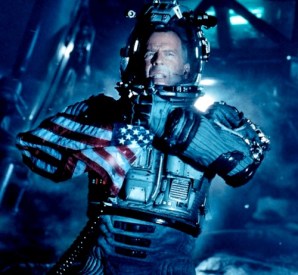
Many Hollywood blockbusters have ludicrous concepts, but Armageddon feels designed to plow new furrows of ridiculousness. Apparently NASA show the film to new managers and ask them to spot the errors. There are at least 168. It only takes a few minutes before it’s already so OTT that it seems like a spoof of Bay — I mean, the title card explodes for crying out loud. When the president makes a speech just before the launch, the quaint shots of the world listening in make it look like the film’s set in the 1950s. Despite being a full two-and-a-half hours long, Bay manages to make the whole film feel like a plot-summarising montage. The average shot length must be Moulin Rouge-level crazy, though where that film weighs super-fast-cut scenes against more measured ones, I think Armageddon is out-of-control-freight-train fast for every last second. Bay is so impatient, the credits start rolling before the film has even finished! And why the fuck does the drilling vehicle have a fucking great machine gun on it?!

Bruce Willis flashesApparently Michael Bay thinks it’s his worst film. In 2013, he said, “I will apologise for Armageddon, because we had to do the whole movie in 16 weeks. It was a massive undertaking. That was not fair to the movie. I would redo the entire third act if I could.” The problems stretch further than that, Michael.
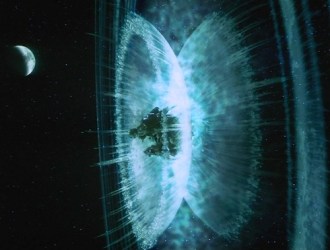
Believe it or not, it’s not all bad. The bit where Bruce Willis’ life flashes before his eyes is actually really good — ten seconds of artistic moviemaking in a 150-minute movie! Visually it looks great throughout, meaning DoP John Schwartzman is possibly the only person who comes out of the whole thing entirely unscathed. The special effects are excellent for 1998. I thought Independence Day’s were still effective when I re-watched it earlier this year, but Armageddon’s feel much less dated, and it was only made two years later. As an effects showcase, it absolutely still holds up today. That said, the top of the Chrysler building falling off, complete with plummeting screaming people, is considerably less palatable since 9/11. And just a minute later there’s a shot of the World Trade Center with burning holes in it. It’s a wonder it hasn’t been re-edited to remove those shots, especially as it’s a Disney-owned movie and they have a history of self-censoring stuff that is no longer considered acceptable.

Armageddon was, famously, released the same year as Deep Impact, which I watched many years ago but remember as a character-driven drama about an asteroid threatening the end of the world. Armageddon’s action-packed bluster was more successful at the box office, of course, but Deep Impact was the more mature movie. SPACE EXPLOSION!Maybe I’m wrong — it has a lower rating on IMDb. But then, that is IMDb. I should probably watch it again, but even without doing that I feel pretty confident saying it’s the better film.

If Michael Bay knew he was making a comedy, Armageddon might be a great movie. But he didn’t. While it’s definitely bad, I did kind of enjoy it… but mainly to laugh at. Make of that what you will.

2 out of 5